
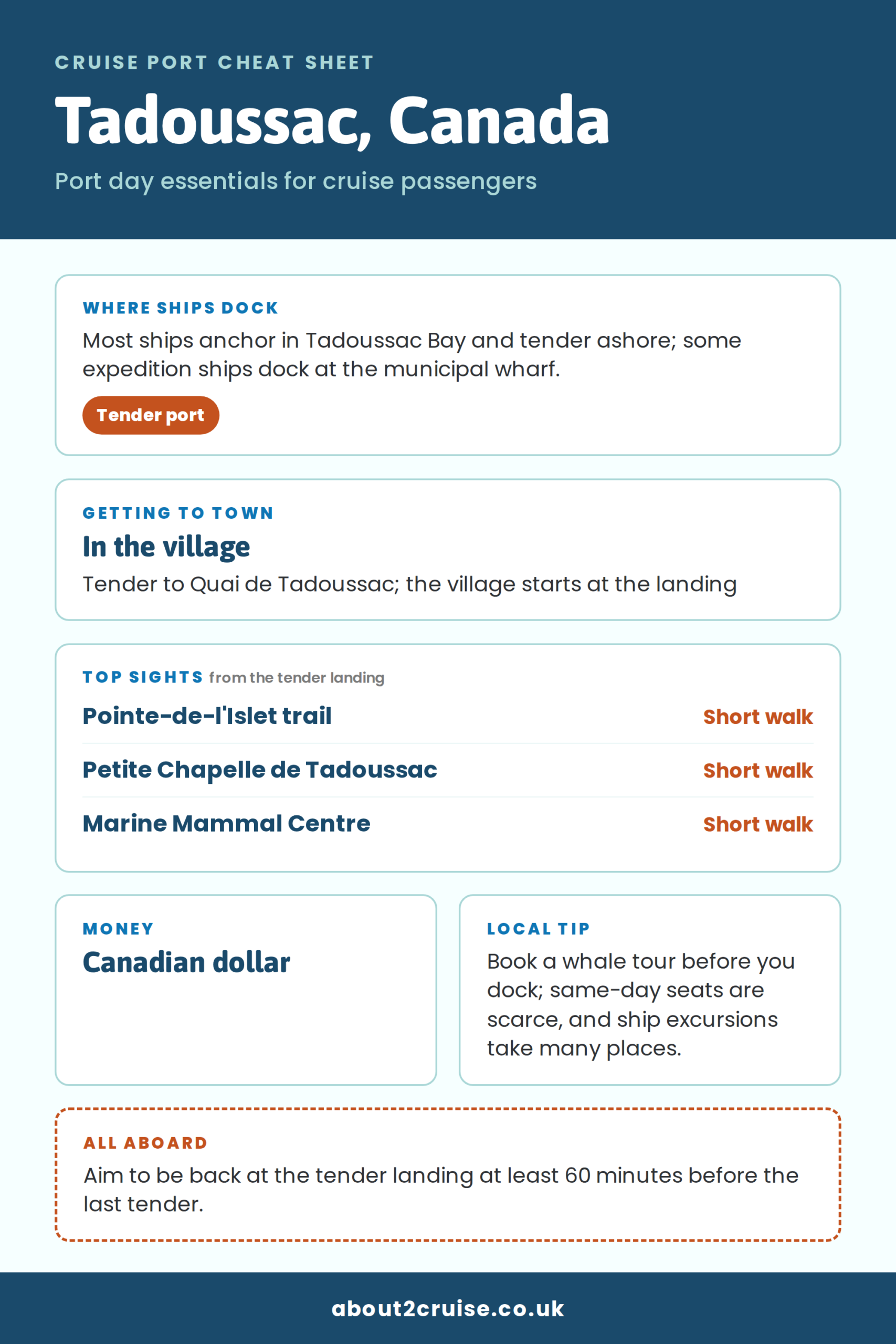
Tadoussac is a small village on Quebec’s North Shore at the meeting point of the Saguenay Fjord and the St. Lawrence River. Cruise ships call here almost entirely for the whale watching: the protected Saguenay–St. Lawrence Marine Park is one of the best places in Canada to see belugas, minke, fin and humpback whales. Most ships anchor in the bay and tender passengers to the municipal wharf, and the village, tour boats and viewpoints are all walkable.
Why Ships Actually Stop Here: A Marine Park Full of Whales
Tadoussac sits at the confluence of the Saguenay Fjord and the St. Lawrence River. Fresh water from the fjord mixes with the salt water of the St. Lawrence, concentrating krill, plankton, and small fish. That is why whales gather here from early May to late October.
The Saguenay–St. Lawrence Marine Park protects 1,245 km² of water, stretching from the mouth of the fjord into the estuary. Up to 13 species of whale and marine mammal are present. Minke, fin, humpback, and beluga whales are the most regularly seen, along with harbour porpoise, grey seals, and harbour seals. Blue whales are possible but less predictable. Belugas live in the St. Lawrence year-round and move into the fjord in summer. That population is endangered, which is why strict approach rules exist.
Whale Watching Rules Worth Knowing Before You Go
The marine park sets hard distances for whale watching. Vessels must stay at least 400 metres from belugas, blue whales, and North Atlantic right whales, and at least 200 metres from all other whale species. If a beluga is within half a nautical mile, boats have to keep moving at 5–10 knots and avoid repeated course changes.
Speed in the park is capped at 25 knots, dropping to 15 knots in the mouth of the Saguenay between 1 May and 31 October. Operators running whale excursions must hold a permit, and their captains and guides complete Parks Canada training on the regulations. Drones and flights below 2,000 feet are prohibited inside the marine park.
Any collision with a marine mammal must be reported immediately to a park warden on 1-866-508-9888. If you are booking an independent tour, look for an operator with a marine park permit or Eco-Whale Alliance membership.
A Little History: Innu Roots and the Fur Trade
Tadoussac was a meeting and trading place for First Nations long before Europeans arrived. The Innu presence is still part of the village’s identity, and the Chauvin Trading Post reconstruction on the waterfront tells the story of first contact and the fur trade. Inside you can handle beaver, marten, lynx, otter, wolf, and bear hides, and there is a themed bookshop on Innu culture and the fur trade.
The Petite Chapelle de Tadoussac, also called the Indian Chapel, is the oldest wooden church still standing in North America. It is a national historic site with period religious objects and a multimedia show about missionary life, open from late May to mid-October. These two stops are easy to fit around a whale tour because they sit within a short walk of the wharf.
The Waterfront and Hôtel Tadoussac
The waterfront is compact and easy to read. The municipal wharf, Quai de Tadoussac, is at 101 rue du Bord-de-l’Eau. From there the boardwalk and road run past the bay. Hôtel Tadoussac, the big wooden Belle Époque-style building with a cupola, is a few minutes from the wharf and is the most photographed landmark in the village. Its restaurants are Le Coverdale and the bar Le Coquart.
Rue des Pionniers, the village’s restaurant street, climbs gently behind the waterfront. The chapel, Chauvin Trading Post, Marine Mammal Interpretation Centre, and most cafés sit within a compact walkable core. On cruise call days the municipality usually fields a welcome committee, guides, and sometimes musicians at the wharf, and may offer guided historic walks of the village.
Shore Viewpoints and Saguenay Fjord Scenery
The local sector of Parc national du Fjord-du-Saguenay protects the dramatic fjord shoreline around Tadoussac Bay. Pointe-de-l’Islet is the closest free viewpoint: a boardwalk and rocky point at the mouth of the fjord where belugas and minke whales sometimes pass close to shore. The trail involves wooden stairs and uneven rock, so it is not wheelchair accessible, and the rocks can be slippery when wet.
Colline-de-l’Anse-à-l’Eau gives a plunging view over Tadoussac Bay and the St. Lawrence. If you have extra time and transport, Pointe-Noire Interpretation and Observation Centre is on the far side of the fjord at Baie-Sainte-Catherine, about a 15-minute walk from the ferry dock, and is a good land-based beluga lookout. Cap-de-Bon-Désir Interpretation and Observation Centre is about 30 km east by road.
Daily SÉPAQ park entry for the Baie-de-Tadoussac sector is around $10.30 per adult and free for 17 and under, while Pointe-de-l’Islet itself is free.
If your ship also calls at La Baie, see our Saguenay cruise port guide.
Is Tadoussac a Tender Port? Here’s How Getting Ashore Works
Most cruise ships calling at Tadoussac anchor in Tadoussac Bay and send passengers ashore by tender. Some smaller expedition ships can come alongside the municipal wharf. The wharf at 101 rue du Bord-de-l’Eau is the landing and boarding point.
Whichever way you arrive, you step straight into the village. There is no long transfer, no cruise terminal building, and no shuttle bus. The wharf is leased to Croisières AML for its own excursion boats, but international cruise ships, Coast Guard, and research vessels are exempted and can use it for calls. Port depths allow a maximum vessel draft of about 9.14 metres, with anchorage depths around 12.5–13.7 metres, which is why Tadoussac attracts small expedition-class ships rather than large mass-market liners.
How to Find Out Where Your Ship Will Dock or Tender
Your cruise line is the only reliable source for whether your ship will anchor and tender or come alongside the wharf. Tadoussac does not publish a public berth-by-berth cruise schedule. Check your pre-cruise documents, the cruise line app, and the daily programme once you are on board. The app usually shows port arrival and departure times, meeting points, and all-aboard times.
On the day, listen to the announcements about tender tickets, queues, and priority boarding. Expedition lines such as Ponant, Viking, Hapag-Lloyd, Silversea, and National Geographic–Lindblad have called here, and most calls are between July and October, with a peak in September and early October. Because Tadoussac has only about 800 residents, one ship changes the foot traffic in the village, but it is still a low-key, walkable port day.
Tadoussac cruise port map
The map shows Tadoussac and the places worth seeing. Tap a pin for directions.
- TadoussacTown centre
- Maison du TourismeTourist information centre · About 2 min walk from the town centre
- Hôtel TadoussacHotel · About 3 min walk from the town centre
- Petite Chapelle de TadoussacWooden chapel · About 4 min walk from the town centre
- Chauvin Trading PostFur-trading post · About 5 min walk from the town centre
- Colline-de-l’Anse-à-l’EauHill viewpoint · About 9 min walk from the town centre
- Marine Mammal Interpretation CentreInterpretation centre · About 10 min walk from the town centre
- Pointe-de-l’IsletCoastal viewpoint · About 15 min walk from the town centre
- Pointe-Noire Interpretation and Observation CentreObservation centre · About 2 km from the town centre
Planning Your Whale Tour: Ship Excursion vs Independent
Whale watching is the reason the ship stops, so book early if you want a specific time. Cruise-organised excursions take up a large share of the available seats, and the local cruise organisation describes excursion take-up on Tadoussac calls as among the highest in the industry.
If you have a confirmed ship excursion, follow the meeting point and time in your ship’s app or ticket. If you book independently, allow enough buffer. Tadoussac is a port of call on St. Lawrence expedition itineraries, not a usual embarkation port; most cruisers arrive here after starting in Quebec City or Montreal. Independent boats leave from the same waterfront area as the tender landing.
Croisières AML runs a covered observation boat from the Quai de Tadoussac. Adult tickets start around $134.99, children 5–12 pay about $104.99, and children 2–4 pay about $59.99. Its Zodiac tours leave from the dry dock at 122 rue de la Cale-Sèche and cost about $134.99 for adults and $114.99 for children 6–12. Tadoussac Autrement operates a Zodiac with sliding windows and first-class seats from the marina, zone 1, at around $125 for adults, $115 for children 2–12, and $480 for a family. Croisières Fjord Baleines offers a roughly two-hour tour from the Tadoussac marina at about $115 for adults, $103.50 for children 2–13, and $395 for a family. Taxes are usually extra.
AML offers a whale warranty: if the captain judges no marine mammal was seen, you get a free repeat boat cruise. Do not expect a refund simply because the weather is grey.
Zodiac or Covered Boat: How to Choose
A covered observation boat is the safer choice for most cruisers. AML’s boat tours run about three hours, with glazed heated saloons, outside decks, bistro service, and restrooms. Wheelchairs and strollers can be accommodated on the covered boat, not on the Zodiac.
Zodiacs are faster, lower to the water, and more exposed, but they have no indoor space, no toilets, and no warm retreat. Children under 6 are not allowed on AML Zodiacs. The Zodiac operators provide windproof and waterproof suits, but the ride is still colder and bumpier. Pregnant women and people with back problems should not go on a Zodiac.
If you want the classic open-water wildlife experience and are steady on your feet, a Zodiac is great. If you want comfort, a dry cabin, and a restroom, choose the boat.
What Whales Can You See from Tadoussac?
Minke whales are the most commonly seen large whales. Fin whales and humpbacks are also regular in season. Belugas are the local speciality: they are present year-round and often visible from shore at Pointe-de-l’Islet or on the water. Harbour porpoise, grey seals, and harbour seals are common. Blue whales are possible but less predictable.
There is no better time of day for a whale cruise; whales surface when they surface. The season runs from early May to the end of October. Because the water is only about 4°C, it cools the air above it, so even a bright summer day can feel raw on the water. On the boat it is usually about 10°C cooler than on shore.
Tour Timing and Getting Back to the Ship
Covered whale-watching cruises are typically about three hours. AML asks independent guests to collect tickets at 177 rue des Pionniers before going to the wharf and to be at the wharf about 30 minutes before boarding. Zodiac trips run about two to two and a half hours.
If a ship excursion is delayed, the ship will normally wait. If you are independent, build in a cushion of at least 45–60 minutes between your tour return and the last tender. The last-tender time is set by the ship and posted on board. Tadoussac is small, but tendering can be slower in wind or swell. Do not assume you can walk straight on to a tender at the last minute.
What to Wear and Bring on a Whale Trip
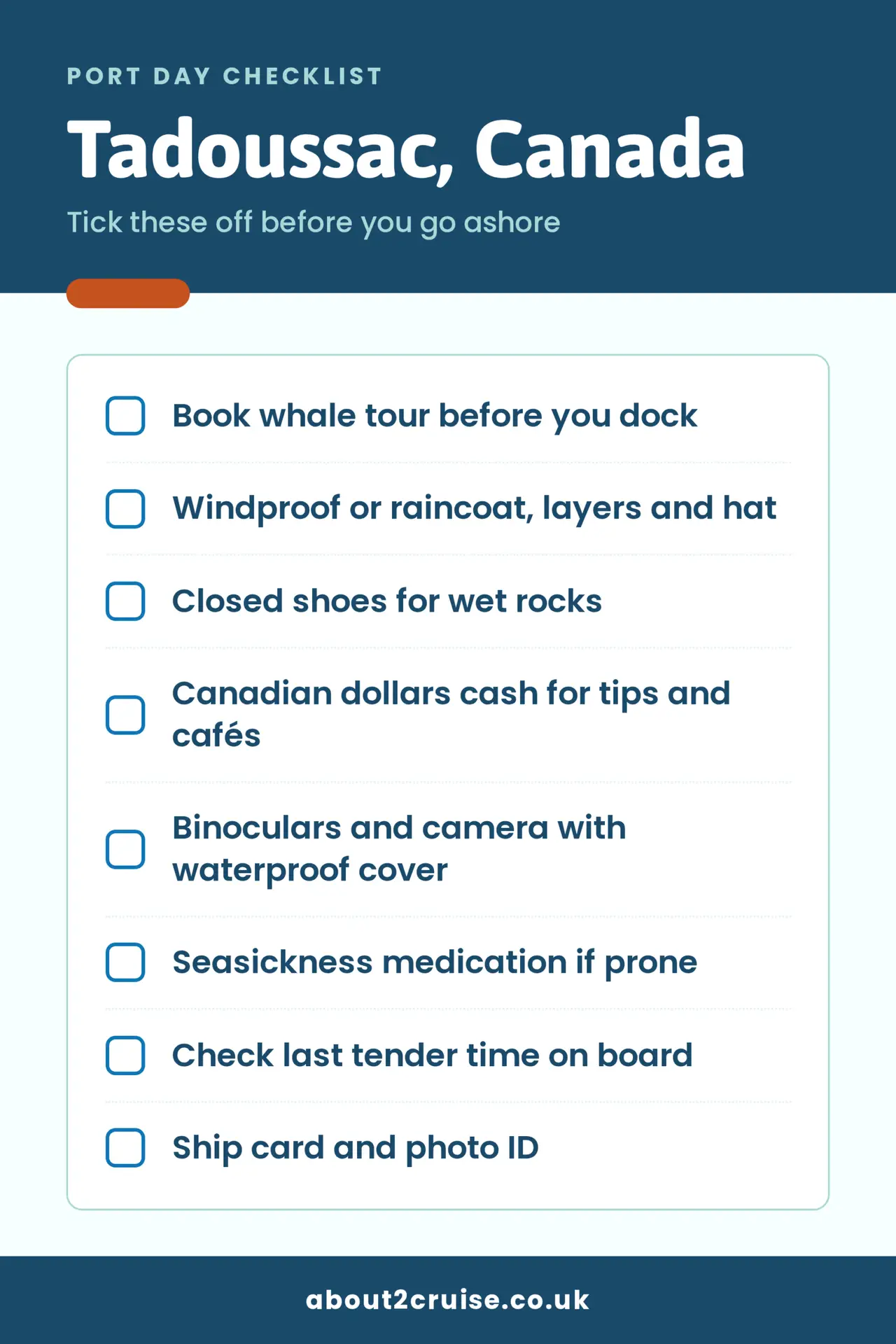
Layers are essential. A windproof or raincoat is the single most important item, even if the sky is clear. Long trousers, closed shoes, a hat, gloves or a scarf, sunscreen, sunglasses, binoculars, and a camera are a solid kit.


On a Zodiac you are fully exposed to wind and spray, and the suit you are given does not fully protect against cold. Wear layers you can add or remove. On a covered boat you can retreat to the heated saloon, but you will still want a warm outer layer for the outside decks. The water is cold and the air on the water is often much cooler than in the village.
Seasickness and Small-Boat Comfort
The mouth of the Saguenay can be choppy, especially when tide, current, and wind meet. If you are prone to seasickness, take medication before boarding, not after symptoms start. Choose a covered boat rather than a Zodiac if you are unsure.
Sitting in the middle or rear of a small boat can reduce motion, and staying outside with your eyes on the horizon helps some people. Operators do not cancel for ordinary rain or fog; they only stop sailings if the captain judges conditions unsafe. That means you should dress for damp weather and be prepared for a wet Zodiac ride.
Photography and Whale-Watching Etiquette
Respect the 400-metre and 200-metre distance rules, and do not ask the captain to chase a whale. A good camera setting for whales is a fast shutter speed, continuous autofocus, and a long zoom lens. Keep your camera ready, because surfacing can last only a few seconds. Use a waterproof cover or dry bag on Zodiacs.

Do not fly a drone anywhere in the marine park: recreational drones are banned at all Parks Canada places and can lead to fines up to $25,000. Binoculars are often more useful than a very long lens, because whales can surface far away.
Walking Routes and Village Sights
From the tender landing you can walk to most sights in minutes. The Pointe-de-l’Islet trail starts near the waterfront and goes out to the mouth of the fjord, where you can watch whales, the ferry, and excursion boats moving through the channel. The trail is short but has stairs and uneven rock, and it is not suitable for wheelchairs or strollers.
The Marine Mammal Interpretation Centre, CIMM, is at 108 rue de la Cale-Sèche and is a good wet-weather stop. It has whale skeletons including a 13-metre sperm whale, naturalists, and a beluga drone footage exhibit. Admission is about $17 for adults and free for under-18s.
The Chauvin Trading Post and Petite Chapelle are also close to the waterfront. If you want a longer walk, ask at the Maison du Tourisme about the current condition of the Colline-de-l’Anse-à-l’Eau trail, which climbs to a viewpoint over the bay.
Food, Drink, and Souvenirs Near the Port
Rue des Pionniers is the village’s restaurant street, a short uphill walk from the wharf. You can find Quebec market cooking such as smoked fish, seafood risotto, pan-fried cod, fish and chips, tartares, and brunch. Maple appears in local dishes like maple-mayonnaise fries and maple-caramelised onion and brie crêpes.

The microbrewery on rue du Bord-de-l’Eau overlooks the bay and serves cheese fondue made with beer, local charcuterie, smoked-salmon sandwiches, poutine, and European-style sausages. Tadoussac’s famous Pale (Wh)ale is a beluga-themed beer, and a portion of sales goes to beluga research.
For souvenirs, the Chauvin Trading Post sells local furs and fur hats, CIMM’s gift shop supports marine-mammal research, and La Galouine on rue des Pionniers sells homemade Terroir Boral products.
Money, Cards, and Tipping
Canada uses the Canadian dollar. Credit and debit cards are widely accepted, but carry a small amount of cash for tips or small purchases. The Desjardins service point in the village at 187 rue Bord-de-l’Eau has limited counter service, usually only Wednesday mornings, so do not rely on a Tadoussac ATM.
Tipping in restaurants and bars is customary at 15–20% of the pre-tax bill. Prices for tours and attractions are usually quoted before tax.
Language, Visitor Information, and Toilets
French is the everyday language in Tadoussac, but visitor-facing staff in restaurants, shops, and tour operators usually speak English. The Maison du Tourisme at 197 rue des Pionniers provides tourist information, free Wi-Fi, a public computer, a public phone, and washrooms.
Public washrooms are also available at the parking lot after leaving the ferry, near the Chauvin Trading Post, and at the highway rest stop off rue Bateau-Passeur. Tadoussac is on Eastern Time, UTC−4 in summer, but always follow ship time for all-aboard and excursion deadlines.
Phones, Wi-Fi, and Emergency Contacts
Mobile signal in the village is generally usable near the waterfront and main streets, but do not count on it out on the water. Free Wi-Fi is available at the Maison du Tourisme.
The emergency number in Canada is 911. For marine mammal incidents in the park, call 1-866-508-9888. For a dead or distressed marine mammal, call 1-877-722-5346 or use VHF channel 16. The local health service is CLSC de Tadoussac at 162 rue des Jésuites, 418 233-2931. The nearest larger health centre is in Forestville, and the referral hospital is in Chicoutimi. There is no large pharmacy in the immediate village core, so bring any essential medication ashore with you.
Accessibility and Limited Mobility
Taking the tender in Tadoussac can be the hardest part of the day. The ship’s crew decides whether a passenger can safely board a tender, and movement between ship and tender is more difficult in swell. The village itself has slopes and older pavements, but the waterfront core is compact.
The covered whale-watching boat can accommodate wheelchairs and strollers, but the Zodiac cannot. Pointe-de-l’Islet is not wheelchair accessible. If you have limited mobility, choose a ship-organised excursion where possible, because the meeting point and transfer will be coordinated for you. Independent tours from the dry dock or marina involve a little more walking from the tender landing.
How to spend a port day in Tadoussac
A port day in Tadoussac is built around one thing: a whale-watching cruise in the Saguenay, St. Lawrence Marine Park. Book early, then walk the compact waterfront sights.
Before you sail
- Book a whale tour early; seats are limited and ship excursions fill many boats.
- Check your cruise line app for whether you will tender or come alongside.
- Bring Canadian dollars cash for tips and small purchases.
Short port day: under 6 hours
- On dockingTender to Quai de TadoussacMost ships anchor in the bay and passengers come ashore by tender at the municipal wharf; the village is at the landing.
- +30 minBoard a covered whale cruiseBook aheadA three-hour covered boat tour from Quai de Tadoussac. Book before you dock; seats are limited on call days.
- +3 hrs 30 minPointe-de-l'Islet trailShort walk from the wharf to the rocky point where belugas and minke whales sometimes pass close to shore.
- +4 hrsLunch near Maison du TourismeTry poutineRue des Pionniers is the restaurant street; try poutine, smoked fish or maple-mayonnaise fries.
- All-aboard minus 1 hrBack at the tender landingWalk back down to Quai de Tadoussac with a cushion before the last tender.
The time on the map is the whole walk, every stop added together.
Open this walking route in Google Maps
If plans change: If the whale tour is cancelled for unsafe seas, walk Pointe-de-l'Islet and visit the Marine Mammal Interpretation Centre instead.
Long port day: 8 hours or more
- On dockingTender to Quai de TadoussacMost ships anchor in the bay and passengers come ashore by tender at the municipal wharf; the village is at the landing.
- +30 minBoard a covered whale cruiseBook aheadA three-hour covered boat tour from Quai de Tadoussac. Book before you dock; seats are limited on call days.
- +3 hrs 30 minPointe-de-l'Islet trailShort walk from the wharf to the rocky point where belugas and minke whales sometimes pass close to shore.
- +4 hrs 15 minLunch near Maison du TourismeTry poutineRue des Pionniers is the restaurant street; try poutine, smoked fish or maple-mayonnaise fries.
- +5 hrs 30 minMarine Mammal Interpretation CentreWhale skeletons include a 13-metre sperm whale, naturalists and beluga drone footage; a good wet-weather stop.
- All-aboard minus 90 minBack at the tender landingWalk back to Quai de Tadoussac, allowing for tender queues.
The time on the map is the whole walk, every stop added together.
Open this walking route in Google Maps
If plans change: If the whale tour is cancelled for unsafe seas, spend longer at the Marine Mammal Interpretation Centre and the village museums.
For help with other Canadian cruise ports, see our Canada cruise ports guide.
If your cruise continues along the St. Lawrence, see our Baie-Comeau cruise port guide.
Tadoussac Port-Day FAQ
Do I need my passport or ID ashore in Tadoussac?
In most Canadian ports of call you do not need your passport to go ashore, but you must follow your cruise line’s specific instructions. Carry your ship card and a photo ID, and leave your passport in the cabin safe unless the ship or local authorities tell you otherwise. Your ship will have cleared Canadian border formalities at the first Canadian port of entry.
Are whale tours suitable for children or older passengers?
Covered boat tours are suitable for most ages and are the better choice for older passengers, young children, pregnant women, and anyone with back or mobility issues. Zodiacs have age minimums and are not suitable for pregnancy or back problems. Check the operator’s age and health restrictions when booking.
What if a whale tour is cancelled for weather?
Rain and fog are not normally grounds for cancellation. Operators cancel only if the captain decides that sea conditions are unsafe. If the operator cancels, you should receive a refund or rebooking according to its terms. If a ship excursion is cancelled, the shore-excursion team will handle rebooking or a credit.
Can I book a whale tour on the day?
You can try, but Tadoussac has limited boats and fixed seat counts, and shore excursions take many seats on call days. Booking ahead is strongly recommended, especially if your port time is short.
Is it easy to walk from the tender to the whale-watching tours?
Yes. The AML covered boat leaves from the same Quai de Tadoussac where you land. The AML Zodiac dry dock is at 122 rue de la Cale-Sèche, and Tadoussac Autrement’s Zodiac leaves from the marina, zone 1. Both are within a short walk of the tender landing, but allow time to collect tickets at 177 rue des Pionniers if required.
Will my phone work in Tadoussac?
Usually yes in the village on Canadian networks or with roaming, but signal can drop out on the water. Do not rely on a phone as your only watch or return-ticket; carry a written or downloaded copy of timings.
Is ship time the same as local time?
Tadoussac is on Eastern Time, UTC−4 in summer. Your ship may keep ship time, which can differ. Always use ship time for the all-aboard, but confirm local tour times in local time when you book independently.