
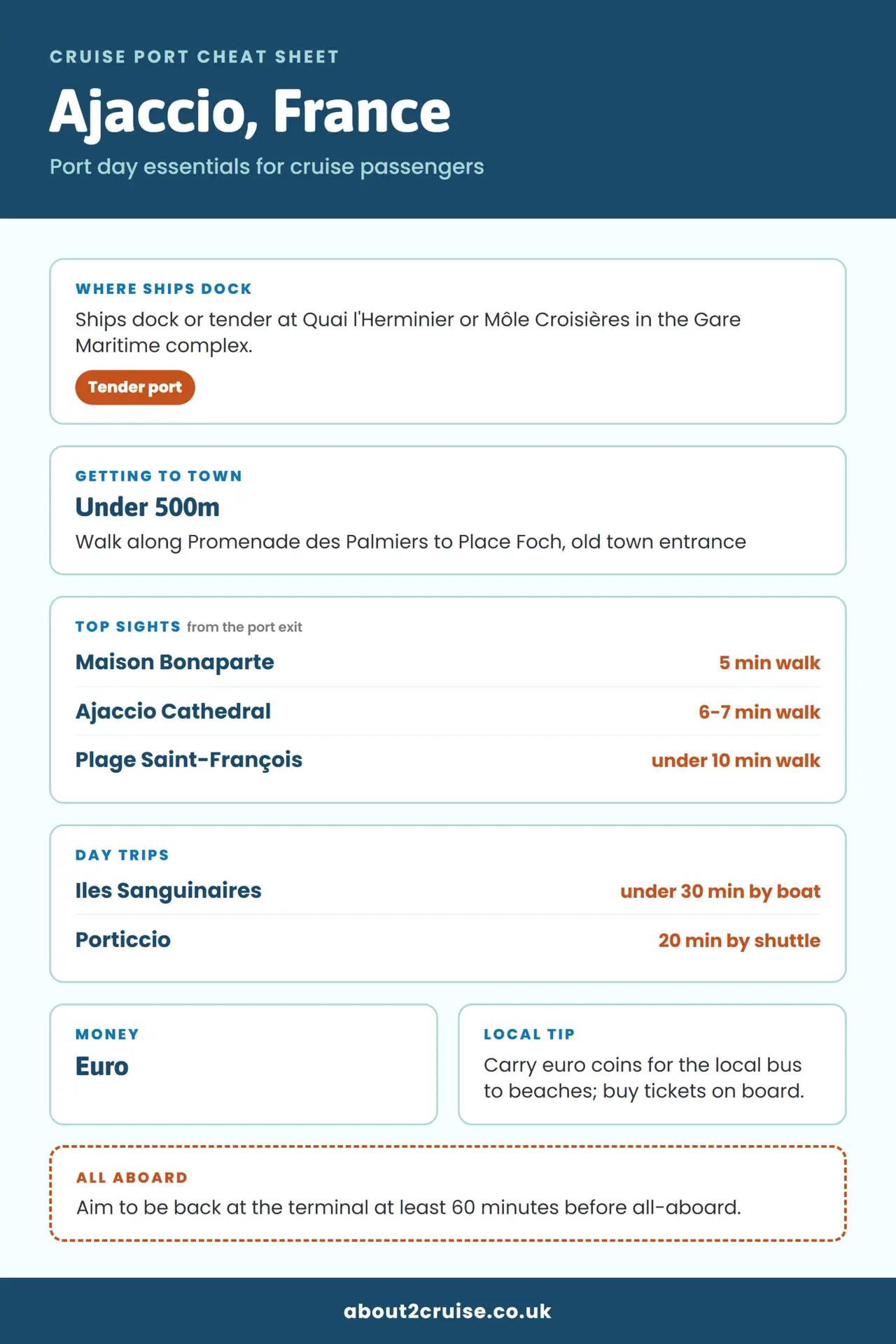
Ships dock or tender at Quai l’Herminier, right on the edge of Ajaccio’s old town, with the walk into the centre taking well under ten minutes. Napoleon’s birthplace, the cathedral, pedestrianised shopping streets, nearby beaches and boat trips out to the Iles Sanguinaires are all within reach in a few hours ashore.
Where Ajaccio cruise ships dock at Quai l’Herminier
The port sits within the Gare Maritime complex right in the centre of town, with the ferry terminal on one side and the fishing port on the other. Larger ships sometimes use the Môle Croisières berth a short way along the same commercial port, and on busier days your ship might anchor off and tender you in rather than pull up alongside.
You’ll see the berth called different things depending where you look: Môle Croisières, Quai d’Honneur, and Môle Croisière/Quai des Cannes all turn up for Ajaccio, and there’s no way to know in advance which one you’ll get. It doesn’t change your day much either way: the quays named are all close together on the same stretch of the commercial port, and the walk into town starts nearby whichever one your ship is assigned. For calls elsewhere on the island, the Corsica cruise port guide covers Ajaccio alongside Corsica’s other cruise stops.
The terminal itself is small and modern, known locally as the Gare Maritime. There’s a Chamber of Commerce and Industry information point, toilets and taxi services, plus booking desks and telephones if you need them.
| Detail | Ajaccio cruise port |
|---|---|
| Dock location | Quai l’Herminier / Môle Croisières, Gare Maritime complex |
| Walk to Place Foch and the old town | 5 to 10 minutes (under 500m) |
| Nearest beach | Plage Saint-François, about 10 minutes on foot |
| Bus station | Gare Routière d’Ajaccio, next to the port |
Walking from the Ajaccio cruise port into the old town
Walking from the Ajaccio cruise port into the old town is simple. Leave the terminal, turn left, and follow the Promenade des Palmiers, a flat, easy stretch of waterfront that leads you straight to Place Foch and the old town. It’s short enough that nobody bothers with a shuttle.
Turn inland towards Rue Cardinal Fesch or Casa Buonaparte and the streets narrow, the paving turns to cobblestones, and the approach up to the citadel picks up a slight incline.
- Maison Bonaparte (Napoleon’s birthplace): about 5 minutes
- Ajaccio Cathedral: 6 to 7 minutes
- Place de Gaulle, the main square: about 3 minutes
- Rue Fesch, the pedestrianised shopping street: two streets up from the waterfront
- The seafront promenade and Plage Saint-François: under 10 minutes
Getting around Ajaccio by bus, shuttle and train
Getting around Ajaccio beyond the old town is easiest by local bus, and you’re never far from a stop whichever direction you head.
City buses on lines 1, 2, 5 and 7 stop at Gare Maritime and Place Foch, both a short walk from the ship, and run along the coast as well as around the city, including out to the beaches west of Ajaccio.
Ajaccio also has a cable car, a maritime shuttle across the gulf to Porticcio, and a commuter train to Mezzana, so there’s no shortage of ways to get further afield without hiring a car. If this is your first Mediterranean cruise, sticking to the bus routes that start at Gare Maritime is the simplest way to see more without worrying about getting back in time.
Napoleon’s Ajaccio: Maison Bonaparte, Palais Fesch and the cathedral
Maison Bonaparte, the house where Napoleon was born on 15 August 1769 and lived with his family, is a listed historic monument and now sits as a national museum.
Palais Fesch carries ‘museum of France’ status and brings together three big collections: Italian Masters, the Napoleonic Collection and Corsican painters. Its Italian Primitive paintings are the most important collection outside the Louvre. It opens Thursday, Friday and Sunday from midday to 6pm, and shuts on Tuesdays.
Ajaccio Cathedral, properly the Cathedral of Santa Maria Assunta, is a short walk from the port. Place d’Austerlitz is further out, about 20 minutes on foot, where the emperor stands atop a granite pyramid overlooking the city at the Monument commémoratif de Napoléon Ier, worth the extra walk if you fancy seeing more of the town on the way.
Ajaccio beaches within walking distance of the port
The closest beach to the Ajaccio cruise port is Plage Saint-François, past the old fortress.
Plage Saint-François is a narrow strip of sand down a flight of stone steps, and a quick dry beach towel earns its keep if you’re planning a swim before the walk back into town. It fills up fast when it’s busy, though it thins out again later in the day.
Plage Trottel is further along the seafront promenade, somewhere between 15 and 20 minutes on foot depending which route you take. Beyond the old town, the Gulf of Ajaccio has more beaches and coves along the Route des Sanguinaires, but those are a bus or taxi job rather than a walk.
Boat trips to the Iles Sanguinaires
Boat trips to the Iles Sanguinaires take under thirty minutes from the port of Ajaccio, out to an archipelago of four rocky islands with flora and fauna worth the trip on their own.
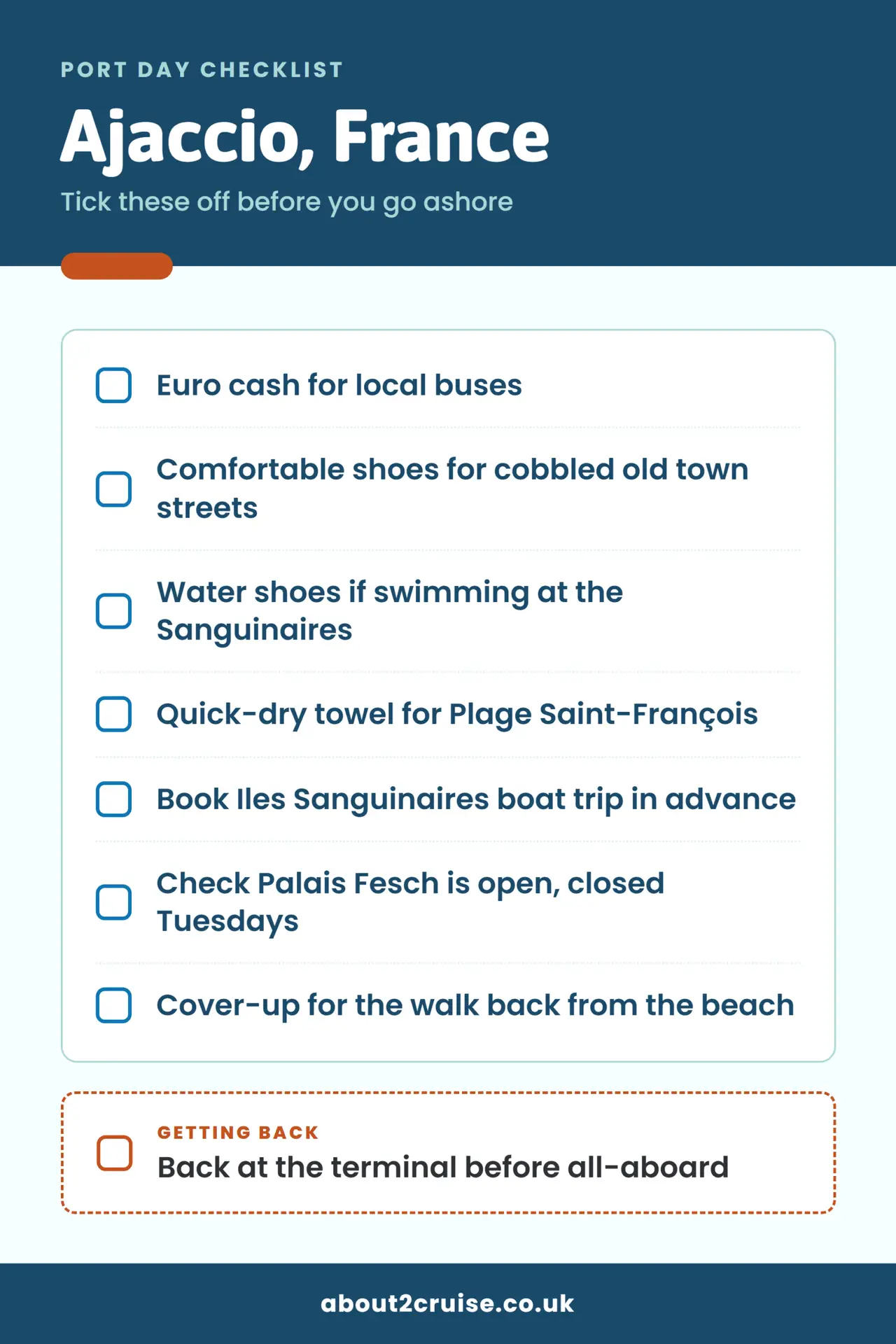
The islands have hiking trails, swimming spots and sunset views back over Pointe de la Parata. Don’t expect white sand, there are no beaches like that here, but the coves are lovely, and water shoes earn their place for swimming off the rocks.
Boats run independently of the ship, so if a Sanguinaires trip is the highlight of your stop, it’s worth booking shore excursions before you arrive rather than hoping there’s space on the day.
Getting to Ajaccio airport from the port
Getting to Ajaccio airport from the cruise port takes around 15 to 20 minutes. The distance itself gets quoted anywhere between 5km and 7km depending where you measure from, but the journey time stays much the same whichever figure you believe.
Plan around the journey time rather than the distance. Bus line 8 and an airport shuttle both cover the route, and a taxi does the same. Heading the other way, a bus links the airport to the town bus station roughly once an hour, so check the timing if you’re flying in before a cruise.
What to eat in Ajaccio
The best things to eat in Ajaccio on a port day are at the market on Place Campinchi, a short walk from the ship, where you can get Corsican charcuterie, brocciu cheese, chestnut beignets and canistrelli from the stalls. Sit in the covered hall with a cheese plate and wine, or take a slower glass at a cafe table in Place Foch.
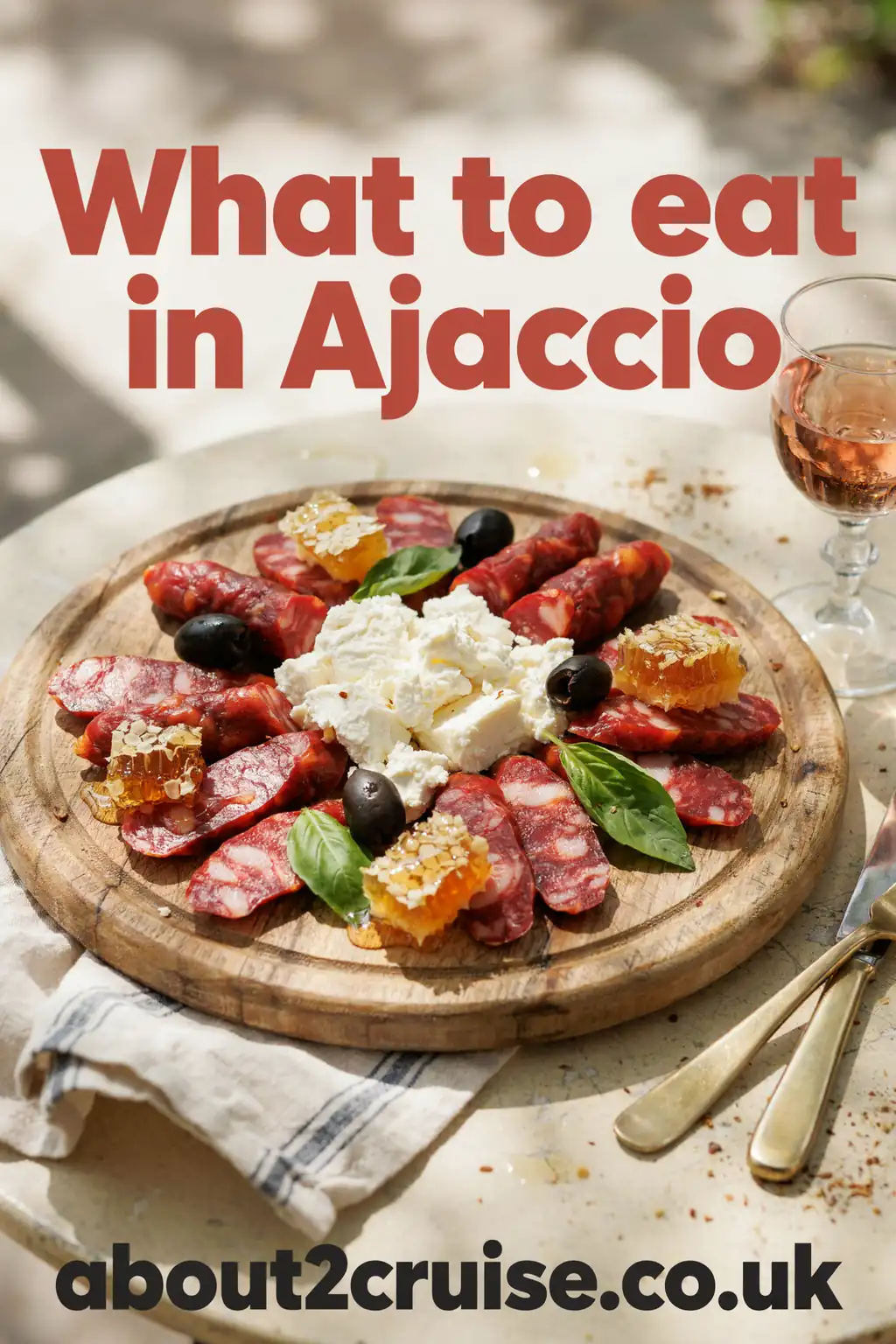
You don’t need a table booking for any of this. The market on Place Campinchi is a short walk from the ship and open Tuesday to Sunday mornings, so if your call falls on a Monday you’ve missed it, but otherwise this is where most of your eating happens.
- Corsican charcuterie: coppa, lonzu, prisuttu and figatellu from the producers’ stalls. Skip straight to the covered halle gourmande next to the outdoor stalls, sit down and order a plate with cheese and a glass of wine.
- Brocciu: a soft, slightly tangy sheep’s or goat’s milk cheese, best caught early in the season at the same market stalls.
- Chestnut beignets and canistrelli: the sweet end of the market, sold alongside the jams and pastries. Bring cash for the stalls.
- Corsican wine: a glass with your cheese plate in the market hall, or a slower one at a cafe table in Place Foch if you fancy watching the square for a while.
What to wear in Ajaccio: outfit ideas for a port day
What to wear in Ajaccio on a port day is flat, comfortable shoes for the cobbled lanes and stone steps once you leave the seafront promenade, plus something to throw over your swimwear if you’re heading to the beach near the old town.

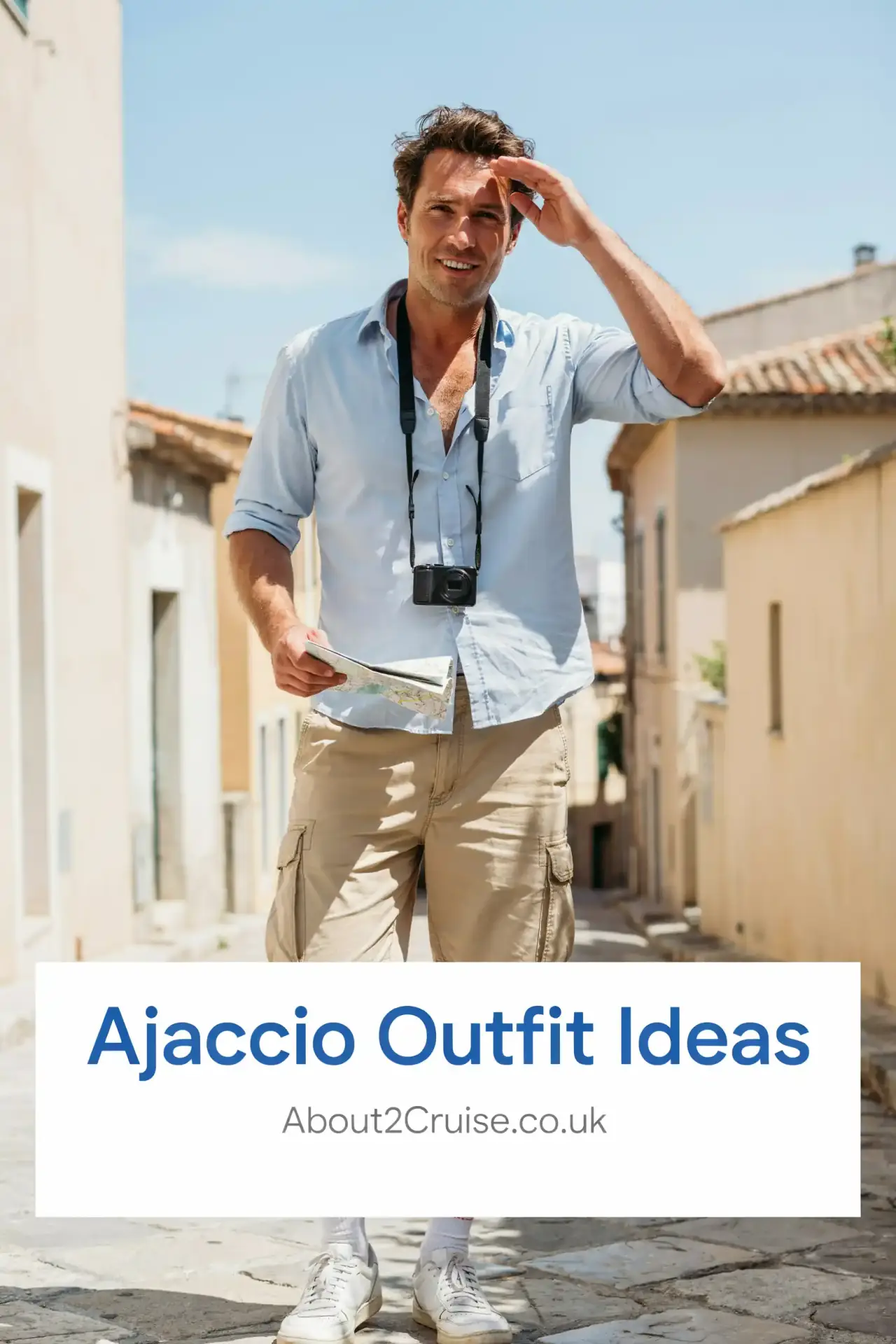
Ajaccio’s waterfront promenade is flat and easy in anything you’ve got on, but the moment you turn inland towards Rue Cardinal Fesch or the citadel, the streets narrow into cobbled lanes with a slight incline. Flat, comfortable shoes beat sandals once you’re off the Promenade des Palmiers, and a pair of walking shoes handles the cobbles and the stone steps down to Plage Saint-François far better than flip-flops ever will.
If a swim’s part of the plan, wear something you can throw over your swimwear for the walk back through town, since Saint-François beach is only ten minutes from the old town’s cafes and shops.
Best photo spots in Ajaccio
The best photo spots in Ajaccio are Place d’Austerlitz with its Napoleon monument on a pyramid about 20 minutes from the port, the quieter headland walk round the citadel walls, and the flat Promenade des Palmiers for an easy harbour view. If you’re out later, the Iles Sanguinaires and Pointe de la Parata are lovely for sunset on the way back from a boat trip.
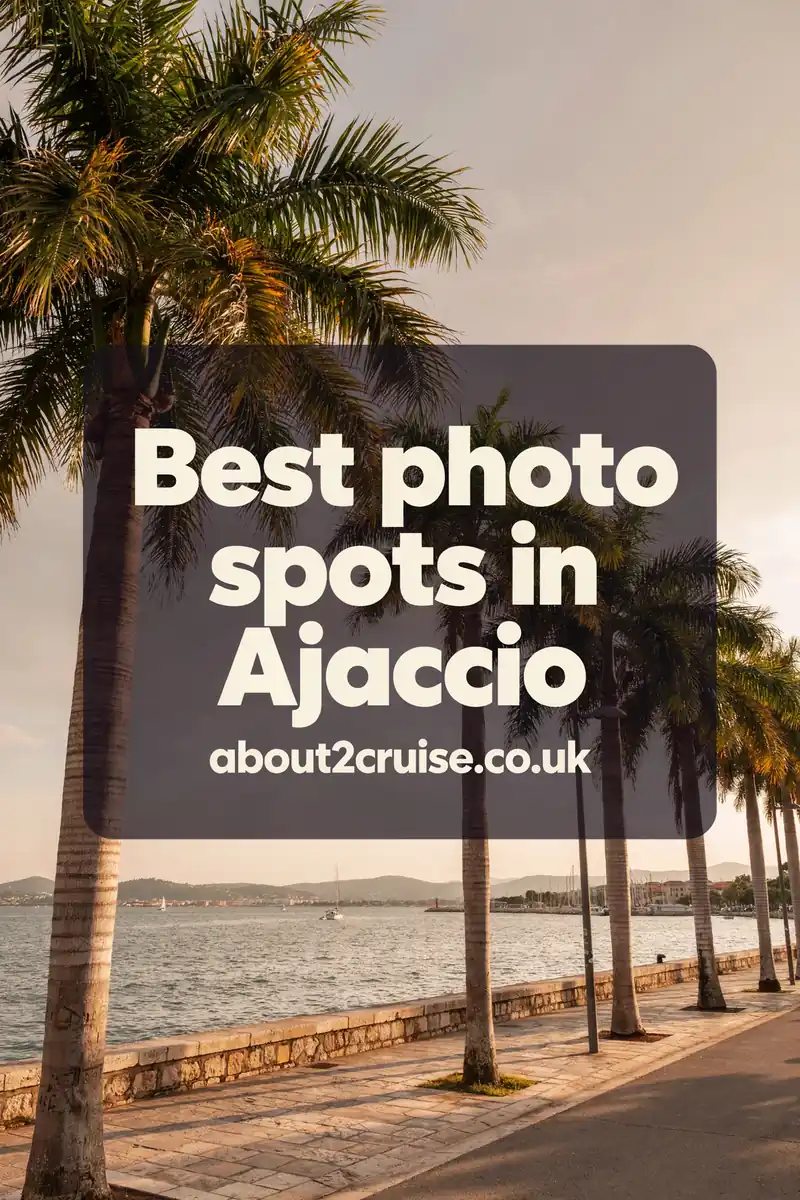
- Place d’Austerlitz: the Monument commémoratif de Napoléon Ier shows the emperor atop a granite pyramid overlooking the city, about 20 minutes’ walk from the port.
- The headland walk near the citadel: a quieter route around the fortress walls gives sea views and a change of pace from the old town streets.
- Iles Sanguinaires and Pointe de la Parata: the archipelago is known for sunset views back towards the point, best seen on the return leg of a boat trip timed for late afternoon.
- Promenade des Palmiers: the flat waterfront walk between the port and Place Foch gives an easy harbour view without leaving the main route into town.
How to spend a port day in Ajaccio
A port day in Ajaccio works well as a slow wander through Napoleon’s old town, or a half-day boat trip out to the Iles Sanguinaires.
Before you sail
- Book Iles Sanguinaires boat trips ahead, they fill fast.
- Check Palais Fesch opening days, it closes Tuesdays.
- Carry euro cash for local buses and beach steps.
Short port day: under 6 hours
- On dockingWalk into the old townNo shuttle neededFollow the flat Promenade des Palmiers from the terminal to Place Foch, about 5 to 10 minutes.
- +10 minMaison BonaparteA 5 minute walk from Place Foch to Napoleon's birthplace, now a national museum.
- +25 minRue Fesch shopping streetWander the pedestrianised street two blocks up from the waterfront for local shops.
- +45 minAjaccio CathedralA further 6 to 7 minutes on foot to the Cathedral of Santa Maria Assunta.
- +1 hr 5 minLunch in the old townLocal specialitiesPick a café near Rue Fesch for Corsican charcuterie and cheese before continuing on foot.
- +1 hr 35 minPlage Saint-FrançoisA 10 minute walk past the old fortress down stone steps to the beach for a swim or relax.
- All-aboard minus 1 hrBack at the terminalThe walk back is under 10 minutes, so there's no need to rush earlier than this.
The time on the map is the whole walk, every stop added together.
Open this walking route in Google Maps
If plans change: If the old town feels crowded, head straight to Plage Saint-François instead, it's just as close to the port.
Long port day: 8 hours or more
- On dockingWalk into the old townNo shuttle neededFollow the flat Promenade des Palmiers from the terminal to Place Foch, about 5 to 10 minutes.
- +15 minMaison BonaparteA 5 minute walk to Napoleon's birthplace, now a national museum.
- +35 minAjaccio CathedralA further 6 to 7 minutes on foot to the Cathedral of Santa Maria Assunta.
- +1 hr 5 minBoat trip to Iles SanguinairesBook aheadBoats leave from the port and take under 30 minutes each way, with time on the islands for hiking trails and swimming spots in the coves.
- +3 hrLunch at Place Campinchi marketBring cashBack from the boat trip, pick up Corsican charcuterie and brocciu cheese from the stalls, with a glass of wine in the covered hall.
- +3 hr 40 minPlage Saint-FrançoisA 10 minute walk past the old fortress down stone steps to the beach for a swim.
- +5 hr 40 minHeadland walk near the citadelA quieter route around the fortress walls for sea views before heading back towards the terminal.
The time on the map is the whole walk, every stop added together.
Open this walking route in Google Maps
If plans change: If Sanguinaires boats are full or cancelled, swap in the walk to Place d'Austerlitz and back instead.
Common Questions
What time does the Ajaccio cruise terminal’s information desk open?
The information desk inside the Gare Maritime terminal opens at 6.30am, seven days a week, and stays open until the last ferry of the day departs.
Is there free Wi-Fi at the Ajaccio cruise terminal?
Free Wi-Fi covers the whole Gare Maritime terminal, and there are vending machines for hot and cold drinks and snacks if you need a top-up before heading off.
What other Napoleon sites are there besides Maison Bonaparte?
Ajaccio’s official list of Napoleon sites also includes the Grotte Napoléon 1769 and the Terre Sacrée landmark, alongside Palais Fesch and the cathedral.
Is the Miollis Citadel open to visitors?
The Miollis Citadel is a working military site, not open to the public, though the walk around its headland is worth doing just for the sea views.
Does Plage Trottel have anywhere to eat or drink?
Plage Trottel has its own beach bar, which makes it a handy stop for a drink or snack without trekking back into the old town.
Last Updated: 19 October 2026