
Glacier Bay is not a port: it is a full scenic-cruising day inside Glacier Bay National Park and Preserve, a UNESCO World Heritage wilderness in Southeast Alaska. On a licensed Alaska cruise, park rangers board, the ship spends hours working past tidewater glaciers, seabird colonies and whale waters, and you watch glaciers such as Margerie calve from the deck. The itinerary is the point: only a limited set of ships may enter.
Why Glacier Bay Feels Different From a Normal Alaska Port Day
There’s no pier, no terminal, no tender, and no getting off the ship in Glacier Bay. The whole visit happens from the deck. That makes it completely different from Juneau, Ketchikan, or Skagway. You’re not there to shop or book excursions, you’re there for the sheer scale of the place.
Glacier Bay covers roughly 3.3 million acres and about 940 square miles of marine water. As recently as 1750, a glacier thousands of feet thick filled what is now a 65-mile fjord. Today the bay holds around 1,000 glaciers, 62 of which have names. A typical cruise ship spends 9–10 hours inside the park without a single port call. More than 90% of the park’s visitors arrive by cruise ship, so the ship isn’t a compromise, it’s the normal way in.
Here’s what that means in practice:
- No shore excursions inside the park. There’s nothing to book, no tender, no shops, and no local cash needed.
- Rangers board early and leave in the afternoon. Times vary by day, cruise line, and weather.
- A park map gets delivered to your stateroom the evening before arrival.
- Limited access. Only two cruise ships may be in the park per day, year-round.
For a wider look at all stops along the Inside Passage, see our Alaska cruise ports guide.
If your itinerary includes Icy Strait Point, our Icy Strait Point cruise port guide covers the piers, gondola and tours.
For the White Pass train and the walk into Skagway from the berths, see our Skagway cruise port guide.
If your ship also docks in Juneau, our Juneau cruise port guide compares shuttles, buses and the walk to Mendenhall Glacier.
The Story Behind Glacier Bay: Ice, Wilderness, and Huna Tlingit Homeland
The headline act is Margerie Glacier and its calving, but Glacier Bay is also a protected homeland. The Huna Tlingit are the ancestral people of this area. Their villages inside the bay were overrun by advancing glaciers in the 1700s, and fish camps and seasonal villages returned as the ice retreated. When the national monument was created, new federal laws sharply curtailed Native activities. Today the park and the Huna Tlingit have a government-to-government relationship.
Xunaa Shuká Hít, the Huna Ancestors’ House, stands on the Bartlett Cove shoreline. Rangers and cultural interpreters board cruise ships to tell that story alongside the geology and wildlife. The park is also designated wilderness, a biosphere reserve, and part of the 25-million-acre Kluane / Wrangell-St. Elias / Glacier Bay / Tatshenshini-Alsek World Heritage Site, which contains the largest non-polar icefield on Earth.
Glacial ice in the bay is about 11% less than in the 1950s, although heavy snowfall in the Fairweather Mountains keeps some glaciers stable. The ice at the face of the park’s glaciers is roughly 200 years old.
Which Cruise Lines Can Actually Visit Glacier Bay?
Access to Glacier Bay is not open to everyone. The park operates under federal vessel quotas and concession contracts. Ten-year cruise-ship contracts were awarded to seven businesses: Princess Cruise Lines, Holland America Line, NCL, Carnival plc for Cunard Line, Seabourn, Viking Cruises, and Royal Caribbean Cruises. Royal Caribbean was awarded access but did not finalize the agreement and removed Glacier Bay from its sailings, sometimes substituting Endicott Arm and Dawes Glacier or Skagway instead.
The lines currently selling Glacier Bay scenic cruising include Princess, Holland America, Norwegian, Cunard, Seabourn, and Viking. Small-ship line UnCruise operates in a separate tour-boat category with two full days inside the park. Historical operator rights give Holland America and Princess the largest share of vessel use days.
If you’re looking specifically at Costa Cruises, Costa’s published destination list does not currently include Alaska, so you’re unlikely to find Glacier Bay on a standard Costa itinerary. You generally need one of the permit-holding operators above.
The park allows a maximum of two cruise ships in the bay per day, year-round, with seasonal caps of up to 184 use days between June and August and up to 122 in May and September. The superintendent sets the actual quota below those maxima. Smaller tour boats have a separate daily limit: three tour boats may operate alongside the two cruise ships. There’s no entrance fee for Glacier Bay itself, but cruise lines pay a per-passenger concession fee that’s built into your fare rather than collected on the day.
Which Ships and Itineraries Include Glacier Bay?
Always check the day-by-day itinerary because not every ship within a cruise line may call on Glacier Bay. As a starting point, these are the main current routes:
- Princess Cruises: Princess schedules a large Glacier Bay season and calls itself the line with the most Glacier Bay visits. The seven-day Voyage of the Glaciers one-way between Vancouver and Whittier includes a Glacier Bay day plus Hubbard Glacier or College Fjord. Some Inside Passage round-trips include Glacier Bay, while others may use Endicott Arm and Dawes Glacier.
- Holland America Line: Seven-day Alaska Explorer round-trips from Seattle and seven-day Alaska Inside Passage sailings from Vancouver are commonly sold with Glacier Bay. Lead-in prices are sometimes shown from around $959 to $984 per person, but those are starting fares, not quotes.
- Norwegian Cruise Line: Seattle round-trips on Norwegian Bliss, Encore, and Joy include Glacier Bay. Norwegian Encore opens the bow on deck eight for the day and hands out hot chocolate.
- Cunard: Queen Elizabeth has sailed Seattle round-trips including Glacier Bay, with inside cabins from around $949 per person on an eight-night voyage. The line’s published deployment showed no Alaska sailings in the following two summers, so check whether this is a factor for your season.
- Seabourn: Seabourn Encore includes Glacier Bay on seven-night voyages, with lead prices around $5,499 per person. Seabourn says it offers more Glacier Bay visits than any other luxury line.
- Viking: Alaska itineraries include Glacier Bay alongside Hubbard Glacier and the Inside Passage.
- UnCruise Adventures: A seven-night Glacier Bay National Park Adventure Cruise round-trip from Juneau spends two full days inside the park, with a ranger joining aboard, from around $3,195 per person.
What Happens on a Glacier Bay Scenic Cruising Day
Ranger boarding times vary; it usually happens early morning, but there’s no fixed public schedule. The ship enters from Icy Strait and passes South Marble Island, a major seabird colony and Steller sea lion haul-out. The day is built around deck viewing, commentary, and food, not a port agenda. Some lines close the casino and shops during the park transit.
At the ranger desk you can get the National Park Service cancellation stamp and buy maps and publications from an Alaska Geographic bookstore. Rangers give presentations, run Junior Ranger activities, and staff an information desk in a main viewing lounge. Cultural interpreters may tell the Huna Tlingit story. The ship typically holds near a major tidewater glacier for around an hour, rotating so both sides get a view. Norwegian’s description of its captain holding near Margerie and Grand Pacific for an hour is a common pattern, but the exact glacier and timing depend on the operating plan, ice conditions, and the master.
Don’t set your watch by a 6am-to-4pm third-party timeline. The park does not publish one. Follow the daily programme in your stateroom and the captain’s announcements.
Food and drink on the day come from the ship. Holland America serves Dutch pea soup on deck, Princess runs hot chocolate and consommé stations, and Norwegian passes out hot chocolate on the bow. If you’re inside a lounge, keep a pair of binoculars by the window; the ship may announce bears or whales at any point.
The Glaciers You’re Most Likely to See
No official source states exactly which glacier a specific ship will reach on a specific day. The usual pattern on larger ships is a long run up the West Arm toward Margerie and Grand Pacific at the head of Tarr Inlet, but Lamplugh and a distant look at Johns Hopkins are common. Ice, light, and the captain can change the order.
Margerie Glacier
This is the headline act. About a mile wide, with an ice face roughly 250 feet above the waterline and another 100 feet below sea level, Margerie is around 21 miles long and flows about 6 feet a day. It has been advancing about 30 feet a year. Ships typically hold here long enough for you to watch for calving, blocks that can be up to 200 feet high breaking away, and the ship may rotate so both sides get the view. Listen as much as you look; the cracking and fizzing bergs are part of the experience.
Grand Pacific Glacier
Beside Margerie at the head of Tarr Inlet, Grand Pacific originates in Canada and is dark with rock debris. It has been receding and is so debris-covered that passengers regularly mistake it for a rock slope. In photographs, that dark face next to Margerie’s white-blue front is a useful landmark.
Lamplugh Glacier
Lamplugh is about three-quarters of a mile wide, 150–160 feet high at the face, and more than 16 miles long. It’s known for intense blue ice, which can look electric in overcast light. It’s often seen on the way up or back rather than as the main holding stop.
Johns Hopkins Glacier
Johns Hopkins is one of the few advancing glaciers in the park and calves below the waterline, so icebergs can rise without warning. That drama is one reason the park keeps vessels at a distance. Cruise ships may not operate south of the line in Johns Hopkins Inlet from May 1 to August 31, and all vessels are barred from that line from May 1 to June 30. The inlet is also a critical harbour-seal pupping and moulting area, with up to around 2,000 seals gathered. The upshot is that on many sailings Johns Hopkins is viewed from a distance near Jaw Point rather than up close.
Wildlife You Might Spot From the Ship
The checklist is whales, sea otters, puffins, bears, and mountain goats. Binoculars matter because animals look smaller than expected against the scale of the bay. More than 280 bird species have been recorded in the park.
- South Marble Island: Tufted and horned puffins, common murres, pelagic cormorants, and black-legged kittiwakes nest here. Up to 300 Steller sea lions haul out. Sea otters have recolonised the bay and float in the kelp.
- Whales: Humpback whales are present in Southeast Alaska from about May to September, with most between June and September. The ship’s presence is managed partly because of whale-strike risk, so scan the water and listen for announcements.
- Bears: Coastal brown bears, often called grizzlies, and black bears are seen on beaches and shorelines at low tide. Glacier bears, a silver-blue colour variant of black bears, also occur in the area. You watch from the ship only; there’s no shore bear encounter.
- Mountain goats: Look for white dots on steep cliff faces. Binoculars make them easier to spot.
- Harbour seals: Pups are born in June, and Johns Hopkins Inlet is a major pupping, resting, and moulting area.
For wildlife beyond Glacier Bay, our Alaska wildlife and nature guide covers bears, moose, whales and northern lights by season.
Where to Stand for the Best Glacier Views
The best side of the ship is outside. Near the glaciers you want the scale and the sound. The bow or an upper forward deck is the single best position. It gets crowded, and people cycle out because of cold. Because the ship rotates in front of the major glacier, there’s no permanently wrong side over the whole holding period.
- Princess opens bow-front viewing areas on select Glacier Bay sailings.
- Norwegian opens the bow on deck eight of Norwegian Encore and hands out hot chocolate there. Ranger commentary is broadcast on stateroom televisions, so a balcony still gets the narration.
- Holland America advises mapping out which decks are warm and comfortable before the day, and serves Dutch pea soup on deck.
If you have mobility needs, ask guest services about accessible viewing areas and lift access to top decks. Some ships may not have step-free access to every forward bow space, so check before the main calving stop.
Balcony or Public Deck: How to Choose
A balcony works as a private retreat. You can step in and out to warm up, avoid the crowd, and still hear commentary on some ships via the stateroom television. The drawback is that you see only one side, and you miss the forward scale and the full sound of cracking ice.
A public deck gives you the bow or forward panorama, the ability to move when a ranger spots wildlife, quick access to warm food and drink, and the shared atmosphere of the park day. The drawback is crowding, especially on the bow near the main glacier, and cold if you stay outside for hours.
The practical strategy is to use both. Start on an upper forward deck for the approach and the long hold near Margerie or Grand Pacific, then retreat to your balcony or an observation lounge when you need warmth or a quieter view. If you’re booking a cabin specifically for scenic cruising, a balcony is nice but not a substitute for the forward deck. The best plan is to know where the public forward space is and arrive early.
What to Wear and Bring for a Full Day on Deck
Temperatures in summer are typically 50–60°F, but wind chill on deck can feel 10–20°F colder than the forecast. Southeast Alaska gets about four sunny days a month and Bartlett Cove receives around 70 inches of precipitation a year, so plan for grey, wet, and cold as the default.


- Layers: moisture-wicking base layer, fleece or wool mid layer, and a waterproof and windproof outer layer.
- Extremities: warm hat, gloves, and a neck gaiter or scarf.
- Feet: non-slip, water-resistant shoes or boots. You may be on damp open decks for hours.
- Rain gear: bring it even if the morning looks clear; weather changes quickly.
- Binoculars: the single most useful item for wildlife and glacier detail.
- Small extras: lip balm, sunscreen for glare off ice and water, and a waterproof pouch for your phone or camera.
There’s no dress code for the park itself because you don’t go ashore. The ship’s normal daytime dress code applies indoors, but your practical Glacier Bay dress question is how many comfortable outdoor layers you have.
Photography and Binocular Tips
Morning light is generally best on Margerie Glacier, so get on deck early even if you’re still waking up. A polarising filter can help cut glare from water and ice. Cold drains batteries faster, so keep spare batteries in an inside jacket pocket. A microfibre cloth is useful for spray and light rain on lenses.
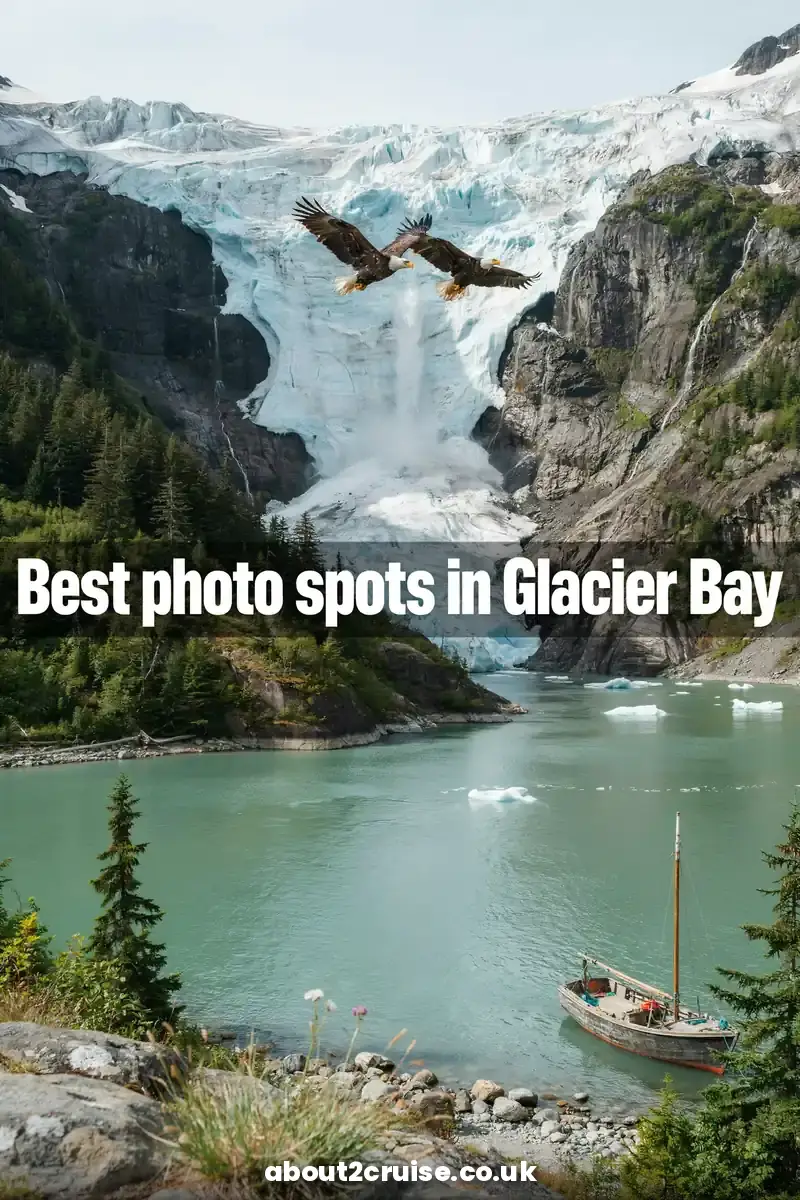
Use a long lens for wildlife, bears, mountain goats, whales, puffins, and a wide or phone lens for the scale of the fjord and the ship against the ice. Don’t watch the entire day through a screen; the sound of calving and the scale of the walls are part of why the day matters. If you want to hear glaciers beforehand, the park publishes a soundscape gallery of cracking ice and fizzing bergs.
Best Month for a Glacier Bay Cruise
Alaska’s cruise season runs roughly late April to early October, and Glacier Bay cruise access is generally May through September. June to August is the peak for weather, daylight, active calving, and wildlife. May and June are usually the driest months at Bartlett Cove; September and October are the wettest.
- May: puffins gather on the small islands; shoulder-season pricing and fewer people.
- June: harbour seal pups are born; often drier and bright.
- July: bears are watched on shore catching spawning salmon; peak season.
- August: reliable wildlife and long daylight but busier.
- September: shoulder prices and fewer people, but wetter and wilder weather; humpback whales are often still present.
There’s no single guaranteed best month. If you want maximum light and wildlife, June or July is the conventional pick. If you want lower fares and can accept more weather risk, May or September is the value play.
Is Glacier Bay Worth It on a Cruise?
Yes, if you have any interest in tidewater glaciers, wild landscapes, or the reason many people choose Alaska over other cruises. It’s not a short detour: the ship is inside the park for most of a day. More than 90% of park visitors arrive by cruise ship, and around 96% of marine-based visitors do. You don’t need to transfer, pay park admission, or book an excursion to see the headline scenery.
There’s no industry-wide success rate for reaching a particular glacier, and the park doesn’t publish cancellation statistics. The only clear consumer backstop found is Holland America’s Glacier Guarantee: if the glacier call is cancelled, the line pays a future cruise credit worth 15% of the cruise fare. Weather, ice, and operational changes can affect any sailing, so build some flexibility into your expectations.
How to Pick an Itinerary That Actually Includes Glacier Bay
Not all Alaska cruises go to Glacier Bay. If you search for an Alaska cruise and choose on price alone, you may get Endicott Arm and Dawes Glacier, Tracy Arm, Hubbard Glacier, or College Fjord instead. Check the day-by-day itinerary for the words “Glacier Bay scenic cruising” or “Glacier Bay National Park.” If the itinerary says “Inside Passage” but does not name Glacier Bay, it usually means the ship is using the broader coastal route, not the park day.
If Glacier Bay is non-negotiable, priority routes include Princess Voyage of the Glaciers one-way between Vancouver and Whittier, Holland America Seattle or Vancouver round-trips with Glacier Bay, Norwegian Seattle round-trips on Bliss, Encore, or Joy, Cunard Queen Elizabeth Seattle round-trips during its scheduled Alaska seasons, Seabourn luxury sailings, Viking Alaska voyages, and UnCruise small-ship trips with two full park days.
If you want more glaciers beyond Glacier Bay, Hubbard Glacier is another large tidewater glacier, Dawes Glacier sits at the end of the narrow Endicott Arm fjord, and College Fjord offers several named glaciers in one scenic run. A Princess one-way Voyage of the Glaciers can combine Glacier Bay with Hubbard or College Fjord, which is one reason it often appeals to glacier-first planners.
If your ship heads to Hubbard Glacier instead, our Hubbard Glacier cruise guide covers timing, packing and where to stand.
Glacier Bay vs Glacier National Park: Don’t Mix Them Up
Glacier Bay National Park and Preserve is in Southeast Alaska, reached by cruise ship, tour boat, or small aircraft. Glacier National Park is a separate land-based park in Montana, reached by road or rail, and it charges entrance fees. If you search “Alaska cruise Glacier National Park,” you’re likely mixing the two. Glacier Bay has no entrance fee for visitors arriving by ship; Glacier National Park has a standard entrance pass and a non-resident fee for visitors aged 16 and over.
UK Travellers: ESTA, Insurance, Flights, and Practicalities
British citizens travelling under the US Visa Waiver Program need an ESTA before flying. The ESTA costs around $40 per application. Carry a valid passport and check the latest US entry rules before booking. UK foreign travel advice notes that violent crime and gun crime rarely affect tourists, but normal urban safety awareness still applies.
- Insurance: Buy comprehensive travel insurance that covers medical costs, repatriation, and any planned outdoor activities. If you plan flightseeing or hiking ashore at other ports, check for mountain rescue and helicopter evacuation cover.
- Package protection: Package holidays sold by ABTA members are financially protected, and flight-based packages are normally covered by ATOL. Book through a bonded cruise specialist where possible.
- Flights: Glacier Bay itself has no cruise terminal or international airport. You’ll fly into an embarkation port such as Seattle, Vancouver, Whittier or Anchorage for Whittier transfers, Juneau, or San Francisco. Allow extra travel time for connections and possible pre-cruise overnight stays.
- Time zone: Alaska Daylight Time is eight hours behind UTC. British Summer Time is one hour ahead of UTC, so in summer Alaska runs nine hours behind the UK.
- Currency: Onboard spending is in US dollars. You don’t need local cash for the Glacier Bay day itself, but you may want US dollars or a card for ports such as Juneau, Ketchikan, Skagway, Sitka, or Icy Strait Point.
Onboard Money, Food, Signal, and Seasickness
There are no ATMs, taxis, shops, or market stalls on a Glacier Bay day, so all spending is onboard. Food and drink come from the ship. Alongside Holland America’s Dutch pea soup, Princess hot chocolate and consommé stations, and Norwegian’s bow hot chocolate, normal dining rooms and buffets continue to operate. Some lines close shops and casinos during the park transit, so check the daily programme.

Dress for the day means outdoor layers, but indoor restaurants still follow normal ship dress. Evening dress codes don’t change because of Glacier Bay, except that after a long cold deck day many passengers keep things casual.
Don’t count on reliable mobile signal or ship Wi-Fi for the whole day. Download offline maps, a guide, or a wildlife checklist before you enter. Some ships may have connectivity that works in patches, but the safest plan is to treat Glacier Bay as an offline day and keep your phone in a warm pocket.
Seasickness in Glacier Bay itself is usually lower because the ship is inside a protected fjord. However, open water crossings to and from Seattle or across the Gulf of Alaska can be rough. If you’re prone to motion sickness, choose a midship lower cabin and bring medication or patches. Inside Passage and fjord days are not a guarantee of calm seas.
Families, Accessibility, and Mobility on Glacier Bay Day
Glacier Bay is one of the easiest Alaska days for families because there’s no rushing, no tender, and no shore transfer. Rangers present Junior Ranger activities aboard, and children can be sworn in and receive a badge before the rangers leave. Holland America’s Junior Ranger programme with the park service covers ages 3–16. Princess runs Glacier Bay Junior Rangers with activity books, presentations, a badge, and a certificate. Even without the formal programme, the ranger desk’s National Park Service cancellation stamp is a favourite for children collecting park stamps.
Accessibility on board is handled by the cruise lines. The National Park Service says most visitors arrive by cruise ship and directs passengers to contact the individual cruise lines, which provide easy access for all. NPS publishes a Braille version of the park brochure and has staff who speak American Sign Language. If you have mobility needs, ask guest services about accessible viewing areas, lift access to top decks, and the easiest route to an indoor observation lounge for the main glacier stop.
Frequently Asked Questions About Glacier Bay Cruises
Is Glacier Bay a cruise port?
No. There is no pier, terminal, tender, or disembarkation. It’s a scenic cruising day inside the national park. Don’t search for parking, transfers, or shore excursions for Glacier Bay; those belong to your embarkation port.
Which side of the ship is best for Glacier Bay?
Both sides get a view because the ship rotates in front of the main glacier. The best single position is outside and as far forward as possible, but you don’t need a specific cabin side for the day.
Can I get off the ship in Glacier Bay?
No. The entire visit is spent aboard. There are no shore excursions, no docks, and no land activities inside the park on a large-ship Glacier Bay transit.
Will I see grizzly bears in Glacier Bay?
You may see coastal brown bears, often called grizzlies, or black bears from the ship along shorelines and beaches at low tide. You won’t encounter them on foot because cruise passengers stay aboard. Bring binoculars; bears look like small dots against the big landscape.
How many cruise ships are allowed in Glacier Bay each day?
Two large cruise ships may be in the bay per day, year-round. Up to three smaller tour boats may also operate. This is part of the park’s vessel quota system.
Do I need a park pass for Glacier Bay?
No. There is no entrance fee for Glacier Bay National Park and Preserve. Cruise operators pay concession fees to use the bay, and those costs are built into your cruise fare.
What if my Alaska cruise does not include Glacier Bay?
Many Alaska cruises skip Glacier Bay and substitute a different glacier experience such as Endicott Arm and Dawes Glacier, Tracy Arm, Hubbard Glacier, or College Fjord. If Glacier Bay matters to you, check the itinerary line by line before booking.
Can I visit Glacier Bay without a cruise?
Yes, but the experience is different. You can fly to Gustavus or Juneau, stay near Bartlett Cove, join a park tour boat, or travel on a small expedition ship such as an UnCruise vessel. Large cruise ships do not dock at Bartlett Cove as an embarkation port.
Is Glacier Bay guaranteed on every sailing?
No specific glacier or park entry is industrially guaranteed. Weather, ice, and operational plans can change. Holland America has a Glacier Guarantee that provides a future cruise credit worth 15% of the cruise fare if the glacier call is cancelled, but no industry-wide success rate is published.