
Antwerp is one of Europe’s easiest cruise calls: ocean ships berth directly below Het Steen, and river ships use nearby city docks. You can walk to the Grote Markt, cathedral, Rubens art and diamond district. This guide covers berths, one-day plans, boat trips, transport, safety and practical tips for UK cruise passengers.
Where your ship actually docks in Antwerp
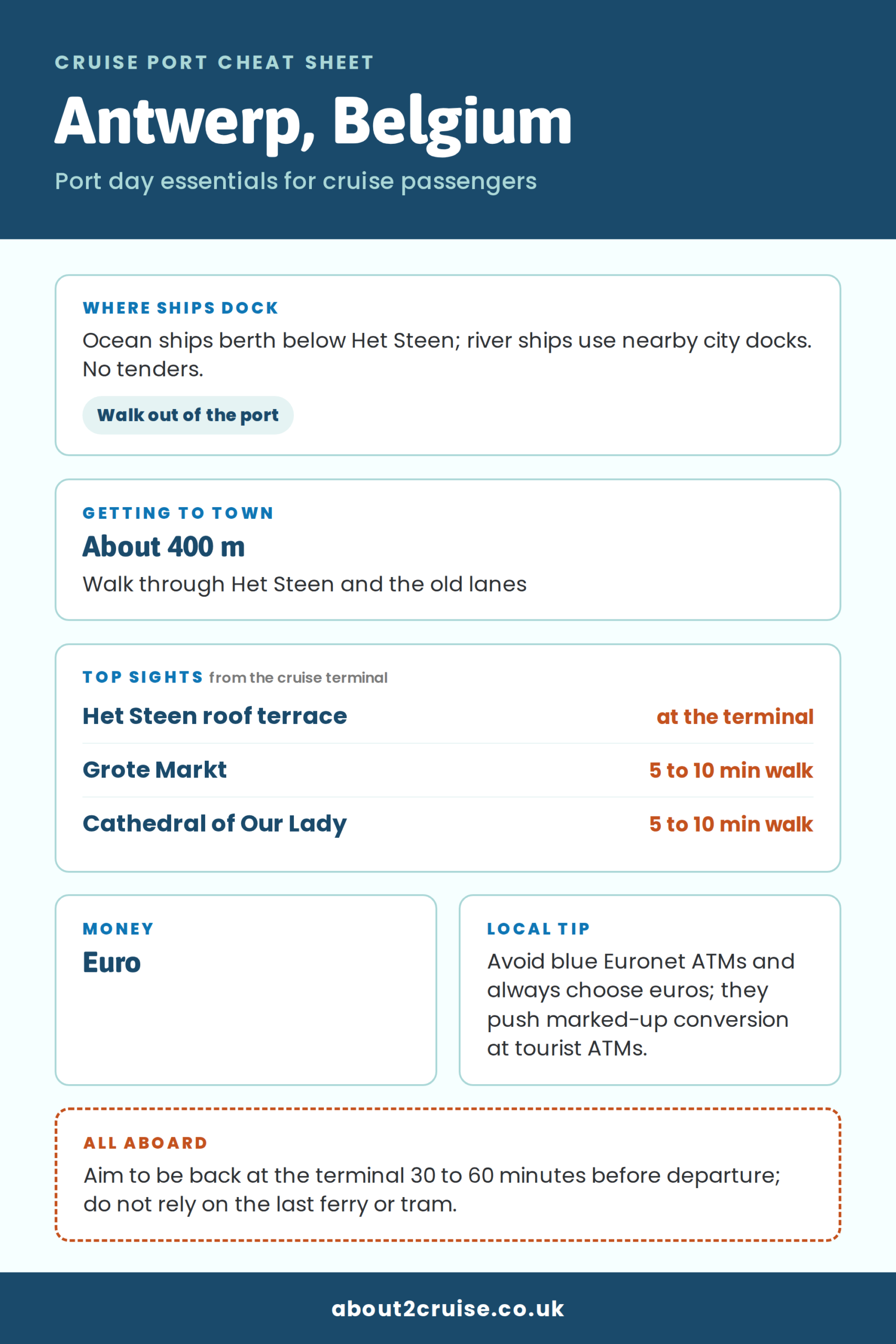
Antwerp doesn’t have a remote industrial cruise terminal. The main cruise pontoon sits on the Scheldt at the foot of Het Steen castle, right in the historic centre. The same floating pontoon, roughly 350–360 m long, can handle either one ocean cruise ship or up to four river cruise ships, depending on size.
Ocean cruise ships
Ocean passengers usually arrive at the floating pontoon directly below Het Steen. Only one sea-going ship can use it at a time. The practical maximum is about 240 m length, 35 m beam and 8 m draught, with 69 m air draught. Ships over 265 m cannot use the Scheldt quays because of the bend at Sint-Annastrand, so they are diverted to other docks in the port. If your ship is in the 240 m class or the 216–220 m range, you are very likely at the central pontoon.
There is no anchorage and no tendering. You step ashore directly alongside.
River cruise ships and Viking berths
River cruise ships use three main locations: the Het Steen pontoon at the Noorderterras, Kattendijkdok, or Willemdok at the Napoleonkaai. Most river ships actually use Kattendijkdok rather than Het Steen itself. Viking and other lines don’t publish the exact quay in advance. Your ship’s daily programme or the port call list is the real confirmation.
Kattendijkdok is about a 10-minute walk from the historic centre, and the MAS and Red Star Line Museum are only about 300 m away. Willemdok is about 500 m from the MAS and 700 m from the Red Star Line Museum. Days with eight or more river ships in port are common, which is why berths are spread across these locations.
Because all three locations are within a short walk or quick tram ride of the old town, there is no separate city shuttle bus.
Antwerp cruise port map
Ships dock at Het Steen cruise terminal. From the cruise terminal, DIVA is about a 3-minute walk, Grote Markt about 5 minutes and Cathedral of Our Lady about 7 minutes. Tap a pin for directions.
- Het Steen cruise terminalWhere ships dock
- Kattendijkdok river berthWhere ships dock
- Willemdok river berthWhere ships dock
- DIVAAbout 3 min walk from the cruise terminal
- Grote MarktMarket square · About 5 min walk from the cruise terminal
- Cathedral of Our LadyCathedral · About 7 min walk from the cruise terminal
- Museum Plantin-MoretusMuseum · About 8 min walk from the cruise terminal
- MoMu fashion museumFashion museum · About 11 min walk from the cruise terminal
- MAS – Museum aan de StroomMuseum · About 15 min walk from the cruise terminal
- MeirAbout 15 min walk from the cruise terminal
- RubenshuisHistoric house · About 18 min walk from the cruise terminal
- Diamond DistrictDistrict · About 29 min walk from the cruise terminal
- Antwerpen-Centraal stationTrain station · About 30 min walk from the cruise terminal
The cruise terminal at Het Steen: address, facilities and check-in
The terminal building is inside Het Steen at Steenplein 1, 2000 Antwerp. It is also listed as Jordaenskaai on some port documents.
What you’ll find inside:
- Waiting room for around 400 passengers, toilets, lifts to all floors and wheelchair access.
- Lounge with Wi-Fi, X-ray and bag-scanning lanes, plus an immigration pavilion on the pontoon.
- Tourist information desk and the paid attraction The Antwerp Story inside the building.
- Free visitor centre and panoramic roof terrace in Het Steen. The roof terrace is open daily 10:00–22:00.
- The Antwerp Story costs €7 for adults, €5 for ages 6–17, and is free for under-6s.
- Covered pontoon canopy to keep you dry when boarding or disembarking in rain.
- No advertised left-luggage service or dedicated cruise car park at the terminal.
- Antwerp City Pass costs €45 for 24 hours, €55 for 48 hours and €65 for 72 hours, and includes public transport. It can be worth it if you plan several museums.
Security follows ISPS rules. Access is restricted to passengers and crew, and any visitors must pre-register online at least 24 hours ahead. Photography, filming and drones are not allowed on the port facility during a ship’s call without permission.
Antwerp is primarily a transit call. Semi- or full turnarounds must be requested in advance from port security, and the port can handle up to about 1,000 turnaround passengers.
How far is the walk from the ship to the Grote Markt?
The Grote Markt is about 400 m, or 0.2 miles, from the terminal. That’s roughly a 5–10 minute walk. The cathedral is another 200 m, or about five minutes, from the passenger exit.
Walk out of Het Steen and follow the quayside or the old lanes. The route is largely level, but cobbles slow you down. A practical self-guided loop, terminal, quayside, Grote Markt, Vlaeykensgang, cathedral, Groenplaats, Plantin-Moretus, back to terminal, is about 2.5 km and 35–45 minutes of pure walking.
Grote Markt itself is completely level and has smoother bluestone strips between the cobbles. There is an underground car park with a lift to square level.
Ocean vs river arrival and disembarkation
Ocean ships generally call at the Het Steen pontoon, with border control possible in a pavilion on the pontoon. River ships may be under Het Steen, at Kattendijkdok or at Willemdok. In every case you walk off onto a quay or pontoon. There is no tender operation.
Ocean passengers go through border control at the terminal or onboard as directed. River passengers typically have a simpler gangway exit, but the same passport and security requirements apply for international river calls.
How busy will Antwerp be on your port day?
Antwerp receives around 30 ocean cruise calls a year and roughly 900 river cruise calls. River and ocean calls are mixed together in the daily port lists, so if you want to see how busy the old town will be on your date, check the port call list and, if you can, separate the ocean ship from the river ships.
Recent ocean seasons have included around 25 calls, 28 berth days, two maiden calls and 13 different ships. Ship arrivals and departures can be watched free from Het Steen’s panoramic roof terrace and the esplanade terrace. The port publishes a rolling day-by-day schedule, but your ship’s itinerary is the final confirmation.
Tides, locks and Scheldt river access
Antwerp is a tidal river port. The floating pontoon means ships moor independently of the tide and use their own gangway. Tidal range is 5.44 m. Maximum air draught at the berth is 69 m, which matters for ship and bridge clearances.
Pilotage is compulsory, tugs are compulsory depending on ship length, and any ship over 170 m must submit a ship file to the Joint Nautical Authority for approval before entering or leaving. The Scheldt quays are being rebuilt in phases, and Oosterweel tunnel construction temporarily narrows the navigable river, which can impose restrictions such as wind limits. This is a working river, so slot times and all-aboard times are taken seriously.
Passports, Schengen entry and terminal security
For UK citizens, Belgium is in the Schengen area. Passports must have been issued less than 10 years before arrival and be valid for at least 3 months beyond your planned departure from the Schengen area. You can stay up to 90 days in any 180 days without a visa. The EU Entry/Exit System records fingerprints and a photo on first entry and may add time at border control.
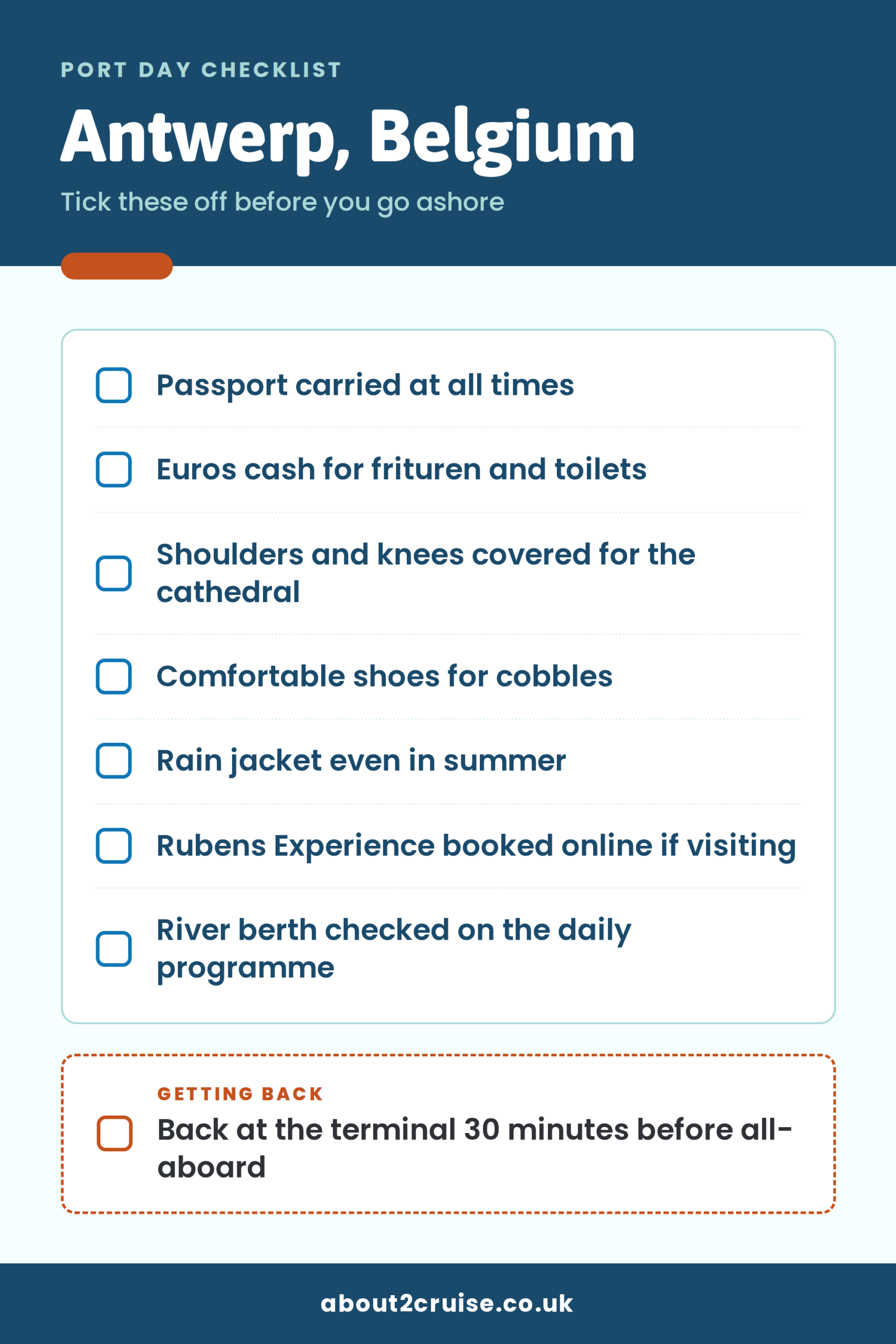
Carry your passport with you throughout the call. It is a legal requirement in Belgium. Facial-covering clothing in public is illegal, with fines up to €137, and there is no tourist exemption.
Getting from the terminal: taxi, tram, bus and walking
You don’t need transport from the terminal to the old town: it’s a five-minute walk. For other destinations:
- Walking: Antwerpen-Centraal is about 2 km away, taking 25–30 minutes on foot via the Meir or the riverside. The cathedral and Grote Markt are 5–10 minutes away. MAS is about 1.5 km north along the waterfront.
- Tram and bus: The nearest stops are Groenplaats and Melkmarkt. Tram 11 runs from Antwerpen-Centraal to Melkmarkt. Tram 4 serves Groenplaats, as do buses 22, 180, 181, 182 and 183. Because of premetro tunnel renovation, tram lines 3, 5, 9 and 15 temporarily stop at Opera and no longer serve Groenplaats or run under the Scheldt. Replacement buses run between Van Eeden and P+R Melsele.
- Taxi: Official ranks are at Groenplaats and outside Antwerpen-Centraal. Use licensed taxis only, and don’t accept rides from drivers who approach you. Taxis are metered with a higher night rate. There’s no fixed published fare from the pontoon to the station, but Central Station is only about 2 km.
- Shuttle bus: There is no general city shuttle because the terminal is central. Ships or tour operators may run their own excursion coaches from the bus pick-up zone at the north gate of the pontoon.
Getting to Antwerp before or after the cruise
Brussels Airport has a direct train to Antwerpen-Centraal taking about 30 minutes. FlixBus stops at Antwerp Rooseveltplaats platform B5, about 400 m from Antwerpen-Centraal. From London, the practical rail route is Eurostar to Brussels-Midi then an SNCB train to Antwerpen-Centraal, about 3h15–3h30 in total. A direct London St Pancras to Antwerpen-Centraal service has been announced at about 2h41, but there is no direct return because UK border checks happen only at Brussels-Midi.
If you’re staying before or after a cruise, the historic centre around Grote Markt and Groenplaats is the best base because the terminal is only a 3–5 minute walk away. Hotel Rubens-Grote Markt, Hilton Antwerp Old Town and Hotel ‘t Sandt are all within about five minutes’ walk of Het Steen.
Mobility, cobblestones and accessibility
The terminal, pontoon bridge and lifts are wheelchair accessible. The old centre is largely level, but cobbles slow walking and can be uncomfortable for wheelchairs or rolling luggage. Grote Markt has smoother bluestone strips between the cobbles. The cathedral has a ramp to the ambulatory and chapels, two wheelchair-accessible toilets and loan wheelchairs. The tower and crypt are not wheelchair or pram accessible. Cover shoulders and knees inside the cathedral, as it is an active place of worship.
Driving to the terminal, low-emission zone and parking
There is no dedicated cruise car park at Het Steen. The nearest public garages are Groenplaats, Sint-Jansvliet and Sint-Katelijnevest, all about 10 minutes’ walk from the terminal. Central garage day rates run about €20–22. Indigo Groenplaats, Cammerpoorte and Brabo are the central operators.
On-street parking in the centre is zoned and expensive: the red zone is about €2.60 for the first hour with a maximum stay of three hours. Q-Park pre-booking is usually cheaper than the drive-up tariff. For cheaper long-stay parking, use P+R Linkeroever or P+R Luchtbal and take the tram into the centre.
Driving into the centre means entering Antwerp’s low-emission zone, which is camera-enforced around the clock. Foreign-plated cars except Dutch vehicles must be registered once, free of charge, before or by the day after entering. Fines run €150–350, and registering after a fine costs €75.
Luggage storage and embarkation/disembarkation
The terminal doesn’t publish a left-luggage service. Antwerpen-Centraal has automatic luggage lockers from €5 for a small locker to €14.50 for a suitcase-size locker per day, bookable at the station or online. The station is about 2 km from the pontoon: 10–15 minutes by tram, or 25–30 minutes on foot. Independent bag-storage shops near the station charge from roughly €1.49 an hour or €4.90 a day per bag.
If you’re disembarking or embarking, check with your line about baggage handling and check-in times. Antwerp is primarily a transit call, so turnarounds need to be confirmed in advance.
One day in Antwerp from a cruise ship
Aim to be ashore early, before the cathedral opens at 10:00, so you can enjoy the quieter parts first.
Before you sail
- Book Rubens Experience online ahead; capacity is limited and runs to fixed slots.
- Confirm your berth via the port call list or your ship's daily programme.
- Keep a little cash; some small food shops are Bancontact-only.
Short port day: under 6 hours
- On dockingGrote Markt and Brabo FountainWalk through Het Steen and along the quay, about 5 to 10 minutes. The square and city hall are free.
- +45 minCathedral of Our LadyCover upA 5-minute walk from Grote Markt. Rubens's Elevation of the Cross, Descent from the Cross and Assumption are inside; pay at the desk.
- +1 hr 45 minLunch near Grote Markt or VrijdagmarktTry moules-fritesOrder a cone of frites or a pot of moules-frites. Cafés line the Grote Markt; the lanes around Vrijdagmarkt are quieter.
- +2 hr 45 minDIVA or Plantin-MoretusBoth are about a 5 to 10 minute walk from lunch. DIVA is open daily except Wednesdays; Plantin-Moretus is cashless and closed Mondays.
- +4 hrs 15 minWalk back via Vlaeykansgang and GroenplaatsThe old-town lanes are mostly level but cobbled; allow 15 minutes to the terminal.
- All-aboard minus 45 minBack at the terminalYou are only minutes from the ship. Do not rely on the last ferry or tram.
The time on the map is the whole walk, every stop added together.
Open this walking route in Google Maps
If plans change: If the cathedral is closed for a service, start with Het Steen and DIVA instead; the Grote Markt loop still works.
Long port day: 8 hours or more
- On dockingGrote Markt and Brabo FountainWalk through Het Steen, 5 to 10 minutes from the pontoon. Perhaps start on the free roof terrace if open.
- +45 minCathedral of Our LadyA 5-minute walk. See the Rubens altarpieces; individual visitors pay at the desk. Cover shoulders and knees.
- +2 hrs 30 minLunch near Grote Markt or VrijdagmarktTry moules-frites or a Bolleke beer. Cafés line the Grote Markt; Vrijdagmarkt is quieter.
- +3 hrs 30 minMuseum Plantin-MoretusA 10-minute walk from lunch. UNESCO-listed printing house and mansion; cashless and closed Mondays.
- +5 hrs 15 minWalk to MAS and rooftopAbout 20 minutes north along the waterfront. The rooftop panorama is free and open late; museum optional.
- +6 hrs 30 minSint-Anna ferry to Linkeroever and backFrom Steenplein, the free ferry gives the classic skyline photo. Runs every 15 minutes by day.
- All-aboard minus 30 minBack at the terminalYou are only minutes from the ship. Do not rely on the last ferry or tram.
The time on the map is the whole walk, every stop added together.
Open this walking route in Google Maps
If plans change: If MAS is closed on Monday or the ferry is suspended, swap that step for the Meir and Antwerpen-Centraal, then tram back.
- 09:00–09:30: Walk through Het Steen and visit the free roof terrace for a view of the ship and the Scheldt.
- 09:30–10:00: Grote Markt, Brabo Fountain and guild houses.
- 10:00–11:15: Cathedral of Our Lady: Rubens’ Elevation of the Cross, Descent from the Cross and Assumption.
- 11:15–12:00: Walk via Vlaeykensgang and Groenplaats, then up the Meir toward Central Station. Pop into the Diamond District around Hoveniersstraat.
- 12:00–13:00: Antwerpen-Centraal interior, and maybe a coffee nearby.
- 13:00–14:00: Lunch back near Grote Markt or Vrijdagmarkt.
- 14:00–16:00: Choose one of MAS museum and rooftop, Plantin-Moretus Museum, DIVA diamond museum, MoMu fashion museum, or Rubens Experience.
- 16:00–17:00: Beer, waffle or chocolate stop. On a warm day, take the free Sint-Anna ferry across to Linkeroever for the skyline photo, or hop on DeWaterbus from Steenplein.
- 17:00: Start walking back to the ship. You’re only minutes from the terminal.
If you prefer food and shopping, swap the Central Station and Diamond District for the Meir shops, Nationalestraat and MoMu, plus the Vrijdagmarkt cafés.
All-aboard time is usually 30 minutes before departure, but some lines require 45–60 minutes. Because the berth is central, you can return from the old town quickly, but don’t rely on the last ferry or tram.
Het Steen: the castle that doubles as a cruise terminal
Het Steen is Antwerp’s medieval fortress and the most unusual cruise terminal in northern Europe. Passengers literally pass through the building. Inside there is a free visitor centre, the paid attraction The Antwerp Story, a city shop and a panoramic roof terrace. The roof terrace is free daily 10:00–22:00 and is the best quick view of your ship. The Antwerp Story costs €7 for adults and €5 for ages 6–17, and is a good rainy-day option. Het Steen is open daily 10:00–18:00 except 25 December and 1 January.
Cathedral of Our Lady
The Cathedral of Our Lady, Onze-Lieve-Vrouwekathedraal, on Handschoenmarkt, is the defining Antwerp sight. It holds Rubens’ Elevation of the Cross, Descent from the Cross and Assumption, and is a five-minute walk from the terminal.
- Open Monday–Friday 10:00–17:00, Saturday 10:00–15:00, Sunday 13:00–17:00. Closed 1 January to tourists.
- Admission is €12 for adults, €10 for groups of 20+, students, disabled visitors and over-60s, and free for under-18s and Antwerp Province residents.
- No timed ticket is needed for individuals. Pay at the desk inside. Groups of 20+ must book three weeks ahead.
- Free guided tours run at set times in several languages and are included in the ticket.
- The cathedral is a living parish, so visits pause for services. The high altar, crypt, garden and tower are not wheelchair or pram accessible.
Tower visits are a separate ticket and operator: about 515 steps and roughly two hours, sold only in limited months and weekday mornings, minimum age 10. The tower is not included in the normal cathedral ticket.
Grote Markt and the Brabo Fountain
The Grote Markt is free to visit, dominated by the Renaissance city hall and 16 guild houses. The Brabo Fountain in the middle tells the local legend of Silvius Brabo throwing the giant’s hand. It is busiest on Saturday afternoons and in December. Early morning or Sunday morning is quietest for photos. Cafés line the edges with terraces.
Rubens, Rubenshuis and Flemish Golden Age art
Antwerp is a Rubens city. Beyond the altarpieces in the cathedral, the Rubenshuis at Hopland 13 is the artist’s home, but the historic house is temporarily closed for renovation. The Rubens Experience, baroque garden and library are open. It is cash-free, and you should book the Rubens Experience online in advance because capacity is limited and entry runs to fixed start times.
Opening is 10:00–17:00 weekdays and 10:00–18:00 weekends, closed Wednesdays and on 1 January, 1 May and 25 December. Tickets are €12 adults, €8 reduced, free under 18.
The Museum Plantin-Moretus on Vrijdagmarkt 22 is the other great Flemish Golden Age stop: a UNESCO-listed printing house and mansion. It is open Tuesday–Sunday 10:00–17:00, closed Mondays and public holidays, and is cashless. Adult admission is €12, €8 for 18–25s, free under 18 and Antwerp City Pass holders.
MAS Museum and the Scheldt waterfront
MAS, the Museum aan de Stroom, at Hanzestedenplaats 1, is about 1.5 km north of the terminal or a 20-minute walk from Grote Markt. It tells the city’s story through its port, trade and collections.
The museum is open Tuesday–Sunday 10:00–17:00, closed Mondays and on 1 January, 1 May, 1 November and 25 December. Tickets are €12 full rate and €8 reduced. The boulevard and rooftop panorama are free and open 09:30–22:00, or until 23:30 in summer, making it a great late-afternoon photo stop.
Antwerp Central Station
Antwerpen-Centraal is about 2 km from the terminal, free to enter and repeatedly voted among the world’s most beautiful stations. The main hall has a 75 m dome and a monumental staircase. The train shed is 43 m high and 186 m long. Walk through the Meir to get there, or take tram 11 from Melkmarkt. Allow 2–3 hours for the walk-and-return with the Diamond District, less if you take a tram back.
Diamond heritage, the Diamond District and DIVA
Antwerp’s diamond district is four square blocks around Hoveniersstraat, next to Antwerpen-Centraal. Around 80% of the world’s rough diamonds and half of cut stones are traded here, but it happens behind closed doors. The street itself is more offices and exchanges than jewellery shops.
For visitors, DIVA at Suikerrui 17/19 near the cathedral is the museum of diamonds, jewellery and silver. It is open daily 10:00–18:00 except Wednesdays, with last entry 17:00. Even if you don’t buy, walking the district and seeing the secure exchanges is part of Antwerp’s identity.
Antwerp fashion and shopping on the Meir
Antwerp is a fashion city, known for the Antwerp Six and its design school tradition. For mainstream shopping, the Meir is the main pedestrian shopping street linking the old town to Central Station. For the city’s dedicated fashion museum, visit MoMu at Nationalestraat 28. It is open Tuesday–Sunday 10:00–18:00, closed Mondays. Tickets are €13 adults, €9 for 18–25s, free under 18, with timed slots and online booking advised.
Diamond and jewellery shops cluster in the Central Station district. For Belgian chocolates, waffles and souvenirs, shop around Handschoenmarkt and the lanes off Grote Markt.
Antwerp Zoo and the Central Station district
Antwerp Zoo is at Koningin Astridplein 20–26, right beside Antwerpen-Centraal. It has about 7,000 animals across around 950 species with its sister park. Tickets are date-priced: roughly €35.50–38.50 for adults and about €28.50 for children aged 3–11, under-3s free, with a small online discount. It is a good family option, but if you have only one port day and want Antwerp’s old town and art, it’s probably a second-visit choice.
Belgian beer, chocolate, waffles and eating near the port
Antwerp specialities to try are Antwerpse Handjes, hand-shaped biscuits and chocolates, Elixir d’Anvers liqueur, De Koninck’s Bolleke beer and Steen beer. You can buy all of them at the Antwerp City Shop inside Het Steen, open daily 10:00–18:00, with a tasting of a local product on the last weekend of the month.
For casual food near the port, a cone of frites costs about €3–5, a sit-down pot of moules-frites runs about €20–30, and a Bolleke in an ordinary café is about €2.50–3.50. Waffle and chocolate shops cluster around Handschoenmarkt beside the cathedral and along the Meir. Cafés and restaurants line the Grote Markt with terraces, and the lanes around Vrijdagmarkt are quieter for a mid-visit stop.
Boat trips, waterbus and port tours from Antwerp
Antwerp is a port city, so a boat trip is one of the best ways to understand it. The key practical point is that Flandria harbour cruises no longer leave from Steenplein. They now depart from Asiadok-Zuidkaai in the Eilandje, opposite the Cadix hospital car park and within walking distance of the MAS.
- Flandria Port of Antwerp cruise: 2 hours on weekdays departing 11:00, €23 adult and €19 child aged 3–11; 3 hours at weekends departing 12:00, €28 adult and €23 child.
- Flandria also runs themed trips such as pancake, brunch and Oosterweel cruises, plus full-day Scheldt trips.
- DeWaterbus is the public passenger boat, calling at Steenplein. It runs eight stops from Hemiksem to Lillo. One-way is €4, return €6, the short crossing to Sint-Anna is €1, bikes are free and under-5s are free. A boat leaves Steenplein in each direction roughly every half hour.
- The free Sint-Anna ferry links Steenplein with Linkeroever. It carries up to 150 people and runs every 15 minutes by day and every 30 minutes at night.
- Guided port tours using the public Waterbus to Fort Lillo and back meet at Steenplein 4 and take about 3 hours 15 minutes, including headsets and a drink at Lillo.
There is no Amsterdam-style city canal tour in Antwerp. Waterborne sightseeing is on the tidal Scheldt and through the docks, not a network of city canals. If you search for an Antwerp canal tour, what you actually want is a Scheldt harbour cruise or the Waterbus.
Money, language, card payments and tipping
Belgium uses the euro. Cards and contactless are standard, including on De Lijn transport. However, some small shops, frituren and bakeries are Bancontact-only and may decline a foreign Visa or Mastercard, so keep a little cash for market stalls, frituren and toilets.
Service and VAT are included by law. Rounding up or leaving about 5% for good service is normal. Avoid the bright blue independent ATMs near Grote Markt, especially Euronet, which push dynamic currency conversion at a 4–8% markup. Always choose euros if prompted. Use bank-branded ATMs such as KBC, ING, BNP Paribas Fortis or Belfius.
Flemish Dutch is the local language, but English is widely spoken in the centre, at sights and in cruise-facing businesses.
Safety, scams and emergency contacts
Antwerp’s old town is a safe and walkable cruise call, but theft and pickpocketing are common in crowded areas, railway stations and on public transport, particularly at night. Keep your passport secure and carry it with you. Use only official licensed taxis, and never use a taxi that stops to offer you a ride.
Belgium’s national threat level is 3, which means serious, and there is an increased police presence in major hubs. Violent incidents related to organised crime do occur, but the risk mostly affects those involved. Strikes and demonstrations can cause sudden transport disruption, so allow buffer time on travel days.
In an emergency dial 112. UK consular assistance is available via the British Embassy in Brussels, but 112 is the immediate response number.
Weather in Antwerp by month and what to pack
In cruise season, the warmest months are June to September, with average daily highs above 20°C. July is typical at 23°C high and 14°C low. January averages 6°C high and 1°C low. The wettest stretch runs from mid-May to late February, with December the wettest month at around 10 rain days. April is the driest. The best general outdoor sightseeing weather is late June to early September.
Pack a waterproof outer layer even in summer. Antwerp rain is frequent enough that the cruise pontoon has a canopy specifically to keep passengers dry. Comfortable walking shoes are essential because of cobbles and a largely pedestrian old town. In winter, bring layers, a warm coat and a hat, and expect shorter daylight hours.
Best photo spots and orientation
For an easy orientation, think of the river as your anchor. Het Steen and the terminal are on the Scheldt. Grote Markt and the cathedral are immediately behind them. Central Station and the Diamond District are about 2 km east. MAS is north along the waterfront. Linkeroever is across the river.
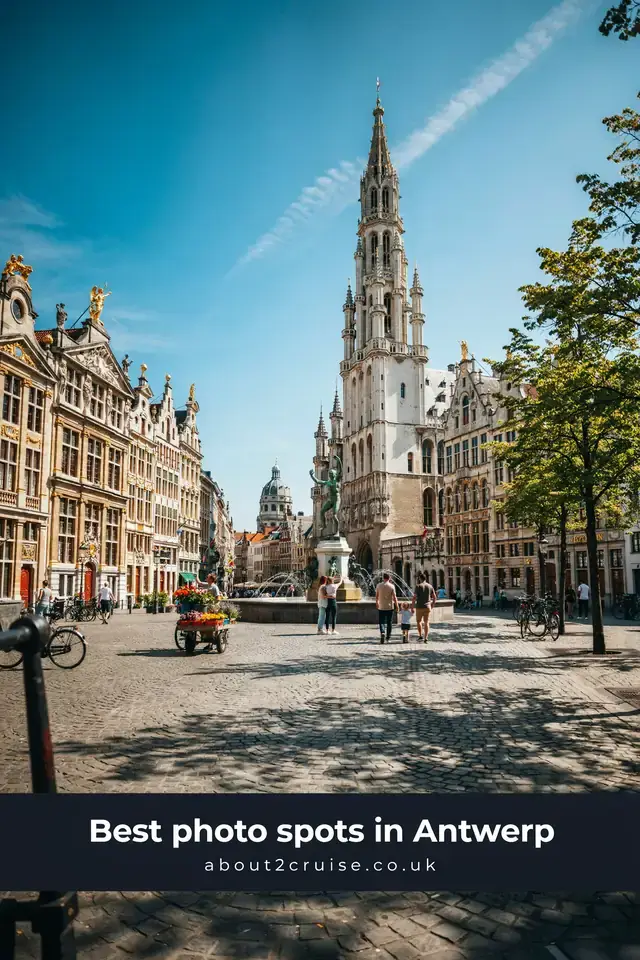
Best photo spots:
- Het Steen’s roof terrace and tower for a free view over the Scheldt and your ship.
- Noorderterras promenade beside the pontoon for close-up ship photos from a few metres away.
- Linkeroever, reached by free ferry, for the classic skyline shot across the river. Late afternoon and evening light is best.
- MAS rooftop for the dockland and city panorama, free and open late.
- Antwerpen-Centraal’s marble hall and dome.
Frequently asked questions
Is Antwerp a tender port?
No. All ships berth alongside, either at the central pontoon or at a river or city dock.
Do I need to pre-book the cathedral?
No timed ticket is needed for individuals. You pay at the desk inside. Groups of 20+ should book ahead.
Where does Viking river cruise dock in Antwerp?
Viking doesn’t publish the exact quay. River ships use the Het Steen pontoon, Kattendijkdok or Willemdok. Most use Kattendijkdok, about 10 minutes’ walk from the old town. Your daily programme or the port call list confirms it.
Can I walk from the cruise terminal to the Grote Markt with luggage?
It’s only about 400 m, but the old town has cobbles. If you’re embarking or disembarking, check baggage handling and use a taxi or tram for heavier cases if needed.
Is there left luggage at the cruise terminal?
No published service. Use Antwerpen-Centraal station lockers or nearby bag-storage shops.
How far is Antwerpen-Centraal from the cruise terminal?
About 2 km, or 10–15 minutes by tram and 25–30 minutes on foot.
Do I need cash in Antwerp?
Cards are widely accepted, but some small food stalls and shops are Bancontact-only. Keep a small amount of euros for market stalls, frituren and public toilets.
What language do they speak?
Dutch or Flemish is the local language, but English is widely spoken in tourist areas.
How early should I be back on board?
Usually 30 minutes before departure, but follow your ship’s announced all-aboard time. Because the berth is central, returning from the old town is quick, but don’t rely on the last ferry or tram.
Can I see the port without booking a ship excursion?
Yes. The Waterbus from Steenplein and the free Sint-Anna ferry are public transport, and Flandria runs bookable harbour cruises from the Eilandje.
More nearby cruise ports
For more port-day planning, see Rotterdam Cruise Port Guide, Amsterdam Cruise Port, Hamburg Germany Cruise Ship Port Guide, or browse our cruise ports guide.