
Burgas is a flat, walkable Black Sea port where ships berth alongside at the Marine Station beside Magazia 1, about 10–15 minutes on foot from the centre and five minutes from the Sea Garden. It is best for an easy DIY day of park, beach and museums, while Nessebar is the standout half-day UNESCO excursion.


What Is Burgas Like? A Short First Impression
Burgas is Bulgaria’s fourth-largest city, home to around 210,000 people, and the country’s biggest port. It sits on the western edge of the Bay of Burgas, surrounded by lakes and salt pans, and it gets more than 2,500 hours of sunshine a year with over 20 km of beaches along the wider area.
For cruise passengers, the appeal is simple. This is a relaxed Black Sea city that’s easy to explore on foot. You get a long seafront park, a wide sandy beach, a compact pedestrian centre and enough museums and cafés to fill a short port day without needing transport.
The headline spots are the Sea Garden and pier, the pink salt pans and birdlife of Lake Atanasovsko, the little island monastery of St Anastasia, and the city’s festival and museum scene. There isn’t one massive blockbuster monument. The real draw is the combination: step off the ship, walk through a restored port warehouse, and a few minutes later you’re standing beside the sea.
Burgas Cruise Terminal: Where Ships Dock and How Arrival Works
Burgas is not a tender port. Ships berth alongside in the port’s public-access zone, close to the city. Most cruise ships use the Marine Station at berths 1 and 2, next to Magazia 1. Magazia 1 is a converted port warehouse with a preserved Eiffel-type riveted roof, and it now houses the tourist information centre and a few facilities.
There’s also a larger two-berth East terminal that can handle longer or overflow ships. Because berth allocation can vary depending on port traffic, confirm your actual berth and any shuttle arrangements on board before you leave the ship.
The public-access zone around the passenger terminal is open to pedestrians, cyclists and cars. It includes restaurants, cafés, shops, the Port of Burgas car park, a yacht club and the PlanetUm children’s science museum. Boat trips to St Anastasia Island also depart from the same waterfront edge beside Magazia 1.
Burgas cruise port map
Ships dock at Marine Station (cruise berths). From there, PlanetUm is about a 2-minute walk, Magazia 1 about 6 minutes and Sea Casino about 19 minutes. Tap a pin for directions.
- Marine Station (cruise berths)Where ships dock
- PlanetUmChildren’s science museum · About 2 min walk from Marine Station (cruise berths)
- Magazia 1Tourist information centre · About 6 min walk from Marine Station (cruise berths)
- South Bus Station BurgasBus station · About 16 min walk from Marine Station (cruise berths)
- Burgas Central railway stationRailway station · About 18 min walk from Marine Station (cruise berths)
- Sea CasinoCultural centre · About 19 min walk from Marine Station (cruise berths)
- Archaeological MuseumAbout 20 min walk from Marine Station (cruise berths)
- Ethnographic MuseumAbout 24 min walk from Marine Station (cruise berths)
- Sea GardenSeafront park · About 28 min walk from Marine Station (cruise berths)
- St Anastasia IslandIsland monastery · About 6 km from Marine Station (cruise berths)
- Lake AtanasovskoSalt lake · About 6 km from Marine Station (cruise berths)
- Aquae CalidaeRoman and Ottoman baths · About 16 km from Marine Station (cruise berths)
- Nessebar Old TownHistoric old town · About 28 km from Marine Station (cruise berths)
How to Get from the Burgas Cruise Port to the City Centre
Walking is the best and simplest option. From the Marine Station to the pedestrian centre and Archaeological Museum is roughly 1.2–1.3 km, which takes about 10–15 minutes on flat ground. The Sea Garden entrance is even closer, about a five-minute walk from the berth. The route is well lit, monitored by port security and passes through a clean commercial waterfront area. Just stick to the public-access route rather than crossing working quays.
There is no published scheduled port shuttle. Some ships may run one if your berth or security arrangements require it, but walking is generally the default. Organised excursions usually pick up from the port area.
Licensed taxis queue at the port gate. Always check the tariff sticker and make sure the meter is running before you set off. Published maximum meter rates in Burgas work out at about €0.92 per km by day and €1.02 per km at night, so a short 3 km city hop should cost roughly €3–5. Avoid drivers who claim the meter is broken or quote an inflated flat fare before you get in. Uber does not operate in Bulgaria, and Bolt is not a car ride-hailing option in Burgas. The local taxi app is Moby, also branded as Taxi Bulgaria.
City buses are cheap and low-floor, with most routes having ramps. A single ticket bought on board costs about €0.80. There’s no hop-on hop-off sightseeing bus in Burgas, so the bus is mainly useful for reaching the bus station, Poda, North Beach or the airport rather than for a quick city tour.
The Sea Garden, Central Beach and Burgas Promenade
The Sea Garden, known locally as Morska Gradina, is Burgas’s signature experience. It’s free, open 24 hours, and stretches for more than 5 km along the coast. It was laid out on what was once bare shore and now contains hundreds of plant species from every continent. The old section is protected as a monument of landscape art.
Inside the park you’ll find the Sea Casino cultural centre, the Summer Theatre, the open-air “Snail” stage, the Flora exhibition pavilion, fountains, playgrounds, sculptures, an outdoor gym and plenty of cafés.
The classic view is from the balustrade terrace at the Bogoridi Street entrance, often called the parapet, which looks out over the sea, the pier and the harbour. A summer tourist train runs the length of the garden with several stops, roughly every 30 minutes. Fares are usually in the region of €2–3 depending on the season and route.
Central Beach runs nearly 2 km beside the Sea Garden, up to 30 m wide, with lifeguards, showers, changing facilities and free sunbeds and parasols. The sand is gentle and it’s the easiest swim stop from the port. North Beach is quieter and reachable by a short bus or bike ride, but Central Beach is the obvious choice when you only have a few hours.
Beach flags follow the usual system: green means swimming is allowed, yellow means caution, and red means swimming is banned. Lifeguards are on duty from 08:00 to 18:00, and you should swim only inside marked zones.
Burgas Lakes, Pink Salt Pans and Birdwatching
Burgas is ringed by lakes, and the most distinctive is Lake Atanasovsko, a hypersaline coastal lagoon north-east of the city split by the Burgas–Varna road. It sits on the Via Pontica migration route and is a haven for birdwatchers. More than 300 bird species have been recorded, greater flamingos now visit and have bred, and the lake’s salt works produce about 40,000 tonnes of sea salt a year.
The lake’s pink colour comes from algae producing red carotenoids, and the colour is strongest in July and August and in the early morning. Some visitors also bathe in the natural lye and black mud pools. The Avocet Trail and birdwatching hide are in the southern part of the lake at the Sarafovo exit, with a ramp making the hide accessible to wheelchair users.
Poda Protected Area, on the Sozopol road at the south-eastern edge of the city, is run by the Bulgarian Society for the Protection of Birds. It records 321 bird species in about one square kilometre. Poda is open daily 09:00–17:00 from April to September and Wednesday–Sunday 09:30–16:00 from October to March. Admission is €4 for adults, €2.50 for students, free for under-6s, and a guided talk and tour costs €10.50. You can reach Poda on city bus 17 from the South bus station.
St Anastasia Island: A Short Boat Trip from the Port
St Anastasia Island lies about 6 km offshore and is one of Burgas’s most memorable short excursions. It has a church, a former monastery that was later used as a prison, a museum, a lighthouse, a small beach and a restaurant.
The municipal catamarans leave from Magazia 1, right beside the cruise landing, at 10:00, 13:30 and 17:00. The crossing takes about 30 minutes each way, with a two-hour stop on the island.
Return boat fares are €9.50 for adults, €8 for students and seniors, €4 for children aged 3–7, €2 for under-3s, and €5 for people with disabilities. Museum entry costs about €3. Because sailings depend on weather, call 0882 004 124 daily from 09:00 to 17:00 before walking to Magazia 1 to confirm the boat is running. The island is not fully step-free, so wheelchair users should check access before booking.
Burgas Museums, Culture and Festivals Worth Knowing
Burgas promotes itself as a city of festivals. Recurring events include the International Folklore Festival, the national song contest “Burgas and the Sea”, the opera festival “Burgas Days of Music: Emil Chakarov”, the Flora flower exhibition and the Sand Sculptures Festival. The Sand Sculptures Festival is held in Park “Ezeroto” in the Sea Garden near the riding school and is open daily in season, with a small entry fee.
The Regional Historical Museum runs four expositions:
- Archaeological at 21 Aleko Bogoridi Boulevard
- Ethnographic at 69 Slavyanska Street
- Natural History at 30 Konstantin Fotinov Street
- History at 31 Mihail Lermontov Street
Adult tickets cost €3, students €1.50, and family tickets range from €5 for one museum to €10 for all four. The museums are indoor and are the best wet-weather fallback. Opening hours can differ, but in summer the city’s museums are generally open daily from mid-morning until early evening. Outside peak season many close on Mondays.
The Cathedral of Saints Cyril and Methodius, designed by Italian architect Ricardo Toscani, is on Bulgaria’s list of 100 national landmarks and is free to enter. The Sea Casino on the central promenade is the city’s cultural centre, hosting concerts, theatre, film nights and exhibitions.
A tip-based free walking tour in English runs daily at 10:00 from the Clock opposite the tourist information centre. It lasts about 1.5 hours and covers the cathedral, Ethnographic Museum, Bogoridi Street and the Sea Casino.
If you have more time or want something different, Aquae Calidae in the Vetren quarter is a Roman and Ottoman bath complex with a 3D mapping show, open Tuesday–Sunday from 10:00 to 19:00.
A Simple DIY Walking Route for a Burgas Port Day
A straightforward Burgas port day works like this: from the ship, walk through the Magazia 1 zone to Aleksandrovska Street, then turn onto Aleko Bogoridi Boulevard, enter the Sea Garden at the Bogoridi entrance, walk to the terrace and pier, drop down to Central Beach, and return through the pedestrian centre past the Clock and cathedral.
Allow 3–5 hours for a relaxed version that includes the Sea Garden, beach and city centre. For a four-hour visit, expect around 4 km of walking. A full day including the whole Sea Garden can run to 8 km.
If you want a guided introduction, join the free English walking tour at 10:00 from the Clock. It’s a short walk from the port and gives you the orientation before you spend the rest of the day on your own. Try to walk the Sea Garden before 11:00 in high summer to avoid the strongest heat.
Where to Swim on a Short Burgas Cruise Stop
Central Beach is the answer. It’s the nearest swim, directly beside the Sea Garden and within easy walking distance of the cruise berth. The sand is wide and gently sloping, with free sunbeds, lifeguards, showers and changing rooms.
Give yourself about 15–20 minutes to walk from the Marine Station to the beach, and don’t take valuables into the water. There is no swimming beach directly at the pier, so don’t expect to jump in beside the ship.
Nessebar, Sozopol and Other Shore Excursions from Burgas
The strongest day trip from Burgas is Nessebar, a UNESCO World Heritage site on a peninsula about 35–38 km north, roughly 40 minutes by road. Its ancient old town is a jumble of medieval churches, wooden houses, cobbled lanes and sea views. Ship tours typically pair a guided walk with free time and run around six hours including transfers.
Independent buses to Nessebar and Sunny Beach leave from bay 3 at the South bus station, roughly every 40 minutes, with a ticket around €4.50 and a ride of about 45 minutes.
Sozopol is about 34 km south, around 37 minutes by road. It has an old town on a peninsula, beaches, and the Apollonia arts festival in late summer. Buses leave from bay 5 at the South bus station, with departures roughly every half hour.
You cannot do Nessebar and Sozopol back to back without returning through Burgas, so treat them as single-destination trips.
Other ship excursions from Burgas include St Anastasia Island, Burgas city highlights, a countryside or farm visit, and combinations with local wine or food. If your Black Sea sailing also calls at Istanbul, Kavala or Thessaloniki, our Eastern Mediterranean cruise ports guide covers the other port days, including dedicated guides for Istanbul, Kavala and Thessaloniki.
For docking at Morska Gara, getting into the centre, and planning around the Varna gold, Roman baths and beach, see our Varna cruise port guide.
For how ships dock or tender, the old town walk, churches, beaches and the Sunny Beach bus, see our Nessebar cruise port guide.
Should You Stay in Burgas or Take a Day Trip to Nessebar?
Burgas is not a port where you must choose between the city and the coast, because the city is the coast. A city day already includes the Sea Garden, Central Beach and the pier, so the real decision is whether to stay in Burgas or spend the day in Nessebar or Sozopol.
On a short call of four to six hours, stay in Burgas. Traffic around the city is slower in summer, and a road trip to Nessebar or Sozopol should replace, not follow, a city programme.
If your call is seven hours or longer and you want a UNESCO site, Nessebar is the better excursion because it is compact, atmospheric and easy to pair with a short look at Sunny Beach. Sozopol is quieter and suits a slower, less crowded old town by the sea. A beach day on Sunny Beach is possible but rarely better than Central Beach when you are already docked beside one.
Getting Back to the Ship on Time: Traffic and Timing Tips
Give yourself a solid buffer on any road trip. Nessebar and Sozopol are only about 35–40 km away, but summer traffic along the coast can slow to a crawl.
If you take the public bus to Nessebar, don’t risk it on a call under seven hours. Use a ship excursion or a pre-booked private transfer with a clear return time. For independent travel, plan to be back in Burgas at least 90 minutes before all-aboard, and know exactly where your taxi or bus will drop you. The bus and railway stations are beside each other at Tsaritsa Yoana Square, about 10 minutes’ walk from the cruise landing, so allow that final walk as well.
Burgas Cruise Port Facilities and Accessibility
The cruise terminal is single-level with metal ramp gangways of moderate incline, and it is usually usable by scooters. Lifts are available if your ship disembarks from an upper deck. Accessible toilets are available at the cruise terminal, Magazia 1 and the Sea Casino cultural centre.
Wheelchair and scooter rental is not available short-term at the terminal, so arrange any equipment in advance with a local provider.
Burgas is rated highly accessible overall: it is flat, with wide boulevards and a maintained coastal park. However, some Sea Garden paths down to the shore have steep steps without handrails, and the decorative paving on Aleko Bogoridi is uneven in places. The pedestrian centre, Sea Garden, Central Beach, railway station and South bus station are all within about 20 minutes’ walk of each other on flat ground. The PlanetUm children’s science museum is in the port’s public-access zone, making it a handy family stop.
Money, Cards, Tipping and Local Costs in Burgas
Bulgaria now uses the euro, and the lev is no longer legal tender. Major credit and debit cards are widely accepted in shops, restaurants, museums and hotels, and most ATMs accept standard international cards and dispense euros.
You’ll still want some cash in small denominations for kiosks, taxis, public toilets in the Sea Garden and small bakeries. A 10% tip is standard in restaurants. For taxis, rounding up to the next euro or two is normal. There’s no need to carry US dollars, and sterling or dollars can be exchanged at banks and exchange bureaux if you arrive with them.
Language Tips and Useful Bulgarian Phrases
Bulgarian is the official language and is written in Cyrillic. English is widely used in tourist areas and among younger people, and you’ll have no trouble at the tourist information office, museums, port cafés and larger restaurants. Russian and German are also common second languages.
Useful words include da (yes), ne (no), molya (please), blagodarya (thank you) and dobar den (good day). Be aware that Bulgarians may nod for “no” and shake the head for “yes”; saying da or ne is safer than relying on gestures. If you are taking a taxi to a specific address, have it written in Cyrillic to show the driver.
What to Eat and Where to Eat Near the Cruise Port
Bulgarian food is inexpensive and well suited to a short port call. Dishes to try include shopska salad, the national salad of tomato, cucumber, onion and peppers under grated white cheese; tarator, a cold yoghurt, cucumber, garlic and walnut soup; banitsa, filo pastry with cheese and egg; and Black Sea fish such as fried sprats, horse mackerel and mussels.

From the grill, kebapche and kyufte are easy choices, usually with rakia or a cold local white wine.
The best area for a sit-down meal is Aleko Bogoridi Street and the Sea Garden edge. Bakeries on and around Aleksandrovska Street are the cheap option for banitsa and everyday pastries.
A banitsa from a bakery costs roughly €0.75–1.30, a full kebapche portion about €2–3, and a mehana meal in the centre about €6–9 per person including a beer. Beach restaurants on the Burgas front are pricier but still reasonable: expect fish soup for about €3.20 and a plate of fried fish with beer and chips for around €6.
Shopping in Burgas: Souvenirs and Local Buys
Shopping concentrates on the two pedestrian streets, Aleksandrovska and Bogoridi, plus the Galleria Burgas and Burgas Plaza malls.
Typical Bulgarian buys include rose oil products and cosmetics, ceramics, embroidered textiles, wooden items, Bulgarian wine and rakia, honey, herbs and local food products. The covered market and neighbourhood grocery shops are the best places for food products to take back.
Shops generally open 10:00–20:00 on weekdays and 11:00–19:00 at weekends. Malls stay open until about 22:00.
Weather in Burgas: What to Expect Each Season
Burgas has a mild maritime climate with long sunny summers. Average daytime maxima run from about 21°C in May to 26°C in June, 28°C in July and August, and 25°C in September. Sea temperatures warm from about 15°C in May to 24–25°C in July and August.
Rain is least likely in July, August and September, while May and June still see occasional showers. UV is strong in high summer, peaking at 8–9, so sun protection matters. The Black Sea is exposed and can be windy, and weather can occasionally affect ship calls. Walk the Sea Garden before mid-morning when it is hot.
What to Do in Burgas When It Rains
Rain in summer is usually brief, but the fallback plan is straightforward. The four city museums are indoor and centrally located. The Sea Casino cultural centre and Flora pavilion host indoor concerts and exhibitions. Aquae Calidae has a 3D mapping museum and an indoor bath complex.
Before you sail
- Check your passport is valid for at least three months after your Schengen departure.
- Book a Nessebar ship excursion or private transfer if your call is under seven hours.
- Bring euros in cash for kiosks, taxis and Sea Garden toilets.
Short port day: under 6 hours
- On dockingWalk to the Sea GardenFlat walkWalk out of the Marine Station through the Magazia 1 public-access zone. The Sea Garden entrance is 5 minutes away.
- +15 minSea Garden terracePause at the balustrade by the Bogoridi Street entrance for the classic view over the sea, pier and harbour.
- +45 minCentral BeachWalk beside the Sea Garden to the nearly 2 km sandy beach. Free sunbeds and lifeguards in summer.
- +1 hr 45 minLunch near Bogoridi StreetTry shopska saladAleko Bogoridi Street and the Sea Garden edge have sit-down spots. Order shopska salad or Black Sea fish.
- +3 hrsArchaeological MuseumA 10 to 15 minute walk back into the centre at 21 Aleko Bogoridi Boulevard. Small entry fee.
- +3 hrs 45 minCathedral of Saints Cyril and MethodiusWalk a few minutes to the free cathedral on the list of 100 national landmarks. Cover shoulders and knees.
- All-aboard minus 1 hrBack at the Marine StationWalk through the pedestrian centre and Magazia 1 zone. If you are late, take a licensed taxi from a rank.
The time on the map is the whole walk, every stop added together.
Open this walking route in Google Maps
If plans change: If the Archaeological Museum is closed or has a long queue, the Ethnographic Museum and the Cathedral are a short walk away.
Long port day: 8 hours or more
- On dockingWalk to South bus station10 min via centreFrom the Marine Station, walk through the Magazia 1 zone and the pedestrian centre to Tsaritsa Yoana Square. The South bus station is beside the railway station.
- +20 minBus to NessebarBuy ticket on boardBuses to Nessebar use bay 3 and leave roughly every 40 minutes. The ride takes about 45 minutes.
- +1 hr 15 minNessebar Old Town walkEnter the UNESCO peninsula and follow the cobbled lanes past medieval churches and wooden houses.
- +2 hrs 45 minLunch in NessebarTry Black Sea fishEat in the old town. Order Black Sea fish, mussels or shopska salad.
- +3 hrs 45 minMedieval churches and squaresContinue through the old town. The peninsula is compact, so you can wander without rushing.
- +5 hrs 30 minNessebar sea wallsFinish with a walk along the sea walls for the best views before you head back.
- All-aboard minus 90 minReturn bus and walk to shipTake the bus back to Burgas, then walk to the Marine Station. If the bus is late, take a licensed taxi.
The times on the map are for the whole journey there by train and bus.
Get train and bus times in Google Maps
If plans change: If buses to Nessebar are full or not running, take a ship excursion or a pre-booked private transfer; if that fails, stay in Burgas and use the short city plan.
Cafés along Bogoridi and Aleksandrovska are good for sitting out a shower, and the covered shopping is concentrated on Aleksandrovska. Note that the free walking tour is usually cancelled in heavy rain, and many museums close on Mondays outside the summer season.

Safety Tips and Common Sense Precautions
Burgas is safe for cruise passengers, but take normal city precautions. Watch for pickpockets and bag thefts in tourist areas, on buses and at transport hubs.
Avoid taxis parked outside hotels or in tourist areas. Flag one with a green available light, use the Moby app, or have the tourist office call one. Check the licence sticker and window tariff, and don’t accept a “broken meter” story without agreeing a clear fare first.
Carry ID at all times; a printed copy of your passport photo page is acceptable. The emergency number is 112. Obey beach warning signs and lifeguard instructions, and follow local advice on jellyfish or sea urchins.
Entry Requirements for UK Cruise Passengers
UK passport holders do not need a visa for Bulgaria as part of the Schengen area for stays of up to 90 days in any 180-day period. Your passport must have been issued less than 10 years before arrival and be valid for at least three months after your planned departure from the Schengen area.
The EU Entry/Exit System now registers fingerprints and a photo on first entry, which can add time at borders. Border officers may ask for proof of accommodation, travel insurance, a return ticket and sufficient funds for your stay.
Dress Codes, Etiquette and What to Wear
Cover shoulders and knees when entering Orthodox churches, keep voices low and phones silent, and ask before photographing icons. Photography may require a small photo ticket inside some churches.


Expect cobbles in Nessebar’s and Sozopol’s old towns and sand on Central Beach, so wear comfortable shoes with grip. The Sea Garden steps down to the shore are steep in places, and the decorative paving on Bogoridi is uneven, so keep an eye on your footing. In high summer, bring sun cream, a hat and water.
Best Photo Spots in Burgas and Nearby
The best classic shot is from the balustrade terrace at the Bogoridi Street entrance to the Sea Garden, looking over the sea, the bridge and the harbour. The bridge, known as Mosta, stretches over the water at the end of the Sea Garden and is a local sunset spot.
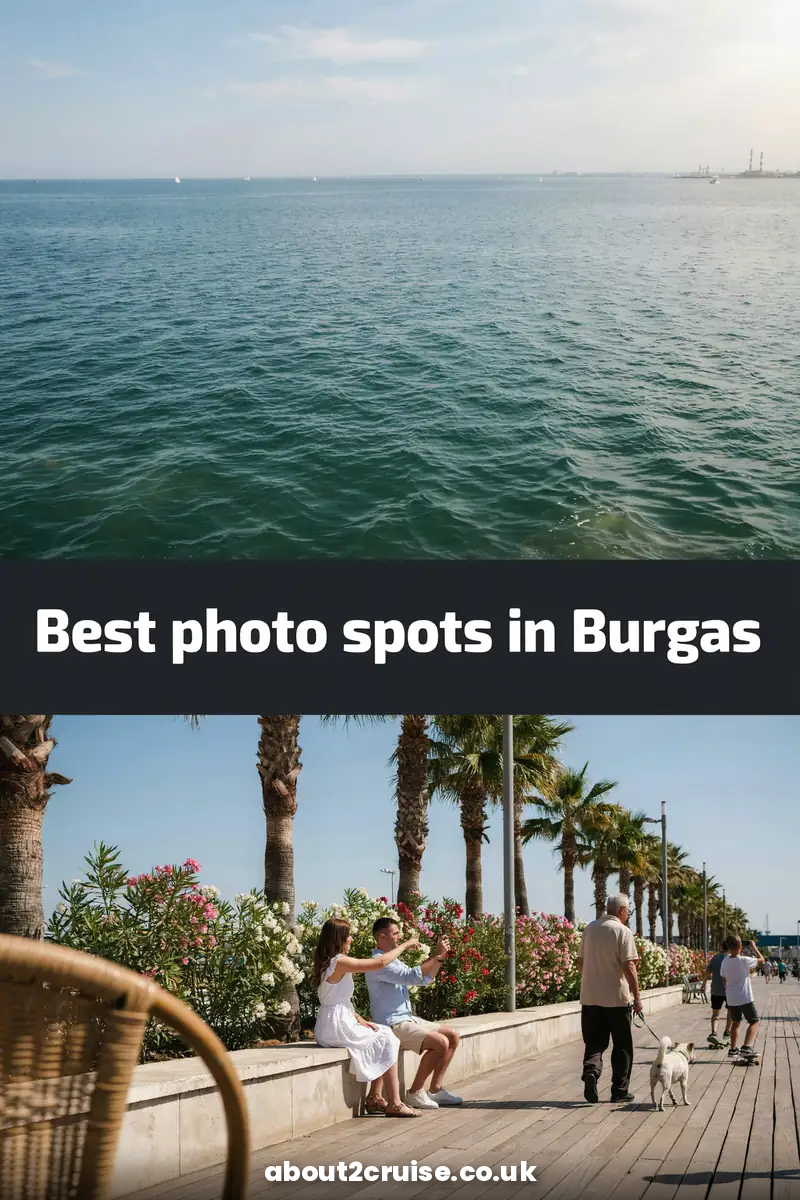
The pier and lighthouse beside the Sea Station make a good foreground for your ship. Lake Atanasovsko’s pink salt pans are most intense in July and August and in the early morning. St Anastasia Island gives 360-degree views across the bay from the boat and the island.
Getting to Burgas, Where to Stay and Local Transport
If your cruise starts or ends in Burgas, the city is compact and easy to navigate. Burgas Central railway station is at Tsaritsa Yoana Square at the start of Aleksandrovska Street, about 10 minutes’ walk from Magazia 1 and next to the South bus station.
Trains from Sofia take roughly 6 hours 45 minutes to 7 hours 45 minutes and cost about €12 in second class. The South bus station has regional services including Nessebar and Sozopol.
Burgas Airport is about 10–12 km from the centre. City bus 15 runs from outside the terminal to the centre and South bus station for about €0.80 in 20–30 minutes, and a taxi to the centre costs around €15.
The closest hotel to the cruise berth is DAS Marina Burgas Hotel, which occupies the Marine Station building. Hotel Bulgaria is in the pedestrian centre, Grand Hotel & Spa Primoretz is a 5-star beside the Sea Garden, and Hotel Residence Promenade sits right beside Central Beach. Staying in the centre is the practical choice because the port, beach, station and pedestrian streets are all within about 20 minutes’ walk of each other.
Burgas Cruise Parking Information
The official car park is in the port’s public-access zone at the Marine Station beside Magazia 1. It is open 24/7 with 250 spaces, including 10 for disabled drivers.
Tariffs are free for up to 15 minutes, €1 per started hour, €10 per 24 hours, €51 per week and €102 for 30 days. Drivers with EU disabled parking cards get up to three hours free in designated spaces. There is no published long-stay cruise parking or meet-and-greet product beyond this official port car park.
Is Burgas Worth Visiting on a Cruise? A Straight Answer
Burgas is worth visiting as an easy, low-stress port day rather than as a bucket-list city. It doesn’t have the headline ruins of some Mediterranean ports, but it has one of the best simple walk-offs in the region. You can go from ship to Sea Garden in five minutes, then enjoy the beach, cafés, museums and seafront park without needing transport.
If you want a bigger sight, Nessebar is a genuinely good UNESCO old town and the natural choice for a longer call. On a short stop, a city day on foot is the smart move.
Burgas Cruise Port FAQs
Can you walk from the Burgas cruise port to the Sea Garden and city centre?
Yes. The Sea Garden entrance is about a five-minute walk from the Magazia 1 berth, and the pedestrian city centre is about 10–15 minutes on foot. The route is flat and passes through the port’s public-access zone.
Is there Wi-Fi at Burgas cruise terminal?
There is no reliable published public Wi-Fi guarantee at the terminal itself. Your best options are cafés in the Magazia 1 zone, along Bogoridi Street, or using roaming and a local SIM if you need data. The tourist information centre at Magazia 1 can help with maps and directions.
Are there left luggage facilities at the cruise port?
No bag storage is documented at the cruise terminal. If you have late flights, use the left-luggage office or lockers at Burgas Central railway station, about 10 minutes’ walk from the landing.
Do I need to book the St Anastasia Island boat in advance?
You don’t need a long advance booking, but you should call 0882 004 124 the same morning to confirm the boat is running, because sailings depend on weather. Boats leave from Magazia 1 at 10:00, 13:30 and 17:00.
Is Burgas safe for cruise passengers, and do people speak English?
Burgas is safe for visitors, with normal precautions against pickpockets and taxi scams. English is widely spoken in tourist areas, museums, restaurants and at the tourist information office, so independent exploration is straightforward.
What is the best thing to do in Burgas in a few hours?
Walk from the port to the Sea Garden, pause at the balustrade for the classic view, stroll along Central Beach, visit the Archaeological Museum or cathedral, and stop for a shopska salad or banitsa. This can be done comfortably in three to four hours without transport.
Is there a hop-on hop-off bus or Uber in Burgas?
No. There is no hop-on hop-off tour bus, and Uber does not operate in Bulgaria. Use licensed taxis from the port rank, the Moby taxi app, or walk. City buses are available but are not a sightseeing loop.
Last Updated: 24 November 2026