
Cruise ships dock at the purpose-built Casablanca Cruise Port on the Jetée Moulay Youssef, about fifteen to twenty five minutes by taxi from the city centre. Don’t expect much at the port itself, it’s mostly maritime essentials, so plan on heading straight into town by taxi, shuttle or the short walk to Casa-Port station.
The terminal itself is functional, not a destination, so the interesting bit starts once you clear the gate. Getting into the city is a short taxi ride or shuttle for most itineraries, and the Hassan II Mosque’s minaret is often visible from the ship long before you dock, handy for getting your bearings.
Port of Casablanca: Key Facts
The port of Casablanca is Morocco’s busiest working harbour, and the cruise berth sits inside it as its own maritime station rather than a stand-alone resort-style terminal. You’ll see it written as Casablanca port, port Casablanca or Casa Blanca port, but they all mean the same facility on the Jetée Moulay Youssef.
| Detail | Information |
|---|---|
| Terminal | Casablanca Cruise Port, Jetée Moulay Youssef platform |
| Operator | Casablanca Cruise Port, a subsidiary of Global Ports Holding (GPH), under a 15 year agreement with Morocco’s National Ports Agency (ANP) |
| Quay length | 650 metres, able to berth ships up to 350 metres |
| Distance to city centre | Roughly 1 to 2 kilometres to the old town, further to some central landmarks; taxi or shuttle recommended over walking |
| Nearest airport | Mohammed V International Airport, a short drive away |
| Landmark visible from the ship | Hassan II Mosque |
Where Do Cruise Ships Dock in Casablanca?
Ships dock at the Casablanca cruise terminal, officially Casablanca Cruise Port, built on the Jetée Moulay Youssef platform and covering around 4,000 square metres. It’s got a 650 metre quay, three boarding bridges and parking for up to 44 coaches, plus facilities for police, customs and the royal gendarmerie.
King Mohammed VI opened the rebuilt terminal, with ANP putting in around €72 million to make it happen. GPH now runs the site through its local subsidiary, Casablanca Cruise Port, under the 15 year concession it agreed with ANP.
According to Global Ports Holding, the terminal is built to handle ships up to 350 metres long and more than 400,000 passengers a year, which tells you how fast Morocco’s cruise trade is growing. Nationally, Moroccan ports welcomed 383,231 cruise travellers in a single year, up 41.7% on the year before, according to Morocco World News.
In its first four months under the new operator, the terminal welcomed 53 cruise ships and nearly 94,000 passengers. This season it’s expected to handle over 100 calls and around 135,000 passengers.
What’s in Port at Casablanca?
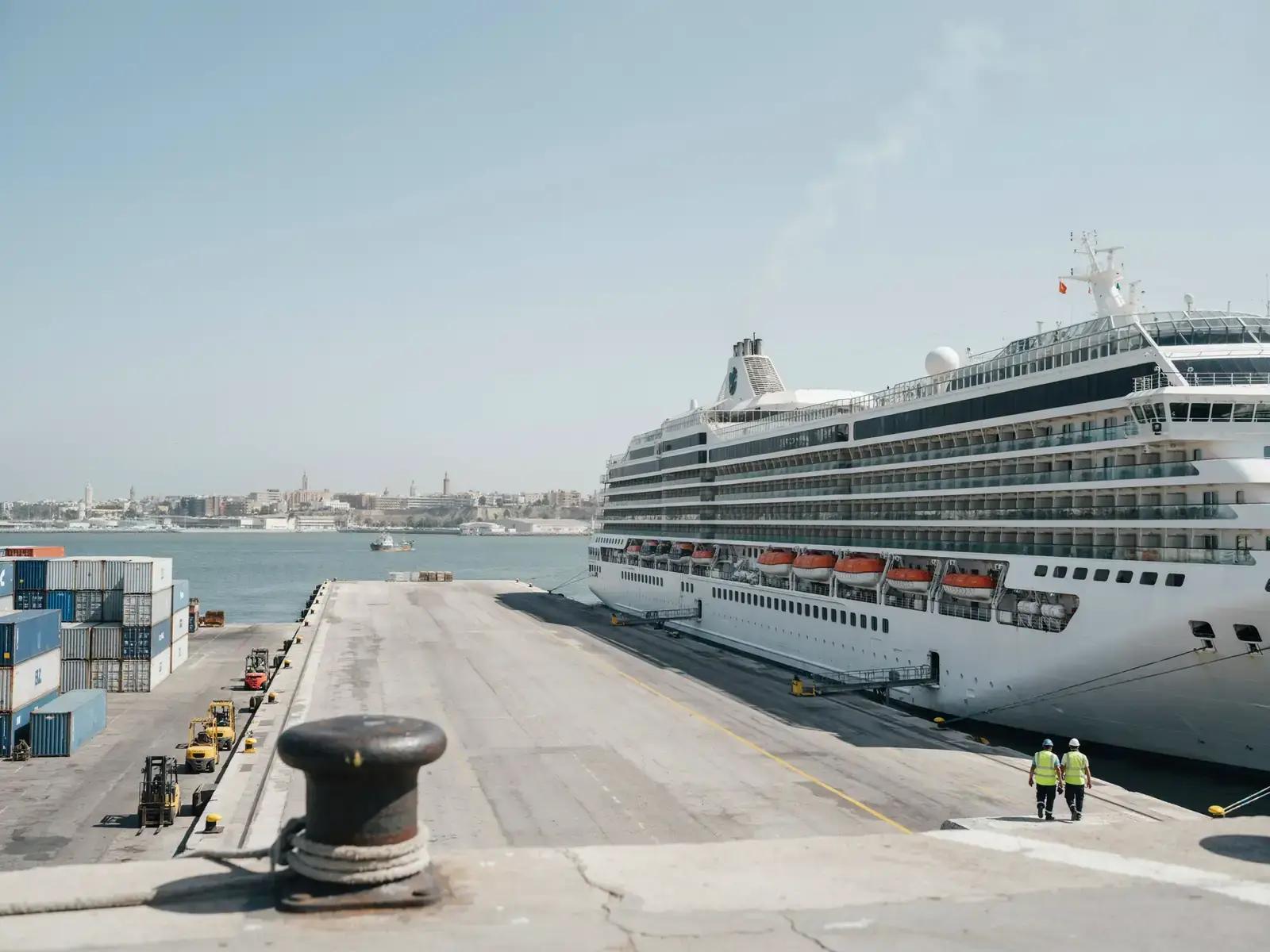
Don’t expect a shopping mall or a row of cafes at the quayside. Accounts of what’s really there don’t agree with each other, the port operator talks up retail space inside the terminal building, while independent visitors describe the older facility as a bare-bones berth with little beyond the basics.
The catch: because the terminal changed hands recently and got rebuilt, guides can’t agree on the walking distance to the exit gate, some say a few hundred metres, others say several kilometres, and nobody’s sure whether shops or a shuttle come as standard. Assume nothing is included until you’ve checked at the terminal on arrival, and keep taxi fare in cash ready regardless of what you’ve read beforehand.
Whatever gets confirmed on the day, everyone agrees on one point, there’s nothing at the dock worth detouring for. Treat it as an arrival point, full stop, and head into the city for anything you actually want.
Getting from Casablanca Cruise Port to the City
Walking is technically possible but not recommended. The route out crosses a working industrial harbour, no shade, no café to break things up, nothing much to look at, and in warm weather it’s a slog.
- Taxi: usually the cheapest way in, though taxis aren’t metered at the port gate, so agree a fare before you get in, not after.
- Official shuttle: costs more than a taxi but runs to a fixed point, dropping you at United Nations Square, opposite the Hyatt Regency Hotel and close to the Old Medina.
- Walk to Casa-Port: the ONCF station sits near the port gate, giving you direct access to Rabat and other regional stops without getting in a car.
Travel time by road into the centre generally runs between fifteen and twenty five minutes depending on traffic, and on days when more than one ship is in, expect a longer queue for taxis at the gate and a wait for a shuttle seat.
Once you’re in the city, red petits taxis are metered, cash only and limited to three passengers, while white grand taxis negotiate a flat fare for groups or longer trips. Ask for the meter to go on, or agree a price before you set off.
Casablanca’s tram network is another option for short hops around the centre, with a flat single fare payable in cash or by card at the platform machine before you board.
By Rail to Rabat and Beyond
Casa-Port station sits close to the port gate and is Casablanca’s terminus for ONCF, Morocco’s national rail operator. Trains to Rabat-Ville run roughly once an hour, take about an hour and the ticket desk takes cards.
Long-distance services toward Marrakech leave from a different station, Casa Voyageurs, not Casa-Port, so check which terminus you need before setting off. The Casablanca to Marrakech run covers around 240 kilometres and takes roughly two hours forty minutes to three hours, with several departures a day.
Hassan II Mosque: The One Sight Worth Prioritising
Built out over the Atlantic, the Hassan II Mosque is the one attraction most cruise passengers make time for, and its minaret is often the first thing you spot from the ship on the way in. The 210 metre minaret and tilework by around 10,000 artisans sit above a prayer hall that holds up to 105,000 worshippers, under a 1,100 tonne retractable cedar roof.
Non-Muslim visitors can only go inside on a guided tour, run most days at set times through the morning and afternoon, with a shorter Friday timetable that skips the midday slots. Tours last about an hour, run in several languages, and shoes come off before the prayer hall, with staff on hand to give you a bag to carry them in.
Foreign adults pay a modest entry fee for the guided tour, though the exterior grounds and sea wall are free to walk. The complex is largely wheelchair accessible, with flat courtyards and ramps or lifts through parts of the site.
Pack something you can layer for modesty, shoulders and knees covered works well inside; our cruise outfit ideas for women has options that suit both the tour and a warm walk round the medina afterwards.
Things to Do Within Reach of the Port
Walk out of the port gate onto Boulevard des Almohades and you’ll reach United Nations Square, the Old Medina and the Central Market within ten to fifteen minutes, cobbles and uneven paving included; a pair of well worn-in women’s walking shoes makes that stretch far more comfortable.
- Old Medina: narrow lanes and small stalls, the closest thing to old Casablanca within easy reach of the port.
- Central Market: fresh produce, seafood and souvenirs, a short drive from the port.
- Habous Quarter: a planned new medina from the French colonial era, known for crafts and pastries.
- Royal Palace of Casablanca: the King’s official residence in the city, viewable from the outside only.
- Morocco Mall: one of Africa’s largest shopping centres, with an aquarium and cinema, further along the coast.
Day Trips: Marrakech, Rabat or Staying Local
Most people who’ve done Morocco before put their day towards Marrakech, around 250 kilometres south, or Rabat, about 90 kilometres north, rather than spending the whole call around Casablanca itself.
- Marrakech: the most popular ship’s excursion, taking in palaces, gardens and the marketplace with its snake charmers, jugglers, acrobats and fortune tellers. Ship excursions typically bundle transport and a guide into one mid-range price.
- Rabat: closer and quicker, a reasonable independent option by taxi or by train from Casa-Port.
Casablanca is one of several stops covered in our wider guide to cruise ship ports of call in Morocco, alongside our Al Hoceima guide and our Tangier cruise ship port guide, handy if your itinerary takes in more than one Moroccan call.
Casablanca also turns up on repositioning itineraries that pair it with the Western Mediterranean or with Mediterranean cruise ports in Spain, so check your full itinerary rather than treating this as a stand-alone Atlantic call.
Planning a Cruise to Casablanca
A few decisions are worth making before you walk down the gangway, since they shape the rest of your day.
- Decide before you dock whether you’re heading to Marrakech, Rabat or staying closer to the port, since travel times rule out doing more than one.
- Check the Hassan II Mosque tour timetable for the day of your call, since Fridays run a shorter schedule with no midday tours.
- Carry cash for taxis, mosque entry and market stalls, card acceptance away from hotels and larger shops is patchy.
- Pack for plenty of walking on uneven ground if you are exploring the medina independently rather than on a ship’s excursion.
- If this is your first time pairing a call like this with a wider Mediterranean cruise, our first-time Mediterranean cruise tips cover ground that applies here too.
Safety and Local Tips in Port
Pickpocketing happens more here than in many of the Mediterranean’s busier cruise ports, particularly in crowded stretches of the medina and around the markets, and bag-snatching on busy streets is a known risk. Keep valuables close in a crowd, and an anti-theft crossbody bag with slash-resistant straps is worth considering for anything you carry ashore.
Faux guides and persistent touts work the Old Medina, offering to show you the way for a fee you never agreed to. A firm, polite no and continuing to walk usually ends the conversation.
English isn’t widely spoken outside tourist hotels and established restaurants; Arabic, Berber and French are the everyday languages. ATMs are widely available and cards are broadly accepted, but markets and taxis run on cash, and US dollars rarely get a warm welcome.
Common Questions
Where do cruise ships dock in Casablanca?
Ships dock at the Casablanca Cruise Port terminal on the Jetée Moulay Youssef, a section of the working Port of Casablanca rather than a resort-style cruise terminal.
Is there a free shuttle bus from the port?
An official shuttle sometimes runs to United Nations Square for a modest fee, but it’s not guaranteed at every call, so confirm on arrival rather than assuming it’s included.
Can I walk from the ship to the city centre?
It’s possible but not pleasant, you’re crossing an unshaded industrial port area. Most passengers take a taxi or the shuttle instead, especially in warm weather.
Do I need to book the Hassan II Mosque tour in advance?
Tours run on a fixed daily timetable rather than a booking system, though the schedule is shorter on Fridays. Aim to arrive in good time for your chosen slot.
Is Casablanca safe for cruise passengers?
Generally, yes, with sensible precautions. Pickpocketing and persistent touts are more common than in some Mediterranean ports, so keep bags secure and turn down unsolicited guides politely.
Can I visit Marrakech on a Casablanca port day?
Marrakech is around 250 kilometres away, so it’s only realistic with an early ship’s excursion or a very long independent day, and only if your ship’s schedule allows it.
What currency should I bring ashore?
Moroccan dirham in cash covers taxis, market stalls and the mosque entry fee. Euros are often accepted for taxis, but dirham works more reliably everywhere else.
Is English widely spoken in Casablanca?
Not widely outside hotels and tourist-focused restaurants. Arabic, Berber and French are the main languages, so a translation app is a useful backup.
Why Trust About2Cruise
This guide draws on official information from the port operator and Morocco’s National Ports Agency, alongside independent traveller reports on transport, transfer times and on-the-ground conditions at the terminal, cross-checked wherever accounts didn’t match up. You can read more about how we put our destination guides together on our about us page.
Last Updated: 19 October 2026