
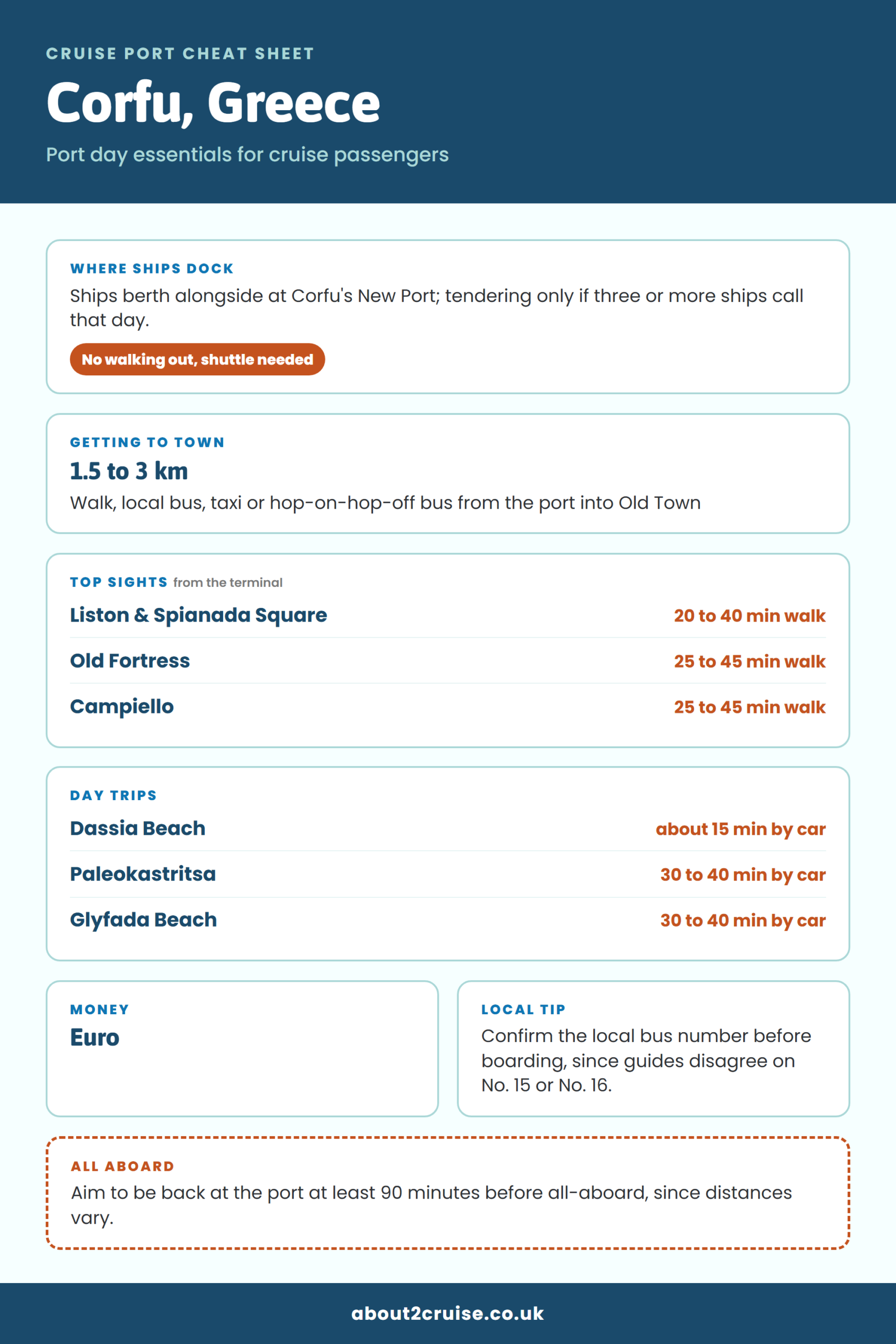
Cruise ships tie up alongside at Corfu’s New Port, Neo Limani, on the north-western edge of Corfu Town (Kerkyra to the locals), so there’s no tender involved. Old Town is a walk, a local bus, a taxi or a hop-on-hop-off ride away. The Liston arcades, the Old Fortress and the nearby beaches make it worth the effort.
Where ships dock in Corfu
Every now and then, when three or more ships turn up on the same day, one has to anchor out and tender passengers in instead, but that’s rare here compared with somewhere like Santorini.
The berths run along a long concrete breakwater, and depending on where your ship ties up, you could be looking at a 500 to 800 metre walk just to reach the terminal building.
Corfu cruise terminal facilities
The terminal building has seven check-in counters, an information kiosk and a waiting hall, and it’s built with facilities for travellers who need them.
| Facility | Details |
|---|---|
| Check-in | Seven counters |
| Information | Info kiosk on site |
| Security | X-ray screening equipment |
| Medical | First-aid clinic |
| Connectivity | Wi-Fi and public phones |
| Money | ATM on site |
| Shopping | Tax-free souvenir shop |
| Accessibility | Facilities for travellers with special needs |
Getting from Corfu cruise port to Old Town
Getting from Corfu cruise port to Old Town takes anywhere from around twenty minutes to forty, depending on which berth your ship uses that day.
The distance is somewhere between 1.5 and 3 kilometres along pavements. Plan for the longer end, especially if you need to be back aboard by a set time.
The local bus into town gets called both the No. 15 and the No. 16 in different places, so don’t trust a number printed in any guide, this one included. Check the number on the bus itself, or ask port staff before you climb aboard.
- Walk: mostly flat, on paved roads and pavements, but once you’re in Old Town itself the cobblestones turn uneven and partly stepped, especially around Liston.
- Local bus: runs frequently from inside the port to the edge of Old Town, near the New Fortress, and the fare is small.
- Hop-on-hop-off bus: City Sightseeing’s meeting point is Corfu New Port’s main gate, about 350 metres from the terminal building. There are 11 stops split across the Kanoni Route, which runs along the southern coast past Mouse Island, and the Achilleion Line, which runs inland through olive groves to Gastouri and Achilleion Palace. Only the Kanoni Route operates when a cruise ship is in port, so the Achilleion Line isn’t an option on a call day.
- Taxi: taxis wait right outside the terminal building, so there’s no hunting around for one.
- Port shuttle: a free shuttle runs within the port between the pier and the terminal building, but nothing’s guaranteed free all the way into town. Some cruise lines run a paid shuttle instead.
What to eat in Corfu
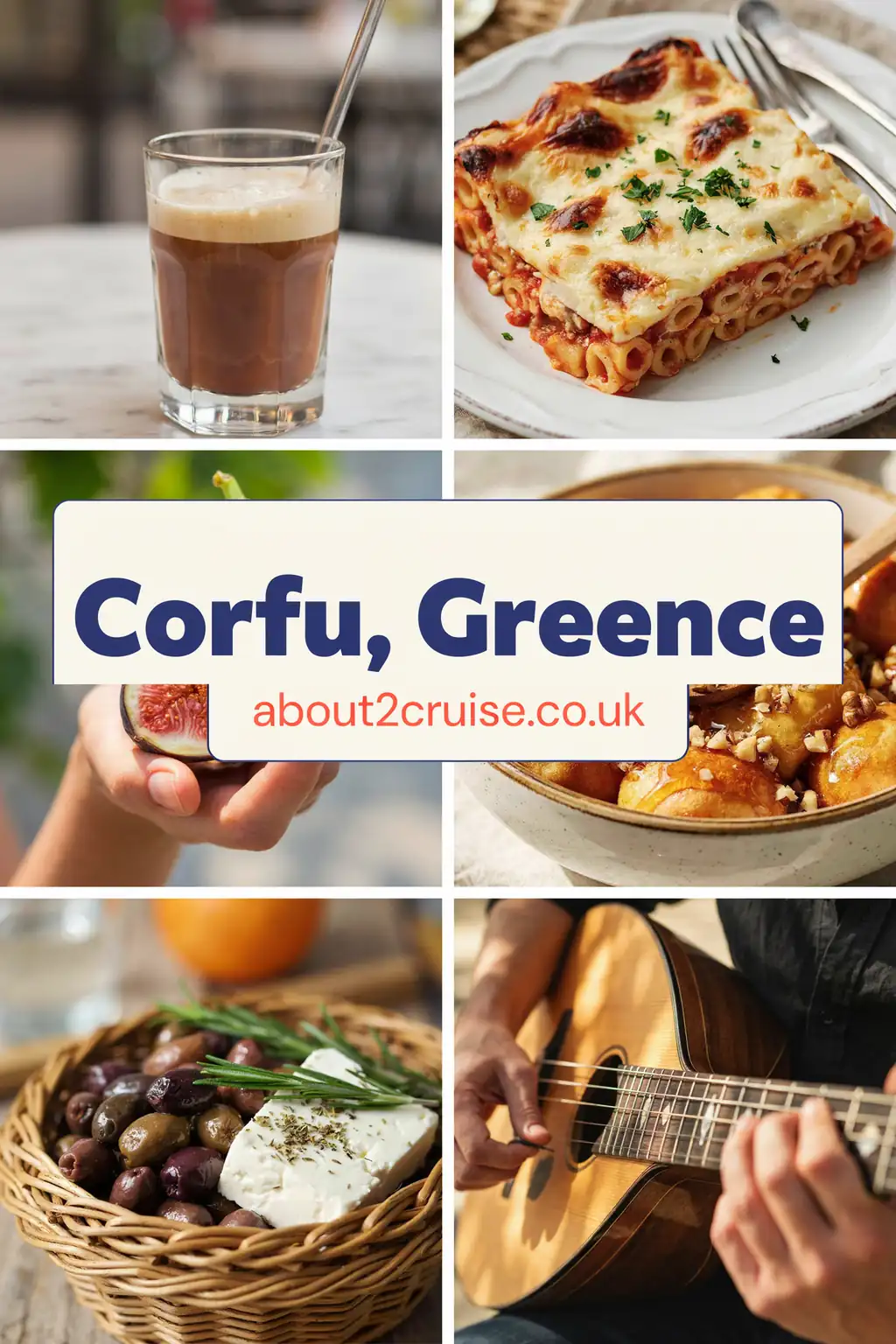
The best introduction to Corfiot food is around Liston and Spianada Square in Old Town, a walk from the port, where the arcaded cafes and bakeries do everything from breakfast staples to heartier island dishes.

- Koulouri, pies and bougatsa: sesame bread rings, spinach or cheese pies, and custard-filled bougatsa pastry are the classic way to start a morning near Liston, usually with a traditionally brewed Greek coffee on the side.
- Tzitzibira (ginger beer): a lemon, sugar and ginger drink the British brought to the island, still the most popular refreshment in Corfu and sold all over Old Town.
- Pastitsada, sofrito and savoro: Corfiot mains shaped by Venetian, French and Sicilian influence, found on menus throughout the Old Town.
- Kumquat treats: kumquat liqueur, marmalade and spoon sweets are sold in shops across Old Town and make a souvenir that’s properly Corfiot rather than generic.
Noumboulo Foumikado, a marinated and smoked pork fillet cured with local herbs, is a cold meat unique to the island and worth tracking down at a deli counter in Old Town.
What to wear in Corfu: outfit ideas for a port day
What to wear in Corfu depends on whether the plan is churches and cobbles in Old Town or a dip at one of the small coves near the port.


- Comfortable flat walking shoes work better than sandals or heels, for women and men alike.
- St Spyridon Church, like most churches on the island, expects shoulders and legs below the knee covered, so pack a light layer even on a warm day.
- Small coves near the port are rocky underfoot, so swim shoes are worth packing if swimming is on the plan, and a hat and sun protection help for the exposed walk up to the Old Fortress.
Need more ideas? Take a look at these casual cruise outfit ideas for women and cruise outfit ideas for men.
Best photo spots in Corfu
The best photo spots in Corfu sit within Old Town itself and along the coast just south of the port, all reachable on a port day without a car.
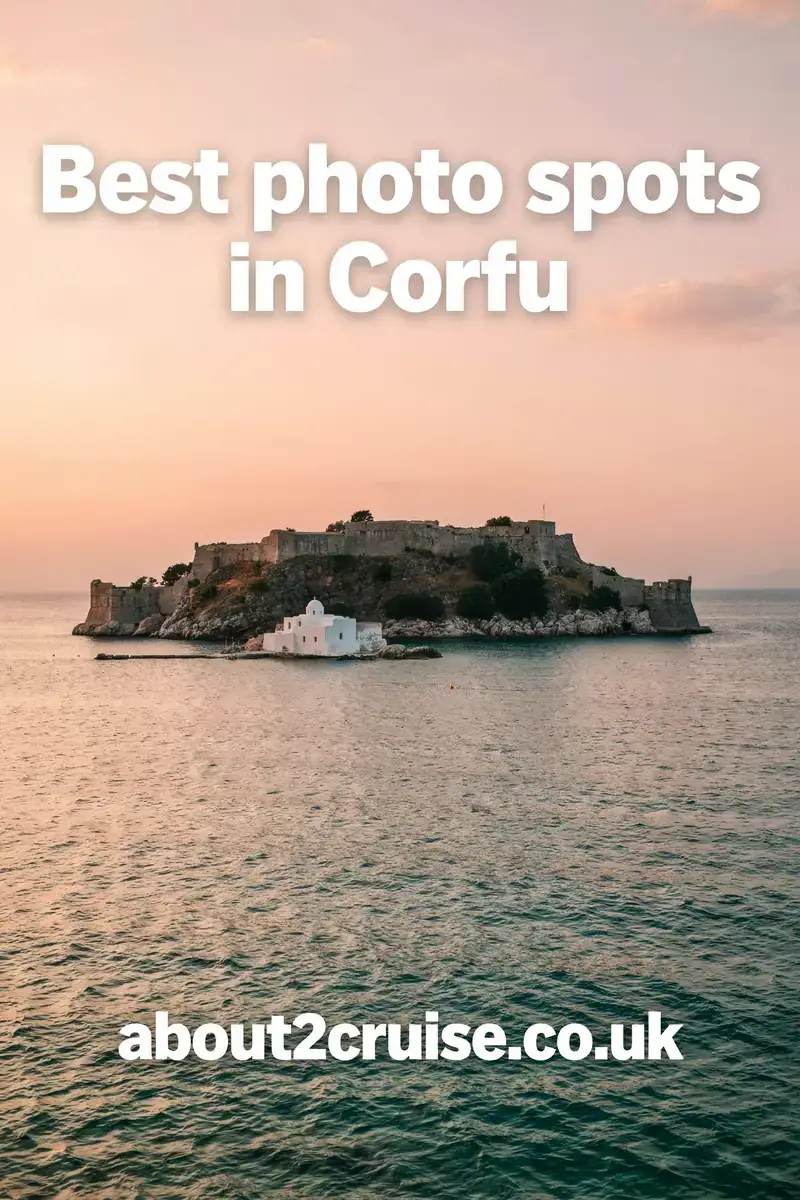
- Kanoni: the view down to the chalk-white Vlacherna Monastery and the emerald dot of Pontikonisi, known as Mouse Island, is calm at first light and cinematic at golden hour.
- The Old Fortress: sunset brings panoramic views across the Ionian Sea and the UNESCO-listed Old Town below.
- Faliraki: this small bay offers the best angle on the Old Fortress, shot against its walls and the sea.
- Campiello: the oldest quarter of Old Town, with narrow lanes, washing lines, tiny shrines and hand-painted nameplates, good for street photography any time of day.
Beaches near Corfu cruise port
The nearest beaches to Corfu cruise port are right in Old Town itself, though they’re smaller and less equipped than beaches elsewhere on the island.
Faliraki, Spilia and Mon Repos are the three in-town options. Faliraki is small, narrow and pebbly, with a good view of the Old Fortress and no actual sand, just stone platforms and ladders for getting into the water, so pack water shoes.
For a proper beach, Dassia is around 15 minutes’ drive away. Paleokastritsa and Glyfada are more scenic again, at around 30 to 40 minutes by car; a private shore excursion covering Paleokastritsa and Old Town covers both without the hassle of arranging a car.
How to spend a port day in Corfu
A port day in Corfu works best if you pick one: a slow wander through Old Town’s Liston and Old Fortress, or that plus an afternoon at Paleokastritsa.
Before you sail
- Book a private Paleokastritsa and Old Town shore excursion if planning the longer day.
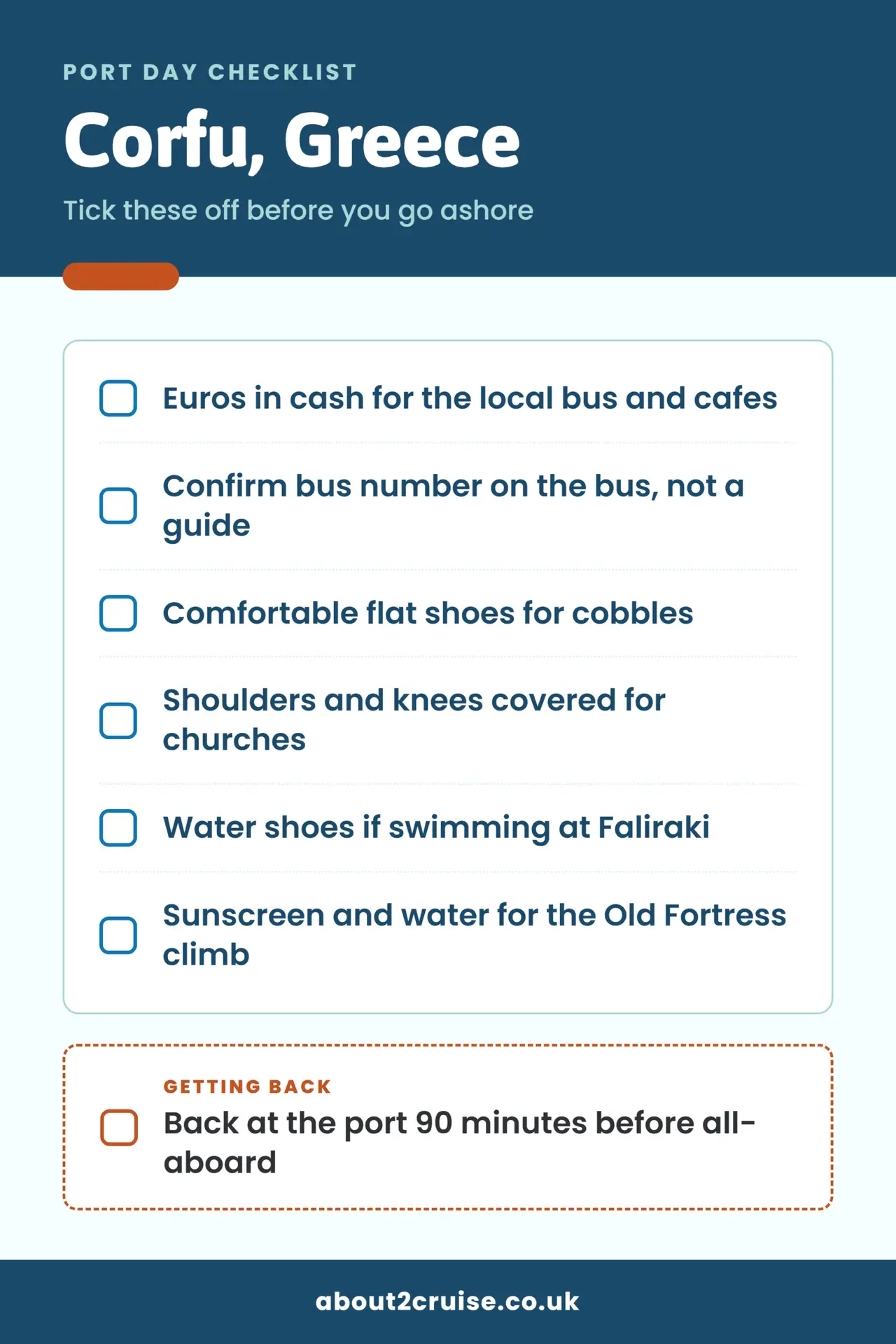
- Pack a light layer for shoulders and knees for church visits.
- Bring euros in cash for the local bus and small cafes.
Short port day: under 6 hours
- On dockingWalk or bus into Old TownConfirm bus numberA 20 to 40 minute walk along pavements, or the local bus from inside the port; check the number on the bus first.
- +45 minListon arcades & Spianada SquareBrowse the arcaded cafes and bakeries in Old Town's main square, a 20 to 40 minute walk from the port.
- +1 hr 15 minOld Fortress climbWater & sun creamA short walk from Liston; climb the ramps and stairs for sea views over Old Town, with little shade at the top.
- +2 hr 15 minFaliraki cove dipPack water shoesA short walk from the Old Fortress; rocky entry with ladders rather than sand, so water shoes help.
- +3 hrLunch at ListonTry pastitsadaOrder pastitsada or sofrito at a cafe under the arcades on the way back through Old Town, Corfu's classic Venetian influenced dishes.
- All-aboard minus 1 hrBack at the portWalk back or catch the local bus near the New Fortress; allow extra time if queues build.
The time on the map is the whole walk, every stop added together.
Open this walking route in Google Maps
If plans change: If the bus number is unclear or queues build, walk or take a taxi instead; both get you back in good time.
Long port day: 8 hours or more
- On dockingWalk or bus into Old TownConfirm bus numberA 20 to 40 minute walk along pavements, or the local bus from inside the port; check the number on the bus before boarding.
- +45 minListon arcades & Spianada SquareBrowse the arcaded cafes in Old Town's social heart, a 20 to 40 minute walk from the port.
- +1 hr 15 minOld Fortress climbWater & sun creamClimb the ramps and stairs for sea views over Old Town and little shade at the top, so bring both.
- +2 hrLunch at ListonTry pastitsadaOrder pastitsada or sofrito at a cafe under the arcades, Corfu's Venetian and Sicilian influenced classics.
- +2 hr 45 minTaxi to PaleokastritsaBook aheadA 30 to 40 minute drive along the coast; a private shore excursion covers this without arranging a car.
- +3 hrs 30 minPaleokastritsa MonasteryFree shawls are handed out at the entrance if your shoulders or legs aren't covered.
- +4 hrs 15 minAfternoon at Paleokastritsa baySwim or relax by the scenic bay below the monastery before the drive back.
The times on the map are for the whole journey there by train and bus.
Get train and bus times in Google Maps
If plans change: If a taxi or excursion to Paleokastritsa isn't available, stay in Old Town and swim at Faliraki instead.
Common Questions
What times does the Kanoni Route hop-on-hop-off bus run in Corfu?
The Kanoni Route runs roughly every 15 to 20 minutes, operating from around 9am to 5pm for most of the year and until 6pm during the busiest summer months.
Does Paleokastritsa Monastery provide cover-ups for visitors?
Paleokastritsa Monastery provides a free shawl at the entrance for anyone whose shoulders or legs aren’t already covered, though modest dress is still preferred.
What does the duty-free shop at Corfu cruise terminal sell?
The duty-free shop at the cruise terminal sells local products including Koum Quat liqueur and olive oil, alongside the usual tax-free souvenirs.
Is there much walking and climbing at the Old Fortress?
The Old Fortress involves a lot of walking, ramps and stairs over mainly uneven cobblestones, with little shade at the top, so sunscreen and water are worth carrying.
Can wheelchairs or pushchairs manage Corfu Old Town’s cobblestones?
Wheelchairs and pushchairs struggle on Old Town’s cobblestones, which are uneven and partly stepped in places, particularly around Liston.
Last Updated: 13 October 2026