
Cowes is a walk-ashore tender port on the Isle of Wight’s sailing coast. Ships anchor in Cowes Roads and land at Trinity Landing on The Parade, right beside the High Street and Royal Yacht Squadron. Most cruisers use the call for Osborne House, the seafront, yachting history or Cowes Week atmosphere. The Floating Bridge links West and East Cowes.
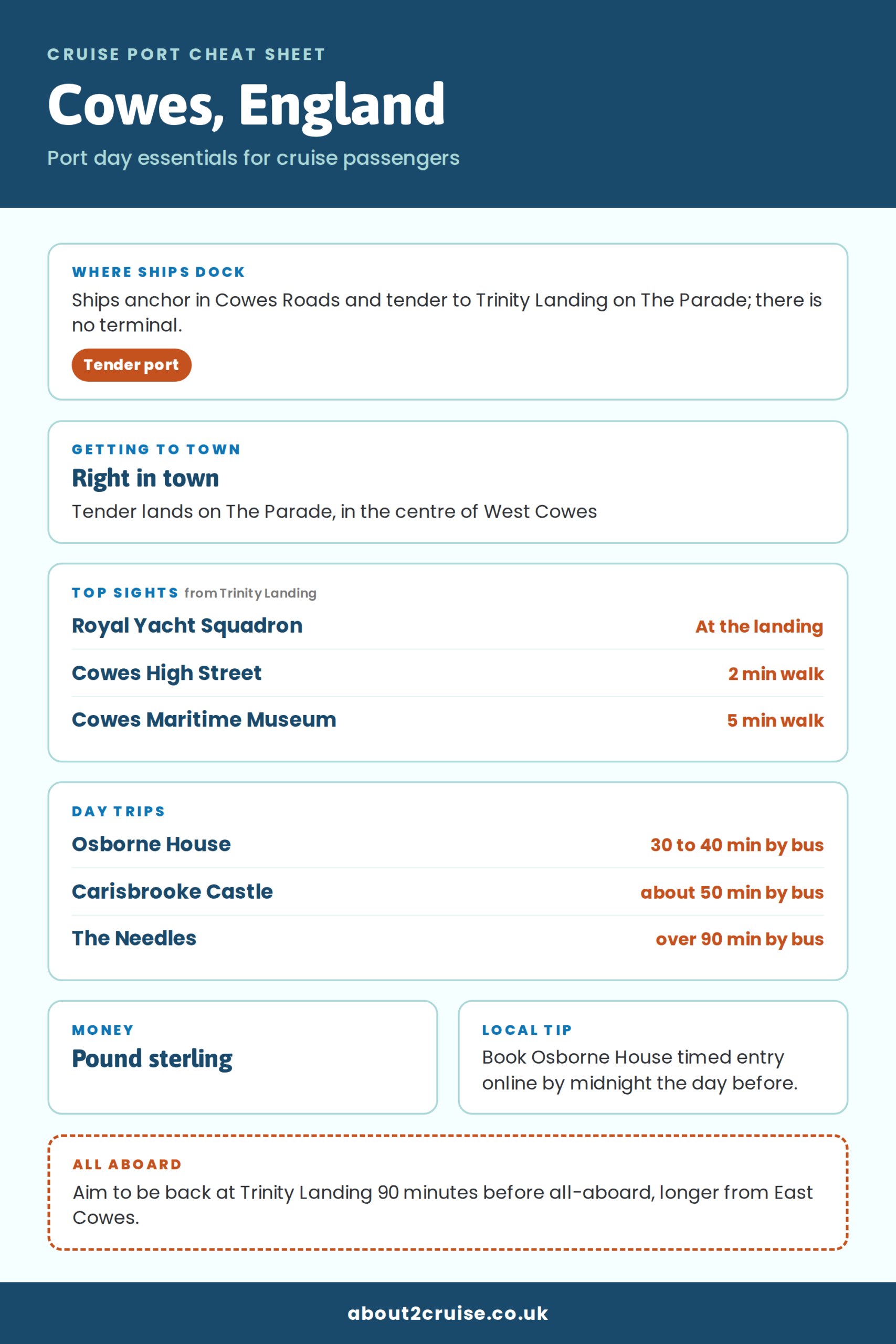
Quick Reference for Your Cowes Port Day
- Tender drop: Trinity Landing, The Parade.
- Tender ride: 5–15 minutes depending on anchorage.
- Last tender: announced by your ship; there is no harbour-set time.
- Nearest toilets: The Parade, Mornington Road, Medina Road.
- Money: GBP; contactless widely accepted; ATMs in town.
- Top sight: Osborne House in East Cowes.
- Best free walk: Cowes seafront to Gurnard.
- Wi-Fi: Cowes Library on Beckford Road.
- Floating Bridge foot fare: £1 single, £1.50 return.
Cowes cruise port map
Tenders bring you ashore at Trinity Landing. From there, Royal Yacht Squadron is about a 2-minute walk, Sir Max Aitken Museum about 5 minutes and Cowes High Street about 6 minutes. Tap a pin for directions.
- Trinity LandingWhere tenders land
- Royal Yacht SquadronYacht club · About 2 min walk from Trinity Landing
- Sir Max Aitken MuseumMuseum · About 5 min walk from Trinity Landing
- Cowes High StreetShopping street · About 6 min walk from Trinity Landing
- Cowes Maritime MuseumMaritime museum · About 12 min walk from Trinity Landing
- Osborne HouseRoyal seaside home · About 2 km from Trinity Landing
- Carisbrooke CastleNorman castle · About 9 km from Trinity Landing
- Gurnard BeachBeach · About 2 km from Trinity Landing
- The NeedlesAbout 24 km from Trinity Landing
Why Cruise Ships Call at Cowes
Cowes is not a big-ship industrial port. It is a yachting town, and that is exactly why small-ship cruise passengers tend to like it. You step off the tender into a working sailing scene, not a commercial quayside. The Royal Yacht Squadron has been based in Henry VIII’s Cowes Castle since 1815, and the schooner America won the 1851 race around the Isle of Wight that gave the America’s Cup its name. Add Queen Victoria’s Osborne House, the West Cowes versus East Cowes split and a serious maritime past, and Cowes has much more depth than a quick glance suggests.
Where Ships Anchor and Where You Actually Land
Cowes has no cruise quay and no terminal building. Ships anchor in Cowes Roads or the commercial ABP anchorage and bring passengers ashore by tender to Trinity Landing, a 100-metre pontoon on The Parade. The harbour now accepts cruise vessels up to 211 metres, with weather limitations and compulsory pilotage. The largest cruise ship to call so far is Europa.
- Smaller ships up to 150 m: use the C1 anchorage about 0.5 nm away, roughly a 5-minute tender run.
- Larger ships: use the ABP anchorage up to 1.5 nm away, roughly a 10–15-minute tender run.
- Landing point: Trinity Landing opens directly onto The Parade in West Cowes.
- Facilities at the landing: there is no terminal, no waiting lounge and no baggage area. Toilets and town services are a short walk away.
- Security: the landing becomes a temporary restricted ISPS area while ship tendering is active.
The big advantage is that you are already in town when you step ashore. There is no need for a shuttle bus to reach the shops, pubs or seafront.
Tender Timing and the Last Boat Deadline
Your ship, not the harbour, sets the last-tender time. There is no single published Cowes tender timetable, so check the daily programme or the port talk carefully. The ship will also explain where to queue at Trinity Landing.
As a rule of thumb, work backwards from the all-aboard time:
- Inner anchorage tender ride: about 5 minutes.
- Outer anchorage tender ride: about 10–15 minutes.
- Allow for a tender queue at busy return times.
- If you are on the East Cowes or Osborne House side, add the Floating Bridge crossing and any wait, typically 15–25 minutes in total.
If your all-aboard is 4.30pm and you are at Osborne House, leaving Osborne around 3.10–3.15pm is a sensible target in summer. If you are just in West Cowes, you can be far more relaxed, but do not arrive at the pontoon exactly at the last possible minute. Tender access is not guaranteed step-free from every ship, so mobility assistance should be arranged in advance.
Ship Excursion or Independent Day Ashore?
The ship’s Osborne House excursion is convenient. It typically runs about four and a half hours, costs around $160 per person, includes about two and a half hours of walking and is rated moderate. It is not advisable for wheelchair users because mobility devices cannot go on the excursion transport.
Before you sail
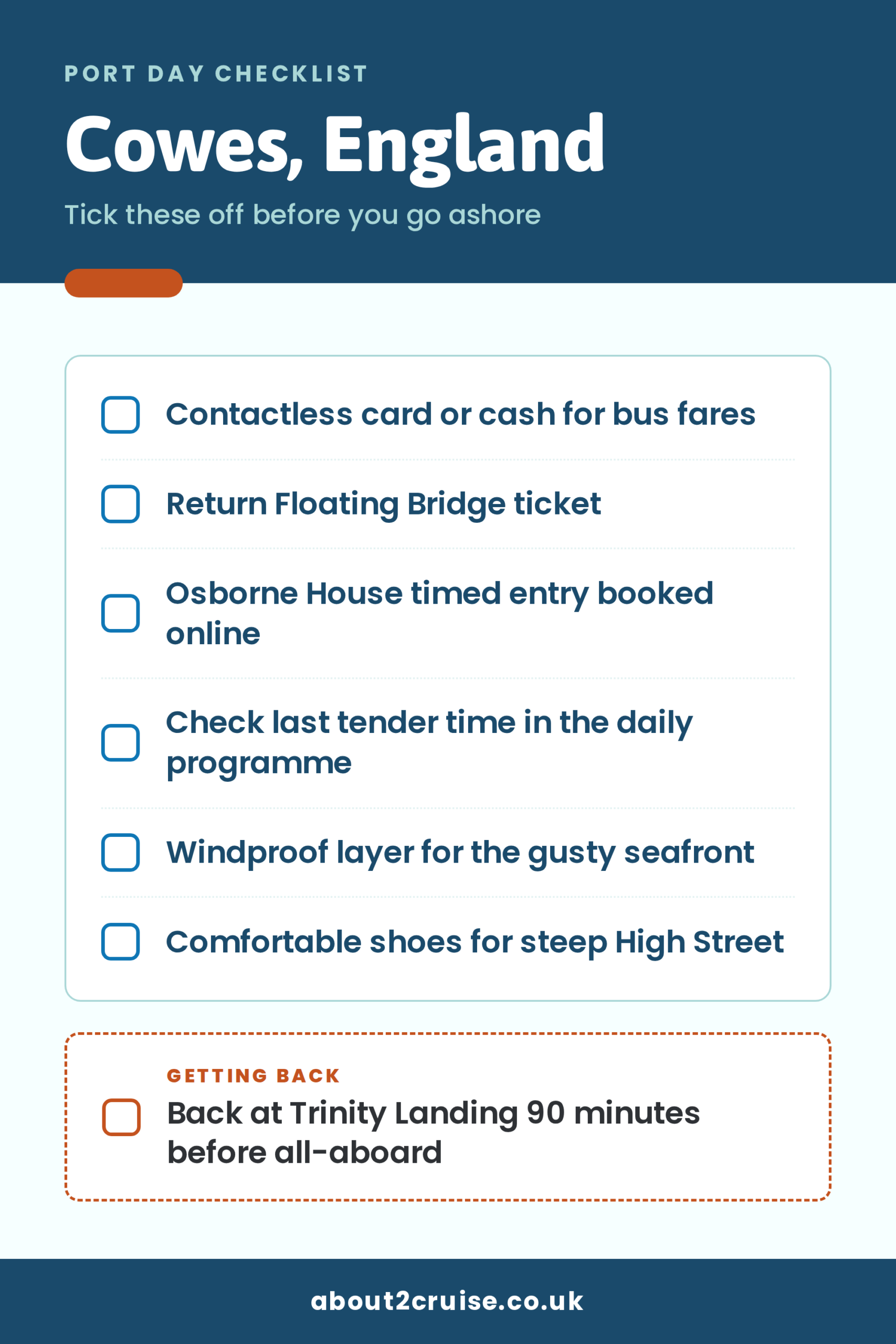
- Book Osborne House timed entry online by midnight the day before for the cheaper advance rate.
- Check your ship's last-tender time in the daily programme before going ashore.
- Bring a contactless card or cash; buses and cafes accept both.
Short port day: under 6 hours
- On dockingTender to Trinity LandingWalk-ashore tenderThe tender lands on The Parade, right beside the Royal Yacht Squadron. The ride is 5 to 15 minutes.
- +15 minRoyal Yacht SquadronHenry VIII's Cowes Castle and the start line of Cowes Week, one minute from the landing.
- +30 minCowes High StreetIndependent shops, chandlers, galleries and cafes run just behind the waterfront.
- +1 hr 15 minCowes Maritime MuseumFree museum in Cowes Library on Beckford Road with the J. Samuel White collection.
- +2 hrsLunch near the High StreetTry Solent crabOrder local crab, lobster or fresh Solent fish at a cafe or pub around The Parade and High Street.
- +3 hrs 30 minSeafront walk to GurnardWalk the flat 2.8 km path past Princes Green and Egypt Point; turn back at Gurnard.
- All-aboard minus 1 hrBack at Trinity LandingBe at the pontoon before the last-tender queue builds.
The time on the map is the whole walk, every stop added together.
Open this walking route in Google Maps
If plans change: If the small museums are shut, the High Street cafes and shops, plus the seafront walk to Gurnard, still fill a short call.
Long port day: 8 hours or more
- On dockingTender to Trinity LandingCheck return timeLand on The Parade and note the ship's last-tender time before you head to East Cowes.
- +15 minTravel to Osborne HouseCheck bridge firstWalk 12 minutes to the Floating Bridge, cross, then route 5 or taxi to Osborne. Allow 30 to 40 minutes.
- +1 hr 15 minOsborne House state roomsBook aheadBook a timed slot online by midnight the day before. The slot is arrival only.
- +2 hrs 30 minSwiss Cottage, private beach and gardensSensible shoesExplore the Swiss Cottage, Queen Victoria's private beach and terraced gardens.
- +4 hrs 30 minLunch at Osborne cafeTry local produceOrder a crab sandwich or Isle of Wight tomato salad in the Osborne cafe or picnic area.
- +5 hrs 30 minReturn to West Cowes for High StreetBus or taxi back, cross the Floating Bridge, then stretch your legs along the High Street.
- All-aboard minus 90 minBack at Trinity LandingAllow for the tender queue and be at the pontoon before the final tender.
The times on the map are for the whole journey there by train and bus.
Get train and bus times in Google Maps
If plans change: If Osborne House timed slots are sold out or route 5 is delayed, use the town maritime museums and the Gurnard seafront walk, or join the ship's Osborne excursion.
Independent travel is significantly cheaper. For Osborne House you would pay roughly £3 return on the Floating Bridge, up to £3 each way on the bus, and about £22–£27 advance entry. That is roughly £31–£36 per person instead of $160. The trade-off is planning: you need to book a timed entry slot, cross the Floating Bridge and catch the route 5 bus or a taxi. For confident independent travellers, Cowes is straightforward.
Shore-side operators, including RIB trips towards The Needles, also meet cruise guests at the Trinity Landing tender pontoons.
Osborne House: The Headline Sight
Osborne House is the stand-out excursion for most cruise passengers. It was Queen Victoria and Prince Albert’s seaside home, built in the mid-19th century, and Victoria died there in 1901. The house is in East Cowes at York Avenue PO32 6JX, about a mile south-east of the East Cowes ferry terminal.
From West Cowes, the practical route is: tender ashore at Trinity Landing, walk to the Floating Bridge, cross to East Cowes, then catch Southern Vectis route 5 from East Cowes or the terminal area. Route 5 runs roughly every 15–20 minutes and stops at Osborne House. The whole trip usually takes 30–40 minutes each way, longer if the bridge is busy. A taxi is a good alternative for two or more people.
- Opening: daily 10am–5pm, last entry 4pm.
- Tickets: book a timed slot online by midnight the day before for the cheaper advance rate. The slot is for arrival, not departure, so you can stay as long as you like inside opening hours.
- Advance adult price: about £22.10–£27.20 with donation; on-the-day prices are higher.
- Travel discount: arriving by bus, train or bike can earn 20% off entry, but only on tickets bought at the site on the day. Weigh that against booking a guaranteed timed slot online.
- Grounds: Queen Victoria’s private beach, the Swiss Cottage, terraced gardens, cafés, picnic areas and two play areas.
Inside the house, expect Victoria and Albert’s state rooms and family rooms, with 31 steps to the first floor and a lift usually available. Paths outside are gravel, concrete and tarmac and can turn muddy, so footwear matters more than dress code. Manual wheelchairs can be borrowed; mobility scooters are restricted to the ground floor. There is usually a free accessibility minibus from April to November, but not between 1pm and 2pm.
If Osborne is your priority, do not try to combine it with Carisbrooke Castle on a short call. Give Osborne three to four hours on site plus the return travel.
Carisbrooke Castle and Newport
Carisbrooke Castle is a good half-day alternative if you want a Norman castle, donkeys, walls and a quieter historic site. It is at Castle Hill, Newport PO30 1XY, about one and a quarter miles south-west of Newport.
- Opening: daily 10am–5pm, last entry 4pm.
- Advance adult price: about £13.60–£17.00 with donation; on-the-day prices are higher.
- Travel from Cowes: Southern Vectis route 1 runs from Cowes to Newport roughly every 7–10 minutes during the day, taking about 20 minutes. From Newport, routes 6, 7, 12 and 38 stop near the castle.
Newport itself is the island’s bus hub and has the usual high-street shops and cafés, but it is more functional than picture-postcard. The castle is the real draw.
The Needles, Yarmouth and Western Isle of Wight
The Needles and Alum Bay are famous, but they are a real time commitment from Cowes. Use Newport as the bus hub: route 7 runs from Newport to Alum Bay. An open-top Breezer runs between Yarmouth and Alum Bay up to every 30 minutes in season. Standard rover tickets are not valid on the Needles or Downs Breezers, so you would need a Rover plus Breezer if you go that way.
The Needles is more relaxed as a long shore excursion or RIB trip from Cowes than as a rushed independent bus day. If you have eight hours or more ashore and want the western island, it is possible, but check return buses carefully.
Ryde, Sandown and East-Island Beaches for Longer Calls
If your port call is long and you want a traditional seaside day rather than yachting history, head east. Route 9 links Newport and Ryde, and the east coast has the more obvious sandy beach towns such as Ryde and Sandown. These are not quick trips from Cowes because you first have to get from West Cowes to Newport by route 1, then change.
For a typical 8–10 hour call, the east coast is only worth it if you really want beach time. For a short call, stay in Cowes or choose Osborne House.
Cowes Week and the Sailing Calendar
Cowes Week is the world’s oldest and largest annual sailing regatta of its type. It runs from Saturday to Friday in the first week of August, with racing starting from the Royal Yacht Squadron line outside Cowes Castle. Some editions have brought more than 630 yachts and over 5,000 crew, with 60,000 people expected in Cowes.
Races generally start at 10am or 10.30am. The Regatta Village on Cowes Parade and the Esplanade towards Egypt Point are excellent vantage points. Spectator boat trips run up to three times a day and are booked online in advance.
During Cowes Week there are temporary traffic restrictions. The Parade is closed to vehicle access between 10am and 6am daily. Parking in Cowes becomes extremely tight and advance booking is essential if you are bringing a car over. The Floating Bridge usually runs extended hours and becomes pedestrian-only during the fireworks.
So is Cowes Week a good or bad time to visit? It is both. The atmosphere is unmatched if you love sailing, but the town is crowded, buses are busier, restaurants are full and pavements are packed. If your cruise deliberately calls during Cowes Week, treat it as the attraction. If you wanted quiet museums and a gentle seafront walk, another date would feel calmer.
Also worth knowing: the Round the Island Race, with over 1,000 boats, starts and finishes at Cowes on a Saturday in mid-July. It is free to watch from the shore, but the town is busy.
West Cowes vs East Cowes and the Floating Bridge
The River Medina divides Cowes in two. West Cowes is the sailing town with The Parade, the Royal Yacht Squadron, the High Street shops, pubs and galleries. East Cowes is quieter, historically more industrial, and is where you find Osborne House and the Red Funnel vehicle ferry terminal.
The Floating Bridge is the quick link between the two. It runs every 10–15 minutes, about 18 hours a day, 365 days a year. Foot passenger fares are £1 single or £1.50 return. Cars and small vans pay £3. The crossing is short, but the walk to the bridge from the West Cowes ferry terminal takes about 12 minutes, and from the East Cowes side it is only a couple of minutes to the terminal, so allow at least 15–20 minutes door to door.
If the Floating Bridge is suspended, a replacement foot passenger launch runs for much of the day. However, it is not suitable for people with limited mobility; the crew can arrange an accessible taxi instead. During Cowes Week the bridge often runs extended hours.
Without the Floating Bridge, the road alternative between West and East Cowes goes inland via Newport and is significantly longer. Do not assume you can simply hop across the river on foot unless the bridge or launch is running.
Maritime History, Shipbuilding and Sailing Museums
Cowes has a serious shipbuilding past. J. Samuel White’s yard moved to Cowes in 1802 and built frigates and other vessels for the Royal Navy. East Cowes later became home to Saunders-Roe, which built flying boats, the Black Knight and Black Arrow rockets, and the SR.N1 hovercraft. That inventive industrial history explains why East Cowes feels more workaday than the yachting west bank.
The best indoor heritage stops are small but worthwhile:
- Cowes Maritime Museum: free, inside Cowes Library on Beckford Road. It holds the J. Samuel White collection of plans, photographs and models. Opening is limited, so check locally.
- Sir Max Aitken Museum: free, at 83 High Street, open May to September.
- Classic Boat Museum: adult £10, under-17s free, family £20, open Tuesday to Friday 11am–3pm, closed Saturday to Monday and closed in winter. There are no toilets on site. Dogs on leads are welcome.
What to Do in Cowes Without an Excursion
You can walk off the tender and have a genuinely good local day without any pre-planned excursion. West Cowes High Street runs parallel to the water and is packed with independent shops, chandlers, galleries and cafés. The Parade, Princes Green and the seafront promenade are all immediately walkable.
- Explore the High Street and waterfront lanes.
- Visit one of the free maritime museums.
- Walk the flat seafront path towards Gurnard, about 2.8 km each way.
- Sit on Princes Green and watch the Solent shipping and yachts.
- Browse the classic boats or join a short RIB trip from the landing area.
- Hire an e-bike or e-scooter if you want to go further; riders must be 18 or over and a driving licence is needed for scooters.
Cowes beach is pebble and shingle below Princes Green. It is better for watching boats than for a beach day, and there are no lifeguards. The bathing water rating is Excellent, but the beach drops into deep water with strong tidal streams off Egypt Point.
Short Walks, Seafront and Photo Spots
The classic short walk is Cowes to Gurnard: 2.8 km, flat, about 40 minutes. You leave The Parade past Cowes Castle and Princes Green, continue round Egypt Point, and reach Gurnard’s green-painted beach huts. The path is suitable for wheelchairs and pushchairs, though there is no step-free access onto the shingle beach itself.
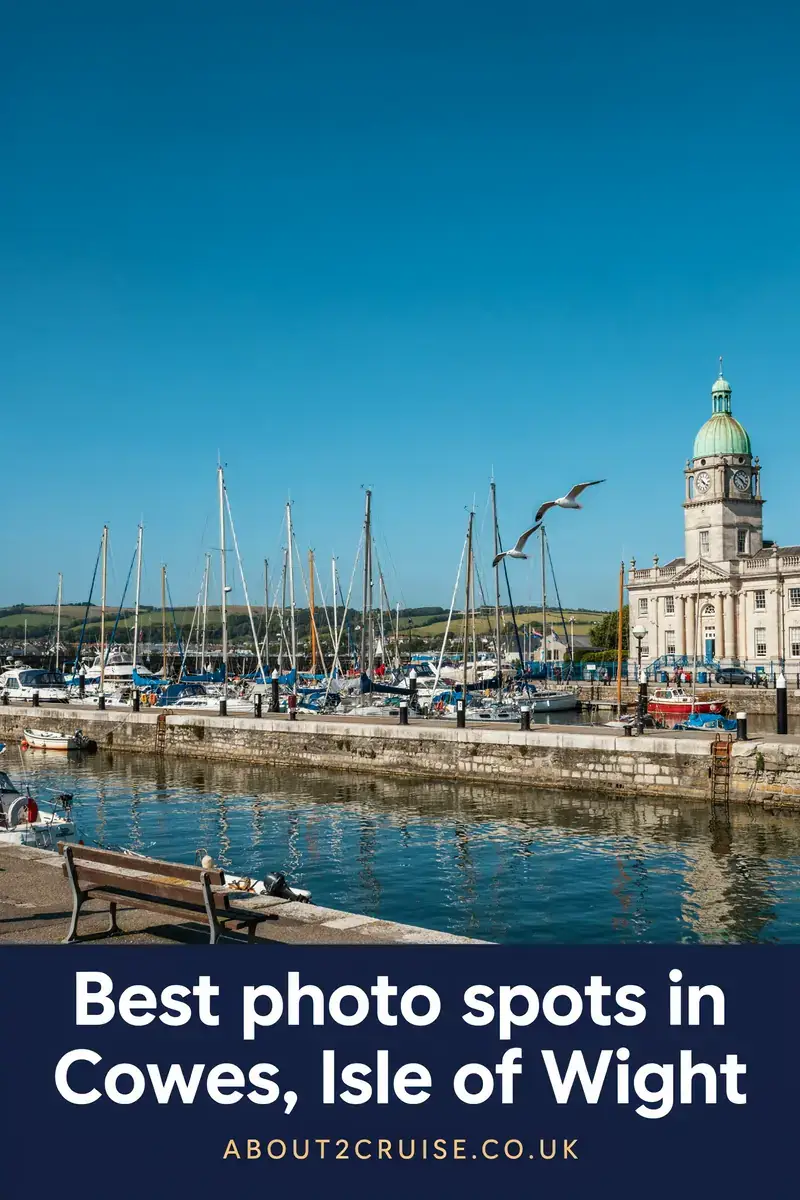
Good photo spots include:
- Princes Green and Cowes beach, looking straight at the Royal Yacht Squadron castle and the harbour entrance.
- The Parade and Regatta Village during Cowes Week, ideally before the 10am or 10.30am starts.
- Gurnard beach and its green beach huts, especially around sunset.
- Northwood Park, above the town, for a wider view.
Food, Pubs and Independent Shops Near the Landing
Cowes is one of the Isle of Wight’s seafood centres. Expect crab, lobster and fresh Solent fish on local menus. The island’s best-known produce includes Isle of Wight tomatoes, garlic, cheese, Mermaid Gin and local ales. In West Cowes, the High Street, The Parade and the streets between them hold the pubs, cafés and restaurants, many with live music in summer. There is also a beach shop and takeaway café at the western end of Princes Parade and a snack bar on Princes Green.
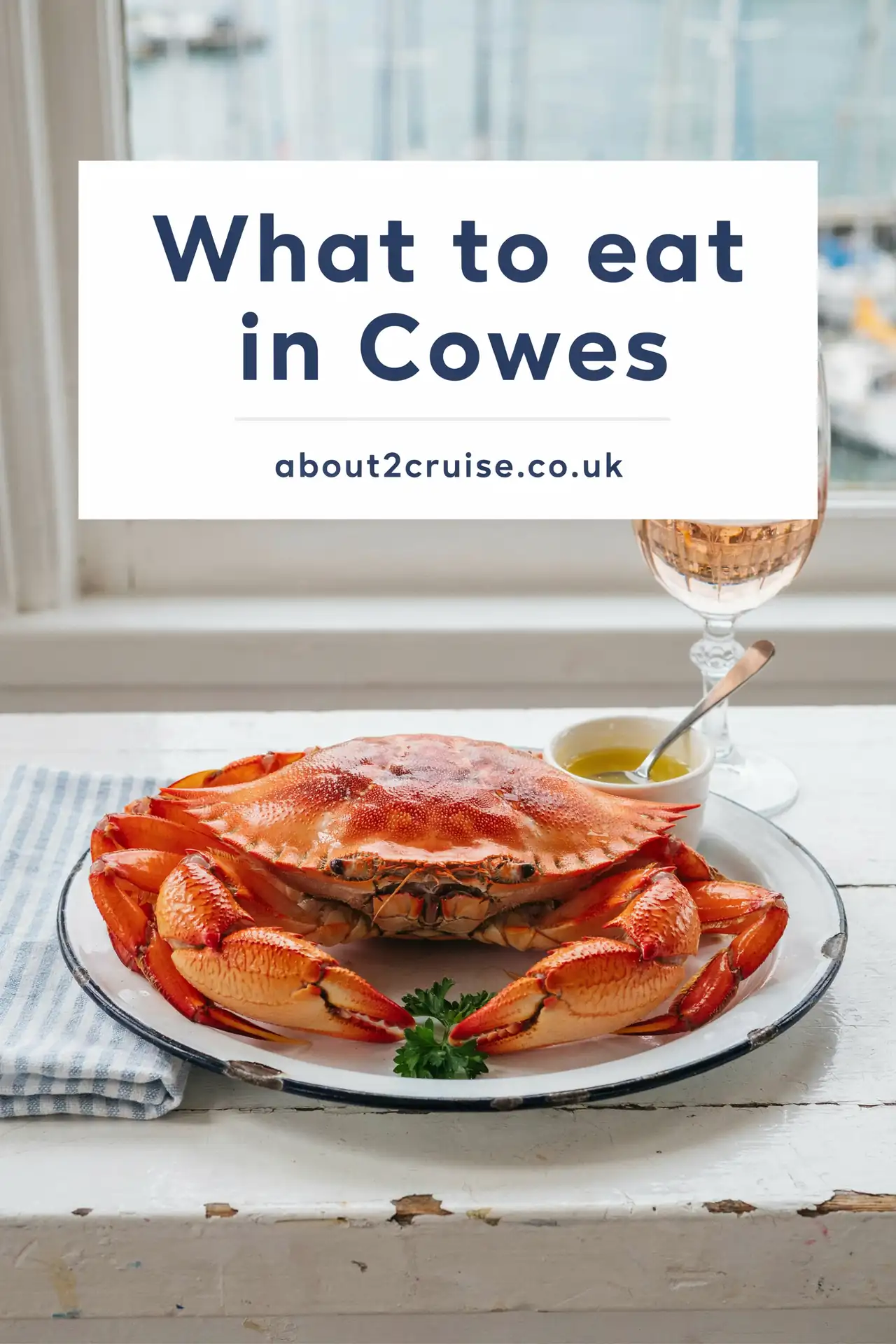
If you want a quick local lunch rather than a long restaurant meal, the High Street delis and cafés are the easiest option. For something stronger, look for the island’s garlic and tomato products in local shops.
Weather, Tides and What to Wear
Cowes sits on the Isle of Wight’s sheltered north shore, but the seafront promenade is exposed and gusty. Long-term island averages are around 19.4°C in July, 19.9°C in August, 18.4°C in September and 15.4°C in October. August averages about 7.8 rain days and a mean wind around 11 knots. October is wetter, with roughly 11.8 rain days. The prevailing wind is west-south-westerly.

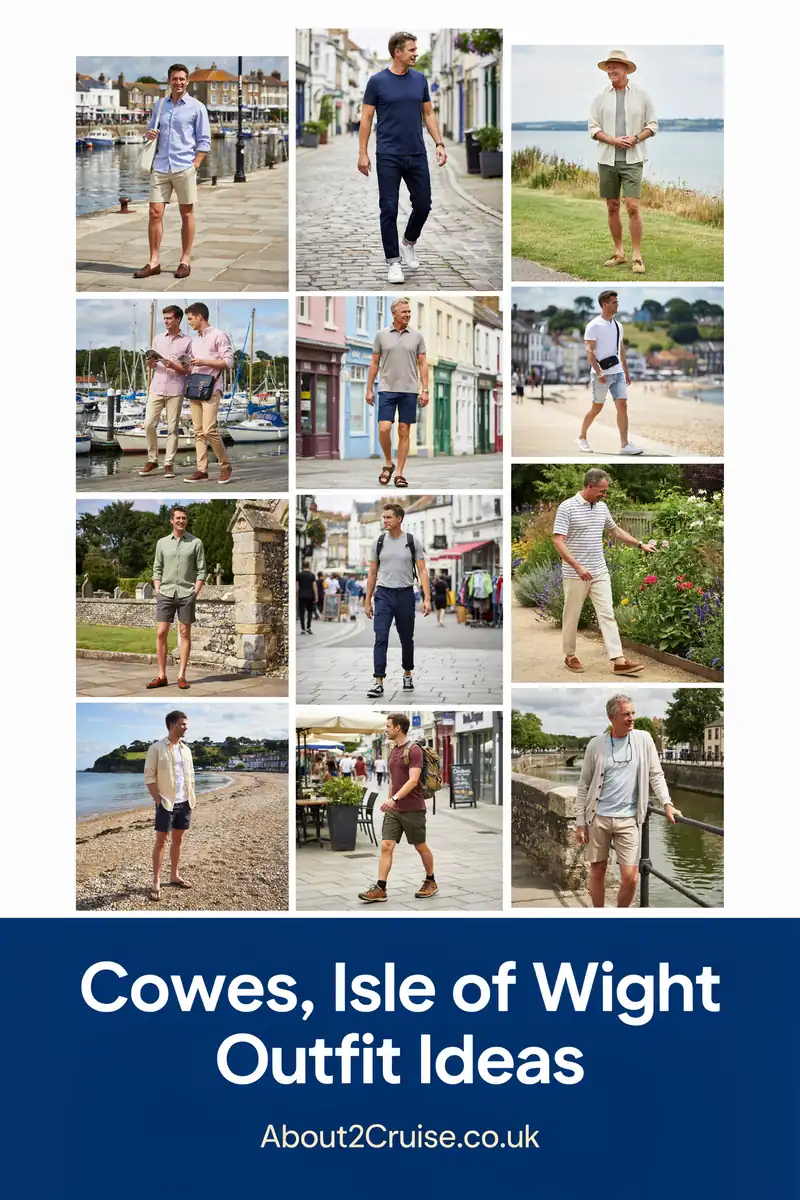
There is no hurricane or monsoon season, but Atlantic low-pressure systems and strong Solent winds can suspend tender operations. The harbour has a spring high water of 4.4 metres above chart datum and a neap low water of 0.9 metres, with a cross current of up to 2 knots in the harbour between about 2.5 hours and high water.
Wear a windproof layer rather than relying on an umbrella. At Osborne House, choose comfortable shoes because paths can be muddy and uneven. In town, the High Street is narrow and steep in places, so flat shoes are easier.
Money, Cards, Wi-Fi and Phone Signal
The currency is pounds sterling. ATMs are in the centre of Cowes, and currency exchange is available at the Post Office and local banks. Buses accept contactless cards or cash, with singles capped at £3. Museums, cafés and shops take major cards, and the Classic Boat Museum accepts cash and all major credit and debit cards.
Free Wi-Fi and public computers are available at Cowes Library on Beckford Road. Local mobile networks provide coverage in the town, and public telephones and a Post Office are also available.
Accessibility and Mobility
Tendering is not step-free from every ship. Wheelchair access is at the captain’s discretion, and mobility help should be flagged before the call. The landing pontoon opens onto The Parade, but there is no cruise terminal with dedicated assistance staff.
Once ashore, the seafront promenade is flat and suitable for wheelchairs and pushchairs. The High Street, however, descends steeply to the waterfront and is narrow throughout. The West Cowes ferry terminal is wheelchair suitable, with handrails on ramps and walkways, an accessible toilet and staff assistance. The replacement launch used when the Floating Bridge is out of service is not suitable for people with limited mobility; crew can arrange an accessible taxi.
At Osborne House, manual wheelchairs can be borrowed, mobility scooters are restricted to the ground floor, and there is usually a lift to the first floor. There are two steps up to the beach boardwalk. The walled garden and Swiss Cottage garden are heavily gravelled, which makes pushing a wheelchair harder.
Family and Dog-Friendly Choices
Osborne House is the best family option. It has two play areas, the Swiss Cottage museum, children’s trails and a gently shelving private beach for paddling. Gurnard has a children’s playground on the green behind the beach.
Dogs are not allowed on Cowes beach between the Egypt Hill slipway and Princes Green from 1 May to 30 September, and they must be on a lead on Princes Green all year. At Osborne, dogs are welcome in the grounds and formal gardens on a short lead, but only assistance dogs go inside the house, Swiss Cottage, cafés, play areas and on the private beach. The Classic Boat Museum welcomes well-behaved dogs on leads.
Rainy-Day Options and Indoor Attractions
Cowes is small, so rainy-day options are limited. The nearest big indoor attraction is Osborne House, where the house interiors are excellent shelter and the cafés provide a dry break. In town, the free Cowes Maritime Museum, the Sir Max Aitken Museum, the Classic Boat Museum and the High Street shops and cafés are the main indoor stops. Check opening days before relying on museums because several close on Sundays or in winter.
If rain is forecast and you have a short call, go straight to Osborne House by Floating Bridge and bus or taxi. If you stay in West Cowes, treat it as a café-and-shop day rather than expecting a large indoor mall.
How Long You Need Ashore
Cowes works well as a short or long port day depending on your pace:
- 2–3 hours: The Parade, High Street, one museum and a seafront walk.
- 4–5 hours: Osborne House by Floating Bridge and route 5, plus a little time on site.
- 6–8 hours: Osborne House with a more leisurely visit, then lunch in Cowes or a seafront walk.
- 8+ hours: Cowes town plus Carisbrooke Castle or a long trip to The Needles or the east coast.
Many cruise calls are around 8am to 6pm, so you can do Osborne independently and still have a relaxed town afternoon. A short call of 7am to 4pm is tighter but still enough for Osborne if you move efficiently.
Getting to Cowes Before or After a Cruise
Cowes is not a cruise turnaround port. There is no cruise terminal to check in, drop bags or wait. Passengers joining a cruise almost always start from Southampton, then use the Red Funnel ferries to visit Cowes or stay on the island before embarkation.
- Red Jet fast ferry: Southampton Terminal 2 at Town Quay to West Cowes, foot passengers only, 28–30 minutes. Departures run about every 35 minutes at peak and about every 70 minutes off-peak.
- Vehicle ferry: Southampton Terminal 1 to East Cowes, about 60 minutes, roughly every 60 minutes March to October and every 90 minutes November to February.
- QuayConnect shuttle: links Southampton Central station and WestQuay with Town Quay about every 30 minutes. It is free with a ferry ticket and £2 return otherwise. Bluestar route 19 covers later evenings.
- Southampton Airport: about 18 miles from Cowes; the island’s Sandown airport is about 13 miles away.
Cowes has no railway station. The mainland railhead for the Red Jet is Southampton Central. The taxi rank in Cowes is at the Red Jet terminal and outside the Marks and Spencer supermarket.
Where to Stay, Parking and Luggage Storage
There is no left-luggage facility at Trinity Landing or anywhere in Cowes town centre. Nearby hotels sometimes hold bags for non-residents on arrival and departure days, but there is no formal bag-drop at the landing.
If you need a pre-cruise base in Cowes, these are all close to the Red Jet:
- The Fountain Hotel, High Street: one minute from the Red Jet terminal.
- The Union Inn, Watch House Lane: four minutes from the terminal, with luggage storage and a porter.
- The Caledon, Mill Hill Road: about ten minutes from the terminal, holds bags before check-in and after check-out, with free on-site parking.
- Best Western New Holmwood, Queens Road: about 17 minutes from the terminal.
Parking in Cowes itself is very limited, and advance booking is essential if you are bringing a car over, especially during Cowes Week. Somerton long-stay car park on the edge of town charges £2.00 for up to 24 hours and is served by route 1. Town-centre long-stay car parks charge by the hour with an overnight charge of £2.00. Queens Road beside Princes Green and the small Mornington Road car park above the toilets are closest to the seafront and the landing.
Safety and Practicalities
The Isle of Wight has one of the lowest crime rates in the country, and Cowes tends to record the lowest crime rate of the island’s main towns. Normal UK town and seafront awareness is all you need.
The greatest practical risk is the water. Cowes beach drops into deep water with strong tidal streams off Egypt Point, and there are no lifeguards. Swimming is not advised for children beyond the shallows, even though the bathing water is rated Excellent. The seafront promenade can also be gusty and exposed, so keep an eye on children and hold onto hats.
Our UK cruise ports of call guide covers the other ports in England, Wales and the Channel Islands.
FAQs
- Is there a cruise terminal or left luggage at Cowes? No. There is no terminal, no waiting area and no left-luggage facility at Trinity Landing. The town is the terminal.
- Can I walk to Osborne House from the tender? You can, but it is a long walk via the Floating Bridge. It is easier to cross the bridge and catch route 5 or a taxi from East Cowes. Allow 30–40 minutes by public transport rather than walking the whole way.
- Are taxis available right at Trinity Landing? Not reliably at the pontoon itself. The main taxi rank in Cowes is at the Red Jet terminal, with another outside the Marks and Spencer supermarket. Walk a few minutes into town if you need a cab.
- Does the Floating Bridge run after the last tender? Normally yes. The Floating Bridge runs until after midnight, with the last crossing around 00.25. But if it is suspended, use the replacement foot passenger launch or ask the crew about an accessible taxi.
- Is Cowes beach good for swimming? Not really. It is a pebble and shingle beach with no lifeguards and deep water with strong tidal streams off Egypt Point. It is better for views, yachts and a seafront walk.
- Are the Cowes museums open on Sundays? Several are closed or limited on Sundays. Cowes Maritime Museum opens Monday, Tuesday, Friday and Saturday only. The Classic Boat Museum is usually Tuesday to Friday. Do not build a Sunday itinerary around small museums.
- Can I visit Osborne House in winter? Yes, it opens daily, but winter visits are usually guided-tour only, the Swiss Cottage closes, and only the ground floor of the house opens. Check the season before booking.
- Where are the nearest public toilets? Public toilets are at The Parade, The Cut, Medina Road by the Floating Bridge and Park Road recreation ground. East Cowes has them on Eastern Esplanade. Mornington Road by Princes Green has accessible cubicles needing a RADAR key.
- What should I do if I miss the last tender? This is rare but serious. Contact the ship’s port agent using the number in the daily programme, and speak to the local harbour or ferry staff. Do not wait silently at the landing after the last departure window has passed.
More UK and Channel Tender-Port Guides
If your cruise also calls at other tender-heavy ports, these guides may help: Falmouth cruise port guide, Saint-Malo cruise port guide and Honfleur cruise port guide.
Last Updated: 15 November 2026