
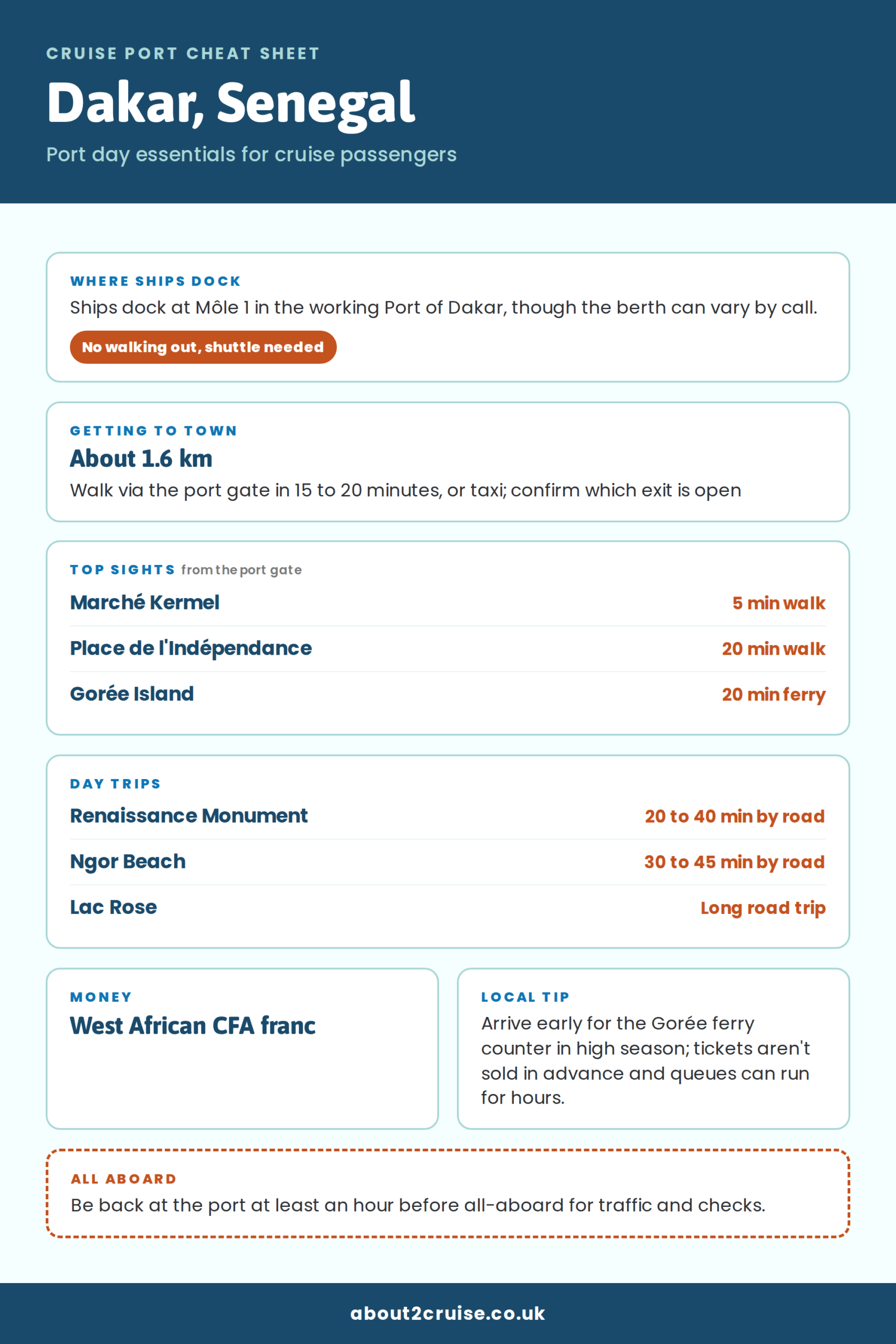
Dakar cruise ships dock at Môle 1 in the working Port of Dakar, on Senegal’s Cape Verde Peninsula. Plateau city centre is about 1.6 km away, 15 to 20 minutes on foot. Gorée Island, 3 km offshore, is the headline outing, and Place de l’Indépendance sits about 2 km from the berth.
Where Dakar cruise ships dock
You’re in a working cargo port here, so the quay you get is assigned for your call rather than fixed for the season. The Port of Dakar puts cruise ships at Môle 1, and the Môle 3 quay, 360 m long with 10 m of depth and 3.5 ha of land behind it, has a shed used for passenger reception on cruise calls.
Some calls use Môle 2 or Môle 3, so look at the berth named in your ship’s daily programme instead of assuming.
The port handles cereals and conventional cargo alongside cruise ships, and you follow the route your ship gives you through it, not the shortest line on a map. The authorised passenger exit decides your real walking distance into Plateau, so ask at the gangway which gate is open and whether a shuttle is running.
Taxis wait outside the main port entrance, with the terminal on Boulevard de la Libération. Agree the fare, the destination and any waiting time before you set off. Sorting it at the end is how these things go wrong.
Dakar cruise port map
Ships dock at Port of Dakar (Môle 1). From there, Marché Kermel is about a 5-minute walk, Place de l’Indépendance about 11 minutes and Musée des Civilisations Noires about 18 minutes. Tap a pin for directions.
- Port of Dakar (Môle 1)Where ships dock
- Gare MaritimeWhere ships dock
- Marché KermelMarket · About 5 min walk from Port of Dakar (Môle 1)
- Place de l’IndépendanceCity square · About 11 min walk from Port of Dakar (Môle 1)
- Dakar railway stationRailway station · About 15 min walk from Port of Dakar (Môle 1)
- Musée des Civilisations NoiresMuseum · About 18 min walk from Port of Dakar (Môle 1)
- Dakar CathedralCathedral · About 24 min walk from Port of Dakar (Môle 1)
- Théodore Monod MuseumMuseum · About 27 min walk from Port of Dakar (Môle 1)
- Gorée IslandIsland · About 3 km from Port of Dakar (Môle 1)
- House of SlavesMuseum · About 3 km from Port of Dakar (Môle 1)
- African Renaissance MonumentMonument · About 9 km from Port of Dakar (Môle 1)
- Corniche OuestSeafront road · About 2 km from Port of Dakar (Môle 1)
- Ngor BeachBeach · About 13 km from Port of Dakar (Môle 1)
Place de l’Indépendance and Plateau: how far from the port
Place de l’Indépendance is about 2 km from the Port of Dakar, and the heart of Plateau is roughly 1.6 km, or 15 to 20 minutes on foot, from the cruise berth. You can walk it. The city is hot, dusty and traffic-choked, though, and the pavements come and go.
The square is the obvious place to get your bearings. Avenue Léopold Sédar Senghor runs south from it to the presidential palace and the cathedral, and side streets lead to Marché Kermel and the Gorée ferry pier.
A Plateau loop is about 3 km, which is 45 to 60 minutes of pure walking. Give it two to three hours once you stop at Marché Kermel, the Théodore Monod museum on Place Soweto, the cathedral and the Musée des Civilisations Noires.
Dakar was founded by the French and took over from Saint Louis as the capital of French West Africa, which is why Plateau is the one properly gridded part of the city.
Yellow-and-black taxis wait at the port exit and on Place de l’Indépendance, and every fare is negotiated. Traffic doesn’t give way to pedestrians, so cross where the locals do.
Gorée Island: the ferry, the tickets and the timing
Gorée Island is 3 km offshore and a 20-minute ferry crossing, and it is why most passengers get off the ship in Dakar. The ferry leaves from the Gare Maritime on Plateau, at the edge of the port area and a few minutes from Marché Kermel. It does not leave from the cruise berth, so ask your ship which exit to use and how to reach the ferry terminal entrance.
Crossings run roughly every 60 to 90 minutes. The first ferry leaves Dakar around 06:15, and the last comes back from Gorée around 20:00 on weekdays, later on Friday and Saturday.
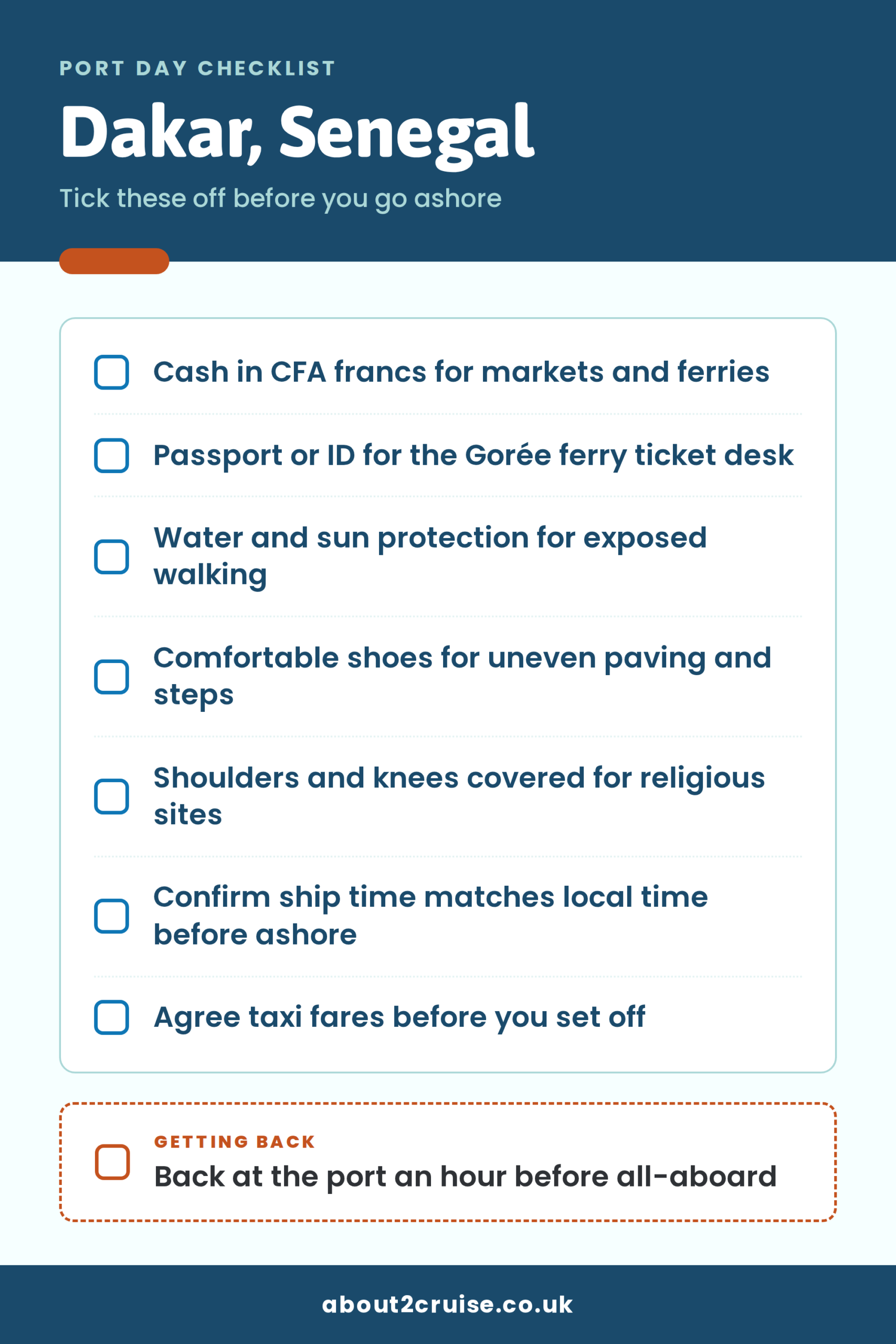
You buy tickets at the counter before departure, and you can’t book ahead. The first morning and midday sailings fill fast. Arrive around 30 minutes early, and allow 45 minutes from buying the ticket to docking on the island once waiting and boarding are added.
Budget four to five hours for the whole outing from the ship, and aim for a ferry that lands you back in Dakar at least 90 minutes before all-aboard. In high season the ticket queue can run for hours in full sun. That’s where a hat and a collapsible water bottle earn their place in your bag.
Gorée itself is car-free, under 1 km long and entirely walkable, with the House of Slaves, the Castel viewpoint and the historical museum inside Fort d’Estrées. The village loop is 1.5 to 2 km, and two to three hours ashore is about right, over uneven paving and the occasional step.
Restaurants near the ferry landing understand the return timetable. Pick one that does.
Fort d’Estrées: how far from the ship
Fort d’Estrées is on Gorée Island, at the northern end above the ferry jetty, so the distance from the cruise berth isn’t a road one. The trip is the 20-minute crossing plus a short walk up from the landing, and the fort holds the IFAN Historical Museum on the history of the island and Senegal.
African Renaissance Monument and the Corniche
The African Renaissance Monument is around 10 km from central Dakar, which is 20 to 40 minutes by road and longer in congestion. Allow 45 to 75 minutes on site, and count the 198 steps on the main approach as a mobility issue even when a vehicle gets you to the base.
The Corniche Ouest seafront road makes up the rest of a western circuit, and it’s best in the evening when it fills with runners and walkers.
Ngor beach, Lac Rose and fitting one outing into a port day
On a typical seven to eight hour call, pick one main outing: Gorée, central Dakar with a museum, or a coastal drive. All three doesn’t fit.
Before you sail
- Check whether ship time matches local time before planning your return.
- Bring cash in CFA francs; cards are little use ashore.
- Confirm with your line whether a Gorée excursion beats the DIY ferry queue.
Short port day: under 6 hours
- On dockingConfirm the port exitAsk at gangwayAsk crew which gate is open today; this working port doesn't use one fixed passenger route.
- +5 minMarché KermelA short walk from the port gate; browse the food and flower market on your way into town.
- +20 minWalk to Place de l'IndépendanceContinue on from the market; the square is the natural point to get your bearings.
- +40 minDakar Cathedral and museumWalk south on Avenue Léopold Sédar Senghor to the cathedral and Théodore Monod Museum.
- +1 hr 40 minLunch near the marketTry thiéboudienneHead back towards Marché Kermel and order Senegal's fish and rice dish where it's cooked in quantity, not kept warm.
- +2 hr 40 minWalk back to the portA short walk from the market to the gate; allow extra time if the streets are busy.
- All-aboard minus 1 hrBack at the port gateCheck ship time matches local time before you plan this return.
The time on the map is the whole walk, every stop added together.
Open this walking route in Google Maps
If plans change: If the museums are shut, spend longer at Marché Kermel or walk the Corniche instead.
Long port day: 8 hours or more
- On dockingWalk to the Gare MaritimeConfirm exitAsk crew which port exit leads to the Gorée ferry terminal, a few minutes from Marché Kermel.
- +20 minBuy Gorée ferry ticketsNo advance bookingTickets are sold at the counter only; arrive early as morning sailings fill fast.
- +50 minFerry to Gorée IslandA 20 minute crossing; allow extra time for boarding once the ticket is bought.
- +1 hr 30 minHouse of Slaves and Fort d'EstréesWalk the island's lanes to the House of Slaves, then up to Fort d'Estrées and its museum.
- +3 hrLunch near the ferry landingTry thiéboudienneChoose a restaurant close to the jetty that watches the return timetable.
- +5 hr 30 minFerry back and Plateau loopCross back to Dakar, then walk to Place de l'Indépendance and Marché Kermel.
- All-aboard minus 90 minWalk back to the portAllow extra margin, since Gorée queues and traffic can both run long.
The times on the map are for the whole journey there by train and bus.
Get train and bus times in Google Maps
If plans change: If the Gorée ferry queue is too long, spend the day in Plateau instead and save the island for next time.
Ngor, on the Atlantic side, has a mainland beach and a pirogue crossing to Ngor Island. It’s 30 to 45 minutes’ drive each way from Plateau, traffic can stretch that, and a relaxed outing takes four to five hours. That makes it one for repeat visitors or overnight calls.
Lac Rose is a long road outing, and its colour varies with the conditions, so don’t let anyone sell it to you as a guaranteed pink photograph. A ship excursion to Gorée removes the ticket queue and the return-ferry guesswork, which is the main reason to take one here.
If your route strings several calls along this coast together, the West Africa cruise port guide sets out what each one offers.
Where to eat near Dakar cruise port
The place to eat near the cruise port is Plateau, and specifically Marché Kermel, a working food and flower market a few minutes from both the berth and the Gorée ferry terminal. Order thiéboudienne, fish cooked with rice, vegetables and tomato, at least once.
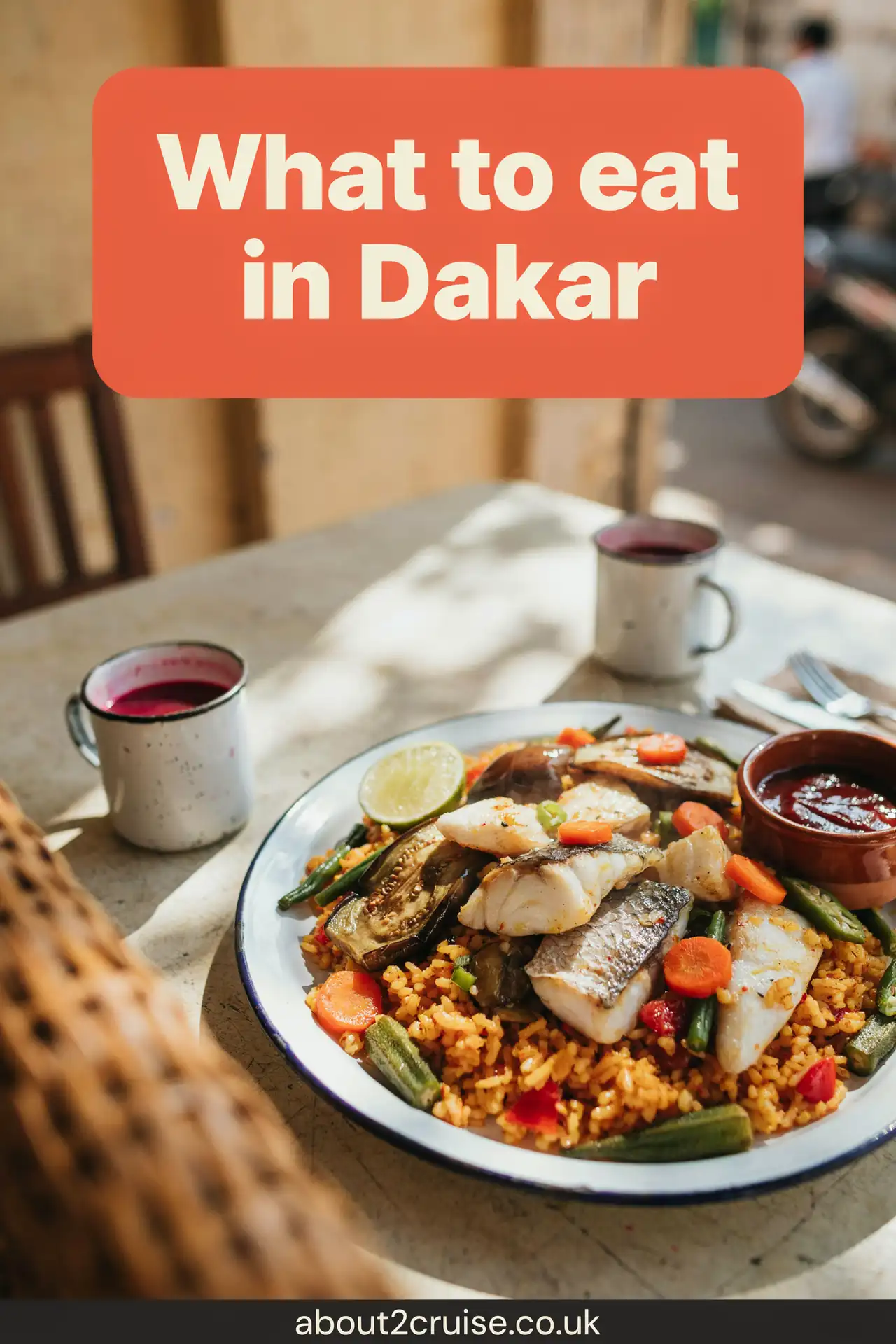
Thiéboudienne is Senegal’s national plate and the thing a Dakar lunch is built around. Order it where you see it cooked in quantity rather than kept warm, and expect rice scraped from the pot rather than a neat mound.
Marché Kermel is where to eat and browse near the ship, and the produce and flowers are worth the walk even if you eat somewhere else. On Gorée, the restaurants close to the ferry landing cook to the return timetable, so a sit-down lunch can work if you keep half an eye on the clock.
Carry cash in West African CFA francs for small purchases and market food. If you have allergies, bring a note in French and ask about peanuts, stocks and shared preparation.
What to wear in Dakar: outfit ideas for a port day
Light, loose clothing and comfortable shoes are what you want in Dakar, because the heat, the sun and the pavements all ask something of you. Water and sun protection are not optional, and exposed walking is better early in the day.

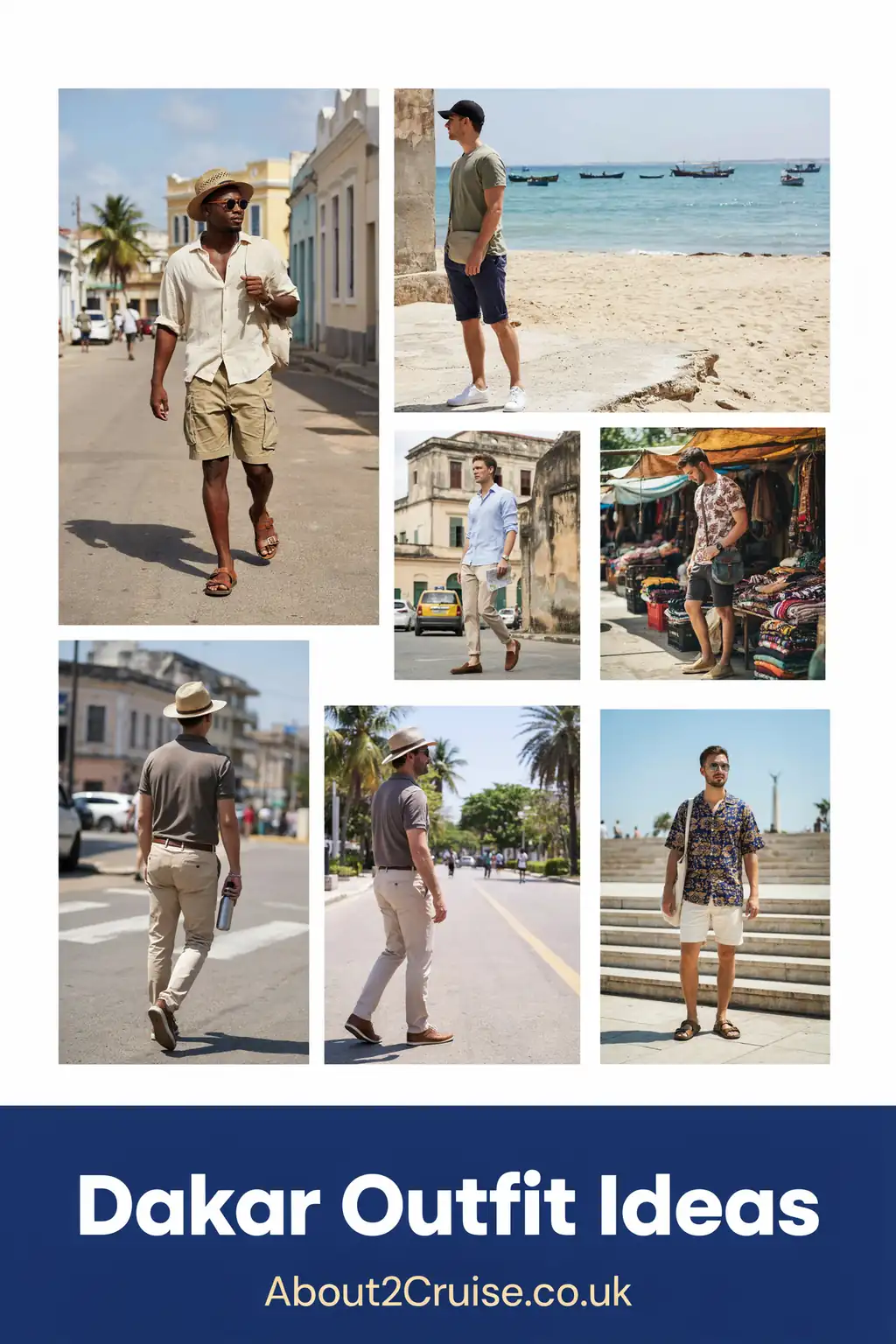
Gorée is pedestrian, with uneven paving and steps, and the climb to the Castel is steeper and more exposed. Skip it in the heat, or if your knees are doubtful. The 198 steps at the African Renaissance Monument are a mobility decision even if a vehicle takes you up there.
Cover shoulders and knees at religious sites, and ask before you photograph people. Don’t photograph port security or guarded installations.
For more inspiration, see these casual cruise outfit ideas for women and cruise outfit ideas for men.
Best photo spots in Dakar
The best photo spots in Dakar are on Gorée and around Plateau, with the Corniche for evening light and the monument out west for a wide shot.
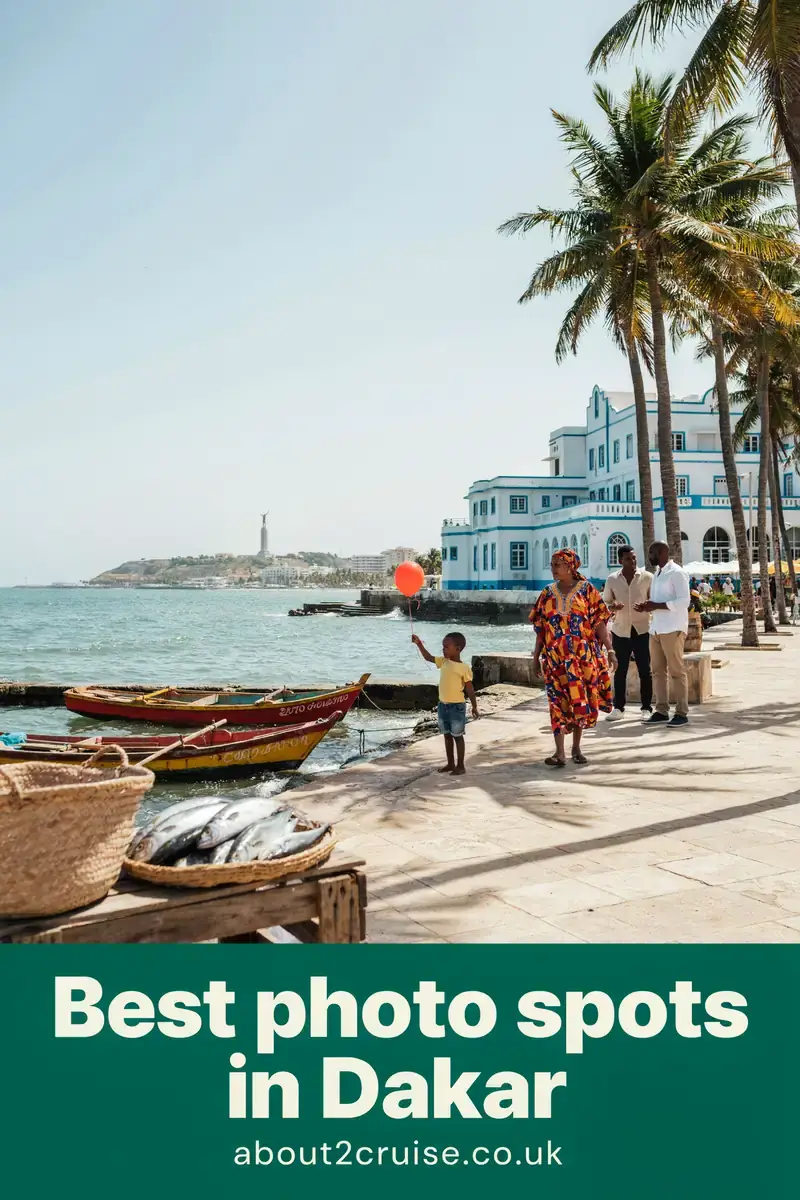
Gorée’s waterfront and lanes give you ochre and pastel houses, cobbles, bougainvillea and the stone jetty below Fort d’Estrées’ cannon battery. Fort d’Estrées and the Castel viewpoint above the harbour are the high shots, though the Castel climb is steeper and exposed.
Place de l’Indépendance gives you fountains, the independence monument, broad radiating avenues and colonial-era civic buildings. The Corniche Ouest seafront is at its best in the evening, when it fills with runners and walkers.
Money, safety and getting back to the ship on time
The currency is the West African CFA franc, and cash matters for markets, ferry extras and small purchases. Pickpocketing is a real risk in the busy parts of Plateau, so keep valuables out of sight and agree guiding fees before you set off.
Before you go ashore, check whether ship time matches local time. Otherwise the all-aboard you’re planning for won’t be the one your ship is keeping. Be back at the port at least an hour before all-aboard to absorb traffic and port procedures.
A souvenir market sets up quayside for cruise calls, and bargaining is expected rather than rude. If you have reduced mobility, ask separately about gangway assistance, port shuttle access, ferry boarding and the island route on Gorée, because an accessible coach does not solve the ferry steps. The general travel safety tips in port hold here too.
Getting to Dakar cruise port: airport, taxi and check-in
Blaise Diagne International Airport is about 55 km east of Dakar, and the A1, the Autoroute de l’Avenir, takes roughly 60 to 90 minutes to the port terminal. Cruise lines run organised shuttles from the airport, and licensed taxis and private transfers also operate there.
By rail, the Gare Maritime sits next to Dakar’s railway station in the city centre, and the main station is about 1 km from Place de l’Indépendance.
Check-in usually runs to a fixed time slot set out in your cruise documents, and the latest time to board is about an hour before departure. Ponant uses Dakar as the start and finish for its Bijagós voyages, so the terminal handles ships beginning and ending their cruises as well as day calls.
Parking at Dakar cruise port
There’s no car park for cruise passengers at the Port of Dakar, and no off-site meet-and-greet, shuttle park or pre-bookable parking is advertised for cruise passengers. The only parking near the passenger terminal is the paid car park at the Gare Maritime, which serves the Gorée and domestic ferries rather than cruise ships.
If someone is driving you to the ship, arrange the drop-off with your cruise line in advance and confirm on the day where the driver can stop at the port entrance.
Where to stay near Dakar cruise port
Plateau is where to stay for a Dakar cruise, because the hotels there sit within about a kilometre of the berth and you can walk to check-in rather than gamble on traffic. It works after the cruise too, when you want a short run to the ship or an easy evening in the city before a flight.
Almadies, further out on the coast, is the alternative if you have a day or two to spare either side of sailing.
The Pullman Dakar Teranga is on Place de l’Indépendance, 10 Rue Colbert, about 0.74 km from the port, with buffet breakfast, 24-hour reception, an outdoor pool, free private parking on reservation and an airport shuttle listed. The Axil Hôtel is about 0.5 to 0.6 km from the port with breakfast, parking and Wi-Fi, and the Hôtel Fleur de Lys Plateau is about 1 km out.
Hotel Baraka, within a kilometre of the port, adds parking, dry cleaning and luggage storage. Further out, Terrou-Bi is about 3.8 km and Noom Hotel Dakar Sea Plaza about 5.1 km away, which suits a longer stay more than a one-night turnaround.
Luggage storage at Dakar cruise port
There’s no left-luggage office listed at Dakar’s cruise terminal, the port, the railway station or the airport, so plan around your bags rather than turning up with them. Hotel Baraka, within a kilometre of the port, is the one place near the terminal listed with luggage storage, which is the usual fix when you’re off the ship early and flying late.
If you need a place for the bags between the ship and the airport, you can book luggage storage near the terminal before you travel.
Dakar cruise port FAQs
What is the name of the port in Senegal?
It’s the Port of Dakar, known formally as the Port Autonome de Dakar, on the Cape Verde Peninsula.
Where is the westernmost point of Africa?
Dakar sits on the Cape Verde Peninsula, which is the westernmost point of the African continent.
Are the House of Slaves and the Fort d’Estrées museum open every day?
No fixed opening hours are advertised for the House of Slaves or the museum inside Fort d’Estrées, and there are no listed closed days or booking route, so check on the island before you plan your visit around going inside.
Do you need ID for the Gorée ferry?
ID may be requested when you buy your ticket at the maritime terminal, so carry your passport or a driving licence ashore with you.
Last Updated: 4 November 2026