
Cruise ships in Darwin dock at Fort Hill Wharf, also called the Darwin Cruise Terminal, at 1 Anchorage Court, Darwin City. There is no tender. It is a 12–15-minute flat walk from Smith Street Mall, and from the terminal gate you can walk, catch a free bus, or take a taxi or rideshare to the Waterfront, Crocosaurus Cove, the WWII oil tunnels or Mindil Beach. This is the Top End’s main cruise berth and the meeting point for most Darwin shore excursions.
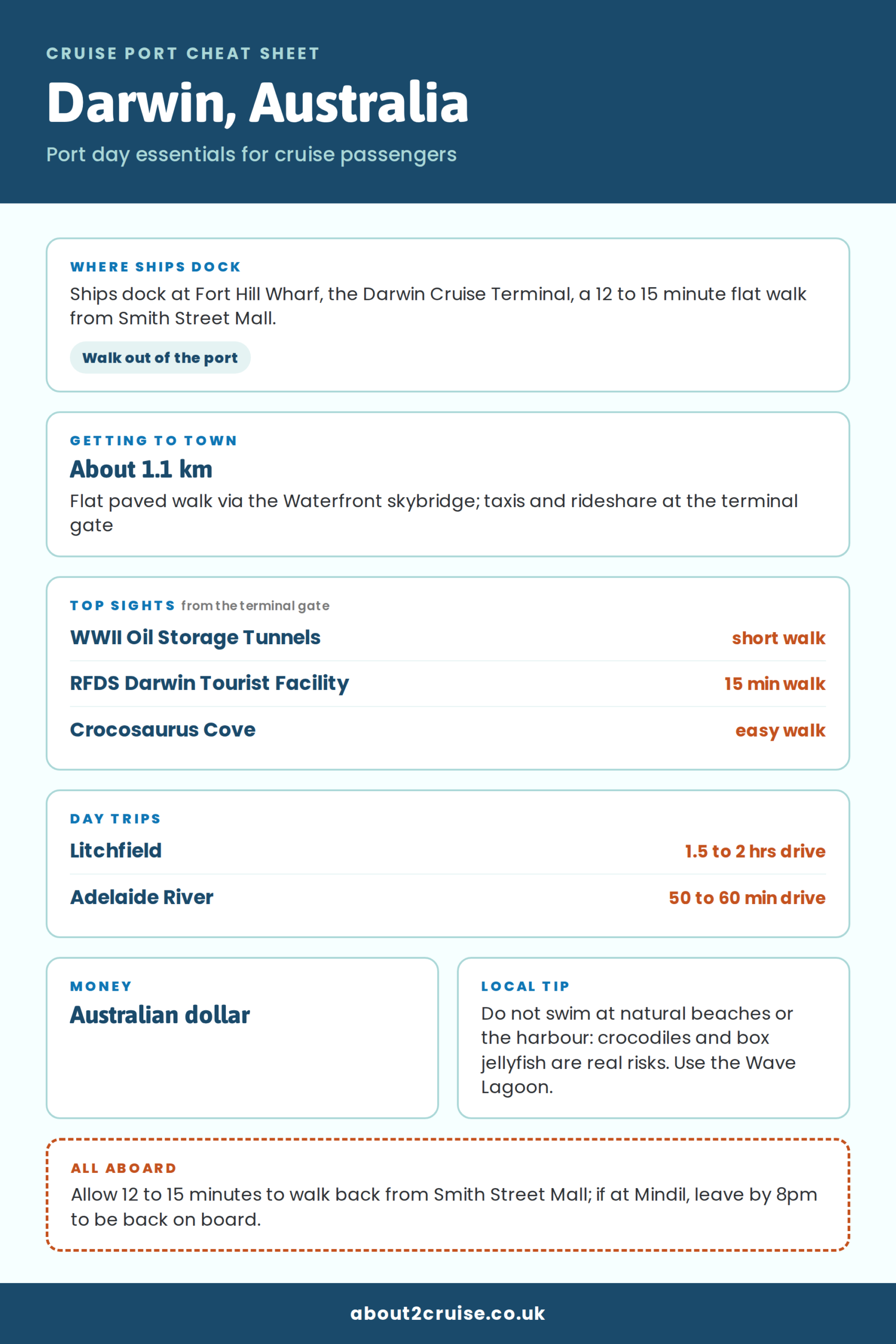
Every cruise ship in Darwin docks at Fort Hill Wharf, which is the same facility as the Darwin Cruise Terminal. The address is 1 Anchorage Court, Darwin City. It’s a walk-off port, no tenders, and the city centre is only a 12–15-minute flat walk away. From the terminal gate you can walk, catch a free bus, or take a taxi or rideshare to the Waterfront, Crocosaurus Cove, the WWII oil tunnels, or Mindil Beach. This is the Top End’s main cruise berth and the usual meeting point for shore excursions.
Darwin cruise port map
Ships dock at Fort Hill Wharf / Darwin Cruise Terminal. From the terminal gate, RFDS Darwin Tourist Facility is about a 7-minute walk, Wave Lagoon about 9 minutes and Stokes Hill Wharf about 11 minutes. Tap a pin for directions.
- Fort Hill Wharf / Darwin Cruise TerminalWhere ships dock
- RFDS Darwin Tourist FacilityFlying doctor exhibition · About 7 min walk from the terminal gate
- Wave LagoonWave pool · About 9 min walk from the terminal gate
- Stokes Hill WharfHistoric pier · About 11 min walk from the terminal gate
- Tourism Top End Visitor Information Centre (city shuttle stop)Visitor information centre · About 12 min walk from the terminal gate
- Larrakia Cultural CentreCultural centre · About 13 min walk from the terminal gate
- Smith Street MallShopping mall · About 15 min walk from the terminal gate
- Crocosaurus CoveCrocodile attraction · About 21 min walk from the terminal gate
- Mindil Beach Sunset MarketSunset market · About 3 km from the terminal gate
- Museum and Art Gallery of the Northern TerritoryMuseum and art gallery · About 4 km from the terminal gate
- George Brown Darwin Botanic GardensBotanic gardens · About 3 km from the terminal gate
- Parap Village MarketsVillage market · About 4 km from the terminal gate
Darwin cruise port at a glance: terminal, berth and location
Darwin is Australia’s tropical Top End capital. It’s small, hot, multicultural, and closer to Southeast Asia than Sydney. The port is more of a gateway to the Northern Territory than a big-city cruise terminal, so most calls focus on the Waterfront, the city centre, Indigenous culture, WWII history, and Darwin’s famous crocodile experiences.
The cruise terminal is sometimes listed under Kitchener Drive because that’s the waterfront road behind it, but the passenger and vehicle gate is signed off Anchorage Court.
| Where ships dock | Fort Hill Wharf / Darwin Cruise Terminal |
| Terminal address | 1 Anchorage Court, Darwin City NT 0800 |
| Berth capacity | One ship up to 350 metres, or two up to 150 metres |
| Tender? | No, walk-off gangway |
| Walk to CBD | 1.1–1.2 km, 12–15 minutes flat |
| Free transport | Darwin public buses; Waterfront Shuttle precinct loop |
| Taxi to Smith Street Mall | About A$12 |
| Port schedule | portinfo.darwinport.com.au/webx |
| Peak season | Larger liners often September–April; expedition ships March–September |
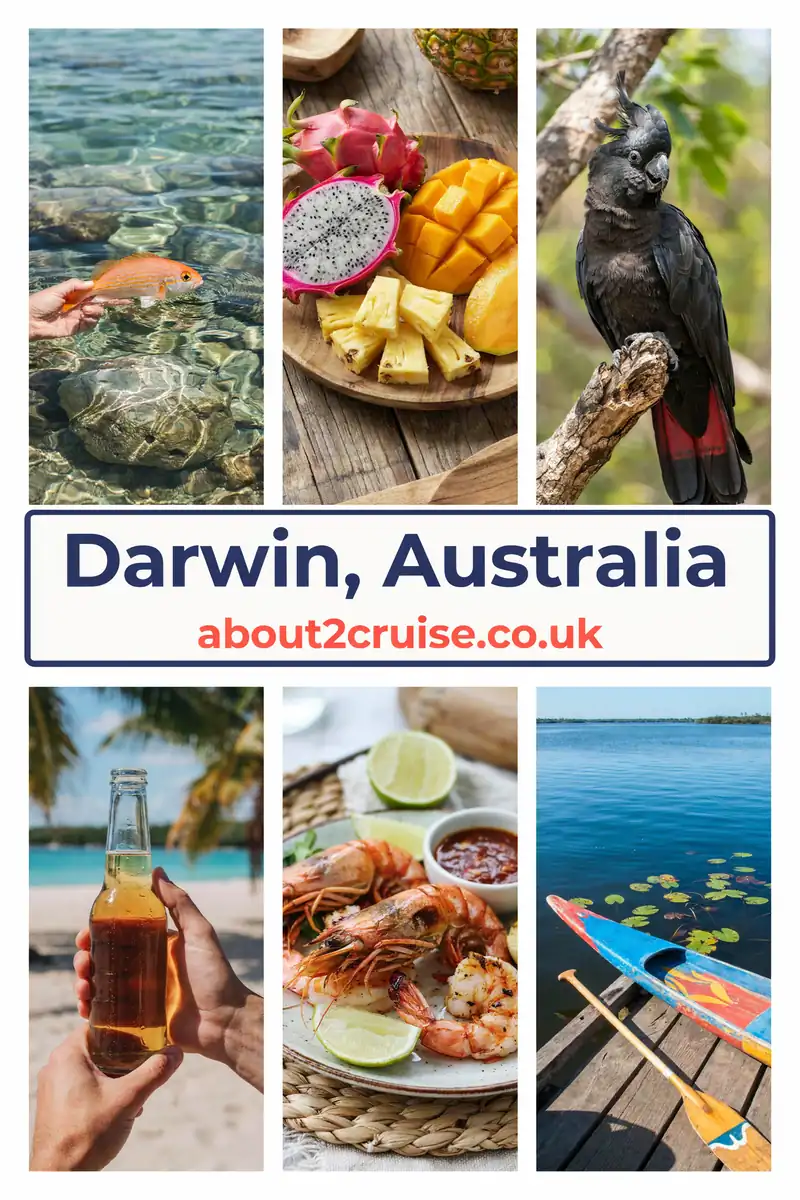
Fort Hill Wharf or Darwin Cruise Terminal? They’re the same place
Fort Hill Wharf and the Darwin Cruise Terminal are not two different ports. Fort Hill Wharf is the deep-water berth where your ship ties up, and the Darwin Cruise Terminal is the passenger building that serves it. If you see “Darwin Cruise Terminal,” “Fort Hill Wharf,” or “Anchorage Court,” they all mean the same cruise facility.
Do not confuse it with East Arm Wharf, which is the commercial and container facility out of town, or Stokes Hill Wharf, the historic pier area near the Waterfront.
- Fort Hill Wharf: principal cruise and naval berth, minutes from the CBD.
- Darwin Cruise Terminal: passenger processing building at Fort Hill Wharf, 1 Anchorage Court.
- Stokes Hill Wharf: not your ship’s berth; it’s the pier area with fish and chips, the RFDS tourist facility, and fishing charters.
- East Arm Wharf: commercial port, not for cruise passengers.
Walking from the cruise terminal to Darwin city centre
The walk from the gangway to Smith Street Mall is about 1.1–1.2 km and normally takes 12–15 minutes. It’s flat, paved, and genuinely easy for most people. You’ll follow a short covered walkway into the Waterfront precinct, then use a skybridge with a glass-walled observation lift and ramps up to city level. From there you can walk along the Esplanade or cut through the city grid to the mall.
Because Darwin is not a tender port, you can come and go as you please once the ship has cleared. If you have limited mobility, ask your cruise line about assistance. The skybridge and lift make the route accessible, but the tropical heat can be punishing in the middle of the day.
Free shuttles and public buses from the cruise terminal
Darwin is one of the easiest Australian cruise ports to do independently, but there’s a common misunderstanding about shuttles.
Free Waterfront Shuttle
There is a free Waterfront Shuttle, but it’s a precinct loop, not a city-centre bus into the CBD. It runs a 15-minute loop from 11:30am–2pm and 4pm–9pm, linking Stokes Hill Wharf, the Cruise Ship Terminal, the Darwin Convention Centre, Vibe and Adina hotels, Waterfront Parklands, Wharf Two residential, the Deckchair Cinema, and the Larrakia Cultural Centre. The vehicle is small, around 12 seats, and fills quickly when a big ship is in.
Darwin public buses
All public bus services in Greater Darwin and Alice Springs are free. There is no fare, ticket, or card needed. Route 14 serves the Waterfront precinct, and buses 4 and 6 are useful for the Museum and Art Gallery of the Northern Territory. The bus stop is outside the terminal area or a short walk from the Waterfront. This is the cheapest way to reach slightly far-out sights.
Darwin Explorer hop-on hop-off
The Darwin Explorer is a hop-on hop-off bus with 12 stops including Crocosaurus Cove, Cullen Bay Jetty, Mindil Markets and Casino, the Military Museum, Parap, Stokes Hill Wharf, and Fort Hill Wharf. A 24-hour pass is about A$47 adult and A$30 child, with a family pass around A$132. A complete circuit takes 60–90 minutes. First tour usually leaves the Tourist Information Centre at 9am and the last stop is at 4.30pm. During the wet season it operates Monday, Wednesday, and Saturday only; otherwise it runs Monday to Saturday plus all large cruise ship days.
Your ship may also run a city shuttle. Free shuttle buses have been provided for some maiden calls and large ships, usually dropping at Paspaley Plaza or the Tourism Top End Visitor Information Centre on Bennett Street, about 1.2 km from the port. This is not guaranteed, so check the daily programme before you walk off.
Taxis, rideshare and private pickup at Darwin’s port
Taxis and rideshare pick up and drop off outside the Fort Hill Wharf terminal gates, not on the wharf itself. If you have booked a private transfer or a “Top End port pickup,” the standard meeting point is outside the secure gate at the terminal entrance on Anchorage Court. Your driver should tell you exactly where they will stand, but they cannot usually drive onto the wharf while a passenger ship is working.
- Taxi to Smith Street Mall: around A$12, with card terminals in taxis and a 1–5% surcharge.
- Uber and rideshare: operates in Darwin; follow signs to the rideshare pickup area at the gate.
- Taxi rank in the city: at the Knuckey Street end of Smith Street Mall; taxis can be booked 24 hours.
- Private transfers: usually wait near the terminal entrance, often with a name board. Confirm the meeting point before arrival, not after.
There is no official long-stay cruise car park at the Fort Hill Wharf terminal. Waterfront precinct car parks are designed for short-stay visitors, with Anchorage Court on-street parking capped at two hours. If you are driving to Darwin for a turnaround cruise, ask your cruise line or a Darwin hotel about off-site parking packages.
How to check the Darwin cruise schedule and confirm your berth
Darwin Port publishes its commercial shipping and cruise schedule through its Port Management Information System at portinfo.darwinport.com.au/webx. The port website at darwinport.com.au also carries arrival information for major calls. This is the most reliable way to check which ship is in Darwin Harbour today or on your travel date.
Third-party sites such as CruiseMapper also list Darwin cruise ship arrivals and departures, which can be easier to browse. If you want a printed or PDF-style schedule, search for “Darwin Port cruise ship schedule pdf” or use the portinfo system and print the page. There is no simple official list that says every ship always berths at Fort Hill Wharf, but for practical purposes cruise ships use Fort Hill Wharf unless the port advises otherwise. The wharf can take one ship up to 350 metres or two smaller vessels up to 150 metres.
Which cruise lines visit Darwin? (UK and world cruise routes)
Darwin is not a busy turnaround port for big ships, but it is an important transit call on Australian, world cruise, and expedition itineraries. Larger ships frequently call between September and April. Expedition and small luxury ships home-port in Darwin from March to September, especially for Kimberley cruises.
- Cunard: Queen Anne world voyages from Southampton call at Darwin on the way to Sydney, so UK readers looking for “cruises to Darwin from UK” will usually find it on world voyage sectors rather than a short fly-cruise.
- Royal Caribbean: Brilliance of the Seas has made an overnight maiden call, and Quantum of the Seas has visited. Some Royal Caribbean itineraries run Sydney–Airlie Beach–Darwin–Lombok–Bali–Singapore.
- Princess: round-Australia voyages often place Darwin between the Kimberley coast and Port Douglas.
- Holland America: Noordam has called at Darwin on longer Australia and New Zealand voyages.
- Oceania: Regatta has called at Darwin with an overnight on a Cairns–Darwin–Komodo–Bali itinerary.
- Kimberley and expedition lines: APT, Coral Expeditions, Lindblad, Scenic, Seabourn, Silversea, Ponant, and Travelmarvel use Darwin as a turnaround for Kimberley cruises. Coral Expeditions runs 10-night Kimberley cruises between Darwin and Broome, with Darwin departures boarding at Fort Hill Wharf from 8am for a 9am sailing.
For wider Australian itinerary planning, see our Australia Cruise Ship Ports Guide.
Transit call vs turnaround day in Darwin
Most passengers experience Darwin as a transit call, usually lasting six to twelve hours. In that window you can comfortably see the Waterfront, Crocosaurus Cove, the oil tunnels, the RFDS exhibition, the Larrakia Cultural Centre, or Mindil Beach on market day, with a meal in the city.
Turnaround days are different. Darwin is a logical home port for smaller expedition and Kimberley cruises linking Australia to Southeast Asia, particularly Indonesia. The terminal can handle small-to-medium home-port operations of around 400–500 passengers comfortably, but not a giant ship. If you are boarding or leaving a ship in Darwin, you will use Fort Hill Wharf, and check-in or bag drop times will be set by your line.
Darwin cruise terminal facilities, luggage and accessibility
Darwin’s cruise terminal is compact and practical rather than a resort-style building. Expect a short covered walkway from the wharf, passenger processing areas, a tourist information presence, and volunteer tourism ambassadors in bright shirts who hand out maps and city guides on transit days. An ATM and currency exchange are sometimes available, but do not rely on the terminal for banking. There is no shopping mall or big café inside.
There is no official luggage storage service at the terminal. Some travellers have reported dropping bags at the terminal before check-in on turnaround days, but that depends on the ship and security staff. Do not leave luggage unattended. If you need storage in Darwin city, third-party luggage drop-off networks list points from about A$2.99–$7.20 per bag per day depending on size.
The terminal and skybridge route are accessible, and the WWII oil tunnels are fully wheelchair accessible. Security zones are activated around the ship on call days, so bring photo ID and follow signposted routes. Only passengers and crew with the right passes can enter the secured area.
Australian visas and biosecurity rules for cruise passengers
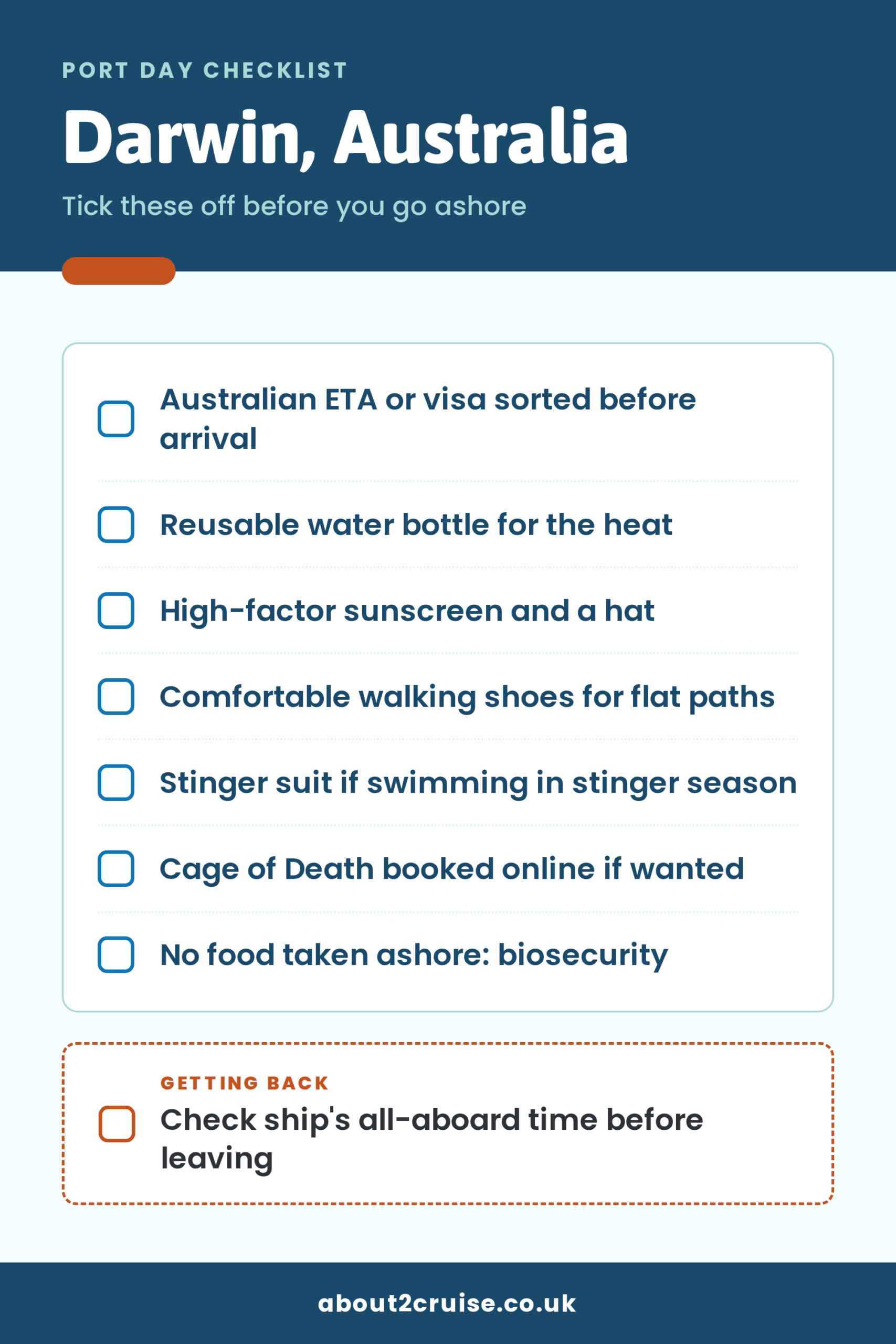
You must have a valid Australian visa or Electronic Travel Authority before arriving, even if you are only ashore for a few hours. Many UK passport holders use the ETA subclass 601 via the Australian ETA app. It costs a A$20 service charge, allows stays of up to three months at a time, and is valid for multiple entries over 12 months. Other passengers may need a Visitor visa subclass 600 tourist stream. Check your nationality before you book, because immigration rules are not the cruise line’s responsibility.
Australia is extremely strict on biosecurity. You must declare or dispose of food and ingredients such as fruit, vegetables, spices, grains, meat, eggs, and dairy, plus plants, seeds, wood, and animal products such as fur or shells. Shoes and outdoor gear must be dry and free of soil, seeds, and grass. All food served on board must stay on board. If you declare goods, you will not be penalised even if they cannot be brought in, but giving false or misleading information can bring an infringement notice of up to A$7,280, civil penalties or prosecution, and possibly visa cancellation.
Darwin weather, stingers and what to pack
Darwin has two seasons, and they change how a port day feels more than the calendar does.
- Wet season, November–April: average temperatures around 24.7–32°C, humidity often above 80%, and heavy afternoon rain. January is the wettest month. Cyclone season officially runs 1 November to 30 April. The heat can feel overwhelming, storms can delay outdoor plans, and some attractions have shorter hours.
- Dry season, May–October: temperatures typically around 21.6–31.8°C with humidity nearer 60–65%. Evenings are comfortable, walking is far easier, and this is when Mindil Beach Sunset Market runs. This is the best season for a Darwin cruise call if you have any choice.
Do not swim at Darwin’s natural beaches or in the harbour. Saltwater crocodiles are a real danger, and the official stinger season runs from 1 October to 1 June, though box jellyfish stings have been recorded in every month. If you want water, use the Wave Lagoon or designated stinger-netted swimming areas.
Pack for heat, humidity, and tropical sun: a hat, sunglasses, high-factor sunscreen, a refillable water bottle, light loose clothing, comfortable walking shoes, insect repellent, and a light rain jacket or poncho in the wet season. Carry a photocopy of your passport for ID and leave valuables in the ship safe. If you plan a water activity in stinger season, wear a stinger suit or a shirt and long trousers over swimwear.
Darwin Waterfront and the Wave Lagoon
The Waterfront is the first area you reach from the ship, and on a hot day it’s the easiest place to cool off. It has restaurants, lawns, hotels, a safe swimming lagoon, and views across Darwin Harbour. The Wave Lagoon is open daily 10am–6pm, with admission around A$10 for adults 15 and over, A$8 for under 15 and concession, A$29 for a family of two adults and three children, and free for under threes. There are also beach areas behind stinger nets, but the safest and most predictable option is the wave pool.
The Waterfront skybridge gives a good view of the harbour and ship, and the free Waterfront Shuttle loops around the precinct if you want to save steps. Stokes Hill Wharf is a short walk away and is the place for casual fish and chips with your feet over the water.
WWII history near the port: oil tunnels and the RFDS exhibition
Darwin was bombed in the same Pacific air campaign that hit Pearl Harbor, and the Top End still carries that history. On 19 February 1942, Japanese aircraft launched two raids on Darwin involving 188 carrier aircraft plus 54 land-based bombers. More than 230 people were killed and over 400 injured, with hundreds more wounded depending on which official source you use. Japanese aircraft bombed Darwin 64 times up to November 1943.
The most cruise-friendly way to see this history is the WWII Oil Storage Tunnels on Kitchener Drive in the wharf precinct. They were built to protect fuel supplies and are now open to visitors. Entry costs about A$12 adult, A$10 senior, A$8.50 child aged 4–16, and infants free. The tunnels are fully wheelchair accessible and sometimes run special opening hours on cruise ship days. Standard hours are 9am–4pm May–September and 9am–1pm October–April, closed 7–25 December.
Also worth the short walk is the RFDS Darwin Tourist Facility at 45 Stokes Hill Road on Stokes Hill Wharf, about a 15-minute walk from the terminal. It combines the Royal Flying Doctor Service story with an interactive account of the bombing of Darwin using screens, virtual reality, holograms, and sound. Entry is around A$30 adult, A$17 child 6–15, A$25 senior/student/concession, and A$85 family. Tickets are valid for 30 days.
Crocosaurus Cove: saltwater crocodiles in the city
Crocosaurus Cove is on Mitchell Street in the city centre, an easy walk or short shuttle from the ship. It holds the world’s largest display of Australian reptiles and is the easiest place to get close to saltwater crocodiles without leaving Darwin.
- General entry: about A$40 adult, A$32 senior, A$25 child.
- Cage of Death: Australia’s only crocodile dive, about A$195 for one person and A$295 for two, or A$197 single and A$299 double on the operator’s own site. Minimum age is 15, participants must arrive 30 minutes early, and times run from 9.30am to 5pm.
- Other encounters: Big Croc Feed VIP experience about A$94 and whipray encounter about A$61 adult.
There are nine reptile shows daily including the Big Croc Feed Show, and wrist passes allow you to come and go through the day. Book the Cage of Death early, especially in peak season, because it is heavily pre-booked. Even if you skip the cage, watching the big crocs and the feeding shows is one of the strongest Darwin memories for cruise passengers.
Mindil Beach Sunset Market: when and how to go
Mindil Beach Sunset Market is Darwin’s signature evening, and it’s worth organising a port day around it if your ship is in on the right night. It runs Thursdays and Sundays from 4pm to 9pm through the dry season, from the last Thursday in April to the last Thursday in October.
The market has more than 300 stalls and over 60 food stalls covering Malaysian laksa, Indonesian satay, Vietnamese pho, Sri Lankan curries, and Indigenous-inspired dishes. Budget about A$15–25 for a full market dinner. The tradition is to sit on the sand and eat while the sun sets over the Timor Sea. It is about a six-minute drive or a 30-minute walk from the city centre. If you go, leave by 8–8.30pm if your ship has an evening all-aboard, as taxis and rideshares get busy when the market closes.
Museum and botanic gardens if you have a longer call
The Museum and Art Gallery of the Northern Territory is the best single place to understand the Top End’s natural history, Aboriginal art, and Cyclone Tracy story. It is at 19 Conacher Street in The Gardens, about four kilometres from the city centre. Entry is free except for touring exhibitions and ticketed programs. Opening hours are 10am–4pm daily, closed New Year’s Day, Good Friday, and Christmas Day. Bus 4 drops on Gilruth Avenue about a 10-minute walk away, and bus 6 goes directly to the entrance.
The George Brown Darwin Botanic Gardens are free and open 7am–7pm daily, with the Visitor and Event Centre open 9am–5pm. They’re a good early-morning stop before the heat peaks, with tropical plants and shaded paths. These two sites are better for a longer call or if you have already seen the Waterfront and city centre.
Larrakia Country and the Larrakia Cultural Centre
The Larrakia people are the Traditional Owners of the Darwin and Garrmalang region, made up of nine family groups, with more than 2,600 Larrakia people living in and around Darwin. The boat docks on Larrakia Country, and the nearest cultural site is the Larrakia Cultural Centre at 29 Stokes Hill Road, a short walk from the terminal.
The centre is open 9am–5pm daily, with the exhibition and gallery 10am–4pm Monday to Saturday and the kiosk from 8am. General admission covers the gardens, permanent exhibition, a temporary gallery of Larrakia artists, and the retail store. Adult admission is about A$30, children A$15, concession A$24, and family A$81. Public guided tours are about A$65 adult. The centre displays 23 cultural items repatriated to Larrakia land and a replica of the Larrakia petition to Queen Elizabeth II.
Darwin is also a good place to buy Arnhem Land, Central Desert, and Western Desert Indigenous arts and crafts. Smith Street Mall and surrounding galleries are the obvious starting points, but ask about provenance and buy from established sellers.
Day trips from Darwin: jumping crocodiles, Litchfield and why Kakadu isn’t a port-day trip
Darwin is marketed as the gateway to Kakadu and Litchfield, but cruise passengers need to be realistic about time and heat. Some of these trips work on a transit call; some do not.
- Jumping-crocodile cruises on the Adelaide River: about 60 km southeast of Darwin, with a 50–60-minute drive each way and a one-hour cruise. A half-day tour from Darwin typically runs 4–4.5 hours including transfers. This is the most achievable “wild Top End” excursion for a cruise call, but treat it as a ship-organised tour or a carefully booked private tour with a guaranteed return.
- Litchfield National Park: about 100 km from Darwin, roughly 1.5–2 hours’ drive each way. It is possible on a full-day call with a ship excursion, but it is a lot of road time. You will see waterfalls, swimming holes, and magnetic termite mounds, but bringing a towel, water, and proper footwear matters.
- Kakadu National Park: about a three-hour drive from Darwin via the Stuart and Arnhem Highways. Do not attempt this as a day trip from a cruise ship. Kakadu is enormous and cannot sensibly be seen in a day. If you want Kakadu, book a pre- or post-cruise stay in Darwin or Jabiru. Park passes in the dry season cost A$40 adult for seven days, or A$25 in the tropical summer. Child, family, and concession rates apply.
Where to eat near the cruise port
Darwin punches above its weight for food, and it’s strongly influenced by Southeast Asia. Laksa is treated as the city’s unofficial dish, sold at Parap Village Markets on Saturday mornings and at Mindil Beach Sunset Market. Barramundi is the Territory’s fish, served grilled, fried, baked, or in curries. Mud crab done chilli or ginger style is a Top End specialty, and crocodile appears as fillets, sausages, or burgers. It tastes mild, somewhere between chicken and fish.
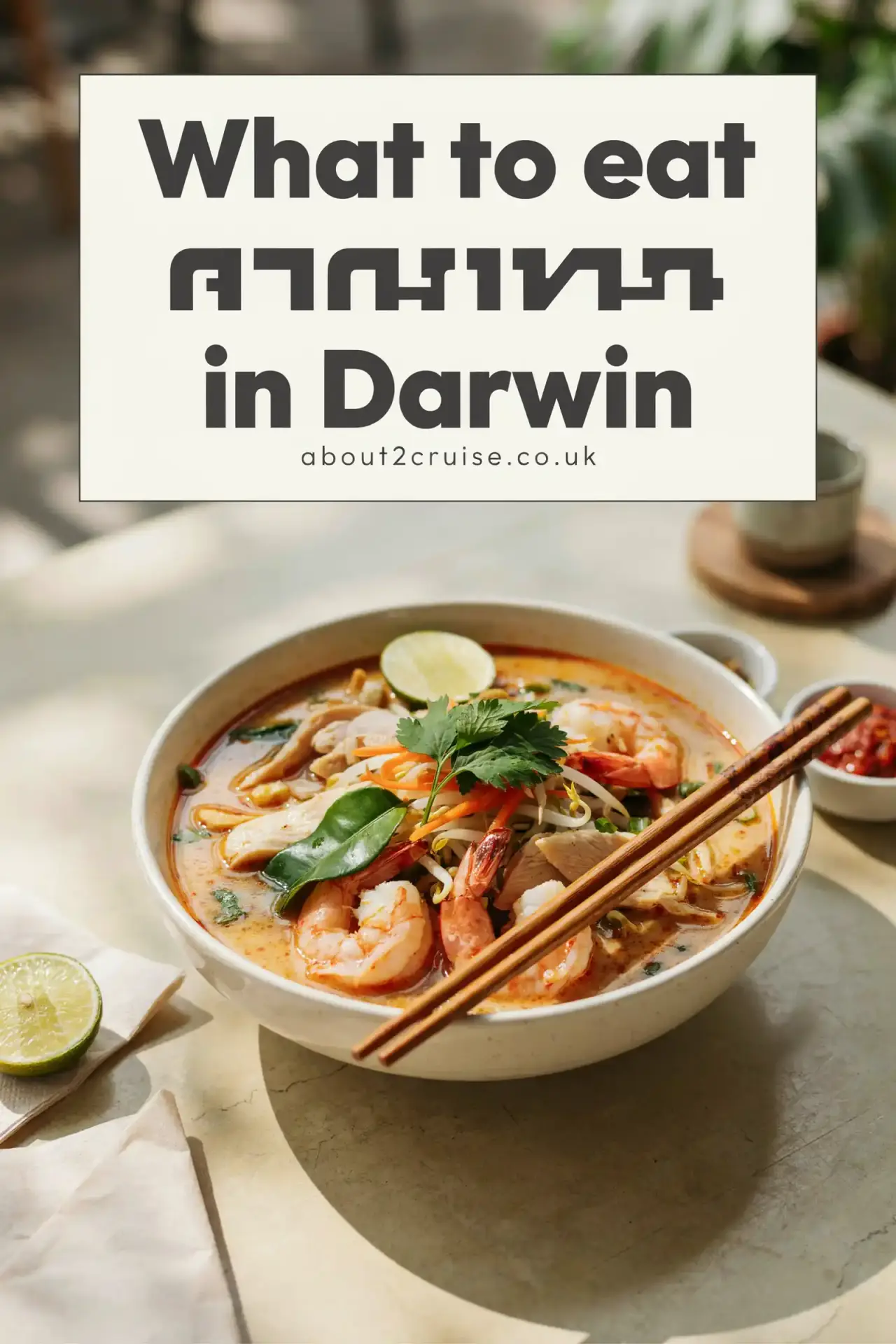
For a casual port-day meal, walk to the fish-and-chip counters at the end of Stokes Hill Wharf, eat in the Waterfront precinct, or browse the food stalls at Mindil on market days. If you have time on Saturday morning, Parap Village Markets is the local laksa pilgrimage, but it’s slightly out of the centre so allow taxi time.
Who owns Darwin Port (and why it doesn’t affect your cruise)
Darwin Port is held on a 99-year lease awarded to Landbridge for A$506 million. This has been politically contested in Australia, and you may see headlines about “take back Port Darwin” or Landbridge’s legal case over the lease. As a cruise passenger, none of this changes your port day. You still dock at Fort Hill Wharf, clear security, and follow the same terminal process. The ownership question is a political and regulatory issue, not a practical cruise-day problem.
How to spend a port day in Darwin
A port day in Darwin works best if you pick one: a walkable city and Waterfront day, or a longer day out to Litchfield National Park. Mindil Beach market is worth planning around if your call falls on a Thursday or Sunday in the dry season.
Before you sail
- Book the Cage of Death online early if you want it. Slots are heavily pre-booked.
- Apply for an Australian ETA or Visitor visa before you travel.
- Check your berth and arrival on portinfo.darwinport.com.au.
Short port day: under 6 hours
- On dockingWalk to the WWII Oil Storage TunnelsIn the wharf precinct a short walk from the ship. They tell the story of the bombing of Darwin.
- +30 minRFDS Darwin Tourist FacilityA 15-minute walk from the terminal on Stokes Hill Wharf. Screens, virtual reality and holograms bring the bombing of Darwin to life.
- +1 hr 15 minLunch at Stokes Hill WharfTry laksaFish and chips at the wharf end. Laksa is Darwin's unofficial dish and appears at market stalls.
- +2 hrs 30 minCrocosaurus CoveBook Cage of DeathWalk via the Waterfront skybridge to Mitchell Street. See Australia's largest reptile display and daily croc feed shows.
- +4 hrsBig Croc Feed Show or Mitchell Street shopsStay for a feeding show or browse Indigenous arts and crafts nearby. Wrist passes let you come and go.
- All-aboard minus 1 hrWalk back to the terminalFrom Mitchell Street it is a 12 to 15 minute walk back to Fort Hill Wharf via the Waterfront skybridge.
The time on the map is the whole walk, every stop added together.
Open this walking route in Google Maps
If plans change: If Crocosaurus Cove is too busy, swap in the Wave Lagoon and the RFDS exhibition, and leave the city walk for another call.
Long port day: 8 hours or more
- On dockingMeet your Litchfield tour at the terminal gatePre-bookShips run full-day Litchfield excursions. Private drivers wait outside the secure gate on Anchorage Court; you cannot walk to Litchfield.
- +30 minDrive to Litchfield National ParkAllow 1.5 to 2 hours each way. The park is about 100 km from Darwin.
- +2 hrs 30 minMagnetic termite mounds and waterfallsStop at the magnetic termite mounds, then continue to a waterfall and swimming hole. Bring a towel, water and proper footwear.
- +3 hrs 30 minLunch in the parkTry barramundiEat a picnic lunch or whatever your tour provides. Barramundi is the Territory's fish and often appears on menus.
- +5 hrsSee more falls and swimming holesWalk short tracks to waterfalls and swimming holes. Bring a towel, water and proper footwear.
- +5 hrs 30 minDrive back to DarwinLeave the park with your driver in time to clear security. The drive back is 1.5 to 2 hours.
- All-aboard minus 90 minBack at Fort Hill WharfAim to be at the terminal gate with time to clear security. The drive from Litchfield is 1.5 to 2 hours.
This map shows the taxi ride from the ship. The time is the drive only, not your time ashore.
Open the taxi route in Google Maps
If plans change: If the tour is cancelled or the park is closed, fall back on the Waterfront, WWII tunnels and Crocosaurus Cove, which are all walkable from the ship.
Darwin cruise port FAQs
Where exactly do cruise ships dock in Darwin?
At Fort Hill Wharf, also known as the Darwin Cruise Terminal, at 1 Anchorage Court, Darwin City. Not Stokes Hill Wharf or East Arm Wharf.
How far is the cruise terminal from the city centre?
Smith Street Mall is about 1.1–1.2 km away, normally a 12–15-minute flat walk. There is no tender.
Is there a free shuttle from the cruise terminal to the CBD?
Not exactly. The free Waterfront Shuttle loops around the Waterfront and Stokes Hill Wharf but does not go to the CBD. Darwin’s public buses are free and can get you into the city or further out. Some cruise lines also run their own city shuttle, but it is not guaranteed.
How much is a taxi from Fort Hill Wharf to Smith Street Mall?
About A$12, with a 1–5% card surcharge in taxis. Rideshare also operates, and the pickup is outside the terminal gates.
Do I need an Australian visa for a cruise call in Darwin?
Yes. You need an ETA subclass 601 or a suitable Visitor visa before arriving. The ETA costs A$20 via the Australian ETA app and allows multiple entries over 12 months.
Can I take food off the ship in Darwin?
No. All ship food must stay on board. Declare or dispose of any fresh food, plants, seeds, or animal products. Biosecurity rules are strictly enforced.
Can I do Kakadu in a day from a cruise ship?
No. Kakadu is about three hours’ drive each way and cannot be seen on a day trip. Litchfield National Park is borderline and works best as a ship-organised excursion on a long call. A jumping-crocodile cruise on the Adelaide River is the most realistic Top End nature option for a transit day.
Is it safe to swim at Darwin beaches?
Do not swim at natural beaches or in the harbour. Saltwater crocodiles and box jellyfish are real risks. Use the Wave Lagoon or designated stinger-netted swimming areas.
What does “what’s in port” mean for Darwin?
Usually it means which cruise ship is berthed at Fort Hill Wharf or expected in Darwin Harbour today. Check portinfo.darwinport.com.au/webx for the official live schedule.
More Australian cruise port guides
If your itinerary also calls in the south or the Pacific, see our Tasmania cruise ship port guide and Norfolk Island, Australia cruise ship port guide. For the wider route, start with the Australia Cruise Ship Ports Guide.
Last Updated: 14 November 2026