
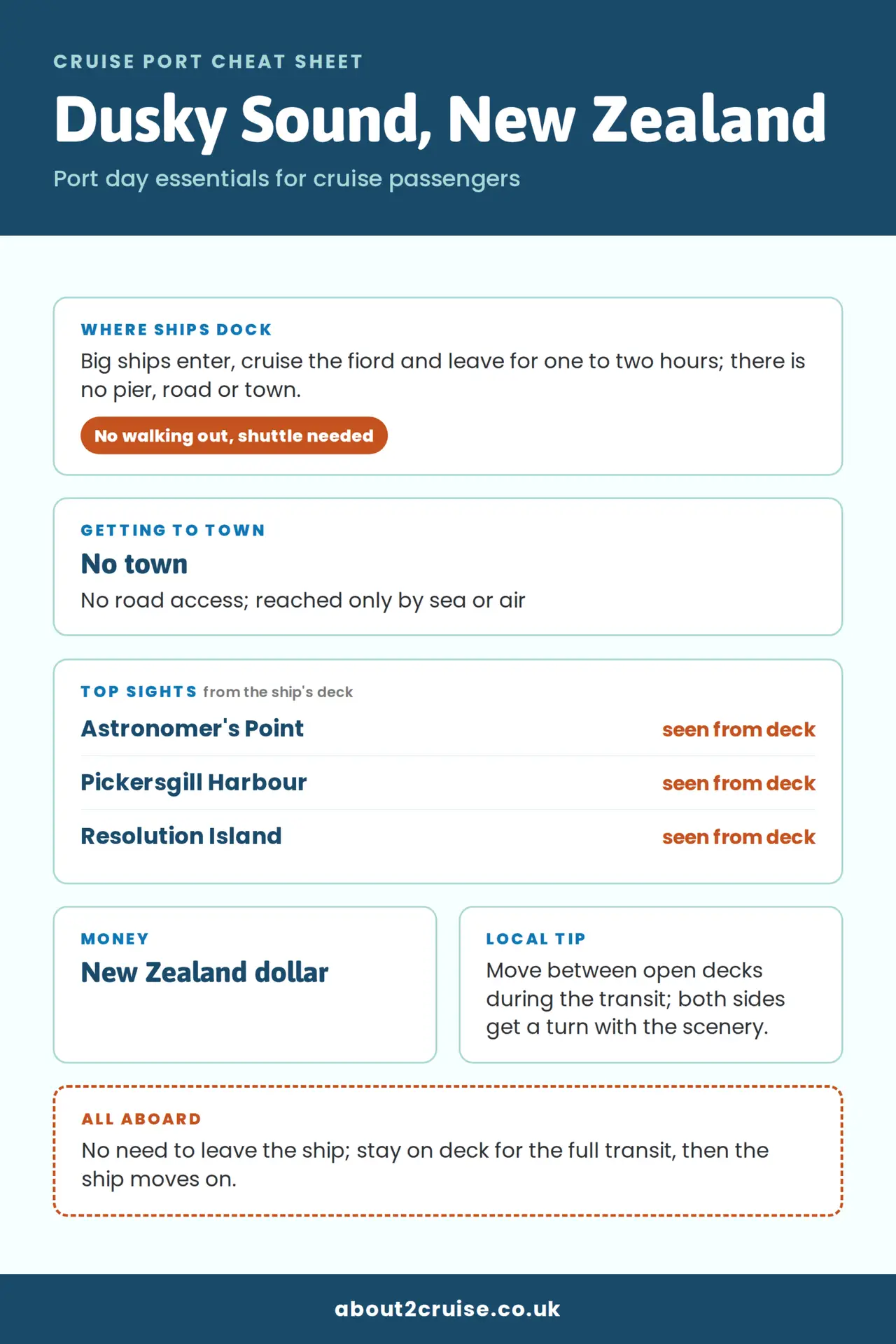
Dusky Sound is a remote Fiordland scenic-cruising day, not a conventional port. There is no pier, no road and no town. Big cruise ships enter, cruise the fiord and leave; passengers watch from deck for about one to two hours. Small expedition ships may use Zodiacs, kayaks or shore landings, but only if conditions allow.
What Is Dusky Sound, Exactly?
Tamatea / Dusky Sound sits in the remote southwest of New Zealand’s South Island, inside Fiordland National Park and the Te Wāhipounamu South West New Zealand World Heritage Area. It’s the largest fiord in the country, around 40 km long and dotted with more than 350 islands. Despite the name “sound,” it’s geologically a fiord: a glacier-carved valley that the sea later filled. The word “sound” survives from early charting and long-established use, which is why Fiordland uses the term.
For cruise passengers, the practical point is simple: this is a scenic cruising area, not a port. Ships don’t dock. There’s no terminal, no shore power, and no visitor facilities.
Dusky Sound cruise port map
Ships dock at Dusky Sound cruise port. Tap a pin for directions.
- Dusky Sound cruise portWhere ships dock
- Astronomer’s PointHistoric point · About 15 km from Dusky Sound cruise port
- Acheron PassageSea passage · About 8 km from Dusky Sound cruise port
- Cooper IslandIsland · About 7 km from Dusky Sound cruise port
- Long IslandIsland · About 6 km from Dusky Sound cruise port
- Doubtful Sound / PateaSound · About 48 km from Dusky Sound cruise port
- Resolution IslandIsland · About 11 km from Dusky Sound cruise port
- Anchor IslandIsland · About 18 km from Dusky Sound cruise port
- Indian IslandIsland · About 13 km from Dusky Sound cruise port
- Luncheon CoveCove · About 18 km from Dusky Sound cruise port
- Supper CoveCove · About 16 km from Dusky Sound cruise port
- Cascade CoveCove · About 14 km from Dusky Sound cruise port
- Duck CoveCove · About 7 km from Dusky Sound cruise port
- Wet Jacket ArmSea arm · About 13 km from Dusky Sound cruise port
- Breaksea SoundSound · About 23 km from Dusky Sound cruise port
- Chalky InletInlet · About 28 km from Dusky Sound cruise port
- Preservation InletInlet · About 34 km from Dusky Sound cruise port
Why Do Cruise Ships Visit Dusky Sound?
Dusky Sound is one of the least modified and most isolated parts of New Zealand. Steep forested cliffs plunge into deep water, small islands break up the surface, and after heavy rain the rock faces turn into hundreds of temporary waterfalls. It’s part of a UNESCO-listed wilderness that most people only ever see from the water. Compared with Milford’s sheer granite walls, Dusky feels wider, more island-studded, and much quieter than Doubtful.
Captain Cook’s First Visit and the History Behind Dusky Sound
James Cook first spotted the entrance on 13 March 1770 but didn’t go in. Unsure whether he could reach it before dark, he named it “Dusky Bay” for its sombre look and kept sailing. He returned on his second voyage in 1773, entering on 26 March and staying until 11 May.
HMS Resolution spent six and a half weeks here. The crew’s base was Pickersgill Harbour on the south-east shore, where they set up an observatory, a blacksmith’s shop, a sailmaker’s camp, and even a brewery. Many names around the sound, Anchor Point, Luncheon Cove, Astronomer Point, Wet Jacket Arm, Indian Island, come from that voyage. A plaque at Astronomer’s Point marks the site. Nineteen years later, sealers at Luncheon Cove became the first European residents of New Zealand.
Waterfalls, Islands and a Landscape Carved by Ice
The shape of Dusky Sound is glacial. Ice carved the U-shaped valleys and left behind a maze of islands and arms. The sound has two entrances and an open-ended connecting passage, Acheron Passage, which separates Resolution Island from the mainland. That matters if you’re cruising: ships can transit through rather than turning around.
Waterfalls are a big highlight. After sustained rain, temporary falls appear across the cliffs. The most dramatic viewing often comes 12 to 24 hours after a heavy front, when the rock faces are still draining. You don’t need perfect sunshine for a good day here, rain is part of the show.
Wildlife You Can Actually See (and Where)
Keep an eye out for New Zealand fur seals, Fiordland crested penguins, and little blue penguins. Bottlenose dolphins live inside the sound, and humpback and southern right whales pass offshore. Anchor Island/Puke Nui is home to about one third of the world’s kākāpō. Resolution Island, New Zealand’s fifth largest island, is the biggest island in Fiordland National Park and part of a restoration project covering more than 700 islands. Blue cod in Dusky Sound are among the healthiest surveyed in New Zealand.
Most wildlife is seen from the ship or a Zodiac, not from shore. Bring binoculars if you have them. You won’t get close to the conservation islands because access is restricted.
No Pier, No Town, No Road: What That Means for Cruisers
Dusky Sound is only reachable by sea or air. There’s no road, no mobile phone coverage, no shop, no ATM, and no café. The nearest town, Te Anau, is roughly 90 km away across rugged country. The only walking route is the Dusky Track, an 84 km, 8–10 day tramp with river crossings and three-wire bridges.
Because there’s no dock, “Dusky Port” isn’t a real cruise port. If your itinerary says “Dusky Sound (Cruising),” that’s exactly what it means: the ship will cruise, not berth.
Which Cruise Lines Include Dusky Sound on New Zealand Itineraries?
Mainstream cruise lines regularly include Dusky Sound as part of New Zealand scenic cruising days. Royal Caribbean’s Anthem of the Seas, Celebrity Edge, and various Princess ships feature it on Australia–New Zealand and New Zealand round-trip voyages. These are scenic transits, not port calls with time ashore.
On the expedition side, Ponant’s Le Soléal includes Dusky Sound on subantarctic itineraries and mentions Zodiac exploration “weather and time permitting.” Heritage Expeditions spends two days inside Dusky Sound on its Fiordland programmes, using Zodiacs, kayaks, and shore landings from an 18-guest vessel.
There’s no official published call schedule for Dusky Sound, so passenger numbers are never simple. It’s part of a day, not a destination terminal.
What a Big-Ship Scenic Cruising Day Looks Like
Most ships treat the Fiordland coast as one full day. On a southbound New Zealand sailing, the usual order is Dusky in the morning, Doubtful around midday, and Milford in the afternoon. From Australia directly to Fiordland, the order can reverse. Celebrity Edge has published a timetable giving Dusky Sound 08:30–10:15, Doubtful 11:45–13:15, and Milford 17:00–18:00 on the same day. Royal Caribbean’s Anthem of the Seas, on a different routing, listed Milford at 10:00, Doubtful at 14:00, and Dusky at 18:00.
That means you may have one to two hours in Dusky Sound, often early or late in the day. The ship will slow, cruise through, and the captain or naturalist will usually provide commentary. There’s no going ashore.
Port or Starboard? Timing, Route and Where to Stand
Dusky Sound has more than one entrance. Ships often transit the sound, entering by one passage and exiting by another, rather than turning around as they do in Milford. That means both sides of the ship get a turn with the landscape: one side may be closer on the way in, the other on the way out.
Don’t camp on one side of the ship. Move between open decks, especially forward or aft, for the widest view. If your ship enters in the morning, the sun may be low over the hills. If it enters in the evening, the light is warmer and longer. There’s no single “best side” for the whole visit.
Expedition Cruises and Shore Landings in Dusky Sound
Big-ship itineraries do not land passengers in Dusky Sound. If getting off the vessel is non-negotiable, you need a small expedition ship. Heritage Expeditions uses Zodiacs, kayaks, and guided shore landings inside the sound. Ponant mentions Zodiac access when weather and time permit, but that’s part of an expedition voyage, not a port stop.
The difference matters: mainstream scenic cruising is deck-based only. Expedition cruising is active, permit-dependent, and far more expensive, but it’s the only way to step ashore in Dusky Sound on a commercial cruise.
Weather, Visibility and the Best Time to Visit Dusky Sound
Fiordland is wet all year. Milford Sound, the nearest long-record climate station, averages up to seven metres of rain annually. Every month is wet: January is the wettest at around 667 mm, June the driest at around 440 mm. Summer daytime highs at Milford average about 19.5°C, winter highs about 9.2°C. Winter is often the most settled time, but daylight is only about 08:30–16:30.
The New Zealand cruise season peaks December to February, with shoulder months October–November and March–April. Ships can miss the sounds entirely if weather closes in. Very strong wind is usually the only weather that cancels a fiord cruise, but visibility can drop to almost nothing. Pack for rain and treat the day as changeable. Rain makes the waterfalls far better, so low cloud isn’t always a disaster.
Dusky Sound vs Doubtful Sound vs Milford Sound
Milford Sound is the famous one: narrow, vertical, dramatic, and road-accessible. It’s also busy and often visited on the same cruise day. Doubtful Sound is wider, longer, quieter, and accessed from Lake Manapouri. Dusky Sound is the largest and most remote of the three, with hundreds of islands and strong historical connections. It lacks Milford’s sheer rock faces but feels wilder and emptier.
On a cruise, you don’t have to choose: most itineraries include all three. For a first-time visitor, Milford is the easiest land-based trip. For a repeat visitor or someone who wants remoteness, Dusky is the one that feels least touched.
Can You Visit Dusky Sound Without a Cruise Ship?
There’s no day trip to Dusky Sound. The shortest scheduled products are four to five nights, and independent access is only by sea or air. The main choices are:
- SEA Fiordland: 4-night/5-day Dusky and Doubtful Sound adventure on MV Tasman Explorer for up to 10 guests, from NZ$4,300 per person. Includes a 30-minute helicopter flight to the vessel.
- Heritage Expeditions: 5-day Undiscovered Dusky Sound, from NZ$5,245 to NZ$7,160 per person, with helicopter transfers between Te Anau and Supper Cove.
- Fiordland Jewel: 6-night Southern Fiords itineraries from NZ$4,750 to NZ$10,000 per person twin share; 9-night Grand Tour from NZ$6,925 to NZ$13,300.
- MV Tutoko: private expedition charter from NZ$4,500 per night for up to 8 guests.
- Shadowland Expeditions: overnighting Dusky Sound trip from NZ$15,000 per night for up to 8 guests, with helicopter transfers quoted separately.
- Scenic helicopter flights: Doubtful and Dusky flights from Te Anau cost around NZ$1,345–NZ$1,550 per adult, with landings depending on the route.
These trips are small, remote, and weather-dependent. They’re not the same as a port excursion, they’re multi-day expeditions. Some departures also have a conservation focus, with profits going to the Tamatea restoration project.
Prices and What It Actually Costs to See Dusky Sound
There’s no cheap way to see Dusky Sound by itself. Mainstream cruise passengers already have the scenic day covered in their fare, but the trade-off is no landing and limited time. An independent small-ship or charter trip costs thousands of New Zealand dollars per person, often with helicopter transfers included. The value is in access: you’re paying for remoteness, small group size, and the chance to enter areas big ships can’t reach.
If you only want a low-cost look, the scenic cruise deck is the answer. If you want to kayak, step ashore, or spend the night inside the sound, budget for an expedition product.
Getting There: Overland, by Air and on Foot
There’s no road to Dusky Sound itself. The usual bases are Queenstown, Te Anau, Manapouri, or Invercargill. Manapouri is about 2.5–3 hours from Queenstown and 30 minutes from Te Anau. Invercargill to Manapouri is around 157 km, or just under two hours by road.
Expedition departures typically start from the RealNZ visitor centre at Pearl Harbour, Manapouri, or from Te Anau airport by helicopter. A few operators include Queenstown transfers, usually as an extra. If you’re not joining an expedition, helicopter scenic flights leave from Te Anau and land inside the sound.
Hikers can reach the area on the 8–10 day Dusky Track, but this is a serious backcountry tramp, not a shore excursion.
Entry Rules, Currency and Phone Coverage
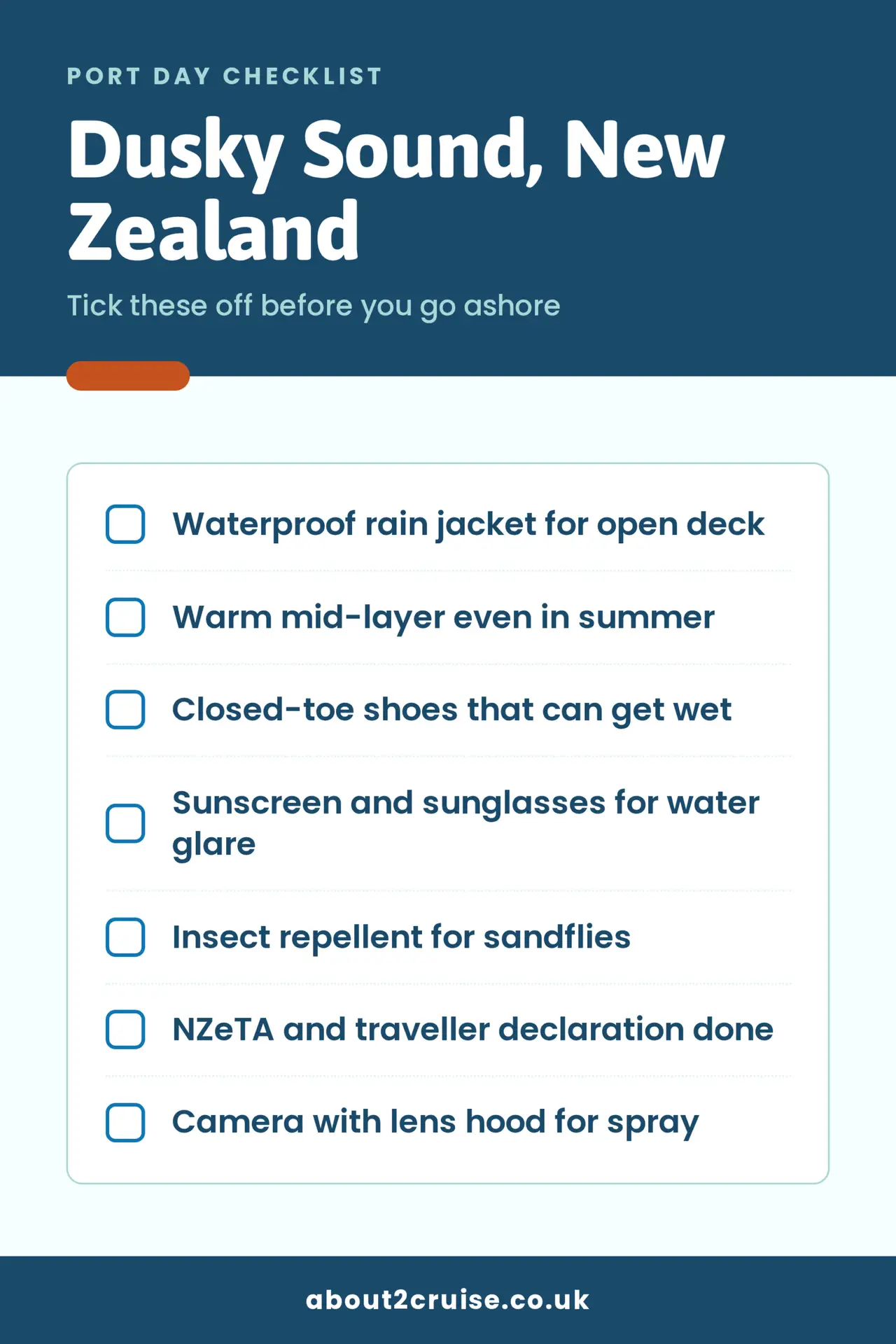
Every cruise ship passenger needs a New Zealand Electronic Travel Authority (NZeTA) unless they hold a New Zealand or Australian passport or a valid NZ visa. The NZeTA costs NZ$17 through the app or NZ$23 online, plus the International Visitor Conservation and Tourism Levy of NZ$100. It’s valid for two years. Cruise passengers are deemed to hold a visa for a maximum of 28 days from first arrival on that voyage. If you fly into New Zealand to join a cruise, normal air entry requirements apply.
Dusky Sound itself has no connectivity, no ATMs, and no shops. Withdraw New Zealand dollars before travelling to Fiordland if you think you’ll need cash, although contactless payment is standard in towns. You cannot take fresh fruit, vegetables, most meats, honey, flowers, seeds, or prepared meals ashore in New Zealand; failing to declare biosecurity items can bring an instant NZ$400 fine.
What to Wear and Pack for a Dusky Sound Cruise
A waterproof outer layer is essential, not optional. Even in summer, open water cools the air, so bring a mid-layer. Closed-toe shoes you don’t mind getting wet are better than sandals. Add sunscreen and sunglasses for glare off the water, and insect repellent for sandflies.


For a deck-based scenic day, pack a waterproof rain jacket designed for changeable weather, a portable charger with built-in cables if you’ll be using your phone for photos, and a waterproof phone pouch for spray and rain. Layering beats one heavy coat because deck temperatures change between sheltered sections and exposed stretches.
Photography Tips and Wildlife Rules
Named viewpoints to watch for include Astronomer’s Point, Pickersgill Harbour, Luncheon Cove, Anchor Point, Resolution Island, Cooper Island, Long Island, and Anchor Island. Rain creates the best waterfall photography, so don’t put the camera away in bad weather. A lens hood and microfibre cloth help with spray.

Keep your distance from wildlife. Vessels must stay at least 20 m from shore where seals are present, at least 50 m from fur seal colonies, and 20 m from other wildlife. No more than three vessels should approach marine mammals within 300 m at once. Red and black coral are protected. In sensitive areas, anchoring is banned because of brittle coral and bryozoan colonies. Look, don’t touch.
Food, Drink and Where to Stay Nearby
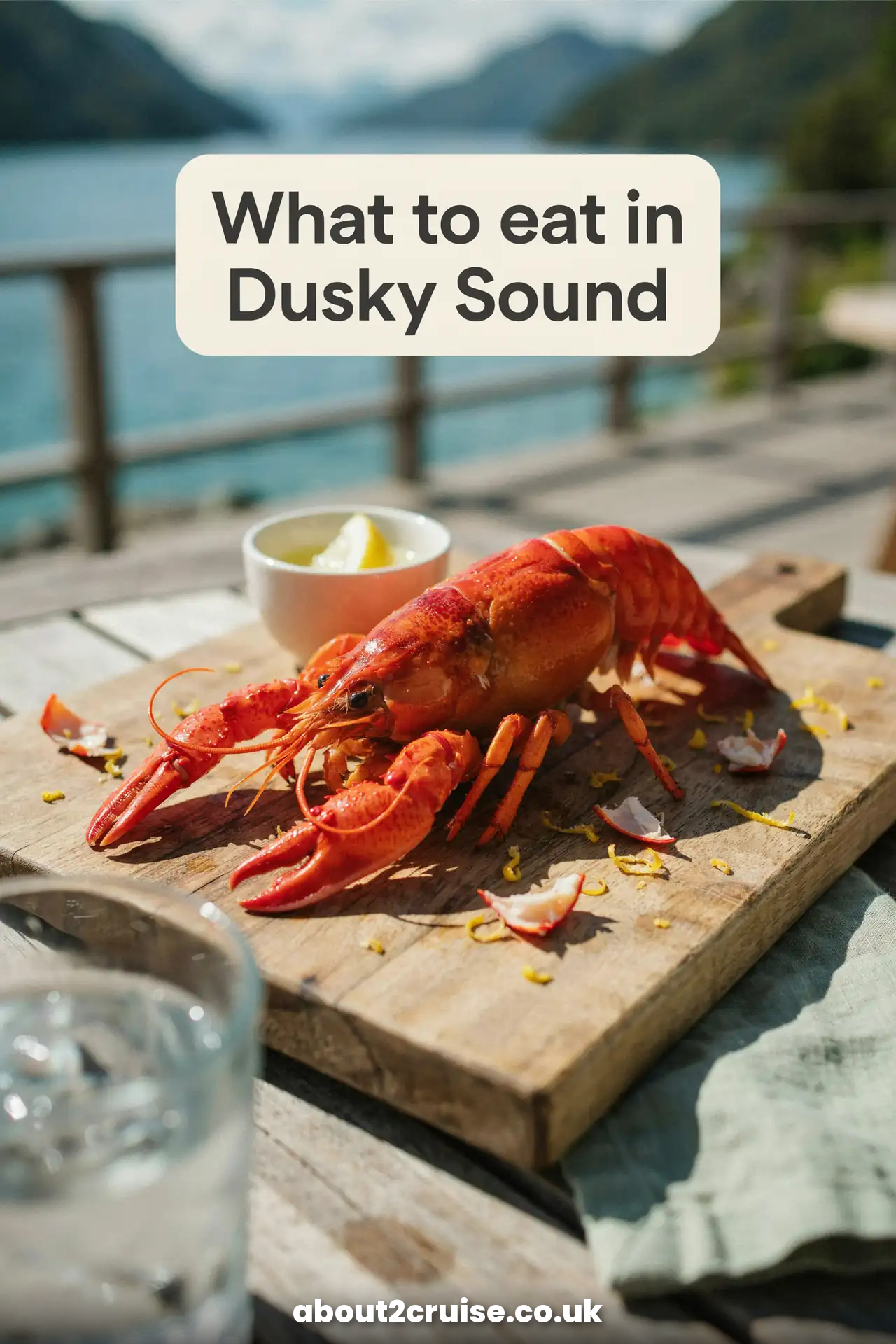
There’s nothing to eat or drink ashore in Dusky Sound. The ship is your only option during the call. The historic food connection is crayfish: Cook’s crew ate it at Luncheon Cove, and Fiordland rock lobster still appears on menus in Te Anau, along with wild venison, blue cod, and river trout. Blue cod from Dusky Sound is considered some of the healthiest in New Zealand.
After a small-ship or helicopter trip, most people overnight in Te Anau or Manapouri. Options include Kingsgate Hotel Te Anau, Fiordland Lakeview Motel and Apartments, The Village Inn Hotel in Te Anau, and Possum Lodge in Manapouri, which is close to the RealNZ visitor centre at Pearl Harbour.
Parking and Luggage
Dusky Sound has no car park, terminal, or left-luggage facility because it has no road or buildings. For expedition departures, free parking is available at Manapouri or at the Te Anau helicopter base. If you’re flying via Queenstown, the airport offers self-service lockers outside the terminal, charged per 12 hours and payable by card only.
Which New Zealand Cruise or Line Is Best?
For mainstream scenic cruising, Royal Caribbean, Celebrity, and Princess all include Milford, Doubtful, and Dusky sounds on many New Zealand itineraries. Celebrity Edge is a strong choice for a modern ship with good open decks and an outward-facing design. For expedition landings, Heritage Expeditions and Ponant are the realistic options.
General cruise line satisfaction varies widely. In UK consumer testing, Saga Ocean Cruises scored highest for customer satisfaction and Norwegian Cruise Line lowest among major operators, while separate review analysis put Costa and MSC at the top of the dissatisfaction table. Those findings aren’t specific to Dusky Sound, but they’re worth considering if you’re choosing a longer Australia–New Zealand sailing. Yes, you can take a cruise ship from Australia to New Zealand: many Fiordland scenic days are embedded in Sydney–Sydney, Sydney–Auckland, or Auckland round-trip voyages.
How to spend a scenic cruising day in Dusky Sound
A scenic cruising day in Dusky Sound is deck-based: stay on open decks for the one to two hour transit, then let the ship move on to the next fiord.
Before you sail
- Get a NZeTA online unless you hold a New Zealand or Australian passport.
- Check your itinerary says scenic cruising, not a landing.
- Book an expedition cruise if you want to step ashore.
Scenic cruising day: 1 to 2 hours
- On entry to the soundHead to an open forward deckNo landingThere is no going ashore; the ship will transit the fiord for one to two hours.
- +15 minWatch for Astronomer's PointCaptain Cook's observatory site can be seen from the deck; a plaque marks it.
- +30 minMove to the other sideShips often enter by one passage and exit by another, so both sides get a turn.
- +1 hrSpot Resolution and Anchor islandsResolution Island is the largest in Fiordland; Anchor Island holds kākāpō.
- +1 hr 15 minLunch on deckTry blue codThe ship is the only food option; look for New Zealand blue cod or crayfish if served.
- At the sound exitStay on deck for the next fiordDoubtful or Milford usually follows; keep your camera ready.
The times on the map are for the whole journey there by train and bus.
Get train and bus times in Google Maps
If plans change: If the ship skips Dusky Sound, use the extra deck time to scout viewpoints for Doubtful and Milford later in the day.
Dusky Sound Cruise FAQs
Is Dusky Sound a fjord or a sound?
Geographically, it’s a fiord, a glacier-carved valley flooded by the sea. The name “sound” survives from early charting and official use, which is why Fiordland uses the term.
Can I do Dusky Sound as a day trip?
No. There’s no road access and no scheduled day trip. The shortest commercial products are four to five nights. Your realistic day-trip option is a scenic helicopter flight from Te Anau.
Do cruise ships go into Doubtful Sound too?
Yes. Many New Zealand scenic cruising days include Dusky, Doubtful, and Milford sounds on the same calendar day. Doubtful is wider and quieter than Milford, with no road access.
Does a mainstream cruise ship ever put passengers ashore in Dusky Sound?
No. Mainstream ships treat Dusky as a scenic transit only. Only small expedition ships with the right permits and conditions may use Zodiacs, kayaks, or shore landings.
Which side of the ship is best in Dusky Sound?
Neither side wins for the whole transit. The ship often enters by one passage and exits by another, so both sides get a turn. Move between open decks instead of fixing yourself to one balcony.
What is the best month to cruise Fiordland?
December to February offers the longest daylight and the main cruise season, but it’s also the wettest. October–November and March–April are good shoulder periods. Winter is often more settled but darker and less served by mainstream cruises.
Is it Dusky Sound or Dusky Sounds?
The official name is Tamatea / Dusky Sound. “Dusky Sounds” is a common misspelling. The word “Dusky Port” is also a search query, but there’s no such port.
Do I need a NZeTA for a cruise that only scenic cruises in Fiordland?
Yes. Cruise passengers still need an NZeTA and must complete New Zealand border declarations unless they hold a New Zealand or Australian passport. The Fiordland scenic day is inside New Zealand waters.
What is Shadowland Expeditions?
Shadowland Expeditions is a specialist Fiordland operator offering overnight Dusky Sound trips for small groups. It’s a private expedition product, not a port excursion, with helicopter access and a high nightly charter rate.
Last Updated: 19 November 2026