
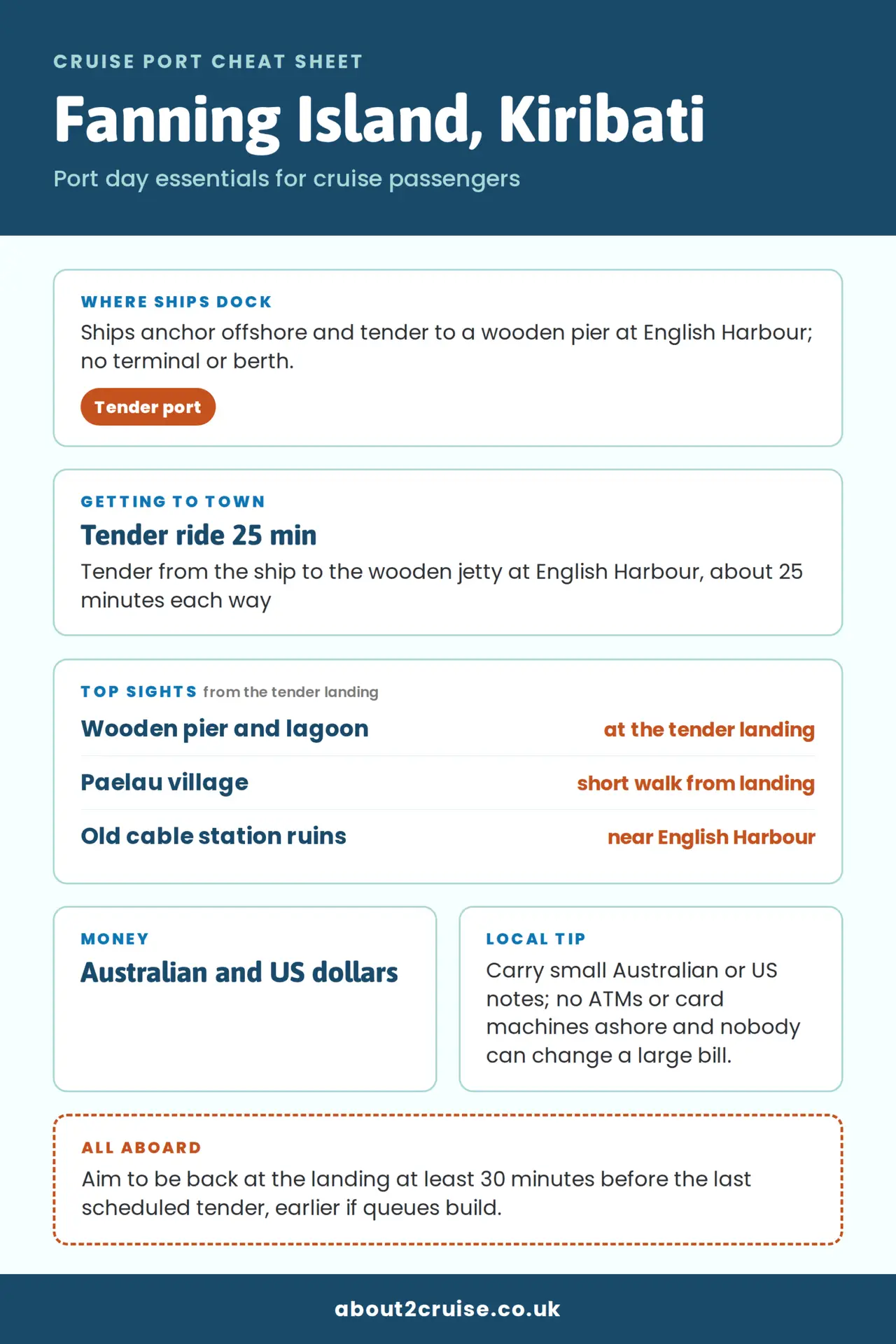
Fanning Island, officially Tabuaeran, is a remote coral atoll in Kiribati’s Line Islands where cruise ships anchor offshore and send passengers by tender to a simple wooden pier at English Harbour. Expect village welcomes, craft stalls, lagoon swimming and a genuinely undeveloped Pacific island, not a terminal. Calls are rare, weather-dependent and, when they work, unforgettable.
What Makes Fanning Island Famous?
This is one of the most remote cruise landings in the Pacific. On a ship day, the real highlight is usually human rather than architectural. Families sing at the jetty, children follow the tender along the shore, and craft sellers set up simple tables nearby.
For years, Norwegian Cruise Line used Fanning Island as a weekly foreign-port stop on Hawaii-based sailings. That’s how many repeat cruisers first heard of it. Those weekly calls ended long ago, so today the atoll feels more like a rare transpacific bonus than a regular port.
Fanning Island Map: Key Spots to Know
Tenders bring you ashore at Fanning Island cruise port. Tap a pin for directions.
- Fanning Island cruise portWhere ships dock
- Paelau villageVillage · About 6 km from the tender landing
- Tereitaki villageVillage · About 9 km from the tender landing
- AontenaAbout 6 km from Fanning Island cruise port
- BetaniaAbout 8 km from Fanning Island cruise port
- TereitannanoAbout 6 km from Fanning Island cruise port
- AramariAbout 6 km from Fanning Island cruise port
- Tabuaeran AirportAirport · About 9 km from Fanning Island cruise port
Is It Fanning Island or Tabuaeran? The Name Explained
Both names refer to the same atoll.
Tabuaeran is the current official Kiribati name, often translated as “heavenly footprint.” Fanning Island is the older Western name, given after American captain Edmund Fanning, who sighted the uninhabited atoll in 1798.
Cruise itineraries and onboard announcements usually say Fanning Island because that’s what most passengers recognise. Local signs, official documents and the national government use Tabuaeran. Both names are recognised in Kiribati’s constitution, so don’t be confused if you see either one.
Why This Tiny Atoll Stands Out in Kiribati and the Line Islands
Kiribati has an enormous ocean territory but very little land. The Line Islands are the country’s easternmost chain, sitting close to the International Date Line and roughly 1,000 nautical miles south of Hawaii.
Fanning Island is one of the first places in Kiribati to enter a new day because the country shifted the Date Line eastward. It’s also almost exactly on the Equator: about 3° north. That means hot, low-lying, palm-covered reef country, not an Arctic landscape. If you’ve arrived here while searching for Arctic cruises, this is a very different part of the world.
Do Cruise Ships Still Visit Fanning Island?
Yes, but not often. Most calls now happen on long transpacific or repositioning voyages rather than regular weekly Hawaii-based runs.
You might see Tabuaeran listed on a 35-night Holland America round trip from San Diego or on Ritz-Carlton Yacht Collection crossings between Honolulu and Papeete. Cancellations are common. Rough sea can stop a landing on the day itself, and operators sometimes drop the call for scheduling or speed reasons. Some sailings simply pass the atoll as scenic cruising without going ashore.
Which Cruise Lines Call at Tabuaeran?
Holland America Line ships such as Koningsdam and Zaandam have been among the most consistent recent callers on long Pacific voyages. Ritz-Carlton Yacht Collection’s Evrima includes the atoll on 12-night crossings between Honolulu and Papeete. A few small-ship and expedition itineraries also include it as part of broader South Pacific routes.
No cruise line currently calls every week. If Fanning Island is a must-see for you, book a specific departure that lists it and keep your expectations flexible.
Anchorage and Tender Landing: What the Port Actually Looks Like
There is no terminal, berth or pier building. Ships anchor outside the reef and passengers go ashore by tender.
Most cruise calls use the west side near English Harbour, where a wooden jetty reaches into the lagoon. Some navigational sources also mention Napari at the northern end of the atoll, so the exact anchorage can vary by vessel.
The atoll is about 11 miles long and 7 miles wide. The lagoon is mostly very shallow, and the narrow pass into it controls whether the landing works on any given day.
Tender Tips and Return-to-Ship Timing
Tender rides usually take around 25 minutes each way. The boat has to thread through the narrow English Channel entrance into the lagoon, and in rough seas the operation is stopped for safety.
The first tender of the day may be reserved for crew carrying supplies or gifts ashore, so passenger service can start later than on a normal port day. Tenders have also been known to scrape bottom in shallow water, which slows things down.
Be back at the landing at least 30 minutes before the last scheduled tender, and earlier if the queue looks long. The return time is the one thing you don’t want to get wrong. If you’re on the far side of the island and the last tender is at 16:30, you’ve left it too late.
The western side around English Harbour is the normal passenger landing area. Paelau, the administrative centre, sits immediately south of the pass. Tereitaki is the largest village. Napari, at the northern end, is where the airstrip is located.
The highest point of land is only about 3 metres above high tide, and the lagoon covers roughly 110 square kilometres.
Can You Go Ashore? Entry and Accessibility
Yes. If the ship’s call goes ahead and you can manage a tender, you can go ashore independently. Cruise passengers usually need a passport or at least the photo ID specified in the daily programme, so don’t leave everything in the safe if the instructions say passport required.
Independent travellers can reach the atoll by flight or supply ship, and yachts need to clear in at Kiritimati first. The tender, jetty and sandy paths are not wheelchair accessible.
Getting to Fanning Island Without a Cruise
Fly to Kiritimati (Christmas Island) on the weekly Fiji Airways service from Nadi or Honolulu. Then take the Air Kiribati Twin Otter flight to Tabuaeran. That inter-island flight takes roughly 1 hour 15 minutes to 1 hour 30 minutes, usually operates around twice a week, and allows about 15 kg of baggage. The grass runway is at Napari in the north-west.
Delays are common, so build in extra time and make sure your insurance covers missed connections. A small angling lodge can arrange week-long fly-fishing packages that include the inter-island flight and transfers. An occasional supply ship also calls, but it isn’t a passenger service you can easily book.
What to Do on a Cruise Day at Fanning Island
This is not a shore-excursion factory. Most passengers fill the day with a village walk, a swim or paddle in the lagoon, a look at the craft tables and perhaps a local truck ride.
Before you sail
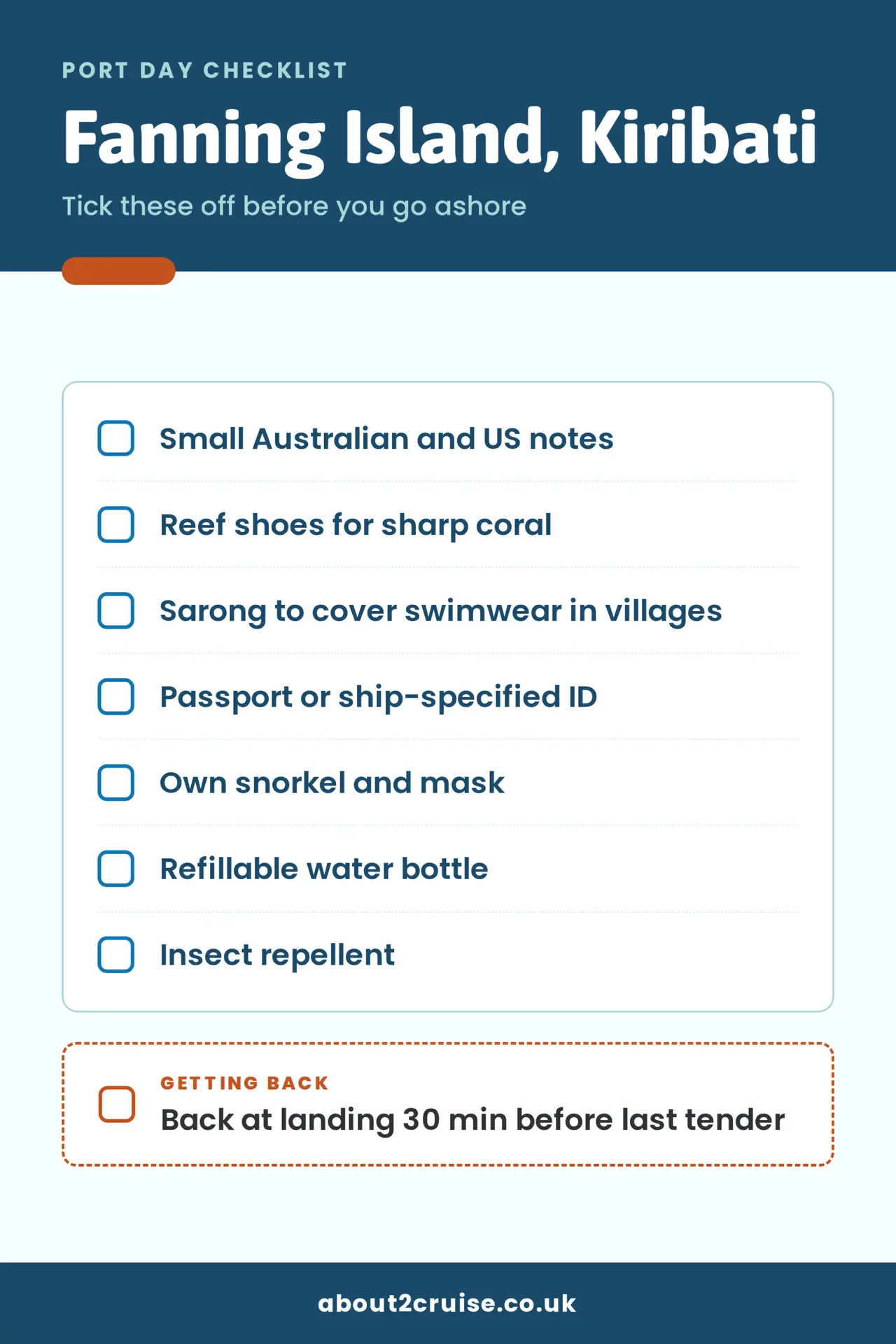
- Bring small Australian and US notes for craft stalls and the local truck tour; no ATMs ashore.
- Pack reef shoes, a sarong for village visits and your own snorkel and mask.
- Check your ship's daily programme for whether a passport or photo ID is required ashore.
Short port day: under 6 hours
- On dockingTake the tender to English HarbourTender ride about 25 minutes to the wooden jetty. Sit near the front for the first view of the lagoon.
- +30 minBrowse the craft tablesBring small notesShell jewellery, pandanus baskets and Kiribati stamps are set out at the landing. Pay in small Australian or US notes.
- +1 hrWalk to Paelau villageCover upA short walk south of the pass. Cover swimwear with a sarong and ask before taking photographs.
- +1 hr 45 minSwim or paddle in the lagoonBring your own maskClear shallow water near the landing. Avoid the channel entrance where currents are strongest.
- +3 hrsSee the old cable station ruinsUnsigned concrete foundations near English Harbour. Ask a local to point out the track.
- +4 hrsBack to the landingWalk back to the jetty, allowing time for the tender queue. There are no cafés or toilets ashore, so bring water and be ready to re-board.
- All-aboard minus 90 minLast tender and lunch on boardTake the tender back to the ship. With no cafés ashore, eat on board and try reef fish cooked with coconut, the everyday Gilbertese dish.
The time on the map is the whole walk, every stop added together.
Open this walking route in Google Maps
If plans change: If the tender landing is skipped for operational reasons, stay on board and treat the atoll as a scenic cruising day; there is no alternative way ashore.
Cultural performances happen only on call days when the community organises them with the ship. There are no ticketed attractions, no museum, no viewpoint with a sign and no beach club. The appeal is the unpaved, unhurried reality of a very remote atoll. Surfers know the island for seasonal breaks, but those are not part of a normal short port call.
Local Tours and Guide Options (Don’t Expect a Shore Excursion Desk)
You won’t find an online shore-excursion inventory to book, and the ship will not sell a list of third-party tours. What exists ashore is informal and arranged on the spot.
An open-air thatched-roof truck tour around the villages costs about US$10 per person. Bicycle hire is sometimes available, or a local guide may walk you to the lagoon or the old cable station ruins. Agree on a price before you set off, and carry small Australian or US notes. On a small expedition ship, the cultural programme may already be included and organised by the expedition team.
Swimming, Snorkelling and Lagoon Safety
The lagoon is shallow and can be clear, warm and good for a cooling swim. The bottom varies between sand, coral rubble and seagrass.
Bring your own mask and snorkel if you want to look for reef fish, because there is no dive shop or rental gear. Some beach areas are soft sand; others are sharp coral pieces that are hard on bare feet. Keep away from the channel entrance where currents are strongest, and don’t swim alone. If the ship runs a beach landing, the crew will point out the safest area.
Village Visits, Culture and Crafts
The craft tables near the landing are the main shopping experience. Expect shell jewellery, woven pandanus baskets, wood carvings, Kiribati stamps and sometimes shark-tooth knives.
Singing and dancing at the jetty are common on ship days but not guaranteed. If you go into a village, cover swimwear with a t-shirt and sarong or wrap. Ask before taking photographs, and don’t walk into private homes uninvited. Being invited into a maneaba, the local meeting house, is a cultural highlight.
Tipping is not part of the culture. Buying crafts and supporting the community directly is the better contribution.
A Quick History: Captain Fanning, Telegraph Cables and War
Captain Edmund Fanning sighted the atoll in 1798 when it was uninhabited. It was later settled by Henry English with workers from Manihiki to produce coconut oil. Britain annexed it, blasted a deeper passage on the west side that became known as the English Channel, and established a relay station for the trans-Pacific telegraph cable.
During the First World War, German sailors landed under a false French flag, destroyed the cable station and dynamited the shore cable before repairs restored the link.
For a cruise visitor, the most tangible piece of this history is the ruin of the old cable station near English Harbour. It is unsigned, so ask a local to point it out.
Population, Villages and Daily Life
At the 2020 census, Tabuaeran had about 1,990 residents. There are several small villages. Paelau is the administrative centre, Tereitaki is the largest settlement, and Napari at the northern end is uninhabited but has the airstrip.
Life is basic by cruise-ship standards. Many homes are thatched and raised on stilts, water comes from wells and rainwater, and people fish, garden and tend coconut and seaweed plots. There is no power grid, no public sewerage system and no hospital. The main health centre at Paelau is staffed by nurse practitioners, with clinics further out.
Reef, Birds and Environment
Tabuaeran is a confirmed Key Biodiversity Area and Important Bird Area, largely because of seabirds and a small colony of the endangered Rimatara lorikeet. The lagoon is shallow and almost enclosed, with extensive mudflats and brackish conditions.
You may see reef-building corals including Acropora and Pocillopora, and occasionally a humphead wrasse. The atoll is heavily planted with coconuts and has no protected-area designation. Rats and feral cats are common, which affects nesting birdlife.
Facilities and What’s Missing
Do not expect cafés, restaurants, bars, car hire, taxis or public toilets. Visitor reports describe no food for sale aimed at tourists and no restaurant at the landing. A few small village stores sell basic provisions, but they are not set up for cruise passengers.
There are no banks, ATMs or money changers ashore. The only tourist accommodation is a small fly-fishing lodge, not a hotel for day visitors. Use the ship’s toilet before you board the tender, carry water, and be self-sufficient for a few hours.
Electricity, Connectivity and Visitor Services
Fanning Island has no phone service and no public power grid. A few locations have satellite internet, but don’t expect to use it as a visitor. The private fly-fishing lodge runs on solar with Starlink, but that is not a public facility.
Your phone will likely show no signal for the entire call, and any Wi-Fi will come from the ship, which may be weak or blocked while the ship is at sea. Download maps, screenshots and documents before you arrive.
Money, Costs and Practical Budgeting
Kiribati uses the Australian dollar, and US dollars are also accepted on Fanning Island for crafts and local tours. Bring small notes; no one on the island can change a large bill. Credit cards are useless ashore and ATMs are hundreds of miles away.
A local truck tour has been reported at around US$10. Crafts vary from a few dollars for shell jewellery to more for larger carvings.
For the cruise itself, long Holland America voyages that call at Tabuaeran have been listed from around US$3,931 per person for a 35-night sailing, while Ritz-Carlton Evrima crossings have been sold from roughly US$11,700 to US$12,500 per person. If flying out of Kiribati independently, a 20 Australian dollar departure tax applies at the airport.
If you’re comparing Kiribati cruises, the best itinerary for a Fanning Island call is usually a long Holland America Pacific sailing or a Ritz-Carlton crossing, but no call is guaranteed.
Best Time to Cruise to Fanning Island: Weather and Swell
Temperature is hot and steady year-round, with average highs around 89°F and lows around 78°F. The atoll is wet, with roughly 2,500 mm of rain a year.
November to April is the wetter, squallier season with stronger swells that can stop tendering. May to September is generally the most pleasant window, with trade winds and less disruptive sea conditions. The nearest official climate station is at Kiritimati, 182 miles away, so local conditions can differ. Squalls can arrive quickly even in the dry season.
Packing List for a Kiribati Port Day
- Lightweight clothes, a swimsuit and a sarong or wrap for villages
- Reef shoes or secure sandals; some beaches are sharp coral and the jetty can be wet
- Sunscreen, hat, sunglasses and insect repellent
- A refillable water bottle
- A few small Australian or US notes
- Passport or the ID specified by the ship
- A dry bag for tender spray and beach time
- Your own snorkel if you want to look underwater, because none are rented
- Hand sanitiser and any personal toilet paper or tissues; public facilities are basic or absent
Do not bring fresh food, fruit, meat or plants ashore, both for biosecurity and practicality.
Safety Tips for Cruise Passengers
There is no specific crime warning for the island, but keep valuables light and leave jewellery and excess cash in the ship’s safe. Stray dogs have bitten visitors; do not run from them, and seek medical help immediately if bitten.
Rip tides and sudden squalls are real around reefs and coastlines. Watch your footing on the wooden jetty and coral paths. Carry official ID at all times. Follow biosecurity rules: no fresh food ashore, and clean your footwear after wet landings before returning to the ship. If you take a local truck or bike ride, stay on main paths and be back early.
Health, Insurance and Medical Preparation
Medical care on Fanning Island is very basic. The health centre at Paelau has nurse practitioners, not a hospital. Anything more than routine first aid may require evacuation to Tarawa or beyond.
Your travel insurance must cover cruise tender landings, medical evacuation by air ambulance and repatriation. Bring all prescription medicines, plus a small kit for blisters, cuts, upset stomach and sunburn. Pharmacies are not available on the atoll. Drink bottled or boiled water, and avoid untreated tap or well water ashore. Dengue and other mosquito-borne illnesses occur in Kiribati, so use repellent. The ship’s medical centre is your first stop for anything that feels serious.
First-Timer Tips for Kiribati Cruises
Treat a Fanning Island call as a bonus, not a promise. Swell, schedule changes and tender safety can all cancel the landing. Attend the port briefing and listen to the return-to-ship instructions.
Go ashore early if you want cooler light and smaller tender queues. Accept that there are no cafés or restrooms. The most meaningful souvenirs come from local tables, not big shops. A small gift for the school, such as notebooks or pens, is more useful than sweets.
If the call is cancelled, enjoy the ship day rather than blaming the cruise line. If you’re considering a family cruise, know that Fanning Island has no children’s facilities, and the long Pacific crossing is better for older children or adventurous adults.
Where Fanning Island Fits in a Pacific Cruise Itinerary
Fanning Island is usually a waypoint on a trans-Pacific route between Hawaii and French Polynesia, or a rare stop on a long South Pacific expedition. You may cross the Equator and the International Date Line in the same voyage.
If your voyage also touches the Solomon Islands or Papua New Guinea, see our guides to the Port of Honiara and Papua New Guinea Cruise Ports. For a broader look, visit the Pacific Islands Cruise Ports Guide.
Fanning Island vs Christmas Island (Kiritimati)
Kiritimati, also called Christmas Island, is the world’s largest coral atoll by land area and the better-known fly-fishing destination. It has more guesthouses, a bank/ATM that may or may not be working, and a designated bird sanctuary with huge seabird colonies.
Fanning Island is smaller, wetter, less set up for independent visitors and more focused on village culture and the simple ship-day welcome. If your cruise has both stops, don’t expect them to feel the same. Kiritimati is also a rare cruise port, with occasional expedition or long-cruise calls.
Cruise Reviews and Passenger Expectations
The port has historically scored around 3.3 out of 5 on Cruise Critic, which tells you it isn’t for everyone. Positive reviewers remember the warm welcome, beautiful lagoon and craft bargains. Critical reviews mention no facilities, shallow tender approaches and a feeling that there is little to do after an hour or two.
Passengers who loved it say they brought water, wore reef shoes, bought crafts early and treated the stop as a cultural exchange rather than a beach club day.
Responsible Visiting and Eco-Friendly Choices
Choose reef-safe sunscreen and avoid touching or standing on coral. Do not bring fresh food or plants ashore; Kiribati has strict quarantine rules and the island has limited waste handling. Refuse single-use plastic bottles and bags where possible.
Support local craft sellers rather than bargaining hard over small amounts. Ask permission before photographing people, especially children. If you’re choosing a small-ship or expedition itinerary, look for operators that work with the community rather than simply showing up.
Photography Opportunities
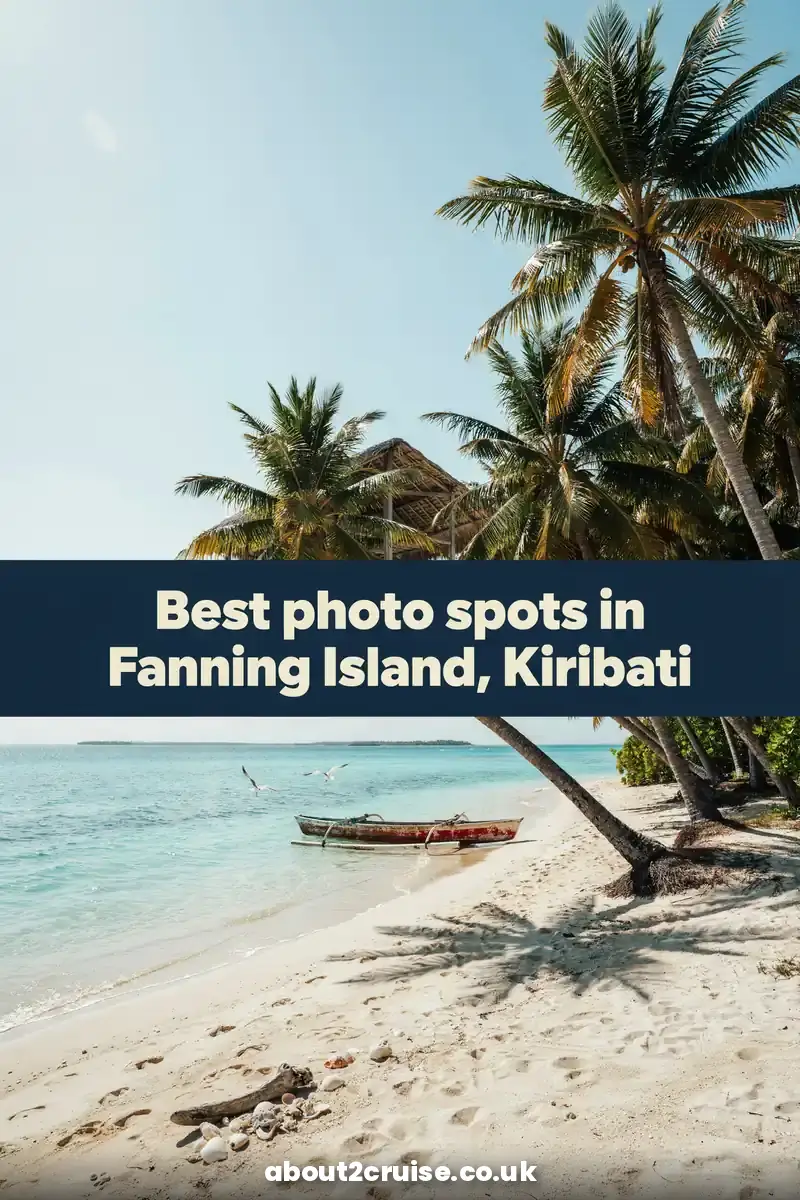
The wooden pier over clear turquoise water as the tender arrives. The lagoon shoreline and palm-fringed sand. The singing and craft tables at the landing. The old telegraph cable station ruins near English Harbour. Village church and maneaba, if invited. The best light is early, before the mid-morning heat and haze build.
Frequently Asked Questions
Is Fanning Island the same as Tabuaeran?
Yes. Tabuaeran is the current official name. Fanning Island is the older Western name, and both are used in cruise itineraries and navigation.
Can I go ashore independently if my ship calls?
Yes. You don’t need a ship excursion. The tender will take you to the landing, and you can walk, hire a bike or arrange a local truck ride once ashore. Just be back before the last tender.
Can I use a wheelchair or mobility scooter at the landing?
Generally no. The tender step, wooden jetty and sandy/coral paths are not wheelchair accessible, and the ship will likely list the port as limited or unsuitable for passengers with mobility difficulties.
Is English spoken?
English is an official language of Kiribati and many people involved with the ship-day market and cultural welcome speak some English. In remote villages, the local language, Gilbertese or te taetae ni Kiribati, is more common, but a smile and pointing will work.
Is there anywhere to eat or use a toilet ashore?
No café, restaurant, bar or public toilet aimed at visitors. There may be a very basic village store, but don’t rely on it. Eat on the ship, use the toilet before tendering, and carry water.
How likely is a Fanning Island tender call to be cancelled?
It varies by season and swell. The pass into the lagoon is narrow, and rough seas can stop landings at short notice. Some ships have also skipped the call for speed or operational reasons. It’s best to think of this as a bonus port.
Is Fanning Island in the Arctic?
No. Fanning Island is at about 3° north of the Equator, south of Hawaii. Kiribati straddles the Equator and the International Date Line, not the Arctic. Searching for Arctic cruises will not bring you here.
Last Updated: 19 November 2026