
Greenland expedition cruises are built around Zodiac landings, small ships and ice-planned days, not big-ship sail-by sightseeing. The main decision is West Greenland and Disko Bay for the Ilulissat Icefjord, versus East Greenland and Scoresby Sund for remote basalt fjords, plus South Greenland for Norse history. Most UK passengers fly via Copenhagen or Reykjavik.
Greenland Cruises: West, East or South? A Quick Route Guide
Greenland is not one cruise destination. It’s three separate coastlines, each with its own personality, feel and logistics.
West Greenland around Disko Bay is the classic introduction: iceberg-choked fjords, colourful settlements and the UNESCO-listed Ilulissat Icefjord. East Greenland and Scoresby Sund is the deep expedition draw, the world’s largest fjord system, basalt cliffs, a barely-populated coast and higher polar bear chances. South Greenland is the history route: Norse ruins, green valleys and the narrow drama of Prince Christian Sound.
The route you pick matters more than the ship. It decides how many sea days you eat, how many landings you get, which wildlife you’re likely to see and whether you spend two days crossing open ocean before the first iceberg appears. This guide walks through each route type, what the days actually look like and how to choose the trip you want rather than the one the brochure cover suggests.
Greenland cruise ports map
Each pin shows how far that place is from the nearest cruise pier. Tap a pin for directions.
- Miðbakki Terminal, Old HarbourWhere ships dock
- Faxagarður PierWhere ships dock
- Oddeyrarbryggja cruise terminalWhere ships dock
- Sisimiut HavnWhere ships dock
- Qeqertarsuaq HavnWhere ships dock
- Ittoqqortoormiit HavnWhere ships dock
- ReykjavíkEmbarkation port · About 5 min walk from Miðbakki Terminal, Old Harbour
- SisimiutSettlement · About 10 min walk from Sisimiut Havn
- QeqertarsuaqSettlement · About 10 min walk from Qeqertarsuaq Havn
- AkureyriEmbarkation port · About 25 min walk from Oddeyrarbryggja cruise terminal
- NuukSettlement · About 320 km from Sisimiut Havn
- IlulissatTender port · About 97 km from Qeqertarsuaq Havn
- Disko BayBay · About 52 km from Qeqertarsuaq Havn
- Ilulissat IcefjordIcefjord · About 96 km from Qeqertarsuaq Havn
- SermermiutInuit settlement site · About 96 km from Qeqertarsuaq Havn
- Disko IslandIsland · About 59 km from Qeqertarsuaq Havn
- UummannaqTown · About 167 km from Qeqertarsuaq Havn
- IttoqqortoormiitSettlement · About 2 km from Ittoqqortoormiit Havn
- Hvalsey ChurchChurch ruin · About 780 km from Sisimiut Havn
- QaqortoqTown · About 785 km from Sisimiut Havn
- Uunartoq Hot SpringsHot springs · About 823 km from Sisimiut Havn
West Greenland and Disko Bay: The Classic Iceberg Cruise
This is the Greenland most people picture. Icebergs the size of apartment blocks drift past the breakfast windows. A boardwalk climbs to a viewpoint over a frozen fjord. Whales feed in the bay. Small brightly painted houses sit against bare rock. West Greenland delivers all of it, and it does so with the easiest logistics in the country.
The heart of the route is Ilulissat Icefjord, a UNESCO World Heritage Site about 250 km north of the Arctic Circle. The glacier at the head of the fjord, Sermeq Kujalleq, moves at around 19 metres a day and calves more than 35 km³ of ice a year, about 10% of all Greenland’s calf ice and more than any glacier outside Antarctica. The icebergs drift out into Disko Bay, and the ship sails among them. From town, a 20-minute boardwalk walk takes you to Sermermiut, a 4,000-year-old Inuit settlement site with elevated views over the icefjord.
Ilulissat itself is a tender port. Ships anchor in Disko Bay and guests ride Zodiacs or ship tenders into the small fishing harbour. The tender landing sits about 100 metres below Zion’s Church, with a 5–10 minute uphill walk to the town centre. The Icefjord Centre is about 1.6 km, or a 20-minute flat walk, from the tender ramp. One important detail: icebergs drifting into the narrow harbour entrance can delay tenders for hours or cut a call short, so build a wide buffer before the last tender.
Disko Bay is also the main summer feeding area for humpback whales, most likely between July and August. Qeqertarsuaq on Disko Island offers columnar basalt, black sand and hot springs within walking distance of the settlement. Further north, Uummannaq takes its name from a heart-shaped mountain above the town. HX runs a 15-night Grand Greenland voyage that reaches Disko Bay, Uummannaq, the Thule region and Qaanaaq.
Typical West Greenland itinerary: 8–10 days, linking Nuuk, Sisimiut, Ilulissat and Disko Island, with no mandatory sea days if you fly into and out of Greenland. This is the shortest, most logistically straightforward introduction. HX has launched an 8-day/7-night West Greenland and Disko Bay route with no sea days and direct access via Nuuk, aimed at passengers with one week.
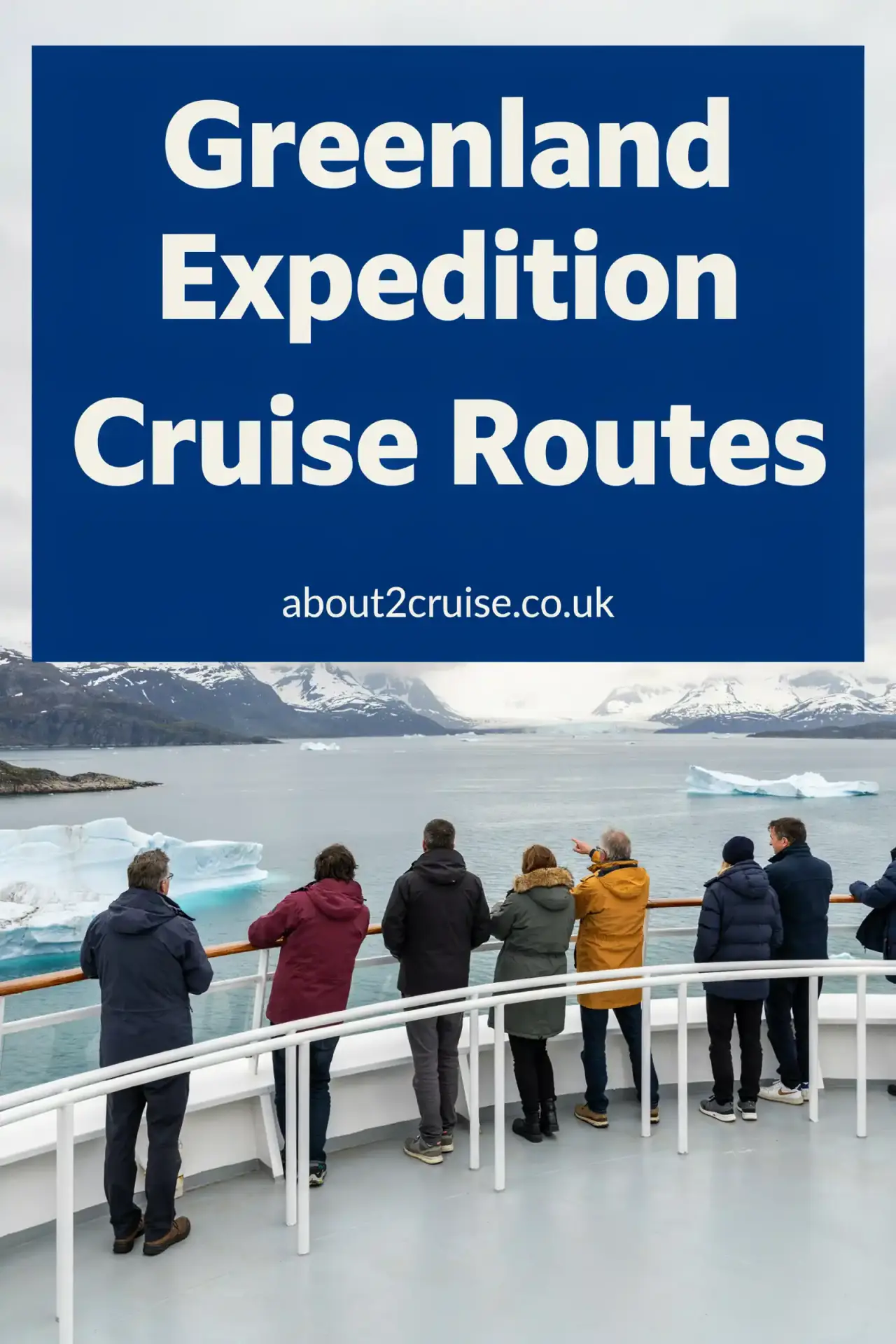
East Greenland and Scoresby Sund: Remote Fjords and Polar Bear Country
East Greenland feels like a different country. The coast is carried by the cold East Greenland Current, which pushes pack ice and polar bears south. The landscape is not just bigger but brutally vertical: basalt cliffs and mountains rising to about 2,000 metres, fjords branching 350 km inland, and a human population measured in the hundreds. This is the deep-remote draw of Greenland expedition cruising.
Scoresby Sund is the world’s largest fjord system by area, with main-basin depths of 400–600 m and some fjords reaching 1,450 m. The only permanent settlement in the region is Ittoqqortoormiit, with around 360 residents who rely heavily on subsistence hunting and fishing for seals, musk oxen, narwhals and polar bears. Landings here are shared with a community that has lived off this land for centuries, and the Tunumiit people of East Greenland have their own language, Tunumiit oraasiat, distinct from West Greenlandic.
This is where you find the serious wildlife audiences. About 40% of the world’s musk oxen live in Northeast Greenland National Park. Polar bear encounter rates are higher on the east coast than the settled west. Polynyas in Scoresby Sund keep parts of the marine environment open even in winter, supporting seals, narwhals, belugas and bowhead whales. Seabird colonies on the basalt cliffs include little auks, puffins and fulmars. Ringed, hooded, harbour, bearded and harp seals all occur here.
Typical East Greenland itinerary: 12–14 days, normally sailing from Akureyri or Reykjavík to Ittoqqortoormiit and into Scoresby Sund. You’ll eat two sea days crossing the Denmark Strait before the first expedition day. The trade-off is clear: the crossing buys access to the most untouched fjord system in the Arctic. Quark’s 14-day East Greenland and northern lights voyage covers the Westfjords, Northeast Greenland National Park, Scoresby Sund and Ittoqqortoormiit from Reykjavik.
East Greenland is not a guaranteed-landing destination. Ice and weather decide day by day. That is the point of expedition cruising here, not a defect. The ship carries Zodiacs and a plan; the ice decides the rest.
South Greenland: Norse History and Greener Landscapes
South Greenland breaks the Arctic stereotype. The landscape is green, valleys roll, and the settlements sit in farmland that has been worked since Norse times. This is the route for people who want the expedition experience without the harshest Arctic edge.
The core attraction is Kujataa, a subarctic farming landscape of five component sites and a UNESCO World Heritage Site. It records Norse settlement from the 10th century and Inuit farming from the 18th century. The standout visit is Hvalsey, the best-preserved Norse ruin in Greenland, with a large dry-stone church. The last documented Norse event in Greenland was a wedding at Hvalsey church in 1408. The site has a boat jetty and is about 45 minutes by boat each way from Qaqortoq.
Prince Christian Sound is South Greenland’s scenic transit. It is 64 km long and 2–4 km wide, narrowing to about 500 metres at its choke point. The sound is usually ice-free because of a strong current, but is often blocked by ice at its eastern mouth. Large ships often try to transit the sound but may be prevented by icebergs at the entrance. The only settlement on the sound is Aappilattoq, with about 100 people.
Qaqortoq anchors the route. The tender dock is in the main harbour, with the town square, museum, shops and sculpture trail a few steps away. Streets are uneven and some paths are rough, so sturdy non-skid shoes matter. Boat trips to Hvalsey and Uunartoq hot springs run from Qaqortoq, and excursions include a Greenlandic tasting session with Inuit specialities.
Typical South Greenland itinerary: 8–11 days, often combined with West Greenland on a longer voyage. Silversea’s Reykjavík–Nuuk voyage includes Prince Christian Sound, Qaqortoq, Hvalsey, Nuuk, Ilulissat, Eqi Glacier and Sisimiut.
West vs East vs South Greenland: Route Comparison at a Glance
Here’s the honest comparison, with sea days, landing counts and who should choose what.
| Route | Duration | Sea days | Best for | Signature moment |
|---|---|---|---|---|
| West Greenland / Disko Bay | 8–10 days | 0 (if flying into Greenland) | First-time Greenland; icebergs and whales; one week available | Ilulissat Icefjord and Sermeq Kujalleq |
| East Greenland / Scoresby Sund | 12–14 days | 2 each way from Iceland | Return expedition travellers; remote fjords; musk oxen and polar bear country | Scoresby Sund basalt walls and Ittoqqortoormiit |
| South Greenland | 8–11 days | 1–2 if combined | History and Norse archaeology; softer landscapes | Hvalsey church ruin and Prince Christian Sound |
| Round-Greenland / High Arctic | 14–21 days | Several | Ice navigation; Thule and High Arctic communities; maximum remoteness | Thule region and Qaanaaq |
A true circumnavigation of Greenland is not a standard cruise product. It is a research or icebreaker undertaking; one scientific expedition used a nuclear icebreaker escort for the North Greenland stretch. When a brochure says “circumnavigating,” read the fine print: it often means a coastal loop of a region, not the full island.
Greenland-only round trips avoid the two-day Denmark Strait crossing required by Iceland–Greenland itineraries. Iceland–Greenland–Svalbard combinations add Svalbard but also add more sea days and a longer total voyage. For a deeper look at how these fit into wider polar cruising, see the Arctic Cruise Destinations Guide.
Combining Iceland, Greenland and Svalbard: What to Know
Most Greenland expedition cruises start in Iceland, not Greenland. Reykjavik is the main embarkation port for Iceland–Greenland routes. Akureyri, in north Iceland, is used as an alternative for East Greenland voyages. The crossing from Iceland to Greenland takes two days across the Denmark Strait, and it can be rough. Beaufort 9–10 conditions are not uncommon, and seasickness tablets are routinely available onboard.
Svalbard combos pack two Arctic destinations into one voyage but add sea days. HX’s Arctic Island Odyssey combines Iceland, Greenland and Svalbard in 14 days. Quark’s Three Arctic Islands trip does Iceland, Greenland and Spitsbergen in 14–15 days, with departures listed for 2028. If you want Greenland and Svalbard without the full Iceland detour, expect a longer voyage and more time at sea.
Arctic Canada is a separate but adjacent itinerary family. If Greenland is one side of Baffin Bay, Canada’s Nunavut coast is the other, and some expedition operators pair them. See the Arctic Canada Expedition Cruises page for how those routes work.
What Does a Day on a Greenland Expedition Cruise Look Like?
The difference between an expedition cruise and a conventional cruise is simple. On a conventional ship, the ship is the destination. On a Greenland expedition, the ship is the tool. You spend your days off the ship, in Zodiacs, on shore, moving across the landscape.
A typical day starts with a briefing. The expedition leader announces the landing site, the weather window, the shore plan and the return times. You kit up and board a Zodiac from the ship’s loading platform. Zodiac rides can be cold and wet, even in July, and landings often mean stepping from a moving boat onto beaches, rocks or snow. No two landings are the same, and none of them are guaranteed.
On shore, you join a guided hike suited to your pace: a long tundra walk, a moderate climb, or a short stroll near the landing. The guides carry safety equipment and know the terrain. Back on the ship, lectures run most afternoons and evenings: glaciology, Arctic history, bird identification, photography. The expedition ship is a floating field station, not a floating hotel, even when the cabins are luxurious.
Kayaking is an optional extra on most Quark Arctic voyages and must be booked before departure. Some ships, such as Quark’s Ultramarine, carry helicopters for flightseeing and landings. Ponant’s Le Commandant Charcot offers kayaking, polar plunges, dog sledding and science labs alongside Zodiacs. The core activity on every Greenland expedition is the same: get people onto the ice edge and into the fjord. Everything else is a bonus.
Best Time to Visit Greenland for a Cruise
The Greenland cruise season is short and intense. The expedition season runs from mid-June to late September, once sea ice has thawed enough for fjord navigation. Most cruise ships visit between mid-July and mid-August. Here’s what each month actually feels like.
June. Longest daylight, sea ice still present, fog where cold ice air meets warmer air, and fewer ships. East Greenland access can still be limited. Nuuk averages 7.0°C in July; June is cooler and wetter in places. This is the month for the midnight sun and the quietest fjords, but with the most ice-risk.
July. Peak departures, warmest weather, best chance of sunny skies, and the most ships in the fjords. Ilulissat averages 5.7°C, Qaqortoq 8.0°C, Tasiilaq 7.2°C. Humpbacks are most likely in Disko Bay between July and August. Mosquitoes are a nuisance in July and August, and small black flies appear in August. The midnight sun lasts roughly until the end of July in Ilulissat.
August. Best open-water access, especially in East Greenland, and often the best wildlife viewing. Mean temperatures drop slightly: Nuuk 6.7°C, Ilulissat 5.2°C, but sea ice has usually cleared enough for the widest fjord access. Late August is when the aurora season begins, and the first dark skies return.
September. Cooler days, 5–6°C averages, red tundra, fewer ships, and the return of properly dark nights. The northern lights become visible from late August onward, and September is the best month to combine daytime ice navigation with night-time aurora photography. Nuuk’s September is its wettest month at 90.2 mm of precipitation, so pack for rain. A late-August or September East Greenland voyage is the classic choice for aurora seekers.
Midnight Sun or Northern Lights? Why Season Matters in Greenland
The sun does not set in Ilulissat for roughly two months in summer. North of the Arctic Circle, the midnight sun lasts roughly until the end of July in Ilulissat. South of the Arctic Circle, Nuuk and Qaqortoq still get about 20 hours of daylight, followed by a twilight night. That means June and July have no astronomical darkness, and the aurora is not visible at all.
The northern lights return from late August to April. South Greenland sees them from late August to September, and East Greenland’s best aurora month is March or April for land-based trips. The best displays often occur in the middle of the night, sometimes requiring alarms at 02:30 or 05:00. Full-moon nights reduce aurora visibility, and the less light pollution the better.
The season you choose changes the trip completely. A July West Greenland cruise is a midnight sun, iceberg and whale trip. A September East Greenland cruise is a tundra colour and aurora trip. There is no single best month; there is only the right month for the trip you want.
How to Choose a Greenland Cruise Ship and Expedition Style
Ship size and expedition intensity are the two dials that matter. Small expedition ships carry 100–250 guests and prioritise landings. Luxury expedition ships carry similar numbers but with higher cabin standards, more included gear and a more polished onboard experience. Conventional large ships, such as MSC’s Greenland round trips, call at Nuuk, Ilulissat and Qaqortoq but do not offer Zodiac landings.
The names to know for Greenland expedition cruising:
- HX (formerly Hurtigruten Expeditions). Dedicated East and West Greenland itineraries. Includes escorted landings with small expedition boats, boot and trekking-pole loans, and a Science Center. Runs the 15-night Grand Greenland and the no-sea-day Disko Bay voyages.
- Quark Expeditions. East Greenland, South Greenland and three-region Arctic voyages. Ships carry no more than about 200 guests. Includes Zodiac landings, a parka to keep, loaned waterproof boots, basic Wi-Fi and evacuation insurance up to US$500,000.
- Ponant. Offers 26 Greenland cruises, including the PC2 icebreaker Le Commandant Charcot, which carries 245 guests and can break ice up to about 2.5 m thick. Also smaller expedition ships. Fares run from US$21,080 for 8 nights.
- Silversea. Silver Endeavour carries about 200 guests, is PC6-rated and has all-balcony suites. Runs combined Reykjavík–Nuuk voyages through South and West Greenland.
- Seabourn. Seabourn Venture carries 264 guests, 24 Zodiacs, kayaks and a 19-person expedition team, and is built to PC6 Polar Class. Runs long Greenland and Iceland voyages including a 29-night Reykjavík–Kangerlussuaq crossing.
- Scenic. Scenic Eclipse carries 228 guests in 114 suites and offers helicopter flightseeing and submersible dives at extra cost.
- Fred. Olsen. The mainstream UK line returning to Greenland, sailing from Liverpool. A 14-night itinerary includes Prince Christian Sound and the Qooroq Ice Fjord.
- MSC. Large conventional ships round-tripping from Warnemünde and Copenhagen, calling at Nuuk, Ilulissat and Qaqortoq with a Prince Christian Sund transit. Different product entirely, but it does bring Greenland within reach for non-expedition passengers.
If you want the expedition experience with less ship, there are small-boat options too. The 12-guest sailing vessel Tecla runs a three-week Iceland–Greenland voyage. The schooner Elsi runs 7-night West Greenland photo charters between Ilulissat, Aasiaat, Qeqertarsuaq and Uummannaq. M/S Balto runs an 11-day Ilulissat–Qaqortoq west coast voyage.
UK Flights to Greenland: Copenhagen, Reykjavik and Nuuk Logistics
There is no direct UK–Greenland flight. UK passengers route through Copenhagen or Keflavík (Reykjavik). London–Copenhagen nonstop takes about 1 hour 50 minutes. London–Reykjavík is about 3 hours. Copenhagen–Nuuk nonstop is about 5 hours. Icelandair flies from Keflavík to Nuuk, Ilulissat, Kulusuk and Qaqortoq in 2 to 3.5 hours.
Reykjavik is the main embarkation port for Iceland–Greenland expedition cruises. Keflavík Airport to Reykjavík centre by Flybus takes about 45 minutes, from ISK 3,999. Reykjavík’s Skarfabakki cruise terminal is about 4 km from the city centre, 8–10 minutes by taxi or 45–55 minutes on foot. There is no free port-run shuttle; cruise lines may run paid shuttles to Harpa, and bus 16 stops near the terminal. A taxi from Skarfabakki to the centre is roughly ISK 2,000–3,000.
Copenhagen is the main gateway for West Greenland fly-cruises and for MSC round trips. Copenhagen’s Oceankaj terminal is about 8 km and 25–30 minutes from the city centre. It is reached by bus 25 or 164 to Orientkaj, then metro M4 to Kongens Nytorv in about 20 minutes. A two-zone Copenhagen bus/metro ticket costs DKK 24. A taxi from Oceankaj to the airport is roughly DKK 450–550.
Nuuk is now a turnaround port with direct Copenhagen and Reykjavík flights and a dedicated terminal handling passport control, immigration and baggage. Nuuk’s main cruise berths are Atlantkaj and Feederkaj, both about 1 km from the city centre with shuttle buses when required. Nuuk handled 78 cruise calls and 43,670 passengers in a recent season, including 27 turnarounds.
Ilulissat now has a 2,200 m runway and direct Copenhagen flights, making it a possible pre- or post-cruise stay. Qaqortoq has a new international airport serving South Greenland. Kangerlussuaq remains the usual fly-cruise embarkation point for West Greenland itineraries. Fred. Olsen sails a 14-night Greenland itinerary from Liverpool.
For a UK passenger flying to a cruise, build in a buffer. Fog in Nuuk can delay flights because of low visibility. Greenlandic weather moves fast, and connections through Copenhagen or Keflavík can be tight. A pre-cruise night in Reykjavik or Copenhagen is almost standard practice, not a luxury.
Greenland Cruise Ports: What to Expect in Nuuk, Ilulissat, Qaqortoq and More
Nuuk. The capital and the most complete port. The Greenland National Museum holds the Qilakitsoq mummies and the Pearyland umiaq, the oldest nearly complete skin boat in the world. Admission is DKK 100, students and children free. Summer hours are 10:00–16:00 daily, with flexible hours when cruise ships are in port. The museum is about 1 km from the cruise quays, 10–15 minutes on foot. The old colonial harbour has views towards the Sermitsiaq massif.
Ilulissat. Tender port. No deep-water cruise pier. Ships anchor in Disko Bay and tender into the small fishing harbour. The boardwalk from town to Sermermiut takes about 20 minutes each way over level decking. The Icefjord Centre is about 1.6 km from the tender ramp. The Icefjord Centre’s exhibition is ticketed; the UNESCO landscape is free to access. Icebergs drifting into the narrow harbour entrance can delay tenders for hours.
Qaqortoq. Tender port. The ship may anchor offshore and guests use tender boats. The tender dock is in the main harbour, with the town square, museum, shops and sculpture trail a few steps away. The town centre is fairly flat, but roads out of town are steep and the lake path is rough. Qaqortoq is considered very safe for independent exploring.
Sisimiut. Usually a tender port, with the landing at the edge of the historic centre and a 5–15 minute walk to the museum and shops. The walk from the harbour is uphill and surfaces are uneven. The town is considered very safe with little or no crime.
Ittoqqortoormiit. The tender/landing point for Scoresby Sund and the national park. This is a subsistence hunting community of around 360 people. Landings are often accompanied by a local guide. Tupilak carvings, once spiritual talismans, are a core part of East Greenlandic cultural heritage and are sold here.
Kangerlussuaq. Greenland’s historic main international gateway and the usual fly-cruise start/end point. It sits close to the ice sheet and is one of the easiest places to see musk oxen once the snow has melted.
How Much Does a Greenland Expedition Cruise Cost?
Greenland is expensive. There is no way around it. What matters is understanding what the fare includes and what it does not.
Indicative fares, per person:
- Quark’s 14-day East Greenland and northern lights voyage: from US$8,395 (about £6,700).
- HX’s 15-night Grand Greenland: from US$11,936 cruise-only.
- HX’s 12-night Discovering Greenland: from £8,866 per person for a balcony suite.
- Ponant’s Greenland sailings: from US$21,080 for 8 nights, US$28,040 for 15 nights.
- Seabourn’s 28-day Greenland and Iceland voyage: from US$21,629 per person.
- Package operators quote £5,589–£10,345 for 12-day South and West Greenland voyages excluding flights.
- A 9-day East Greenland package ranges from £4,830 to £16,045 excluding flights.
- An 11-day Greenland and northern lights package ranges from £8,295 to £9,495 excluding flights.
What’s included varies by line. HX includes escorted landings with small expedition boats, boot and trekking-pole loans, an expedition jacket and water bottle, Starlink Wi-Fi (without streaming) and gratuities. Quark includes Zodiac landings, a parka to keep, loaned waterproof boots, basic Wi-Fi on one device, drinks and evacuation insurance up to US$500,000. Swan Hellenic includes an expedition parka and rubber boots on Arctic fares.
What’s usually extra: international flights, optional excursions, kayaking, travel insurance and tips. Kayaking on Quark voyages must be booked before departure and costs extra. Ponant’s Le Commandant Charcot extras include kayaking, polar plunges, dog sledding and helicopter flightseeing.
Deposit terms: Quark takes a 25% deposit with balance due 120 days before departure. Intrepid requires a non-refundable 20% deposit and full payment 120 days before departure. These are not refundable flexible fares; Arctic expedition cruises are a commitment.
If you want help choosing between lines and route types, use the polar expedition cruise enquiry form and the team will match you to the right voyage.
What to Pack for a Greenland Expedition Cruise
The rule is simple: layers, waterproofs, and good boots. Dress in layers with a waterproof and windproof outer layer, warm fleece, hat and gloves. Waterproof trousers and waterproof hiking boots are recommended for South Greenland. Sturdy, non-skid shoes are needed for Qaqortoq’s uneven streets and paths.
The dress code on expedition ships is relaxed and casual; there are no formal nights. Zodiac rides can be cold and wet, so waterproof outer layers and a dry bag for cameras are essential. A mosquito head net is useful in summer, especially July and August. Sunscreen, polarised sunglasses and a long lens are recommended for glare from ice and 20-hour summer daylight.
What you get from the line: HX loans boots and trekking poles and gives guests an expedition jacket and water bottle. Quark loans waterproof boots and gives guests a parka to keep. Swan Hellenic includes an expedition parka and rubber boots. The loaned boots are usually good enough; you don’t need to buy specialist gear unless you’re doing kayaking or long hikes.
Ilulissat’s boardwalk can ice over in September, making wooden slats treacherous. Coastal rocks and paths can be slippery, and weather can change within a day. Pack for rain and wind even in July. Nuuk has around 123 days with precipitation a year, and September is its wettest month at 90.2 mm.
Greenland Weather, Rough Seas and Why Routes Change
Greenland’s weather is unpredictable and can change with no notice. Coastal areas near open sea are cooler and more humid. Foehn winds can gust above 50 m/s, and East Greenland’s piteraq can gust up to 324 km/h. The itinerary is a plan, not a promise. Ice and weather decide landing sites day by day.
The Denmark Strait crossing can be rough. Beaufort 9–10 conditions and widespread seasickness are common on the Iceland–Greenland crossing. Expedition ships carry a doctor and over-the-counter seasickness medication, and seasickness tablets are routinely handed out. Lifts may be closed in rough seas, requiring stairs to reach meals and lectures. If you are prone to motion sickness, plan medication before you board.
Fog and ice can delay or cancel tenders at Ilulissat. Fog in Nuuk can delay flights. Sea ice can prevent access to East Greenland until June or July. The expedition team’s job is to find alternative landings when the planned one fails. That is not a failure of the cruise; it is how Greenland works. A successful Greenland expedition is one where you see the fjord, even if the route is different from the brochure.
What Wildlife Can You See on a Greenland Cruise?
West Greenland. Humpback, fin and minke whales are the common summer whales. Disko Bay is a key breeding area for fulmars and terns and holds the last remaining thick-billed murre colony in the area. Whales are most likely between July and August. You are unlikely to see polar bears on West Greenland routes; the settled west coast has much lower encounter rates than the east.
East Greenland. Polar bear encounter rates are higher than the settled west coast. About 40% of the world’s musk oxen live in Northeast Greenland National Park. Narwhals and belugas occur in East Greenland, with special guidelines to avoid disturbing them in Scoresby Sund and the Blosseville Coast. Ringed, hooded, harbour, bearded and harp seals occur here. Seabird colonies on the basalt cliffs include little auks, puffins and fulmars.
Polar bear rules. Polar bears are the world’s largest predator and are dangerous to humans. Encounters must be expected anywhere in bear country. It is illegal to lure, pursue, seek out or otherwise disturb polar bears in Greenland. Vessels over 10 m must never approach a polar bear closer than 200 m. Drones may not be used to film polar bears. Only two operators, Sermilik Adventures and Tsigaar Naasor, are authorised to guide polar bear experiences in East Greenland.
Musk oxen. Easiest to see once snow has melted, mainly in East Greenland and around Kangerlussuaq. They are shaggy, improbable-looking animals, and they can be aggressive if approached. Your guide keeps the group at safe distance.
Inuit Culture and Archaeological Sites in Greenland
The fifth and sixth Greenland settlements are not museum exhibits; they are living communities. Kaffemik, visiting a local home for coffee and food, is part of West Greenlandic hospitality and is offered as a shore experience in some ports. Qaqortoq excursions include a Greenlandic tasting session with Inuit specialities. Ittoqqortoormiit residents rely on subsistence hunting and fishing; when you visit, you are a guest in someone else’s economy.
The archaeological story is deep. Sermermiut, next to the Icefjord Centre, is a 4,000-year-old Inuit settlement site. Kujataa records Norse settlement from the 10th century and Inuit farming from the 18th century. The last documented Norse event in Greenland was a wedding at Hvalsey church in 1408. Tupilak carvings in East Greenland were once spiritual talismans, and they remain a core part of cultural identity, not just souvenirs.
The Greenland National Museum in Nuuk holds the Qilakitsoq mummies, one of the most remarkable archaeological finds in the Arctic. The museum is in the old colonial harbour buildings at Hans Egedesvej 8. Admission is DKK 100; students and children free. The museum usually flexes opening hours when cruise ships are in port, so a ship visit normally gets you in even outside standard days.
Health, Safety and Accessibility on Greenland Expedition Ships
Expedition cruising demands a fair level of mobility. You need to be able to step from a moving Zodiac onto beaches, rocks or snow, walk on uneven terrain, and manage wet landings. Expedition operators require medical declarations and can refuse passage if fitness requirements are not met. If you use a wheelchair or scooter, Ilulissat has steep streets, gravel, ice and limited adapted transport; tendering itself may determine whether you can go ashore.
Emergency medical assistance and search and rescue are limited in remote parts of Greenland. Emergency response times are slow outside Nuuk. Expedition ships carry a doctor. Travel insurance must cover medical evacuation, not just standard medical costs, and most expedition operators require proof of comprehensive cover. The UK’s GHIC or EHIC does not cover medical costs in Greenland unless you are resident in a Nordic country or Denmark.
The main safety risks in Greenland are environmental: weather, ice, remoteness and polar bears. Crime rates are low, though opportunistic crime can occur in Nuuk. Qaqortoq and Sisimiut are considered very safe for independent exploring.
Wi-Fi, Money, Language and Tipping on Greenland Cruises
Wi-Fi is limited. HX includes Starlink Wi-Fi, but streaming is not supported. Quark includes free basic Wi-Fi on one device. In remote areas, connectivity drops entirely. Do not plan to work or stream on a Greenland expedition.
Onboard currency varies. Silversea’s onboard currency is US dollars. HX includes gratuities and adds no service charge; guests may leave cash in US dollars or euros at reception. On most expedition ships, anything you buy onboard (bar, shop, extras) goes on your cabin account and is paid by card at the end.
English is widely spoken in Greenland, alongside Greenlandic and Danish. Some Greenlanders speak little English outside the main towns. Carry some Danish krone cash for markets, small vendors and remote settlements, because card terminals can fail and small sellers prefer cash.
When to Book a Greenland Cruise and How Far Ahead
Greenland’s season is short, and peak July and August departures sell out first. Booking 12–18 months ahead is recommended for Arctic summer departures. Some operators advise booking 9–12 months ahead, with July and August going first. If you want a specific cabin on a specific itinerary in July, do not wait.
HX has opened a 2028/29 season with 26 new voyages, including an 8-day Disko Bay itinerary. Quark has Three Arctic Islands departures listed for 2028. Fred. Olsen’s Greenland return is in its 2027 programme. Ponant lists 26 Greenland cruises across its current programme. MSC sells Greenland round trips for the current and following seasons.
The booking pattern is consistent: early birds get the cabins they want, and late bookers get what is left. For a once-in-a-lifetime Arctic trip, book 12–18 months out and lock in the route and ship that actually match what you want.
Family, Luxury and Small-Ship Greenland Cruise Options
Greenland expedition cruising skews adult, but it is not adult-only. Quark lists an age range of 8–99 on some Greenland trips. Aurora Expeditions welcomes children over 8 but has no kids clubs or dedicated facilities. Hapag-Lloyd’s Young Explorers programme runs for ages 10–17 on selected expedition ships. If you are bringing children to Greenland, choose a line with a minimum age you can meet and set expectations: this is expeditioning, not kids’ club cruising.
Luxury options in Greenland include Silversea Silver Endeavour (200 guests, PC6, all-balcony suites), Seabourn Venture (264 guests, PC6, carries submarines and Zodiacs), Scenic Eclipse (228 guests, PC6, helicopter flightseeing and submersible dives) and Ponant Le Commandant Charcot (245 guests, PC2, breaks ice up to about 2.5 m thick). Luxury in Greenland means better cabins, more included gear and a higher staff-to-guest ratio, not less expedition.
Small-boat cruises are the true specialist option. The 12-guest sailing vessel Tecla runs a three-week Iceland–Greenland voyage under sail. The schooner Elsi runs 7-night West Greenland photo charters. M/S Balto runs an 11-day Ilulissat–Qaqortoq west coast voyage. These are not comfortable hotel ships; they are hands-on sailing expeditions with a completely different social dynamic.
For a completely different kind of Greenland expedition, land-based ice sheet crossings run 26–32 days and cover roughly 540–560 km on skis with pulks. Ousland-Colliard’s Greenland crossing is priced at €20,000 per person for 30–32 days. Adventure Consultants’ crossing is 539 km over 30 days, priced at €27,000. These are not cruise products, but if the search that brought you here was for “Greenland crossing,” that is the honest answer.
Passport, Visa and Insurance for UK Travellers to Greenland
UK citizens do not need a visa for a short tourist visit to Greenland, but they must hold a biometric passport to qualify as visa-free. Greenland is not in the EU or the Schengen area; a Schengen visa does not cover Greenland. If you are transiting Copenhagen or Reykjavik, you clear Schengen immigration there before continuing to Greenland.
Travel insurance is not optional. It must cover medical evacuation, not just standard medical costs. Emergency medical assistance and search and rescue are limited in remote parts of Greenland. Travel between towns is only by air, sea or dogsled, so delays and cancellations should be expected. Accommodation around Kangerlussuaq is limited, and there may be no beds during disruption unless booked ahead.
Carry enough prescription medication for the whole trip. Supply chains are limited, and a pharmacy in Ittoqqortoormiit cannot restock a niche UK prescription. Altitude sickness is a risk in parts of Greenland. If you have any doubt about your fitness for an expedition, declare it to the operator before you book, not after.
Greenland Cruise Permits, Sustainability and Local Rules
Greenland cruises operate under a strict permission system. Sailing within 3 nautical miles of the Northeast Greenland National Park baseline requires an expedition permit, regardless of trip length. Permit applications must start at least 12 weeks before the expedition, and the application fee for a tourism or cruise expedition is DKK 4,000. Cruise permits for the national park are a distinct permit type. Your operator handles this; you never apply yourself.
Beyond permits, there are operational rules. Heavy fuel oil is banned in Arctic waters, with exemptions for some double-hulled ships until 2029. AECO members commit to site-specific guidelines, wildlife distances, biosecurity and waste rules. Dedicated marine mammal observers should be deployed in narwhal summer areas, and speed should not exceed 5 knots in inshore Blosseville Coast and inner Scoresby Sund waters.
Local overcrowding is a real issue. Ilulissat and Qaqortoq have experienced local overload when several large ships call at once. Only one cruise ship normally visits a Greenland community each day, but when that ship is a 4,000-berth conventional vessel, the effect on a town of 4,000 is obvious. If local impact matters to you, choose a small expedition ship and accept the trade-offs that come with it.
Greenlandic Food Worth Trying on Your Cruise
The food is part of the trip, not a side note. Greenland’s national dish is suaasat, a clear soup of seal, whale, reindeer or seabird with onion, potato and rice or barley. Mattak is diced raw whale skin and blubber, eaten in small pieces; it is an acquired texture and taste. Musk ox, reindeer, Greenland halibut, snow crab, Arctic char and cold-water shrimp are the local staples. Greenlandic coffee is hot coffee with whisky, Kahlúa and Grand Marnier, topped with cream and flamed.

In Nuuk, the Kalaaliaraq market, also called Brættet, is by the old harbour and sells the morning’s catch and game direct from hunters and fishermen. It is roughly open 08:00–15:00 and is cash-only. Godthaab Bryghus in Nuuk brews with glacial meltwater. In Ilulissat, Brættet market is a few hundred metres east of Zion’s Church. Visitors can buy fresh fish or meat at Brættet and ask the ship’s chef to prepare it, which is one of the best-value food experiences on the entire cruise.
Where to Stay Before or After a Greenland Cruise
In Reykjavik, most passengers stay in the city centre rather than at Skarfabakki, because the terminal is 4 km east of the centre. East-side hotels shorten the transfer to Skarfabakki: Hotel Cabin, Fosshotel Reykjavík, Hotel Reykjavík Grand, Hilton Nordica and Tower Suites are practical choices. Even from these, a taxi is the sensible option with cruise luggage.
In Copenhagen, Comwell Copenhagen Portside is about 2.2 km from Oceankaj and has a metro station next door. Residence Inn by Marriott Copenhagen Nordhavn offers studios with kitchens near Nordhavn station, useful for families or longer stays. There are no hotels immediately at Oceankaj.
In Nuuk, Hotel Hans Egede is a four-star hotel with airport shuttle, breakfast, luggage storage and a restaurant. Nuuk Airport is about 5 km from the hotel, and the shuttle takes 15–30 minutes. Nuuk city hotels are about a 10-minute transfer from the cruise port.
Using Danish Kroner in Greenland: Money Tips
Greenland uses the Danish krone (DKK), pegged to the euro at about 7.46. Credit cards are accepted in most places. Visa and Mastercard are widely accepted, but American Express and Diners are less common. ATMs exist in most main settlements, including Nuuk, Ilulissat, Qaqortoq, Sisimiut and Kangerlussuaq. The only airport ATM in Greenland is at Nuuk Airport.
Some tourist shops may accept euros or US dollars, but this is not common and the rate is unfavourable. Carry some DKK cash for markets, small vendors and remote settlements. The Nuuk market is cash-only. If you buy fresh fish or game from Brættet, you will need kroner in your pocket.
Best Photo Spots on a Greenland Cruise
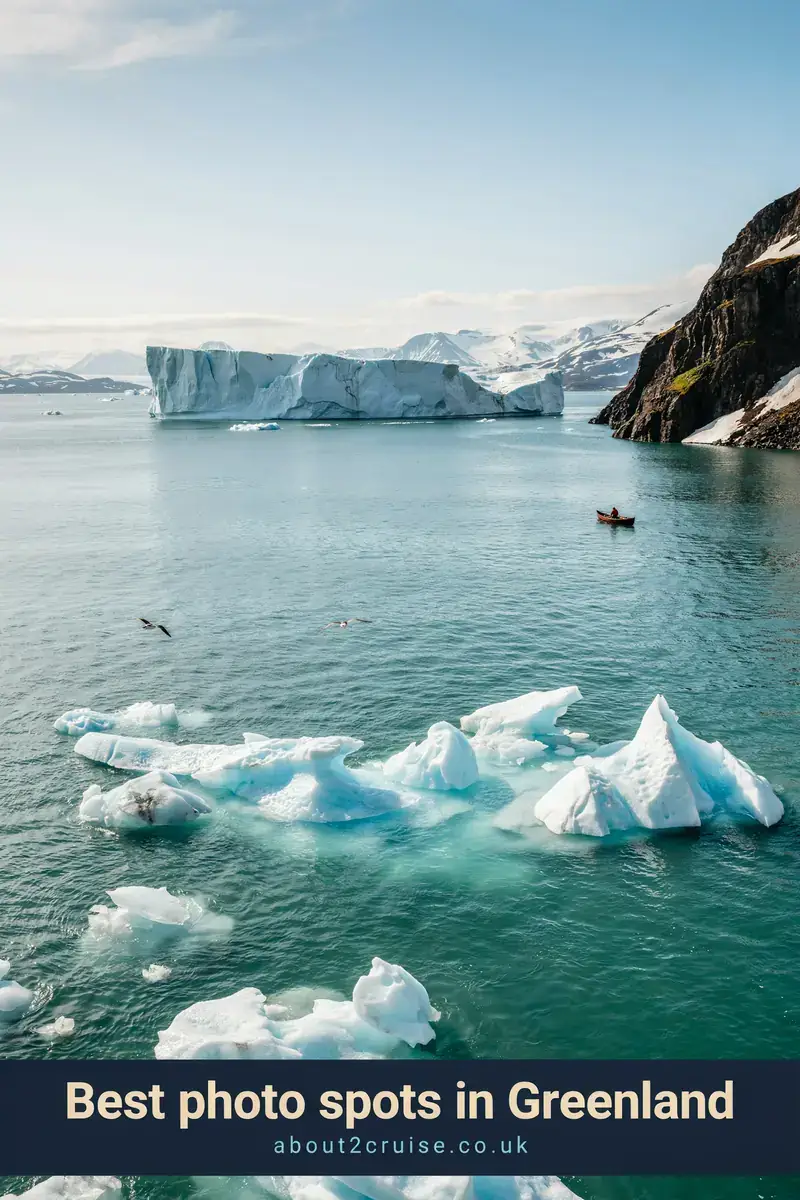
The Ilulissat boardwalk and Sermermiut viewpoint give elevated views over the icefjord and icebergs, and the Icefjord Centre has a walkable roof designed for unobstructed views of the World Heritage site. Prince Christian Sound offers steep cliffs, waterfalls and glaciers within a 500 m narrows, best shot from the deck or a Zodiac. Nuuk’s old colonial harbour has the National Museum and views towards the Sermitsiaq massif. Scoresby Sund’s red sediment layers, basalt walls and cathedral-sized icebergs are the East Greenland signature shot. Qaqortoq’s brightly coloured houses around Greenland’s oldest fountain and the lake are the town’s classic view. Uummannaq’s heart-shaped mountain dominates the harbour approach. Aurora photography is best in the middle of the night, away from full moon and street lights.
Greenland Cruise FAQs: Your Questions Answered
How long does it take to cross from Iceland to Greenland?
The Denmark Strait crossing takes two days each way on a typical Iceland–Greenland expedition. The distance is about 500–700 km depending on the exact routing, and sea conditions can be rough. Some itineraries avoid the crossing by flying into Greenland and starting the cruise there, which saves two sea days each way.
Can I actually set foot on the Greenland ice sheet?
It depends on the route and the weather. Kangerlussuaq is the easiest access point, and some itineraries include a coach trip or hike to the ice sheet edge. Other routes include helicopter landings or snow walks. Check the itinerary details before you book; the ice sheet is not guaranteed on every Greenland cruise.
Can large cruise ships go to Greenland or just expedition ships?
Both can go. Large conventional ships such as MSC’s vessels call at Nuuk, Ilulissat and Qaqortoq and transit Prince Christian Sound, but they do not offer Zodiac landings and tendering may not suit guests with mobility issues. Expedition ships can access smaller fjords, make remote landings and visit places like Scoresby Sund that large ships cannot reach. The choice is between sail-by and land-on.
Is Greenland suitable for children?
It can be, but it is not a family cruise market. Quark lists an age range of 8–99 on some trips. Aurora Expeditions welcomes children over 8 but has no kids’ clubs. Hapag-Lloyd’s Young Explorers programme runs for ages 10–17 on selected ships. Expect an adult-oriented expedition atmosphere, and set expectations before you go.
What if my cruise cannot make any landings?
This is rare but possible, especially in early June or in bad ice years. Expedition operators plan multiple landing alternatives per day, and the ship itself is usually sailing through icebergs, fjords and wildlife areas even when landings are impossible. Fares are generally not refunded for missed landings, because itinerary flexibility is part of the product. Check your operator’s terms before booking.
Do I need a polar bear guard?
No. Your expedition team carries out bear assessments and carries the necessary equipment and training. You do not bring a weapon or a guard. The rules for passengers are simple: follow your guide, stay with the group, and do not walk towards a polar bear. The ship’s staff manages the risk.
What is the temperature really like on a Greenland cruise?
Expect summer cruise temperatures between 5°C and 10°C. July means are Nuuk 7.0°C, Ilulissat 5.7°C, Qaqortoq 8.0°C, Tasiilaq 7.2°C, Ittoqqortoormiit 5.7°C. On a Zodiac or in wind, it feels colder. Coastal areas near open sea are cooler and more humid, and September can be wet. Pack for cold wind and rain, even in July.
Can I book a round trip from the UK without flying?
Fred. Olsen’s 14-night Greenland sailing from Liverpool is the main UK round-trip option. Otherwise, expect to fly to Copenhagen or Reykjavik and either join the ship there or continue by air to Nuuk, Ilulissat or Kangerlussuaq. There is no direct UK–Greenland flight, but Copenhagen–Nuuk nonstop takes about 5 hours.
Ready to start narrowing down your route? Use the polar expedition cruise enquiry form and the team will help you match the West, East or South Greenland route to the ship and the season that fits you.
Last Updated: 14 November 2026