
A family-owned New Zealand line with three ships and no two of them alike: a 140-guest ice-class expedition vessel, an 18-guest coastal yacht, and a 130-guest ship with the fleet’s only balconies, arriving in May 2027. Fares include landings, lectures and house drinks with meals. Gratuities, Wi-Fi and kayaking aren’t included.
Who owns Heritage Expeditions, and where the company is based
Heritage Expeditions belongs to the Russ family, and has since Rodney and Shirley Russ founded it in 1984. Rodney was a biologist with the New Zealand Wildlife Service, working on kakapo and the Chatham Island black robin, which is why the line still reads as a conservation outfit that happens to own ships rather than a cruise company with a wildlife theme.
Their sons, Aaron and Nathan, run it now from a purpose-built office in Christchurch, where bookings, logistics, reservations and marketing all sit. The company is registered in New Zealand as Heritage Expeditions Limited and calls itself the country’s only family-owned, family-operated small-ship expedition line.
There’s no British office, no British phone line and nothing on a high street. You book through Christchurch or through an agent, and an agent booking comes with the agent’s conditions sitting alongside Heritage’s own.
Who a Heritage voyage suits, and who should book elsewhere
A Heritage voyage suits birders, sub-Antarctic completists and anyone who reads polar history for fun, and the name sets expectations it doesn’t always meet. A typical day brings two landings, a lecture or two and a fair amount of standing about in a Zodiac, so it rewards people who are steady on their feet and happy on a working ship.
There are no balconies below suite level on the flagship, no casino, no show lounge and one dinner sitting. Families with young children, travellers who want butler service and anyone hoping for a short fly-cruise to the Antarctic Peninsula are looking at the wrong product, and they’ll be disappointed by the right one.
If you want the expedition experience without the long haul, the Europe itineraries are the realistic way in. If a balcony and a spa matter more than time in the field, wait for the new ship or book another line.
Heritage Expeditions ships: Heritage Adventurer, Heritage Explorer and Heritage Discoverer
The fleet is three ships, and no two of them are the same product. One is an ice-class expedition ship, one is a New Zealand coastal yacht and one is a larger, newer arrival with the only balconies in the fleet. Read a review of one and book another, and you’re comparing nothing.
| Ship | Guests | Built | Ice class | Cabins | What it is |
|---|---|---|---|---|---|
| Heritage Adventurer | 140 (built for 184) | 1991, Rauma, Finland; formerly MS Hanseatic | 1A Super | 74 ocean-view, around 22m², no balconies; suites 44m² | Polar and sub-Antarctic flagship; 14 Zodiacs; open bridge |
| Heritage Explorer | 18 | 2004, Carey’s Boatyard, Picton, New Zealand | Not stated | 10 cabins over three decks | New Zealand coastal yacht; two tenders; kayaks and fishing gear |
| Heritage Discoverer | 130 (some listings say 140) | Launched as MS Delfin Clipper; later Silver Explorer and Exploris One | 1A | 70 ocean-view; 12 suites of 37 to 67m² with private balconies | Joins in May 2027; restores High Arctic and Antarctic Peninsula seasons; 14 Zodiacs; expedition team of 15 |
Heritage Adventure and Heritage Adventures aren’t ships. If a booking site offers you either name, it means Heritage Adventurer, the flagship.
Heritage puts the new arrival at 130 guests, and the British Isles voyage has been sold at 140, so expect that figure to settle once she starts sailing. Her build lineage gets told two ways as well: she began life as MS Delfin Clipper and has since sailed as Silver Explorer and Exploris One, so older deck plans and write-ups use those names.
Cabins: portholes, panoramic windows and the one ship with balconies
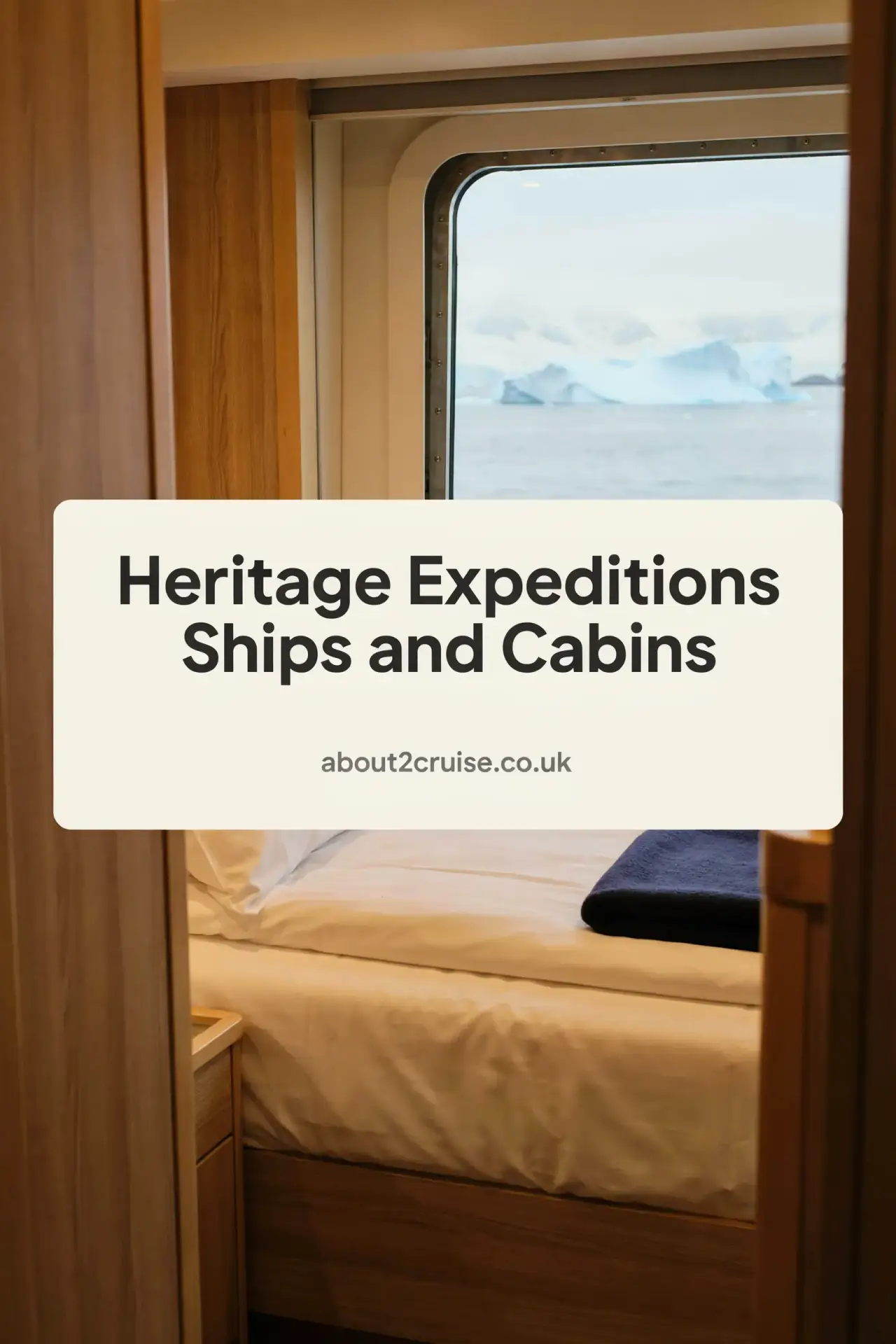
On Heritage Adventurer nearly every cabin is the same size, so paying more buys deck, position and perks rather than space. All 74 staterooms are ocean-view across six categories, all around 22m² apart from the 44m² suites, and none has a balcony.
Deck 3 cabins use two portholes and sit near the gangway and the expedition room. Decks 4 and 5 have large panoramic windows, and Deck 4 is the restaurant deck.
The suites are forward-midship on Deck 6, and the top category adds in-room dining, a minibar restocked daily, free laundry and a spa credit. Superior cabins and above get premium bath amenities, a minibar with beer, wine and soft drinks, and concierge room service.
Heritage Explorer works the other way round. The cheapest cabin is a bunk with a porthole on the lower deck; the best is the Royal Master Suite on the bridge deck, with a queen bed and French doors onto the covered deck. Heritage Discoverer is the only ship with true balconies, and only the 12 suites have them.
Because deck and position decide more than size here, it helps to know how cruise cabin categories are priced before you pick one.
Solo travellers: where the single cabins are and what sole use costs
Solo travellers do better here than on most expedition ships. Deck plans show 12 dedicated Main Deck Single cabins on Heritage Adventurer, each around 22m² with two portholes on Deck 3, plus two Main Deck Triples. Some two-berth cabins can be sold for solo use without a supplement, and Superior cabins can go as solo or same-sex shared.
Elsewhere the published booking terms charge sole occupancy at 1.8 times the fare, and twice the fare in suites. Solo travellers willing to share pay the published double-occupancy fare whether or not a cabin mate turns up. Nobody publishes a total count of single cabins, and these are the sort of terms that get revised, so ring the Christchurch office and confirm the live policy before you commit.
For the wider picture on travelling alone, see how to avoid single supplement fees.
Life on board: an open bridge, one dinner sitting and slow satellite Wi-Fi
Life on board centres on the top decks. Heritage Adventurer’s public rooms sit high and forward: Deck 7 holds the observation lounge, library and bar under 270-degree windows, with a 360-degree observation deck above. The bridge on Deck 6 is open to passengers except during port arrivals and departures, and it’s the thing people rave about most.
The dining room on Deck 4 serves one sitting. A bistro on Deck 6 handles early risers and light meals and opens onto a covered, heated teak deck. The Bar and Lounge on Deck 5 seats the whole complement and hosts the daily briefing and evening recap.
Wellness is better than the ship’s age suggests: an open-air saltwater pool that can be heated or chilled, a glass-enclosed hot tub, a gym with sea views, a Finnish sauna and a European steam room, plus a hospital and a shop. Cabins have two-prong European 220v sockets and bedside USB, so bring an adapter.
Two expectations to set. Satellite Wi-Fi is chargeable and slow, and an eSIM bought before you fly beats leaning on the ship’s connection, as cruise ship internet cost saving tips explains. And there’s no casino, no show lounge and no dressing up: this is a working expedition ship from the early 1990s.
Tours ashore: Zodiac landings, sea kayaking and the lecture programme
Shore time runs on Zodiacs. Heritage Adventurer and Heritage Discoverer carry 14 each, and the 18-guest yacht works from two tenders, which is why the smallest ship gets into places the others can’t.
Between landings the expedition team, naturalists, botanists, historians and regional specialists, lectures and interprets what you’re looking at. That team is the part that justifies the fare.
Sea kayaking is a separate programme run with Southern Sea Ventures, capped at 12 paddlers, and it needs a booking form and sign-off from the guides. Weather and sea state decide whether you get out at all, and in the Subantarctic it isn’t a programme for novices. Paddling also takes you out of whatever else is running that day, so look at the plan before you commit.
What a Heritage cruise costs from the UK, all in
The fare isn’t the whole bill, and the gap is bigger from Britain than from New Zealand or Australia. Here’s what the standard voyage price covers and what it leaves out.
| Included | Not included |
|---|---|
| Pre and post cruise transfers | International and domestic flights |
| One night pre-cruise hotel in a twin-share room with dinner and breakfast on many voyages | Visas and travel insurance |
| Onboard accommodation with all meals | Gratuities |
| House beer, wine and soft drinks with lunch and dinner | Laundry and items of a personal nature |
| All expedition shore excursions and the naturalist lecture programme | Wi-Fi packages and premium drinks |
| Landing fees and GST on New Zealand coastal voyages | Kayaking and other optional activities |
Fares are quoted per person in US or New Zealand dollars depending on the voyage, so there’s no sterling price and currency movement sits on top of the fare. Flights to the gateway are always extra: Christchurch, Invercargill, Auckland or Sydney for southern voyages, and Portsmouth or Glasgow for the Europe season.
Insurance is the hard rule. Travel insurance is a condition of carriage, not a suggestion: details have to be with Heritage before final payment, and they can cancel the booking with no refund and the balance still owed if those details aren’t produced.
Buy a policy that covers expedition travel and remote-area evacuation when you book, not the week before you fly, and check the wording names the region you’re sailing in.
Gratuities are excluded on every voyage document and no daily figure is published, so budget for them separately. Some resellers ask passengers over 70 for a GP-completed medical form and a minimum level of evacuation cover. For the wider arithmetic, see budgeting a polar expedition cruise.
Where it sails, and the first no-fly itineraries from Portsmouth and Glasgow
It sails almost everywhere except the Mediterranean and the Caribbean. The core programme is the Ross Sea and the heart of Antarctica, the New Zealand and Australian sub-Antarctic islands, the Antarctic Peninsula with the Falklands, South Georgia and the South Shetlands, and Svalbard, Greenland and Iceland. Add Japan, Taiwan, Indonesia, Papua New Guinea, the Solomon Islands, Vanuatu, the Philippines and the Kimberley coast.
The Ross Sea is the itinerary the line built its name on, and the Ross Sea Antarctica cruise guide sets out how it differs from a Peninsula trip.
Voyages run from five to 28 days, with group sizes from 18 to 140. Heritage Explorer is a New Zealand coastal product only, working Fiordland, Stewart Island and the Marlborough Sounds, which makes it the shortest and least expensive way in. The New Zealand cruise port guide covers the places it calls at.
For a UK reader the change that matters is the Europe season. Heritage Discoverer turns around at Portsmouth and Glasgow (Greenock), with Lisbon and Reykjavík closing the loops.
The British Isles, Ireland and Scotland Expedition runs 12 days from Portsmouth to Glasgow, taking in England, Ireland, Wales, the Channel Islands, the Isles of Scilly, the Isle of Man, Skye, Rùm, St Kilda, Iona and Islay, with a London hotel night and the transfer to Portsmouth included.
Around it sit a 12-day Atlantic Shores Odyssey from Lisbon to Portsmouth via Portugal, Spain, France, Guernsey and Sark; a 13-day Scotland, Faroe Islands and Iceland run from Glasgow to Reykjavík with a Glasgow hotel night, dinner, breakfast and transfer; an 11-day Iceland circumnavigation from Reykjavík; and a 15-day Svalbard, Greenland and Iceland voyage that opens with a Paris hotel night and a charter flight to Longyearbyen.
Heritage Expeditions compared with the lines on your shortlist
Heritage doesn’t win on hardware and doesn’t pretend to. Its case rests on field time, the depth of the expedition team and itineraries longer and rarer than most lines run.
The names that usually sit alongside it are Ponant, Aurora Expeditions, Quark Expeditions and Scenic in the polar regions, and Coral Expeditions on the Kimberley coast. What separates them isn’t a secret: the age of the hull, whether there are balconies, how much drink and how many gratuities sit inside the fare, and how many days you get ashore.
Judge Heritage on those four points and the trade-off is plain. You give up balconies, included gratuities and a newer ship; you get landings in places few operators reach and a route that may not exist anywhere else. If the second list matters more, this is the right line.
What reviews praise and what they complain about
Reviews praise the same handful of things, and Heritage’s own testimonials say it too: the expedition team, the captain and crew, the food, the organisation, the open bridge and access to places you couldn’t otherwise reach.
The criticisms are specific and mostly fixable. Satellite Wi-Fi is chargeable and slow, so buy an eSIM before you fly.
The pool is small and the gym modest, which matters only if you booked expecting a cruise ship. The kayak programme can pull you out of other activities running at the same time, and the ship is a working expedition vessel rather than a luxury one.
There’s no big consumer review score to check. Heritage publishes its own testimonials and there’s no independent aggregate to weigh them against, so trust named, specific comments over vague ones.
Booking from the UK: deposits, agent terms and waitlists
Book direct and the deposit is 25% of the total, with the balance due 90 days before departure, or 120 days for Antarctic voyages. Inside 90 days the full amount is due when you book. The office will normally hold space for seven days while a booking form comes back, and a 3% card fee applies to payments after the initial deposit.
Book through an agent and the agent’s conditions sit on top of Heritage’s, and Heritage states it isn’t liable for representations the agent makes. Read both sets of terms.
Small ships sell out. Individual departures on the 18-guest yacht already show waitlists by cabin category, so treat a voyage you want as a booking to make rather than a decision to take later.
Price is moved most by booking early. The new ship’s maiden season carries a fifth off all berths, plus another 10% for past guests, on bookings made by a published deadline.
Selected New Zealand coastal departures carry a fifth off selected cabins, excluding landing fees and optional extras, new bookings only and not combinable. A fuel surcharge can be added after booking if oil prices move, and itineraries stay at the line’s discretion for weather, ice and nautical reasons. For more on timing, see how to save money on your cruise.
Heritage Expeditions FAQs
Can I pay for a Heritage voyage in pounds?
Not as a published price. Fares are quoted per person in US or New Zealand dollars depending on the voyage, so a UK booking carries currency risk on the fare until it’s settled.
How long are Heritage Expeditions voyages?
Voyages run from five to 28 days, with group sizes from 18 to 140 guests depending on the ship. The shortest are the coastal New Zealand departures; the longest are the deep polar itineraries.
Is there a doctor on board?
There’s a hospital on Heritage Adventurer and a medical centre on Heritage Discoverer. Nothing medical appears on the plans for the 18-guest Heritage Explorer, so ask if that matters to you.
What happens if ice or weather changes the itinerary?
The expedition leader can deviate from the programme for weather, ice or nautical reasons, and there’s no compensation for a missed landing. Treat every published shore day as an intention rather than a booking.
Do older passengers need a medical form?
Some resellers ask passengers over 70 for a GP-completed medical form and a minimum level of emergency evacuation cover. Heritage’s own terms set neither rule, so ask whoever takes your booking.
Last Updated: 28 October 2026