
Ilhabela is a tender-only island off São Paulo’s north coast, known as Brazil’s sailing capital and for rainforest-backed beaches, waterfalls and caiçara seafood. Ships anchor in the São Sebastião Channel and land at the Vila pier, where a compact historic centre, west-coast beaches and boat trips make an easy port day if you guard your tender timing.
What Makes Ilhabela Worth Getting Off the Ship
Ilhabela officially holds the title of Brazil’s National Sailing Capital, and the regattas around the island are a regular part of the summer sailing season. But even if you never set foot on a boat, the island gives you plenty of reasons to head ashore.
Roughly 85% of Ilhabela sits inside Ilhabela State Park. That means the interior is mostly protected rainforest, with a mountain spine that tops out around 1,379 metres, more than 40 beaches and well over 250 mapped waterfalls.
For a cruise passenger, that makes the choice unusually varied for a small island. You can:
- Walk around the historic Vila
- Pick one west-coast beach
- Swim at an easy waterfall
- Take a sailing or speedboat trip
- Or do a bumpy 4×4 day to a wild east-coast beach
It’s a very different stop from mainland colonial Paraty or the urban scale of Santos. Ilhabela is more about green outdoors, casual beach life and local caiçara seafood than grand architecture or big-city sightseeing.
Ilhabela cruise port map
The map shows Ilhabela and the places worth seeing. Tap a pin for directions.
- IlhabelaTown centre
- Mercado do PeixeFish market · About 7 min walk from the town centre
- Praia do PerequêBeach · About 14 min walk from the town centre
- Igreja Matriz Nossa Senhora d’AjudaHistoric church · About 4 km from the town centre
- Praia do CurralBeach · About 8 km from the town centre
- Praia de CastelhanosBeach · About 9 km from the town centre
- Cachoeira da Água BrancaWaterfall · About 2 km from the town centre
- Cachoeira do GatoWaterfall · About 9 km from the town centre
- Museu NáuticoNautical museum · About 4 km from the town centre
Where Your Ship Anchors and How Tenders Work
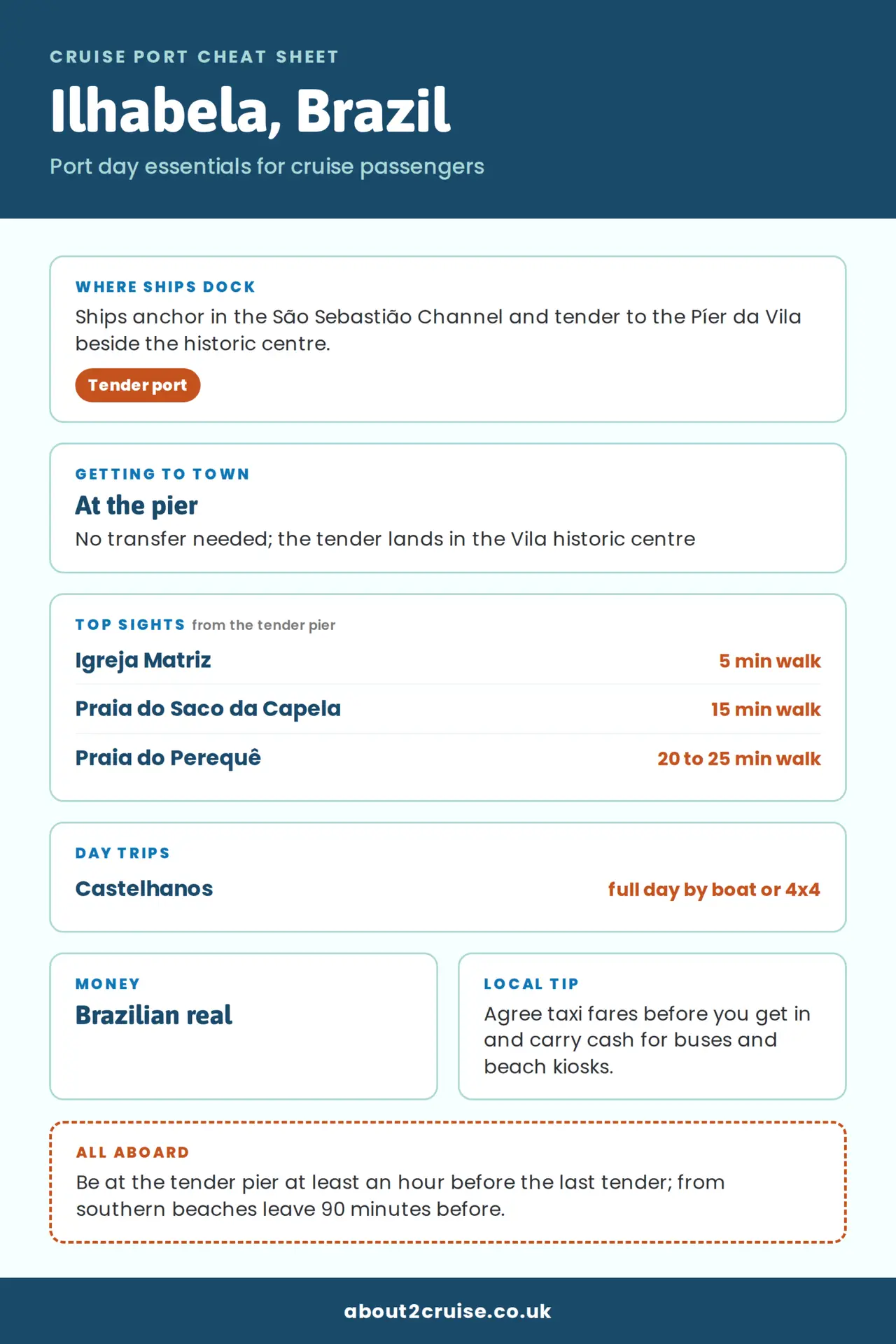
There is no cruise terminal and no cruise berth in Ilhabela. Larger ships anchor in the São Sebastião Channel, the sheltered stretch of water between the island and the mainland.
Tenders bring you to the Píer da Vila, a concrete pier right beside the historic centre and Praça da Bandeira. When you step ashore you’re at a working municipal pier. It’s fairly basic, but there is shade, an information and reception area, local guides, excursion sellers and, in season, staff who speak English and Spanish.
The main shopping street, Rua do Meio, starts a short walk from the landing.
The tender ride itself is usually around ten minutes, but don’t treat that as a guarantee. Marine weather, fog and the number of boats in the water can change the rhythm of the day.

Tendering: Tickets, Timing and the Return Line
Expect a ticket-and-priority system, but exact rules vary by ship. In practice, people on ship-organised excursions, suite or Yacht Club guests and top loyalty-tier passengers usually get off first. Everyone else typically collects a free tender ticket through the app or a lounge.
If you’re not in a rush, waiting until late morning often works in your favour. By then the early queue has usually thinned and the gangway may be open without tickets.
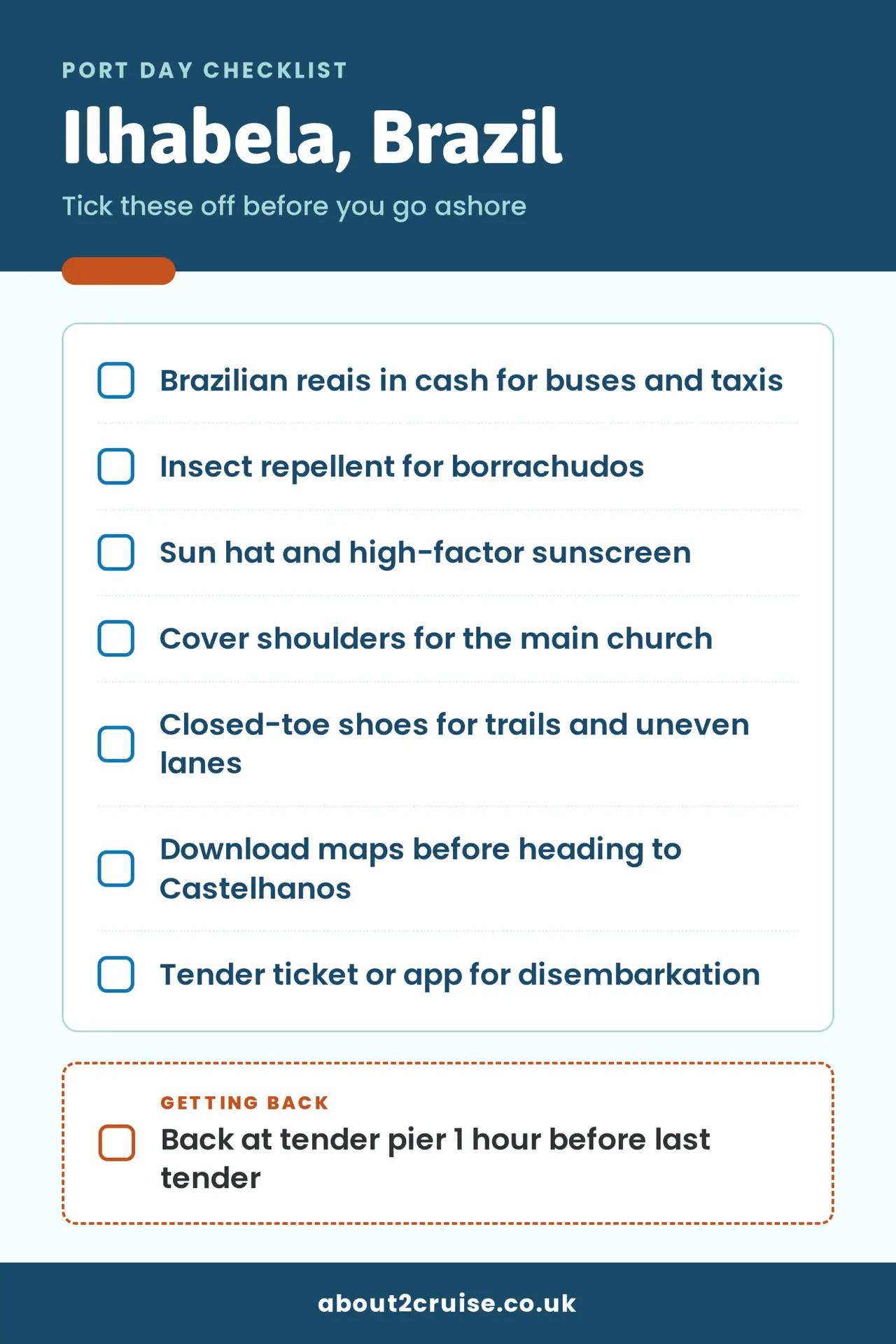
The return journey is the part that catches people out. The queue at the pier can build quickly as beachgoers all head back at once. Arrive at the tender pier at least an hour before the last tender. If you’re coming back from the southern beaches, leave yourself 90 minutes.
A taxi from Praia do Curral to the Vila pier can take 25–40 minutes, and the local bus can take an hour. The port agent’s number is in the daily programme if you find yourself running late.
Ilhabela does carry a modest tender-cancellation risk, often quoted around 3–7% of calls. That said, the São Sebastião Channel is naturally more protected than many open-roadstead ports. Morning fog and heavy summer rain can delay the first boats, but the anchorage itself is generally calmer than you might expect.
First Impressions: The Vila and the Pier Area
The landing is in Vila, Ilhabela’s original settlement, and the area around the pier is compact and walkable.
Rua do Meio runs from the pier area into the centre as a pedestrian street lined with shops, restaurants and small galleries. The main church, Igreja Matriz Nossa Senhora d’Ajuda e Bonsucesso, dates from the late 1600s and sits at the top of a broad 35-step staircase in the Centro Histórico.
Nearby you’ll also find a former jail and forum building that now houses the nautical museum, plus a weekend craft fair in high season. Most shops and services in the historic centre open around 09:00 and stay alive into the evening, but restaurants are at their busiest between midday and 14:30.
Getting Around Ilhabela: Taxis, Buses and the Aquabus
Taxis and vans wait at the pier, but Ilhabela doesn’t have a fixed taxi tariff you should rely on. Always agree the price before getting in.
As a rough guide:
- Short hops around Vila: R$40–80
- Vila to Curral: often R$50–60 one way
- Return with waiting time: R$100–150
Drivers may prefer cash, so have reais ready. Don’t count on Uber for the return trip to the pier, and don’t attempt to walk from Vila to Curral.
Local buses run the main west-coast road from Vila to Perequê and Jabaquara. Tickets are bought from the driver in cash.
The municipal Aquabus water taxi also uses the same pier area. It runs from 08:10 to 19:00 to Praia Grande, Perequê, Engenho d’Água and Ponta Azeda. It’s cheap, air-conditioned and accessible, but it uses a rechargeable card. No cash is accepted on board.
The Best Beaches for a Port Day
Not every beach in Ilhabela makes sense on a cruise call, especially when you’re watching the clock.
The most practical beach for a short visit is Praia do Saco da Capela, about 1 km from the pier. You can walk there along the main avenue, and it has kiosks and services.
Praia do Perequê is about 2 km south, a 20–25 minute walk or a short taxi or bus ride. It’s a good all-rounder with calm water and restaurants.
Praia da Feiticeira is the family pick, with gentle water, kayaks and paddleboards.
Praia do Curral is the classic drive-to beach with bars on the sand and a strong sunset reputation, but it’s around 15 km from Vila and you’ll need transport.
Praia de Castelhanos is the famous wild beach on the exposed east coast. You can reach it by boat from Perequê or by an authorised 4×4 track through the state park, but it’s a full-day commitment. On a short or late-tender call, leave Castelhanos off the list. The beach is open ocean with shore break and currents, and there is no ATM, pharmacy or reliable phone signal out there.
Waterfalls You Can Actually Fit In
If you want a waterfall and a swim without losing half your day, Cachoeira da Toca is the easiest option.
It’s on private property about 4 km from the centre, open daily from 09:00 to 17:00. There are four falls, pools, a natural slide, toilets, parking, monitors and an artisanal cachaça distillery with tasting. Admission is roughly R$30–50 depending on the day and visitor category, with reductions for seniors, students and children.
Cachoeira da Água Branca is free and better as a viewpoint than a swim, with falls up to about 60 metres.
Cachoeira do Gato is a beautiful 40-metre fall behind Castelhanos beach, but it means a 30–45 minute trail each way. It only makes sense on a full Castelhanos day.
One warning: waterfall pools can rise suddenly after rain in the hills. If the water begins to rise or turns muddy, get out immediately.
Sailing Trips, Schooners and Speedboats
Ilhabela is a sailing capital, so the water is the point.
A shared schooner trip typically lasts about six hours and costs around R$200 per person, calling at several northern beaches with swimming stops.
A speedboat trip to Castelhanos is faster but still a five-hour commitment, usually around R$350 per person. Operators may exclude children under five and pregnant passengers.
Remember that boat trips add another small-boat boarding to a day that already began with a tender. If you’re prone to seasickness or the sea is lively, choose a land day instead.
Rainforest Trails and Nature Near the Port
Most of the island sits inside Ilhabela State Park. The park’s trails are free to enter, but a few require a registered environmental monitor paid directly in cash. The main ones are Veloso, Três Tombos and Pico do Baepi.
The Castelhanos road is a 4×4 route with a one-way entry window from 07:00 to 14:00 and a mandatory return window from 15:00 to 18:00. It’s capped each day and can close at short notice in rain.
The real physical discomfort on any forest trail is the borrachudo, a tiny black biting fly that lives around clean water. Repellent needs to be reapplied after swimming, and ankles and lower legs need covering on paths.
Rainy-Day Ideas
Summer rain is common from November to March, but it usually builds into late-afternoon storms rather than washing out the whole day.
If rain arrives, the old centre still works. Indoor options include:
- The nautical museum in the old jail and forum building
- The electricity and lighting museum at Parque das Cachoeiras
- The Afro-Brazilian culture museum at the Engenho d’Água farmhouse
The Mercado do Peixe is a roofed fish market that cooks and serves lunch, and there is free cinema in the Centro Cultural at weekends.
Alternatively, use rain as a reason to sit at a waterfront restaurant with a moqueca or grilled fish.
What to Eat and Drink
Ilhabela’s food is the caiçara cooking of the São Paulo coast: fish with green banana, moqueca, caldeirada and seafood stews.

The waterfront restaurants between Vila and Saco da Capela are the easiest place to eat without losing beach time, and many tables face the channel.
The Mercado do Peixe in Perequê is the most local experience. You choose fish from the market and eat at an on-site kiosk. It’s open roughly 11:00–17:00 and closed on Tuesdays.
At a beach bar, a simple grilled fish plate with rice and farofa might run about R$45, plus a caipirinha. Restaurants usually add a 10% service charge, so no extra tip is required.
Arrive before midday or after 14:30 to avoid the Brazilian lunch rush.
Souvenirs, Cachaça and Shopping
Rua do Meio is the souvenir strip. Expect ceramics, woodwork, bio-jewellery made from seeds and shells, natural soaps, sarongs, hats and nautical objects.
The thing to buy if you buy one thing is cachaça. The Engenho da Toca distillery has been producing artisanal cachaça since the 1930s and remains the island’s last working distillery. Many waterfall trips include a tasting.
If you don’t want to carry a bottle back on the tender, choose small bottles or locally made textiles instead.
Money, Cards and ATMs
The currency is the Brazilian real.
Cards are widely accepted in Vila and Perequê, but beach kiosks, local buses and some taxi drivers are cash-only. There are no ATMs at the pier, but banks with ATMs are about a five-minute walk into town, typically open 10:00–15:00.
Ilhabela has no reliable 24-hour ATM on the island, so don’t leave cash withdrawal to late afternoon. Foreign cards can be hit-and-miss at Brazilian ATMs, especially after hours. US dollars and euros are not generally accepted.
Carry small notes for bus fares, taxi haggling and Castelhanos beach restaurants, where card machines and phone signal are unreliable.
Language and Connectivity
Portuguese is the language. English is limited outside the pier reception area, though people are patient with gestures and basic words.
A few phrases help:
- “Quanto custa?”: how much?
- “Obrigado” or “obrigada”: thank you
- “A conta, por favor”: the bill, please
Free municipal Wi-Fi is available at dozens of points around the island, including the Mercado do Peixe, the nautical museum and the farmhouse museum. Sessions last up to two hours after registration.
Mobile signal disappears on the Castelhanos road and at Castelhanos itself, so download maps or tickets before setting out.
Weather, Sea Conditions and Tender Risk
The cruise season is summer: highs around 30°C, sea temperatures around 27°C, high humidity and frequent afternoon storms.
January can see rain on about 20 days, February around 16. Mornings are often clear and give you the best conditions for photos and hiking.
The bigger risk is tender disruption from wind, swell or fog, and heavy summer rain can briefly suspend boat operations. The channel anchorage is relatively protected, but local beach currents can be strong, especially on open-ocean beaches such as Castelhanos.
Heed flags and lifeguard advice, and get local guidance before swimming at wild beaches.
What to Pack for a Day Ashore
Think island, not city.
Before you sail
- Bring Brazilian reais in cash for taxis, buses and beach kiosks.
- Book a boat or 4×4 trip to Castelhanos early if it is essential.
- Check your passport has at least six months validity for Brazil.
Short port day: under 6 hours
- On dockingTake the tender to Píer da VilaTender ticketTickets may be needed for early boats; ship excursions and suites go first. The crossing is around 10 minutes.
- +15 minIgreja Matriz and Rua do MeioWalk up the pedestrian street to the church at the top of its 35-step staircase in the Centro Histórico.
- +45 minPraia do Saco da CapelaA 15 minute walk along the main avenue. Kiosks and beach services make this the easiest first swim.
- +1 hr 45 minLunch near Saco da CapelaTry moquecaOrder grilled fish or a caiçara seafood stew at a waterfront table. Restaurants add a service charge.
- +3 hrs 15 minRua do Meio craft shoppingCachaça souvenirBrowse ceramics, textiles and small bottles of local cachaça, or duck into the nautical museum.
- All-aboard minus 1 hrBack at the tender pierThe return queue builds as beachgoers all head back at once. Be at the pier an hour before the last tender.
The time on the map is the whole walk, every stop added together.
Open this walking route in Google Maps
If plans change: If the beach is closed or unsafe, swap it for the nautical museum and a long lunch at the roofed Mercado do Peixe.
Long port day: 8 hours or more
- On dockingTake the tender to Píer da VilaGo earlyEarly boats are less busy. The crossing is about 10 minutes, then walk into the historic centre.
- +30 minTaxi to Cachoeira da TocaAgree fareAbout 4 km from the centre. Agree a cash fare before leaving; there is no fixed taxi tariff.
- +1 hr 15 minSwim at Cachoeira da TocaCash entry feeOpen from 09:00. Four falls, pools, a natural slide and a cachaça distillery with tasting.
- +3 hrsLunch at Mercado do PeixeTry caldeiradaTaxi towards Perequê and choose fish at the market, then eat at an on-site kiosk. Closed on Tuesdays.
- +4 hrs 30 minPraia do Perequê or FeiticeiraWalk or take a short taxi to Perequê beach. Feiticeira is calmer and good for families if you have time.
- +6 hrsBack to Vila for craftsCachaça souvenirReturn to the historic centre for Rua do Meio shops and a final cold drink before heading to the pier.
- All-aboard minus 1 hrBack at the tender pierBe at the pier at least an hour before the last tender. Taxis from southern beaches can take 25 to 40 minutes.
This map shows the taxi ride from the ship. The time is the drive only, not your time ashore.
Open the taxi route in Google Maps
If plans change: If Cachoeira da Toca is closed or the pools are unsafe, stay in Vila for the nautical museum and a long lunch at Mercado do Peixe.
Bring:
- Lightweight clothing
- A hat
- High-factor sunscreen
- A light rain jacket
- Swimwear
- A daypack
- Closed-toe shoes or walking sandals
Strong insect repellent is the single most important item after sunscreen. The borrachudo is worse than the heat.
If you plan to enter the main church, wear something modest enough to cover shoulders and avoid very short swimwear. The tropical sun on the tender queue is real, so carry water and reapply sunscreen before returning to the ship.
Staying Safe and Avoiding Common Mistakes
Ilhabela feels safe in the main town and at popular beaches, but the tender pier and crowded craft market are pickpocket-prone.
Do not wear flashy jewellery, don’t hold your phone out in a crowd, and keep sight of your card when paying. The UK Foreign Office advice for Brazil is to use app-based or authorised taxis rather than street hails, and not to accept rides from people approaching you.
In the water, the biggest hidden dangers are currents and flash-flooding waterfall pools. In the forest, it’s unguided trails and the flies.
Accessibility Notes
Ilhabela is not an easy tender port for everyone.
The cruise lines themselves warn that tendering may not be suitable for people with disabilities, reduced mobility or balance issues. The concrete pier is mostly flat but uneven in places.
Once ashore, the Vila is flat enough for a wheelchair around the centre, and the Aquabus water taxi is accessible. Several beaches offer free amphibious beach chairs with flotation tyres, including Perequê, Saco da Capela, Curral and Ilha das Cabras. The Parque das Cachoeiras also has an accessible ramp to a waterfall pool.
Some ship excursions are explicitly not recommended for guests with mobility problems, so check before booking.
Ship Tours vs Exploring on Your Own
Ship-organised excursions in Ilhabela are mostly minivan scenic tours, waterfall visits and beach transfers, and many are run with Portuguese-speaking guides. They carry the obvious advantage of return-to-ship security.
Costa’s short tour typically takes in Praia do Curral, the Casa da Princesa, the town church and a viewpoint for photographing the ship. MSC’s tours often add the Água Branca and Toca waterfalls, cachaça tasting or a Jabaquara 4×4-and-schooner combination.
Independent sightseeing works well for Vila, Saco da Capela, Perequê and a taxi-negotiated beach stop. But Castelhanos is where an organised tour earns its price because of the park access rules and the tight return timing.
Ilhabela with Kids
Families with younger children do best with the easy waterfall experience at Cachoeira da Toca and the calm water at Praia da Feiticeira or the west-side beaches near the pier.
Speedboat trips to Castelhanos are not suitable for children under five or pregnant women, and the open-ocean beach at Castelhanos has a strong shore break.
The minivan ship excursions are not recommended for guests with serious insect-bite allergies, so young children who react badly to bites may be happier staying near the Vila and swimming in a pool or calm bay.
Brazil Entry Rules for UK Passengers
UK passport holders can visit Brazil without a visa for tourism for up to 90 days.
Your passport must have at least six months of validity after arrival, and it should be stamped on entry. Cash or travellers cheques of US$10,000 or more must be declared online.
These rules apply to cruise calls too, although in practice you may not clear immigration beyond the ship’s manifest for a day at Ilhabela. The separate e-visa rules for US, Canadian and Australian passport holders do not apply to UK passports.
Is Ilhabela Worth Visiting on a Cruise?
Yes, if you want a green, outdoor, Brazilian beach stop rather than a grand sight.
It’s not a port of architectural set-pieces or major museums. It’s an island of sailing, rainforest, waterfalls and casual beach life.
If your cruise also calls at Ilha Grande, you’ll find that island wilder and more boat-focused. Paraty gives you a preserved colonial town on the mainland. Ilhabela is the scenic, low-fuss contrast.
For most passengers, the best day is clear: tender ashore, explore the Vila, choose one beach or waterfall, eat seafood, and return early enough to enjoy the channel view from the ship.
Ilhabela Cruise Port FAQs
Can I walk from the tender pier to Praia do Curral?
No. Curral is about 15 km from the Vila, and the road is not a pleasant or safe walking route. Use a taxi, local bus or an organised tour, and agree the return plan before leaving.
Are there ATMs or currency exchange near the port?
There are no ATMs on the pier, but bank ATMs are about a five-minute walk into town. Currency exchange is limited, and there is no reliable 24-hour ATM on the island, so bring reais or withdraw early.
Do taxis in Ilhabela accept cards?
Some may, but you should not assume it. Cash is the reliable option, and there is no fixed price list. Agree the fare in reais before you start the journey.
Is there left-luggage at the tender pier?
No. There is no official left-luggage or bag storage at the pier or in the Vila, so plan to carry what you bring ashore or keep your beach day light.
Can I use US dollars or euros in Ilhabela?
Not realistically. Shops, kiosks and drivers price in Brazilian reais. Cards are fine in many restaurants and larger shops, but small purchases and buses need cash.
Is the tap water safe to drink?
Bottled or filtered water is the safe choice for a short visit. Many restaurants serve bottled water, and beach kiosks sell cold drinks.
Can I book a local boat trip on the spot?
You can, especially at Perequê and around the Vila, but the best boats fill during the midday window in high season. If a schooner or speedboat is essential for your day, arrange it early or book through the ship.