
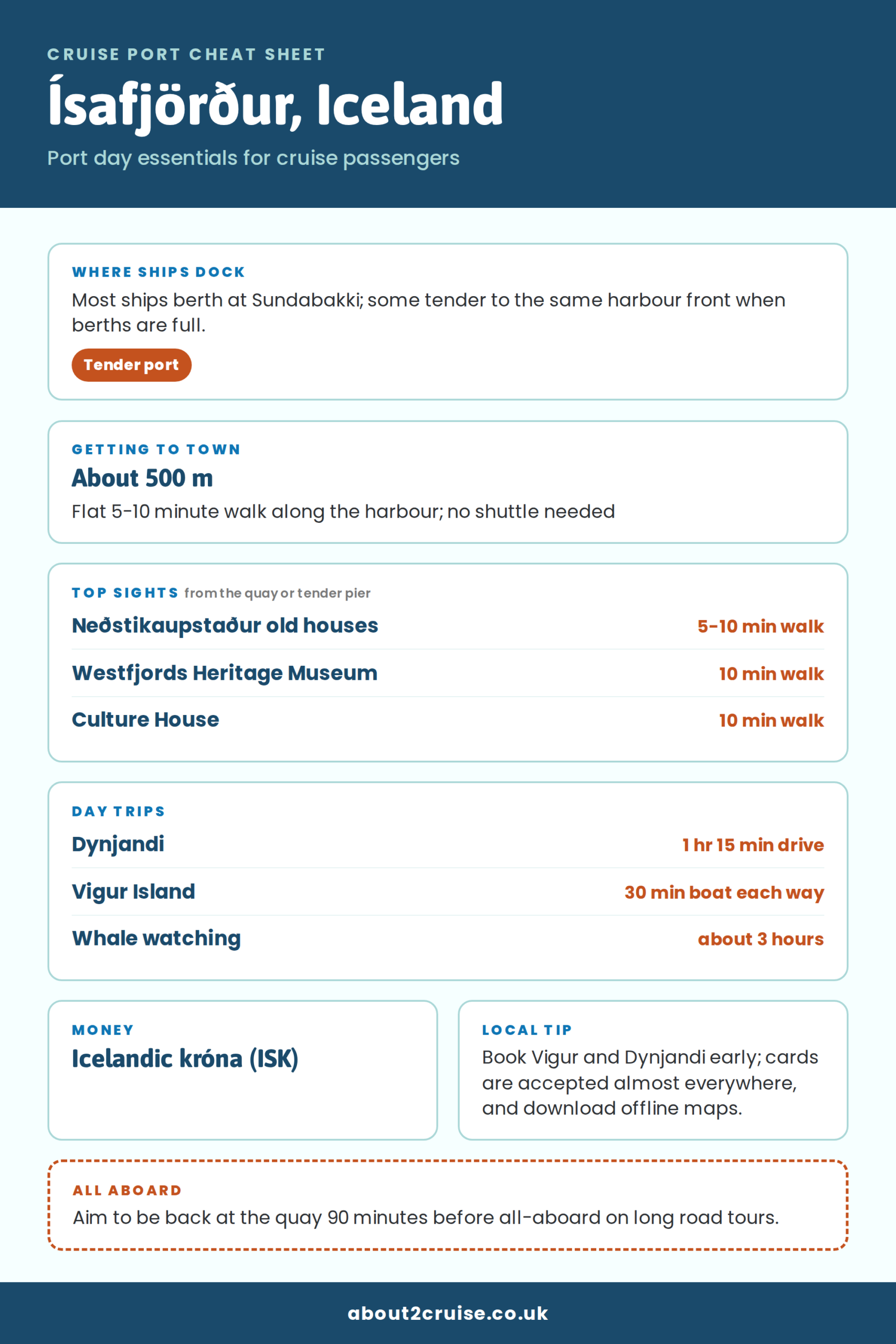
Most ships berth at Sundabakki, a flat 500 m walk from Ísafjörður’s old town. On a short call, walk the rainbow street and timber-house museum. On a longer one, choose one main excursion: Dynjandi waterfall, Vigur Island puffins, or the Troll Seat hike. Book small-group tours early, pack waterproofs, and respect your all-aboard.
Ísafjörður Port Facts
- Region: The capital of Iceland’s Westfjords, surrounded by fjords and mountains.
- Ships: Most dock at Sundabakki; a few tender when berths are full or conditions call for it.
- Town: A flat 0.5 km from the quay: no shuttle needed.
- Signature tours: Dynjandi waterfall, Vigur Island puffins, whale watching, Troll Seat hike.
- Season: May to October, cool, changeable and often wet even in midsummer.
- Money: Icelandic króna (ISK), but cards are accepted almost everywhere.
Where Do Cruise Ships Dock in Ísafjörður?
The main cruise quay is Sundabakki, right on the harbour front at 400 Ísafjörður. It has been lengthened to around 500 m and dredged, so most large cruise ships now pull alongside. You may also see smaller quays named Ásgeirsbakki, Mávagarður and Sundahöfn; these are used by smaller vessels and local boats.
Sundabakki is not an industrial dock far from town: it’s effectively in town. There is no full cruise terminal, but a new reception building is being built next to the berth. Until it opens, expect a simple quayside operation: walk off the ship, meet your tour, or follow signs into the centre.
If your ship tenders, the landing point is next to the cruise dock on the town harbour front. You’ll lose roughly 20–30 minutes at each end of the day, but the practical position is the same: you’re already in Ísafjörður when you step onto the pier.
Berth assignments aren’t usually published far in advance. The port’s season calendar at port.isafjordur.is shows call dates and times, but your ship’s daily programme or shore excursion team confirms docking versus tendering on the day.

Ísafjörður cruise port map
Tenders bring you ashore at Sundabakki. From the quay or tender pier, Aðalstræti 27 is about a 5-minute walk, Neðstikaupstaður about 7 minutes and Westfjords Heritage Museum about 7 minutes. Tap a pin for directions.
- SundabakkiWhere tenders land
- ÁsgeirsbakkiWhere tenders land
- MávagarðurWhere tenders land
- Aðalstræti 27Rainbow street · About 5 min walk from the quay or tender pier
- Westfjords Heritage MuseumLocal history museum · About 7 min walk from the quay or tender pier
- NeðstikaupstaðurOld timber-house quarter · About 7 min walk from the quay or tender pier
- NaustahvilftMountain hike · About 27 min walk from the quay or tender pier
- DynjandiWaterfall · About 38 km from the quay or tender pier
- Vigur IslandPuffin colony · About 13 km from the quay or tender pier
Can You Walk from the Port into Town?
Yes. It’s a flat 500 m walk from the cruise quay to the centre. Allow 5–10 minutes at an easy pace, depending on where along Sundabakki your ship is tied and whether you’re at the outer end. There’s no shuttle bus, and you won’t need one just for the town.
The route follows the harbour edge and leads you toward the old timber houses at Neðstikaupstaður. Some inner-harbour streets don’t have pavements, so stay to the side, watch for service vehicles, and remember this is still a working port. It’s not a long or difficult walk, just be aware of your surroundings.
If you arrive by tender, the landing is beside the main dock, so the walking distance is essentially the same. Tour coaches and minibuses pick up a few metres from the gangway or tender pier.
The Scenic Sail-In: What You’ll See Before You Dock
Arriving through Ísafjarðardjúp is part of the experience. You sail between steep fjord walls with flat-topped mountains on three sides, often with mirror-calm water and low cloud cutting the peaks. Keep an eye out for seals on rocky shores, seabirds working the water, and occasionally whales in the deeper part of the fjord.
If your ship has open decks or a forward lounge, use them for the approach and sail-away. The best light is often soft, grey and dramatic rather than bright sun, so don’t wait for perfect weather to enjoy the view.
Dynjandi Waterfall: Is It Worth the Drive?
Dynjandi is the big one: a protected natural monument in Arnarfjörður. The cascade drops about 100 m in six named tiers, with Fjallfoss at the top, fanning out like a bridal veil. It’s one of Iceland’s most photogenic waterfalls and the standard Westfjords shore excursion.
The drive from the port usually takes 1 h 15 min each way, partly through the Dýrafjörður tunnel. A standard half-day tour runs about five hours and gives you around one hour at the falls; an express version takes about three hours. Local prices are roughly ISK 26,400 for the five-hour Dynjandi and Þingeyri tour and ISK 15,800 for the three-hour express. Ship-run versions are usually higher and may not suit limited mobility.
From the car park, the lower path to Hrísvaðsfoss is paved and easy. After that the path becomes natural, rocky and uneven in places, with viewing platforms beside two of the falls. Most cruise passengers stop at the first big viewpoint or walk partway up. The full trail to the upper fall isn’t a technical climb, but it is uneven and can be slippery in rain.
There are toilets year-round, bus parking and summer rangers on site. If you book with a local operator, the coach or minibus is timed to your ship and the guide keeps the return-to-ship window in mind. On a short call, book this early because coaches and small-group places sell out before arrival.
Vigur Island Puffins: What to Expect
Vigur Island is the birdwatching outing: around 100,000 puffins from mid-April to early August, plus eiders, guillemots, Arctic terns and more than 60 species. It’s an internationally recognised Important Bird Area, and the boat ride across the fjord is half the experience.
The official Vigur excursion runs about three hours door to door: 30 minutes each way by boat and roughly two hours ashore. Groups are capped at 45 guests, which keeps the island visit calm. The local price is about ISK 25,313 per person, and the operator refunds in full if your ship cannot dock. Cruise-line versions are often more expensive and may be packaged with other activities.
Puffin numbers drop sharply after early August, so if you’re cruising in late August or September, set your expectations accordingly: you may see a few rather than thousands, but the island itself is still lovely. In July, Arctic terns can be aggressive near the path. The guide hands out sticks or flags to wave above your head, which often keeps them away.
The boat has steps with handrails, so you need to manage a step down and up. Paths on the island are grass, with ramps to some buildings, but there are stairs up to the windmill viewpoint and along some puffin paths. No drones, pets or smoking are allowed. You finish with coffee and happy marriage cake at Europe’s smallest post office, next to Iceland’s only surviving windmill and oldest seaworthy boat.
Naustahvilft (The Troll Seat): Is the Hike for You?
Naustahvilft is the bowl-shaped scar in the mountain directly above the airport, visible from the ship. The short, steep climb is about 2.3 km round trip with roughly 200 m of ascent. Most reasonably fit people reach the seat in about 30 minutes, but the path is primitive and the descent can be slippery, especially after rain.
From the top you look straight back across the town, the fjord and your ship far below. It’s free, open at all hours, and a rewarding DIY option if you have a few hours and the weather plays ball. The starting point is a small car park around the fjord past the airport. By car or taxi it’s only minutes, but on foot from the ship it becomes a longer route.
Don’t treat this as an easy pavement stroll. Wear walking shoes with grip, carry a waterproof layer, and don’t rush the downhill. In high wind, rain or poor visibility, skip it and pick the old town or a museum instead.
Ísafjörður Old Town and Rainbow Road: A Short Walking Route
Ísafjörður isn’t a city, but it does have a proper old quarter. Head for the tip of the sandspit to Neðstikaupstaður, the oldest cluster of timber houses in Iceland. Four of the country’s oldest houses sit here, now part of the museum area, with the harbour on one side and mountains on the other.
The rainbow-painted stretch is on Aðalstræti, at number 27. It’s a flat, paved street, not a traffic-free pedestrian zone, so stand at the edge for your photo and keep an eye out for cars. Sunrise and sunset give the strongest colour, but on typical grey Westfjords days it still pops.
Walk from the quay through the harbour, up past the old houses, then into the main shopping and café streets around Silfurtorg and Aðalstræti. You can comfortably see the old town, rainbow road, harbour and a museum in two to three hours on a short call.
Museums in Ísafjörður: Heritage Museum and Culture House
The Westfjords Heritage Museum sits at Neðstikaupstaður, in the old merchant buildings. It covers fishing, trading and daily life in the Westfjords, with period rooms and boats. Opening hours from 16 May to 31 August are 09:00–17:00 daily, then 09:00–15:00 to 15 September and 11:00–15:00 to 30 September. Admission is ISK 1,750 for adults, ISK 1,300 for seniors and students, free for children, and ISK 1,300 per person for groups over ten.
The town’s Culture House, Safnahúsið, is the former hospital and now holds the library, archives, photograph collection and art collection. There’s usually at least one exhibition open, and it’s a good wet-weather stop. There’s also a small Museum of Everyday Life in the centre, easy to combine with coffee and a walk.
If you only have an hour or two, the old houses around the heritage museum give you the historic atmosphere even if the museum itself has a queue or is closed when you pass.
More Shore Excursions: Whale Watching, Kayaking and ATVs
Whale watching runs from the harbour around Ásgeirsgata and takes about three hours. Adult tickets are about ISK 14,000, plus a mandatory ISK 240 harbour fee; children cost about ISK 7,000. This is good value compared with ship versions: for example, a 2.5-hour RIB whale safari on a cruise line has been sold at around US$309 before extras. If your itinerary also calls at Húsavík, that is the better known whale-watching base; see our Húsavík cruise port guide.
Local operators also sell kayaking around the fjord, an ATV panorama trip, a town culture walk and a mountain-bike ride. These are all port-based and timed to ship days, but they are small capacity. Book direct or via your ship as soon as you know your dates.
How to Plan Your Time in Ísafjörður
The biggest decision is whether you protect ship time or use a long tour. Use this rule of thumb:
- Short call, under about 6 hours: Stay in town. Walk the old harbour, rainbow road, heritage museum, coffee and maybe the Culture House. You’ll be back near the ship with no stress.
- About 7–8 hours: Pick one main excursion, either Dynjandi or Vigur, plus a short town walk before or after depending on your all-aboard.
- Long call, 9–10 hours: You can do a morning excursion and a late-afternoon town wander, or tackle the Troll Seat hike plus town. Don’t try to force Dynjandi and Vigur on the same day; you’ll rush both.
If your cruise also includes Akureyri, don’t expect the same scale of tour infrastructure here. Ísafjörður is smaller and more DIY-friendly for the town, but the best scenery requires transport. For the bigger northern town, see our Akureyri cruise port guide. For how this port fits into a whole Iceland itinerary, use our Iceland cruise ship ports guide.
Booking Ísafjörður Tours Early: Refunds and Risks
Vigur Island is capped at 45 guests, Dynjandi coaches and whale-watching boats have limited seats, and local taxis are scarce. If you want a small-group or independent tour, book as soon as your cruise is confirmed: not when you board. Most local operators plan around the ship timetable and offer a full refund or alternative departure if the ship misses the port, but the cheapest ship-organised tours may not offer that flexibility.
Direct local prices are usually lower than the cruise line for the same core tour, but you trade the ship’s “we will wait for you” guarantee. On tours with long drives, that matters. For Dynjandi and Vigur, local operators build in buffer time and use guides who know the road, but you should still set a personal alarm as a backup.
Westfjords Weather and What to Pack
This is subarctic, not Mediterranean. July and August average high temperatures around 10°C and lows around 5°C. It rains in every cruise month, and it gets wetter as the season goes on: average monthly rainfall is roughly 66 mm in June, 84 mm in July, 107 mm in August and 131 mm in September. Wind is usually calmest in July, but strong gusts appear with little notice, especially near open water and on boat trips.
Pack for four seasons in one day: a waterproof and windproof jacket, a mid-layer, walking shoes or trail shoes with grip, and a spare layer in your day bag. Don’t bring only sandals for the town; even short walks can be damp. For the Troll Seat and Dynjandi, proper footwear is the difference between a good stop and a fall.
In still, damp spells, some travellers report midges around the lower ground, but the usual Westfjords wind keeps them away. A small insect repellent is a sensible just-in-case, not a must-pack item.
Where to Eat, Shop, and Buy Groceries in Ísafjörður
Icelandic food here means fish and lamb. Look for plokkfiskur, a comforting mash of fish, potato, onion and white sauce; kjötsúpa, lamb soup with root vegetables; hangikjöt, smoked lamb; harðfiskur, dried fish; and skyr, a fresh cheese eaten like yoghurt. The local cake is hjónabandssæla, “happy marriage cake”, an oat and rhubarb slice served with coffee on Vigur.

The easiest café and restaurant streets are around Silfurtorg and Aðalstræti. For picnic supplies, there’s a Netto supermarket in the town centre. Café prices in Iceland are high, so buying a sandwich, skyr and drink at Netto can be a big saving on a shore day.
Souvenirs: knitwear, sheepskin, local crafts and small puffin-shaped things are in the centre, but if you also call at Reykjavik you may find more choice at better prices. Set a small budget for Westfjords art in the Culture House or museum shop.
Money, Cards, and Internet in Ísafjörður
The currency is the Icelandic króna, ISK. Cards are widely accepted in shops, cafés, museums and for tours; you usually don’t need cash. There’s a Landsbankinn branch on Hafnarstræti with an ATM, open Monday to Friday 10:00–16:00, if you want króna for a market stall or tip.
Don’t rely on port Wi-Fi. There is no full cruise terminal, so the promise of “free terminal Wi-Fi” is not dependable. Cafés and the library may offer free Wi-Fi, but download an offline map and your boarding pass before arrival. If your phone uses EU roaming, Iceland is not in the EU, so check your UK plan’s Iceland roaming charges.
Accessibility and Mobility at the Port and on Tours
The town is mostly flat and the quay-to-centre walk is manageable for many mobility scooters, but watch for uneven kerbs and harbour streets without pavements. Tender access, gangway positions and wheelchair transfer are decided by the ship and the port on the day, not published far ahead.
For tours, be specific when booking. The Vigur boat has steps with handrails and no ramp or lift, so you must be able to step on and off the boat. The Dynjandi path is paved and accessible to the lower fall at Hrísvaðsfoss, but beyond that it’s a rocky natural path and not suitable for wheelchairs. The Troll Seat is an uneven mountain path and is not accessible.
If you use a wheelchair or scooter, the old town and museum are the simplest and lowest-risk option. Check with the tour operator about vehicle capacity before booking a coach tour, because not all local minibuses have lifts.
Safety, Emergency Contacts, and Missing the Ship
Iceland’s emergency number is 112. The SafeTravel app from ICE-SAR lets you send a GPS location to 112 if you get into trouble on a hike, and it’s worth having on your phone even for short walks. Share your route with someone on the ship if you go beyond the town.
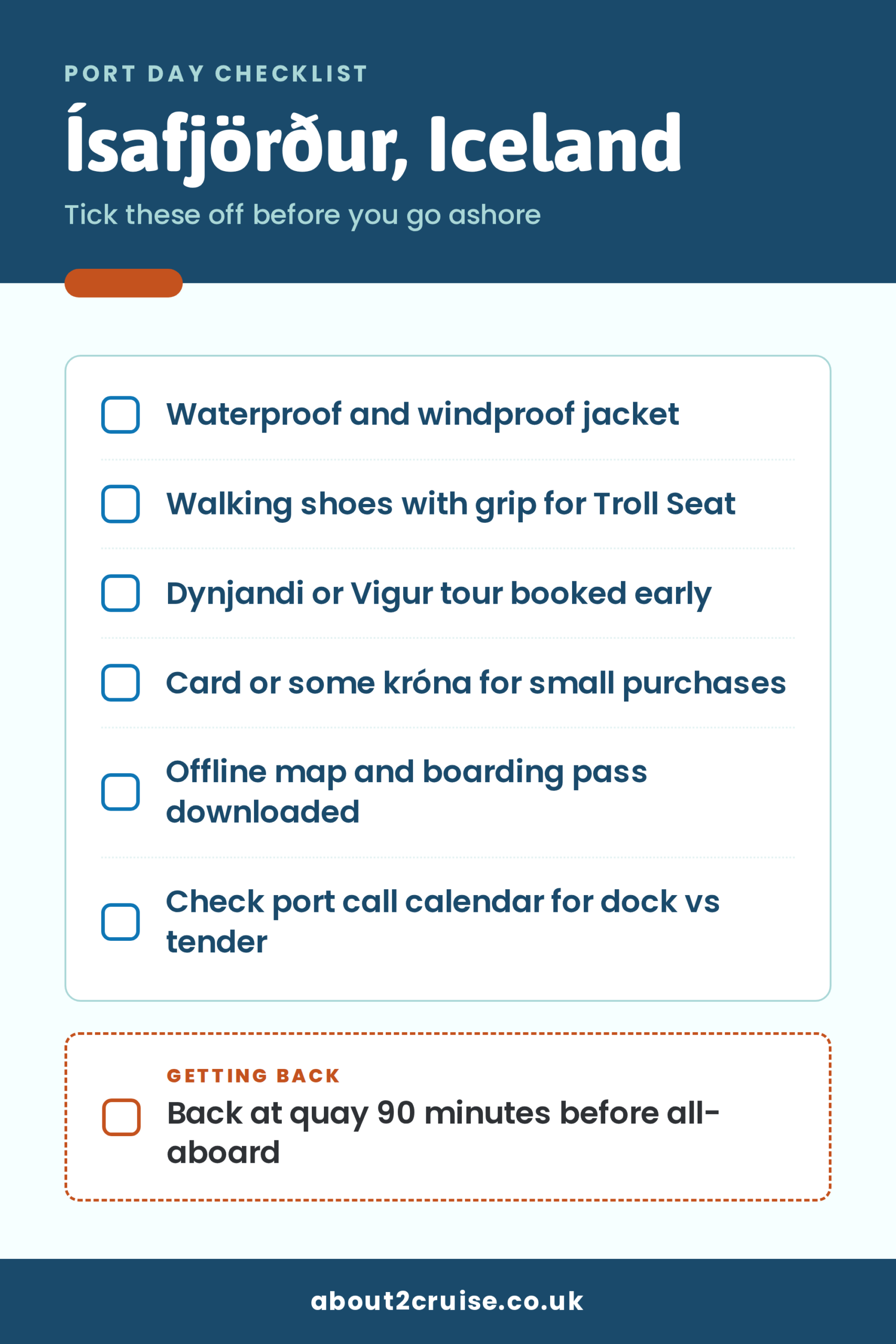
The main risks here are weather, wind, slippery rock and the sea. Keep back from cliff edges, don’t approach the water’s edge on rocky outcrops, and don’t trust a dry-looking path after rain. On long road tours, keep a buffer of at least 90 minutes between the scheduled return and all-aboard, and set a reminder to leave the falls or island with the guide.
If you miss the ship in Ísafjörður, the next practical exit is by air from the local airport 5 km away or by road to Reykjavík, about 450 km and 6–7 hours. Know your ship’s agent contact and start with the port office at +354 450 8080. Don’t let an independent tour’s return time drift.
Practical Details: Tourist Info, Taxis, Holidays and Parking
Tourist information: +354 450 8060, info@vestfirdir.is. Summer hours are roughly 08:00–17:00 on weekdays and 08:00–14:00 at weekends, shortening from September. Staff advise on walks, tours, food and transport, but they don’t sell tours.
Taxis are very limited. The local operator most often listed is Sophus Magnússon on Sundstræti 39, +354 893 8355, which also runs bus transfers for up to 43 passengers. Book ahead if you want a taxi to the Troll Seat or a specific viewpoint. Rental cars and tour coaches are available at the port, with coaches picking up close to the gangway.
Most shops and public services close on public holidays, including 17 June and Commerce Day, the first Monday in August. If your call falls on one of those, expect the museum and some cafés to keep reduced hours or close, but the scenery is still there. The port’s published call calendar is at port.isafjordur.is; your ship’s daily programme is the final word.
If you arrive by car, there’s parking near the harbour and in the town centre, with further parking on Skipagata and Austurvegur about 250–300 m from the harbour.
Getting to Ísafjörður Without a Cruise Ship
Ísafjörður is also reachable by air and road. The airport is 5 km from the harbour, with Icelandair flights from Reykjavík’s downtown domestic airport. By road, it’s about 450 km and 6–7 hours from Reykjavík via Route 1, Route 60 and Route 61. Mountain passes into the Westfjords can close temporarily in severe weather, so check road.is before driving.
If you’re starting or ending a cruise in Reykjavik, see our Reykjavik cruise departure port guide.
Where to Stay in Ísafjörður
Most cruisers visit as a port of call, but if you’re staying pre or post-cruise, rooms are scarce in the Westfjords. Hótel Ísafjörður at Silfurtorg 2 is central and close to the port; Hotel Ísafjörður: Horn at Austurvegur 2 is about a 10-minute walk from the heritage museum; Ísafjörður Inn and the local hostel are simpler options. Book ahead for high season.
How to spend a port day in Ísafjörður
A port day in Ísafjörður works best if you pick one: a slow walk around the old town and rainbow road, or a longer Dynjandi or Vigur Island tour.
Before you sail
- Book Vigur Island and Dynjandi tours as soon as your ship's call is confirmed.
- Download offline maps and your boarding pass; don't rely on port Wi-Fi.
- Pack a waterproof and windproof jacket plus walking shoes with grip.
Short port day: under 6 hours
- On dockingWalk from the quay into townNo shuttle neededFlat 500 m walk to Neðstikaupstaður; harbour streets may lack pavements.
- +15 minNeðstikaupstaður old housesThe oldest cluster of timber houses in Iceland, at the tip of the sandspit.
- +45 minWestfjords Heritage MuseumCard acceptedOpen 09:00-17:00 in summer; paid entry, children free.
- +1 hr 30 minAðalstræti Rainbow RoadThe flat, paved rainbow-painted street at number 27; stay at the edge for photos.
- +2 hrs 15 minLunch near Silfurtorg or AðalstrætiTry plokkfiskurPlokkfiskur, kjötsúpa and skyr are the everyday dishes; Netto has picnic supplies.
- +3 hrs 15 minCulture House (Safnahúsið)Former hospital with library, archive and exhibitions; a good wet-weather stop.
- All-aboard minus 1 hrBack at the quayThe flat walk takes 5-10 minutes. Aim to be at the ship with buffer.
The time on the map is the whole walk, every stop added together.
Open this walking route in Google Maps
If plans change: If the Heritage Museum is closed or busy, the old timber houses and rainbow road still make a worthwhile walk, and the Culture House is a useful fallback.
Long port day: 8 hours or more
- On dockingMeet your Dynjandi tour at the quayBook earlyCoaches pick up a few metres from the gangway or tender pier. Book as soon as your call is confirmed.
- +15 minDrive to DynjandiLong transferThe drive is 1 hr 15 min each way, partly through the Dýrafjörður tunnel.
- +1 hr 45 minWalk to the lower viewpointPaved path firstThe path to Hrísvaðsfoss is paved and easy; beyond it is rocky, uneven and can be slippery.
- +2 hrs 30 minRejoin the coach and returnWatch the clockThe standard tour allows about an hour at the falls, then drives back to Ísafjörður.
- +4 hrs 15 minLate lunch near Silfurtorg or AðalstrætiTry local fishPlokkfiskur, kjötsúpa or skyr make a good lunch; Netto has cheaper picnic options.
- +5 hrs 45 minOld town and rainbow roadWalk Aðalstræti to number 27 and the old timber houses at Neðstikaupstaður.
- All-aboard minus 1 hrBack at the quayFlat 5-10 minute walk. Aim to be back at the ship with time to spare.
This map shows the taxi ride from the ship. The time is the drive only, not your time ashore.
Open the taxi route in Google Maps
If plans change: If Dynjandi coaches are full or cancelled, take the Vigur Island boat or the Troll Seat hike instead, or stay in the old town and Culture House.
Ísafjörður Cruise Port FAQ
Is Ísafjörður walkable from the cruise port?
Yes. Most ships berth at Sundabakki, about 500 m from the old town. Tender passengers land next to the same harbour area. The walk is flat and takes 5–10 minutes. No shuttle is needed.
What should I do in Ísafjörður if I don’t want a long bus tour?
Walk the old harbour and Neðstikaupstaður, photograph the rainbow road on Aðalstræti, visit the Westfjords Heritage Museum or Culture House, and stop for coffee or lunch in the centre. You can do this in two to three hours and stay close to the ship.
What are the main attractions in Ísafjörður?
Dynjandi waterfall is the headline excursion. Vigur Island is the best puffin and birdwatching trip. Naustahvilft, the Troll Seat, is the classic short viewpoint hike. In town, the old quarter, rainbow street and heritage museum are the main stops.
Is Ísafjörður worth visiting?
Yes, for raw Westfjords scenery and fewer crowds. It doesn’t have the big tourist infrastructure of Reykjavik or Akureyri, but the fjord setting, old town and access to Dynjandi and Vigur make it a unique Iceland port.
Can I see puffins in late August or September?
Puffins are on Vigur from mid-April to early August. Numbers drop sharply after early August. Late in the season you may see a few rather than tens of thousands, but the boat trip and island are still worthwhile.
Do I need Icelandic króna in Ísafjörður?
Not usually. Cards are accepted almost everywhere, including museums, cafés and tour operators. If you want cash, there’s a bank branch and ATM on Hafnarstræti.
Can I do Dynjandi independently with a rental car?
It’s possible, but it’s a 1 h 15 min drive each way on unfamiliar roads and you need to be back for all-aboard. On a cruise day, a local tour is usually safer and not much more expensive than a one-day rental plus fuel, especially because operators time the return to the ship.
How early should I book Vigur or Dynjandi?
As soon as you know your ship will call. Vigur is capped at 45 guests and sells out, and Dynjandi coach places are limited. Don’t wait until you board.
Is the Troll Seat hike suitable for beginners?
Fit beginners can do it in dry weather, but the path is primitive and the descent can be slippery. If it’s wet, windy or visibility is poor, choose a lower walk or the town instead.
Which is better, Ísafjörður or Akureyri?
They’re different. Ísafjörður is smaller and more dramatic for fjord scenery and remote excursions. Akureyri is larger with more amenities and a wider range of tours. See our Akureyri cruise port guide for the comparison.
Is there a PDF map or official port guide?
The port’s visitor brochure and call calendar are on port.isafjordur.is. Download or screenshot them before arrival because you can’t rely on a full terminal Wi-Fi signal. The town is compact enough that an offline phone map works well.