
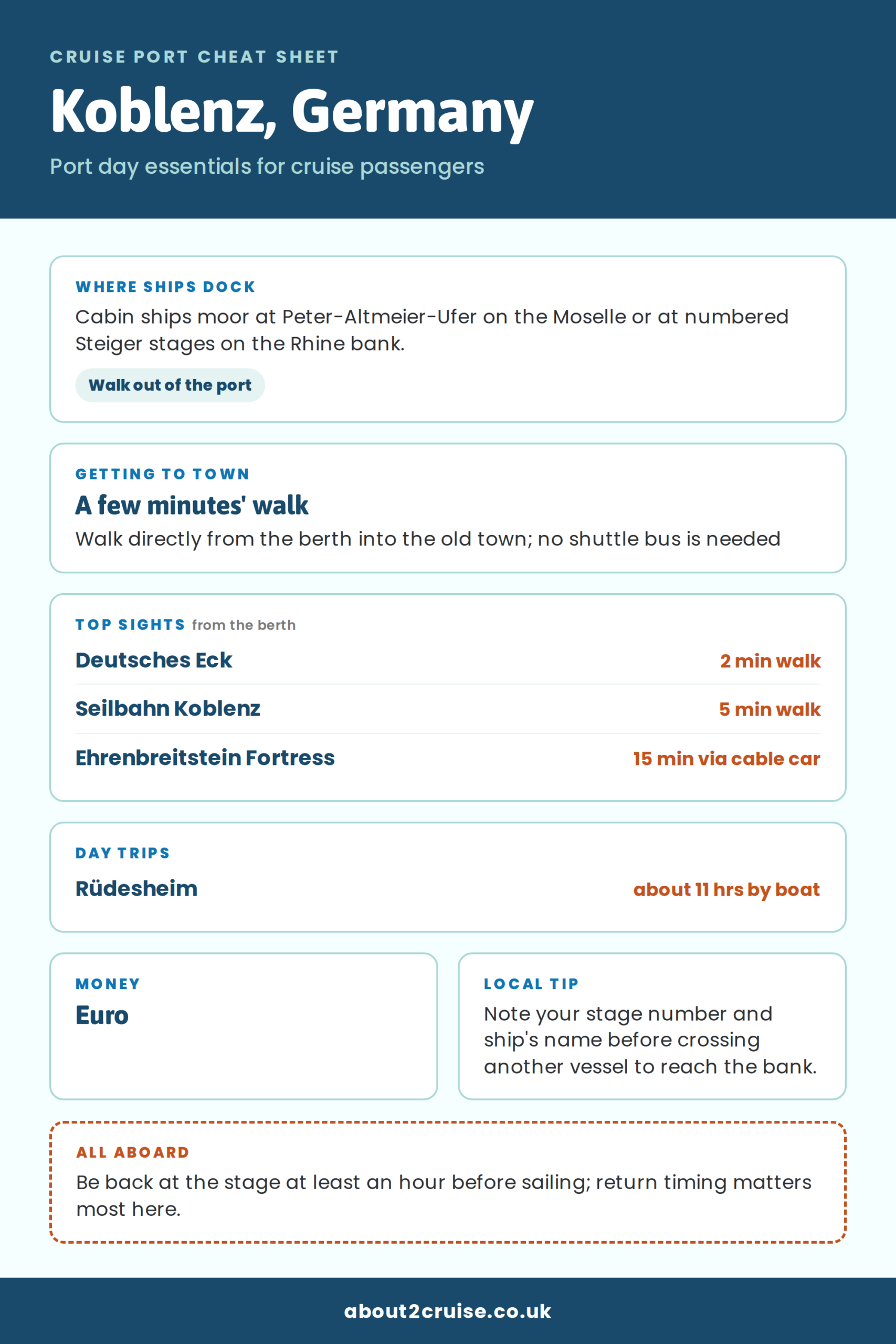
Koblenz river cruise ships tie up on the Moselle at Peter-Altmeier-Ufer, right by the Deutsches Eck, or at the numbered Steiger stages along Konrad-Adenauer-Ufer on the Rhine. Either way you’re a few minutes’ walk from the old town, the cable car up to Ehrenbreitstein Fortress and the Rhine promenade, and the sights fit into a normal port day.
Where Koblenz cruise ships dock
There’s no terminal in Koblenz. River ships tie up at landing stages, called Steiger and numbered along the quay, and the number you get decides how much walking you do and which bit of town you see first.
| Berth | Where it is | Who uses it |
|---|---|---|
| Peter-Altmeier-Ufer | Moselle bank, kilometre 0.580 to the Balduinbrücke, at the Deutsches Eck | Most cabin ships |
| Konrad-Adenauer-Ufer, Steiger 1 | Rhine, city bank | Viking River Cruises |
| Konrad-Adenauer-Ufer, Steiger 4, 5 and 7 | Rhine, at the Deutsches Eck, Steiger 4 nearest the cable car | KD |
| Konrad-Adenauer-Ufer, Steiger 9 | Rhine, city bank | Personenschifffahrt Gilles |
| Konrad-Adenauer-Ufer, Steiger 10 | Rhine, city bank | Marksburgschifffahrt Vomfell |
| Kaiserin-Augusta-Anlagen (Rheinanlagen) | Rhine, river kilometre 590.27 | KD, one berth, no double-banking |
| Rheinsteiguer in Ehrenbreitstein | Rhine, at Ehrenbreitstein | Leased to Viking |
Most cabin ships moor on the Moselle at Peter-Altmeier-Ufer, between the Balduinbrücke and the spot where the Moselle meets the Rhine. Those stages open straight onto the Deutsches Eck, which is why they’re popular. The rest go on the Rhine bank at Konrad-Adenauer-Ufer.
Rafting is routine. When it’s busy, ships tie two and three deep. Your gangway can open onto another ship’s deck, and you walk across her to reach the bank.
Note the stage number and the name of the ship you crossed. That’s your way back.
Berths move with the water level and with how many ships are in, so the stage named in your daily programme is the one that counts. Check it before you go ashore, then check it again before you come back.
Koblenz cruise port map
Ships dock at Peter-Altmeier-Ufer berth. From the berth, Altstadt Koblenz is about a 6-minute walk, Mittelrhein-Museum about 8 minutes and Basilika St. Kastor about 10 minutes. Tap a pin for directions.
- Peter-Altmeier-Ufer berthWhere ships dock
- Konrad-Adenauer-Ufer stagesWhere ships dock
- Kaiserin-Augusta-Anlagen berthWhere ships dock
- Altstadt KoblenzOld town · About 6 min walk from the berth
- Mittelrhein-MuseumMuseum · About 8 min walk from the berth
- Basilika St. KastorCatholic basilica · About 10 min walk from the berth
- Seilbahn KoblenzCable car · About 11 min walk from the berth
- Ludwig MuseumArt museum · About 11 min walk from the berth
- Deutsches EckHeadland monument · About 13 min walk from the berth
- Ehrenbreitstein FortressFortress · About 24 min walk from the berth
- Koblenz HbfRailway station · About 25 min walk from the berth
- Rüdesheim am RheinRiverside town · About 55 km from the berth
Getting from the Koblenz berths into the old town
The centre is close enough that most people walk. The Peter-Altmeier-Ufer stages put you at the Deutsches Eck, the KD stages on Konrad-Adenauer-Ufer are two minutes from the Rheinstraße/Fähre bus stop, and the Altstadt squares sit just inland from the Rhine promenade.
Bus 1 towards Altstadt/Deutsches Eck drops at Rheinstraße/Fähre, two minutes from the KD stages. Bus 1 and bus 11 both stop at Deutsches Eck/Seilbahn for the cable car. From Koblenz Stadtmitte, it’s three minutes to the Löhr-Center bus station for bus 1, or about twenty minutes on foot.
Coaches set down on Konrad-Adenauer-Ufer itself, with eight coach spaces and five bus stops beside the landing stages. Five more spaces sit on Peter-Altmeier-Ufer about eight minutes’ walk away, nine at Weindorf about twelve minutes, and three bus stops on Stresemannstraße about six. Coaches over 3.5 tonnes can’t use the Europabrücke into the city.
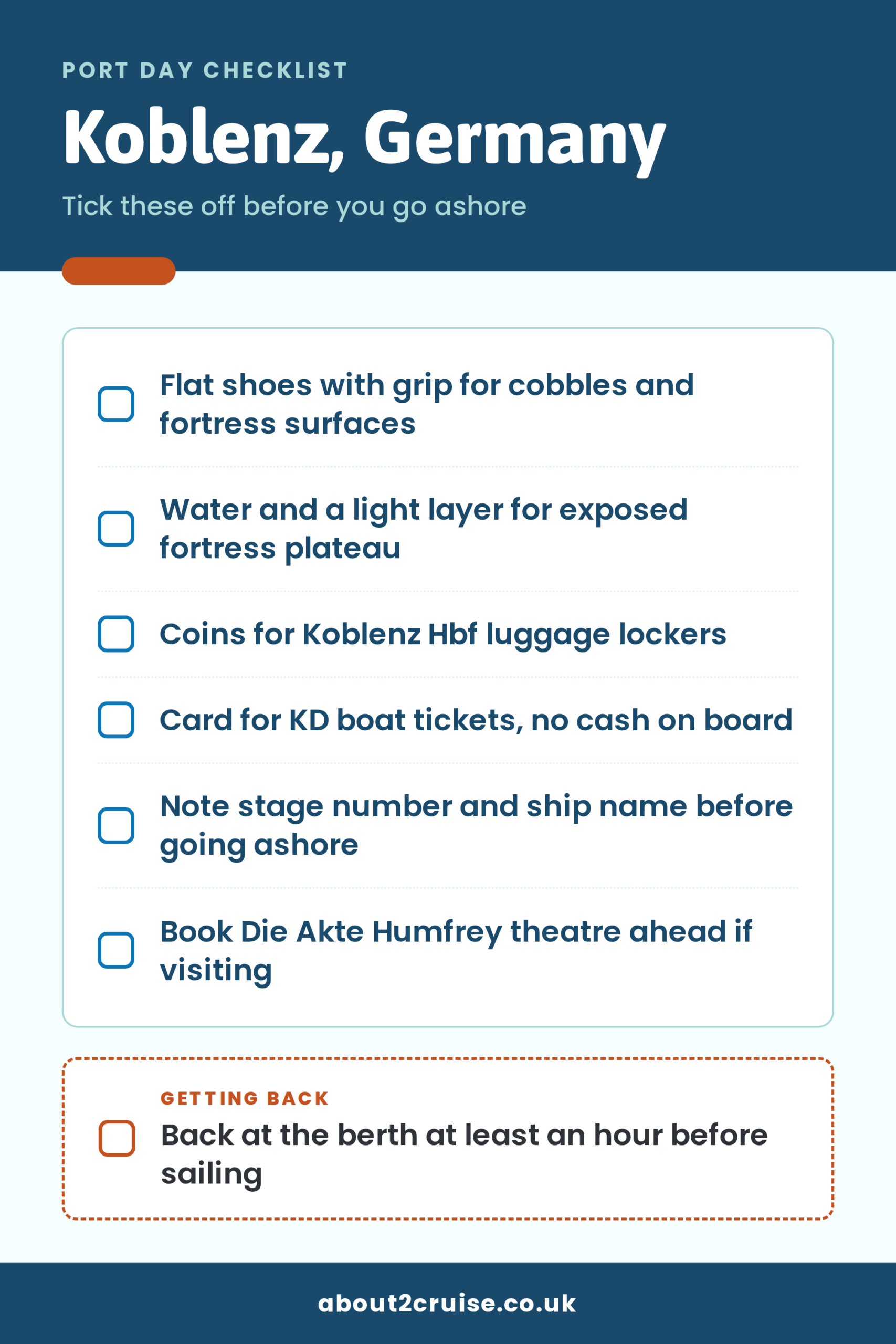
River ships usually want you back on board at least an hour before sailing, so build the return leg into whatever you plan. The gangway angle shifts with the river level, and rafting adds steps and thresholds. That matters if you’re cutting it fine.
The Deutsches Eck, where the Moselle meets the Rhine
The Deutsches Eck is the headland where the Moselle joins the Rhine. A 37 m monument topped with a 14 m equestrian statue marks it, and it sits on Konrad-Adenauer-Ufer. A ship at Peter-Altmeier-Ufer puts you almost underneath it.
Only the street-level plateau is step-free. The base of the monument is up steps. Access gets restricted during big events such as the Kaiserfestival and Electronic Wine, so a call that clashes with one changes what you can reach on foot.
The Ludwig Museum is in the Deutschherrenhaus at the Deutsches Eck, and the Mittelrhein-Museum is in the Forum Confluentes in the city centre. Both work if you want an hour indoors.
Public toilets at the Deutsches Eck
There’s a large public toilet building on Konrad-Adenauer-Ufer, put in as part of the riverside redevelopment with ship passengers in mind. It’s a short walk from both the Rhine stages and the Deutsches Eck. Koblenz doesn’t publish opening times or a charge, so use it when you pass rather than planning the day around it.
Ehrenbreitstein Fortress and the Koblenz cable car
Most people take the cable car up to the fortress. The Seilbahn Koblenz runs 890 m from a valley station on Konrad-Adenauer-Ufer near the Basilika St. Kastor to the plateau at Ehrenbreitstein, and a cabin leaves every minute.
In season it runs daily from 10:00 to at least 19:00, with the last ascent at 19:00. The fortress museums and exhibitions close at 18:00.
The fortress opens 10:00 to 18:00 in summer and 11:00 to 16:00 in winter at roughly half the admission. Its grounds and restaurants are generally free to enter from 18:00 until around midnight in summer. The exhibition buildings shut on 24 and 31 December.
Both ends are barrier-free. The cabins take wheelchairs, and the fortress is largely step-free via ramps and lifts, certified under “Reisen für Alle”. Historic passages and some exhibitions aren’t.
Cruise groups arrive in waves, and the queue at the lower station builds fast. Go at opening, or wait until the coaches have moved on.
If you want one ticket covering the boat, the cable car and the fortress, KD sells a combined ticket at its ticket offices on the quay. An evening return on the cable car is valid from 17:30.
You can also book Koblenz and Rhine attractions before you sail if you’d rather have the fortress timed and ticketed.
Day boats from Koblenz: KD line services and the Rüdesheim paddle steamer
If you’ve got a full day, or you’re staying on before or after a sailing, the scheduled river boats are the easiest way to see the gorge. KD runs line services between Cologne with its magnificent cathedral and Mainz and its Gutenberg connections, calling at more than 30 landing stages, seasonally from early April to mid-October.
KD uses Steiger 4, 5 and 7 at the Deutsches Eck, plus its berth at Kaiserin-Augusta-Anlagen. Steiger 4 takes 135 m by 25 m and can be double-banked.
The Rheinanlagen berth doesn’t allow double-banking. The other operators have their own stages: Personenschifffahrt Gilles at Steiger 9 and Marksburgschifffahrt Vomfell at Steiger 10.
The nostalgic paddle steamer Goethe is the headline run: Koblenz to Rüdesheim am Rhein and its wine taverns and back through the Upper Middle Rhine Valley. It goes out around 09:00 and back around 20:00, daily except Mondays in season. Those hours make it a whole-day outing, not something to bolt onto a short call.
Be at the stage 15 minutes before departure. If you bought your ticket somewhere other than KD, show it at the KD ticket office on the quay first.
KD is card only on board, no cash. Gilles and Vomfell both run day trips into the Rhine Gorge from their stages.
They ask passengers to arrive about 15 minutes before sailing and to reserve for day trips.
Koblenz sits where the Moselle meets the Rhine, which is why it appears on so many European river cruises and on both rivers’ itineraries. Going downstream, Rhine sailings run on to Andernach with its medieval towers.
Then comes Bonn and its Beethoven heritage, then Cologne and Düsseldorf with its modern art scene. Upstream, the gorge stretch brings Boppard with its Rhine loop views and Rüdesheim before Mainz.
Turn up the Moselle instead and the calls are Bernkastel-Kues and its wine heritage and Trier with its Roman ruins.
When the Rhine runs high or low at Koblenz
Water level is the thing that quietly rearranges a Koblenz call. KD publishes its own limits: the Rheinanlagen berth closes to berthing at a flood level of 4.20 m and has a low-water limit of 1.00 m. Steiger 4 stays usable up to 6.00 m of flood and down to 0.85 m.
That usually means a change of plan rather than a lost port. High or low water tends to bring a bus transfer, a vessel swap, a shortened call or a different landing instead of a cancellation. The same happens at cruise ports throughout Germany when the river is out of sorts.
River events close stages too. KD’s landing stages shut for Rhine in Flames Koblenz, so a call that clashes with it lands somewhere else.
Money in Koblenz: currency, cards and cash
The currency is the euro, and cards work almost everywhere you’ll spend money ashore.
EC and major credit cards, contactless, Apple Pay and Google Pay all work in shops, restaurants and at the boat ticket desks on the landing stages. American Express is the exception, and the tourist office doesn’t take it either. Keep some cash for small bakeries, kiosks and snack stalls, and for tips, which aren’t usually added to the bill. Public toilets near the berths charge a small fee, so keep some coins. US dollars aren’t accepted. It’s euros only.
Is Koblenz safe for cruise passengers?
Koblenz is a safe port for cruise passengers and an easy one to walk around, with no specific warning against it.
Crime in Germany is about the same as at home, and recorded crime in Koblenz has fallen sharply. Watch your bag in crowds, around the station and at busy sights, and change money only at banks or ATMs. There’s one local hotspot, the Löhrrondell and Altlöhrtor area, where street drug dealing happens openly. It’s away from the berths and the old town squares you’ll visit. Taxi overcharging and scams aimed at cruise passengers aren’t a common problem here.
Where to eat near Koblenz cruise port
Eat in the Altstadt, immediately inland from the Rhine stages. The squares around Florinsmarkt, Am Plan, Jesuitenplatz and Gemüsegasse are the heart of it, along with the Rheinstraße and the riverside strip between the Deutsches Eck and the Electoral Palace. That’s the tavern and café quarter, and it’s a short walk from every central berth.
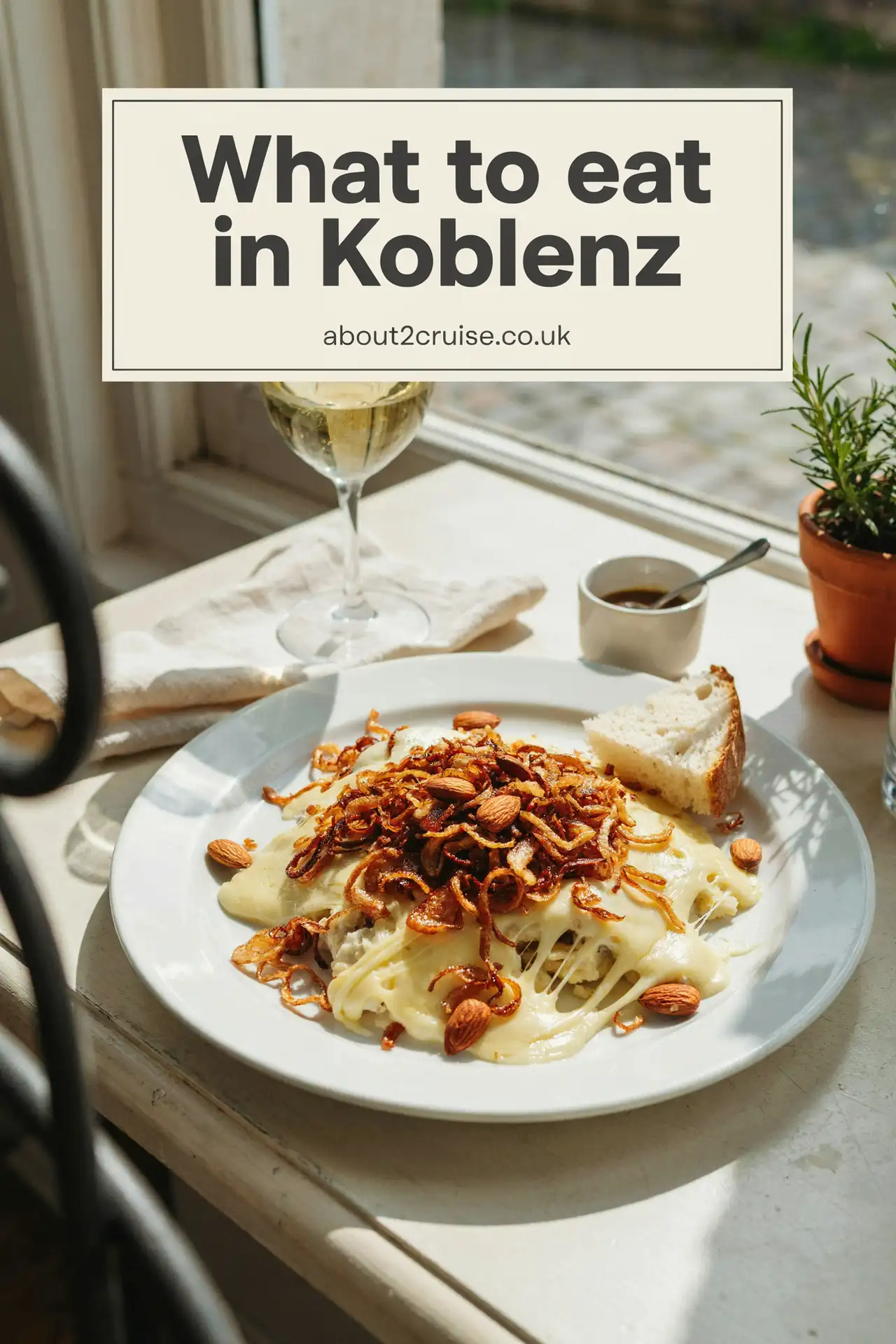
Riesling is the local pour, Moselle and Rhine steep-slope, served in the Altstadt’s wine taverns and along the promenades. Order it with the local plates.
- Spundekäs: cream cheese and quark spread with onions, served with a pretzel, traditionally a midday or early-evening snack.
- Flammkuchen and Sauerbraten: the standard Rhineland plates in the Altstadt.
- Schrottele and Debbekooche: Koblenz’s own specialities, on the Altstadt menus.
- Kalte Ente: the other Rhineland classic to look for alongside the Riesling.
Best photo spots in Koblenz
The fortress plateau is the shot. From the top of the cable car you look down on the confluence, the Deutsches Eck and the point where the Rhine and Moselle meet. The easy route to evening light is the cable car’s evening return, valid from 17:30, with the fortress grounds free to walk until around midnight in summer.
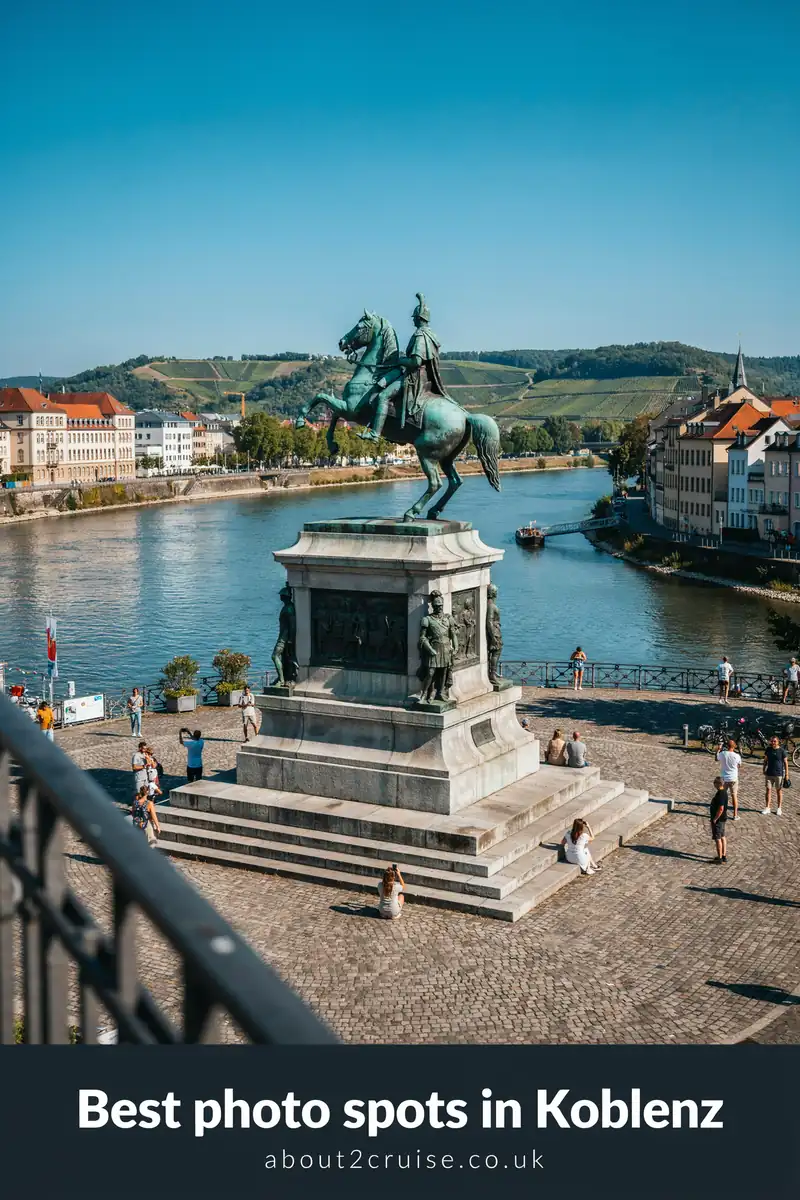
The Deutsches Eck itself gives you the reverse: the monument in the foreground and Ehrenbreitstein Fortress across the Rhine. The Rhine promenade, the Rheinanlagen and the Electoral Palace gardens are the landscaped stretch between the berths and the palace. They give you the classic framing of the confluence.
Save this port day plan to Pinterest if you want the cable car and fortress timings to hand on the day.
Weather in Koblenz for a cruise port day
Days are mild to warm whenever your ship calls, and there’s a good chance of rain at any time of year.
Most cruise calls fall between April and October, when daytime highs run from the mid-teens in spring to the mid-twenties in July and August, then cool again into autumn. Rain is spread through the year rather than concentrated in one season. There’s no hurricane season here, because Koblenz is inland Germany. It can be breezy in the mornings and along the Rhine promenade, and the fortress plateau is more exposed than the old town streets below. Pack a light rain layer whatever month you’re sailing.
What to wear in Koblenz: outfit ideas for a port day
Flat shoes with grip are the one thing that changes the day. The Altstadt streets are cobbled, fortress surfaces are rougher still, and rafting means steps and thresholds at the gangway. The Rhine promenade and the path to the Deutsches Eck are smooth and step-free.

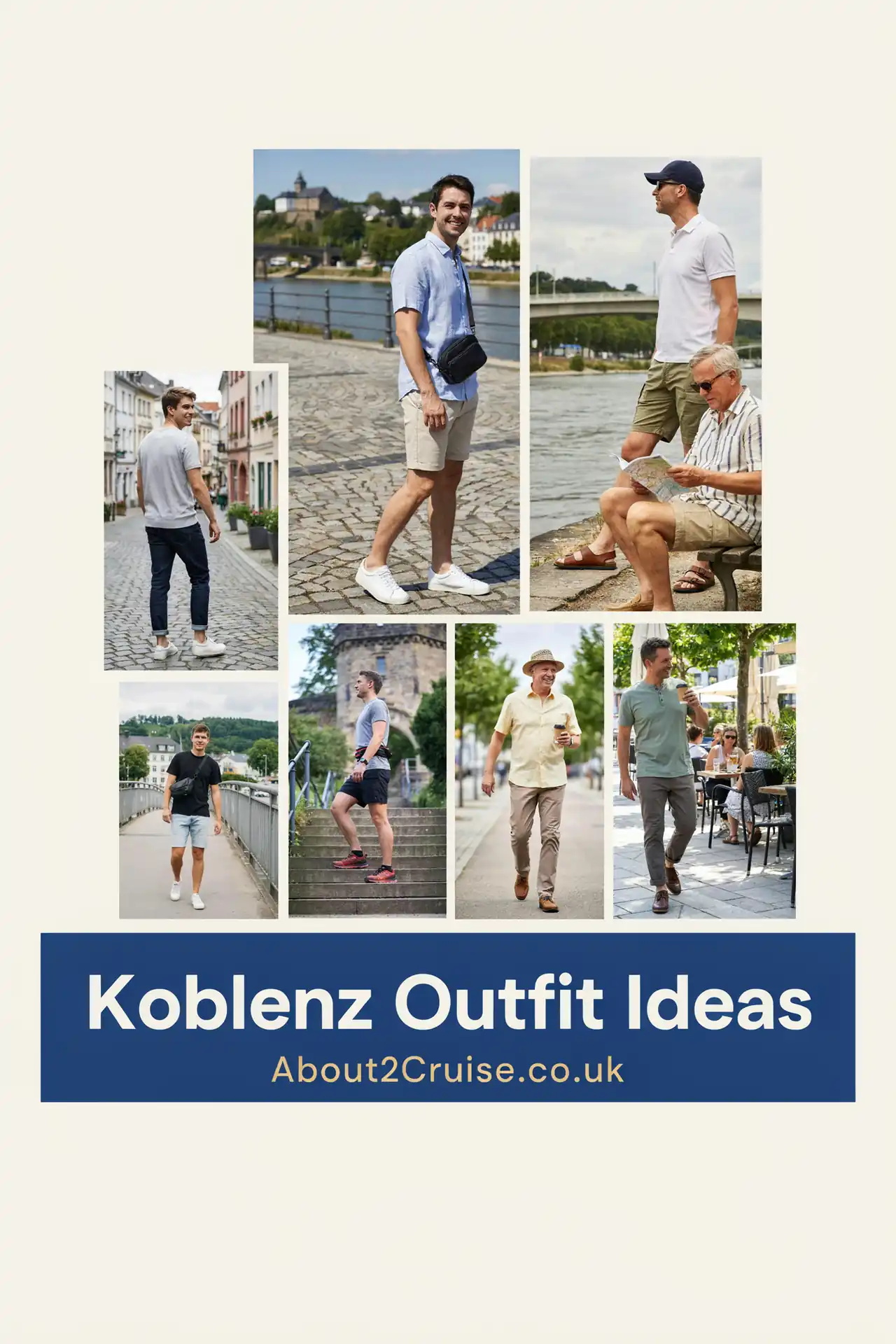
Dress in layers. You go from a warm cable car cabin to an open fortress plateau in a few minutes, so a light layer you can take off beats a heavy jacket. A bottle of water is worth carrying up.
The Basilika St. Kastor is a working Catholic basilica with Mass on Saturday evening and Sunday morning. There’s no published dress code, so visitors tend to keep it quiet and covered.
For more inspiration, see these casual cruise outfit ideas for women and cruise outfit ideas for men.
Joining or leaving a ship in Koblenz
Koblenz is mostly a port you stop at, not one where you join or leave the ship. The city’s planning assumes no boarding or leaving, and most ships simply pass through.
CroisiEurope is the exception: it sells Rhine cruises that start in Koblenz and boards at the Deutsches Eck. If your paperwork says Koblenz is day one, plan for a port where you start and expect one of the central stages.
Koblenz Hbf is the station to aim for. The Rheinanlagen berth is about ten minutes on foot from it. A taxi to the Rhine berths takes five to ten minutes, and walking from the station to the dock area is fifteen to twenty minutes.
Frankfurt (FRA) and Cologne/Bonn (CGN) are the usual arrival airports. Both have direct long-distance rail links and take roughly 60 to 90 minutes to Koblenz. Frankfurt Flughafen Fernbahnhof to Koblenz Hbf takes about an hour to an hour and a half on RE or ICE services.
Check-in times are usually fixed and come with your travel documents, and the latest boarding is generally about an hour before departure. Book the train with that hour in hand rather than aiming at the sailing time.
Parking at Koblenz cruise port
Nothing parks at the landing stages, so if you’re driving to a Koblenz departure, you leave the car in the city and walk. There’s no port-operated car park to book either. The choice is a city garage you drive into on the day, or a guarded service that shuttles you to the pier.
- Görresplatz underground garage: about five minutes’ walk from the Rheinanlagen berth, open 24 hours.
- Schloss underground garage: about nine minutes’ walk.
- Peter-Altmeier-Ufer car park: about eight minutes.
- Schängel-Center garage: the other central option.
- Park & Boat: guarded parking with a shuttle direct to the pier.
- Longer stays: Parkhaus Altstadt near Görresplatz, the open-air car park at the Deutsches Eck and Parkhaus Rhein-Mosel-Halle.
Koblenz doesn’t publish daily rates for these, so check the current charge when you book. If you’re sailing from Cologne with A-ROSA, that line’s parking partner is Globus Parkservice in Cologne, not Koblenz, and it has to be booked online in advance.
Where to stay near Koblenz cruise port
Stay within about a kilometre of the Deutsches Eck and you can walk to both the Peter-Altmeier-Ufer stages and the Konrad-Adenauer-Ufer stages on the morning of the sailing. That beats a taxi at dawn. The same pocket of old town and Rhine promenade works for a night after the cruise.
Hotel Morjan sits on the Rhine promenade near the Deutsches Eck and the cable car valley station. It has luggage storage, a breakfast buffet, river-view rooms and a terrace facing Ehrenbreitstein. sander Hotel is on the edge of the Altstadt, five to ten minutes on foot from the Deutsches Eck, with a breakfast buffet built on regional products and an underground garage subject to availability. Altstadt Hotel & Café is on Jesuitenplatz, about ten minutes’ walk from the Deutsches Eck, with breakfast in the attached café. It has no lift.
Breakfast timing matters more than anything else on a sailing morning. None of these publishes cruise-day arrangements, so confirm it when you book and keep a walk or a taxi as your fallback to the stage.
Luggage storage at Koblenz cruise port
Nothing at the landing stages is set up for bags. The left luggage is at Koblenz Hbf, which has 64 lockers at 24 × 42 × 76 cm and 60 at 44 × 61 × 91 cm, coin-operated and available around the clock. From the main entrance they’re at the back to the right and at the foot of the stairs down to the platforms.
They’re coin-and-key, so arrive with change. Forum Mittelrhein in the city centre also has lockers, rucksack sized, but they close on Sundays and public holidays. If the station is the wrong end of town for the day you’ve planned, find a place to leave your bags in Koblenz before you travel.
How to spend a port day in Koblenz
A port day in Koblenz works best if you pick one: a short loop round the Deutsches Eck and fortress, or a full day on the Rhine to Rüdesheim.
Before you sail
- Book Die Akte Humfrey fortress station theatre ahead if you want to see it
- Check the Goethe paddle steamer timetable before planning a Rüdesheim day
- Bring a card for KD boat tickets; no cash accepted on board
Short port day: under 6 hours
- On dockingWalk ashore at the berthNo terminalThere's no terminal in Koblenz; walk off the gangway and note your stage number and ship name for the return.
- +10 minDeutsches EckA couple of minutes from Peter-Altmeier-Ufer, the headland where the Moselle meets the Rhine.
- +30 minCable car to Ehrenbreitstein FortressGo earlyRide the Seilbahn Koblenz up to the fortress before the coach groups build a queue at the lower station.
- +1 hr 30 minExplore the fortress plateauWalk the ramps and lifts for the view over the Rhine-Moselle confluence; carry water, it's exposed up top.
- +3 hrCable car down, lunch in the AltstadtTry SpundekäsBack down to Konrad-Adenauer-Ufer, then into the Altstadt for Spundekäs, a cream-cheese dip with pretzel and Riesling.
- +4 hrRhine promenade back to the berthWalk the riverside Rheinanlagen past the Electoral Palace gardens back towards Peter-Altmeier-Ufer.
- All-aboard minus 1 hrBack at the berthCheck your stage number again; rafting may mean crossing another ship's deck to reach your own.
The time on the map is the whole walk, every stop added together.
Open this walking route in Google Maps
If plans change: If the cable car queue is long, visit the Ludwig Museum at the Deutsches Eck first while it clears.
Long port day: 8 hours or more
- On dockingWalk to the KD landing stageArrive earlyHead to Steiger 4 or 5 on Konrad-Adenauer-Ufer; be there 15 minutes before the paddle steamer leaves.
- +15 minBoard the Goethe to RüdesheimCard only on boardThe paddle steamer sails to Rüdesheim am Rhein and its wine taverns through the Upper Middle Rhine Valley, leaving around 9am.
- +1 hr 45 minScenic cruise through the Rhine GorgeStay on deck as the Goethe passes Boppard and the Loreley rock on the way upstream.
- +3 hr 15 minArrive in Rüdesheim, lunch in a wine tavernTry SpundekäsOrder Spundekäs, the cream-cheese and onion dip, with pretzel and a glass of local Riesling.
- +5 hrBrowse Rüdesheim's wine taverns and lanesExplore the town before heading back to the quay for the return sailing.
- +6 hr 30 minBoard the return sailing through the GorgeThe Goethe heads back downstream towards Koblenz, arriving around 8pm.
- All-aboard minus 1 hrWalk back to your berthThe return sailing docks at the KD stage; check your stage number again before crossing any rafted ships.
The times on the map are for the whole journey there by train and bus.
Get train and bus times in Google Maps
If plans change: If the paddle steamer is full or cancelled, Gilles or Vomfell run shorter Rhine Gorge day trips from Steiger 9 and 10 instead.
Koblenz cruise port FAQs
What should I do in Koblenz on a Rhine river cruise stop?
Start with the Deutsches Eck, since the Peter-Altmeier-Ufer stages open onto it. Then ride the cable car up to Ehrenbreitstein Fortress before the coach groups build the queue. Come back down for the Altstadt, a glass of Riesling and the Rhine promenade.
Is Koblenz a tender port?
Koblenz isn’t a tender port: ships moor alongside at fixed stages on the Moselle and the Rhine, so you walk off down a gangway rather than waiting for a boat.
Can you take dogs and bicycles on the Koblenz cable car?
Dogs and bicycles are both allowed on the Seilbahn Koblenz, and the cabins are fully barrier-free, so wheelchairs go up as well. Cabins leave every minute.
Do I need to book the fortress station theatre in advance?
Die Akte Humfrey, the station theatre on the fortress history route, has to be reserved ahead of your visit, so book it before you sail if it’s the reason you’re heading up.
Last Updated: 5 November 2026