
Manaus is Brazil’s Amazon river port, an ocean-ship gateway roughly 900 miles from the Atlantic. Most calls dock or tender at a floating quay in the city centre, close to the rubber-boom Amazon Theatre and the boats heading out to the Meeting of the Waters. The essentials are heat, river transfers, health preparation and knowing exactly where your ship comes alongside.

Why Cruise Ships Visit Manaus
Manaus sits deep in the Amazon basin, roughly 1,450 km (900 miles) from the Atlantic, up the Amazon and then the Rio Negro. It’s the main ocean-ship gateway for Brazilian Amazon cruises, and the season generally runs from November to April. Holland America, Oceania, Regent and P&O have all called here, and it’s a common turnaround point for Amazon voyages as well as a stop on longer South America itineraries.
The city is the former rubber-boom capital, and the Amazon Theatre is its Belle Époque calling card. The Meeting of the Waters, where the dark Rio Negro runs beside the muddy Rio Solimões without immediately mixing, is the natural spectacle most first-time visitors want to see. Around both sits the real reason ships come this far: the rainforest, the river and the chance to get out on the water.
Because Manaus often appears on longer South America or repositioning itineraries, you may also find our guides to Bridgetown, Barbados, Scarborough, Tobago and Port of Spain, Trinidad useful if your ship is heading that way. For other Amazon and Brazilian calls, see our Brazil cruise ports guide.
Where Your Ship Docks in Manaus (and When You Might Tender)
Cruise ships use the public Port of Manaus downtown, at the floating quay known as Cais das Torres or Flutuante das Torres. The port address is Rua Taqueirinha, 25, Centro. It’s a working river port with floating structures that rise and fall with the Rio Negro, and the access flap adjusts to the river level. The cruise quay is about 180 m long and rated for large ships, with berthing and unberthing done in daylight.
The big caveat? Manaus has historically been described as a possible tender port, and at least one cruise line still warns passengers that the ship may anchor offshore and use tenders. Since December 2023, cruise ships have again been berthing at the Flutuante das Torres, but there’s no public schedule telling you in advance which ship gets which quay or whether your call will tender. Check your cruise line’s port information, the onboard app and the daily programme. If your ship tenders, expect a slower exit and possibly a less accessible transfer, especially if you have reduced mobility or balance issues.
The passenger terminal covers more than 1,900 m² and has a Federal Police tourist desk, a tourist police station and a vaccination post. A tourist information desk with bilingual staff and maps operates for cruise arrivals, normally Monday to Friday from 08:00 to 17:00. Terminal hours are 06:00 to 18:00 daily. After clearance, follow signs to the terminal exit; taxis and ride-hailing pickups are usually just outside or a short walk away, but confirm meeting points with port or ship staff because the floating access can change the usual route.
Manaus cruise port map
Tenders bring you ashore at Manaus cruise port. From the quay, Mercado Adolpho Lisboa is about a 8-minute walk, Teatro Amazonas about 14 minutes and Largo de São Sebastião about 16 minutes. Tap a pin for directions.
- Manaus cruise portWhere tenders land
- Mercado Adolpho LisboaMarket · About 8 min walk from the quay
- Teatro AmazonasTheatre · About 14 min walk from the quay
- Largo de São SebastiãoSquare · About 16 min walk from the quay
- Palácio Rio NegroPalace · About 19 min walk from the quay
- Porto da CEASABoat departure point · About 10 km from the quay
- MUSA Museu da AmazôniaMuseum · About 17 km from the quay
- Bosque da CiênciaScience grove · About 6 km from the quay
- Museu do Seringal Vila ParaísoMuseum · About 20 km from the quay
- Ponta Negra BeachBeach · About 11 km from the quay
- Marina do DaviMarina · About 13 km from the quay
Manaus Immigration, Customs and Ship Clearance
Clearance at Manaus involves Receita Federal for customs, Polícia Federal for immigration, ANVISA for health and VIGIAGRO for agricultural controls. Most of this is handled by the ship through the Porto Sem Papel system before arrival, so you’ll usually clear via the ship’s own documentation process or a quick terminal check. Keep a copy of your passport and photo ID with you. British citizens can visit Brazil without a visa for up to 90 days for tourism, but passports must have at least six months remaining after arrival. If you’re carrying US$10,000 or more in cash or travellers cheques, it must be declared online.
Don’t plan an independent tour assuming you’ll step straight off the ship at the advertised arrival time. Clearance, tendering and gangway setup can all add time, especially on a large ship or a first call of the season.
Getting Around Manaus: Taxis, Ride-Hailing and Walking
For most cruise passengers, the practical choices are walking, taxis, ride-hailing apps and pre-booked private tours. The old centre around the theatre and market is compact, but heat and uneven pavements make short walks feel longer than the distance suggests.
Use a ride-hailing app rather than hailing taxis in the street. Uber and 99 are the common apps in Brazil. Check the plate, driver photo and vehicle model before getting in, and sit in the back. A taxi from the theatre back to the port costs roughly R$20 and takes 10 to 15 minutes in Centro traffic. Private tour vehicles often meet passengers on or near the pontoon, with minibuses for city tours and two-level riverboats for water trips.
Don’t rely on public buses for a short port day unless you know exactly where you’re going, they’re slower, and the FCDO warns that robberies are common on Brazilian buses.
Key Distances and Transfer Times from the Port
From the cruise port, here are the practical distances and transfer times:
- Mercado Adolpho Lisboa: beside the passenger port, a few minutes on foot.
- Teatro Amazonas: about 1.2 km, roughly a 15 to 20-minute walk or a 10-minute taxi ride.
- Largo de São Sebastião: directly in front of the theatre.
- Porto da CEASA (main departure point for short Meeting of the Waters boat trips): about 12 km, around 25 minutes by taxi.
- Ponta Negra: about 13 km from the centre, typically 30 minutes by taxi.
- Eduardo Gomes International Airport: about 13 km from the port, roughly 17 to 25 minutes by road.
- MUSA (Amazon Museum in the Adolpho Ducke reserve): about 50 minutes by bus 448 from the centre, or around R$40 by ride-hailing from the theatre area.
Amazon Theatre: Manaus’ Belle Époque Icon
The Teatro Amazonas opened on 31 December 1896 and is the city’s must-see building. Its dome has 36,000 tiles imported from Alsace, the steel walls came from Glasgow and the marble from Italy. The auditorium seats 684 people across stalls and three tiers of boxes. It sits on Avenida Eduardo Ribeiro, 659, at Largo de São Sebastião.
Visits are guided, not free-flow. Opening hours are Tuesday to Saturday 09:00 to 17:00, and Sundays and public holidays 09:00 to 13:00; it’s closed to visitors on Mondays. A full ticket costs R$20 and a half ticket R$10. Children up to 10, disabled visitors and Amazonenses with proof enter free. The box office number is (92) 3622-1880.
The square in front, Largo de São Sebastião, is part of the experience. Its black and white wave pavement is said to represent the Meeting of the Waters. It’s also where you can try tacacá at street kiosks and photograph the theatre dome in the afternoon light.
Mercado Adolpho Lisboa and the Rubber-Boom Centre
The Mercado Adolpho Lisboa is right beside the passenger port at Rua dos Barés, 46, Centro. It opens Monday to Saturday from 06:00 to 17:00, and Sundays and holidays from 06:00 to 13:00. Entry is free. Construction began in 1880 during the rubber boom, and the building was fully restored in 2013. It has two façades, one facing the city and one facing the river.
Inside you’ll see regional fruit, fish, flour, herbs, spices, handicrafts and natural remedies, plus food stalls overlooking the Rio Negro. It’s a working market as much as a sight, so keep your bag close and ask before photographing stallholders. Nearby Palácio Rio Negro is free and open Monday to Saturday except Tuesdays from 09:00 to 15:00, but it’s not essential on a first port day.
The surrounding streets contain the Galeria dos Remédios and Galeria Espírito Santo craft galleries, which sell regional crafts and Amazonian food products. Walking from the market to the theatre takes about 12 minutes, longer in heat because of uneven pavement and busy crossings.
Meeting of the Waters: What a Day Trip Actually Looks Like
The Meeting of the Waters is the line where the dark Rio Negro and the muddy Rio Solimões flow side by side without mixing, thanks to differences in density, temperature and current. It lies about 20 km southeast of the city, and there’s no land viewpoint that shows it properly, you need to be on a boat.
The shortest practical trip starts from Porto da CEASA, about 12 km from the centre and roughly 25 minutes by taxi. From there, boats can reach the confluence in under 10 minutes of navigation. The boatmen’s cooperative Solinegro runs short trips without booking; a guide price is around R$150 for two people for a roughly 30-minute tour, but prices vary by boat, time and negotiation. Confluence-only excursions typically take two to three hours including transfers, while full packages with Janauari, lunch and other stops run seven to eight hours door to door.
Independent day packages have been seen from around R$95 to R$150 per person, while mid-range market tours generally fall between about US$91 and US$189, with a median of about US$140 and a typical length of 6.5 hours. The boundary line isn’t a straight, perfect border; it undulates with the current. The colour contrast often reads better from slightly away from the exact meeting point, and it’s best on a clear day with calm water. Bring a dry bag for cameras and phones, because small boats can spray.
If you only have a short port call, the Meeting of the Waters is the most efficient way to say you’ve seen the Amazon’s signature natural spectacle. If you have a full day, combine it with a creek stop or Janauari rather than spending the whole day on the transfer.
Rio Negro Creeks, Janauari and Realistic Wildlife Expectations
Janauari Ecological Park sits at the confluence of the Solimões and Negro. It has boardwalks and a lake of Victoria Regia giant water lilies, whose leaves can exceed two metres across. In high water, roughly December to May, boats can navigate between flooded forest trees. In low water, roughly June to November, trails are more walkable and bank wildlife is often easier to see. Lily pads and flowering are not guaranteed, and in low water some itineraries substitute forest walks.
Treat wildlife sightings on a short river trip as a bonus, not a promise. You may see birds, caiman, river dolphins or monkeys, but animals are wild and the main channel is busy. Trips that enter creeks and flooded forest give a much better rainforest feel than a quick confluence run. If your cruise line offers a longer Amazon waterways or rainforest excursion, it’s usually the best use of a full Manaus day, weather and mobility permitting. Canoe-based Amazon excursions are often uncovered, may not be wheelchair accessible and aren’t recommended for passengers with physical or walking difficulties.
Rainforest and Culture Beyond the Main Trip
If you want a greener, more structured experience without a long independent boat transfer, MUSA, the Museu da Amazônia, occupies 100 hectares of the Adolpho Ducke forest reserve. It’s open daily except Wednesdays from 08:30 to 17:00, with last entry at 16:00. Full entry is R$50 and half is R$25; guided trail, sunset and combined tickets cost more. The 42 m observation tower has 242 steps, so it’s not a quick stop in high heat unless you’re fit.
Bosque da Ciência, the INPA science grove, is another forest option. It’s open Tuesday to Sunday from 09:00 to 17:00, closed Mondays, free but requires advance booking, with the gate closing 30 minutes before closing time.
Museu do Seringal Vila Paraíso tells the rubber-boom story in a more atmospheric way, but it’s only reached by river, about 30 minutes from Marina do Davi. It opens Monday to Saturday except Wednesdays from 09:00 to 15:00, and Sundays from 09:00 to 13:00. Entry is R$20 full and R$10 half. The return boat crossing costs about R$21 each way, and the full trip takes around three hours. This is a better choice for an overnight in Manaus or a cruise that starts or ends here than for a tight port call.
Ponta Negra, River Beaches and Water Levels
Ponta Negra is the city’s river beach on the Rio Negro, about 13 km from the centre. It has a roughly 2 km waterfront, kiosks, sports courts and an amphitheatre. Sunset from the waterfront is best from about 17:00, with the Rio Negro Bridge in view. The beach widens enormously in the low-water season and can almost disappear as the river rises. For most cruise passengers it’s a secondary stop, best combined with a relaxed afternoon or an overnight call rather than squeezed into a short Amazon port day.
One-Day Manaus Itinerary for a Full Port Call
If you have a full port call and prefer independent travel, start early and protect the all-aboard time. A solid one-day plan is to leave the ship as soon as clearance allows, walk or taxi to the Amazon Theatre for the first guided visit, then walk down to Mercado Adolpho Lisboa while the market is still lively. Stop at Largo de São Sebastião for tacacá or a cupuaçu juice, then take a pre-booked taxi to Porto da CEASA or your arranged boat pier for a midday Meeting of the Waters trip. A two to three-hour return trip gets you back to Centro with buffer time. If you have a late all-aboard and the weather cooperates, you could add a short sunset run to Ponta Negra, but only if the transfer math works.
A more immersive alternative is a full-day river trip of seven to eight hours that includes the Meeting of the Waters, Janauari or creeks, and possibly an indigenous village stop or floating restaurant. Book that through the cruise line or an established operator with a return-to-ship guarantee. Don’t try to combine MUSA and a long river trip on the same day unless your ship overnights.
Half-Day Manaus Itinerary for Late Arrivals or Early Departures
For a half-day call you have to choose between city and river. The city option is the safer, lower-risk port day: taxi to the theatre, visit the market, eat something local and walk the rubber-boom centre. That can be done in three to four hours without relying on a boat timetable.
Before you sail
- Book a longer river trip with a return-to-ship guarantee, especially on tendered calls.
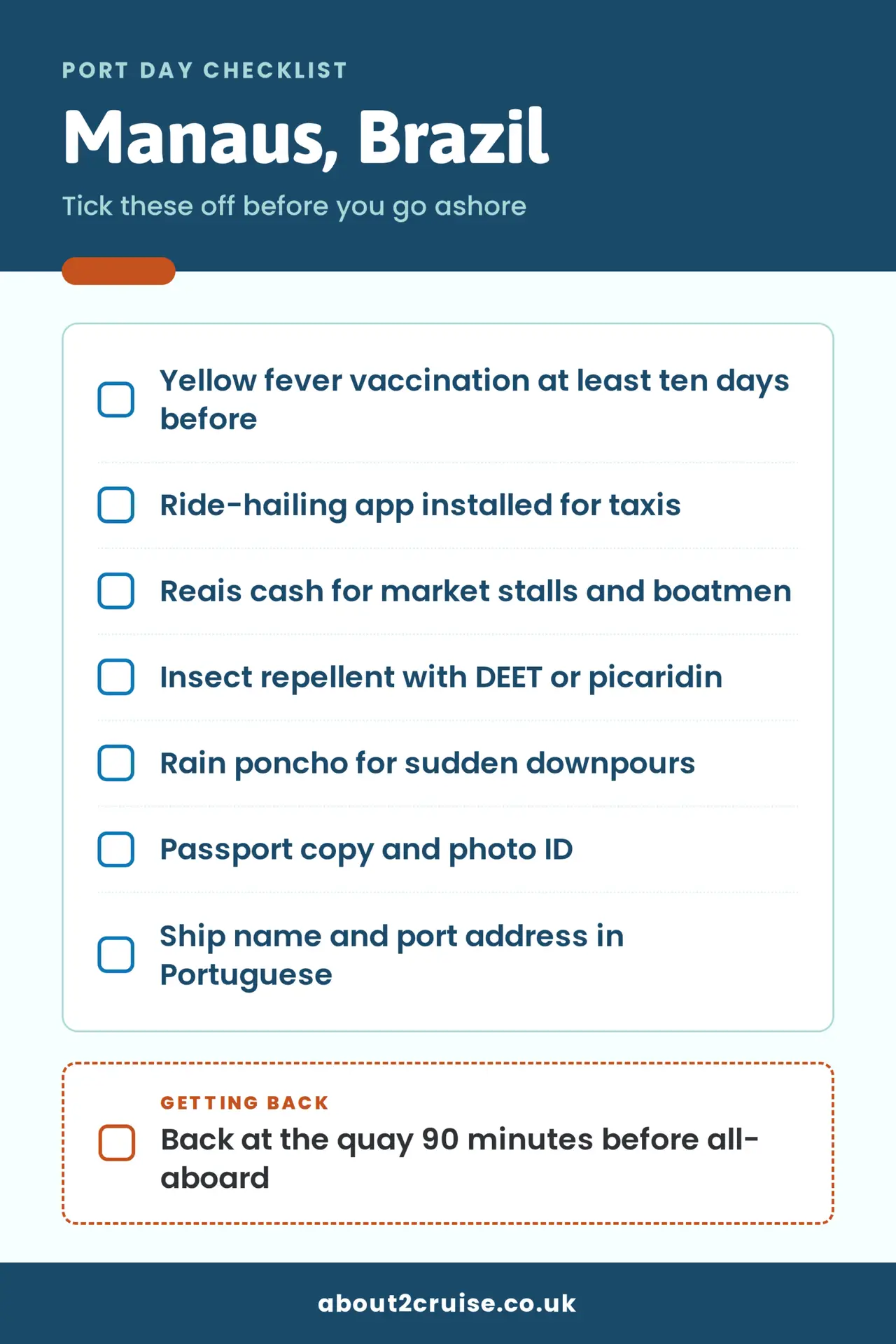
- Get yellow fever vaccination at a registered centre at least ten days before arrival.
- Check UK passport validity and Brazil entry requirements before you sail.
Short port day: under 6 hours
- On dockingWalk to Teatro AmazonasFrom the floating quay it is about 1.2 km, roughly 15 to 20 minutes on foot. Take a taxi if the heat is too much.
- +30 minTeatro Amazonas guided visitThe Belle Époque opera house is guided-visit only and closed Mondays. The square outside has a wave pavement said to echo the Meeting of the Waters.
- +1 hr 30 minLunch at Largo de São SebastiãoTry tacacáOrder tacacá, the hot tucupi and jambu broth served at kiosks, or a cupuaçu juice. It is the local street dish.
- +2 hr 45 minWalk to Mercado Adolpho LisboaHead back towards the port to the restored iron market. See fish, fruit, spices and handicrafts, and keep your bag in front.
- All-aboard minus 1 hrBack at the floating quayThe market is beside the port, so you are nearly back. Leave enough time for the floating access bridge and gangway.
The time on the map is the whole walk, every stop added together.
Open this walking route in Google Maps
If plans change: If the theatre is closed on Monday or the queue is long, swap it for Palácio Rio Negro, then do the market and lunch at Largo de São Sebastião.
Long port day: 8 hours or more
- On dockingTake a taxi to Porto da CEASAUse ride-hailing appBook through the official ride-hailing app, not a street taxi. Porto da CEASA is about 25 minutes from the city centre.
- +45 minBoat to the Meeting of the WatersBoats from CEASA reach the confluence in under 10 minutes. You need a boat to see the two rivers run side by side.
- +1 hr 45 minMeeting of the Waters viewingThe dark Rio Negro runs beside the muddy Solimões without mixing. The colour contrast reads better from slight distance.
- +3 hrsJanauari Ecological ParkBoardwalks and a lake of Victoria Regia giant water lilies. In high water, boats can navigate between flooded forest trees.
- +4 hrs 30 minLunch on the riverTry tambaquiA floating restaurant or lunch stop on the tour. Grilled tambaqui ribs or pirarucu de casaca is the regional order.
- +5 hrs 45 minCreek or flooded forest navigationThe richest rainforest feel is in the creeks, away from the main channel. Wildlife is a bonus, not a promise.
- All-aboard minus 90 minBack at the floating quayReturn to CEASA and take the taxi back. Keep the port address in Portuguese and allow a buffer.
This map shows the taxi ride from the ship. The time is the drive only, not your time ashore.
Open the taxi route in Google Maps
If plans change: If the river operator does not confirm, fall back to the city centre: Teatro Amazonas, Mercado Adolpho Lisboa and lunch around Largo de São Sebastião.
The river option is the faster bucket-list fix: go straight to Porto da CEASA and take a short confluence-only boat trip. Allowing 25 minutes each way for the taxi and at least 30 minutes on the water, it can fit in around three hours, but only if the ship is cleared on time and the taxi is waiting. If you’re tendering, choose the city option rather than risk a missed boat or a rushed return.
Manaus Weather and the Best Months to Cruise
Manaus is hot year-round with no true dry season. Cruise season, November to April, sits mostly in the local rainy season. Average daily maxima are around 30.4°C to 32.1°C and minima around 23.1°C to 23.7°C. Rain days run from about 12 in November to 18 in December and 20 or 21 in January, February, March and April. March is usually the wettest month at about 313 mm. Relative humidity averages around 83% and runs 85% to 88% from January to April.
The shorter drier period is roughly June to September, but that’s outside the main ocean cruise season. UV levels reach extreme, and heavy rain can fall as sudden downpours rather than all-day drizzle. Forest fires are common from May to September, and smoke can occasionally reduce visibility on the Amazon. For cruise calls, expect heat and humidity first, with rain as a frequent extra.
What to Wear and Pack for a Manaus Port Day
For a comfortable port day, pack:
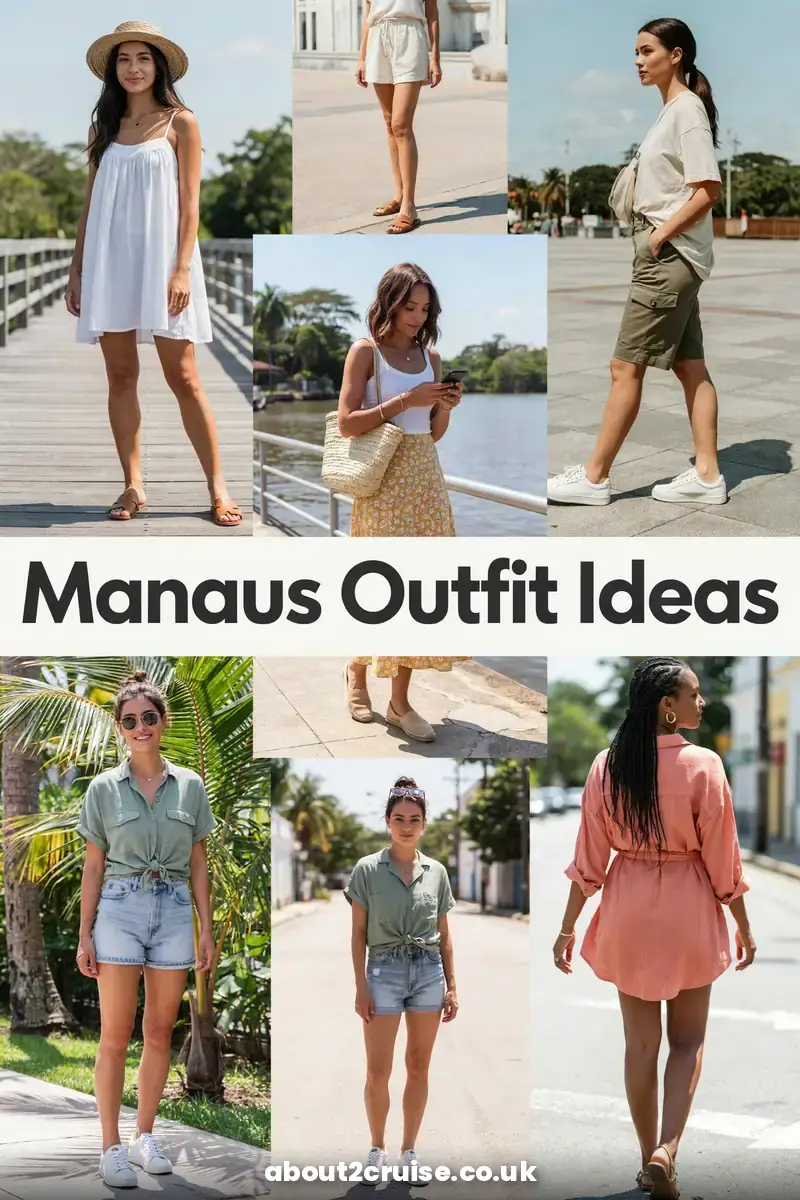

- Lightweight, breathable clothing in light colours.
- Hat and sunglasses, plus high-factor sunscreen.
- Rain jacket or packable poncho, even on a sunny morning.
- Insect repellent with DEET or picaridin, applied over sunscreen.
- A small backpack or crossbody bag that can stay closed in crowds.
- A dry bag or zip-lock bag for phone, cash and documents on boats.
- A reusable water bottle or sealed bottled water.
- Comfortable shoes with grip; old-centre pavements can be uneven and wet.
- A spare light layer in case you get soaked by rain or river spray.
You don’t need trekking boots for a standard city and Meeting of the Waters port day, but avoid flip-flops if you plan to walk more than a few blocks or board a boat with wet decks.
Accessibility and Walking Challenges in Manaus
Manaus isn’t an easy city for passengers with mobility limitations. Sidewalk quality in the historic centre is poor, with narrow widths and few ramps. The Meeting of the Waters, the main natural attraction, has been flagged for limited disabled access infrastructure. Riverboats and canoes may have steps, wet decks and no wheelchair access. Tenders at Manaus may also be unsuitable for passengers with disabilities, reduced mobility or balance issues.
MUSA’s observation tower requires climbing 242 steps. The Seringal museum has no road access and requires a 30-minute boat crossing. If you use a wheelchair or walker, the most reliable Manaus option is a private accessible vehicle tour of the theatre area and market, the theatre itself is purpose-adapted with a tactile model, audio description and subtitles. Confirm all access arrangements with the operator before booking, especially for river trips.
Portuguese Basics, Guide Languages and Independent Touring
Many established guides and cruise-line shore excursions operate in English, but don’t assume every taxi driver, boatman or market stallholder speaks English. A few basics help: bom dia for good morning, boa tarde for good afternoon, obrigado or obrigada for thank you, and quanto custa? for how much. Download offline translation for Portuguese, because phone signal will fail once you leave the city on the river.
Independent touring is perfectly possible in Manaus if you keep the plan simple and carry the name and address of your ship in Portuguese. The easiest independent day is theatre plus market plus a short pre-arranged river trip from CEASA. The risk is time, not navigation.
Amazon Food, Market Etiquette and Safe Eating in Manaus
Tacacá is the signature street dish: a hot broth of tucupi, manioc gum, jambu leaf and dried shrimp served in a gourd bowl. It’s sold at kiosks around Largo de São Sebastião, with a bowl typically costing about R$20 to R$30. Other regional dishes worth trying are grilled tambaqui ribs, pirarucu de casaca, fried jaraqui, x-caboquinho, and Amazonian açaí served with farinha rather than granola. Cupuaçu juice and guaraná are the local drinks.

At the market, choose busy stalls with high turnover, avoid raw or undercooked fish, and drink bottled or boiled water. Ice in reputable restaurants is usually fine, but if you have a sensitive stomach it’s safer to skip ice from street stalls. Peel fruit yourself and wash your hands before eating. Ask before photographing stallholders or their produce, and don’t handle food you’re not buying.
Souvenirs, Handicrafts and Bargaining at the Market
The easiest take-home buys in Manaus are Brazil nuts, tucumã, cupuaçu sweets, guaraná products and regional handicrafts. The best places to look are the Mercado Adolpho Lisboa, the Galeria dos Remédios and Galeria Espírito Santo, and the craft shops around Largo de São Sebastião. Bargaining is common in tourist markets but should be polite and low-pressure. Don’t buy wildlife products or items made from endangered species, and keep receipts if you buy plant or food items that could cause issues at customs later in your voyage.
Staying Safe in Downtown Manaus and Around the Port
The FCDO advises against all but essential travel to certain listed river areas of Amazonas, but that warning does not cover Manaus city itself. Normal city precautions still apply. Robberies are common in Brazilian cities, and thieves especially target mobile phones between 16:00 and 21:00. Don’t resist attackers; hand over valuables without argument. Avoid expensive jewellery and watches, keep large sums of cash hidden, and don’t use your phone in the street or near traffic.
Don’t hail taxis in the street. Book through an official ride-hailing app, check the registration and driver match, and avoid displaying your phone or valuables. Avoid all favelas, including favela tours, and check GPS routes don’t cross them. The police emergency number is 190. Around the port and market, keep your bag closed and in front of you, and don’t leave valuables on café tables. The immediate port area is busy during cruise calls, especially when many passengers leave at once, so avoid stopping to use your phone in the crowd.
Money in Manaus: Reais, ATMs, Cards and Tipping
The currency is the Brazilian real, written R$. Cards and contactless are accepted almost everywhere, including small vendors and taxis, but cash still matters at markets and street stalls. Use ATMs inside bank branches such as Banco do Brasil, Itaú, Bradesco or Santander. Standalone Banco24Horas kiosks can charge R$20 to R$35 on a foreign card. ATMs may cap withdrawals at R$300 to R$500 between 22:00 and 06:00, with higher daytime limits.
Always decline the terminal’s offer to charge your card in your home currency, that conversion can cost 6% to 12%. Watch your card during transactions and check the amount on the terminal. If withdrawn cash has pink marks, speak to the bank or police immediately, because it may be marked as damaged or counterfeit.
Restaurants usually add a 10% service charge. Paying it is customary but legally optional. Taxi drivers don’t expect a tip beyond rounding up. Hotel porters get about R$5 to R$10 per bag. Carry only enough cash for small purchases, and keep a separate card or emergency note back on the ship.
Internet, eSIM and Staying Connected in Manaus
Manaus has solid 4G coverage in the city, but coverage fails on river journeys beyond the main river towns and in deep forest. If you need maps, translation and ride-hailing, a data connection in the city is very useful. Brazilian SIMs may require a CPF or passport for activation and a registration fee of R$10 to R$20. A travel eSIM avoids that paperwork, but it will still lose signal on the river. Download offline maps and translation before you leave the ship. Many guides, hotels, restaurants and operators use WhatsApp rather than phone or email, so having WhatsApp installed is practical.
Cruise-Line Excursions vs Independent Tours in Manaus
Manaus isn’t a port where you automatically need a cruise-line excursion. The city centre is close and walkable, and a short taxi to CEASA is straightforward. But river trips carry timing risk, especially if the ship is tendering or clearance is slow. A cruise-line shore excursion or a reputable tour specialist with a return-to-ship guarantee is worth the extra cost if you’re doing a long river day, an overnight Amazon ecopark, or any canoe-based activity. General marketplace listings and local boatmen don’t guarantee your return to the ship.
If you book independently, plan to be back at the port at least 90 minutes before all-aboard, not 30. Keep local cash for taxis, have the port address in Portuguese, and tell the driver the ship name and berth. Don’t rely on a single ride-hailing pickup at the end of a long day; have a backup plan.
Yellow Fever, Malaria and Amazon Health Preparation
Yellow fever vaccination is recommended for travellers aged nine months and older going to Amazonas state, which includes Manaus. The vaccine is only available at registered yellow fever vaccination centres in the UK, must be given at least ten days before arrival to be valid, and is then valid for life. Check with your GP or travel clinic well before departure because stock and appointments can be limited.
Malaria advice for Manaus isn’t fully consistent between UK sources. The main travel health guidance classes Manaus and the Amazon basin as low risk, with bite avoidance recommended and antimalarial tablets considered only in exceptional circumstances. Other risk indices describe year-round malaria transmission in Amazonas, including Manaus and Amazon cruises. Because the guidance differs, make the decision with a travel health professional based on your exact itinerary, duration and medical history.
Dengue, Zika and chikungunya circulate in the region, and dengue rises in the first months of the year. Use insect repellent day and night, especially at dawn and dusk. Treat clothing with permethrin if staying overnight in a rainforest lodge. Bring a small medical kit with plasters, rehydration sachets, anti-diarrhoeal medicine and any personal medication. Brazil and the UK have no reciprocal health care agreement, so comprehensive medical insurance with evacuation cover is essential. Any fever within a year of an Amazon trip should prompt a same-day malaria test, so note your travel dates.
If Your Cruise Starts or Ends in Manaus
Manaus is a turnaround port on many Amazon itineraries, so you may fly in or out of Eduardo Gomes International Airport, about 13 km from the port. Azul, GOL, LATAM and Copa Airlines serve the airport. There’s no rail connection. Riverboats are the other long-distance route, with services to Belém and the Amazon interior.
If you need a hotel, staying in Centro around Largo de São Sebastião keeps the theatre, market and port walkable. Hotel Villa Amazônia and Juma Ópera Boutique Hotel & Spa are both close to the theatre and a short taxi ride from the quays. Hotels in Ponta Negra or Adrianópolis are 6 to 13 km from the port and require taxis. Airport to port by taxi or ride-hailing takes roughly 18 to 25 minutes; bus line 306 runs to Terminal Matriz but isn’t the easiest option with cruise luggage.
Manaus Cruise FAQ
Is Manaus a tender port?
It can be. Since December 2023 ships have been berthing at the Flutuante das Torres in the city centre, but cruise lines may still warn that the ship may anchor offshore and use tenders. There’s no published berth schedule telling you in advance, so check your cruise line’s port information and listen for onboard announcements.
How far is the Manaus cruise terminal from the Amazon Theatre?
About 1.2 km. That’s roughly a 15 to 20-minute walk in the heat or a 10-minute taxi ride. The Mercado Adolpho Lisboa is beside the port, so you don’t need transport for the first stop if you start there.
Can you do the Meeting of the Waters in a half day?
Yes, if you take a short boat trip from Porto da CEASA and have your taxi arranged in advance. Allow about three hours for the return transfer and boat trip, plus buffer time for ship clearance and traffic. If your ship is tendering or arrives late, choose the city-centre sights instead.
Do I need yellow fever vaccination for Manaus?
Yellow fever vaccination is recommended for travellers aged nine months and over going to Amazonas state, including Manaus. It must be given at least ten days before arrival at a registered yellow fever vaccination centre. Malaria is a separate decision to discuss with a travel clinic.
Is Manaus safe to walk around from the cruise ship?
The area between the port, market and theatre is busy by day and is the most practical walking route. Use normal city precautions, avoid using your phone in the street, don’t wear expensive jewellery, and don’t walk alone at night. Use a taxi or ride-hailing app for longer distances or after dark.
Can cruise passengers visit the rainforest in one day?
Yes, but the quality depends on the tour. A long river day of six to eight hours can include the Meeting of the Waters and a creek or Janauari stop with flooded forest. A short city day doesn’t really get you into the rainforest. Choose a cruise-line excursion or a reputable operator with a return-to-ship guarantee for the best chance of a proper rainforest experience.
What if the ship overnights in Manaus?
An overnight gives you much more flexibility. You can do a full-day river and rainforest trip on day one, then see the theatre and market the next morning or evening. Some cruise lines offer an Amazon Ecopark overnight or an evening at the opera house. Confirm the ship’s security and gangway hours before booking any late-night plan.
Do UK passengers need a visa or vaccinations for Brazil?
UK tourists don’t need a visa for stays of up to 90 days, but passports must have at least six months remaining after arrival. Yellow fever vaccination is recommended for Manaus and Amazonas state. No vaccine is mandatory solely because you are entering Brazil, but entry rules can change, so check the latest official UK foreign travel advice before you sail.