
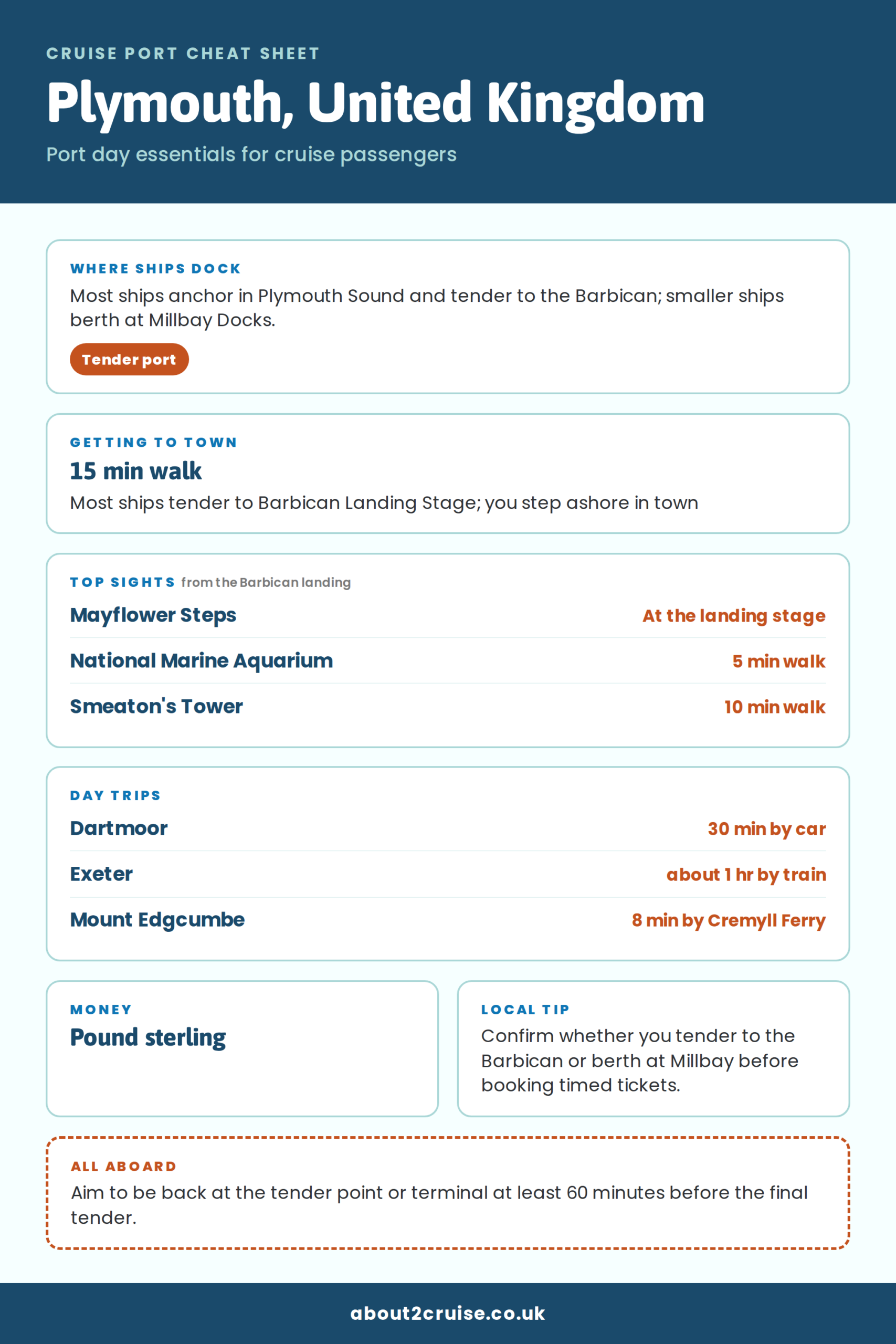
Plymouth is a compact, walkable UK port call where most ships anchor in Plymouth Sound and tender to the Barbican Landing Stage, while smaller ships can berth at Millbay Docks. The Hoe, Mayflower Steps, Barbican lanes and National Marine Aquarium are all close by, making independent sightseeing easy. Confirm your ship’s arrival point before booking timed tickets.
First Things First: Anchored in the Sound or Tied Up at Millbay?
The biggest thing to confirm before you plan your day is where your ship will actually put you ashore. Most cruise ships calling at Plymouth anchor in Plymouth Sound and tender passengers to the Barbican Landing Stage, right in the historic quarter. A smaller number of expedition or boutique ships berth directly at Millbay Docks, which has two alongside berths: West Wharf (max ship length 215 m, 8.5 m draft) and Trinity Pier (max 120 m, 4.5 m draft). Vessels up to 295 m can anchor in the Sound.
Don’t assume you’ll be alongside just because your itinerary mentions Millbay. Millbay can also run tender operations to its King Point tender point. Always check the ship’s daily programme or ask Guest Services whether you’ll be anchored or alongside before you book timed tickets, meet a private guide or plan a tight schedule.
If You’re Using Millbay Docks: Terminal and Facilities
Millbay Docks is Plymouth’s dedicated cruise passenger terminal, run by Associated British Ports (ABP). The address is ABP Port Office, Millbay Docks, Plymouth PL1 3EF; for satnav use PL1 3DQ. Inside you’ll find five check-in desks, a passenger lounge, a licensed café bar, tourist information, X-ray screening, ISPS-compliant security, accessible toilets with baby changing, payphones and wheelchair access. There’s also a dedicated coach, taxi and drop-off area, short-stay parking with disabled bays and long-stay parking on site. A passenger boarding bridge is used for turnaround calls.
The facilities are modern but compact. If you’re on a same-day port call, which covers almost all Plymouth cruise visits, you probably won’t use the terminal building at all. If you’re embarking or disembarking, treat it like any UK regional terminal and allow enough time. There’s no left-luggage facility at the terminal or at the Barbican landing stage, so only bring ashore what you can comfortably carry.
Plymouth cruise port map
Tenders bring you ashore at Barbican Landing Stage. From the Barbican landing, Mayflower Museum is about a 2-minute walk, Mayflower Steps about 2 minutes and The Barbican about 2 minutes. Tap a pin for directions.
- Barbican Landing StageWhere tenders land
- Mayflower StepsMonument · About 2 min walk from the Barbican landing
- The BarbicanHistoric quarter · About 2 min walk from the Barbican landing
- Mayflower MuseumMuseum · About 2 min walk from the Barbican landing
- National Marine AquariumAquarium · About 5 min walk from the Barbican landing
- Plymouth Gin DistilleryGin distillery · About 6 min walk from the Barbican landing
- Royal CitadelMilitary fort · About 7 min walk from the Barbican landing
- Smeaton’s TowerLighthouse · About 9 min walk from the Barbican landing
- Royal Parade (shuttle stop)Shuttle stop · About 15 min walk from the Barbican landing
- The BoxAbout 17 min walk from the Barbican landing
- Plymouth railway stationRailway station · About 26 min walk from the Barbican landing
- Royal William YardWaterfront leisure complex · About 2 km from the Barbican landing
- Saltram HouseGeorgian house · About 4 km from the Barbican landing
- Mount Edgcumbe HouseHouse and garden · About 3 km from the Barbican landing
- Devonport Naval Heritage CentreNaval museum · About 3 km from the Barbican landing
Tendering Ashore: What to Expect at the Barbican Landing Stage
When your ship anchors in Plymouth Sound, the tender ride to the Barbican Landing Stage takes about 8 minutes. The landing stage is usable at all states of tide, which makes Plymouth tendering more reliable than many other UK anchor ports. The pontoon has disabled access and a purpose-built cruise tender area where three 12 m tenders can lie alongside at once. Free accessible toilets and showers are available for cruise guests, and there’s a drop-off area for coaches about 100 m away.
You step ashore directly into the Barbican, right next to the Mayflower Steps. The Tourist Information Centre is a 2-minute walk, Sutton Harbour 5 minutes, the National Marine Aquarium 5 minutes, and Plymouth Hoe about 10 minutes uphill. Tender operations can slow down if the Sound turns choppy later in the day, so leave a realistic buffer before the final tender. Your ship will advise the last tender time; it’s usually well before the scheduled departure.
Walking Times to Help You Plan Your Route
Plymouth is genuinely walkable, but the old paving and the climb from the Barbican to the Hoe require reasonable mobility. From the Barbican landing stage: Tourist Information Centre 2 min, Sutton Harbour 5 min, National Marine Aquarium 5 min, Plymouth Hoe / Smeaton’s Tower 10 min, Drake Circus shopping centre and The Barcode 11 min, city centre 15 min, The Box 18 min, railway station 20 min. From Millbay Docks, the Hoe is about a 20-minute walk to Smeaton’s Tower.
If your ship tenders to Millbay’s King Point, you can walk to Royal William Yard in about 15 minutes. The Barbican to Hoe route is uphill and partly cobbled; if you have limited mobility, take a taxi between these areas rather than walking. The city is compact and well signed, but an offline map on your phone helps because the medieval lanes twist.
How to Spend Your Plymouth Port Day
Before you sail
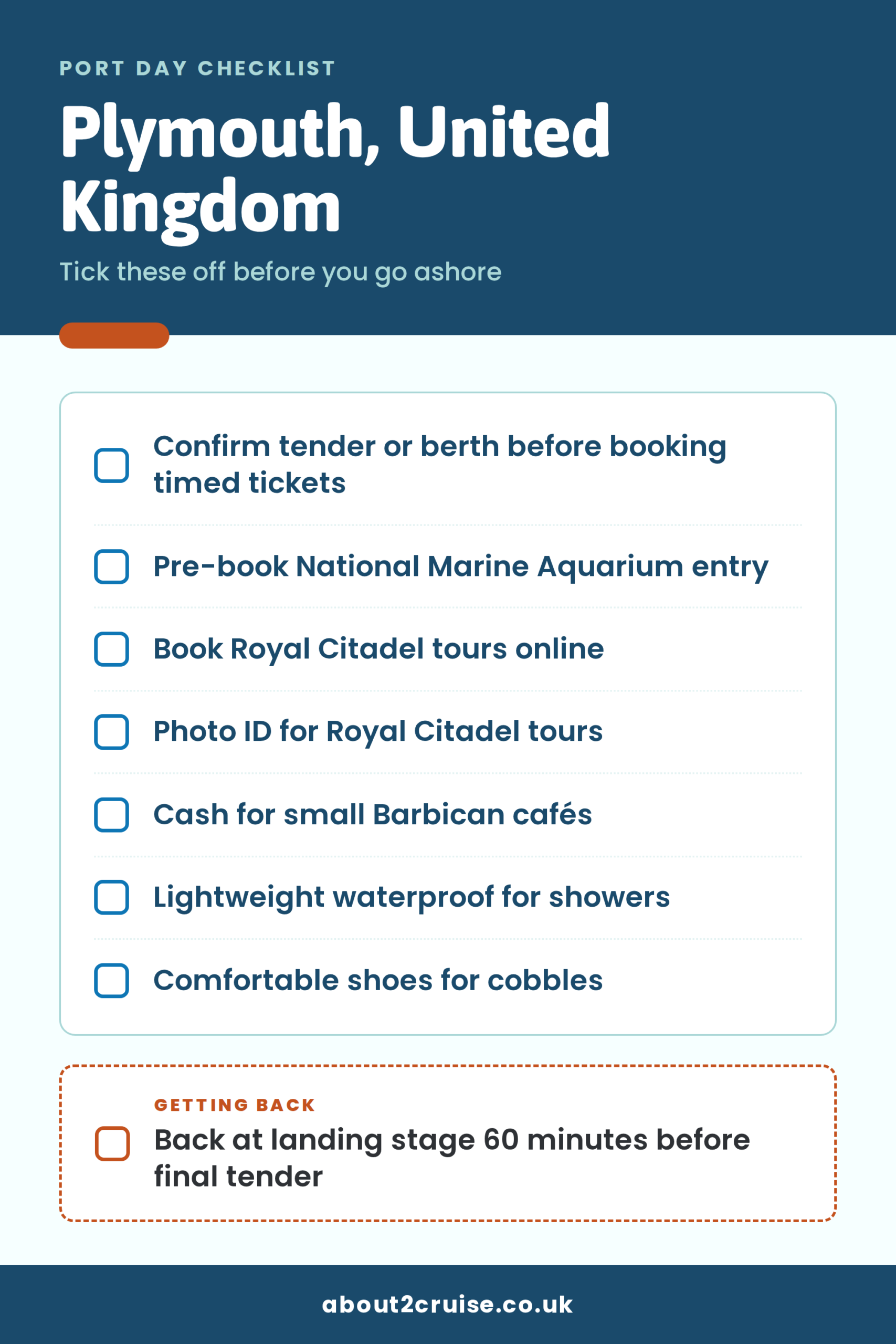
- Confirm whether you will tender to the Barbican or berth at Millbay before booking timed tickets.
- Pre-book National Marine Aquarium tickets; walk-in entry is not guaranteed at peak times.
- If your call is Saturday, book Royal Citadel online 24 hours ahead and bring photo ID.
Short port day: under 6 hours
- On dockingTender to Barbican Landing StageConfirm landing pointThe 8-minute tender brings you to the Barbican next to the Mayflower Steps. Check your ship's daily programme.
- +15 minMayflower Steps and Barbican lanesExplore the cobbled lanes around New Street, the oldest street in Plymouth, and the Mayflower Steps monument.
- +1 hrPlymouth Hoe and Smeaton's TowerBook online to saveA 10-minute uphill walk from the landing stage. Climb Smeaton's Tower for views over the Sound.
- +1 hr 45 minLunch: fish and chips in the BarbicanTry cream tea tooThe Barbican's chippies and seafood stalls sit near the Mayflower Steps and Sutton Harbour; a Devonshire cream tea is the sweet alternative.
- +3 hrsHarbour cruise from the landing stageOne-hour scenic cruise past the Hoe, Drake's Island and the Tamar warships. It leaves from the Barbican Landing Stage.
- All-aboard minus 1 hrBack at Barbican Landing StageReturn on the tender; queues can build later in the day.
The time on the map is the whole walk, every stop added together.
Open this walking route in Google Maps
If plans change: If Smeaton's Tower is closed on a Monday, swap in the Mayflower Museum or The Box, both indoors near the Barbican.
Long port day: 8 hours or more
- On dockingTender to Barbican Landing StageConfirm landing pointThe 8-minute tender brings you to the Barbican next to the Mayflower Steps. Check your ship's daily programme.
- +15 minNational Marine AquariumPre-bookA 5-minute walk from the landing stage across the harbour bridge. Give it 2 hours; pre-booking avoids a full queue.
- +2 hrs 15 minMayflower Steps and Barbican lanesCross back to the Barbican and explore the cobbled lanes around New Street and the Mayflower Steps monument.
- +3 hrsLunch: fish and chips in the BarbicanThe Barbican's chippies and seafood stalls sit near the Mayflower Steps and Sutton Harbour; a Devonshire cream tea is the sweet alternative.
- +4 hrsPlymouth Hoe and Smeaton's TowerUphill 10 minutes to the Hoe. Climb Smeaton's Tower for views over the Sound.
- +5 hrs 30 minPlymouth Gin Distillery tourBook aheadA 45-minute to 1-hour tour at England's oldest working gin distillery on Southside Street.
- All-aboard minus 90 minBack at Barbican Landing StageReturn tender; listen for last tender time, which can be well before departure.
The time on the map is the whole walk, every stop added together.
Open this walking route in Google Maps
If plans change: If the aquarium is full or has a long queue, spend that time at The Box and the Mayflower Museum, both near the Barbican.
Plymouth Hoe and Smeaton’s Tower: The Big Viewpoint
The Hoe is a large south-facing public space with wide views over Plymouth Sound, free to walk. Smeaton’s Tower, the 72-foot lighthouse rebuilt from the Eddystone reef, is the iconic landmark. It opens 10am–5pm Tuesday–Sunday plus bank holiday Mondays from April to late September, then selected October dates. Last entry 4.30pm. Adult £8 on the door / £7 booked online, child 5–15 £4 / £3.50, family £19 / £17, under-5s free. The lantern room gives the best panorama in the city. Check for occasional closures. The 1935 art deco Tinside Lido sits below the Hoe and is open seasonally.
The Barbican, Mayflower Steps and Old Plymouth Streets
The Barbican has cobbled streets, narrow lanes and more than 200 listed buildings, many Tudor and Jacobean. New Street is the oldest street in Plymouth. The Mayflower Steps mark the approximate point where the Pilgrims left for America in 1620, and the monument carries British and American flags. The Mayflower Museum is directly opposite at 3–5 The Barbican, PL1 2LR. Hours: April–October 9am–5pm Monday–Saturday, 10am–4pm Sundays and bank holidays; November–March 9am–5pm Monday–Friday, closed Sunday. Entry adult £6, senior £5, student £4, child £3, family £16. No toilets inside, but public toilets are close. The Elizabethan House on New Street is open Friday and Saturday only, 12pm–4pm from April to late September, adult £8 / child £4. It has limited disabled access due to narrow stairs and uneven floors.
Royal Citadel: A Limited but Fascinating Tour
The 17th-century Royal Citadel on the Hoe is still an active military site used by 29 Commando Royal Artillery. Access is by guided tour only, on Saturdays from April to end of September. Tours meet at the Commando Memorial on Lambhay Hill at 14:00 for security checks. Tickets £12.50, no concessions, must be booked online at least 24 hours ahead. You’ll need photo ID matching the ticket name, bags are searched, no large bags, no photography and no phones. Allow at least 2 hours, and children under 7 cannot join. Because tours are limited and strictly timed, this suits only a specific Saturday call with enough buffer.
National Marine Aquarium: Big, Indoor and Close to the Tender
The National Marine Aquarium at Rope Walk, Coxside is the UK’s largest aquarium, with over 5,000 animals. From the Barbican landing stage it’s a 5-minute walk, but parts of the route are cobbled and uneven. Adult £26, child 3–15 £16, concession £23, under-3s free. Every paid ticket includes a free 12-month return pass, which is useless for most cruisers but reflects local pricing. Open 10am–5pm daily, last entry 4pm. Pre-booking is recommended because walk-in entry cannot be guaranteed at peak times. The site is fully accessible with ramps and lifts, and free manual wheelchairs are available on a first-come basis. A typical visit is 3–4 hours, so if you want to see more of Plymouth, plan for 2 hours.
Royal William Yard and the Cremyll Ferry: A Waterfront Escape
Royal William Yard is a Grade I listed former Royal Navy victualling yard on the Tamar, now filled with restaurants, bars, shops, a marina, watersports and a cinema. It’s a 15-minute walk from Millbay Docks or a ferry ride from the Barbican. The Devil’s Point staircase has a glass viewing platform over the estuary. The Cremyll Ferry from Admiral’s Hard, Stonehouse to Cremyll in Cornwall runs every 30 minutes, takes 8 minutes, adult £3.00, child £2.00, card or cash on board. The ferry is not wheelchair accessible but crew will assist. There’s also a Plymouth Boat Trips waterlink ferry linking the Barbican, Royal William Yard and Saltash, adult single £5.00, child £2.50.
Saltram House: A Half-Day National Trust Detour
Saltram, a National Trust Georgian house and landscape garden, is 3½ miles east of the city centre off the A38 at Plympton, postcode PL7 1UH. Non-member house and garden: adult £16, child £8, family £40; garden only £9.50 / child £4.75; car parking £3 for non-members. House generally open daily 11am–4.30pm in season, garden 10am–5pm. Saltram is not walkable from the port; allow a taxi or ship excursion of around half a day.
Mount Edgcumbe: Gardens and a Ferry Ride into Cornwall
Across the water on the Rame Peninsula in Cornwall, Mount Edgcumbe’s 865-acre park is free, while the house and Earl’s Garden charge: adult £14, concession £10, child £6.50. House and garden open Tuesday, Wednesday, Thursday and Sunday 11am–4pm in season, last tour 3pm. This makes a good combination with the Cremyll Ferry from Stonehouse. It does not open on Fridays, Saturdays or Mondays, so check your port day.
Devonport Naval Heritage Centre: For Naval History Fans
For naval history, Devonport Naval Heritage Centre at Vivid Approach off Granby Way, Devonport, PL1 4RW is free (donations welcome) but only open Wednesdays 10am–3pm and the second Saturday of each month, closed in winter. It records the dockyard’s history, including a gallery on the submarine service with a working periscope. Ground floor is wheelchair accessible. Because it’s small and limited to specific days, only visit if your call falls on the right day and you have a strong naval interest.

Where to Eat and Drink: Fish, Cream Teas and Gin
Fish and chips are the signature waterfront dish: the Barbican has a cluster of chippies and seafood restaurants, including one next to the National Marine Aquarium and another beside the Mayflower Steps. Look for crab, mussels and fish landed at Plymouth Fisheries. For a Devonshire cream tea, head to a Barbican or Hoe waterfront café. Scones come with clotted cream and jam: Devon tradition is cream first, then jam.

Plymouth Gin has been made at Black Friars Distillery, 60 Southside Street on the Barbican, since 1793, described as England’s oldest working gin distillery. Tours: distillery tour £15, Gin Connoisseur’s Tour £35, Master Distiller’s Private Tour £55; under-18s free but accompanied. Tour times Monday–Saturday 10:30–16:30, Sunday 11:30–15:30, booking advised. The distillery is small and atmospheric, perfect for a 45-minute to 1-hour stop.
Harbour Cruises and Short Boat Trips
One-hour scenic harbour cruises leave the Barbican Landing Stage off the Mayflower Steps at 11:00, 12:30, 14:00 and 15:30 daily through the season, weather and minimum numbers permitting. Prices: adult £12.50, child 3–15 £7.00, family £37.00. The commentary cruise passes the Hoe, Drake’s Island and the Tamar warships and submarines. It’s an easy way to see the Sound without walking far, and times usually work with a half-day visit.
Day Trips from Plymouth: Dartmoor, Cornwall or Exeter
If you want to get out of the city, Dartmoor is the most popular option. Princetown on the moor is about 15 miles and 30 minutes by car, or roughly 45 minutes by bus. A Dartmoor day trip typically takes 4–6 hours, covering Postbridge’s clapper bridge and Princetown’s prison museum. A taxi tour is easiest for a group; ship excursions are also offered. Devonport and Saltram are closer and can be done independently with a taxi or bus.
Exeter is about an hour from Plymouth by train, making a short rail trip possible but tight inside a port call. Cornwall across the Tamar is reachable by the Cremyll Ferry in 8 minutes, putting you on the Rame Peninsula and Mount Edgcumbe without road traffic. If you plan to rent a car or take a bus into Cornwall, remember that the ferry is foot-passenger only and small. For more Cornish cruise ports, see our guides to Falmouth and Cobh (Ireland).
Getting Around: Buses, Taxis and Shuttles
Plymouth Citybus single fares are capped at £3, returns at £6, payable by cash or contactless on the bus. Service 25 runs between the Barbican/Mayflower Steps and Royal Parade in the city centre, looping around the Hoe. A hackney carriage taxi from Millbay Docks to the Barbican or Hoe will cost roughly £8–£10 based on the council’s maximum tariff (£4 flag fall, then 30p each eighth of a mile). Taxi ranks are at the terminal and near the Barbican. Some cruise lines run shuttles from Millbay to Royal Parade; the stop is signed with the line’s branding but may not be free: check onboard.
Walking remains the best way to see the core sights. The Barbican, Hoe and city centre form a rough triangle, and you can cover the main loop in 2–3 hours without rushing. If you tire or the weather turns, a short taxi hop between the Hoe and Royal William Yard saves energy.
Practical Info: Money, Weather, Toilets and More
Money and Cards
Plymouth uses UK pound sterling. Credit, debit and contactless cards are widely accepted, and contactless is capped at £100 per transaction. Some small cafés and market stalls may be cash-only or have a minimum spend, so carry a small amount of cash. Euros are rarely accepted. The Barbican Post Office at 49–50 Southside Street, PL1 2LD offers cash withdrawals.
Weather and What to Wear
Plymouth’s cruise season runs roughly late April to late October. Long-term averages for July and August are about 20°C, June and September 18°C, May 16°C, October 15°C. Rain is possible in any month: on average 10–15 rain days per month. The Sound is sheltered inside the breakwater, so tendering is normally short and calm, but wind can pick up later in the day. Dress in layers, carry a lightweight waterproof, and wear comfortable shoes for cobbles and hills.
Public Toilets
Public toilets: Barbican Quay Point (PL1 2LR) has one disabled and six gender-neutral toilets with baby changing, closing 11pm; Hoe Promenade (PL1 2PA) has eight gender-neutral and one disabled toilet, open 9am–6pm; West Hoe (PL1 3DE) has ten automatic toilets, open 8am–6pm; chargeable toilets cost 60p. The Barbican landing stage has free accessible toilets and showers for cruise guests.
Accessibility and Mobility: What to Expect
The Barbican cruise tender pontoon has disabled access, but tender boarding itself depends on the ship’s equipment and sea conditions. Always discuss your needs with the cruise line before the call. The King Point tender point at Millbay has step-free access, and the Millbay terminal is wheelchair accessible with a lift to the first-floor lounge. Free accessible toilets and showers are at the Barbican landing stage.
The Barbican’s cobbled streets can be challenging, and the walk to the aquarium entrance is over uneven surfaces with no close vehicle drop-off. The aquarium itself is fully step-free. For mobility limits, taxis are the easiest way between the Barbican, Hoe and Royal William Yard. An Easy Access guide describes a mostly level 5.6-mile waterfront route from the National Marine Aquarium to Royal William Yard, with drop kerbs but some inclines. If you use a wheelchair or have limited stamina, plan your route with the ship’s shore excursions team or a local accessible taxi.
Security and Getting Back to the Ship
The cruise terminal and tender points are ISPS-compliant security areas with X-ray screening. You will need your cruise card and photo ID to go ashore and to return. If you tender, you may have to wait for a tender number; listen for announcements. The final tender is usually well before the ship’s departure, often 45–60 minutes before, but the ship will confirm the exact time. Allow extra time if you are returning from Dartmoor or Saltram by taxi or bus, because traffic and tender queues can delay you. There is no published left-luggage facility at the terminal or Barbican, so do not bring large bags ashore.
Parking, Drop-off and Pick-up at the Port
Port parking at Millbay Docks costs £11.00 per 24 hours, operated by ABP. Spaces cannot be pre-booked but are described as plentiful. The terminal has adjacent short-stay parking including disabled bays and long-stay parking on site. There is a dedicated coach, bus, taxi and drop-off area at the terminal. If you are driving, use satnav postcode PL1 3DQ for the cruise port approach or PL1 3EF for the terminal. Coaches can pick up and set down at Millbay Docks, PL1 3EW. There is no official cruise-specific meet-and-greet or shuttle parking product with published rates, so the £11/24h tariff is the only official figure. For a cruise call, if you are only dropping off or picking up, use the short-stay area; do not assume you can leave a car free.
Getting to Plymouth: Train, Coach, Car and Airports
Plymouth railway station is on North Road, five minutes from the city centre, about 20 minutes’ walk from the Barbican landing stage. Fast Great Western Railway services run Plymouth to London Paddington in roughly 3–3.5 hours; Exeter St Davids is about 55–70 minutes away. CrossCountry runs direct services to the Midlands, the north of England and Scotland. National Express coaches run from Plymouth Coach Station on Armada Way to London Victoria up to seven times a day, fastest 5 h 35 min, from £14.40. By road, Plymouth is reached on the A38 Devon Expressway, which links to the M5 at Exeter. Newquay airport is 38.5 miles away, Exeter 40.7 miles, Bristol 94.4 miles. There is no direct bus from the station to the ferry terminal, so take a taxi or walk if you are mobile.
Where to Stay in Plymouth Before or After a Cruise
Almost all Plymouth cruise calls are same-day port stops, not turnarounds, so most passengers do not need a hotel. If you are embarking or disembarking in Plymouth, the closest hotels are the Duke of Cornwall Hotel and the Best Western New Continental Hotel, both on Millbay Road, PL1 3LG and PL1 3LD respectively, within a 15-minute walk of the ferry terminal. The Premier Inn Plymouth City Centre (Sutton Harbour) at 28 Sutton Road, PL4 0HT is a 5-minute walk from the National Marine Aquarium and 6 minutes from the Barbican, handy for tender embarkation. Parking at the New Continental is £7.00 per 24 hours. No terminal left-luggage exists, so arrange with your hotel if you need bag storage.
Wet-Weather Plans: Museums, Malls and Indoor Stops
Plymouth has several good wet-weather options. The Box museum, art gallery and archive is free, open 10am–5pm Tuesday–Sunday, no booking needed, and is about 18 minutes’ walk from the landing stage or a short taxi. The National Marine Aquarium is indoors and suitable for 2–3 hours. Drake Circus shopping centre and The Barcode leisure complex are 11 minutes from the Barbican landing stage. The Mayflower Museum is indoors and right opposite the Steps. Plymouth Gin distillery tours are indoors. If rain is heavy, avoid the exposed Hoe and Royal William Yard unless you have good waterproofs. Cafés, pubs and restaurants throughout the Barbican provide cover. The Tourist Information Centre inside the Mayflower Museum building can provide maps and current advice.
Our UK cruise ports of call guide covers the other ports in England, Wales and the Channel Islands.
Common Questions About a Plymouth Cruise Stop
Is Plymouth worth visiting on a cruise stop? Yes. It packs maritime history, a waterfront, a genuine historic quarter, and a proper aquarium into a walkable area. It’s especially good for first-time UK cruisers who want an easy, compact port day without long transfers.
Can passengers walk from the cruise terminal to the city centre? From the Barbican tender landing stage, the city centre is about a 15-minute walk. From Millbay Docks, it’s about 20 minutes to the Hoe and slightly longer to the centre. Taxis are available if you prefer not to walk.
How far is the cruise berth from the Barbican and Plymouth Hoe? If you tender to the Barbican, you are already in the Barbican, and the Hoe is a 10-minute uphill walk. If you berth at Millbay, the Hoe is about 20 minutes on foot, and the Barbican is slightly further.
What should I do in Plymouth in one day from a cruise ship? A classic independent day: tender to Barbican, see Mayflower Steps, walk through the old streets, head up to the Hoe and Smeaton’s Tower, visit the National Marine Aquarium, have fish and chips or a cream tea, and if time allows catch a harbour cruise or visit Royal William Yard. Ship excursions often add Dartmoor or Saltram.
What is the Plymouth cruise terminal address and postcode? ABP Port Office, Millbay Docks, Plymouth PL1 3EF. For satnav to the cruise port approach use PL1 3DQ.
Is Plymouth a port of call or a turnaround port? Almost all cruise visits are same-day port of call calls. Very few lines use Plymouth for embarkation or disembarkation. Check your itinerary to confirm.
Does Plymouth have a cruise terminal with luggage storage? The Millbay terminal has passenger facilities but no left-luggage service. The Barbican landing stage has free toilets and showers but no bag storage. Arrange luggage through your ship or hotel.
How do I get from Plymouth to Falmouth or another Cornish port? Plymouth is not a transfer hub for other cruise ports. Falmouth is about 1.5 hours by car, and there is no direct train to Falmouth Docks. If you are considering a land trip between ports, search routes in advance. See our Falmouth port guide for more local advice. For nearby Irish and French ports, see Cobh and Saint-Malo.
Nearby Cruise Port Guides to Check Next
If you are cruising the British Isles or Atlantic coast, you might also visit Falmouth in Cornwall, Cobh in Ireland (for Cork), or Saint-Malo in France. Each has a very different docking and tender setup, so check the relevant guide before you go.
Last Updated: 15 November 2026