
Stanley is the Falkland Islands’ compact, weather-exposed capital and, on almost every cruise call, a tender port. You ride a ship’s tender to the public jetty in the centre of town, then walk to the cathedral, museum and pubs, or join a pre-booked 4×4 to see penguins, wildlife and 1982 battlefields. Wind and sea state control everything.
Why Cruise Ships Call at Stanley
Stanley is the capital of the Falkland Islands, a remote British Overseas Territory. Ships stop here because it offers one of the easiest single-day combinations in this part of the world: big penguin colonies and significant 1982 Falklands War battlefields within reach of one port call.
More than 35 cruise lines include the Falklands in itineraries. Expedition ships often pair the islands with South Georgia and the Antarctic Peninsula, while larger ships call here on South America and Cape Horn routes.
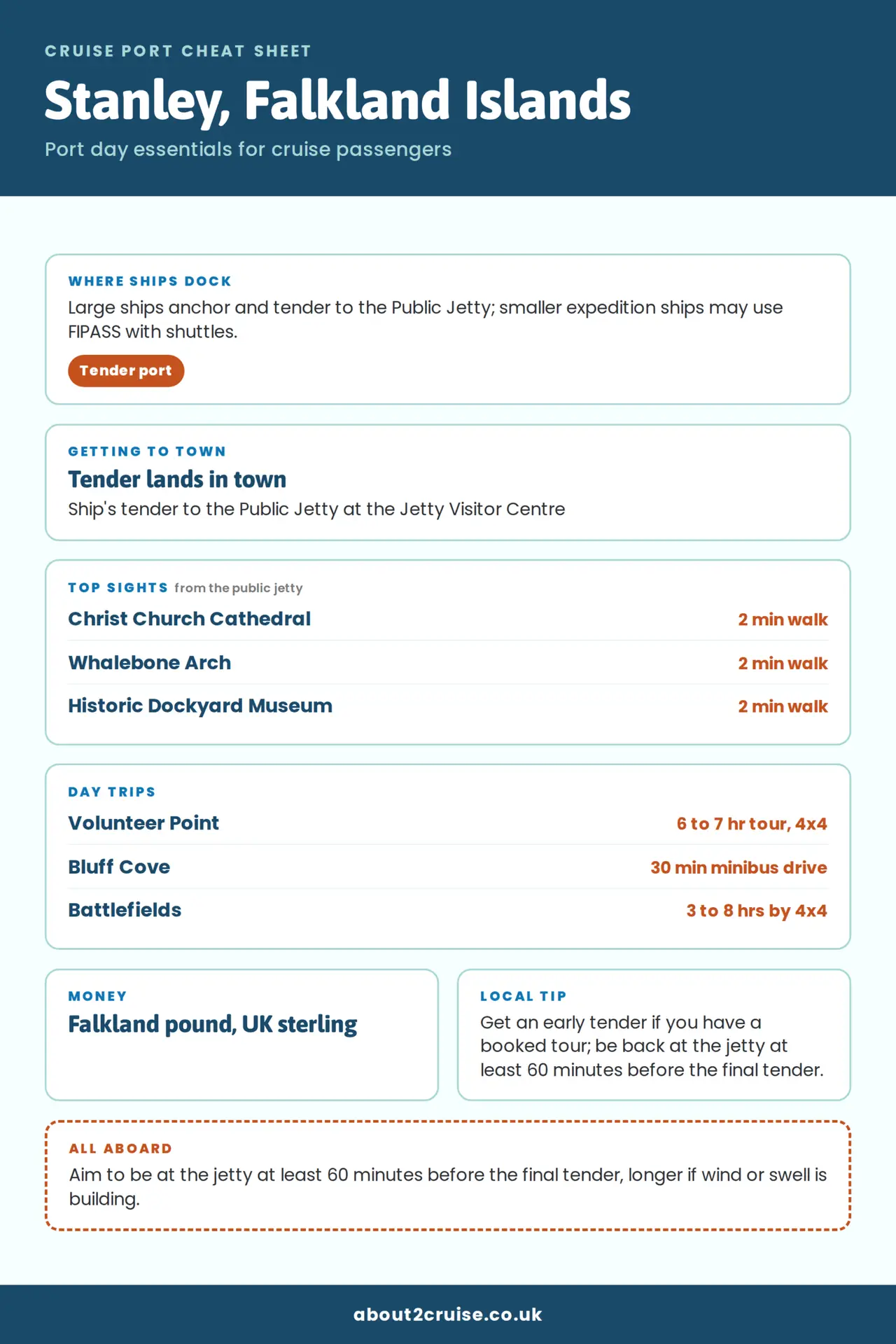
Despite the word “port,” Stanley is a port of call, not an embarkation hub. There is no conventional cruise terminal, no cruise parking, and no left-luggage facility by the jetty. Large ships anchor and tender passengers ashore. Some smaller expedition vessels use FIPASS, a floating dock a few minutes from the centre, with shuttles into town. The official population is only around 2,458, so one large ship can put more visitors into town than the number of people who live here.
How the Tender and Jetty System Works
Most cruise ships anchor and run tenders to the Public Jetty at the Jetty Visitor Centre, right in the middle of Ross Road. Smaller vessels may be allowed into Stanley Harbour, but larger ships generally use Port William. The jetty pontoon can be split so two ships’ tenders can operate, though passengers still disembark one tender at a time. On busy days, the East Jetty may also open.
The Visitor Centre next to the jetty is your main reference point ashore. It has toilets, sheltered seating, free street maps, and Wi-Fi. There are security checks around the waterfront Temporary Restricted Area, and ship staff manage passenger flow. Tenders slow to 4 knots within 200 metres of the south shore. If your ship uses FIPASS, you will usually be shuttled to the Visitor Centre rather than walking from the dock.

Tender Tickets, Queues, and Getting Back on Time
Your ship controls the tender ticket system, boarding order, and final return time. Some cruise lines give suite guests priority getting off, but the ride back is usually first come, first served. That means the tender queue can shrink your usable time at both ends of the day, especially during the first hour ashore and the last hour back.
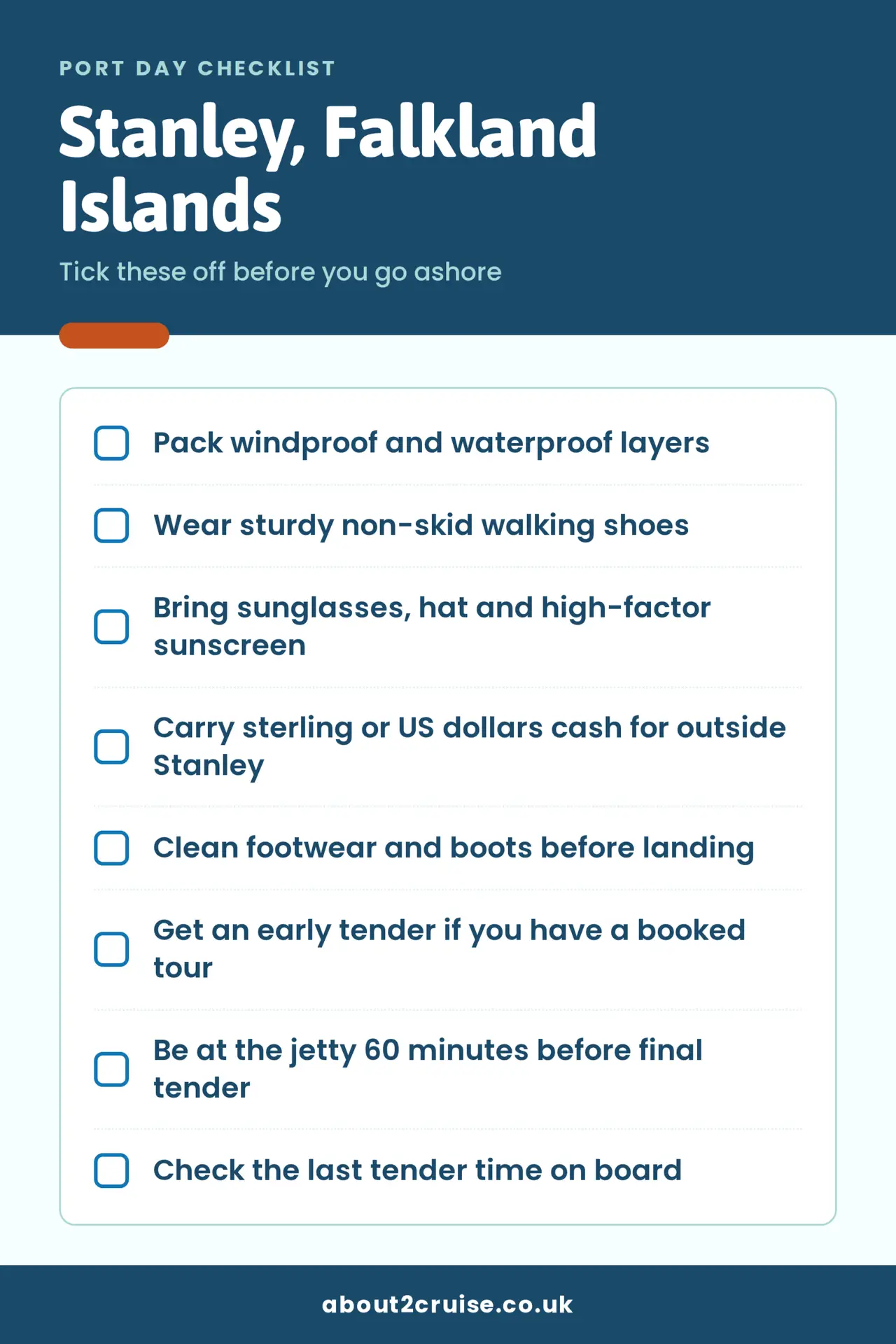
If you have a booked wildlife or battlefield tour, aim for an early tender. The first boats fill quickly on busy days. Pay attention to the last tender time posted on board, not a casual all-aboard time mentioned by someone. Plan to be at the jetty at least 60 minutes before the final scheduled tender, and longer if the swell is building, because loading from a floating pontoon slows down in rough conditions.
Wind, Weather, and Why Stanley Sometimes Gets Skipped
Weather is the biggest risk at Stanley. The official rule is clear: Stanley Harbour closes to cruise vessels, fishing vessels, and all passenger tenders and zodiacs when wind reaches a sustained 30 knots and rising. It can also close below that at the Harbour Master’s discretion. Tender operations stop when visibility falls below 0.1 nautical mile, with limited exceptions. FIPASS generally also closes above 30 knots.
There is no official published cancellation rate, but the rule exists because swell and katabatic winds can make tender transfers unsafe very quickly. If your call is cancelled, ship-sold excursions are refunded. Independent operators’ missed-port policies vary, so check before paying.
The best mindset is to not assume you will definitely land. Have a loose plan for a sea day, keep expectations flexible, and read the independent operator’s weather refund clause carefully before paying a deposit.
Stanley has a cool oceanic climate. January averages about 12°C and February highs around 15°C. January is the wettest month, with around 72mm and normally 12 days of rain. The weather can change quickly, and you may experience several seasons in one day. The cruise season runs roughly October to March, with the heaviest traffic from December to February. November to February is generally the most agreeable window for both weather and wildlife.
Penguin and Wildlife Trips Compared
This is the decision most cruise passengers are really making. The table below covers the main options.
| Wildlife site | Distance from Stanley | Typical visit | Penguins | Accessibility | Price guide |
|---|---|---|---|---|---|
| Gypsy Cove | under 4 miles / 6 km | walk about 1.5 hours each way, or short taxi/coach; site is free | Magellanic penguins, roughly 200 pairs, September to April | paths generally flat but uneven in places; toilets at car park | free entry; transport extra |
| Bluff Cove Lagoon | about 30-minute minibus drive | about 3 hours including tea at Sea Cabbage Café | over 1,000 gentoo pairs plus a growing king penguin colony | uneven surfaces; courtesy vehicle for limited mobility, not fully wheelchair accessible | from about US$234 |
| Bertha’s Beach | about 1 hour’s drive | private farm visit, usually part-day | gentoo and Magellanic penguins; Ramsar site and Important Bird Area | private land; permission and charges may apply | from about US$379 per person or US$413 per vehicle |
| Volunteer Point | about 50 miles / 80 km | 6 to 7 hours, with around 90 minutes to 2 hours on site | largest king colony outside South Georgia: about 1,200 adult kings, plus gentoos and Magellanic penguins | not wheelchair accessible; unsuitable for hip, neck or back problems due to off-road driving | from roughly £265/€311 or US$338–350 |
Volunteer Point: Worth It, But Not a Casual Drive
Volunteer Point is the headline wildlife trip, but it is a serious all-day commitment. The drive is about 2.5 hours each way, with around 12 miles of rough off-road terrain, and vehicles often travel in convoy on cruise-ship days. This is not something you should attempt as a casual independent drive in an ordinary hire car.
The main colony is about 500 metres from the parking area over uneven peaty moorland. Take the official advice seriously: the tour is unsuitable for people with neck, hip, or back problems. Toilets are at the site. The king penguin colony is the largest outside South Georgia, which is why the trip sells out early. For more on that wider region, see our South Georgia Island port guide.
Gypsy Cove: The Closest DIY Penguin Option
Gypsy Cove is the closest independent option and the answer to the question “Can I see penguins without a tour?” It is free, open at all times, and part of the Cape Pembroke peninsula National Nature Reserve. About 200 pairs of Magellanic penguins breed here from September to April. You can walk there in about 1.5 hours or take a taxi or coach.
Stay on marked paths. Yorke Bay and parts of Gypsy Cove remain fenced off because of minefields and must not be entered.
Bluff Cove and Bertha’s Beach: Easier Alternatives
Bluff Cove is the comfortable middle option. It is a 30-minute minibus trip from Stanley, and the excursion runs about three hours with tea and home baking at the Sea Cabbage Café. You get a large gentoo colony, a growing king penguin colony, and a much shorter travel day than Volunteer Point.
Bertha’s Beach is another strong penguin option on Fitzroy Farm, about an hour’s drive out. It has gentoo and Magellanic penguins and is a Ramsar site and Important Bird Area. Access is private, so permission must be sought in advance and charges may apply.
Most tour operators and meet-and-greet vehicles gather at or beside the Public Jetty and Jetty Visitor Centre. But do not rely on finding spare seats on a busy day. Advance booking is essential, particularly when two or three ships are in. The tourist board recommends booking shore excursions through your ship as the best option for anyone keen to take a tour. Independent operators, including Premium Penguin Tours and Travel Falklands, advertise refunds if the ship cannot dock, but confirm exact terms before paying.
Stanley cruise port map
Tenders bring you ashore at FIPASS floating dock. From there, Lady Elizabeth wreck is about a 22-minute walk. Tap a pin for directions.
- FIPASS floating dockWhere tenders land
- East JettyWhere tenders land
- Lady Elizabeth wreckShipwreck · About 22 min walk from FIPASS floating dock
- Jetty Visitor CentreVisitor centre · About 2 km from FIPASS floating dock
- Liberation MemorialWar memorial · About 3 km from FIPASS floating dock
- Memorial WoodMemorial woodland · About 2 km from FIPASS floating dock
- Gypsy CovePenguin colony · About 2 km from FIPASS floating dock
- Bluff Cove LagoonPenguin colony · About 24 km from FIPASS floating dock
- Bertha’s BeachPenguin beach · About 45 km from FIPASS floating dock
- Volunteer PointKing penguin colony · About 21 km from FIPASS floating dock
- Cape Pembroke LighthouseLighthouse · About 7 km from FIPASS floating dock
Biosecurity and Wildlife Rules
The Falklands are serious about biosecurity, especially with avian influenza. Wash outdoor clothing at 60°C before travel, scrub all footwear top and bottom, wipe with Virkon or a 3.5% diluted bleach solution, empty and vacuum pockets, bags, and Velcro, and wipe tripods and walking poles. Ideally do this before leaving the previous port and again before disembarking in Stanley. Biosecurity staff may ask to see your footwear and equipment and may dip soles in Virkon. Foot baths are available in Stanley, but if you are heading elsewhere on private land you may need to carry your own cleaning kit.
Ashore, keep at least 6 metres (about 20 feet) from wildlife. Stay on the outside of colonies, move slowly, turn your flash off, and do not use selfie sticks to push closer. Disturbing wildlife can be an offence and can carry significant fines. Almost all land outside Stanley is private, so landowner permission is required before entering.
1982 Falklands War Sites
Stanley is the easiest base for seeing the Falklands War landscape. In town, the Liberation Memorial on Ross Road lists the 255 British personnel who died. Memorial Wood, near Stanley Cemetery, and the Liberation Monument on Ross Road are the main town-centre commemorations.
If you want to go out to the battlefields, 4×4 tours usually cover Sapper Hill, Mount William, Mount Tumbledown, Mount Harriet, Two Sisters, Mount Longdon, and Wireless Ridge. Fitzroy and Port Pleasant are about an hour from Stanley. A short battlefield tour runs around three hours by 4×4 and on foot, while a full private day can run up to eight hours and include several mountain tops plus the Fitzroy Farm memorials. The terrain is uneven and exposed, so treat it as an active excursion with warm layers and a windproof, waterproof outer layer.
Walking Around Stanley: Cathedral, Museum, and More
Once you are off the tender, central Stanley is genuinely walkable. Christ Church Cathedral and the Whalebone Arch are a few minutes’ walk from the jetty. The cathedral, consecrated in 1892, is the most southerly Anglican cathedral in the world and is open daily; entry is free with donations accepted. The Whalebone Arch beside it was made from the jawbones of two blue whales and marks a century of British rule.
The Historic Dockyard Museum is also on Ross Road. It is the best bad-weather fallback in town, with social history, maritime exhibits, and 1982 material. Cruise passengers can enter free, and on ship days the museum often extends hours beyond its usual Tuesday to Friday 10:00–16:00, Saturday 13:00–16:00, Sunday 13:00–16:00 pattern, sometimes opening on Mondays when ships call. Check the current board at the door or ask at the Visitor Centre.
Further out, Cape Pembroke Lighthouse is about seven miles east of Stanley. The key is available from the museum. On the way to Gypsy Cove you may spot the Lady Elizabeth, an iron barque built in 1879 that has lain wrecked in Whalebone Cove since she broke her moorings in a storm in 1936.
Food, Drink, and Souvenirs Near the Jetty
Stanley’s cafés, pubs, and restaurants cluster around the centre and along Ross Road beside the waterfront. Local flavours include squid, upland goose pâté, lamb, mutton, and beef, with diddle-dee jam and teaberry in scones, cakes, and meringues. The local mid-morning custom is smoko: tea or coffee with home-baked cakes, and it is a good bet when a cruise ship is in.
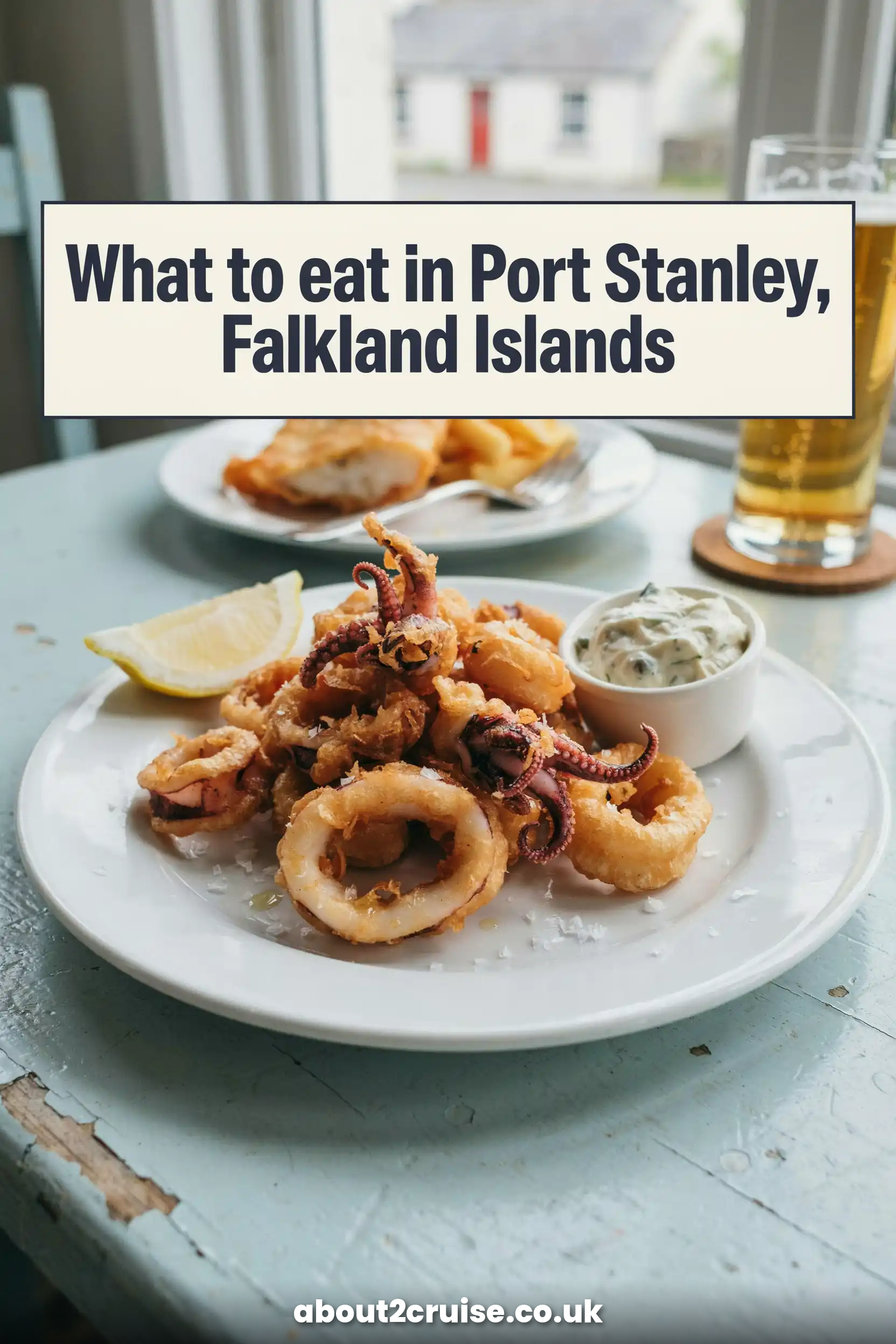
Look for Falkland Beerworks beers such as Peat Cutter and Rock Hopper, and locally made gin. The traditional warmer in licensed premises is a hot toddy of rum, hot water, and sugar. If you only have an hour, a short Stanley walking route recommends trying fried squid and a locally made beer or gin.
The Visitor Centre shop sells locally crafted items, stamped postcards, artwork, and clothing. The town centre is not a huge shopping destination, but it is good for souvenirs, outdoor gear, and useful supplies. Card acceptance is generally fine in Stanley’s main retailers, but outside Stanley you should carry cash.
Taxis, 4x4s, and Independent Tours
There is no public bus network and no official taxi rank you can rely on at the jetty. Taxis and 4×4 operators must be booked ahead. Simon’s Taxis runs port, airport, and ferry transfers with 4×4 vehicles, but availability is thin on multi-ship days. Some guides wait at the Visitor Centre, but only booked passengers are secure.
Treat taxis and guides as a pre-booked resource. If you simply turn up hoping for a taxi to Gypsy Cove on a three-ship day, you may waste the best part of your port call. Independent operators meet at the Public Jetty or Visitor Centre and dispatch from there. Many advertise full refunds if the ship cannot dock, which matters at a wind-prone tender port. If your itinerary is tight or the sea is marginal, the ship’s own excursion can be the stronger choice because the ship will refund a missed call and knows the port timetable.
Money, Cards, Phones, and Wi-Fi
The Falkland Islands pound is at parity with UK sterling, and both circulate interchangeably in Stanley. Major retailers accept cards, and sterling is accepted. US dollars are widely accepted in tourist businesses, but Argentine pesos are not. There is only one ATM, at the Stanley Services fuel station on Bypass Road. Some businesses in Stanley offer cashback. Outside Stanley, cards are not widely accepted, so carry cash in pounds sterling or US dollars. Some travellers have had trouble exchanging Falkland Islands notes at UK banks, so spend or change them before you leave.
Expect usable but limited connectivity. There is 4G in Stanley and surrounding settlements, with limited 4G on the road network. The Jetty Visitor Centre has Wi-Fi, and some hotels, cafés, and restaurants offer it, often via hotspot cards. Contract phones may work on the Sure network if your provider has a roaming agreement. A local pay-as-you-go SIM needs an unlocked handset.
What to Wear and Pack
Stanley is not an Antarctic landing, but it is a cold, windy, quickly changing port. Pack warm layers, a windproof and waterproof outer layer, a warm hat, gloves, and a scarf, and sturdy non-skid walking shoes. The sun can be strong even when the air is cold, so take sunglasses, a hat, and high-factor sunscreen. If you are doing a penguin colony or battlefield tour, expect uneven, peaty, or gravel surfaces and exposed stretches with no shelter. A folded waterproof daypack layer is more useful than a heavy coat if you are in and out of cafés, the museum, and tenders.


Accessibility and Limited Mobility
Stanley is a tender port with open-water transfers, so the first accessibility issue is the step from ship to tender and from tender to pontoon. In swell, wheelchair users may struggle, and the ship’s crew will make the final call. If you cannot walk easily, many Stanley guides will give a vehicle tour instead of a walking tour, and the local Stanley on Foot routes are mostly flat and can be adapted or shortened on request.
Bluff Cove has a courtesy vehicle for limited mobility and offers some assistance, but the tour itself is not fully wheelchair accessible. Volunteer Point is not wheelchair accessible and is unsuitable for people with neck, hip, or back problems because of the rough off-road drive. The Historic Dockyard Museum and Visitor Centre are the easiest indoor options, with the museum on Ross Road close to the jetty.
Safety, Medical Care, and Emergencies
The Falkland Islands have a low crime rate and there is rarely any disorder. The bigger practical risks are environmental and medical. Landmines and unexploded weapons from 1982 can still be found on major battlefields and washed up on beaches. If you see anything suspicious, do not touch or approach it. Mark the area, photograph from safety, call 999, and wait.
The emergency medical number is 999. Stanley has a modern hospital with medical and dental staff, but outside Stanley coverage is limited and help may be delayed. UK residents get free medical care under a reciprocal agreement with proof of residency, but medical evacuation is not covered. A medevac flight to mainland South America costs at least about US$34,000, commercial flights are limited, and Mount Pleasant is frequently affected by rotor winds. Travel insurance should cover at least US$2 million in medical and evacuation costs.
Take care driving outside Stanley, especially on the Mount Pleasant to Stanley road, where strong winds and road conditions make accidents common. A permit is needed to photograph at Mount Pleasant Airport because it is a military site.
Photography and Drone Rules
For wildlife photography, the same distance rule applies: keep at least 6 metres away, stay low, move slowly, turn the flash off, and never use a selfie stick to push closer. That is both an ethical rule and a legal one.
Drone rules are strict. Drones must stay at least 50 metres from any wildlife site at all times, including launch distance, altitude, and flight distance. Do not fly near southern giant petrels, flying seabird colonies, or breeding pinniped sites. Operate only in wind under 15 mph and use a second person to watch wildlife. Deliberately disturbing breeding protected species is an offence carrying a fine of up to £4,000. General drone limits include a maximum of 400 feet and no flying within 150 feet of people, vessels, vehicles, or structures not under your control. Stanley Airport’s air traffic zone covers the town, so call the airport before flying there. Outside Stanley, almost all land is private, and you need landowner permission before any flight. Commercial or aerial-work drone use needs permission from the Director of Civil Aviation.
Cruise Season and Itinerary Context
The Stanley cruise season runs broadly October to March, with the heaviest pressure from December to February. In one recent season, 120 vessels were booked over 82 days, and more than 72,000 passengers visited. Multi-ship days are routine. On a busy February day, three ships could potentially bring nearly 6,000 visitors, so the difference between an early tender and a late one is the difference between a quiet museum visit and a packed minibus queue.
Stanley often appears on South America and Antarctic itineraries alongside Ushuaia, Puerto Madryn, South Georgia, and the Chilean fjords. If you are planning a longer itinerary, see our guides to Ushuaia cruise ship passenger departure port, Puerto Madryn cruise ship port guide, South Georgia Island port of call guide, and our broader Argentina and Uruguay cruise ports guide.
How to spend a port day in Stanley
A port day in Stanley works best if you decide early: stay around the jetty and Ross Road, or pre-book one penguin or battlefield excursion. Tender time and wind set the rhythm.
Before you sail
- Book Volunteer Point or Bluff Cove excursions before the cruise; they sell out.
- Clean boots and outdoor clothing before leaving the previous port.
- Check your independent operator's missed-port refund terms.
Short port day: under 6 hours
- On dockingTake the ship's tender ashoreTenders land at the Public Jetty in the centre of Stanley. Sit near the door and be ready to step between ship and tender.
- +15 minChrist Church Cathedral and Whalebone ArchTwo minutes' walk from the jetty. The cathedral is open daily and the arch stands beside it.
- +30 minHistoric Dockyard MuseumA few minutes along Ross Road. Cruise passengers enter free, and hours often extend on ship days.
- +1 hr 15 minLunch near Ross RoadTry fried squidOrder fried squid or a lamb dish with a Falkland Beerworks beer at a pub along the waterfront.
- +2 hrs 15 minLiberation Memorial and waterfrontWalk past the memorial on Ross Road, then browse the Visitor Centre shop for postcards and local crafts.
- +3 hrs 15 minMemorial Wood or harbour viewIf energy remains, walk to Memorial Wood near Stanley Cemetery, then begin returning to the jetty.
- All-aboard minus 60 minBe back at the public jettyQueue for the return tender. If the line is long or swell is building, allow extra buffer.
The time on the map is the whole walk, every stop added together.
Open this walking route in Google Maps
If plans change: If the museum is closed or the tender queue is long, swap it for the Visitor Centre and the Liberation Memorial.
Long port day: 8 hours or more
- On dockingTake an early tenderTenders can queue. If you plan to walk to Gypsy Cove, use the jetty as your start.
- +15 minChrist Church Cathedral and Whalebone ArchTwo minutes from the jetty. The cathedral is open daily and the arch stands beside it.
- +2 hrsLunch near Ross RoadTry smokoOrder smoko, tea or coffee with home-baked cakes, plus fried squid or a lamb dish.
- +2 hrs 30 minWalk to Gypsy CoveStay on marked pathsAbout 1.5 hours each way along the coastal route. Keep to paths; fenced minefield areas are off limits.
- +4 hrsMagellanic penguins at Gypsy CoveA free colony with about 200 pairs. Stay 6 metres back and turn your flash off.
- +4 hrs 45 minGypsy Cove viewpointsSpot the Lady Elizabeth wreck in Whalebone Cove if visible. Stay behind marked fences and keep your distance.
- +5 hrs 30 minHead back from Gypsy CoveWalk back or take a taxi from the car park if available. The walk takes about 1.5 hours.
The time on the map is the whole walk, every stop added together.
Open this walking route in Google Maps
If plans change: If Gypsy Cove is closed or the walk feels too long, return to Stanley and use the saved time for the Historic Dockyard Museum and the Liberation Memorial.
Stanley Cruise Port FAQs
Is there left luggage at the jetty?
No documented left-luggage or bag-storage facility exists at the public jetty, Visitor Centre, Stanley Airport, or Mount Pleasant. Pack for a tender day and carry only what you need.
Will I definitely get ashore?
No. If the wind reaches a sustained 30 knots and rising, or visibility drops below 0.1 nautical mile, the harbour can close to tenders. Treat Stanley as probable, not guaranteed, and check cancellation terms.
Can I do Volunteer Point independently?
Not realistically on a cruise day. The access is off-road, operators run in convoys on busy days, and booking transport is the practical route. Use a ship excursion or a pre-booked local operator with a clear missed-port refund policy.
Are there taxis at the pier?
Sometimes, but not enough for a busy day. Pre-book a taxi, 4×4, or guide if you have fixed plans. Relying on a walk-up taxi at the jetty is risky on multi-ship days.
Do I need Falkland Islands pounds?
No. Sterling and Falkland Islands pounds are used interchangeably in Stanley. Outside Stanley, carry sterling or US dollars cash, because cards are not widely accepted.
Is Stanley walkable from the cruise ship?
Yes, in the sense that the tender lands directly in the centre of town. From the public jetty, the cathedral, museum, and memorials are only a few minutes’ walk. The ship itself remains at anchor, so the tender is the only land access.
What time is the last tender?
Your ship sets that time, not the port. It is usually posted on board and announced over the ship’s PA. Plan to be at the jetty at least 60 minutes before the final tender, with more buffer if the wind or swell is building.