
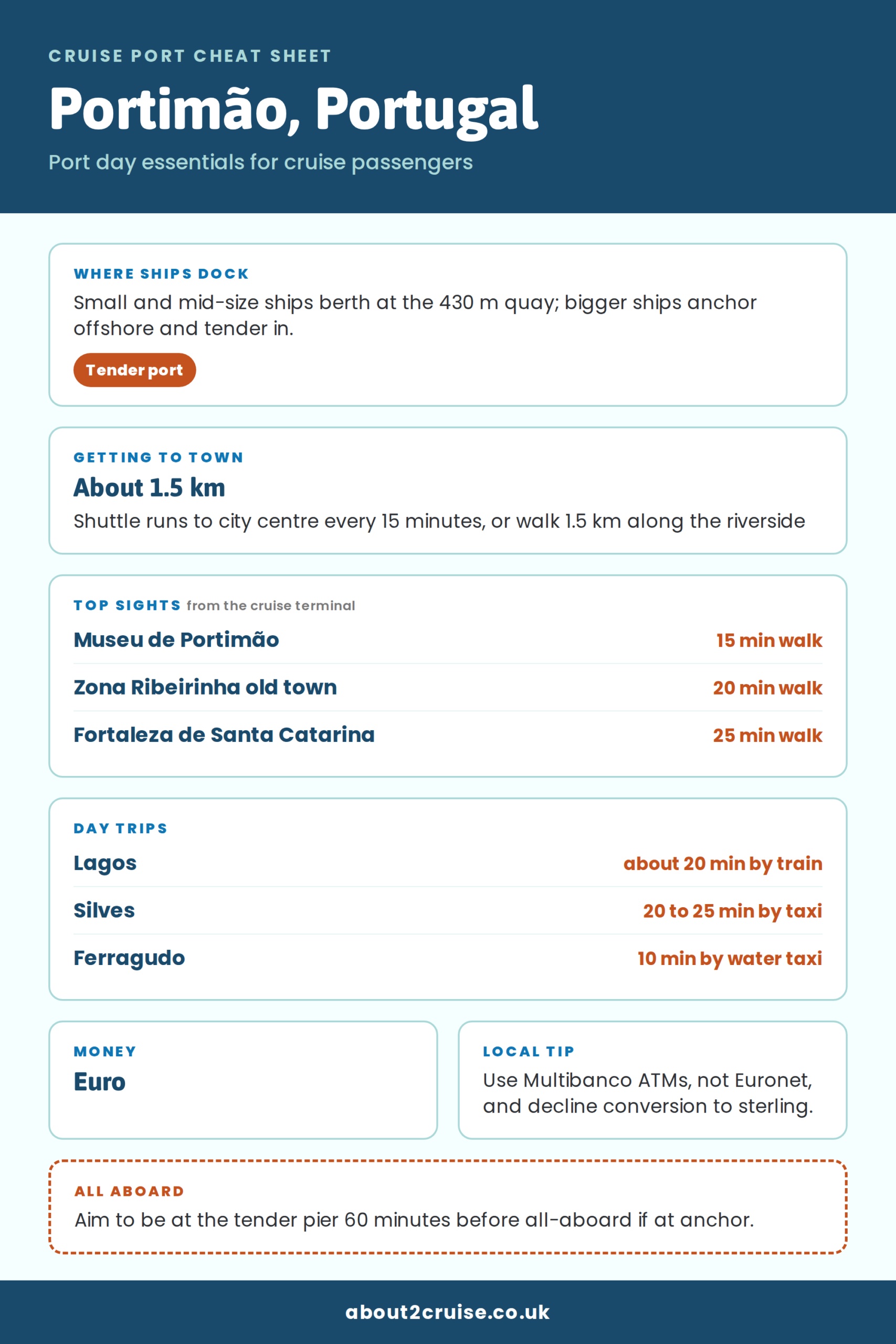
Portimão is the Algarve’s cruise port, set on the Arade river. Small and mid-size ships berth at the 430 m quay; bigger ships anchor offshore and tender in. From the terminal it’s a short shuttle or roughly 1.5 km walk to the old town, and about 2 km to Praia da Rocha beach. Most cruisers split the day between the riverside sardine restaurants, the beach, or a Benagil caves boat trip.
Where your ship docks: alongside or at anchor
Portimão has one cruise quay measuring 430m long. It can take ships up to roughly 210–220m in length and 8m draft, depending on which port source you check. That means small to mid-size ships can berth alongside the Gare Marítima on the Arade river. Larger vessels, and many cruise lines still call here with bigger tonnage, anchor just off the river mouth and use tender boats. Norwegian’s page for the port simply says: “Ship will ANCHOR OFFSHORE at this port.”
The tender drop-off is the same terminal, so your day starts in the same place whether you dock or anchor. The port authority has been rebuilding the ro-ro quay so two tenders can unload at once, which should cut queues on busy calls, but don’t expect tender times to be published: check the daily programme and the last-tender time at the gangway.
Because the anchorage is just off the river mouth, the ride in is short but subject to Atlantic swell. In rough conditions tendering can be slow or, very rarely, the port can be skipped. If you’re on a line that regularly anchors here, book a ship excursion for anything tight or book independently with a generous buffer.
Portimão cruise port map
Ships dock at Portimão Cruise Terminal. From there, Museu de Portimão is about a 15-minute walk, Marina de Portimão about 18 minutes and Igreja Matriz de Portimão about 24 minutes. Tap a pin for directions.
- Portimão Cruise TerminalWhere ships dock
- Museu de PortimãoMuseum · About 15 min walk from Portimão Cruise Terminal
- Marina de PortimãoMarina · About 18 min walk from Portimão Cruise Terminal
- Praia da RochaBeach · About 24 min walk from Portimão Cruise Terminal
- Igreja Matriz de PortimãoParish church · About 24 min walk from Portimão Cruise Terminal
- Fortaleza de Santa CatarinaFortress · About 25 min walk from Portimão Cruise Terminal
- Mercado Municipal de PortimãoMunicipal market · About 29 min walk from Portimão Cruise Terminal
- Portimão railway stationRailway station · About 2 km from Portimão Cruise Terminal
- Lagos Old TownOld town · About 13 km from Portimão Cruise Terminal
- Terminal Rodoviário de PortimãoBus station · About 2 km from Portimão Cruise Terminal
- Praia dos Três CastelosBeach · About 2 km from Portimão Cruise Terminal
- Praia do VauBeach · About 3 km from Portimão Cruise Terminal
- Praia de AlvorBeach · About 5 km from Portimão Cruise Terminal
- Passadiço de AlvorBoardwalk · About 6 km from Portimão Cruise Terminal
- Algar de BenagilSea cave · About 11 km from Portimão Cruise Terminal
- Praia de BenagilBeach · About 10 km from Portimão Cruise Terminal
- Praia da MarinhaBeach · About 11 km from Portimão Cruise Terminal
- Forte de São João do AradeFort in Ferragudo, across the river · About 2 km from Portimão Cruise Terminal
- Igreja Matriz de FerragudoParish church in Ferragudo, across the river · About 2 km from Portimão Cruise Terminal
- Castelo de SilvesCastle · About 11 km from Portimão Cruise Terminal
- Sé de SilvesCathedral · About 11 km from Portimão Cruise Terminal
- Ponta da PiedadeHeadland · About 13 km from Portimão Cruise Terminal
Inside the Portimão cruise terminal: what to expect
The terminal is officially the Gare Marítima, on the town side of the Arade between the old town and museum, and the marina at Praia da Rocha. There’s no published street number or postcode, which is why most guides describe it as “on the Arade waterfront.” For a taxi or sat nav, the most reliable pin is the Google Maps listing for “Portimão Cruise Terminal” or the words Gare Marítima de Portimão.
Inside you’ll find check-in, passenger and bag X-ray, customs, a tourist office, WCs, a bar/coffee shop with terrace, a duty-free shop, an ATM, vending machines and phones. Port authorities rate it at about 1,000 passengers an hour, which is fine for smaller ships but slower when a big tender operation stacks up. There is no luggage storage or locker at the terminal.
There’s a parking area at the terminal, but no published daily tariff and no documented long-stay cruise parking product. If you’re starting or ending a cruise here, plan to use off-site parking or get a transfer rather than relying on the terminal car park.
Pedestrian signage now runs from the port towards the town centre and Praia da Rocha, so once out of the secure area you can follow signs rather than rely on memory.
For a call at Funchal, the Funchal port guide covers the terminal, places to eat and nearby transport.
Getting into town and to Praia da Rocha from the port
Whether you berth or tender, you come ashore at the same terminal. The old town and Zona Ribeirinha riverfront are about 1.5 km along the riverside boulevard; the Museu de Portimão is about 1.1 km from the terminal. Praia da Rocha is roughly 2 km south, with the Fortaleza de Santa Catarina at its eastern edge.
A shuttle runs from the terminal to the city centre every 15 minutes. The port markets this service, but operators don’t publish whether it’s free on any given call: some lines wrap it into the excursion programme, others treat it as a port-run courtesy. Check your daily programme or ask at the gangway.
For local buses, the Vai e Vem town service is useful. Route 33 links Largo do Dique with Praia da Rocha and the fort every 30 minutes, with extra buses in summer; route 11 does the same stretch roughly every 45 minutes on weekdays. Fares are €1.50 single and €3.50 for a day ticket. The nearest town-bus stop is about 400 m from the terminal gates, not inside the secure pier area.
Taxis wait at the terminal exit and are metered. As a rough idea, taxi guides quote Portimão to Silves castle at €18–22 and Praia do Vau at about 10 minutes. There is no official fixed-fare board for the standard cruise runs, so confirm the fare before you set off if the meter bothers you.
The train station is about 1.5 km from the centre and not a sensible walk from the terminal with beach gear; take a taxi or shuttle into town first if you’re heading to Lagos by rail.
If Lisbon is on your cruise, the Lisbon guide to docking and transfers covers the main terminals and routes into the centre.
Planning your day in port: what’s actually doable
Portimão splits naturally into three kinds of calls: stay in town for food, river and beach; take a boat trip to the Algarve caves; or push west to Lagos. In a six-to-eight-hour port day you can comfortably do two of these, not all three.
A strong default is: walk or shuttle into the Zona Ribeirinha for an early grilled-sardine lunch, then head to Praia da Rocha for a couple of beach hours and the fort viewpoint, leaving enough padding for the tender. If you’ve been to the Algarve before or the weather is calm, swap the beach for a Benagil caves boat trip from the marina: most trips run about two hours and need booking ahead in summer.
If you want Lagos or Ponta da Piedade, be realistic about the timetable. Lagos is about 21 km west, 20–22 minutes by car or about 20 minutes on the regional train, but the train only has around eight services a day and Portimão station is 1.5 km from the centre. A taxi or a ship excursion removes the train risk. For more on how this call fits a wider voyage, read our guide to Portugal’s cruise ports.
For a stop at Porto Santo, our Porto Santo cruise port guide sets out what to see and where to eat ashore.
If your cruise also calls elsewhere in Portugal, our Portugal cruise port guide compares what each port offers.
Things to do in Portimão’s old town and riverfront
Portimão is a working fishing and former canning town, not a resort. That’s its appeal: the two-storey houses with wrought-iron balconies, the grilled-fish restaurants along the Zona Ribeirinha, and the smell of charcoal from the riverside grills.
Before you sail
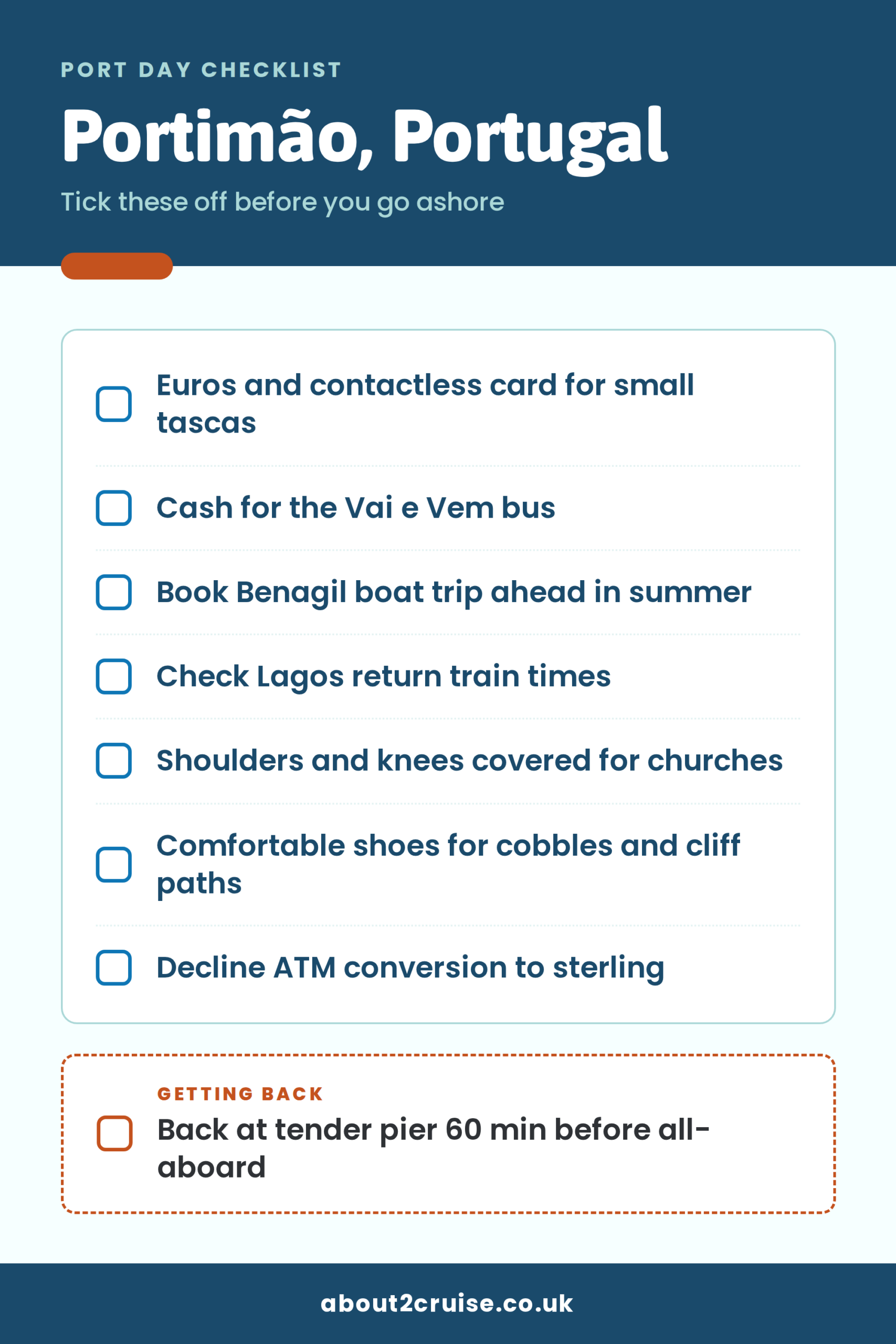
- Book Benagil cave boat trips ahead in summer; morning slots sell out.
- Check the Portimão to Lagos train timetable; only about eight trains a day.
- Bring euros and a contactless card; small tascas may have card minimums.
Short port day: under 6 hours
- On dockingWalk to Museu de PortimãoPedestrian signsFollow the riverside path from the terminal gates, about 1.1 km and 15 minutes.
- +15 minMuseu de PortimãoFormer Feu Hermanos sardine cannery with a recreated canning line and archaeology. Closed Mondays; has lockers and a café.
- +45 minOld town and Largo da BarcaContinue along the riverfront to the two-storey streets and the traditional fish-house square.
- +1 hr 30 minGrilled sardine lunchTry sardinhas assadasOrder whole sardines grilled over coals and served on thick bread at the Zona Ribeirinha grills.
- +2 hrs 30 minIgreja do ColégioLoop past Portimão's 17th-century former Jesuit college church before heading back.
- All-aboard minus 1 hrWalk back to the terminalReturn along the riverside route, about 20 minutes. Leave time for port security at the terminal.
The time on the map is the whole walk, every stop added together.
Open this walking route in Google Maps
If plans change: If the museum is closed on a Monday, spend longer along the riverfront and see the Igreja do Colégio instead.
Long port day: 8 hours or more
- On dockingTaxi to station, then train to LagosTake a taxi from the terminal to Portimão station, then catch the 20-minute regional train to Lagos. Check the return time when you buy your ticket.
- +45 minTaxi to Ponta da PiedadeFrom Lagos station, take a taxi or local bus to the clifftop boardwalks above the sea stacks.
- +1 hr 15 minPonta da Piedade viewpointsWalk the free clifftop boardwalks with views over the stacks and the stairway of nearly 200 steps.
- +2 hrs 45 minLunch in Lagos old townTry cataplanaReturn to the walled old town and order cataplana or grilled fish at a local restaurant.
- +3 hrs 45 minWalk the old town walls and marinaStroll the historic centre, the city walls and the marina before heading to the station.
- +5 hrs 30 minWalk to Lagos station and train backAllow 15 minutes to reach the station, then take the 20-minute train to Portimão. Check the return time before leaving.
- All-aboard minus 90 minTaxi to the terminalFrom Portimão station, take a taxi straight to the cruise terminal. If you are at anchor, aim for the tender pier.
The times on the map are for the whole journey there by train and bus.
Get train and bus times in Google Maps
If plans change: If the train timetable doesn't fit your call, take a taxi to Lagos and back; a ship excursion is the safest fallback.
The town’s signature dish is sardinhas assadas: whole sardines grilled over coals, served on a thick slice of bread with salt and olive oil, usually about €10–14 a plate with bread, salad and potatoes. The place to eat them is the quayside grill strip between the road and railway bridges. Arrive before 12:30 for a riverside table; the dock area is at its busiest from 12:30 to 14:00. Largo da Barca is the traditional square for the long-established fish houses, and they also do cataplana, the copper-pot seafood stew, and fried fish with broad beans and tomato rice.
If you want something beyond grilled fish, try a conservas board, a tasting of tinned sardines, tuna, mackerel and octopus, which is a local speciality, or grab a pastel de nata. The Museu de Portimão is worth the short walk even if you’re not a museum person: it’s set in the former Feu Hermanos sardine cannery, with a recreated canning line, local archaeology and a section on President Manuel Teixeira Gomes. Admission is €3, it’s closed on Mondays, and it has luggage lockers plus a café. Tuesdays open from 14:30, and summer hours shift to afternoons and evenings.

Beaches near the port: Praia da Rocha and beyond
Praia da Rocha is the beach most cruise passengers picture: roughly 1.3 km of sand, Blue Flag, lifeguards in season from 1 June to 30 September, toilets, showers and a long wooden boardwalk. It’s about 2 km from the terminal, or a short ride on bus 33 from Largo do Dique. The eastern end is the Fortaleza de Santa Catarina, built in the 1600s to guard the Arade mouth and now a free public viewpoint over the beach, the marina and Ferragudo.
Beach clubs and restaurants line Avenida Tomás Cabreira behind the sand, with the marina end noticeably quieter. Sunbeds and a parasol on Praia da Rocha typically cost about €17 for a day or €12 for a half day, sometimes waived with restaurant spend. There are marked beach entrances, including one level access point and a first-aid post.
Further west along the coast are Praia do Vau, Praia dos Careanos and Praia do Alemão: smaller cliff-backed coves with warm-coloured rock and fewer people. Vau is about 10 minutes by taxi from the terminal. Alvor’s main beach, about 5–6 km west of the town, is long and accessible, backed by the Ria de Alvor wetlands, but it’s better as a deliberate short trip than a spontaneous add-on.
Benagil caves by boat: what to know from a cruise ship
The Benagil cave is the Algarve’s most famous boat destination, and Portimão is one of the easiest places to do it from. Trips leave from the Marina de Portimão, about 2 km south of the terminal, and most run around two hours for €30–35. You’ll spend roughly 30–40 minutes each way on open water, so it’s a real boat ride, not a quick hop.
The rules changed in 2024–25: nobody may land on the beach inside the cave or swim in the cave. Motorboats get two minutes inside, guided kayak or SUP groups eight minutes, with a cap on boats and paddle craft inside at once and life jackets worn throughout. Operators now sell it as a see-it-from-the-boat experience, which it always was for most cruise passengers on a tight call.
Book Benagil ahead in high season, and treat morning slots as more reliable: Atlantic swell builds through the afternoon and operators cancel rather than risk the cave entrance in chop. If you’re on a short call and the sea is up, skip it and go to the beach instead; the boat trip can’t be compressed.
Portimão’s heritage: easy stops near the port
Beyond the beach and the sardines, Portimão has a working maritime identity worth noticing. The Igreja do Colégio, the 17th-century former Jesuit college church, is the best-known church and sits in the old town. The Convento de São Francisco lies between the centre and Praia da Rocha, though visitor access is limited, and the Igreja Matriz houses an 1886 Henry Fincham organ used in the Algarve International Organ Festival.
The Fortaleza de Santa Catarina is the easiest heritage stop because it’s free, outdoors and photogenic. It was built between 1621 and 1633 to protect the river mouth and now frames the classic view of Praia da Rocha, the marina and Ferragudo. Parts of the exterior are under restoration, but you can still walk the ramparts and take the coastal path towards Praia da Rocha.
Day trips from a Portimão call: Lagos, Ferragudo, Alvor and Silves
Lagos is the comparison most passengers make. It’s prettier and more historic, with the walled old town and the clifftop walks of Ponta da Piedade. The famous headland is free from land, with clifftop boardwalks and a stairway of nearly 200 steps down to the water. Boat trips from Lagos marina start around €20. The risks are the train timetable: roughly eight services a day, 20 minutes each way, station 1.5 km from the centre: and the return time. A taxi or a ship excursion turns Lagos into an easy half-day; a train makes it a timetable-managed one.
Ferragudo is the low-effort opposite-bank option. It’s a small fishing village across the Arade, reached by a seasonal water taxi from the quay or a 10–15 minute road journey over the bridge. Its lanes are steep and cobbled, but the village-and-river views are the point, with Praia Grande and Praia da Angrinha as the local beaches and the privately owned castle of São João do Arade between them.
Alvor is about 5–6 km west and has a flat 3 km boardwalk through the Ria de Alvor estuary, a Natura 2000 wetland where flamingos and waders show up. The boardwalk is accessible and good for families. Silves, 13–20 km inland, is the standard castle-and-cathedral add-on: the castle is about 20–25 minutes and €18–22 by taxi. If you’re travelling with children, Slide & Splash near Lagoa, Zoo de Lagos and SandCity are the usual family days out.
Portimão works best as a do-it-yourself town day; for more on how it slots into a longer voyage, read our guide to Portugal’s cruise ports. It’s a very different call from Madeira’s Funchal, which has a larger-ship berth and a more established cruise schedule; if your itinerary also stops at Porto Santo Island in the Madeira archipelago, that’s a far quieter beach-led contrast.
Ship excursion or DIY? How to decide
Portimão is one of the easier Portuguese ports to do independently. The town shuttle, the €1.50 local bus and metered taxis all make the old town and Praia da Rocha simple. Independent Benagil cave trips sell at roughly the same price as ship excursions, about €30 for two hours, and leave from the nearby marina, so the main reason to take a ship tour is protection if the swell cancels the outside operator’s run.
For Lagos, a ship excursion removes the train timetable and transfer risk, which is worth the premium if your call is short or you’re at anchor. The standard port-day rule applies: be back at the gangway about 30 minutes before departure, and allow about 60 minutes before the advertised all-aboard when you’re at anchor and using tenders. Those times are posted at the gangway and in the daily programme, not published by the port.
Practical info: money, weather, safety and what to pack
Portugal uses the euro; cards and contactless are near-universal, but keep cash for small tascas, markets and card-minimum cafés. Use Multibanco ATMs rather than standalone Euronet machines in tourist areas, and decline conversion to sterling if offered. Tipping is optional: round up, or leave 5–10% for good restaurant service. The emergency number is 112.
In cruise season, Portimão is mild and dry. August averages a high of about 30°C, with sea temperature around 20–22°C by late summer. Spring and autumn calls are often in the 20s and comfortable, but the Atlantic wind means a light layer is worth having. Rain is rare in summer and most likely in December.
The FCDO flags cliff erosion and falling rock, particularly in the Algarve, along with rip tides and strong undertow on unsupervised beaches. Supervised beaches use a flag system: red means do not enter the water, yellow means paddle only. Drink spiking is flagged in Portuguese nightlife, and drinks in Portuguese bars are often stronger than in the UK. Overall it’s a normal-precautions destination.
Dress is beachwear or walking clothes; cover shoulders and knees if you plan to go into churches. For Benagil boat trips, operators say they are not suitable for people with back problems, pregnant women or wheelchair users, and life jackets are compulsory.
Portimão cruise port FAQs
How do I find out which ships are in Portimão today or on my date?
The port authority doesn’t publish a public cruise schedule; use third-party trackers such as CruiseMapper or your ship’s daily programme. Ship-specific arrival and departure times also appear on cruise-tracking apps once the manifest is loaded.
What address do I give a taxi or sat nav for the cruise terminal?
There is no published street number. Give the driver “Gare Marítima de Portimão” or “Portimão Cruise Terminal” and the Arade waterfront should be enough. Use the Google Maps pin for Portimão Cruise Terminal if you’re navigating yourself.
Is there parking at the cruise terminal?
There’s a parking area, but no published daily tariff and no documented long-stay cruise parking. If you’re driving to the port for a cruise, arrange off-site parking or a transfer rather than relying on the terminal car park.
Can you walk from Alvor to Portimão?
Yes, there’s a flat coastal and estuary route that walkers use, but it’s 5–6 km and takes well over an hour in one direction. For a cruise call, take a taxi or bus if you want Alvor itself, and save the walking for the boardwalk once you’re there.
What happens if the tender can’t run?
In rough Atlantic swell the port may delay tendering or the ship may skip the call. Ship excursions get priority on transfer boats if timings tighten, which is one more reason to book anything cave- or Lagos-based through the ship on a marginal forecast.
Is much open on a Monday or Sunday?
Beaches and most restaurants open every day. The Museu de Portimão closes Mondays and opens from 14:30 on Tuesdays. Shops and the local bus service are quieter on Sundays, so plan around the beach or a pre-booked trip that day.
Is Portimão worth visiting, or should I just go to Lagos?
Portimão is worth a port day if you want a relaxed Algarve mix of sardines, riverside life and a proper beach without long transfers. Lagos is the better pick for historic-town atmosphere and cliffs, but it’s more logistics. Many passengers do a half-day in Portimão, then decide if they still want Lagos on a future call.
Last Updated: 23 November 2026