
Puerto Williams is the world’s southernmost city and a small Antarctic expedition gateway on Isla Navarino, facing the Beagle Channel. Most cruisers arrive as Silversea fly-cruise or expedition guests, check in through included hotel logistics, then use the new Punta Lagunilla pier before flying or sailing south. Expect wild weather, simple services, cash and paperwork prep, king crab, short hikes and Yagán history.
What Puerto Williams is known for
Puerto Williams sits on the north shore of Isla Navarino, with Argentina across the Beagle Channel and the Dientes de Navarino ridge rising behind. Chile classifies it as a city, which is why it carries the southernmost city in the world billing: and it is the capital of Antártica Chilena province.
For cruise passengers, the town means three things: a jump-off point for Antarctic expeditions, a place with real Yagán and naval heritage, and one of the best compact wilderness bases at this latitude. It is not a polished cruise terminus like the big southern airports or Ushuaia, but that is exactly why some expedition lines use it.
Map and orientation: making sense of the town
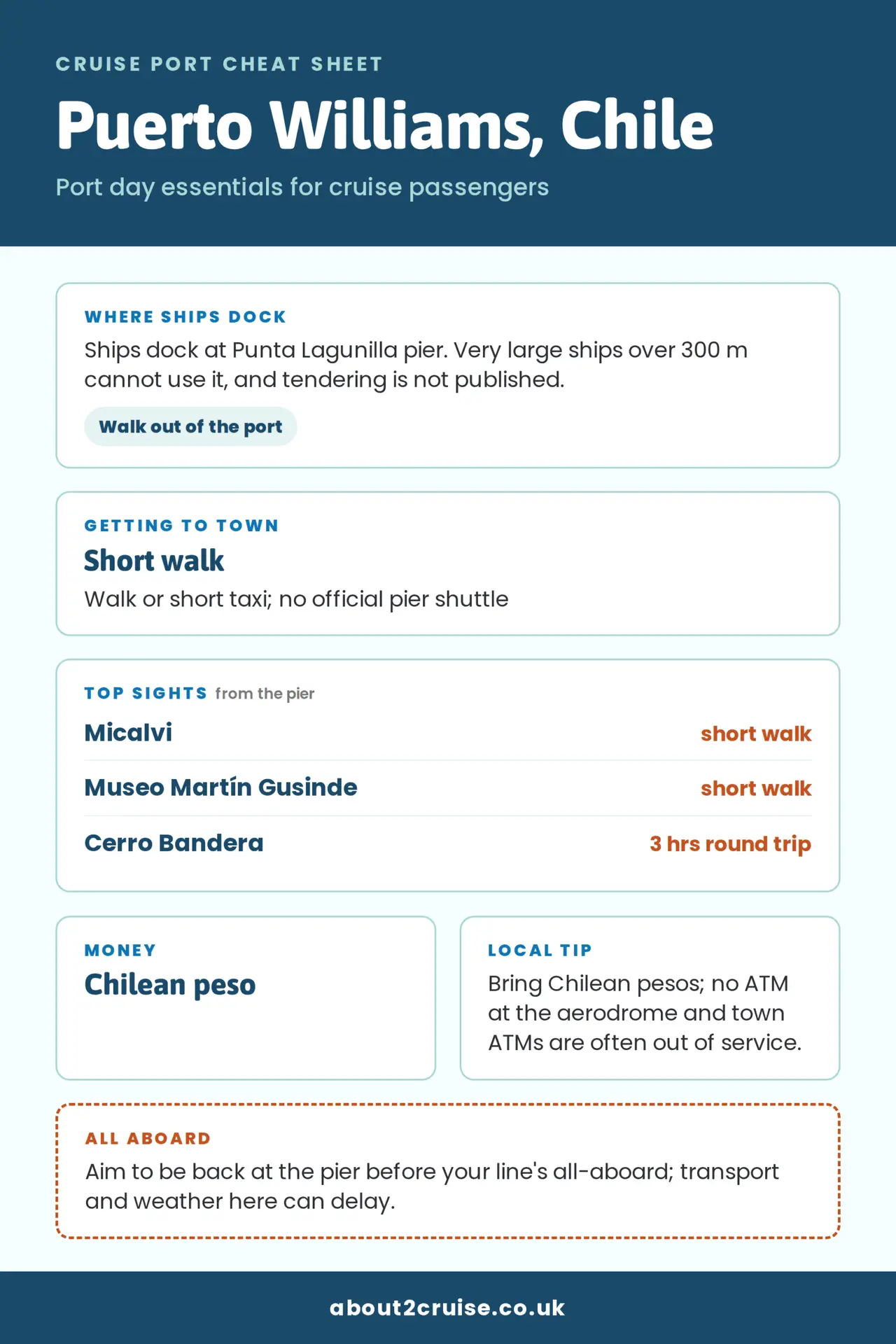
Ships dock at Punta Lagunilla pier. From the pier, Villa Ukika is about a 12-minute walk, Museo Martín Gusinde about 15 minutes and Micalvi about 19 minutes. Tap a pin for directions.
- Punta Lagunilla pierWhere ships dock
- Guardián Brito pierWhere ships dock
- Villa UkikaVillage · About 12 min walk from the pier
- Museo Martín GusindeMuseum · About 15 min walk from the pier
- MicalviAbout 19 min walk from the pier
- Zañartu aerodromeAirport · About 27 min walk from the pier
- Cerro BanderaHill · About 4 km from the pier
- Omora Ethnobotanical ParkEthnobotanical park · About 5 km from the pier
Cruise lines that use Puerto Williams
Silversea is the confirmed big player here. Silver Wind, Silver Cloud and Silver Endeavour operate from Puerto Williams, with round-trip Antarctic Peninsula voyages and one-way sailings to or from King George Island. Voyages run from six to 21 nights, and some extend to South Georgia, the Falklands and the South American coast. Eleven voyages are scheduled to sail the Drake in both directions from the town; many more use the fly-cruise pattern.
Other expedition calls appear on third-party schedules, but check directly with your line. If you are booked on a voyage that includes South Georgia, do not assume Puerto Williams works like a large turnaround port. It is an expedition base, not a conventional embarkation hub with dozens of berths.
The port and new pier at Punta Lagunilla
The new multipurpose pier is at Punta Lagunilla, on the west side of the fishing cove. The first stage built a 150 m dock with a 130 m berthing head and an esplanade. A second stage adds mooring dolphins and posts, and once fully operational the pier is planned to handle vessels up to 240 m. Because of the nearby Guardiamarina Zañartu aerodrome, ships are height-limited to roughly 32 m while flights are operating, and ships over 300 m cannot use the pier at all.
The older Guardián Brito pier is a naval facility and cannot take larger vessels. The planned land stage will add parking, a terminal building with immigration control, SAG, Customs and international police, plus fuel tanks and lines. Until that terminal is in service, do not expect a big check-in hall. Most cruise guests will be handled either ship side, at the hotel or through temporary arrangements laid on by the line.
Docking is the norm for current expedition ships. Tendering is not a published fallback for oversize vessels; the practical answer is that very large ships don’t call here. If your vessel is over the published limits, confirm with the cruise line before booking flights.
Port planners project around 90 cruise calls in the Antarctic Province in a busy season, though not all are Puerto Williams turnarounds. The agricultural inspectorate processed more than 70,000 passengers through the region’s maritime border posts in one season, many of them at Puerto Williams, so biosecurity checks are real but usually quick if you have completed the declaration.
Check-in, boarding and biosecurity
For Silversea fly-cruise passengers, the real check-in happens at the hotel, not a traditional terminal. The sequence is usually: charter flight from Santiago to Puerto Williams, a night at The Cormorant at 55 South, briefing and gear issue at the hotel, then the short flight to King George Island or embarkation on the ship at the pier. Boots and expedition clothing are often issued at the hotel, and guests go through a biosecurity briefing before flying south.
On the Antarctic charter flight, only the supplied backpack and essential hand luggage are allowed. Wheeled hand luggage is not accepted. On arrival at King George Island, boots go into disinfectant, followed by a vehicle transfer and Zodiac. The same biosecurity mindset applies around Puerto Williams: do not carry raw vegetables, seeds, honey, uncooked meat or dirty outdoor gear into sensitive areas without declaring or cleaning it.
If your cruise starts at the pier rather than with a flight, check-in may be run by the ship’s team at a temporary desk or on board. There is no fixed public terminal cafe, shop or left-luggage desk to rely on.
How to get to Puerto Williams, Chile
There is no road link to mainland Chile. You either fly or take the ferry.
- Flights. DAP operates small aircraft between Punta Arenas and Guardiamarina Zañartu aerodrome. The flight is roughly 1h15, seats are limited, and services are weather-dependent. Around six departures a week are typical. The aerodrome has only one scheduled destination, Punta Arenas, six days a week. It is about 1–2 km from the centre, or 5–10 minutes by vehicle.
- Silversea charter. Silversea’s private charter is the only direct Santiago–Puerto Williams flight, taking about 3h30 from its private Santiago terminal. This is arranged as part of the fly-cruise package, not something you book independently.
- Ferry. A TABSA ferry connects Punta Arenas with Puerto Williams in about 30–33 hours, roughly twice a week. In high season it is usually the Kawéskar; in low season the Yaghan. It leaves from Tres Puentes terminal in Punta Arenas. Check tabsa.cl for current sailings and fares.
- Transfers and shuttles. The Cormorant at 55 South runs a free shuttle to central Puerto Williams. Other hotels and lodges often arrange airport pick-ups; Errante Ecolodge advertises a free airport shuttle. Local taxis exist but fares are informal, with no published tariff. Agree a price before you get in, and don’t expect ride-hailing apps.
Weather routinely delays both flights and ferry sailings. Leave a 24-hour margin and build flexible connections; 12–24-hour waits are described as common on the Punta Arenas–Puerto Williams route.
UK flight routing, baggage and connection timing
British Airways is the only nonstop Heathrow–Santiago operator, at about 15h35 and three flights a week. Iberia goes via Madrid in roughly 17–21 hours. Santiago is three hours behind London.
From Santiago, fly-cruise passengers take the Silversea charter, which usually begins with an included hotel night in Santiago before the 3h30 charter to Puerto Williams. Independent travellers fly to Punta Arenas on LATAM or Sky, then take DAP onward to Puerto Williams. Do not book a same-day UK arrival onto the last DAP flight; the weather risk is too high. Build an overnight in Santiago or Punta Arenas at the beginning and end.
Check internal baggage allowances separately. DAP’s small aircraft and Antarctic charter flights are much more restrictive than a long-haul bag. Keep essential documents, medication, a change of clothes and hiking layers in your carry-on, even if that carry-on is the issued expedition backpack.
Where to stay in Puerto Williams
Fly-cruise passengers do not normally choose their pre-cruise hotel. The Cormorant at 55 South is included before and after the voyage for many Silversea itineraries. It has 150 rooms, a restaurant called Latitude 55, Bar Sur and a fireplace lounge, and operates seasonally from October to March. It was built on the site of the former Hotel Lakutaia and primarily hosts Silversea fly-cruise guests, but rooms may be available to other travellers when occupancy allows.
If you are arranging your own stay, options include Hotel Fio Fio, Hostal Akainij, Errante Ecolodge and Refugio Jemmy Button. Some offer luggage storage, tour desks and free airport shuttles. Book far ahead in the Antarctic season: beds are limited and weather delays can fill the town quickly. Chile’s tourism board also stresses booking accommodation well ahead and bringing cash.
Chile entry rules and Antarctic paperwork
A full British citizen passport can enter Chile for up to 90 days without a visa. You’ll receive a tourist card to keep and hand back on departure. The passport should be valid beyond the date you plan to leave Chile. Children travelling with one parent, a guardian or alone need a notarised authorisation from the non-travelling parent and an original birth certificate.
Every arrival must file an agricultural declaration; it can be completed digitally up to one day before arrival at ingresoachile.cl. Personal food is allowed after declaration and inspection if it contains no raw vegetables and any meat is cooked and boneless. Vacuum-packed items must still be declared. Do not hide outdoor gear with soil on it.
For Antarctica, your operator will require a medical declaration and travel insurance covering emergency evacuation. Minimum cover varies by line: many ask for US$100,000–500,000, and some make insurance a condition of carriage. Silversea has been described as not requiring a physician’s sign-off, while other operators demand it. Mobility aids and medical devices must be pre-approved before boarding an expedition ship. If in doubt, send the form to your GP early and do not assume standard travel insurance covers polar evacuation. Carry printed copies of your passport photo page, itinerary, insurance and next flight details.
Weather by season and what to pack
Puerto Williams has a cool maritime climate. Mean monthly temperature is about 10.5°C in January and 1.7°C in July, with an annual mean around 5.5°C. Mean relative humidity is 75% and mean wind speed is 6.8 m/s, peaking in February and October. Prevailing winds are west and south-west. Annual precipitation at the town is around 467 mm, but just west along the channels it can exceed 3,000 mm.
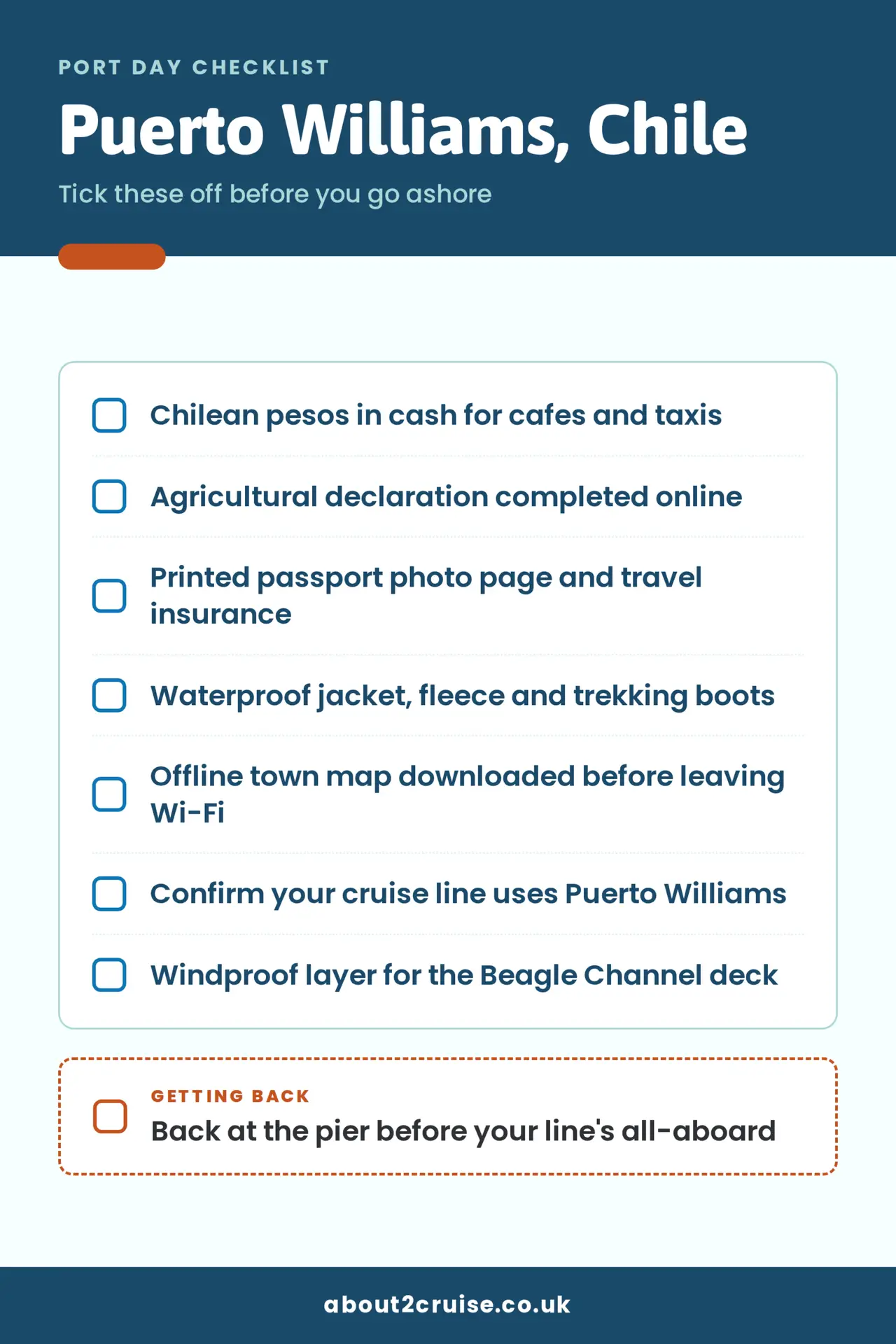
The Antarctic season runs November–March, with long days in December and January and better whale watching in February and March. Pack thermal base layers, fleece, waterproof jacket and trousers, high-cut trekking boots, gloves, a warm hat and sun protection. The weather changes drastically, and Cape Horn winds can reach 150 km/h. On slippery surfaces, falls are a real risk.
Luggage, expedition gear and pack list
For fly-cruise guests, some gear is usually provided: parka, waterproof trousers, boots, a backpack and a water bottle are issued at the hotel. On the Antarctic charter flight, you may carry only the supplied backpack and essential hand luggage. Wheeled hand luggage is not allowed. Keep your passport, travel insurance, medical forms, printed flight and cruise documents, prescription medicines, sunglasses, lip balm and a small power bank in that backpack.
There is no left-luggage facility at the pier or the aerodrome. Some hotels and hostels, including Hotel Fio Fio and Hostal Akainij, offer luggage storage. If you are in transit for a day, ask your accommodation or cruise line’s ground team where you can leave non-expedition luggage. Pack as if your checked bag may be delayed by weather or a small-aircraft weight restriction.
Money, cards and tipping
The currency is the Chilean peso. Not all services accept cards, so bring cash. There is no ATM or currency exchange at the aerodrome. The nearest ATM is the BancoEstado branch in town, but ATMs in Puerto Williams are scarce and frequently out of service. Withdraw cash in Santiago or Punta Arenas first.
Restaurant bills in Chile must carry a suggested 10% tip; it is voluntary but almost universally paid for acceptable service. Taxi fares are informal, so agree a price before getting in. In practice, a small amount of Chilean cash will make your day much easier than hunting for a working card machine.
Language, Wi-Fi and mobile signal
Spanish is the working language. Some tourist operators and hotel staff have basic English, but do not expect universal English service. Learn a few words: hola, gracias, ¿cuánto cuesta?, no entiendo.
The fibre-optic network has reached Puerto Williams, lifting browsing speeds from roughly 500 KB/s to 7 MB/s. Free Wi-Fi is available in parts of the small commercial area and at the tourist office. Entel prepaid SIM cards are sold at several places in town. Mobile coverage is best inside town and disappears quickly on trails, so download offline maps and carry a satellite messenger or personal locator beacon for the Dientes or remote walks.
Health, safety and emergency contacts
The Hospital Comunitario Cristina Calderón at O’Higgins 246 is the southernmost hospital in the world. It is low-complexity but has 24/7 emergency care, hospitalisation, minor surgery and telemedicine links to the regional centre. Serious cases are evacuated by air from the province. Bring enough prescription medicine with you; this is not the place to assume a large pharmacy or specialist supply.
UK government advice for Chile says pickpocketing, mugging and theft from vehicles are very common, including at transport hubs and ports. Carry a printed copy of your passport photo page. Use official taxis at airports and book inside the terminal where possible; avoid unlicensed taxi touts. Drinking alcohol in public streets, squares and promenades is illegal in Chile. Tell the local authorities before setting off exploring or mountaineering; rescue services may charge.
Emergency numbers: ambulance 131, fire 132, police 133.
Accessibility and mobility at the port
The Martín Gusinde museum has wheelchair access. Beagle Channel kayak tours are not wheelchair accessible. The landing trail in Cabo de Hornos National Park is a stepped boardwalk with strong winds and no confirmed wheelchair access. Expedition ships require mobility aids and assistance needs to be pre-approved before boarding, so if you use a wheelchair, rollator or CPAP, contact the cruise line before paying in full.
No published pier-side accessibility information exists for the new Punta Lagunilla berth. The town is compact but has uneven pavement, slopes and wind. If you have mobility concerns, arrange a taxi or hotel shuttle rather than attempting the walk from the pier with luggage.
Things to do in Puerto Williams, Chile
With a free afternoon or a full day before boarding, you can cover the town on foot. Start with the Museo Antropológico Martín Gusinde, the world’s southernmost museum, which holds Yagán ethnography and the Casa Stirling. It is typically free, with wheelchair access, visitor Wi-Fi and a café. Hours vary, but recent listings show morning and afternoon sessions through the week and a shorter Saturday opening.
Before you sail
- Confirm your cruise line uses Puerto Williams, not Punta Arenas or Ushuaia.
- Complete Chile's agricultural declaration online at ingresoachile.cl before arrival.
- Carry Chilean pesos; no ATM at the aerodrome and town ATMs are unreliable.
Short port day: under 6 hours
- On dockingWalk to the MicalviWindproof layerFrom the Punta Lagunilla pier, walk to the cove where the former cargo ship is grounded as the yacht club.
- +20 minMicalviThe most photographed thing in town, with yachts rafted alongside. No ticket needed to view it.
- +50 minMuseo Martín GusindeWorld's southernmost museum with Yagán ethnography and the Casa Stirling. Check that day's opening session.
- +2 hrsVilla UkikaWalk to the last Yagán settlement to see crafts and the community cemetery.
- +3 hrsLunch near the waterfrontOrder centollaTry Beagle Channel king crab or chupe de centolla. Cash is useful; many small cafes do not take cards.
- +4 hrs 15 minWalk back to the pierAim to be at the pier before your line's all-aboard. There is no terminal waiting area.
The time on the map is the whole walk, every stop added together.
Open this walking route in Google Maps
If plans change: If the museum is closed between its sessions, visit Villa Ukika first and return for the next opening.
Long port day: 8 hours or more
- On dockingWalk to the MicalviWindproof layerFrom the Punta Lagunilla pier, follow the waterfront to the cove of the grounded cargo ship.
- +20 minMicalviThe grounded cargo ship used as the yacht club is the most photographed thing in town.
- +1 hrMuseo Martín GusindeWorld's southernmost museum. Check the opening session; entry is usually free.
- +2 hrsLunch near the waterfrontOrder centollaKing crab is the local specialty, served boiled or as chupe de centolla. Bring Chilean pesos.
- +3 hrsClimb Cerro BanderaAllow 3 hoursA medium-difficulty trail up to the 590 m summit. Steps and handrails lead to panoramic views over town and the Beagle Channel.
- +4 hrs 30 minAt the summitTake in the panoramic view over Puerto Williams and the Beagle Channel before starting the descent.
- +6 hrsDescend and return to the pierFollow the trail down to the waterfront and back to Punta Lagunilla. Aim to be at the pier before all-aboard.
The time on the map is the whole walk, every stop added together.
Open this walking route in Google Maps
If plans change: If the Cerro Bandera trail is closed for maintenance, book a half-day Beagle Channel kayak trip instead.
Walk the waterfront for the Micalvi, a former German-built cargo ship grounded and used as the local yacht club. It is the most photographed thing in town. Villa Ukika, the last Yagán settlement, has a community cemetery and crafts for sale. For a view, climb Cerro Bandera; allow three hours round trip from town, medium difficulty.
Do not try to add Cape Horn as a port-call excursion. It is about 12 hours’ sailing each way and has no land access without a booked expedition vessel. The full Dientes de Navarino circuit takes four to five days and requires mandatory registration with Carabineros, so it is not a shore-day activity.
Hiking, kayaking and wildlife watching
The Cerro Bandera trail climbs from about 80 m to a 590 m summit over roughly 2.8 km. It has steps, handrails, viewpoints and signage, and gives a panoramic view over Puerto Williams and the Beagle Channel. The first stage of the Dientes de Navarino circuit to Paso de la Australia is a serious 8–10 hour round trip and is not a casual warm-up.
Omora Ethnobotanical Park protects 1,700 hectares of miniature moss and lichen forests about 3 km from town. Book a guided visit. For Beagle Channel access, local operators run half-day kayak trips, typically four hours with dry suit, kayak, guiding, a snack and local beer. Slots are usually 10:00–14:00 or 15:30–19:30, with hotel pick-up, so they fit a shore day. A longer seven-hour sea-lion kayak tour is sold for around US$178 per person and is not wheelchair accessible. Local operators are registered with Sernatur and authorised by the Chilean Navy.
Wildlife is genuinely wild: expect seabirds, sea lions and the possibility of whales, especially in February and March, but no zoos or guaranteed sightings. Bahía Wulaia, an early Yagán canoe-people settlement, is usually visited by expedition ship rather than as a public day trip. Puerto Toro, the southernmost community, is reached only by a monthly boat and is not a casual excursion. Cabo de Hornos National Park is open October–April, requires advance tickets on pasesparques.cl, and has no accommodation, food or emergency facilities. The landing trail to the lighthouse is about 500–730 m over a stepped boardwalk; strong winds make falls a real risk.
Food, cafes and local services near the port
Eat centolla, the southern king crab from the Beagle Channel. It is served boiled or grilled, as chupe de centolla, a baked crab and cheese casserole, and in empanadas. A large centolla plate might run CLP 30,000–50,000, chupe CLP 15,000–25,000, merluza austral CLP 12,000–18,000 and seafood empanadas CLP 3,000–5,000. Restaurants tend to open late for dinner, from around 20:00.
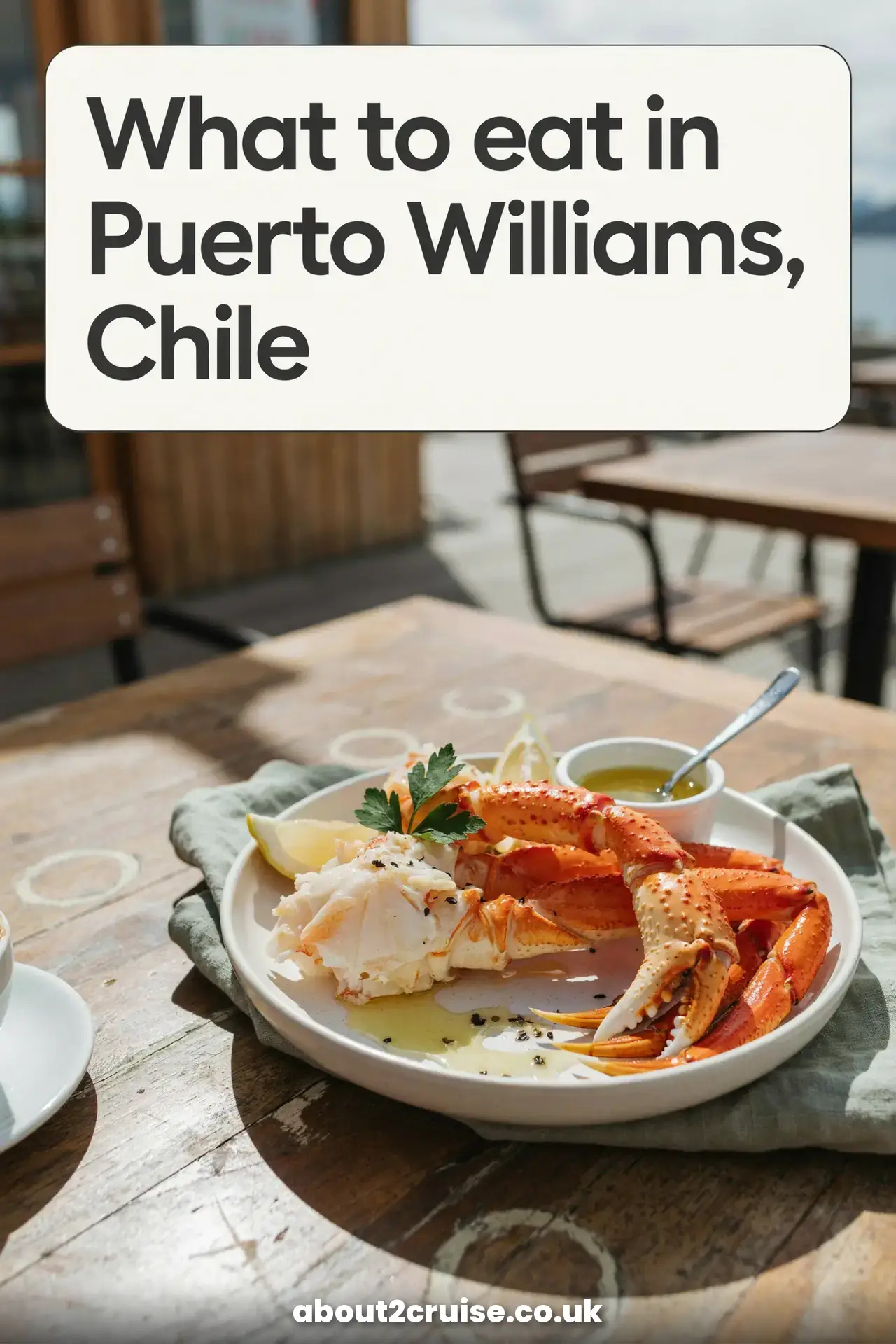
Other local staples include cordero al palo and calafate berries in jams, desserts and liqueurs. The museum and most services are within walking distance of the compact waterfront. If you are at The Cormorant, Bar Sur serves calafate and pisco cocktails. Bring cash for smaller cafes and bars.
Puerto Williams vs Ushuaia vs Punta Arenas
Ushuaia handles about 95% of Antarctic expedition departures and has far greater capacity, around 14 daily flights and thousands of hotel beds. Punta Arenas is the Chilean fly-cruise base, with about two-hour charters to King George Island. Puerto Williams is a niche expedition turnaround used mainly by Silversea.
Total Antarctic visitation in a recent complete season was about 118,491 passengers, and the Antarctic Peninsula accounts for about 98% of tourism voyages, which depart from Ushuaia or, to a lesser extent, other ports north of the Treaty area. If your itinerary says Puerto Williams, don’t compare it with Ushuaia’s infrastructure. It is smaller, slower and weather-exposed, but also much closer to the expedition. If you are already booked from Ushuaia, that is an entirely different city and port in Argentina.
Is Puerto Williams worth visiting?
Yes, if you are already there for an Antarctic cruise or want the southernmost city and Beagle Channel walking country. A full day is genuinely interesting: museum, waterfront, Micalvi, Cerro Bandera, king crab. If you are only considering a long detour from Punta Arenas or Ushuaia and do not plan to explore Isla Navarino, the weather uncertainty and simple services may not be worth it for one afternoon.
It is at its best as a start or end point, not a traditional port of call with rows of excursion buses. If you can build in an extra day, the payoff is big: one of the quietest, most atmospheric small towns at the end of the Americas.
Is Punta Arenas, Chile worth visiting?
Punta Arenas is the other Chilean gateway and is worth a look if you need to position for a flight to Puerto Williams or a fly-cruise from King George Island. It is served daily from Santiago by LATAM and Sky, has the Muelle Prat cruise berth within walking distance of the centre, and offers Isla Magdalena’s Magellanic penguins from October to March.
If your cruise documents say Puerto Williams, do not book hotels and transfers in Punta Arenas assuming that is where you sail from. It is the transit airport town, not the embarkation port, unless your line specifically says otherwise.
The town sits on the north shore of Isla Navarino, looking across the Beagle Channel to Argentina. The Dientes de Navarino form the southern backdrop. The new pier is at Punta Lagunilla on the west side of the fishing cove. The Micalvi sits in its own cove with yachts rafted alongside. The museum, waterfront, small supermarket areas and cafes are compact and walkable, but no official source publishes the exact walking distance from the pier. Treat any pier-to-town transfer as short by taxi, manageable on foot without luggage.
Which side of the ship is best for Beagle Channel views?
There is no official best side for leaving Puerto Williams because ships often turn and expeditions may not hug the channel in the way you expect. The ship’s port side is the left side when facing the bow; starboard is the right side. In Puerto Williams, the town faces north toward the channel, with Argentina across the water. The Dientes de Navarino rise behind to the south. On a westbound departure you may see Argentina on the starboard side and the Dientes behind you on the port side, but a turn can reverse all of that.
The practical tip: don’t fixate on one side. Go to an outside deck and move. Keep your camera protected from spray and wind. If you are on a fly-cruise, the Beagle Channel views are usually better from a Zodiac or deck before and after Antarctica than from a cabin window.
Common booking mistakes and what reviews say
- Confusing Puerto Williams with Punta Arenas or Ushuaia. Check the cruise line’s exact embarkation point before booking flights and hotels.
- Arriving without cash and relying on ATMs. The aerodrome has no ATM; town ATMs are unreliable.
- Booking tight same-day flights from the UK to Punta Arenas and then on to Puerto Williams. Weather delays of 12–24 hours are common.
- Assuming Cape Horn or the Dientes circuit are day activities. They are not.
- Bringing wheeled hand luggage on the Antarctic charter, or forgetting to declare food at SAG.
- Not checking insurance for polar evacuation or not getting medical forms signed early.
Reviews and common questions tend to focus on the drama of crossing the Drake, the weather, the remoteness and the surprisingly warm welcome in a small town. Passengers who are comfortable with expedition travel and flexible scheduling normally rate it highly; those expecting a big cruise terminal or last-minute excursion desks find it too basic.
Not Portugal or the Mediterranean: a quick clarification
Puerto in this name is Spanish for port, not Portugal. Puerto Williams is in Chile’s Magallanes region, not the Mediterranean or the Portuguese coast. Portugal’s main cruise ports are Lisbon, Porto (Leixões), Portimão and Funchal in Madeira. If a search for Puerto brought you here, this is the Chilean Antarctic gateway, not a Mediterranean cruise port.
Puerto Williams FAQs
What happens if my flight from Punta Arenas to Puerto Williams is cancelled?
Weather is the main cause. Work through your airline or cruise line, stay flexible, and wait out the delay. Puerto Williams accommodation is limited, so do not move to a tight same-day connection. The general rule is to have at least one extra day of margin.
Do I need a visa if I am only transiting Chile for an Antarctic cruise?
For a British citizen, no. Chile allows up to 90 days visa-free, gives you a tourist card to keep and hand back on departure, and requires an agricultural declaration. The Antarctic cruise operator handles Antarctic landing permits but will require medical and insurance paperwork.
Is Puerto Williams really the southernmost city in the world?
Chile classes it as a city, which is why it carries that billing. Ushuaia in Argentina is the better-known southernmost city for mainstream travellers, and the two are often confused.
Can I use Uber or app taxis in Puerto Williams?
No. It is a very small town with informal taxis. Agree the fare before getting in, or rely on hotel and cruise-line shuttles.
Is there a left-luggage facility at the pier or airport?
No. The pier has no terminal building yet, and the aerodrome does not advertise left luggage. Use hotel or hostel storage, such as Hotel Fio Fio or Hostal Akainij.
Which side of the ship is best for Beagle Channel views when leaving Puerto Williams?
There is no official side. Port means left when facing forward, starboard means right. The town faces north with Argentina across the water and the Dientes behind to the south, but ships can turn. Stay on deck and move sides.