
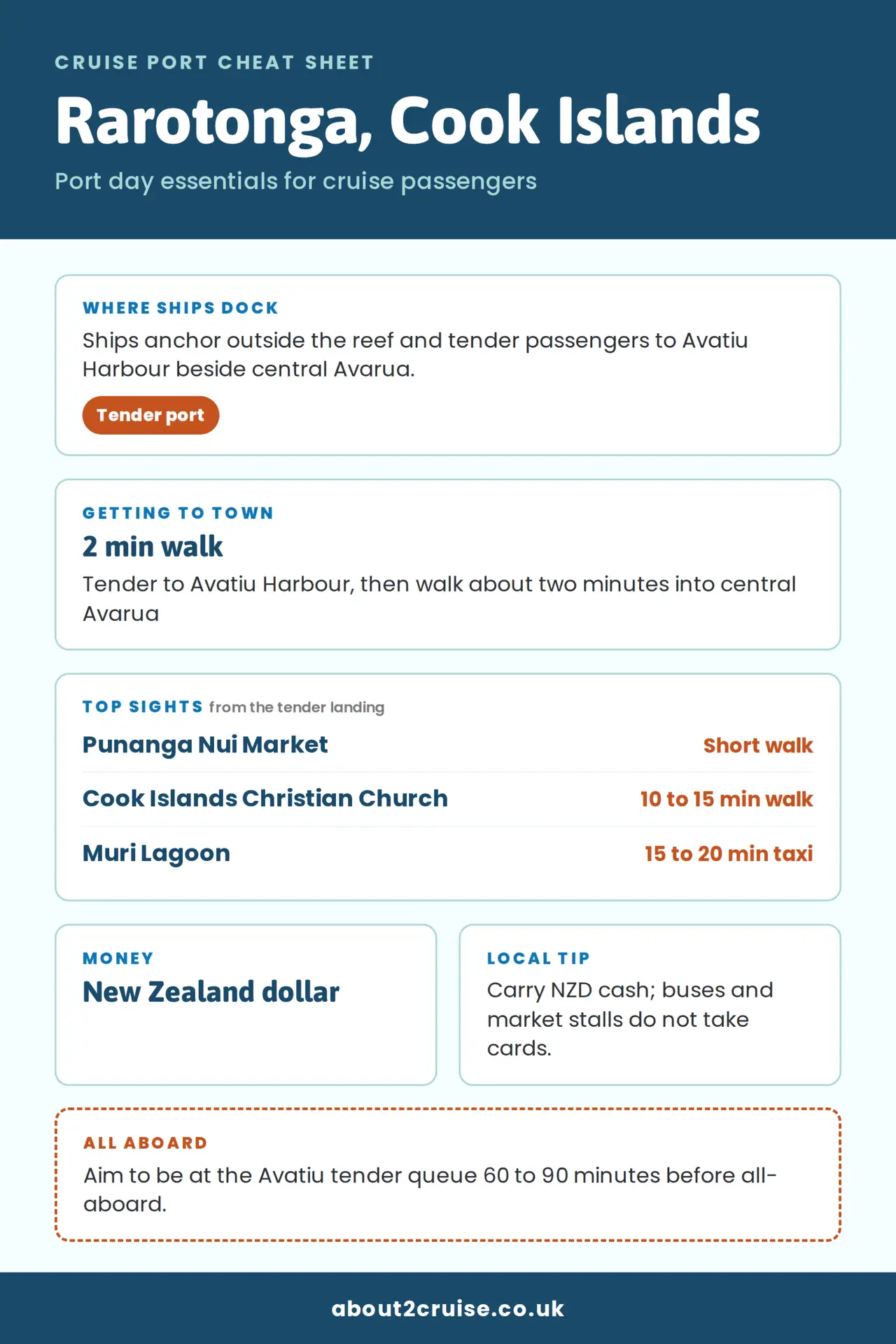
Rarotonga is a tender port. Cruise ships anchor outside the reef and send passengers ashore to Avatiu Harbour, a small working harbour on the edge of Avarua, the Cook Islands capital. Most cruisers use the day for a Muri Lagoon boat trip, a bus ride around the 32 km ring road, or the Saturday market.
Rarotonga Cruise Port Guide: What to Actually Expect on a Port Day
Rarotonga is a tender port. Your ship won’t pull up to a dock: it anchors outside the reef and small boats bring you into Avatiu Harbour, a compact working port on the edge of Avarua, the Cook Islands’ main town. Most cruise passengers fill the day with a Muri Lagoon boat trip, a loop around the 32 km coastal road, or a Saturday wander through Punanga Nui Market.
Finding Your Bearings: Rarotonga Cruise Port Map and Orientation
Tenders bring you ashore at Avatiu Harbour tender landing. From the tender landing, Punanga Nui Market is about a 5-minute walk and Cook Islands Christian Church about 24 minutes. Tap a pin for directions.
- Avatiu Harbour tender landingWhere tenders land
- Arorangi tender landingWhere tenders land
- Punanga Nui MarketMarket · About 5 min walk from the tender landing
- Cook Islands Christian ChurchChurch · About 24 min walk from the tender landing
- Muri LagoonLagoon · About 8 km from the tender landing
- Black RockRock formation · About 4 km from the tender landing
- Wigmore’s WaterfallWaterfall · About 6 km from the tender landing
- Te Rua MangaRock needle · About 4 km from the tender landing
- Arai Te Tonga maraeSacred marae · About 4 km from the tender landing
Muri Lagoon: The Postcard-Perfect Rarotonga Day
Muri Lagoon is the island’s best-known water scene: shallow, turquoise, protected by a fringing reef, and scattered with four small motu: Motutapu, Oneroa, Koromiri and Taakoka. It’s where most cruise passengers head first, around 15–20 minutes by taxi or organised transfer from Avatiu.
The classic trip is a four-hour lagoon cruise: a glass-bottom boat, a guided snorkel among tropical fish and coral heads, a stop on a motu, a pareu-tying and coconut-husking demonstration, and a fish barbecue lunch. Prices usually sit around NZ$105–120 per adult and NZ$40–50 per child. Captain Tama’s and Koka Lagoon Cruises are the two big names, and both run Sunday to Friday.
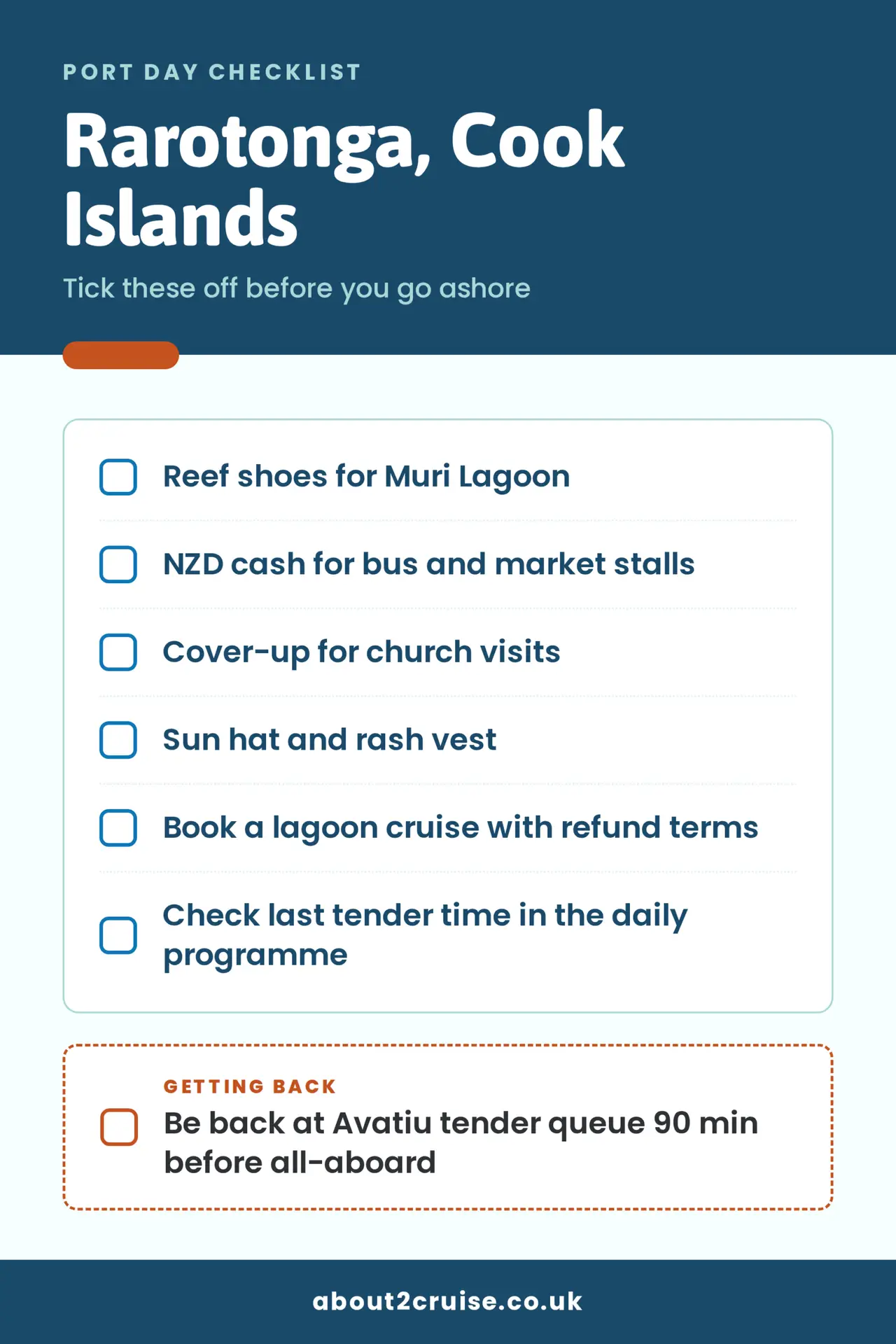
If you prefer to go solo, buses and taxis can drop you at Muri Beach. From there you can swim, paddleboard or kayak toward the motu, or snorkel the inner reef. Tide matters here: high tide brings the colour and better snorkelling, while low tide exposes coral rubble and seagrass. Bring reef shoes or sturdy sandals: the lagoon floor isn’t all soft sand.
Rarotonga’s Mountain Interior and the Cross-Island Track
Rarotonga’s jagged green interior is the island’s other signature. The highest point, Te Manga, tops out at 652 m, but the famous viewpoint and hiking objective is Te Rua Manga, the 413 m rock needle.
The classic Cross Island Trek is 6 km, moderate-to-hard, and takes 3–3.5 hours. It runs from the north trailhead in Avarua, up Uraua Drive behind the Pandanus petrol station, to the south trailhead at Wigmore’s Waterfall on Papua Road. The track is marked with orange markers and has steep, muddy sections, ropes and clay that turns slick after rain. Don’t climb the Needle itself: the final rock is dangerous.
The usual north-to-south route ends with a swim at Wigmore’s Waterfall, but flow depends on recent rain. On a tight tender day, only attempt this with a guide and a firm turnaround time, because you finish on the opposite side of the island and still need transport back to the port.
Driving the Ring Road Around Rarotonga’s Coastal Villages
Rarotonga is 32 km around, sealed all the way by the Ara Tapu, the coastal ring road. There’s no cross-island road: anything by vehicle goes around.
A non-stop drive around the island at the 40–50 km/h speed limit takes 45–50 minutes, but real life is slower. The road strings together Avarua, the east-coast lagoon district of Ngatangiia and Muri, the southern beaches of Titikaveka, and the west-coast villages of Arorangi and Nikao. It’s the easiest way to see Black Rock, the CICC church, fruit stalls, village meeting houses and inland sacred sites such as Arai Te Tonga, about 3 km east of Avarua on the inland Ara Metua road.
The public bus runs both ways on the Ara Tapu, and you can flag it anywhere along the road. If you hire a scooter or car, stay with the ring road and keep your eyes on the road rather than the lagoon.
Avarua: The Cook Islands Capital on Foot
Avarua is the capital and the only real town. The name means “two harbours,” and the town stretches between Avatiu Harbour and the older Avarua Harbour at Takuvaine. For a port day, it’s compact enough to cover on foot in a morning.
The main landmark is the white coral-stone Cook Islands Christian Church, Ziona Tapu, built in 1853, with Te Rua Manga rising behind it. Its graveyard holds missionary John Williams and Albert Henry, the first premier. Visitors are welcome at Sunday service from 10am, but dress modestly: men in long trousers and collared shirts, women in dresses or skirts below the knee. Don’t walk on sacred marae: Arai Te Tonga is one of the most important.
In the evenings, Te Vara Nui Village at Muri and Highland Paradise at Arorangi run cultural shows, umu feasts and storytelling. For a cruise day in town, the CICC church, the museum, the market and the harbourfront are the best culture stops.
Saturday at Punanga Nui Market: Local Life on Display
Punanga Nui Market is the signature Rarotonga experience if your ship calls on a Saturday. It sits on the Ara Tapu at the west end of Avarua, beside the harbour and a short walk from the Avatiu tender landing.
Saturday hours are roughly 7am to midday, with food stalls, tropical produce, black pearls, crafts, local coffee and free live music and dance on the main stage from about 10am. Locals queue for coconut rolls, firi firi doughnuts and ika mata.
A smaller weekday version runs about 7am to 3pm, though it’s quieter. There are two ATMs at the market entrance, but many small stalls still prefer cash. If your ship stays late on another evening, the Muri Night Market runs Tuesday, Wednesday, Thursday and Sunday from 5pm until sold out, with food trucks and stalls: just check you can get back before the last tender.
What Cruise Passengers Look Forward to Most on a Rarotonga Port Day
Most cruise passengers look forward to the same trio: a Muri Lagoon boat and snorkelling day, a lap of the island’s coastal villages and lookouts, and a wander through Avarua with the market or church as an anchor.
The tender ride itself is part of the attraction: the crossing goes over the reef and can deliver whale sightings between July and October. People also want to taste ika mata, photograph the CICC church with the Needle behind it, and beat the tender queue back to the ship.
Tender Timings and Return-to-Ship Confidence
Rarotonga is a tender port with no deep-water cruise berth: ships anchor or drift outside the reef and run boats into Avatiu Harbour. The tender crossing is short, and the landing is on the western edge of Avarua, about a two-minute walk from town. That part is easy.
The thing to get right is the return. Tender queues build heavily in the last two hours, so be in line 60–90 minutes before the all-aboard time printed in your ship’s programme. The last tender from shore normally leaves about 30 minutes before all-aboard. If you’re already in the queue at that point, the line will keep running; if you’re still in a taxi, you’re late.
Book independent excursions only with operators who offer a clear no-landing refund, because a call can be cancelled or cut short. Some guides estimate the missed-call rate at Rarotonga is higher than many passengers expect, driven by wind and swell rather than rain.
Choosing a Lagoon, Island, or Town-Focused Day in Rarotonga
Because Rarotonga is small, you can combine town and island, but you usually have to choose one main focus.
A lagoon-focused day means going straight to Muri for a boat trip, snorkelling and beach time. An island-focused day means the circle bus, a scooter, a shared island tour or a private 4WD trip with stops at Black Rock, the southern beaches, a waterfall lookout and a village. A town-focused day means walking Avarua: the market, CICC church, harbourfront, museum and lunch.
If tenders are delayed, town is the easiest fallback. If the call is full-length and weather is calm, a morning lagoon or island excursion with a late town stop before the queue works well.
Where You Land: Avatiu Harbour and Avarua
Ships land at Avatiu Harbour, a small working harbour on Rarotonga’s north coast, immediately beside the capital Avarua. There is no cruise terminal and no berth for large ships. The conventional berth is only 160 m long with 7 m draft and an air-draft restriction because of the airport flight path, so vessels over about 120 m generally anchor outside the reef.
Once ashore you are at the western edge of Avarua, about a two-minute walk into the centre. The other Cook Islands cruise port is Aitutaki, at Arutanga on its west coast, and many itineraries visit both. If Avatiu is unusable, an alternative tender landing can be Arorangi on the west coast, which changes transfer times and meeting points, so confirm with your operator.
How Tender Operations Work at Rarotonga
Tendering is short but weather-dependent. The ship anchors or drifts outside the reef and runs small boats into the harbour. The crossing can be bumpy in swell. The port has no shelter for large ships, so a call can be cancelled even when the island is sunny. Winds over about 20 knots can hold vessels offshore.
Crew may decline to carry wheelchairs or scooters on tenders if the water is moving; mobility access is limited at the wharf and there is no formal passenger terminal. Public restrooms and a small takeaway are nearby, and on call days local operators usually set up a pop-up market by the landing. Listen to the ship announcements for which side and which harbour are being used.
Rarotonga Cruise Ship Schedule and Arrival Patterns
There is no single official public schedule for Rarotonga cruise calls. The island receives roughly 24 calls and about 28,000 passengers in a typical 12-month period, mostly between the South Pacific cruise season and world-cruise positioning months. Call times are typically 7am–5pm, 8am–7pm or 9am–6pm.
The most reliable current source is your own ship itinerary. Third-party port trackers and the daily programme give live arrival and last-tender times. For a particular sailing, the cruise line is the authority.
Which Cruise Lines and Ships Visit Rarotonga?
Rarotonga appears on world cruises, South Pacific loops and repositioning voyages. Ships that call include Norwegian Spirit, Costa Serena, Costa Deliziosa, Paul Gauguin, Silver Dawn and Silver Cloud, Oceania Vista, Star Breeze, ms Europa 2, Artania, Amera, Westerdam, Zuiderdam, MSC Magnifica and Viking Sky. Sizes range from about 250 passengers on Silver Cloud to more than 3,000 on Costa Serena.
Some itineraries pair Rarotonga with Aitutaki as the two Cook Islands calls. Not all passengers go ashore, on a large MSC Magnifica call, around 1,000 of 2,100 passengers tendered in, so booked tours and independent plans both work, but spaces on lagoon boats can fill.
Small-Ship and Expedition Cruises in the Cook Islands
Small-ship and expedition itineraries are the most comfortable fit for Rarotonga because they tender fewer people and sometimes use Aitutaki as well. Aranui 5, a passenger/freighter of about 230 passengers, has added Rarotonga, Aitutaki and Atiu. Ponant’s Le Jacques Cartier runs an “Ancestral Cultures of the South Pacific” route through Fiji, Tonga, the Cook Islands and French Polynesia. Paul Gauguin carries about 330 guests and includes Rarotonga on Cook Islands & Society Islands voyages. Star Breeze, all-suite with 312 guests, calls at both Aitutaki and Avatiu.
For the wider region, read our Pacific Islands Cruise Ports Guide.
Cruises That Include Rarotonga from New Zealand and Australia
Rarotonga is not a home port, but it appears on cruises departing from Auckland, Sydney and Melbourne on repositioning and world-cruise legs, usually between New Zealand and Papeete. Examples include Westerdam from Auckland to Seattle via Rarotonga, Europa 2 from Auckland to Lautoka, and Oceania Vista from Los Angeles to Sydney via Rarotonga and Aitutaki.
These South Pacific itineraries often combine the Cook Islands with other Pacific stops such as Vava’u in Tonga. If you’re looking for a round trip from New Zealand or Australia that includes Rarotonga, check world cruise segments and repositioning dates rather than weekly departures.
For calls in French Polynesia, the Bora Bora cruise port guide explains tendering to Vaitape and getting to Matira Beach or a lagoon tour.
For the next leg into French Polynesia, the Papeete cruise port guide covers docking in town and reaching the market or Moorea ferry.
Arrival, Last Tender, and All-Aboard Times
Rarotonga is a day-only call. Ships typically arrive between 7am and 8am and depart between 4pm and 6pm. A sample call window might be 7am–5pm, so a 4:30pm last tender and 5pm all-aboard; another might be 8am–7pm.
The exact last-tender time is printed in the daily programme and often announced over the ship PA. Treat the last tender from shore as your hard deadline, not the ship’s all-aboard. Aim to be back near Avatiu at least an hour before that, because the queue forms in the last two hours. Keep ship’s time on a watch rather than relying on local time if the ship stays on a different zone.
Getting Around Rarotonga: Bus, Taxis, Scooters, and Tours
The public bus is the budget way around. It runs two loops on the Ara Tapu: clockwise leaves Cooks’ Corner in Avarua hourly on the hour, 7am–10pm Monday to Saturday; anti-clockwise leaves on the half hour, 8:30am–4:30pm Monday to Friday and 8:30am–1:30pm Saturday. A single adult fare is NZ$5 cash, child NZ$3, a return is NZ$8 and an all-day pass is NZ$20. On Sunday only the clockwise route runs, 8am–12pm and 2pm–4pm. The bus does not take cards.
Taxis are limited and not metered in the usual sense; figure roughly NZ$3 per kilometre, with Avatiu to Muri about 15–20 minutes. Scooter hire starts at about NZ$15 a day, but a car licence doesn’t cover a scooter: you need a Cook Islands visitor licence if you don’t have motorcycle entitlement, and helmets are compulsory. Several local operators sell 3–4 hour island tours; some will only take cruise passengers through the ship’s shore excursions desk. Private guided tours run about NZ$300–600 for a half-day.
Rarotonga Shore Excursions: Lagoon Cruises, Snorkelling, and Island Tours
The most popular shore excursion is the Muri Lagoon boat cruise. Captain Tama’s sells a four-hour snorkel, lagoon cruise and barbecue at NZ$115 per adult, a 90-minute snorkelling-only version at NZ$50, and private charters. Koka Lagoon Cruise offers a similar glass-bottom boat, guided snorkel, fish barbecue and entertainment, departing Muri Beach at 10am Sunday to Friday.
Cruise line shore excursions generally package a transfer from the pier, the lagoon boat, gear and lunch. Island tours range from air-conditioned coach circles to 4WD runs up into Avatiu Valley rainforest, Hospital Heights and Wigmore’s Waterfall, and nature walks in the Takitumu Conservation Area. Book anything with a clear cancellation policy if the tender doesn’t land.
A Muri Beach Day from the Cruise Port
Muri is the easiest lagoon day from the port. From Avatiu the drive is about 15–20 minutes by taxi or excursion bus; the public bus is slower but far cheaper. The beach is east-facing, so mornings are calmer and the sun is over the lagoon; you won’t get sunset there.
At high tide the water is the vivid turquoise you see in photos, and the inner reef between Motu Koromiri and Taakoka is a good snorkel. At low tide parts of the lagoon drain to ankle depth and expose coral rubble and seagrass. Reef shoes are the single best thing to bring for Muri. You can hire kayaks and paddleboards and paddle toward the motu. There are small shops and cafes at Muri, but not much shade on the sand.
Avarua on Foot: Shops, the Church, and Market Timing
Avarua is easy to walk from the tender. Go left along the harbourfront and you pass the port area, the market ground, shops and the main road. The CICC church is in the town centre. The National Culture Centre holds the National Library and Museum and is a useful indoor stop if it rains.
Shopping is best at Punanga Nui Market on Saturday morning; on weekdays try the smaller market or the pearl and craft shops along the main road in Avarua. Cook Islands black pearls are the classic purchase; also look for local coffee, vanilla, shell jewellery and woven hats. If you’re in port on a Sunday, most shops close and the bus is limited, so a town walk plus church service and a resort lunch are the realistic options.
Food to Try Near the Port in Rarotonga
The flavours to look for are ika mata (raw fish marinated in lime and coconut), rukau (steamed taro leaves), poke (banana with arrowroot and coconut), mitiore (fermented coconut with onion and seafood) and firi firi doughnuts. Punanga Nui Market stalls sell many of these, and Bite Time Cafe there is known for ika mata that sells out early.
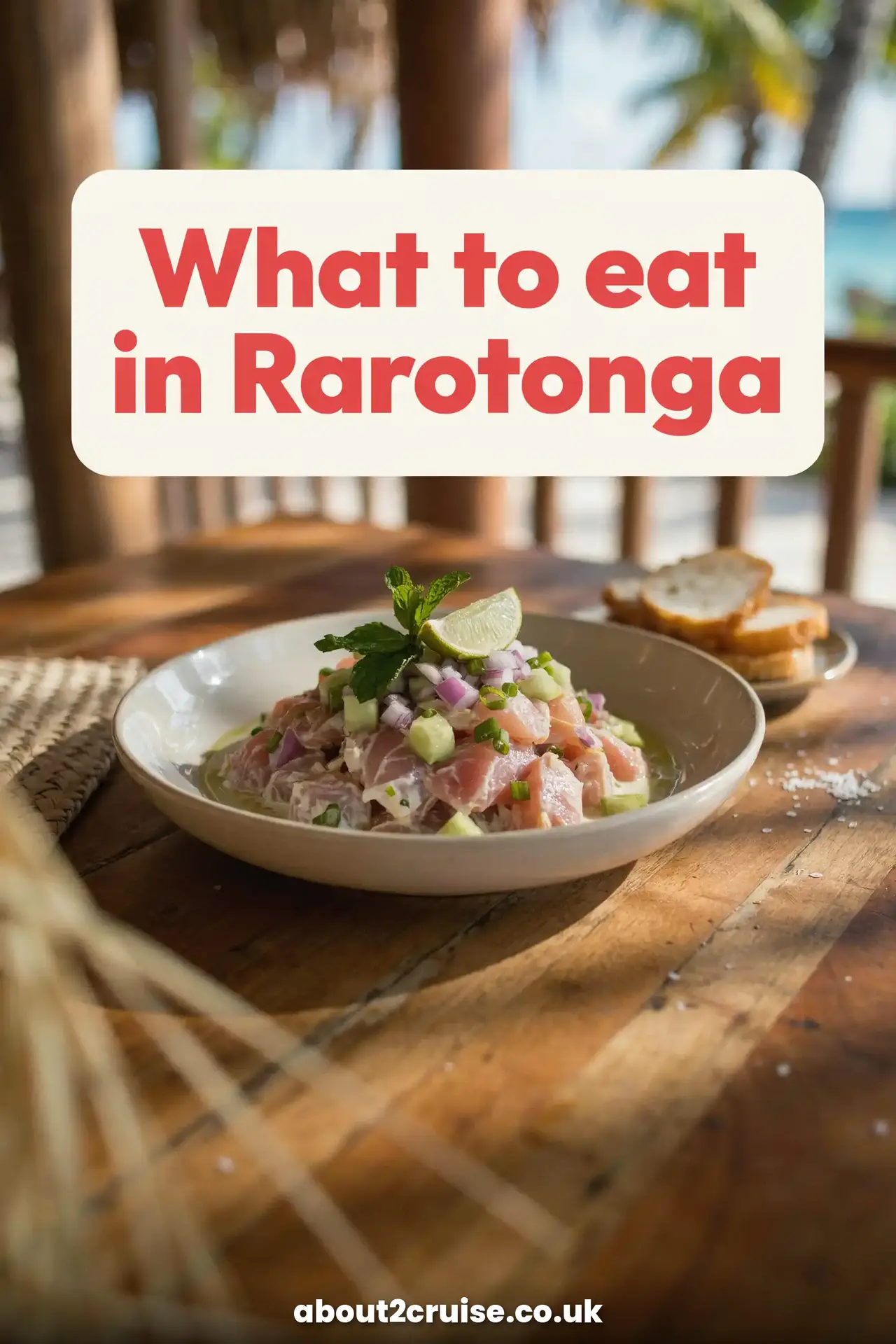
Near the port there is a small takeaway, and Avarua has cafes and restaurants along the main road. The Muri Night Market is the evening food spot, but only if your ship stays late. The umu, a traditional earth oven, is served at cultural shows and island nights. If you want a proper sit-down local meal, ask which restaurants serve ika mata that day rather than ordering generic resort food.
Money, Cards, Tipping, and Internet in Rarotonga
The Cook Islands uses the New Zealand dollar, plus local Cook Islands coins and notes that cannot be spent after you leave. ATMs in Avarua dispense standard NZD notes. There are two ATMs at the Punanga Nui Market entrance and branch ATMs from BSP, Bank of the Cook Islands and ANZ on the main road; withdrawal fees for international cards are typically NZ$5.50–7.50.
Cards and EFTPOS work at many hotels, restaurants and bigger shops, but the bus, market stalls, roadside fruit stands and many small takeaways are cash only. Carry small notes. Tipping is not customary and not expected. Vodafone Cook Islands is the only mobile network; a travel SIM can be bought at the airport, and eSIMs can be bought before you leave.
What to Pack for a Cook Islands Cruise Port Day
For a Rarotonga port day, pack light but specifically: reef shoes or sturdy sandals for the lagoon, a rash vest or swimwear, a towel, reef-safe sunscreen, a hat, a water bottle and a dry bag. The tender can be damp.
On land, standards are modest outside resort areas; don’t walk through town in only swimwear. If you plan to attend a church service, men need long trousers and collared shirts, and women need longer skirts or dresses, ideally with covered shoulders. Bring cash in NZD, your ship card, and a fully charged phone. If you hire a scooter, a helmet is compulsory. The day is casual but respectful.
Rarotonga Weather: Best Months and What to Avoid
Rarotonga’s dry season is May to October; the wet season is late November to April or May. Average highs run about 29–30°C from December to April and 24–27°C from May to November. Humidity averages around 80%, and March is the muggiest month.
July to October is the most comfortable dry-season window and overlaps humpback whale migration. The official cyclone season runs 1 November to 30 April, with the worst risk December to March. Independently of rain, wind and swell decide whether tenders run, so a lovely day can still be a no-landing day. For cruise passengers, Sunday is the other thing to avoid: many businesses close, the anti-clockwise bus doesn’t run, and the remaining bus is limited.
Safety, Health, and What to Watch Out For
The Cook Islands is generally a low-crime destination; the FCDO does not advise against travel and Australia’s Smartraveller compares safety to New Zealand. Still, don’t leave valuables on the beach or in scooter storage.
The bigger risks are natural. Most beaches are unpatrolled. Swim and snorkel inside the calm lagoon, not in reef passages. The Avaavaroa and Rutaki passages have warning signs because of strong currents that can pull swimmers out to sea; do not ignore them. Medical care is limited and serious cases may need evacuation to New Zealand or Australia; there is no decompression chamber. Emergency numbers are police 999, ambulance 998, fire 996. Rarotonga Hospital in Nikao is open 24/7; Tupapa Clinic in Avarua is open daily 8am–4pm. Scooter accidents are common; wear a helmet and make sure your insurance covers riding.
Is the Cook Islands a Country? A Quick Context for Visitors
The Cook Islands is a self-governing country in free association with New Zealand. It runs its own internal affairs and conducts its own international relations, but Cook Islanders are New Zealand citizens, the currency is the New Zealand dollar, and King Charles III is the shared head of state. It is not a UN member but is a full member of the Pacific Islands Forum.
For a cruise passenger this mostly matters for paperwork and money: you are not technically entering New Zealand, but NZD cash, NZ English and New Zealand-style road rules are the daily reality. The Cook Islands sits on UTC−10 all year, the same as Hawaii.
How Long Does It Take to Walk or Circle Rarotonga?
The coastal road around Rarotonga is 32 km long. You cannot walk around in a port day: that would be a full day’s hike or more. Driving or riding without stops takes 45–50 minutes at the island speed limits, but with stops budget half a day.
The only cross-island route is the walking track, not a road. In Avarua, the walkable core from the tender landing to Punanga Nui Market and the CICC church is about 10–20 minutes each stretch. If someone tells you to “circle the island,” they mean by vehicle, bus or bike.
The Rarotonga cruise port sits at Avatiu on the north side of the island, right beside Avarua. The tender landing is inside the harbour at the western edge of town. The main road, Ara Tapu, runs right past the port; Punanga Nui Market is a short walk west along the waterfront, and Avarua’s central shops and church are east of the harbour.
What Avatiu Harbour and the Tender Pier Look Like
Avatiu is small and working, not a polished terminal. There is no formal passenger building; expect a landing area, public restrooms, a small takeaway and pop-up market stalls on call days. The wharf can look industrial with fishing boats, container activity and the green flanks of the interior behind it.
The best photo is usually from the water on the tender, looking back at the harbour and the CICC church spire against the mountains. If you want to see what the pier looks like before you go, search for “Avatiu Harbour tender” and “Cook Islands Port”: the real scene is modest.
Rarotonga Photo Spots: Where to Point Your Camera
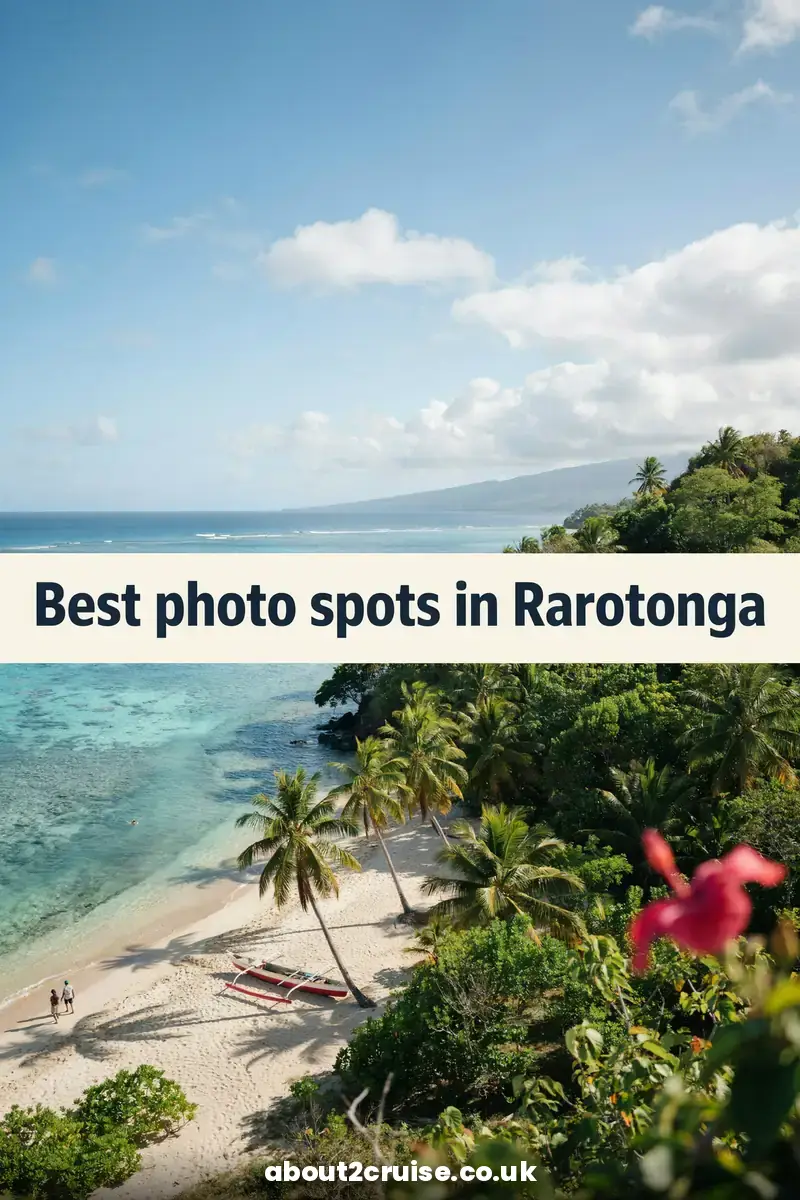
Black Rock, or Tuoro, at Nikao on the western edge of the island is the best-known sunset spot and is open and free. Muri Beach faces east and gives sunrise over the motu. The white CICC church in Avarua with Te Rua Manga behind it is the classic framed shot. The Cross Island Track gives ridge views over both coasts. From the tender or the ship between July and October you may photograph humpbacks. In town, the Saturday market is full of colour. For clean lagoon water shots, go at high tide.
How to spend a port day in Rarotonga
A port day in Rarotonga works best if you pick one: Muri Lagoon and the east-coast beaches, or Avarua on foot.
Before you sail
- Book a Muri Lagoon cruise with a clear no-landing refund policy.
- Check your call day: Saturday market closes by midday, Sunday buses are limited.
- Bring NZD cash for the bus, market stalls and small takeaways.
Short port day: under 6 hours
- On dockingTender into Avatiu HarbourTender portShips anchor outside the reef and run tenders to Avatiu Harbour, about a two-minute walk from central Avarua.
- +15 minPunanga Nui MarketCash for stallsShort walk west along the waterfront. Saturdays are the big market until midday; weekdays are quieter.
- +45 minCook Islands Christian ChurchWalk east to Avarua's white coral-stone church, built in 1853, with Te Rua Manga behind it.
- +1 hr 30 minLunch near Avarua main roadTry ika mataLook for ika mata, raw fish marinated in lime and coconut, at market stalls or a cafe on the main road.
- +3 hrsNational Culture CentreIndoor stop holding the National Library and Museum, a short walk from the main road.
- +4 hrsWalk Avarua harbourfrontStroll back towards Avatiu, passing the working harbour and any pop-up market stalls.
- All-aboard minus 90 minJoin the tender queueDon't be lateBe at the Avatiu tender queue 60 to 90 minutes before all-aboard. If you are still in a taxi, you are late.
The time on the map is the whole walk, every stop added together.
Open this walking route in Google Maps
If plans change: If Punanga Nui Market is not running, head to the National Culture Centre and the harbourfront instead.
Long port day: 8 hours or more
- On dockingTender into Avatiu HarbourTender portShips anchor outside the reef and tender to Avatiu Harbour. Taxis and buses leave from near the landing.
- +15 minCatch the circle bus at Cooks' CornerCash for the busWalk to Cooks' Corner on the Ara Tapu in Avarua and board a bus towards Muri. Pay the driver in NZD cash.
- +1 hrMuri Lagoon snorkel or glass-bottom boatBook aheadSnorkel the inner reef or join a prebooked glass-bottom boat trip. High tide brings the best colour.
- +2 hrs 30 minLunch at MuriTry ika mataOrder ika mata at a cafe near Muri Beach, or eat the fish barbecue included on a lagoon cruise.
- +4 hrs 30 minMuri Beach or paddle to the motuSwim at Muri Beach or hire a kayak and paddle towards the motu. Wear reef shoes in the lagoon.
- +5 hrs 30 minBus back to Avarua and walk the town centreReturn by circle bus and walk the town centre: church, market or harbourfront, depending on the day.
- All-aboard minus 90 minJoin the tender queueDon't be lateBe at the Avatiu tender queue 60 to 90 minutes before all-aboard. If you are still on the bus, you are late.
The times on the map are for the whole journey there by train and bus.
Get train and bus times in Google Maps
If plans change: If the lagoon boat is cancelled, ride the circle island bus around the whole island and stop at Black Rock and Titikaveka instead.
First-Timer Questions About Rarotonga’s Tender Port
First-timers often ask: Do we dock or tender? You tender. Where do we land? Avatiu Harbour, unless the captain uses Arorangi as an alternative. Do I need a visa? Most British, EU, NZ and Australian passport holders do not need a separate Cook Islands visa for a day call, but the ship holds the passenger manifest and local clearance.
What is there at the landing? Restrooms, a small takeaway and a pop-up market; not a terminal. Is there a port control building? Yes, but you won’t go through it. The ship is cleared as a vessel, and you walk from the tender onto the quay. How will I know if the call is cancelled? The captain announces it, sometimes the night before or on the morning. If you have an independent tour, wait to pay until you are ashore or insist on a no-landing refund.
Cook Islands Cruise FAQs
Is there luggage storage at Avatiu? No, there is no left-luggage office at the tender landing. Airport lockers in Avarua are the option if you are arriving or leaving by air.
Can I use US, AUD or EUR dollars? The local currency is the New Zealand dollar. The bus may accept some foreign notes at a dollar-for-dollar rate, but you will get better value using NZD cash.
Can I visit Aitutaki from Rarotonga on a port day? No, Aitutaki requires a domestic flight, and there is no time on a cruise call. It is a separate ship call.
Is Rarotonga good for children? Yes, the lagoon, beach and glass-bottom boat trips are family-friendly. The Cross Island Track is not suitable for young children.
Can I drink the tap water? Tap water in Avarua is generally safe, but many visitors prefer bottled water; ask locally and stay hydrated.
Are there beaches within walking distance of the port? Avarua Beach is close, but the classic lagoon beach is at Muri, a short transfer away.
What if my ship calls on Sunday? The Saturday market will not be running, many shops close, and bus service is reduced. A church service, a coastal walk, a resort lunch or a pre-arranged tour are the best options.
Can I stay overnight before or after a cruise that visits Rarotonga? Rarotonga has no cruise embarkation, but if you arrive early or stay after a fly-cruise, Avarua hotels put you near the port and Muri hotels put you near the lagoon. Confirm transfers with your hotel or cruise line.
Last Updated: 23 November 2026