
If you’ve been solo cruising on big ocean ships and found yourself lost in a sea of families, couples, and hard-to-crack social circles, river cruising might be the reset you didn’t know you needed.
River cruises offer solo travellers a smaller, more intimate alternative to ocean cruising, with ships carrying 100–200 guests, built-in social spaces, and itineraries that encourage natural mingling. Several major lines now run single-supplement waivers or reductions across 2026 sailings, making them a genuinely cost-competitive option for anyone tired of paying double to cruise alone.
Why River Cruising Works Better for Solo Travellers
River ships are fundamentally different animals from their ocean-going cousins. You’re not navigating a floating resort with 3,000 strangers. You’re on a vessel where you’ll recognise faces by day two, where the lounge feels like a proper living room, and where shore excursions depart from the same gangway you used to board.
- Small ship, big difference: Most river ships carry 100–200 guests, meaning you’re never anonymous but never overwhelmed. The social spaces, lounges, observation decks, and dining rooms are scaled to encourage conversation, not isolation.
- Built-in social structure: Daily guided excursions, group dinners, and evening briefings create natural opportunities to chat without the forced “singles mixers” some ocean lines lean on. You’re not seeking out company, you’re just surrounded by it.
- Shorter distances, more immersion: River itineraries move you port to port without long sea days. You’re docking in small towns, historic cities, and vineyard regions where it’s easy to explore on your own or tag along with others you’ve met onboard.
- Less pressure to pair up: River cruises attract a healthy mix of couples, solo travellers, and small groups. The vibe is less “romantic getaway” and more “shared cultural exploration,” which takes the edge off being the only one at your table without a plus-one.
The result is a cruising style that feels less like a holiday package and more like a house party on water, where everyone’s been invited to the same itinerary and conversation flows without orchestration.
The Single Supplement Reality (And How to Dodge It)
River cruising used to punish solo travellers with single supplements that doubled the base fare. That’s changing, slowly but meaningfully, as lines realise solo travellers represent a sizeable, underserved market.
Lines Running Solo-Friendly Deals Right Now
| Cruise Line | Solo Offer | What You Need to Know |
|---|---|---|
| Tauck | Waived single supplement on Category 1 cabins; heavy reductions on other categories | Over 250 European river departures affected. Category 1 cabins are entry-level but perfectly liveable. Book early, these sell out. |
| AmaWaterways | 10–25% single-supplement reductions, occasional waivers on select ships | Promo-code-driven (SOLO10, SOLO25). Ships like AmaCello, AmaDante, AmaDolce, and AmaLyra have dedicated single-occupancy cabins. Time-limited offers, so check frequently. |
| Aqua Expeditions | Single-supplement waivers on designated cabins across Aqua Blu, Aqua Nera, and Aqua Mekong | Good for Mekong, Amazon, and coastal itineraries. Boutique, small-vessel feel. Limited cabin eligibility, so read the fine print. |
| Riviera Travel | Solo traveller credits, occasional 2-for-1 or half-price air offers | Strong value option for price-conscious travellers. Promotions vary by sailing, so check their offers page regularly. |
If you’re flexible on dates and cabin category, you can cruise solo on a European river for roughly the same cost as sharing a cabin with a mate. That’s a significant shift from even a few years ago.
How to Maximise Your Solo Savings
- Target Category 1 cabins with waivers: Tauck’s no-supplement Category 1 cabins are the best-known example, but other lines run similar promotions on lower-deck or smaller cabins. You’re not getting a suite, but you’re getting a fair price.
- Watch for promo codes: AmaWaterways and others release time-limited codes (SOLO10, SOLO25) that knock a chunk off the single supplement. Sign up for email alerts or work with a specialist agent who tracks these.
- Book early for single-occupancy cabins: Some ships have a handful of true single cabins (not doubles sold to one person). These go fast. If you see one available on your preferred itinerary, grab it.
- Consider shorter itineraries: Six- to eight-night sailings are often more affordable than longer voyages, and they’re just as social. You’re not sacrificing the vibe by keeping it shorter.
- Use a specialist agent: River cruise agencies and aggregators often know about solo deals before they’re publicly announced. They can also sometimes negotiate or hold space while you decide.
The key is to be proactive. These deals exist, but they’re not handed out freely, and availability is always limited.
What Makes River Cruising More Social Than Ocean Cruising
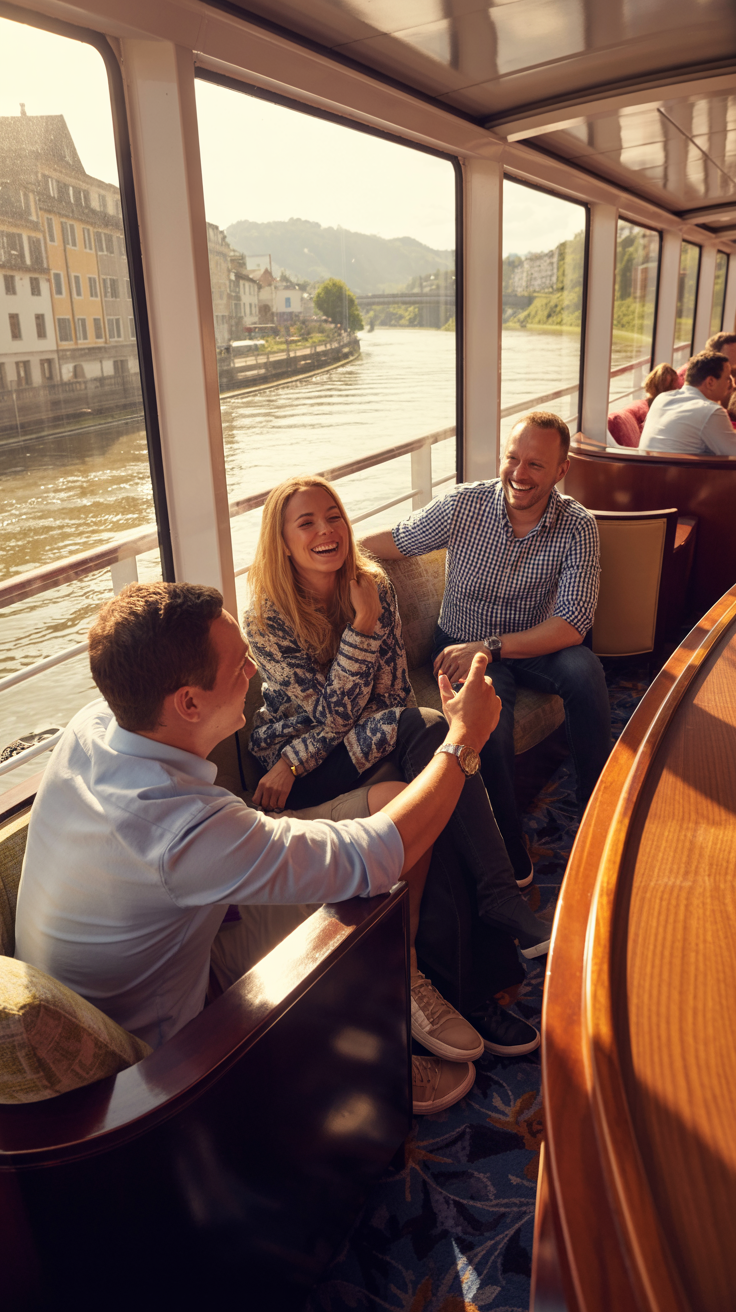
It’s not that ocean ships are unfriendly, it’s that they’re too big to feel naturally social unless you actively seek it out. River ships remove that barrier entirely. For solo travellers who want easy opportunities to make friends on solo cruises without forced activities, river cruising is a comfortable middle ground.
- You’ll see the same people every day: With only 100–200 guests, you’re not constantly surrounded by strangers. By the second evening, you’ll recognise half the ship. By the third, you’ll have your preferred dining companions.
- Shared excursions create natural bonds: You’re all getting off in the same medieval town, all visiting the same vineyard, all sitting through the same local folk performance. It’s easy to share a laugh, compare notes, or suggest grabbing a coffee together.
- Lounge culture is real: Unlike ocean ships where public spaces are vast and impersonal, river ships have cosy lounges where people actually linger. Pre-dinner drinks, post-excursion debriefs, and evening talks all happen in the same room, making it hard not to chat.
- Less age-segregated: River cruising attracts a wider age range than you might expect. Yes, there are plenty of retirees, but also younger professionals, solo travellers over 50, and solo travellers over 60 who are active, curious, and up for conversation.
The structure of a river cruise naturally facilitates connection without ever making you feel like you’re being herded into a “singles group.” You’re just part of the ship’s community, full stop.
Best River Cruise Regions for Solo Travellers
Not all river itineraries are created equal when you’re travelling alone. Some regions lend themselves better to solo exploration, social onboard culture, and manageable logistics.
Europe: The Classic Choice
The Danube, Rhine, and Seine dominate the European river cruise market for good reason. They’re well-trodden, easy to navigate, and packed with cultural stops that feel accessible even if you’re on your own.
- Danube (Vienna to Budapest, or longer): High concentration of solo-friendly lines running waivers or reductions. Cities are compact, English is widely spoken, and there’s a strong café culture that makes solo exploration comfortable.
- Rhine (Amsterdam to Basel): Castles, vineyards, and Christmas markets (if you’re sailing in late autumn). Very social onboard vibe, with wine tastings and group excursions that naturally bring people together.
- Seine (Paris to Normandy): Shorter itineraries, often six to eight nights, making it a good first-timer option. Paris is a strong draw, and the smaller French towns along the route are easy to explore independently.
European river cruises tend to attract a mix of first-timers and repeat cruisers, which creates a welcoming, non-cliquey atmosphere. If you’re new to small ship cruising, Europe is the easiest entry point.
Mekong: For the More Adventurous
If you’ve done Europe or you’re simply after something more off-piste, the Mekong (Vietnam and Cambodia) offers a quieter, more immersive experience. Ships are even smaller, often under 50 guests, and the pace is slower.
- Aqua Expeditions runs solo-traveller specials on Aqua Mekong sailings, with waivers on designated cabins. The ships are boutique, the itineraries are deeply cultural, and the guest mix tends to skew towards independent, curious travellers.
- Less polished, more authentic: You’re visiting floating markets, rural villages, and temples with minimal tourist infrastructure. If you’re comfortable with that, the social atmosphere onboard is incredibly warm.
The Mekong isn’t for everyone, but if you’re someone who thrives on exploration and prefers substance over polish, it’s worth considering.
Other Regions Worth Noting
- Douro (Portugal): Wine-focused, relaxed, and increasingly popular with solo travellers. Ships are small, the scenery is glorious, and Porto is a fantastic city to bookend your trip.
- Rhône (Southern France): Similar vibe to the Seine, but warmer, sunnier, and with a Provençal flavour. Good for foodies and wine lovers.
- Egypt (Nile): More traditional tourist trail, but the ships are small and the history is staggering. Solo-traveller deals are less common here, but if you can find one, it’s a memorable trip.
What to Expect Onboard as a Solo Traveller
River ships are not party boats. They’re also not silent floating libraries. The vibe sits somewhere in between: sociable but calm, engaged but not rowdy.
- Dining is communal or semi-communal: Most river ships use open seating, meaning you can sit where you like. Some assign tables for the duration of the cruise, which can be a blessing (instant dinner companions) or a curse (if your tablemates are dull). If you’re assigned, you can usually request a move after the first night.
- Dress code is smart-casual: No formal nights, no tuxedos. Think clean jeans and a nice shirt, or a dress and flats. You’re not underdressed if you skip the jewellery.
- Entertainment is low-key: Expect local musicians, historians giving talks, or wine tastings. No comedy shows, no casinos, no pool parties. If you’re looking for the benefits of cruising for solo travellers without the noise, this is it.
- Cabins are smaller but functional: River ships are narrow by necessity, so cabins are compact. Most have a French balcony (floor-to-ceiling window that opens) rather than a walk-out balcony. Storage is limited, so pack light.
The overall feel is more boutique hotel than resort. If you value quality over quantity, you’ll feel right at home.
Practical Tips for Solo River Cruising
- Book early for the best solo deals: Single-supplement waivers are capacity-controlled. The sooner you book, the more likely you are to snag one.
- Join group excursions, at least at first: Even if you prefer independent travel, the included shore excursions are an easy way to meet people. You can always peel off and explore solo later in the trip.
- Bring a refillable water bottle: River ships often have water stations, and you’ll be doing a lot of walking in ports. Staying hydrated without buying bottled water constantly is a small but meaningful saving, and a collapsible water bottle takes up minimal space in your cabin or day bag.
- Pack layers: European rivers can be chilly in spring and autumn, even if the days are warm. A lightweight jacket that packs down small is essential for evening deck time.
- Don’t over-plan your free time: River itineraries are packed. If you try to squeeze in extra sightseeing on top of included excursions, you’ll burn out. Give yourself permission to skip a stop and just sit in a café.
- Ask at reception about solo meet-ups: Some ships informally organise solo-traveller gatherings, especially on sailings with a high solo guest count. It’s worth asking.
How River Cruising Compares to Singles Cruises
If you’ve been eyeing dedicated singles cruises, river cruising offers a different approach, one that’s less explicitly “singles-focused” but often more naturally social.
| Aspect | River Cruise | Singles Cruise |
|---|---|---|
| Ship size | 100–200 guests | Varies widely, often 500–2,000+ |
| Social structure | Organic, through shared excursions and lounges | Organised mixers, group activities, hosted events |
| Age range | Mixed, skewing 50+ | Depends on the cruise, can be narrower (e.g., 30s–40s or 50s–60s) |
| Cost | Often more affordable with solo waivers/reductions | Single supplements still common, though some lines waive them |
| Vibe | Intimate, cultural, low-key | Can be high-energy, party-oriented, or activity-heavy |
| Flexibility | Easy to be social or solitary as mood dictates | More pressure to participate in group activities |
River cruising suits solo travellers who want connection without commitment, who prefer conversation over choreographed fun, and who are comfortable letting friendships form naturally rather than through icebreaker games.
Common Mistakes Solo River Cruisers Make
- Waiting too long to book: Solo deals are limited and sell out quickly. If you see a waiver or reduction on your preferred itinerary, book it. Waiting rarely results in a better deal.
- Choosing the cheapest line without checking the vibe: Not all river cruise lines are equally solo-friendly. Some skew heavily towards couples or incentive groups. Read reviews from solo travellers before committing.
- Over-packing: Cabins are small, and you’ll be moving every day. Two pairs of shoes, a few layerable tops, and one smart outfit will cover you. Anything more is dead weight, and compression packing cubes can help you maximise the limited storage space.
- Skipping the lounge in the evenings: This is where the social magic happens. If you retreat to your cabin every night, you’ll miss out on the easiest opportunity to connect with other guests.
- Ignoring the single-occupancy cabin option: Some solo travellers assume these are more expensive or unavailable. In reality, on ships with dedicated single cabins, you might pay less than you would for a double cabin with a supplement.
Is River Cruising Right for You as a Solo Traveller?
River cruising isn’t a universal solution. It works brilliantly for some solo travellers and feels wrong for others. You’ll thrive if you value cultural immersion over entertainment, if you prefer smaller social settings over big-ship anonymity, and if you’re comfortable with a slower, more deliberate pace.
You might struggle if you need constant activity, if you prefer to control every aspect of your itinerary, or if you find small-ship dining (where you can’t easily hide) stressful. River cruising is inherently social, even when it’s not explicitly organised as such. If that sounds appealing, it’s worth exploring your options seriously.
For solo travellers who’ve felt invisible or overcharged on ocean cruises, river cruising offers a genuine alternative, one where avoiding single supplement fees is increasingly possible and where the experience itself is designed around connection, not crowds.
Common Questions
Are river cruises really more social than ocean cruises for solo travellers?
Yes, the smaller ship size and shared excursion structure make it much easier to meet people naturally. You’ll recognise faces quickly, and conversation happens organically in lounges and at meals without forced mixers.
How much cheaper are river cruises with a single-supplement waiver?
With a full waiver, you pay the per-person rate as if sharing. That can cut your total cost nearly in half compared to paying a 100% single supplement. Partial reductions (10–25% off) still offer meaningful savings.
Which river cruise line is best for solo travellers?
Tauck and AmaWaterways currently offer the strongest solo-traveller deals, with frequent single-supplement waivers or reductions. Aqua Expeditions is excellent for smaller, more adventurous itineraries. Riviera Travel is good for budget-conscious travellers.
Can I get a single cabin on a river ship?
Some ships have dedicated single cabins, but they’re limited and sell out quickly. AmaWaterways ships like AmaCello, AmaDante, AmaDolce, and AmaLyra offer these. Book early if this is a priority.
What if I don’t want to join group excursions?
You’re never forced to participate, but group excursions are included and make it easy to meet people. You can always skip them and explore independently, though you might miss the social benefits that make river cruising appealing for solo travellers.
Are river cruises suitable for younger solo travellers?
Most river cruises skew 50+, but you’ll find younger guests, especially on European itineraries. If you’re comfortable being in the minority age-wise and value culture over nightlife, you’ll likely enjoy it. Mekong sailings tend to attract a slightly younger, more adventurous crowd.
Do I need travel insurance for a river cruise?
Absolutely. Medical emergencies, trip cancellations, and missed connections all happen. River cruises often operate in remote areas where medical care can be limited, making comprehensive travel insurance essential for solo travellers.
How far in advance should I book to get a solo deal?
Six to twelve months is ideal for securing single-supplement waivers or reductions. Last-minute deals occasionally appear, but availability is unpredictable and you risk missing out on popular itineraries or preferred cabin categories.
What’s the food like on river cruises?
Generally very good, with regional menus that reflect your itinerary. Dining is less formal than ocean cruising, with open seating and a focus on local wines and ingredients. Dietary requirements are usually well accommodated if you notify the line in advance.
Why Trust About2Cruise
We’ve spent years researching and experiencing river and ocean cruising from a solo traveller’s perspective, tracking which lines genuinely support solo guests and which just pay lip service. Our team includes solo cruisers who’ve navigated the single-supplement maze on both rivers and oceans, and we update our advice based on current offers, not outdated assumptions. We don’t take payments from cruise lines for any of our advice.