
Riviera River Cruises is the river cruising arm of Riviera Travel, a UK operator known for packing return flights, full-board dining, an included drinks package, guided excursions and transfers into a single fare. Its European ships carry between 114 and 178 guests, there is no enforced dress code, and solo travellers get dedicated departures and a generous no-single-supplement programme. Here’s how it all works in practice.
What Is Riviera Travel Like? A Quick Overview
Riviera Travel is a British operator based in Burton-on-Trent. It has been in business since 1984 and running river cruises since 2009. It now markets itself as the UK’s leading river cruise operator, and its river fleet operates with Swiss partner Scylla.
Which? has rated Riviera a Recommended Provider for river cruises and cultural tours for 14 years running. The line regularly wins or places in awards as a best-value river cruise line. The atmosphere is unashamedly geared to British passengers aged 50-plus, though Riviera itself says the age mix runs from travellers in their 30s to passengers in their 80s.
Riviera Travel also sells escorted tours and no-fly ocean cruises, so the river product sits alongside a much larger touring operation. The key pitch is simple: the fare bundles in flights or rail, transfers, full board, drinks across much of the day, one or more included shore excursions in most ports, Wi-Fi and port charges. It is not full luxury in the sense of included gratuities, butlers and unlimited premium alcohol, and it doesn’t pretend to be. Passengers repeatedly describe it as a strong four-to-five-star experience at a price that undercuts the better-known luxury river brands.
Riviera River Cruise Ships: Classes, Names and Passenger Numbers
Riviera operates a young and increasingly standardised fleet around Europe. The newest ships fall into the 135-metre Radiance class, while the older writer-named ships remain well regarded and widely used across the Rhine, Danube, Main and Moselle. Smaller ships serve the Douro, Seine and Rhône. Riviera doesn’t publish one tidy fleet table, and capacities vary slightly between official pages and third-party databases, but in practice you’re looking at ships carrying roughly 114 to 178 passengers.
Radiance Class Ships
The newest Riviera ships are MS Riviera Radiance, MS Riviera Resplendence, MS Riviera Reflection and MS Riviera Rhapsody. They are 135 metres long, carry around 178 guests and 44 crew, and have 89 cabins. More than 80% of cabins and suites on these ships have a French balcony or full balcony.
Facilities include a main restaurant, Riverview Kitchen, a speciality restaurant, a Panorama Lounge and Bar, a spa and wellness area, a splash pool and a boutique. A lift connects the three internal decks but not the sun deck. The Radiance class was designed to qualify for the Gold Standard of the Green Award programme.
Writer-Named Ships
Riviera’s classic vessels are named after British literary figures. The main group includes MS Charles Dickens, MS Emily Brontë, MS Geoffrey Chaucer, MS George Eliot, MS Oscar Wilde, MS William Shakespeare and MS William Wordsworth. Most of these carry around 169 guests and 44 crew across 88 suites and are 442.9 feet long.
MS Jane Austen carries 140 guests on the Seine, while MS Lord Byron and MS Thomas Hardy work the Rhône and Saône. These are all-suite ships. Each suite has twin beds that convert to a double, an en-suite with a rain shower, air-conditioning, a safe, a mini fridge, tea and coffee making facilities, a TV and a hairdryer. Lower-deck suites have fixed windows; middle and upper deck suites have floor-to-ceiling sliding doors opening to a French balcony.
Douro, Seine, Rhône and Mekong Ships
On the Douro, Riviera runs MS Douro Elegance, MS Douro Splendour, MS Porto Mirante and MS Riviera Rose. Riviera Rose is the smallest European vessel at 114 guests. The Seine operation centres on MS Jane Austen, while MS Lord Byron and MS Thomas Hardy serve the Rhône and Saône. In Asia, Riviera operates RV La Marguerite and the 50-guest MS Riviera Alba on the Mekong. The line has said it plans to grow to 26 ships within five years.
A Note on Capacity Confusion
You may see small discrepancies when researching ships. MS Oscar Wilde is listed as 167 guests on Riviera’s own page but 169 in most fleet databases. Some Radiance-class listings say 176 guests rather than 178. None of these differences changes the on-board experience in any meaningful way. The practical takeaway is that even the largest Riviera ship carries far fewer passengers than a 190-guest Viking Longship at a similar length.
Choosing a Cabin on a Riviera River Ship: Decks and Room Types
Choosing the right cruise cabin on a river ship is simpler than on an ocean liner, but deck choice does matter.
Riviera uses a gemstone naming system across most of the fleet: Diamond Deck is the upper deck, Ruby Deck is the middle deck, and Emerald Deck is the lower deck. Diamond and Ruby cabins generally have French balconies, while Emerald Deck cabins have fixed windows.
On the Radiance class, Grand Suites measure 32 square metres with a separate living space and full balcony. Superior Suites measure 24 square metres with a French balcony, and standard double cabins measure 16 square metres. On the writer-named ships, standard suites start at about 17 square metres, Superior Suites at 23 square metres, and Deluxe Balcony Suites at 25.5 square metres with a private balcony.
Riviera’s own guidance is that cabins towards the middle and front of the ship are less affected by noise when the vessel manoeuvres or docks, while rear cabins can hear more engine and thruster activity. The sun deck on most Riviera ships is reached by stairs only, so if you have any difficulty with steps, a middle-deck cabin near the lift still leaves you one floor below the open air.
Every cabin has UK plug sockets, and the newest ships also have USB charging points. A continental breakfast can be delivered to your cabin, which is a nice touch for early-morning sail-throughs such as the Rhine Gorge.
What’s Included on a Riviera River Cruise: and What Costs Extra
Riviera’s full-board river product includes far more than most UK travellers expect from a cruise fare.
Included in the fare:
- Return flights from up to 17 regional UK airports with no regional supplements, or rail travel on selected itineraries
- Transfers between the airport or station and the ship
- Full-board dining
- A drinks package from 10am until midnight
- Included shore excursions with local guides
- Wi-Fi, port charges and taxes
- A Cruise Director and Cruise Host
- 20kg or more of checked luggage
The automatic drinks package covers house wines, including non-alcoholic options, draught beers, soft drinks and juices, a cocktail and mocktail of the day, house spirits and mixers, and tea and coffee from the bar.
What you pay for separately matters just as much. Gratuities are discretionary, with a suggested guideline of €8–12 per person per day, left in an envelope in your cabin on the final evening. Knowing the norms for tipping on your cruise holiday is worth doing because it’s easy to forget this cost.
Travel insurance is a condition of booking and is not included. Spa treatments, laundry, most optional excursions, drinks outside package hours and premium spirits beyond the package list are paid separately. Museum entrance fees on included excursions are usually not included, so ask before you assume a gallery or château interior is covered.
Food and Drink on Riviera River Cruises
Breakfast is a substantial buffet with more than 60 options, eggs cooked to order and a continental breakfast available in your cabin. Lunch is also buffet-style, with soup, a served main course and a pasta station. Dinner is a four-course à la carte affair with open seating rather than fixed tables. You sit where you like and with whom you like, which is one of the small social freedoms river cruisers love.
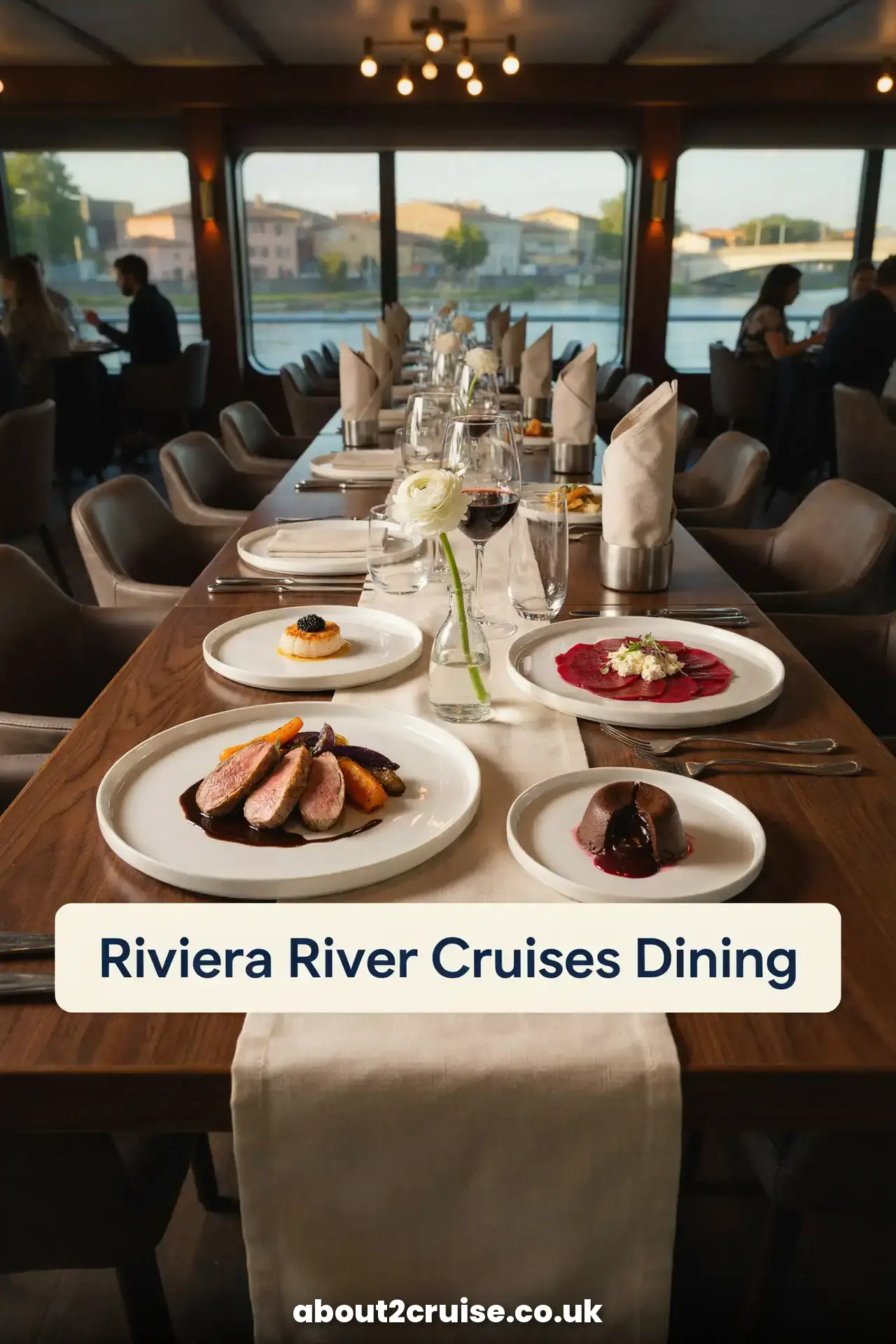
Onboard dining is one area Riviera passengers consistently praise, particularly the Riverview Grill on the newest ships. One reviewer singled out the Riverview Grill for amazing food and service in a direct comparison with Viking.
The drinks package officially runs from 10am to midnight, but several reviewers report no bar service in the afternoon and a limited cocktail list. The cocktail of the day is included; other cocktails are generally chargeable at around €9. If you care about fine wine or single malt, budget for it.
Vegetarian, vegan, gluten-free and low-sugar diets are catered for with advance notice, and some ships show allergen numbers on menus. The on-board currency is the euro, settled at the end of the cruise by Visa, Mastercard or Maestro. American Express is only accepted on MS Douro Elegance and MS Douro Splendour. Cheques and prepaid cards are not accepted.
Take some euros in cash ashore, because public toilets often need coins and some places in Europe are cash-only. There are no doctors on any Riviera river ship. Some crew have basic first aid training, and the ship can stop to transfer a passenger to local medical facilities if needed. This is one of the most important bits of pre-cruise knowledge for UK travellers used to ocean ships with an onboard medical centre.
Riviera River Cruise Dress Code: Smart Casual, No Black Tie
Let’s settle this directly, because it’s the single most searched thing about Riviera river cruises. There is no formal dress code and no enforced black-tie night.
The official standard is smart casual for both day and evening. Men are asked not to wear shorts for dinner, and vest tops are not worn in the dining room at any time. A jacket and tie are optional and, frankly, the minority choice.
The Chef’s Dinner is the one evening passengers tend to dress up for, along with welcome drinks and the captain’s gala dinner, but nothing is compulsory. If you own cruise formal night outfits, you can leave the tuxedo at home. A smart dress, tailored trousers or a collared shirt will never feel out of place.
Ashore, comfortable shoes are the priority because old-town streets are cobbled and often involve steps. In churches and religious sites, covered shoulders and knees are the usual expectation, so a light wrap or scarf earns its suitcase space.
What’s On in the Evening on a Riviera River Cruise?
Riviera does not promise theatre, casinos or production shows, and it does not have them. Entertainment is lounge-based and deliberately low-key.
A daily programme is delivered to your cabin each evening, listing the next day’s activities. Evenings revolve around the lounge. Local performers come on board, a German trio here, a Hungarian folklore show there, a classical quartet in Vienna, alongside quizzes, enrichment talks on regional history and culture, and occasional tastings. On Radiance-class ships the lounge seats 178 passengers and is the entertainment hub. Some writer-named ships have a resident pianist.
The ship often stays moored late into the evening or overnight in port, which means the best evening entertainment may simply be a post-dinner stroll ashore to a cobblestoned square empty of day-trip crowds.
If you’re expecting West End spectacle, a river cruise will not deliver it. If you want a glass of included wine, a quiz, a local accordionist and a moonlit walk, Riviera does this well. The honesty of that trade-off is worth understanding before you book.
Riviera Shore Excursions: How Included Tours Work
Riviera includes guided excursions with local guides on most days of a cruise, and on many days there is a choice of options. Passengers are asked to choose their preferred included excursion at least four weeks before departure, so there’s a small planning task ahead of travel.
Participation is always optional. You may stay on board, wander independently or book an optional excursion instead. The included excursions are the same product Riviera sells as its tour programme backbone, so organisation is generally smooth.
Museum entrance fees are usually not included, so if you’re joining an included excursion that stops at a castle or gallery, budget a little extra or confirm before you leave. Optional extras vary: an Austrian lunch in Salzburg at around £65 per person, a Côa Valley 4×4 tour from £76 per person, a Bateaux Parisien cruise at about £17 per person. The line also offers a collection of exclusive included experiences branded The Riviera Moment, designed to give passengers something they couldn’t easily arrange themselves.
Riviera Itineraries: Danube, Rhine, Douro, Seine and More
The flagship product is The Blue Danube, an eight-day round-trip from Budapest calling at Esztergom, Bratislava, Dürnstein, Melk, Linz or Salzburg and Vienna, with nine included experiences.
The Rhine Cruise to Switzerland runs from Cologne to Basel through Strasbourg, Speyer, Breisach, the Black Forest, Lucerne, Rüdesheim and the Rhine Gorge. On the Douro, the Douro, Porto and Salamanca itinerary includes Porto’s port lodges, Pinhão, Castelo Rodrigo, Salamanca with a flamenco lunch, Mateus Palace or the Douro Museum, dinner at Quinta da Pacheca, Lamego and a Portuguese folk music performance on board.
The Seine itinerary covers Paris, Rouen, the D-Day sites and Normandy beaches, Honfleur or Étretat, Monet’s house and gardens at Giverny, La Roche-Guyon and Versailles.
Festive Christmas market cruises run from four to eight nights on the Rhine and Danube in November and December. Short-break offerings start at three or four nights. The Amsterdam, Kinderdijk and Dutch bulbfields sailing is four nights, and a three-night Rhine Gorge & Cologne Discovery cruise is advertised from £999 per person.
For longer trips, back-to-back grand cruise itineraries run from 14 to 29 nights, including Budapest to the Black Sea and a 14-night Grand Cruise of France. Three-night city extensions bolt on before or after in Budapest, Vienna, Porto, Lisbon, Zermatt, Lake Geneva or Amsterdam. Cruise & Stay packages add a three-night hotel stay with transfers, daily breakfast and drinks on the cruise.
If you’re weighing a European river cruise against Mediterranean cruises, the decisive difference is city-centre docking and unpacking once versus a new port almost daily with a moving hotel.
Solo River Cruises with Riviera: No Single Supplement Explained
Riviera is unusually good at solo travel. Solo guests get their own double-occupancy cabin with no single supplement on selected departures, and the line runs more than 20 dedicated solo departures a year, mostly in shoulder seasons. The programme is designed with the pace and preferences of travellers aged 50 and above in mind, though all ages are welcome.
Solo guests are met at the UK departure airport and helped through check-in, and there is a welcome drink and dinner to break the ice on night one.
The big news is MS George Eliot, which Riviera is converting into what it calls the world’s first river cruise ship dedicated entirely to solo travellers. Every cabin will be for one guest, with no sharing and no supplement, across a full season of solo departures on the Rhine, Moselle and Danube. Solo travellers are not matched with a roommate on the solo ship; even friends travelling together each book their own cabin.
The line has also expanded no-single-supplement cabins on The Blue Danube, Cruise the Heart of Europe, Rhine, Moselle & Medieval Germany, The Douro, Porto & Salamanca and The Seine, Paris & Normandy. This fits squarely into the broader world of singles cruises over 50. If you’re a solo traveller over 50 considering Riviera, you’re looking at one of the better no-supplement programmes in the river sector.
How Much Does a Riviera River Cruise Cost? Real Prices and Extras
Riviera advertises competitive lead-in prices, but you should never read the from-price as the final cost.
Example starting prices:
- Three-night Rhine Gorge & Cologne Discovery: from £999 per person including flights or Eurostar
- Four-night Amsterdam, Kinderdijk and Dutch bulbfields: from £1,399 per person
- Eight-day Blue Danube: typically from £1,949 per person
- Eight-day Rhine Cruise to Switzerland: from £1,999 per person
- Seven-night Douro, Porto and Salamanca: from £2,199 per person in a river-view cabin, with suites from £3,649
- Seven-night Seine, Paris & Normandy: from £2,599 per person
- Ten-night Seine cruise: from £4,549 per person
- Fourteen-night Grand Cruise of France: from £3,749 per person
- Fourteen-night Budapest to the Black Sea: from £5,299 per person
- Solo departures, such as The Blue Danube for solo travellers: typically from £2,749 per person
On top of the headline fare, budget for travel insurance, gratuities of €8–12 per person per day, optional excursions, drinks outside the package, spa treatments, laundry and any museum entry fees. A realistic per-person extra cost for a seven-night cruise is £150–£250 once gratuities, a couple of optional excursions and a few paid drinks are added.
Riviera also markets 2-for-1 as 50% off brochure price on river cruises and a 2-for-1 Cruise & Stay extension where one guest’s extension is free. The UK site frequently leads with 10% off 2027 and 2028 holidays, up to £500 per person off selected festive cruises and a free drinks package.
Learning a few of the core principles of how to save money on your cruise helps here: book early for the best cabin choice, watch for solo supplement waivers if you travel alone, and remember that the lowest deck cabins on the shortest sailings are the genuinely cheap entry point.
Riviera Booking Terms: Deposits, Balance and Cancellation Policy
Standard deposits are £350 per person for European river cruises under seven nights and up to £500 per person for seven nights or more, with a promotional flat £99 per person deposit frequently available. The balance is due 101 days before departure.
Cancellation charges are the deposit if you cancel more than 101 days out. After that they escalate: 50% at 100–61 days, 70% at 60–31 days, 90% at 30–15 days and 100% at 14 days or fewer.
Riviera has a quality promise to price-match an equivalent holiday found cheaper within 48 hours of booking, and a price promise that pays a future travel voucher for the difference plus 25% if the price falls after booking. Its Happiness Guarantee brings a customer home with a full refund if they are not happy by day two.
Fly-cruise holidays are ATOL-protected under Riviera Travel’s ATOL 3230. Cruise-only holidays are ABTA-protected. The line operates 24/7 UK-based support before and during a holiday, which matters when rivers misbehave.
Low Water on the Rhine and Danube: Riviera’s River Cruise Assurance
Low water on the Rhine and Danube is a genuine late-summer risk, and Riviera is more transparent about it than many river lines.
The line’s European River Cruise Assurance automatically compensates for each complete 24 hours affected, by cabin grade: lower deck £80, middle deck £100, upper deck £120, and superior and deluxe suites £140 per person.
To keep a holiday going, the line may stay moored an extra night, run coach excursions of no more than two hours each way, or swap ships with a coach transfer of no more than four hours. If a holiday is cut short, Riviera refunds pro rata for each full 24 hours lost.
If a significantly disrupted cruise cannot be replaced with an equivalent, it is cancelled. The customer is contacted at least 48 hours before departure where possible and given a full refund. Affected passengers can rebook like-for-like at no extra cost, transfer to another holiday with any fare difference refunded or a £250 per person contribution if the new trip costs more, or take the full refund. Customers who choose not to transfer receive a goodwill Welcome Home offer of 15%, rather than the standard 10%, valid for six months against a future European river cruise.
The line has paused sales of some Rhine and Danube departures rather than sell holidays it cannot deliver as advertised, and it publishes a River Cruise Update Centre with a 72-hour outlook plus a dedicated Facebook group for low-water updates. Passengers due to travel on the Rhine, Moselle, Danube or Main receive structured updates around 14 days, 7 days and 72 hours before departure.
The Five-Point Promise commits the line not to replace large sections of a river journey with repeated long coach journeys, to communicate personally, to offer choice on significant changes, and to operate only when it can deliver the booked experience. Compensation does not apply where delay is caused by civil or military hostilities.
Getting to Your Riviera River Cruise: Flights, Rail and Transfers
Unlike ocean cruises that depart from UK ports, Riviera’s European river cruises begin at Continental ports reached by included flights or rail.
Return flights from up to 17 UK airports are included with no regional supplements, and selected itineraries offer Eurostar and TGV with regional rail options instead of flying. Transfers between the airport or station and the ship are included. Coaches typically transfer passengers from Düsseldorf airport to the ship in about 20 minutes, or from Cologne airport in about 70 minutes.
Riviera also sells cruise-only versions of its river cruises for travellers who prefer to arrange their own positioning. This is a different animal from cruises from UK ports like Southampton or Tilbury, where you drive to the ship. If you’re searching for a no-fly river cruise from a UK port, you won’t find it with Riviera: and, outside a handful of Thames or ferry products, you won’t find it with any major river operator.
Accessibility and Mobility on Riviera River Ships
The minimum age on Riviera river cruises is 12 at departure, and any minor must share a cabin with an adult aged 21 or over. That’s notably higher than Avalon, AmaWaterways and Uniworld, which tells you something about the target market. This is an adult product, and the line does not pitch itself at families. Solo departures are designed for travellers 50 and above, but all ages are welcome.
For mobility, the honest reality is that Riviera ships are not adapted for wheelchair access. Wheelchairs or mobility scooters cannot be used on board for safety reasons and must be stored in the cabin. Passengers must be able to walk on and off the ship themselves, because gangplanks can be at a steep angle and ships often moor alongside each other. Disembarking can involve walking across gangplanks and another ship’s sun deck.
Shore excursions involve cobbled streets on an incline. A travelling companion is expected to help with any physical needs, because river crews are much smaller than ocean crews. If you have limited mobility but can manage a few steps with a companion, the Douro and Dutch waterways tend to be gentler than the hilltop villages of the Rhine and Moselle, though Riviera does not publish a formal accessibility grading by itinerary.
Best Time to Cruise with Riviera: Weather, Seasons and Packing
European river cruises run from spring to autumn, with festive market cruises in November and December. The sweet spot for warm-but-not-scorching cruising is May, June and September.
Cologne averages a July daytime high of about 23°C, Budapest around 27°C and Porto about 24°C with very little rain. December on the Rhine and Danube is cold, Cologne averages 6°C with rain on around 12 days, so Christmas market cruises demand layers, a waterproof, warm gloves and a hat.
Low water on the Rhine and Danube is a late-summer risk, with the Rhine Gorge and the stretch above Cologne the pinch points. The Douro, Seine and Rhône have been the rivers least affected when the Rhine and Danube have been disrupted.
Some cruise ship tips and tricks are universal: pack in layers rather than bulky coats, bring comfortable shoes with grip for cobblestones, and carry a small daypack for excursions. Unless you’re on a Christmas sailing, a light waterproof beats an umbrella for spring and autumn sailing.
Travel Insurance, Passports and ETIAS for Riviera River Cruises
Travel insurance is a condition of booking with Riviera, so arrange it at the time you pay the deposit if you can.
A UK Global Health Insurance Card or EHIC is advised alongside insurance, but it’s only valid in the 27 EU countries and not in Iceland, Liechtenstein, Norway or Switzerland. For the EU and Schengen area, a UK passport must have been issued less than 10 years before entry and be valid for at least three months after the planned return date. UK travellers can stay 90 days in any 180 in the Schengen area without a visa.
ETIAS is being introduced for visa-exempt visitors to 30 European countries. It will cost €20 for adults aged 18–70, be free for under-18s and over-70s, be valid for three years, and be checked before boarding a plane, cruise or UK-departing train. Riviera river cruises call at ports where UK citizens do not need a visa, but passport validity is non-negotiable. Check your expiry date before you get excited about a 2027 sailing that requires a passport valid through autumn 2027.
Riviera River Cruise Reviews, Awards and Common Complaints
Riviera sweeps up awards and mostly earns them. Which? rates it a Recommended Provider for river cruises and cultural tours 14 years running and names it best-value river cruise line. Condé Nast Traveler has ranked it in the top five river cruise lines, and it holds World Cruise Award titles for World’s Best River Cruise Line and Europe’s Best River Cruise Line.
Feefo shows 4.6/5 for service and 4.5/5 for product over the past year. Cruise Critic’s cruiser rating is 4.0 out of 5 from 66 reviews, described as Very Good. Independent editorial scoring gives Riviera the best value score of the rated river lines, 5.0 out of 5, with an overall 3.8. Trustpilot shows 4.7/5.
Reviewers consistently praise the crew, the food and the ships’ cleanliness and comfort. One reviewer on a lower Danube cruise called the food awesome; a first-time cruiser in her 70s said the cruise exceeded all expectations.
The most frequently repeated complaints are that food is not always hot, drinks service is limited outside package hours, evening entertainment is sparse, showers on older ships are small, and vegetarian options can be patchy. Some passengers say the on-board Riviera staff were less visible and less organised than the ship’s crew. A reviewer comparing Riviera with Viking said Riviera has some improving to do but singled out the Riverview Grill for excellent food and service.
The balanced verdict from most passengers: think of it as a strong four-star product at a fair price, not five-star luxury at a discount.
River Cruising vs Ocean Cruising: What to Expect
If you’re new to cruising or coming from an ocean ship, the differences are stark.
River ships carry 100–200 passengers compared with thousands on ocean ships. There is no theatre, casino, climbing wall or big-ship entertainment. There is no tender process, because river ships dock directly in city centres and villages: you step off and you’re there.
This is small ship cruising at its most intimate, and that intimacy reshapes the social experience. You will know most of your fellow passengers by day three. Meals are at set times rather than all-hours. There’s no sea day, and the scenery is the entertainment for much of the journey.
If you need constant programmed activity, a river cruise will feel slow. If you want a floating country hotel that docks in the heart of Europe’s most beautiful towns, this is the right product.
How Riviera Compares to Viking, Avalon and AmaWaterways
Comparing cruise lines like these is about price, inclusion and on-board atmosphere.
Viking Longships carry about 190 guests and include one excursion in every port plus beer and wine with meals. Viking is adults-only from 18. Avalon Waterways ships carry 128–166 guests, and AmaWaterways averages about 156 guests.
Riviera’s newer 135-metre ships carry 178 guests, fewer than a Viking Longship of similar length, which translates to more space per passenger on paper. Riviera is usually the value play. Its fares include more excursions and a broader drinks package than Viking includes, but Viking has a more polished on-board aesthetic.
Avalon and AmaWaterways generally sit above Riviera on luxury and price, while Riviera wins on value and on its no-single-supplement programme, which is more generous than anything Viking offers. AmaWaterways and Uniworld consistently outrank Riviera in published luxury rankings, but Riviera’s value score is unmatched. The right choice depends on whether you’re buying comfort or buying luxury.
Short River Cruise Breaks from the UK: Riviera Options
Riviera markets three- and four-night European river cruises as a short-break introduction, and the three-night Rhine sailing from Cologne with flights or Eurostar included is advertised from £999 per person. That’s a four-day round trip, ideal for a first taste.
Overnight river cruising within the UK itself is limited. Thames options are mostly day cruises, with European Waterways’ eight-passenger hotel barge Magna Carta as the principal overnight exception. Self-drive Thames boating holidays are available from operators such as Le Boat and Kris Cruisers on three- and four-night breaks, but these are self-catering boats, not a crewed river cruise product.
If you want a UK short-break river cruise with a crew, dining and daily sightseeing, your realistic choice is a short European river sailing like Riviera’s Rhine Gorge product or a hotel barge.
Not That Riviera: Oceania, Ferries, Tilbury and Other Queries
This page attracts several searches that belong elsewhere, and it’s worth clearing them up.
Oceania Cruises sails a 1,250-guest ocean ship also called Riviera. That 66,084-gross-tonnage vessel has 11 guest decks and 800 crew, and it’s completely unrelated to Riviera Travel’s river ships.
P&O Cruises’ Azura carries 3,100 passengers and is an ocean ship. The New Camellia is an overnight ferry between Fukuoka and Busan with dormitory berths and private cabins: a ferry, not a cruise. Tilbury departures are Ambassador Cruise Line’s adult-only no-fly ocean sailings, with Ambience carrying around 1,400 guests and Ambition around 1,200.
Riviera does not sell long-term residential cruise living. Its longest European product is back-to-back grand cruise itineraries of up to 29 nights. If you searched for any of those, you now know where they stand.
Frequently Asked Questions about Riviera River Cruises
Is Riviera Travel going bust?
There is no evidence of that. Riviera Travel generates more than £255 million in annual revenue and is about half river cruise and half escorted tours. Private equity owner Silverfleet Capital, which has backed the business since 2017, appointed advisors in 2026 to review strategic options, which could include a sale, but no buyer or change of ownership has been announced. The business is operating normally, taking bookings for 2027 and 2028, and its ATOL and ABTA protections remain in place. If you’re worried, book a fly-cruise package for ATOL protection and pay by credit card for extra Section 75 protection.
Are there doctors on board Riviera river ships?
No. There are no doctors on any Riviera river ship. Some crew have basic first aid training, and the ship can stop to transfer a passenger to local medical facilities if needed. This is standard for the river sector, even luxury river lines rarely carry a doctor, but it differs from ocean cruise ships, which have onboard medical centres. If you have a medical condition, talk to Riviera before booking and make sure your travel insurance covers pre-existing conditions and European medical care.
Can I book Riviera river cruises without flights?
Yes. Riviera sells cruise-only versions of its river cruises as well as fly-cruise packages. Cruise-only bookings are ABTA-protected rather than ATOL-protected, so the financial protection mechanism changes. Cruise-only can make sense if you live near the embarkation port, want to use frequent flyer points, or plan a longer European rail journey of your own. On the full package transfers are included; for cruise-only, you make your own way to the ship and back.
What is ETIAS and when does it affect UK river cruisers?
The European Travel Information and Authorisation System is a new digital check for visa-exempt visitors to 30 European countries, including the EU and Schengen area. It will cost €20 for adults aged 18–70, be free for under-18s and over-70s, and be valid for three years. It is not a visa: it’s a quick online authorisation checked before boarding a plane, cruise or UK-departing train. UK citizens do not need a visa for Riviera’s European river ports, but once ETIAS is live you will need an ETIAS before travelling. Apply online on the official EU site, not through third-party agencies that charge fees.
What currency is used on board and how do I settle my account?
The on-board currency is the euro, and accounts are settled at the end of the cruise. Visa, Mastercard and Maestro are accepted on all ships; debit cards are accepted on most. American Express is only accepted on MS Douro Elegance and MS Douro Splendour. Cheques and prepaid cards are not accepted. Settle your account on the final evening or morning of departure, and take euros in cash for use ashore.
Do children sail on Riviera river cruises?
The minimum age is 12 at departure, and any minor must share a cabin with an adult aged 21 or over. It is not a family cruise product: there are no kids’ clubs or child-focused facilities. Solo departures are designed for travellers aged 50 and above, and the entire brand skews strongly to an adult audience. If you’re looking for a family river cruise, Avalon, AmaWaterways and Uniworld are all more permissive.
Last Updated: 20 November 2026