
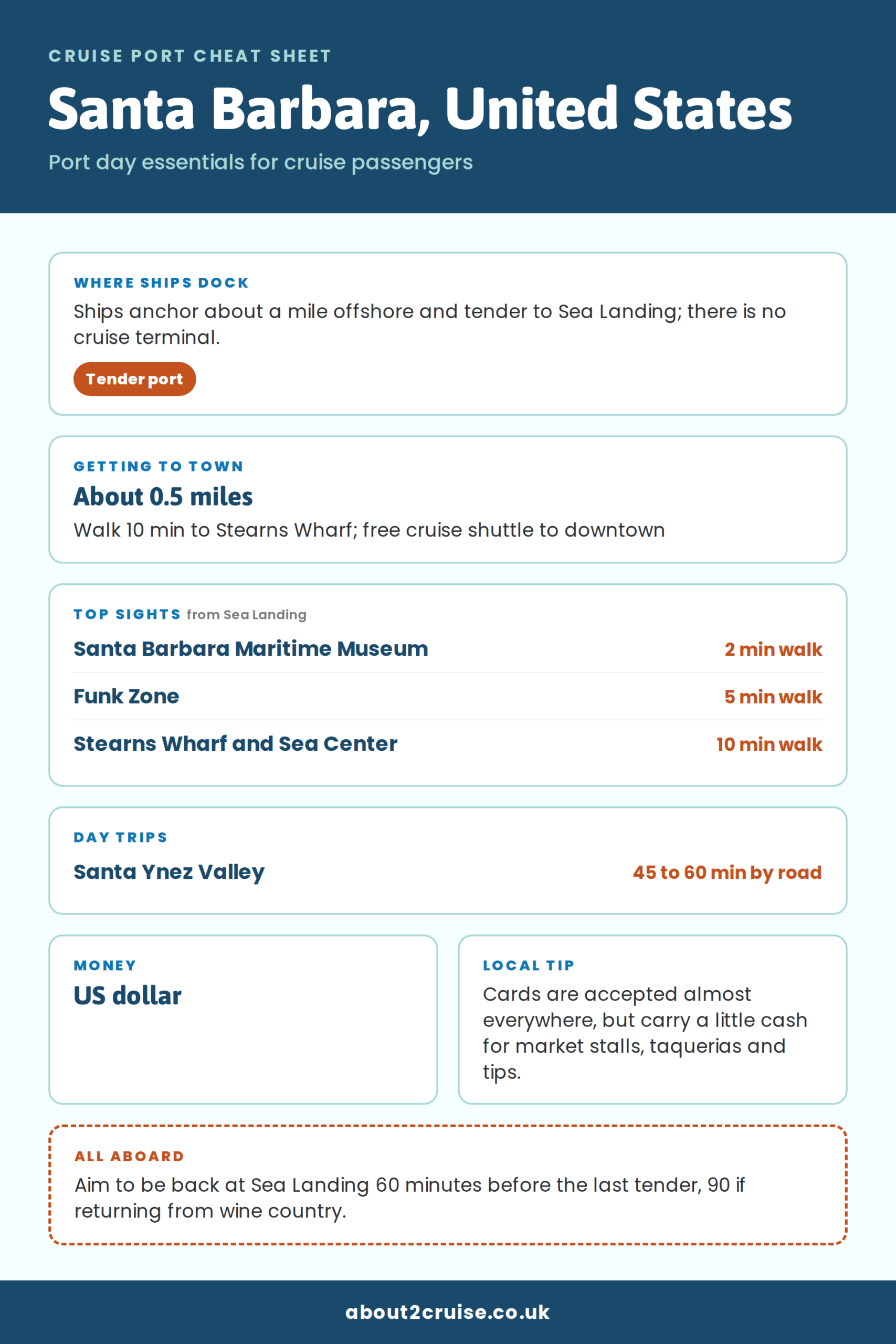
Santa Barbara is a tender port, not a dock: ships anchor about a mile offshore and send passengers ashore to Sea Landing beside Santa Barbara Harbor. There is no cruise terminal. You get the American Riviera, Spanish architecture, Stearns Wharf, the Funk Zone wine trail and the Old Mission, compact enough for a brilliant 4–7-hour port day.
Why Cruise Lines Stop in Santa Barbara
Santa Barbara wears the “American Riviera” nickname well. The city sits between the Santa Ynez Mountains and the Pacific, with a Mediterranean climate, whitewashed Spanish-style buildings, red-tile roofs, and a long palm-lined waterfront. Cruise lines use it as a softer, smaller stop on California coastal itineraries, often paired with San Francisco, Monterey, Catalina Island, San Diego, or Ensenada.
This is not a big industrial port day. You tender into a working harbor, then walk or shuttle into a very polished small city.
Santa Barbara is also a controlled cruise destination. The city caps visits at 20 ships a year, with no weekend calls and no summer calls between Memorial Day and Labor Day. That means your visit is likely to be in spring, autumn, or winter, and the town isn’t typically overrun by cruise passengers.
Where Ships Anchor and Where You Come Ashore
There is no deep-water cruise dock and no dedicated cruise terminal building in Santa Barbara. Cruise ships anchor about a mile offshore. Passengers come ashore by tender boats that hold roughly 100 people at a time. The crossing takes about 15–20 minutes each way, depending on sea conditions. Tenders land at Santa Barbara Landing, better known as Sea Landing, at 301 W Cabrillo Boulevard, immediately west of Stearns Wharf and inside Santa Barbara Harbor.
| Tender detail | What to expect |
|---|---|
| Ship position | Anchored about one mile offshore |
| Tender landing | Sea Landing, 301 W Cabrillo Blvd |
| Crossing | 15–20 minutes each way in a boat seating about 100 people |
| Cruise terminal | None: there’s a secured hospitality area with restrooms, maps, and volunteers |
| Baggage hall | None: Santa Barbara is not a homeport |
| Last tender | Published on board: build in the crossing plus a queue |
When you arrive at Sea Landing, you enter a secured passenger staging area. It has restrooms, information booths, local volunteers, and space for pre-arranged transport. It’s welcoming and efficient, but it’s not a terminal with shops, luggage storage, or check-in desks. Think of it as a very well-organized tender dock.
Finding Your Bearings: The Waterfront Layout
Sea Landing sits at the western end of the main waterfront. From the tender gangway, the key points fan out east and north:
- Sea Landing and Santa Barbara Harbor: where you arrive; home to the Maritime Museum and a departure point for Condor Express whale watching.
- Stearns Wharf: California’s oldest working wharf, about a half-mile walk from Sea Landing. It’s the obvious first landmark and the foot of State Street.
- State Street: the main downtown axis, running north from Stearns Wharf. Lower State Street is walkable and lively. The top of downtown is roughly 2 miles from the harbor.
- The Funk Zone: a warehouse and wine-tasting district between the waterfront, the railway line, and lower State Street, directly beside the Amtrak station.
- Chromatic Gate: a 12-colour steel arch between the harbor and Stearns Wharf, one of the most photographed free pieces of public art in the city.
- Dolphin Fountain: the landmark at the start of Stearns Wharf.
The simplest way to picture it: Sea Landing is the tender dock, Stearns Wharf is the tourist pier about 10 minutes’ walk east, and State Street runs north from the wharf into downtown.
Which Ships Visit Santa Barbara and When
The official source for dates and ships is the City of Santa Barbara cruise ship schedule. It lists ship name, arrival and departure times, and passenger capacity, with the warning that times can change. If you’re trying to check “is there a cruise ship in Santa Barbara today?”, that’s the page to use.
Princess ships dominate the schedule. You may see Royal Princess, Ruby Princess, Coral Princess, Grand Princess, Discovery Princess, or Emerald Princess on the list. Holland America’s Eurodam and Virgin Voyages’ Brilliant Lady also appear on recent city schedules. Celebrity Cruises does not currently advertise Santa Barbara as an active port. Some third-party schedules show other ships such as AIDAdiva, but the City of Santa Barbara’s own list is the one that matters for an actual call.
No ships call between Memorial Day and Labor Day, and there are no weekend calls. A typical call lasts about eight hours, with arrivals normally between 7am and 8am and departures from mid-afternoon to early evening. On a classic Princess California coastal loop, Santa Barbara is often scheduled from about 7am to 4:30pm, but always check your own itinerary for the exact time.
Can You Cruise From Santa Barbara? No, It’s a Port of Call
Cruises do not begin or end in Santa Barbara. There is no terminal, no check-in facility, no long-term cruise parking operation, and no baggage hall. Coastal itineraries that include Santa Barbara almost always start and end in Los Angeles, San Francisco, San Diego, or Vancouver. In a major medical or outbreak incident, ships would be rerouted to Los Angeles, the nearest homeport. If you see a query for “cruises from Santa Barbara” or “cruises out of Santa Barbara,” the practical answer is that you need to look at round-trip sailings from Los Angeles or San Francisco that stop in Santa Barbara as a port of call.
How the Tender Process Works, and What Happens in Rough Seas
Because tendering is the only way ashore, the whole day depends on sea state. Santa Barbara can lose a call to wind or swell. A Viking ship has had to cancel all shore tours when conditions made tender runs unsafe. If the ship cannot operate tenders, you simply have a sea day. This is one of the most important things to understand before you book a private excursion or buy non-refundable tickets.
Wind on the waterfront typically builds through the afternoon, which is also when you need to get back to the ship. If the forecast is borderline, plan your independent return earlier rather than later. Harbour Patrol can escort tenders in fog or poor visibility, but they cannot force a ship to stay if conditions deteriorate.
Your ship will publish a last-tender time. Build in the 15–20 minute crossing plus a possible queue. A sensible rule of thumb is to be back at Sea Landing 60 minutes before the last tender if you are on the waterfront, and 90 minutes before the last tender if you are returning from the Old Mission, Montecito, or wine country.
Accessibility varies by ship and by tender boat. Some coastal itineraries warn that the tender boat is not wheelchair accessible. Even where the tender can take a mobility device, the step from the ship to a moving boat can be difficult. If you use a wheelchair or have limited mobility, ask your cruise line about tender access for your specific sailing before arrival. On shore, the waterfront and lower State Street are flat, but some tenders require a step across and a short ramp.
Getting Around Once You’re Ashore
From Sea Landing you can walk to a surprising amount. Stearns Wharf is about half a mile away, roughly 10 minutes on foot. The Funk Zone is even closer to the northeast. Lower State Street, with its shops and restaurants, is a 15–20 minute walk. The Santa Barbara County Courthouse is about 2 miles from the waterfront, so it’s walkable for keen walkers but better by shuttle, taxi, or rideshare if time is tight.
The city usually provides free transport for cruise passengers from the hospitality area to downtown locations. The exact locations and frequency are not always published in advance, so ask at the hospitality tent when you arrive. Don’t rely on the regular MTD Downtown-Waterfront Shuttle: it only runs on summer Fridays to Sundays, and ships do not call in summer. Standard MTD local buses cost about $2.50 and can be useful for reaching areas outside the waterfront core, but they are not a dedicated cruise shuttle.
Taxis and rideshares such as Uber and Lyft operate in Santa Barbara. If you’re heading to the Mission, Montecito, the Botanic Garden, or any inland point, use a taxi, rideshare, or ship excursion rather than trying to walk uphill. Bicycles are a good option for the flat waterfront path; rentals are available near the harbor, and the promenade from Sea Landing to East Beach is flat and easy.
State Street is a pedestrian promenade through much of downtown, so the cruise shuttle and local buses use parallel streets such as Chapala and Anacapa. The promenade itself is excellent for walking, window-shopping, and stopping for coffee or wine.
Stearns Wharf and the Sea Center: The Classic First Stop
Stearns Wharf is the city’s signature pier. Built by John Peck Stearns, it stretches about 2,300 feet into the Pacific and is described as California’s oldest working wharf. It’s free to walk. On the pier you’ll find shops, restaurants, a shellfish market, and the Santa Barbara Sea Center, a small but excellent marine museum run by the Santa Barbara Museum of Natural History.
The Sea Center is open daily from 10am to 5pm. Adult admission is $17, seniors and teens $15, and children 2–12 $13. Tickets are sold on site only. It’s a great stop for families and for anyone who wants to see local marine life without taking a boat trip.
Sunset from Stearns Wharf is one of the classic Santa Barbara views. If your ship stays late enough, walking back to the wharf for the golden-hour light over the harbor and mountains is a simple, low-cost way to end the day.
The Funk Zone: Wine Tasting Steps from the Dock
The Funk Zone is a roughly 10-block warehouse district between the waterfront, the railway tracks, and lower State Street. It’s the closest wine-tasting area to the tender landing and an easy walk from Sea Landing. What was once industrial is now one of the best urban wine districts in California, with street art, indie shops, studios, and tasting rooms.
The Urban Wine Trail includes more than twenty winery tasting rooms across the Funk Zone and nearby downtown areas. Most rooms pour Santa Barbara County Chardonnay, Pinot Noir, and Syrah. A tasting flight typically costs $15–$35 for four to six wines, and many rooms waive the tasting fee with a bottle purchase. If you plan to visit several, the Urban Wine Trail tasting card can make sense: it gives one free tasting at each member winery and 10% off a purchase that day, valid for 12 months.
For a short port day, the Funk Zone is one of the smartest DIY options. You can walk there in under 10 minutes, taste for an hour or two, browse the murals, and be back at Sea Landing without touching a car.
Santa Barbara cruise port map
Tenders bring you ashore at Sea Landing (tender drop-off). From there, Santa Barbara Maritime Museum is about a 9-minute walk, Stearns Wharf about 10 minutes and Funk Zone about 14 minutes. Tap a pin for directions.
- Sea Landing (tender drop-off)Where tenders land
- Santa Barbara Maritime MuseumMaritime museum · About 9 min walk from Sea Landing
- Stearns WharfWharf · About 10 min walk from Sea Landing
- Funk ZoneWine-tasting district · About 14 min walk from Sea Landing
- Leadbetter BeachBeach · About 20 min walk from Sea Landing
- East BeachBeach · About 20 min walk from Sea Landing
- Chromatic GatePublic art arch · About 30 min walk from Sea Landing
- El Presidio de Santa Bárbara State Historic ParkHistoric park · About 30 min walk from Sea Landing
- Santa Barbara County CourthouseCourthouse · About 2 km from Sea Landing
- Old Mission Santa BarbaraMission · About 45 km from Sea Landing
- Santa Barbara stationTrain station · About 7 km from Sea Landing
- Los OlivosAbout 48 km from Sea Landing
Old Mission Santa Barbara: Worth the Short Ride
Old Mission Santa Barbara is the city’s landmark sight. It stands above town at 2201 Laguna Street, about 2 miles from the waterfront. It is the only California mission that still houses Franciscan friars and remains a working Catholic parish. The setting, with the twin bell towers and the mountains behind, is the classic Santa Barbara postcard view.
Self-guided admission is $17 for adults, $15 for seniors and military, and $12 for youth aged 5–17. The Mission is not really a walkable round trip on a short cruise call. Royal Caribbean, for example, notes that while downtown is walkable, you’ll likely need a car for places like Mission Canyon. Use a taxi, rideshare, or a ship excursion.
Check the day before if you’re visiting on your own. The church and cemetery can close to tour visitors after 3:15pm on Saturdays and between 9:30am and 12:30pm on Sundays for Mass. Weddings or funerals can also close areas, typically on Saturday middays. If seeing the Mission is a must-do, a weekday morning call is ideal.
State Street and the Courthouse Clock Tower: Free Views Over the City
State Street runs from Stearns Wharf north through the commercial heart of Santa Barbara. Much of it is now a pedestrian-friendly promenade. Lower State Street near the waterfront has the easiest walk from the tender landing. Further up you’ll find national and independent shops, cafes, and restaurants. On Saturday mornings, a certified farmers market operates on State Street downtown.
The Santa Barbara County Courthouse is the best free viewpoint in the city. The building is a Spanish-Moorish showpiece, with hand-painted ceilings and tile work. Entry is free. The clock tower, known as El Mirador, has a free observation deck reached by stairs or lift. From the top you get a 360-degree view over the red-tile roofs, the waterfront, and the Santa Ynez Mountains.
Free one-hour docent tours run at 10:30am and 2pm on weekdays and at 2pm on weekends and court holidays. No booking is needed; you meet in the Mural Room. All visitors pass through security screening at the entrance. The best light is late afternoon, when the red roofs warm up, but on a typical 7am–4:30pm call you may want to do the tower earlier and save lower State Street for the end.
El Presidio de Santa Bárbara: A Quieter Piece of Spanish History
El Presidio de Santa Bárbara State Historic Park preserves the site of the last Spanish fortress founded in Alta California. It’s at 123 E Canon Perdido Street, a little northeast of the main shopping district and about a 25–35 minute walk from the waterfront. The site is open daily from 10:30am to 4:30pm. Admission is $5 for adults, $4 for seniors, and free for under-16s, and includes Casa de la Guerra.
If you’re interested in the Spanish colonial story rather than just the Mission, this is the better choice from the port. It’s closer, cheaper, and easier to visit independently than Old Mission Santa Barbara.
Beaches and the Waterfront Walk
The waterfront path runs from the harbor west to Leadbetter Beach and east to East Beach. It’s flat, paved, and ideal for a cruise passenger who wants a simple, no-cost port day.
East Beach runs about 1.25 miles east from Stearns Wharf along Cabrillo Boulevard. It’s the city’s volleyball beach and has a broad promenade linking it to the wharf. Leadbetter Beach sits west of the harbor, just beyond the Maritime Museum and around 5–10 minutes’ walk from Sea Landing. It was created by sand accretion after the detached breakwater was completed. It’s the beginner surf spot in town, with lifeguards staffed daily in summer and on busy holiday weekends.
Free beach wheelchairs are available at East Beach, with older chairs at West Beach and Leadbetter. If you need one, ask at the nearest lifeguard tower or beach office.
Santa Barbara Maritime Museum: Right Next to the Tender Landing
The Santa Barbara Maritime Museum is the zero-transfer port stop. It’s at 113 Harbor Way, right beside the tender landing, inside the same Waterfront Center building as the Outdoors Santa Barbara Visitor Center. If you want a good museum with no taxi, no shuttle, and no risk of missing the last tender, this is the one.
The Maritime Museum is open daily from 10am to 5pm. Adult admission is $12, students and youth aged 6–17 are $6, under-5s are free, and active military and first responders are free. The free Outdoors Santa Barbara Visitor Center, open daily from 10:30am to 4:30pm, has views over the harbor, city, mountains, and Channel Islands.
Santa Ynez Valley Wine Country: Should You Book the Tour?
Santa Ynez Valley wine country and the Danish-style town of Solvang are about 35 miles from Santa Barbara, roughly 45–60 minutes by road over Highway 154 or US-101. That distance makes a DIY wine-country day possible only if you have a long, predictable port call and a rental car or pre-booked driver. For most cruise passengers, the safer choice is a ship excursion.
Princess sells a 6.5-hour “Santa Barbara & Los Olivos” food and wine tour from around $299.95. The line’s shorter Santa Barbara options include Coastal Whale Watching at 2.5 hours from about $119.95, Island Whale Watching at 4.5 hours from about $199.95, and Santa Barbara In Depth at 4.75 hours from about $179.95. Holland America also offers Santa Ynez Valley food and wine days and a trolley architecture tour.
If your ship arrives at 7am and last tender is around 4pm, a 6.5-hour wine tour is a big commitment. Check the exact tour duration against your ship’s last-tender time before booking, and do not leave a wine country tour with only a 20-minute cushion.
Whale Watching and Small Boat Trips from the Harbor
Because you’re already at Sea Landing, you can sometimes join a local boat trip without a transfer. Condor Express runs whale watching directly from Santa Barbara Landing at 301 W Cabrillo Boulevard. The main island trip is about 4.5 hours, with a shorter coastal trip in gray-whale season. Advertised adult fares for the 4.5-hour island trip are around $129.38, juniors $77.63, and seniors $116.44, plus a booking service fee. Passengers are told to arrive an hour before departure, so this only works if your ship’s all-aboard time gives you enough margin.
On Stearns Wharf, Celebration Cruises runs a 1.5-hour sunset cruise on the Azure Seas. Adult main deck tickets are about $75.11 and upper deck $86.67. Its one-hour Discover Santa Barbara coastal cruise is about $52 adult main deck or $63.56 upper deck. The Lil’ Toot water taxi offers a 25-minute narrated tour between the harbor and Stearns Wharf. These local boats fill the gap between a full whale-watching trip and simply walking the waterfront.
Where to Eat and Drink Near the Waterfront
Santa Barbara’s food identity is seafood, wine, and Central Coast comfort food. The harbor and Stearns Wharf are the easiest places to eat near the tender landing.
Look for spot prawns, red sea urchin, and rock crab landed at Santa Barbara Harbor. Spot prawns run roughly February to September, peaking from February to May. Clam chowder and shellfish counters are a Stearns Wharf staple, and eating on the wharf lets you watch the harbor while you eat.
Santa Maria-style barbecue is the regional inland dish: tri-tip grilled over red oak, served with pinquito beans, salsa, and garlic bread. Fish tacos and regional Mexican food cluster on Milpas Street, about a mile east of downtown. In the Funk Zone and Presidio tasting rooms, you can pair local Pinot Noir, Chardonnay, or Syrah with a small plate or food truck. Cards are accepted almost everywhere, but at least one well-known taqueria is cash-only. Standard sit-down tipping is 18–20%.
ATMs are available along Cabrillo Boulevard, including near 216 and 220 W Cabrillo Boulevard and on Stearns Wharf.
Weather and What to Pack
Santa Barbara is mild by California standards. Long-term normals show average daily highs around 65°F in January and December, 66–70°F from March to May, 75°F in September, 73°F in October, and 69°F in November. Rain is concentrated from November to March, and nearly absent from May to October.
Late spring brings the coastal marine layer known locally as May Gray and June Gloom. It usually burns off by afternoon. More importantly for cruise passengers, the Pacific breeze picks up on the waterfront by late afternoon. Dress in layers: you may start in cloud and end in sunshine, or vice versa. The waterfront, wharf, and downtown are flat and walkable, so comfortable walking shoes are fine. If you visit the Mission, remember it’s an active church with uneven historic ground; respectful dress and sturdier shoes are a good idea. Courthouse visitors pass through security screening.
Accessibility and Mobility: The Tender Is the Biggest Hurdle
The tender ride is the main accessibility bottleneck. Some lines state plainly that the tender boat on coastal itineraries is not wheelchair accessible. Even where a wheelchair can be carried, the step from ship to tender may be difficult. Speak to your cruise line before sailing if you have concerns.
On shore, the waterfront and lower State Street are flat and generally easy for wheelchairs and walkers. The Old Mission is 2 miles uphill and has rough historic ground. Free beach wheelchairs are available at East Beach. The city also provides portable restrooms in the hospitality area for larger ship calls, but the permanent restrooms near Sea Landing are the first choice.
Luggage, Restrooms, Money, and Other Practicalities
Toilets are available in the hospitality area at Sea Landing. When ships carry more than 1,000 passengers, the city rents additional portable restrooms. There is no official luggage storage at Sea Landing or the harbor. This is a port of call, not a homeport, so most passengers simply carry a day bag. If you need storage before or after a cruise, look at downtown or railway-station luggage services, not the tender dock.
The currency is the US dollar. Cards are accepted widely, but carry a small amount of cash for farmer’s market stalls, small taquerias, or tips. Parking is not a cruise product in Santa Barbara, but day visitors to the waterfront pay about $3.50 per hour up to a daily cap of $20 at city waterfront lots.
Safety and Making It Back to the Ship on Time
Santa Barbara is generally a low-stress, safe port stop. The city requires two uniformed Santa Barbara Police officers on site while cruise passengers are ashore, and the tender staging area is a secured area with contracted Coast Guard-approved security. Standard travel sense still applies: do not leave valuables in unlocked bags, keep an eye on your phone, and do not leave passports in a rental car. UK government advice for the US says violent crime rarely affects tourists, but take care in unfamiliar areas and avoid quieter areas alone at night.
The biggest practical risk in Santa Barbara is missing the last tender because of wind, traffic from wine country, or simply losing track of time. Work backwards from the last-tender time, not the ship departure time. A 15–20 minute tender crossing plus a queue can add half an hour to the end of your day. If you’re on the waterfront, aim to be back at Sea Landing 60 minutes before the last tender. If you’re returning from the Mission, Montecito, or Santa Ynez Valley, give yourself 90 minutes or more.
Getting to Santa Barbara by Train, Plane, or Hotel
If you’re joining a cruise from Los Angeles or San Francisco and simply stopping in Santa Barbara, the city is easy to reach by train. Santa Barbara station is at 209 State Street, beside the waterfront and an easy walk to the Funk Zone and lower State Street. Amtrak’s Pacific Surfliner from Los Angeles Union Station takes about 2.5–2.75 hours, with one-way fares from roughly $25–30. From the San Francisco Bay Area, Amtrak’s Coast Starlight from Emeryville takes about 9.5 hours once a day. Santa Barbara Airport is about 7 miles west of downtown in Goleta. The Santa Barbara Airbus runs LAX–Santa Barbara coaches in about 2.5–2.75 hours, with fares advertised from around $77 one way.
Santa Barbara is not a turnaround port, so there’s no cruise parking product. If you’re staying before or after a visit, the most convenient hotels sit on Cabrillo Boulevard between Sea Landing and Stearns Wharf. Harbor View Inn at 28 W Cabrillo Boulevard and Hotel Milo at 202 W Cabrillo Boulevard are both within about five minutes’ walk of the wharf. Hotel Californian at 36 State Street sits next to the Funk Zone, and Beachside Inn is across the street from Santa Barbara Harbor.
How Santa Barbara Compares with Other California Cruise Stops
Santa Barbara is often visited on the same itinerary as Catalina Island and San Francisco. Catalina is also a tender port, but the tender ride is much shorter. Ships anchor just outside Avalon Harbor and tenders land at the Cabrillo Mole in the middle of town. Santa Barbara’s anchor point is about a mile offshore, so the tender crossing is longer and more exposed to swell. San Francisco, by contrast, has a proper cruise terminal at Pier 27. If you’re planning several California stops, it helps to understand those differences before you set expectations.
There’s also a name-confusion trap. “Cruise Santa Barbara” also turns up the 1980s NBC soap opera Santa Barbara, whose cast reunion cruise sailed from Miami to the Bahamas on a Royal Caribbean ship. That has nothing to do with the California port. On some Pacific coastal routes, Santa Barbara has been used as a substitute call when storms affect Mexican ports, so it’s always worth checking the official schedule even if your original itinerary changed.
For more on the region, see these port guides:
- US West Coast Cruise Ship Port Guide
- Port of San Francisco, California
- Santa Catalina Island, California Cruise Ship Port
How to spend a port day in Santa Barbara
A port day in Santa Barbara works best if you pick one: a slow walk around the waterfront and Funk Zone, or a wine country excursion to Los Olivos.
Before you sail
- Book wine country tours through the ship early, and check the tour duration against the last tender time.
- If you use a wheelchair or have limited mobility, ask your cruise line about tender access for your sailing.
- Check Mission Mass times if visiting on your own
Short port day: under 6 hours
- On dockingTender to Sea LandingCheck last tenderThe 15 to 20 minute tender ride lands at Sea Landing. Confirm the last tender time before leaving the ship.
- +15 minStearns Wharf and Sea CenterTickets on site10 minute walk along the waterfront to California's oldest working wharf and the Sea Center marine museum.
- +1 hr 30 minLunch on Stearns WharfTry clam chowderOrder local seafood or clam chowder at a shellfish counter with harbour views.
- +2 hrs 30 minFunk Zone wine tastingUrban Wine Trail5 minute walk from the wharf to tasting rooms for local Pinot Noir, Chardonnay or Syrah.
- +3 hrs 30 minSanta Barbara Maritime Museum10 minute walk back towards the tender landing; allow about 40 minutes for the exhibits.
- All-aboard minus 1 hrBack at Sea LandingWalk back to the tender landing. Queues build late, so aim to be there before the last tender.
The time on the map is the whole walk, every stop added together.
Open this walking route in Google Maps
If plans change: If the Sea Center queue is long, skip it and spend longer in the Funk Zone tasting rooms.
Long port day: 8 hours or more
- On dockingTender to Sea LandingMeet your tourThe 15 to 20 minute tender ride lands at Sea Landing. Meet your wine country tour at the hospitality area.
- +30 minDepart for Los Olivos45 to 60 minute drive over Highway 154 or US-101 into the Santa Ynez Valley.
- +2 hrsWine tasting in Los OlivosLocal Pinot NoirTaste Santa Barbara County Pinot Noir, Chardonnay and Syrah in the tasting rooms.
- +3 hrs 30 minLunch in Los OlivosSanta Maria barbecueOrder Santa Maria-style tri-tip, grilled over red oak and served with pinquito beans and salsa.
- +5 hrsMore wine tastingWalk to a second tasting room or browse the small-town shops before the return drive.
- +6 hrsLast tasting and departFinish your last pour and board the coach for the drive back to Sea Landing.
- All-aboard minus 90 minBack at Sea LandingReturn with the tour. Last tender queues build, so stay near the landing.
This map shows the taxi ride from the ship. The time is the drive only, not your time ashore.
Open the taxi route in Google Maps
If plans change: If the wine country tour sells out, switch to the courthouse, Presidio and Funk Zone on foot instead.
Santa Barbara Cruise Port FAQs
Can I walk to Old Mission Santa Barbara from the cruise tender?
You can, but it’s not a great use of port time. The Mission is about 2 miles from the waterfront and sits above town. You’d need roughly 45–60 minutes uphill each way. A taxi, rideshare, or ship excursion is the sensible choice unless you’re a strong walker with a long call.
What is the closest beach to the Santa Barbara tender landing?
Leadbetter Beach is the closest beach west of the harbor, about a 5–10 minute walk from Sea Landing. East Beach is about a 10–15 minute walk east past Stearns Wharf. Both are flat and linked by a paved waterfront path.
What happens if my ship cannot tender in Santa Barbara?
You miss the port. The ship cannot dock, so if wind or swell makes tender operations unsafe, shore excursions are cancelled and the day becomes a sea day or the ship diverts. This is rare but possible, especially on spring and winter calls. Book independently with flexible cancellation where possible.
Is there luggage storage at Santa Barbara cruise port?
No. There is no terminal building and no official left-luggage facility at Sea Landing or the harbor. Downtown luggage services and the Amtrak station are the closest options. If you’re on a day call, bring only what you can carry comfortably.
How early should I be back at Sea Landing?
Aim for 60 minutes before the last tender if you’re on the waterfront, and 90 minutes before if you’re returning from the Mission, Montecito, or wine country. The last-tender time is published on board, and the crossing itself takes 15–20 minutes before any queue.
Is Santa Barbara the same as Stearns Wharf?
No. Stearns Wharf is the historic tourist pier at the foot of State Street. The cruise tender landing is Sea Landing, about half a mile west of Stearns Wharf, at the west end of Santa Barbara Harbor.
Last Updated: 16 November 2026