
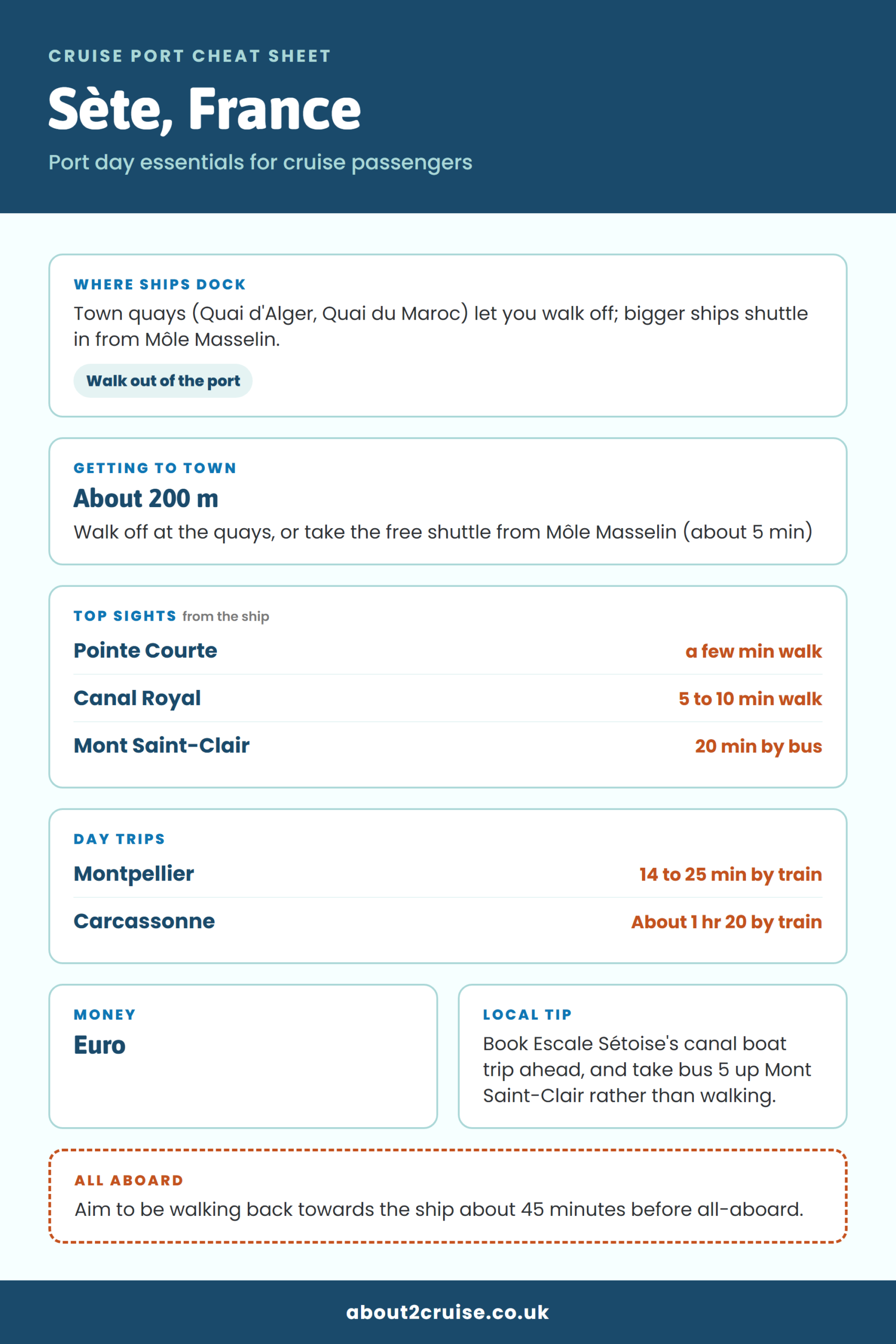
Sète has two places for cruise ships: the town quays at Quai d’Alger and Quai du Maroc, a few minutes from the canals, or Môle Masselin’s M1 and M2 berths, where a free shuttle does the five minutes into town. Your day can be the Canal Royal, Les Halles market and Mont Saint-Clair by bus.
Where Sète’s cruise ships dock
Cruise calls use two areas. Quai d’Alger, where the Gare du Maroc building is the passenger station, is the quay the port keeps for cruise calls, and it’s a few minutes from the centre. Quai du Maroc, about 250 m from the centre, takes the smaller ships.
Bigger ships go to Môle Masselin, berths M1 and M2, on the outer side of the harbour. Shuttles run into town from there in about five minutes. The port also lists an H berth.
The terminal on the town quays is air conditioned and has Wi-Fi, a tourist information desk, a shop, currency exchange, a taxi rank and parking for 12 tour coaches.
Sète is a working fishing and ferry port, so your berth isn’t always the same one. The daily programme names it, and that’s the line to trust when you’re planning the walk ashore.
On a western Mediterranean cruise, Sète usually comes between Marseille and Barcelona. Further east along the French coast are Toulon, Nice and Villefranche-sur-Mer.
Sète cruise port map
Ships dock at Quai du Maroc. From there, Saint-Louis lighthouse is about a 7-minute walk, MIAM about 13 minutes and Cimetière marin about 17 minutes. Tap a pin for directions.
- Quai du MarocWhere ships dock
- Môle MasselinWhere ships dock
- Saint-Louis lighthouseLighthouse · About 7 min walk from Quai du Maroc
- MIAMArt museum · About 13 min walk from Quai du Maroc
- Musée Paul ValéryMuseum · About 17 min walk from Quai du Maroc
- Cimetière marinCemetery · About 17 min walk from Quai du Maroc
- Théâtre de la MerOpen-air theatre · About 17 min walk from Quai du Maroc
- La Croix Saint-ClairViewpoint · About 22 min walk from Quai du Maroc
- Notre-Dame-de-la-SaletteChapel · About 23 min walk from Quai du Maroc
- Gare de SèteTrain station · About 24 min walk from Quai du Maroc
- Pointe CourteFishermen’s quarter · About 30 min walk from Quai du Maroc
- Les Halles de SèteCovered market · About 3 km from Quai du Maroc
Getting from the ship into Sète
At the town quays you walk off and you’re already in Sète. Five to ten minutes on foot puts you on the Canal Royal, and the centre is roughly 200 m from the berths.
From Môle Masselin the shuttle takes about five minutes, and it’s free. That free shuttle is for the outer berths; step off at the town terminal and there’s nothing to shuttle to.
Ships normally berth alongside at the quays in Sète. If your ship uses an outer berth, follow the transfer instructions on board rather than walking the industrial roads yourself.

Mont Saint-Clair: bus 5 up, walk down
Mont Saint-Clair rises 183 m directly behind the town. From the top you get the canals, the port, the Étang de Thau and the coast in one sweep. Notre-Dame-de-la-Salette chapel sits near the summit area.
Bus 5 leaves from Passage le Dauphin in the centre and climbs to La Croix Saint-Clair, calling at La Pompe, Belbezet, Les Pierres Blanches and Le Golfe on the way. It comes back down past the Musée Paul Valéry and the Cimetière marin. It runs Monday to Saturday, and on Sundays and public holidays in July and August.
Don’t walk up. The climb is steep, the Quartier Haut’s stairs are unshaded, and the summit is open to the sky.
Take the bus or a taxi up and walk down instead. If you do want the uphill leg on foot, go before 11:00 or after 15:00, when it’s far less punishing.
Canal Royal, water jousting and the Pointe Courte
The Canal Royal is the main urban waterway, lined with boats and cafés, and it’s where the water jousting tournaments are held in the jousting season. The canal network is why the town gets called the Venice of the Languedoc.
Pointe Courte, the fishermen’s quarter with its colourful facades, is a few metres from where ships moor. The Théâtre de la Mer, an open-air theatre in a former fort facing the sea, and the Cimetière marin above it are both working places, so access can be limited on the day.
To see it from the water, Escale Sétoise runs an electric sightseeing boat through the canals, out to the Mediterranean and the Étang de Thau in about 50 minutes, boarding at quai Général Durand. Booking is required, and the crew speak English and French. Sète Croisières runs a canal trip under nine bridges to Pointe Courte, plus a little train tour with commentary in eight languages.
The museums are close to the quays too: MIAM, the Musée International des Arts Modestes, the Musée Paul Valéry above the Cimetière marin, and the Centre Régional d’Art Contemporain near the waterfront.
Montpellier and Carcassonne on a port day
Gare de Sète is 1.5 km from the port, roughly 18 to 20 minutes on foot along the canals. Direct trains reach Montpellier Saint-Roch in 14 to 25 minutes.
Montpellier fits a port day if you leave room. Be back at Place de la Comédie about two and a half hours before all-aboard so the train and the walk back to the ship don’t run you close.
Carcassonne takes about 1 h 07 to 1 h 35 on a direct train, then a 26-minute walk up to the Cité. Only a few direct trains run each day, so a confirmed direct train back matters more than shaving minutes off the outward leg.
Many western Mediterranean itineraries pair Sète with Marseille or Toulon, and a guide to Mediterranean cruise ports in France sets out how those bigger calls differ.
When Escale à Sète fills the quays
Escale à Sète is a biennial maritime traditions festival held around Easter, when more than 120 heritage vessels fill the town-centre canals and quai d’Alger and the town fills with visitors. There is no edition in the year between.
On those days the centre goes pedestrian, free shuttles run from the Quai Paul Riquet car parks, and routes along the quays change at short notice. Allow extra time to get back to the ship, and expect Les Halles and the quayside restaurants to be packed.
Money in Sète: currency, cards and cash
You’ll use euros in Sète. Cards work almost everywhere in shops, cafés and restaurants, but bring some notes for Les Halles market stalls, taxis and smaller vendors, because they don’t always take cards. Contactless works up to about €50 a tap before you need your PIN. If the Sète Croisières boat trip is on your list, bring euros: it takes cash or cheques only. There are ATMs along Quai de la Résistance and the streets nearby, and bank machines like BNP Paribas and Société Générale don’t charge their own fee for a foreign card. You need euros here, not dollars.
Is Sète safe for cruise passengers?
Sète is safe and easy to walk around on a cruise day, and the UK government has no warning against it. Recorded crime has fallen across the board, including thefts from people and from vehicles. Watch out for people in the centre posing as plain-clothes municipal police. They offer to walk you home, then ask for money or ID. The real municipal police work in pairs and never ask for cash. If that happens, walk away and call 17. Taxis are metered and run on a set tariff, so overcharging isn’t a known problem here. Around busy spots like Les Halles and the quays, keep your bag close.
Where to eat near Sète cruise port
The eating is in the town centre, within a short walk of the ship, around the Canal Royal and the covered market. Two things define a Sète lunch: tielle sétoise and the shellfish from the Étang de Thau behind the town.

- Tielle sétoise: a savoury pie filled with octopus or squid in spiced tomato sauce. Pick one up at Les Halles and carry it away for a quick lunch.
- Thau oysters and mussels: the lagoon’s shellfish. Les Halles stalls sell them to eat on the spot, and the quays serve them too.
- Bourride: the local fish dish, and it turns up on lunch menus along the old port quays.
Les Halles is open every morning, though individual stalls keep their own days and hours, and it’s at its best early. For a sit-down lunch, head for the La Marine quayside, the pedestrian quai Suquet, the quays by the fish auction, or the cafés on quai Maximin Licciardi.
Sète keeps traditional lunch hours: kitchens serve from 12:00 to 14:00 and close after about 14:30, so a late arrival finds the tables shut.
Weather in Sète for a cruise port day
Most ships call at Sète between spring and autumn. Summer’s warm and dry, with daytime highs in the high 20s°C from June to September. July’s the driest month and August’s the most humid. The tramontane, a dry north-west wind, can blow hard for three or four days at a stretch in any month. October’s the wettest, and short, heavy downpours known locally as épisodes cévenols can flood streets quickly, so check the forecast if you’re ashore then. For most of the season, dress for sun and easy walking on open, flat ground, not rain.
What to wear in Sète: outfit ideas for a port day
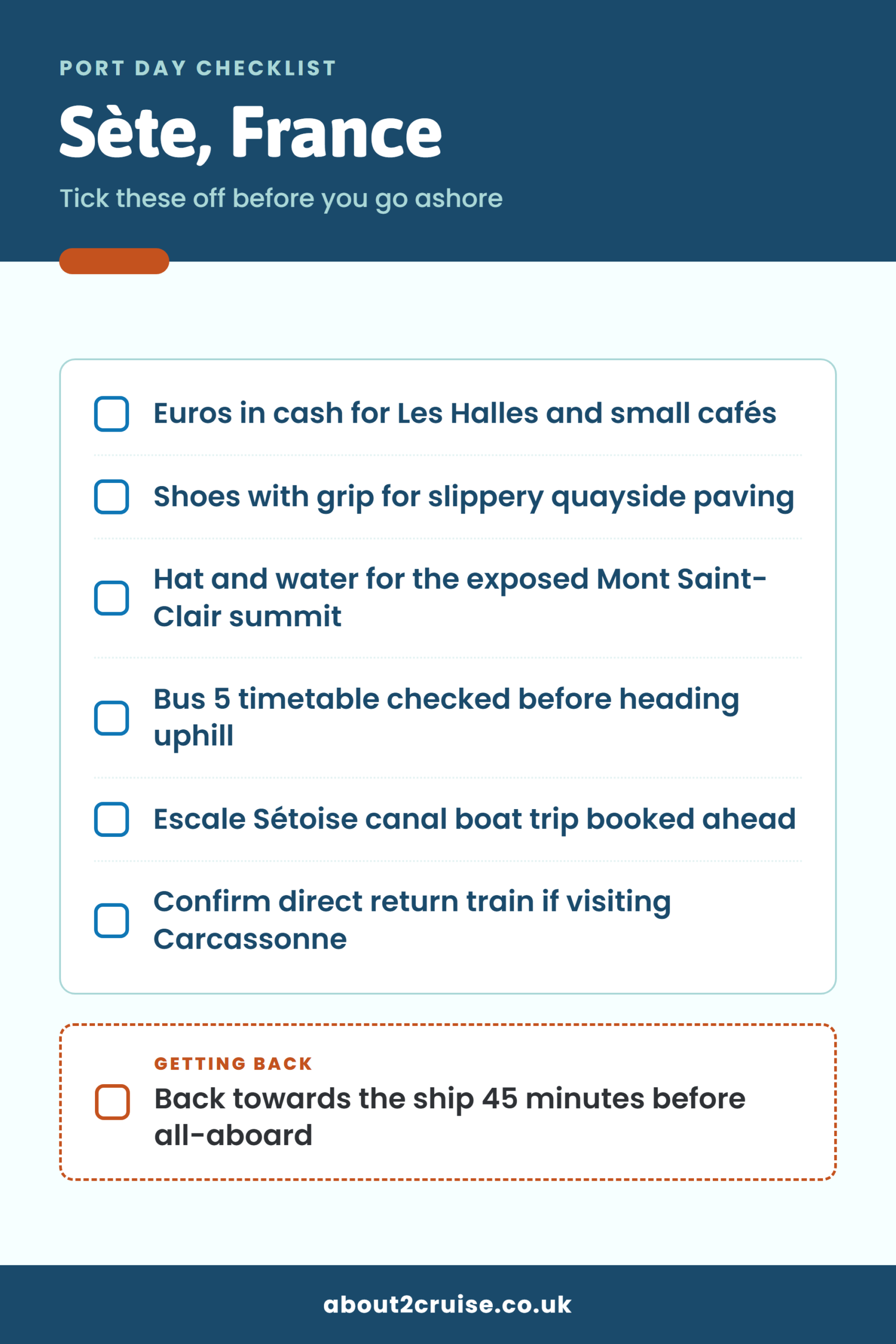
The stone quays and the historic paving around the Canal Royal and the Quartier Haut turn slippery underfoot, so wear shoes with real grip rather than smooth soles. That goes for men and women alike.


The climb to Mont Saint-Clair and the Quartier Haut stairs are exposed, so a hat, water and sun cover earn their place more than a beach outfit does. A light layer helps on the open summit.
Sète is a casual town, but shorts read as underdressed at a quayside lunch, where casual-chic sits better.
For more inspiration, see these casual cruise outfit ideas for women and cruise outfit ideas for men.
Best photo spots in Sète
Head to the top of Mont Saint-Clair at La Croix Saint-Clair for the best photo in Sète: the canals, the port, the Étang de Thau and the coast line up in one frame.
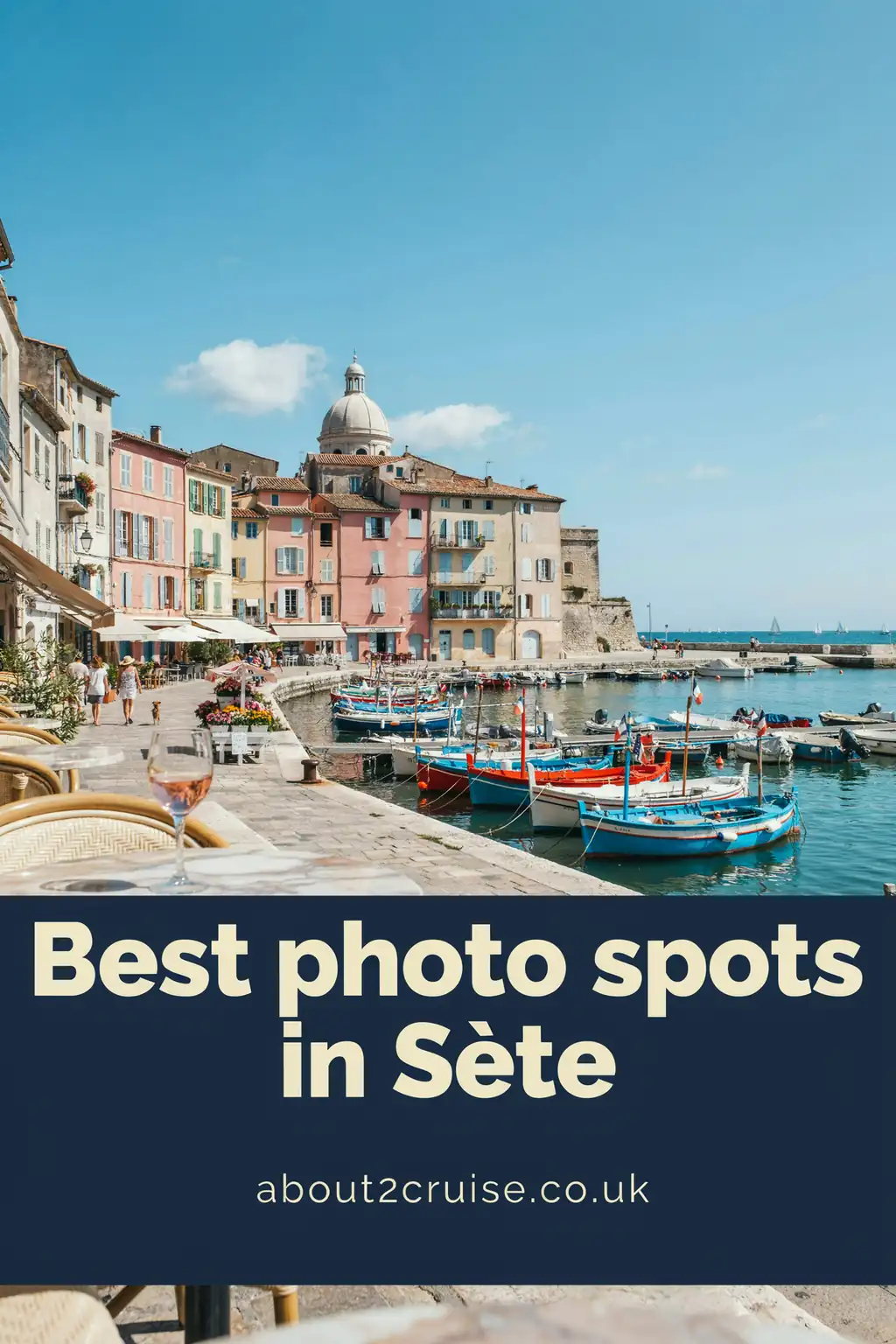
The Canal Royal gives you fishing boats, bridges and reflections, and it’s where the water jousting happens. Pointe Courte, the fishermen’s quarter, is the one for colourful facades, and it’s right by the moorings.
Les Halles is worth a frame in the morning, when the stalls are fullest and the light is coming in. From the water, the Saint-Louis lighthouse at the end of the môle and the Théâtre de la Mer both show up on the canal boat trips.
Getting back to the ship before all-aboard
Aim to be walking back towards the ship about 45 minutes before all-aboard. From the Canal Royal the walk is about 12 minutes and flat, while a taxi covers it in about five.
The friction is taxis in the afternoon. They thin out as the town settles into its afternoon, which is exactly when most passengers want one. Book at the quay rank earlier in the day if you can, or leave the buffer and walk the canals back.
Missing the ship generally means a train to the next port, so that buffer is cheap insurance. The port authority is on +33 4 67 46 34 00.
How to spend a port day in Sète
A port day in Sète works best if you pick one: a slow walk around the Canal Royal and the town’s museums, or a longer day that takes in Mont Saint-Clair too.
Before you sail
- Book Escale Sétoise's canal boat trip online, as it must be booked ahead.
- Check bus 5's timetable, since it doesn't run every day in winter.
- Bring euros in cash for Les Halles stalls and small cafés.
Short port day: under 6 hours
- On dockingWalk ashore at Quai d'AlgerNo tender neededAt the town quays you walk straight off and you're already in Sète.
- +15 minPointe CourteA few minutes along the quay, the fishermen's quarter with colourful facades.
- +45 minCanal RoyalThe town's main canal, lined with boats and cafés, and the setting for water jousting.
- +1 hr 30 minLunch at Les HallesTry tielle sétoisePick up a tielle sétoise, the local octopus or squid pie, at the covered market.
- +2 hr 45 minMIAMThe Musée International des Arts Modestes, a short walk from the market.
- +3 hr 45 minMusée Paul ValéryAbove the Cimetière marin, a quiet last stop before heading back to the quay.
- All-aboard minus 45 minBack at the shipThe walk from the Canal Royal is about 12 minutes and flat.
The time on the map is the whole walk, every stop added together.
Open this walking route in Google Maps
If plans change: If Les Halles is quiet or shut, buy a tielle sétoise from a bakery near the Canal Royal instead.
Long port day: 8 hours or more
- On dockingWalk ashore at Quai d'AlgerWalk straight off at the town quays, or take the shuttle if berthed at Môle Masselin.
- +20 minBus 5 to La Croix Saint-ClairTake the bus upBoard at Passage le Dauphin. Don't walk up, the climb is steep and exposed.
- +50 minMont Saint-Clair summitViews over the canals, port and Étang de Thau, with the chapel of Notre-Dame-de-la-Salette nearby.
- +1 hr 40 minWalk down past Musée Paul ValéryDescend via the museum and the Cimetière marin, back towards the town centre.
- +3 hrLunch at Les HallesTry tielle sétoiseOrder tielle sétoise or Thau oysters at the covered market stalls.
- +4 hrCanal Royal and Pointe CourteWalk the canal quays, then the fishermen's quarter of Pointe Courte nearby.
- +5 hr 30 minMIAMThe Musée International des Arts Modestes, a last stop before heading back to the ship.
The time on the map is the whole walk, every stop added together.
Open this walking route in Google Maps
If plans change: If bus 5 isn't running, take a taxi up Mont Saint-Clair, or skip the summit and spend longer around the canals and museums.
Sète cruise port FAQs
Do I need cash in Sète?
The euro is the currency and cards are widely accepted, but carry some cash for Les Halles stalls and small cafés, where you’ll be glad of it.
How far is Sète cruise port from Montpellier airport?
Montpellier Méditerranée airport is 40 km from the port, about 30 minutes by road on the motorway. Marseille is the alternative for long-haul connections.
Do any cruises start and finish in Sète?
Sea cruises treat Sète as a port of call rather than a turnaround port. Canal cruises on the Rhône à Sète canal and the Étang de Thau do begin and end here, boarding in the evening, with coach transfers offered from Arles.
Can you visit the Étang de Thau oyster farms from the ship?
Boat trips from Sète head out onto the Étang de Thau to see the oyster and mussel beds. The lagoon sits directly behind the town, a short walk or ride from the quays.
Can you go inside the Saint-Louis lighthouse?
The Saint-Louis lighthouse at the end of the môle opens for visits and the climb on selected days rather than daily, so check before you set out from the ship.
Last Updated: 4 November 2026