
Saga Cruises practically invented the no single supplement cruise for over-50s, and several UK lines now compete hard for your business with dedicated solo cabins, waived supplements, and social programmes designed for mature singles. The catch: not all “solo-friendly” claims are equal, and knowing which ships actually deliver can save you hundreds, sometimes thousands.
This guide covers solo cabin options, supplement policies, and onboard social programmes across the major cruise lines popular with over-50s solo travellers, with honest assessments of which ones genuinely deliver and which ones don’t.
Why the Single Supplement Still Exists (and Who’s Actually Waiving It)
Cruise lines price cabins for double occupancy because two passengers generate more onboard revenue than one. When you sail alone, you’re occupying a cabin that could house two bar tabs, two casino players, two shore excursion buyers. The single supplement, typically 150-200% of the per-person fare, compensates for that lost revenue. It’s not a popularity tax; it’s business logic. But several lines targeting the 50-plus UK market have realised that waiving or drastically reducing that supplement fills cabins that might otherwise sail empty, especially outside peak season.
Here’s who genuinely offers no or very low single supplements, consistently:
- Saga Cruises: No single supplement on standard solo cabin fares across most departures. This is their flagship selling point, and they’ve built their entire passenger demographic around it.
- Ambassador Cruise Line: Regular promotional periods with reduced or waived supplements on selected sailings. Not universal, but frequent enough to plan around if you’re flexible with dates.
- Norwegian Cruise Line: Purpose-built Studio cabins with no supplement on qualifying ships and itineraries. The Studio Lounge and organised solo events make this the standout option if you want a lively, modern ship.
- Cunard: Occasional single-supplement waivers on specific sailings, often during off-peak periods or as part of limited-time promotions. Not a core part of their model, but worth monitoring if you’re drawn to their traditional style.
- Fred Olsen Cruise Lines: Solo cabins on some ships with competitive supplements, and periodic single-friendly offers. They cater to a mature, quieter crowd, and their smaller ships suit travellers who prefer a more intimate onboard experience.
If a line doesn’t appear on this list, assume the single supplement applies unless you see a specific promotion stating otherwise. Always read the fine print: “reduced” supplement can still mean 125-150% of the per-person rate, which isn’t necessarily a bargain.
Saga Cruises: The Gold Standard for UK Solo Travellers Over 50
Saga built its reputation on no single supplements, and both Spirit of Discovery and Spirit of Adventure deliver on that promise with a high proportion of solo cabins and a social programme designed to help you meet fellow travellers without forced jollity. The ships are exclusively for passengers over 50, which means you won’t be navigating waterslides or competing with families for loungers. The atmosphere skews towards enrichment lectures, comfortable dining, and well-organised shore excursions rather than late-night clubs.
What makes Saga work for singles:
- No single supplement as standard: This isn’t a promotional gimmick. It’s how they price solo cabins on the vast majority of sailings. You pay one person’s fare, full stop.
- All-inclusive pricing: Drinks, gratuities, Wi-Fi, and often shore excursions are bundled into the fare. This simplifies budgeting and removes the anxiety of onboard spending spiralling out of control.
- Solo-focused social events: Meet-and-greets, hosted dinners, and informal gatherings are woven into the programme. You’re never obligated to attend, but the structure is there if you want it.
- UK departure options: Many itineraries sail round-trip from UK ports, eliminating the need for flights. Door-to-door transfers are sometimes included, which is a genuine convenience if you’re travelling alone.
- Mature passenger profile: The average age skews towards 60-plus, and the pace onboard reflects that. This isn’t a criticism; it’s a feature if you prefer conversation over karaoke.
The trade-off: Saga’s base fares can appear higher than mass-market lines, but once you factor in the inclusions and the lack of a single supplement, the per-person value often comes out ahead. If you’re comparing prices, compare what’s actually included, not just the headline figure. Our guide to Saga Cruises for solo travellers breaks down the full picture.
Which Saga Ship to Choose
Spirit of Discovery and Spirit of Adventure are near-identical in style, both purpose-built for the 50-plus market with a focus on comfort and enrichment. Spirit of Discovery tends to offer shorter, UK-focused itineraries, whilst Spirit of Adventure leans towards longer, more immersive voyages to distant destinations. Both ships have a high proportion of solo cabins, and the onboard experience is virtually interchangeable. Choose based on itinerary and length of cruise rather than ship features.
Ambassador Cruise Line: Budget-Friendly Solo Options from the UK
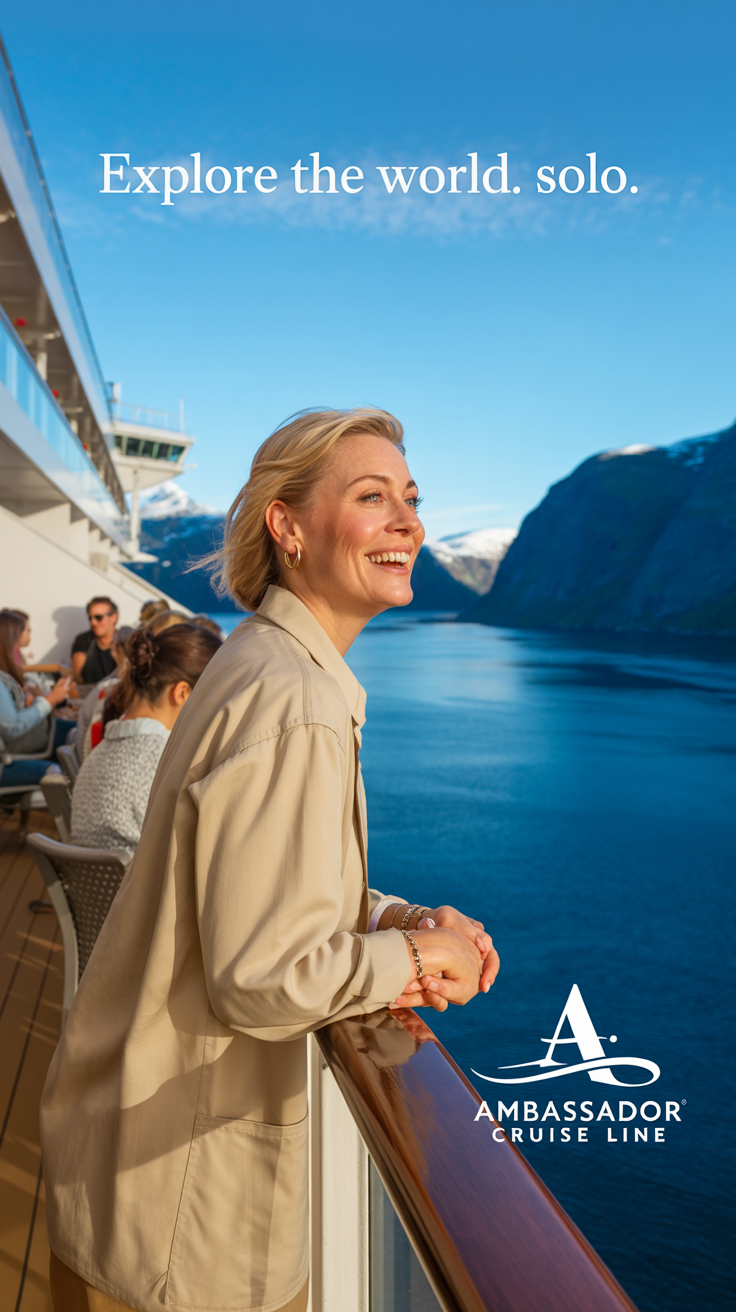
Ambassador Cruise Line is the newer player in the UK-based, value-focused market, and they’ve made solo travellers a clear priority. Ambience and Ambition both feature dedicated solo cabins, and the line runs regular promotions that reduce or eliminate the single supplement on selected sailings. The ships are older and less polished than Saga’s purpose-built boutique vessels, but the pricing is noticeably more accessible, and the passenger demographic is similarly mature and sociable.
Why Ambassador works for solo travellers over 50:
- Frequent single-supplement promotions: Unlike lines where “solo-friendly” is an occasional offer, Ambassador runs these promotions multiple times per year across a range of itineraries. If you’re flexible with dates, you can often find a sailing with zero supplement.
- UK departures and no-fly cruises: The majority of Ambassador itineraries depart from UK ports, which cuts out the hassle and expense of flights. This is particularly appealing if you’re nervous about navigating airports alone or prefer to keep your entire holiday within UK logistical reach.
- Active solo events calendar: Organised meet-ups, hosted dinners, and informal gatherings are part of the onboard programme. The vibe is friendly and unpretentious, without the stuffiness you might encounter on more traditional lines.
- Lower base fares than Saga: Even before factoring in promotions, Ambassador’s pricing is more budget-conscious. The inclusions are fewer (you’ll pay for drinks, speciality dining, and most shore excursions), but the upfront cost is easier to stomach if you’re watching your spending.
The catch: Not every sailing has reduced or waived supplements, and the inclusions are less comprehensive than Saga’s all-inclusive model. You’ll need to budget separately for drinks, gratuities, and excursions, which can add up. But if your priority is keeping the base fare low and you’re happy to manage your onboard spending, Ambassador offers excellent value. Our Ambassador Cruises solo travel guide covers what to expect in more detail.
Norwegian Cruise Line: Studio Cabins and the Best Modern Solo Experience
Norwegian Cruise Line doesn’t market itself as a UK-specific line, but it’s widely sold in the UK market and offers the most innovative solo-cabin concept in mainstream cruising. Studio cabins are purpose-built for solo travellers, smaller than standard cabins but efficiently designed, and priced per person with no single supplement. The Studio Lounge, exclusive to Studio guests, provides a private social space where you can meet other solo travellers without the awkwardness of wandering into a bar alone.
What makes Norwegian’s Studios work:
- No single supplement by design: Studio cabins are priced for one person, full stop. This isn’t a promotional waiver; it’s the cabin category’s entire reason for existing.
- Dedicated Studio Lounge: A private lounge with complimentary snacks, coffee, and a relaxed atmosphere where solo travellers can meet and socialise. It’s optional, but it takes the edge off the “where do I sit?” anxiety that many solo cruisers experience in public spaces.
- Modern ships with diverse dining and entertainment: Norwegian’s fleet skews younger and livelier than Saga or Ambassador, with a broad range of dining venues, active nightlife, and contemporary entertainment. If you’re 50-plus but want a more vibrant onboard atmosphere, Norwegian delivers.
- Ships with Studios: Epic, Breakaway, Getaway, Escape, Bliss, Encore, and Joy all feature Studio complexes. Availability varies by ship and sailing, so book early if you’re targeting a specific itinerary.
The trade-off: Norwegian’s base fares are competitive, but the line’s “freestyle cruising” model means fewer inclusions. You’ll pay for speciality dining, drinks, gratuities, and shore excursions unless you purchase a package. The passenger demographic is broader and younger than Saga or Ambassador, which may feel less tailored to a mature, quiet-seeking audience. But if you want a modern ship, excellent solo infrastructure, and guaranteed no supplement, Norwegian is the standout choice. Our guide to Studio cabins explains what to expect in practice.
Cruises for Singles Over 50 from UK Ports
Sailing from a UK port eliminates the hassle of flights, reduces your overall travel cost, and makes the entire experience more manageable if you’re travelling solo. Southampton, Dover, and Liverpool are the primary departure points for UK-based cruise lines, and several international lines also offer seasonal UK departures. If you’re based in the UK and prefer to avoid airports, focus your search on lines and itineraries that sail round-trip from British ports.
| Departure Port | Primary Lines | Typical Destinations | Solo-Friendly Features |
|---|---|---|---|
| Southampton | Saga, Ambassador, Cunard, P&O | Northern Europe, Mediterranean, Canary Islands, transatlantic | Saga and Ambassador offer consistent solo cabins and supplement waivers; Cunard occasional promotions |
| Dover | Ambassador, Saga (seasonal) | Northern Europe, British Isles, Norway | Ambassador’s budget-friendly promotions frequent from Dover; Saga’s seasonal departures include solo-focused itineraries |
| Liverpool | Fred Olsen, Ambassador | British Isles, Iceland, Norway | Fred Olsen’s smaller ships and mature demographic; Ambassador’s no-fly convenience |
| Tilbury | Fred Olsen | Northern Europe, Baltic, British Isles | Smaller ships with solo cabins; quieter, more intimate onboard atmosphere |
UK departures also mean you can bring as much luggage as you can physically manage, without airline weight restrictions. This is a genuine advantage if you’re travelling for two weeks or more and prefer not to rely on laundry services. The convenience of boarding a ship from your home country, without navigating foreign airports or managing transfers, removes a significant source of solo-travel anxiety.
All-Inclusive Cruises for Singles Over 50 (and What That Actually Means)
When cruise lines claim “all-inclusive,” the actual scope varies wildly. Saga Cruises includes drinks, gratuities, Wi-Fi, and often shore excursions in the base fare, which genuinely simplifies budgeting and removes the drip-feed of onboard charges. Ambassador and Norwegian include far less: you’ll pay for drinks, speciality dining, gratuities, and excursions separately unless you purchase a package. Cunard’s all-inclusive offerings are typically reserved for Grills-class cabins, which come at a premium.
What to check before assuming “all-inclusive” means everything:
- Drinks: Does the package include premium spirits, or just house brands? Is there a daily cap on wine at dinner? Are soft drinks and bottled water included in your cabin?
- Gratuities: Are crew tips bundled into the fare, or will you see a daily charge added to your onboard account?
- Wi-Fi: Is internet access included, and if so, is it fast enough to video call home, or just sufficient for checking email?
- Shore excursions: Are excursions included in every port, or just selected tours on certain itineraries? Can you choose your excursions, or are they pre-assigned?
- Speciality dining: Are reservations at premium restaurants included, or do they carry a surcharge?
If you’re comparing an all-inclusive Saga cruise with a lower-priced Ambassador or Norwegian sailing, add up the likely cost of drinks, gratuities, and excursions on the latter before deciding which represents better value. For many solo travellers, the psychological benefit of a genuinely all-inclusive package, knowing you won’t be hit with surprise charges, is worth the higher upfront cost. Our guide to avoiding single supplement fees includes budgeting tips for comparing true costs across different pricing models.
Cruises for Over 50s: Couples vs Singles and Why It Matters
Most “over 50s cruises” are designed for couples, and the onboard atmosphere, cabin configuration, and social programming reflect that assumption. If you’re travelling solo, you need to actively seek out lines and ships that treat solo travellers as a core demographic, not an afterthought. The difference isn’t subtle: ships designed for couples may have limited solo cabins, no organised solo events, and dining policies that leave you feeling conspicuous as a party of one.
What distinguishes a genuinely solo-friendly cruise from a standard over-50s cruise:
- Dedicated solo cabins: Purpose-built single-occupancy cabins, not just “small doubles at a discount.” These cabins should be well-integrated into the ship’s layout, not tucked away on awkward decks.
- Organised solo social events: Hosted meet-and-greets, solo traveller dinners, and informal gatherings that make it easy to meet other singles without forced participation. This is crucial: optional structure beats both isolation and compulsory jollity.
- Flexible dining options: The ability to dine at shared tables, join hosted tables, or eat alone without feeling conspicuous. Traditional fixed-seating dining can be awkward for solo travellers if not managed thoughtfully.
- No assumption of coupledom: Shore excursions, cabin configurations, and onboard messaging that acknowledge solo travellers as a legitimate and valued passenger segment, not an anomaly to be accommodated.
Saga, Ambassador, and Norwegian all meet these criteria to varying degrees. Cunard and P&O can work for solo travellers, but you’ll need to research specific ships and sailings to confirm solo-friendly features are in place. If you’re considering a line not explicitly marketed to singles, check whether solo cabins exist, what the supplement policy is, and whether the ship has any organised solo events before booking. Our broader guide to singles cruises covers what to look for across all age groups and line types.
Senior Singles Cruises: Amenities, Accessibility, and Onboard Pace
If you’re over 60 or 70, your priorities on a cruise may differ from those of a 50-year-old solo traveller still working full-time. Accessibility features, onboard medical facilities, the physical layout of the ship, and the overall pace of activities become more important. Lines targeting senior singles need to balance social opportunities with comfort, accessibility, and a realistic understanding of mobility and stamina variations among passengers.
What to prioritise if you’re a senior solo traveller:
- Cabin accessibility: Are cabins equipped with grab rails, roll-in showers, and accessible layouts if you have mobility concerns? Even if you don’t need these features now, consider whether the ship is designed to accommodate them if your needs change mid-cruise.
- Lift access and deck layout: Are lifts plentiful and well-located, or will you spend half your day waiting for one? Are key facilities (dining rooms, theatre, medical centre) clustered on a few decks, or spread across multiple levels requiring frequent navigation?
- Onboard medical facilities: Does the ship have a well-equipped medical centre with a doctor and nurse on duty 24/7? What’s the protocol for medical emergencies in port or at sea?
- Shore excursion pace: Are excursions rated by activity level, and does the line offer gentler, slower-paced options for less mobile passengers? Can you pre-book accessible transport or wheelchairs for tours?
- Onboard activity pace: Is the daily schedule packed with high-energy entertainment and activities, or is there space for quieter, slower-paced enrichment and relaxation?
Saga excels here: their ships are purpose-built for mature passengers, with accessible cabins, slower-paced itineraries, and shore excursions designed for a range of mobility levels. Fred Olsen’s smaller ships also cater well to senior passengers, with a quieter, more intimate onboard atmosphere and a mature demographic. Norwegian’s larger, livelier ships may feel overwhelming if you prefer a slower pace, though the Studio cabins and lounge provide a quieter retreat within a bustling environment. Our guide to singles cruises over 60 explores these considerations in more depth.
Best Norwegian Singles Cruise Over 50: Which Ships and Itineraries Work
If you’ve settled on Norwegian Cruise Line for the Studio cabin concept, the next decision is which ship and itinerary to choose. Not all Norwegian ships have Studios, and the quality of the Studio experience varies by ship age and design. The best Norwegian cruises for singles over 50 balance modern Studio facilities with itineraries that suit a mature traveller’s interests, avoiding ships dominated by families or heavily geared towards younger passengers.
Best Norwegian ships for solo travellers over 50:
- Norwegian Epic: The original Studio ship, with the largest Studio complex and most established solo-traveller community. The ship is lively and varied, with excellent dining options and entertainment, but the Epic skews younger than some other Norwegian vessels.
- Norwegian Escape, Breakaway, Getaway: These Breakaway-class ships have well-designed Studio complexes and a broad range of onboard amenities. They’re large, modern ships with diverse passenger demographics, making them a good middle ground between lively and mature.
- Norwegian Encore and Bliss: Newer ships with the most modern Studio designs, including improved soundproofing and slightly larger cabins. These ships are popular with families during school holidays, so book outside peak periods if you prefer a quieter atmosphere.
- Norwegian Joy: Less commonly marketed in the UK but features Studios and a slightly more relaxed onboard vibe than the Breakaway class. Good for passengers who want the Studio benefits without the intense activity level of the bigger ships.
Itineraries to consider if you’re over 50 and prefer cultural or scenic cruising over party destinations:
- Northern Europe and Scandinavia: Norwegian’s Baltic, Norway, and Iceland itineraries attract a more mature demographic and focus on scenic beauty and cultural enrichment rather than beach parties.
- Mediterranean: Norwegian’s Med sailings from Barcelona, Rome, or Venice offer a good balance of history, culture, and cuisine, with a passenger mix that skews older than Caribbean cruises.
- Transatlantic repositioning cruises: These longer voyages attract a quieter, more mature crowd, with plenty of sea days for relaxation and enrichment lectures. Studios on repositioning cruises often offer excellent value.
Avoid Norwegian’s Caribbean itineraries during school holidays if you’re seeking a quiet, mature atmosphere. These sailings are family-heavy, and the onboard vibe is noticeably livelier. If you’re considering Norwegian, our Studio cabins guide includes ship-by-ship comparisons and booking tips.
Mediterranean Cruises for Singles Over 50 (and Why They’re Ideal for Solo Travellers)
The Mediterranean offers the best combination of cultural richness, manageable port days, and excellent solo-travel infrastructure of any cruise region. Shore excursions are well-organised, ports are generally safe and easy to navigate independently, and the itineraries suit a mature traveller’s pace. If you’re new to solo cruising or prefer destinations with depth and variety, the Med is the safest bet.
Why Mediterranean itineraries work well for solo travellers over 50:
- Cultural depth: Every port offers museums, historical sites, architecture, and cuisine that reward slower, more thoughtful exploration. You’re not limited to beach clubs and water sports.
- Easy independent exploration: Many Mediterranean ports are walkable from the ship or a short, inexpensive taxi or public transport ride from the city centre. You don’t need to book an excursion if you’re confident navigating solo.
- Established solo-travel infrastructure: Mediterranean ports are used to cruise passengers, and local businesses cater to solo travellers. You won’t feel conspicuous dining alone or exploring independently.
- Weather reliability: Spring through autumn, the Med offers consistent sunshine and warm temperatures without the humidity or hurricane risk of Caribbean or tropical itineraries.
Best Mediterranean itineraries for solo travellers over 50:
- Western Med (Barcelona, Rome, Florence, Monaco): Classic art, architecture, and cuisine, with ports that are easy to navigate independently. Saga, Ambassador, and Norwegian all offer Western Med itineraries with good solo options.
- Eastern Med (Venice, Dubrovnik, Greek Islands, Istanbul): More varied culturally, with a mix of history, beaches, and vibrant local life. Slightly less crowded than the Western Med, especially outside peak summer.
- Adriatic (Venice, Split, Kotor, Corfu): Smaller ports, less touristy, and excellent for travellers who prefer quieter, less commercial destinations. Fred Olsen and smaller lines excel here.
If you’re choosing between the Mediterranean and other regions, the Med offers the best balance of cultural interest, solo-travel ease, and mature passenger demographics. Caribbean itineraries skew younger and more family-oriented, whilst Northern Europe can be more expensive and weather-dependent. Our guide to travel safety in port includes Mediterranean-specific tips for solo exploration.
River Cruises for Singles Over 50 (and How They Differ from Ocean Cruising)
River cruises appeal to solo travellers over 50 who prefer smaller ships, more intimate onboard atmospheres, and itineraries focused on cultural immersion rather than onboard entertainment. The ships are smaller, typically carrying 100-200 passengers, and the experience skews heavily towards mature, curious travellers. Single supplements on river cruises are notoriously high, but several lines now offer solo cabins or promotional supplement waivers on selected departures.
What makes river cruising different for solo travellers:
- Smaller ships and intimate atmosphere: You’ll recognise the same passengers throughout the cruise, which can feel more sociable and less anonymous than a large ocean ship. This suits solo travellers who want to make friends without forced participation.
- Port-intensive itineraries: River cruises dock in the heart of cities and towns, often within walking distance of major sights. You spend more time ashore and less time navigating transfers or shuttle buses.
- Included excursions: Most river cruises include daily guided tours in the fare, which simplifies budgeting and removes the anxiety of planning solo shore days.
- Higher cost per day: River cruises are more expensive than ocean cruises on a per-day basis, and single supplements can be punishing. But the inclusions and experience are genuinely different, not just a scaled-down version of ocean cruising.
Best river cruise lines for solo travellers over 50:
- Riviera Travel: Regular solo-focused sailings with reduced or waived supplements, and a mature, sociable passenger demographic. Their European river itineraries are well-regarded for value and quality.
- Saga River Cruises: Saga’s river arm offers the same no-supplement policy as their ocean cruises on selected departures. The passenger profile is exclusively 50-plus, and the inclusions are generous.
- Uniworld: Boutique river cruising with occasional solo promotions. Expensive, but the onboard experience is a step up in luxury and attention to detail.
- Emerald Waterways and Scenic: Both offer solo cabins on some ships, and occasional supplement waivers. The ships are modern and stylish, with a focus on active, culturally curious passengers.
If you’re considering a river cruise, book early. Solo cabins are limited, and the best promotions sell out quickly. River cruising is also seasonal, concentrated in spring and autumn when European weather is mild and river levels are stable. Our guide to river cruises covers what to expect and how to choose the right itinerary.
Singles Cruise Holidays Over 50s: Planning Your Sailing Calendar
If you’re planning a singles cruise, timing matters. Solo-friendly promotions, weather, passenger demographics, and pricing all vary by season and departure date. Spring and autumn offer the best combination of value, weather, and mature passenger demographics, whilst peak summer and Christmas/New Year sailings are more expensive and more family-oriented.
Best times to book singles cruises over 50:
- Spring (April-May): Mediterranean and Northern Europe itineraries are at their best, with mild weather, fewer crowds, and lower pricing than summer. Saga and Ambassador both run frequent solo promotions in spring.
- Autumn (September-October): The peak of solo-friendly pricing and promotions. Weather is still warm in the Med and acceptable in Northern Europe, and the onboard atmosphere is noticeably more mature than summer sailings.
- Winter (November-March): Caribbean and Canary Islands itineraries offer warm-weather escapes, with good value and fewer families. Winter is also when repositioning cruises (transatlantic, Panama Canal) offer excellent solo deals on longer voyages.
- Avoid peak summer (July-August) and school holidays: Pricing is highest, solo promotions are rare, and the passenger demographic skews heavily towards families. If you must sail in summer, choose adult-only lines like Saga or book a repositioning cruise that doesn’t coincide with school breaks.
How far in advance to book:
- Saga and Ambassador: Book 6-12 months ahead to secure solo cabins and the best early-booking discounts. Solo cabins sell out first, especially on popular itineraries.
- Norwegian Studios: Studios are limited and sell quickly. Book as soon as the sailing opens for sale, particularly if you’re targeting a specific ship or itinerary.
- Last-minute deals: Occasionally, lines will reduce single supplements or offer solo cabins at a discount to fill unsold inventory. This is a gamble, and you’re unlikely to secure your preferred cabin or itinerary, but if you’re flexible and spontaneous, last-minute deals can offer excellent value.
Our guide to the best times to book singles cruises includes a month-by-month breakdown of when to expect promotions and which lines to watch.
Shore Excursions vs Independent Exploration for Solo Travellers
One of the most common anxieties for solo cruisers is whether to book organised shore excursions or explore ports independently. The right answer depends on your confidence, the port’s layout and safety, and the type of experience you’re after. Organised excursions offer security and structure, whilst independent exploration offers flexibility and often better value.
When to book a shore excursion as a solo traveller:
- Remote or unfamiliar ports: If the port is far from the city centre, poorly served by public transport, or in a region where you don’t speak the language, an organised excursion removes the logistical anxiety.
- Ports with safety concerns: In destinations where solo travellers may feel vulnerable (Naples, certain Caribbean ports), a cruise-line excursion provides guaranteed safe return to the ship.
- Ports requiring transport: If you’re visiting a specific site that’s not easily accessible by public transport (Stonehenge from Southampton, Pompeii from Naples), a tour simplifies logistics.
- Social opportunity: If you want to meet other passengers and prefer not to explore alone, group excursions provide built-in company and shared experiences.
When to explore independently:
- Walkable ports with safe, well-marked city centres: Barcelona, Venice, Dubrovnik, and most Mediterranean ports are easy to navigate solo. You’ll save money and enjoy more flexibility exploring on your own.
- Ports you’ve visited before: If you’ve been to the destination previously, you don’t need a guided tour. Spend your time on the specific sights or experiences you missed last time.
- When you prefer your own pace: Group tours run to a fixed schedule, often rushing you through sights or spending too long in souvenir shops. Solo exploration lets you linger where you want and skip what doesn’t interest you.
If you do book an excursion, consider third-party operators rather than cruise-line tours. They’re often cheaper, smaller groups, and more flexible, though you sacrifice the cruise line’s guarantee of waiting for the ship if the tour runs late. Our port safety guide includes tips for evaluating whether a port is safe for solo exploration.
Making Friends on a Solo Cruise (Without It Feeling Forced)
The fear of eating alone, sitting alone, or spending the entire cruise without conversation is what stops many people from booking a solo trip. The reality: most solo cruisers find it easier to make friends on a cruise than in almost any other holiday setting, provided the ship has basic solo-friendly infrastructure. Organised solo events, communal dining, and the natural rhythm of shipboard life create multiple opportunities to meet people without forced participation.
How to meet fellow solo travellers without awkwardness:
- Attend the first solo meet-and-greet: Saga, Ambassador, and Norwegian all host an early-cruise gathering for solo travellers. Go. Even if you’re shy, it’s the easiest way to identify other solos and form informal groups for dining or shore days.
- Use communal or open-seating dining: If the ship offers flexible dining or communal tables, take advantage. You’ll meet different people each night, and the conversation flows more naturally than at a fixed table with the same companions for a week.
- Join enrichment activities or classes: Art classes, wine tastings, and guest lectures attract curious, sociable passengers. These settings are less intimidating than a bar or lounge for striking up conversation.
- Spend time in the Studio Lounge (Norwegian) or solo spaces: If your ship has a dedicated solo space, use it. These lounges are specifically designed to make meeting other solos feel natural and optional, not compulsory.
- Shore excursions: Group tours are an easy way to spend a day with the same people, and if you click, you can arrange to meet up onboard later in the cruise.
What not to do:
- Don’t hide in your cabin: If you’re nervous about being solo, the worst thing you can do is avoid communal spaces. The first night is awkward; the second night is easier; by the third night, you’ll recognise faces and feel more comfortable.
- Don’t assume everyone is coupled: Many passengers are travelling with friends, siblings, or solo themselves. Don’t let the assumption that “everyone is paired off” stop you from introducing yourself.
- Don’t feel obligated to socialise constantly: It’s fine to eat alone, read in a quiet corner, or skip the evening entertainment. Solo travel is about having the option to socialise, not the obligation.
Our guide to making friends on solo cruises includes scripts for starting conversations and tips for navigating onboard social dynamics.
What to Avoid When Booking a Singles Cruise Over 50
Not all “solo-friendly” cruises are created equal, and some lines and itineraries are genuinely unsuitable for mature solo travellers despite marketing that suggests otherwise. Avoiding common pitfalls saves you money, disappointment, and the frustration of feeling like an afterthought in a sea of couples.
Red flags to watch for:
- “Reduced” single supplements that still exceed 150%: A 175% supplement isn’t a deal; it’s standard pricing with misleading marketing. If the “reduced” rate is still significantly higher than the per-person double-occupancy rate, walk away.
- Solo cabins in terrible locations: Some ships cluster solo cabins on the lowest decks, near crew areas, or in noisy sections. Check deck plans and read reviews before booking. A cheap solo cabin next to the engine room or nightclub is not a bargain.
- No organised solo events: If the line doesn’t host solo meet-ups or communal dining, you’re left to navigate the social landscape entirely on your own. This is manageable for extroverts; it’s isolating for everyone else.
- Fixed seating at a table with couples: Traditional fixed-seating dining can be awkward if you’re the only solo at a table of four couples. Confirm the dining policy before booking, and opt for open seating or communal tables if available.
- Family-oriented ships during school holidays: If you book a mainstream line like P&O or Royal Caribbean during half-term or summer holidays, expect a noisy, child-heavy atmosphere that’s the opposite of a relaxing, mature solo cruise.
- Lines that treat solo travellers as an inconvenience: If the booking process is difficult, solo cabins are hidden on the website, or customer service is dismissive about solo travel, take your money elsewhere. Lines that value solo travellers make it obvious.
If you’re unsure whether a specific ship or sailing is genuinely solo-friendly, search for reviews from other solo travellers. Cruise Critic’s solo traveller forums and dedicated solo cruise review sites offer honest assessments that cut through marketing spin.
First-Time Solo Cruise: What You Actually Need to Know
If you’ve never cruised solo before, the logistics and social dynamics can feel overwhelming. The good news: first-time solo cruisers consistently report that the anticipation was worse than the reality, and most wish they’d done it sooner. A few practical preparations remove most of the anxiety.
What to sort before you sail:
- Travel insurance: Solo travellers need single-trip or annual insurance that covers medical emergencies, trip cancellation, and missed departures. Don’t rely on cruise-line insurance; independent policies offer better coverage and value.
- Documents and copies: Carry photocopies of your passport, travel insurance, and cruise documents in your luggage, and leave another set with a trusted contact at home. Solo travellers don’t have a cabin-mate to hold spare copies.
- Onboard credit card: Set up onboard billing to a credit card rather than paying cash. This simplifies budgeting and protects you if you lose your cruise card.
- Pre-cruise contact: If the ship has a solo traveller Facebook group or online forum, join it before sailing. You can arrange to meet up with other solos on embarkation day, which removes the awkwardness of walking into a bar alone on the first night.
- Emergency contact: Ensure your cruise line has an emergency contact on file, and give that person a copy of your itinerary and ship contact details. Solo travellers need someone at home who knows where you are.
What to pack that solo travellers often forget:
- Power strip or multi-plug adapter: Cruise cabins have limited plug sockets, and you’ll need to charge a phone, camera, tablet, and possibly a laptop or e-reader. Solo travellers can’t borrow a partner’s charger.
- Book or e-reader: Solo travellers spend more time reading than couples, especially during sea days or quiet evenings. Bring more reading material than you think you’ll need.
- Refillable water bottle: Staying hydrated in warm weather or during shore excursions is easier if you’re not relying on buying bottled water. Most ships have water stations where you can refill.
- Small day bag: You’ll need a bag for shore excursions that’s large enough for water, sunscreen, and a camera but small enough to carry comfortably all day. Solo travellers can’t hand off the heavy bag to a companion.
Our first solo cruise guide walks through the entire process, from booking to disembarkation, with specific tips for nervous first-timers.
Solo Female Cruise Safety for Mature Travellers
Solo female travellers over 50 often express specific safety concerns about cruising alone, particularly around onboard security, port exploration, and dining alone. The reality: cruise ships are among the safest holiday environments for solo women, with 24/7 security, controlled access, and a largely mature, respectful passenger demographic on lines like Saga, Ambassador, and Fred Olsen. Port safety varies more widely, but basic precautions and informed choices remove most risks.
Onboard safety for solo female travellers:
- Cabin security: Cruise ship cabins lock automatically, and access is controlled by key card. Keep your cabin locked when you’re inside, and use the deadbolt at night. Don’t let crew or passengers into your cabin unless you’ve verified their identity.
- Alcohol and social settings: Solo travellers are more visible, and unfortunately, some passengers misinterpret friendliness as romantic interest. Be clear about your boundaries, and don’t feel obligated to accept drinks or invitations from strangers.
- Solo dining: If you’re uncomfortable eating alone, request communal seating or join hosted solo traveller dinners. Most solo women report that dining alone becomes easier after the first night, but the option to join others removes the pressure.
- Evening safety: Cruise ships are well-lit and heavily staffed, but avoid isolated deck areas late at night. Stick to public spaces, and if you feel uncomfortable, ask crew or security to escort you to your cabin.
Port safety for solo female travellers:
- Research ports before arrival: Some ports are safer than others for solo exploration. Mediterranean ports are generally safe; certain Caribbean and Central American ports require more caution. Check current travel advice and read recent solo traveller reviews.
- Stay in touristy areas: In unfamiliar ports, stick to well-marked tourist areas and avoid wandering into residential neighbourhoods or poorly lit streets. If you’re unsure, book a shore excursion rather than exploring independently.
- Avoid displaying valuables: Leave expensive jewellery on the ship, carry minimal cash, and keep your phone and camera in a secure bag. Solo travellers are more conspicuous targets for pickpockets.
- Trust your instincts: If a situation or person feels off, leave. Don’t worry about being polite or causing offence. Your safety trumps social niceties.
Our solo female cruise safety guide covers these topics in detail, with port-by-port safety assessments and scripts for handling unwanted attention.
Comparing UK Solo-Friendly Cruise Lines: The Honest Summary
| Cruise Line | Best For | Single Supplement Policy | Typical Passenger Age | Onboard Vibe |
|---|---|---|---|---|
| Saga Cruises | Mature, sociable solos who want all-inclusive ease and guaranteed no supplement | No single supplement on most solo cabins; all-inclusive pricing | 60-75 average | Refined, enrichment-focused, relaxed pace |
| Ambassador Cruise Line | Budget-conscious solos seeking UK departures and frequent promotions | Regular reduced or waived supplements on selected sailings | 55-70 average | Friendly, value-focused, sociable but unpretentious |
| Norwegian Cruise Line | Solos who want modern ships, guaranteed no supplement, and lively atmosphere | No supplement on Studio cabins by design | 40-65 average, broader demographic | Contemporary, active, diverse entertainment and dining |
| Fred Olsen Cruise Lines | Quieter, more intimate cruising on smaller ships with mature passengers | Solo cabins on some ships; periodic reduced supplements | 65-80 average | Traditional, calm, slower-paced, classic cruising |
| Cunard | Traditional luxury seekers who want occasional solo deals on iconic ships | Occasional single supplement waivers; most sailings carry full supplement | 55-75 average | Formal, classic, elegant, traditional ocean-liner style |
Common Questions About Cruises for Singles Over 50
Do I have to pay a single supplement on every cruise?
No. Saga Cruises offers no single supplement on most solo cabins as standard, and Norwegian Cruise Line’s Studio cabins eliminate the supplement by design. Ambassador Cruise Line runs frequent promotions with reduced or waived supplements on selected sailings. Other lines occasionally offer single-supplement waivers during off-peak periods or as limited-time promotions, but these are less predictable. Always confirm the supplement policy for your specific sailing before booking.
Will I feel awkward dining alone on a cruise?
Not on solo-friendly lines. Saga, Ambassador, and Norwegian all offer communal or open-seating dining options, and many solos report that dining alone becomes comfortable after the first night. If you prefer company, request shared tables or attend hosted solo traveller dinners. Traditional fixed-seating dining can be more awkward, so confirm the dining policy before booking.
Are river cruises or ocean cruises better for solo travellers over 50?
It depends on your priorities. River cruises offer smaller ships, more intimate atmospheres, and port-intensive itineraries, but single supplements are often higher and cabin availability is limited. Ocean cruises provide more solo cabin inventory, better supplement policies, and greater variety in onboard activities and dining. If you prefer cultural immersion and quieter ships, choose river; if you want choice, value, and guaranteed solo-friendly infrastructure, choose ocean.
Can I explore ports independently as a solo traveller, or do I need to book excursions?
Most Mediterranean and Northern European ports are safe and straightforward to explore independently. Walkable city centres, reliable public transport, and established tourist infrastructure make solo exploration manageable and often more rewarding than organised tours. In less familiar or more remote ports, or where safety is a concern, organised excursions provide security and structure. Check port-specific advice before deciding.
What happens if I get ill or need medical help whilst cruising solo?
All cruise ships have onboard medical centres staffed by doctors and nurses. If you fall ill, visit the medical centre or call reception from your cabin. Ensure your travel insurance covers medical emergencies, repatriation, and missed departures. Provide the cruise line with an emergency contact before sailing, so someone at home can be notified if necessary. Solo travellers should carry a written list of medications, allergies, and medical conditions in case of emergency.
How do I meet other solo travellers on a cruise?
Attend the solo traveller meet-and-greet on the first or second night. Saga, Ambassador, and Norwegian all host these events, and they’re the easiest way to identify other solos and form informal groups. Use communal dining, join enrichment activities, and spend time in solo spaces like Norwegian’s Studio Lounge. Shore excursions also provide natural opportunities to meet fellow passengers in a relaxed setting.
Are there age limits or restrictions on solo cabins?
Saga Cruises restricts all passengers to 50-plus, so solo cabins are only available to mature travellers. Ambassador and Norwegian have no age restrictions on solo cabins, but their passenger demographics naturally skew towards adults. Some lines reserve solo cabins for specific age groups or membership programmes, so check the booking terms for your chosen sailing.
Is it worth paying more for an all-inclusive cruise as a solo traveller?
If you value budgeting certainty and dislike tracking onboard spending, yes. Saga’s all-inclusive model bundles drinks, gratuities, Wi-Fi, and often excursions, which simplifies costs and removes the anxiety of surprise charges. If you’re happy managing your spending and prefer a lower upfront cost, lines like Ambassador or Norwegian offer better base fares but fewer inclusions. Compare the total likely cost, including drinks and extras, before deciding which model suits you.
Why Trust About2Cruise
We’re solo cruisers ourselves, and we’ve sailed on every line recommended in this guide, from Saga’s boutique ships to Norwegian’s lively Studios. We’ve negotiated the social dynamics of dining alone, tested the reality of “no single supplement” claims, and explored ports independently across three continents. Our advice comes from practical experience, not press releases, and we’re honest about what works and what doesn’t. If you want to know more about our approach, visit our about us page.