
The best time to book a solo cruise depends on which way you’re dodging the single supplement. A cabin built for one needs booking 12 to 18 months out, while there’s still inventory. A waived or reduced supplement on a standard cabin turns up during Wave Season, January to March, or in the last 60 days before sailing.
What a single supplement costs you
Everything’s priced per person on the assumption there are two of you in the cabin. So if you want a cabin to yourself, you pay 200% of the per-person fare unless the pricing says otherwise.
No single supplement just means the solo fare matches the per-person double fare, with nothing extra for sailing alone. When lines do publish a figure, the solo fare usually comes out at 175% to 200% of the per-person double fare, which is a supplement of 75% to 100%.
Plenty of lines don’t publish a percentage at all and quote a solo price sailing by sailing, which is where the arithmetic gets slippery.
Convert the percentage before you compare anything. A 100% supplement means paying two full per-person fares.
A 50% supplement means 150% of the per-person fare. A headline of 70% off the second fare leaves you with roughly a 30% supplement.
The unit matters as much as the percentage. A saving quoted per person doubles when it’s applied to the cabin; the same figure quoted per stateroom halves per person. And a waived supplement isn’t a discount on its own: a cheap fare with a small supplement can still undercut a full fare with none.
Three routes round the single supplement
Every no-supplement option you’ll see is one of three things, and they suit different trips. The cheapest route for your dates isn’t automatically the one you started searching for.
A cabin priced for one. The fare is already a solo fare, so there’s nothing to convert. The range runs from small inside studios to oceanview balconies, and the list of ships with dedicated studio cabins priced for single occupancy grows every year.
A reduced or waived supplement on an ordinary cabin. This is what most solo searches are really after, and it nearly always comes with a condition: a selected cabin grade, a selected sailing, or a booking window. Ponant waives the supplement on many departures each season, but not in the Owner’s Suite.
Sharing. At least one operator pairs solo travellers by gender and cabin category and drops the supplement if no match is found. If they do find a match, you share a cabin, and a 50% surcharge applies for sole occupancy on two of its ships.
Specialist agents run room-mate matching at roughly half the cost of sole occupancy, and the risk is the obvious one: you don’t choose who you get.
Price all three before you commit. On heavily promoted sailings a reduced double fare at sole occupancy can rival or beat the dedicated single-cabin price, and it pays to know how to avoid single supplement fees before you start comparing quotes.
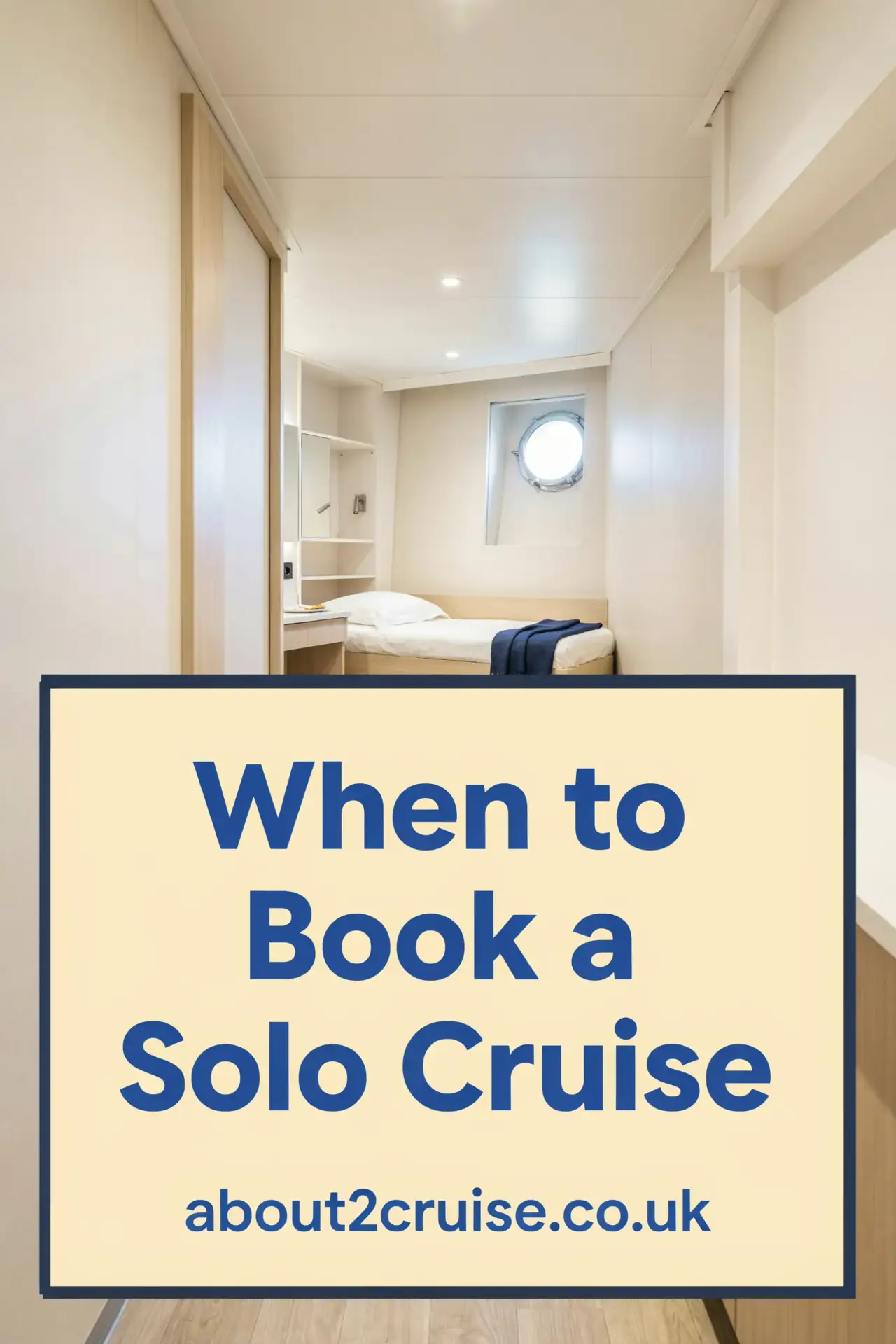
The studio cabin trap: first to sell out, not first on price
Dedicated solo cabins are often the worst value on the ship. Take Norwegian’s Studio: 100 square feet, a full-size bed, a one-way window onto the corridor and no balcony, though you do get Studio Lounge access.
P&O’s single insides on Iona and Arvia are 101 square feet, and the single balconies are 107. Royal Caribbean’s studios run from 101 to 199 square feet, against 150 and above for a typical two-person cabin.
They’re also scarce. Solo cabins are the first category to sell out on most lines, and three studios on a 2,000-passenger ship can go on the day the sailing opens.
On one Royal Caribbean sailing the oceanview balcony studios had already sold out while eight interior studios remained, and the studio inside came out only about a tenth cheaper than a larger standard inside booked for a single guest. Studios also sit on a handful of decks, so if you want a particular position on the ship, they won’t deliver it.
And because they’re priced as their own category, a special offer on a double cabin can undercut the regular solo-cabin price on the same cruise. Norwegian shows the comparison worth making: its Studios and solo lounge sit on around ten ships, while its Solo Inside, Oceanview and Balcony categories put nearly 1,000 cabins for one across the fleet.
Those are ordinary cabins priced for a single guest, so price them against the Studio before you book the small one.
Which cruise lines to check first
Start with lines that sell a cabin for one, rather than lines that happen to have a deal on. On a line with no solo inventory and no waiver, you’re simply paying the second fare.
Fred. Olsen Cruise Lines has single-occupancy cabins on every ship, from interior to suites, and one of the highest ratios of single cabins in the industry. Solo guests made up 12% of its passengers in a year the line reported.
Its three smaller ships, Bolette, Borealis and Balmoral, are pitched at solo guests for that reason, and the Fred. Olsen Cruise Lines solo offers vary by cruise and apply to selected grades only.
Ambassador Cruise Line’s adult-only fleet is the other UK option, with 78 sole-occupancy cabins on Ambition and more on Ambience, none carrying a supplement. Its low or zero supplements apply to selected sailings and are subject to availability, and its site has a Show Solo Prices Only toggle that filters the fleet to cabins you can book alone.
P&O Cruises carries single cabins in inside, sea view and balcony configurations depending on the ship, with 22 on Iona, 22 on Arvia and the most on Britannia. At the luxury end supplements are lowest: Seabourn and Silversea from 10%, Explora Journeys 15%. Virgin Voyages sails 18+ only and has solo cabins.
Wave Season: January to March, and the deals start in November
Wave season is the industry’s biggest annual booking-promotion period, roughly January to March, when nearly every line competes at once. It’s a window for booking, not for sailing: a Wave deal booked in February can be for a cruise the following winter. There’s no official start or end, so watch for offers from January running into February and sometimes into March.
A reduced single supplement is one of the standard levers, alongside onboard credit, drinks and wifi packages, upgrades and reduced deposits. That makes Wave Season the best window for a waiver, and not automatically the best window for a price. Compare the fare with what the same sailing sells for outside the window before you decide the deal is real.
Twelve to eighteen months out, before solo cabins go
Booking up to two years ahead secures the best rates and availability, especially on new ships and peak-season sailings. For a solo traveller the binding constraint is inventory rather than price, because solo cabins are routinely the first category to sell out across the lines that have them.
This is also when you get the cabin you wanted, on the deck you wanted. Wait, and you’re choosing from what’s left, which on a popular sailing can be nothing at all in the category you can afford.
Six months out is the dead zone
Six months before sailing is the worst of both worlds. The cabins built for one have usually gone, and the waivers that fill a ship at the end haven’t been released yet, so you’re left pricing a standard cabin at the full supplement or gambling on a fare that may never appear.
Waiting also strips cabin choice. The richest perks go early, and late discounts surface only on the cabins a line still needs to fill, which is rarely the grade or the position you were after.
Ninety days out: the final payment cliff and the first real waivers
Final payment falls 90 days before sailing on many mainstream lines, and 120 days on some longer or premium sailings. Book inside that window and you usually pay in full at the time of booking, so you lose the deposit-only stage and most of your room to change your mind.
Cancellation terms step down at the same point: on one line, 100% back at 90 or more days, 50% at 82 to 46 days, nothing at 45 days or less.
It’s also when late inventory appears. Last-minute discounting generally starts around 90 days before departure, when cabins are released, and waivers show up either well in advance or at the last minute as lines fill what’s left. The late solo deals cluster on longer voyages, repositioning cruises and less popular months, because those are the sailings a line still needs to sell.
The work-around for the cliff is to book before it, on a refundable deposit, so you keep the right to re-fare if a waiver appears inside the window. Booking after 90 days means paying in full for a fare you can no longer easily improve.
Early or last minute: which gamble still pays
Holding out for a fire sale is a weaker play than it was. Late-November sales now frequently beat Wave Season on the raw base fare, and real last-minute discounts surface year-round on cabins a line still needs to fill, so the smarter rule is to book against a promotion rather than against a date in the calendar.
Waiting also has costs that never appear in the fare. Cabin choice narrows, and for anyone flying to the ship, air fares rise as departure approaches. A last-minute solo deal pays best from a home port, where the saving isn’t swallowed by the flight.
Why the week you sail matters more than the day you book
The sailing date does more for your solo fare than the booking date, because waivers and reductions appear as filler on the sailings a line still needs to sell. A peak July Mediterranean cruise won’t be rescued by clever timing. The weeks either side of peak season, such as mid-January to early March, late April to May, September to early November and early December, are where the no-supplement offers concentrate.
The two can stack. Booking a shoulder-season sailing during a Wave Season sale gives you both advantages at once, and that combination is the most reliable way to bring a solo fare down.
Ocean or river: why the same tactics give worse maths on a river ship
River waivers exist, but they’re narrower and more conditional than at sea, and river cruises for solo travellers run on their own calendar. Avalon Waterways waives the single supplement on the cruise portion of selected Europe river departures, and selected Mekong departures, within a fixed booking window, and around 10% of its guests travel solo.
Riviera Travel runs more than 20 dedicated solo river departures a year, most of them in spring and autumn, with every guest in a private cabin and no supplement, and it has expanded its no-supplement cabins on the Blue Danube, Rhine and Moselle, Douro and Seine itineraries.
Its MS George Eliot is configured entirely for solo travellers: 68 guests, every cabin a double for sole occupancy, no supplement on any departure, 83% with a French balcony, and all-inclusive cover for excursions, meals and an all-day drinks package.
That all-inclusive element changes the comparison, because a river fare with no supplement and everything included can beat a bare ocean fare with a waiver attached once drinks and excursions are added back on. A waiver on the cruise portion of a river trip also leaves flights and any hotel nights at full price.
Book early for these: 72% of the capacity on Riviera’s solo ship was already sold before its season opened, with one of its first departures gone.
The UK advantage: no-fly departures and the flight that eats the saving
Being within driving distance of the ship is what makes a late solo booking work, and it’s why no-fly cruises from UK ports carry the best last-minute odds. Fly to the ship and the air fare can swallow the supplement saving by itself.
The UK no-fly options with single cabins are limited but real. Fred. Olsen sails long itineraries direct from Southampton, including an 87-night Amazon and Antarctica voyage on Borealis with dedicated no-supplement cabins. Ambassador’s round-trip sailings from the UK cover Norway, the Mediterranean and the Northern Lights with no flight at all.
What the fare includes once the supplement is settled
Wave offers are frequently value in kind rather than a fare cut: onboard credit, drinks packages, wifi, speciality dining, upgrades, reduced deposits and pre-cruise hotel nights. The same headline fare can therefore be worth very different amounts, and a waived supplement on a bare fare can lose to a small supplement on an all-inclusive one.
So compare the all-in cost, against what the same cruise sells for outside the window and against the alternative cabin. Ask whether gratuities, drinks and wifi are inside the fare, because those three are what push a cheap solo quote above a dearer all-inclusive one.
Booking mechanics that claw money back after you pay
Book on a refundable deposit where you can, so you can re-fare to a better price if one appears before final payment. Cancelling a non-refundable early-booking fare before final payment typically returns only a future cruise credit equal to the deposit less an admin fee, and changing ship or date carries a per-person fee before final payment, so the deposit isn’t free.
Formal price protection exists. One line accepts a lower-fare claim up to two business days before sailing, provided the fare is for the same ship, sailing, stateroom category and number of guests and is available at the time you claim.
An unpaid booking is simply re-priced; a paid one gets the difference back as non-refundable onboard credit. Claims are not accepted against fares that don’t let you choose your cabin.
A guarantee cabin, where the line picks the room, sometimes comes with a lower fare. On a solo booking the trade-off is sharper, because the cabins left late are the ones nobody else wanted, under a galley or at the front of the ship.
Watch the booking flow itself. On at least one line, single fares only appear once you select a single-capable grade and set the guest count to one; miss either step and the site quotes sole-occupancy pricing on a double instead. If a solo price looks absurd, check the guest count before you believe it.
Four questions to get answered in writing before you pay
Offers are narrower than the headline. Fred. Olsen’s solo offers are grade-limited and vary by cruise, Ambassador’s apply to selected sailings and are subject to availability, and Coral Expeditions’ solo standby fare cannot be combined with any other discount, including its own member benefits. Most lines don’t publish whether a waiver is new-bookings only or capacity-controlled.
So get four answers in writing before you pay: is the waiver capacity-controlled or category-limited, does it apply to the grade I’ve chosen, is it for new bookings only, and does it combine with loyalty benefits or onboard credit? A supplement removed in a quote can reappear on the invoice when the offer turns out to belong to a different cabin category.
Hosted singles cruises, and sharing a cabin with a stranger
Plenty of what’s sold as a singles cruise is a social programme, not a pricing offer, and you’ll want to know which one you’re looking at. Hosted singles cruises and solo traveller programmes add a host, a table and a group rather than a discount.
Fred. Olsen runs welcome drinks, shared dining tables, solo meet-ups and Dance Hosts. Ambassador runs a hosted programme on sailings of six nights or more, including a welcome cocktail party, and some luxury lines provide gentlemen hosts who invite solo female travellers to cocktails, dinner or dancing.
Specialist agents sell hosted groups with a physical host, a dedicated dinner table and a pre-cruise group chat, sometimes with a programme fee on top of the cruise fare. Some are dating-focused and many are for friendship. None of it changes the supplement, so price the fare separately from the social side.
Sharing with a matched stranger is the third route and the cheapest of the three. It’s also the one where you hand over control of who you spend the week with, which is why it suits some solo travellers and rules out others.
Solo cruise FAQs
What is a solo standby fare?
A solo standby fare is a place in a twin-share cabin at the per-person twin-share price, with no supplement, sold on new bookings within 60 days of departure. Coral Expeditions runs one and opens a waitlist at 60 to 75 days.
Can I book a solo cruise through a specialist agent?
Specialist solo agents do two things a line’s own site won’t: match room-mates, and claim access to unadvertised allocations and alerts before promotions go public. They’re worth asking if your dates are flexible.
Is it cheaper to book a double cabin and travel alone?
The margin is tiny. On one line the same inside cabin priced for two came out only around 3% cheaper than pricing it for one guest, which is the figure any no-show arrangement has to beat.
Are singles cruises worth it?
Hosted singles cruises are worth it for company: a host, a dinner table and a group to join. They don’t change the fare, so price the supplement separately before you decide.
Can I sail solo in an accessible cabin?
Ambassador can’t allocate an adapted cabin to a solo traveller; its policy requires an able-bodied companion to provide assistance on board and ashore, which rules out some solo passengers entirely. Confirm any line’s position in writing before you pay a deposit.
Last Updated: 14 November 2026