
Stornoway on the Isle of Lewis is not a classic step off the ship into a tourist strip port. If your ship berths at the inner harbour, the town is right there. If you dock at the Deep Water Terminal, the transfer is short but necessary. The real decision is whether to spend your day in town or head west to the Calanais Standing Stones and the wilder coastline. This guide covers both. Our Scotland cruise ports guide covers the country’s other cruise calls.
Where Ships Dock and How You Get into Town
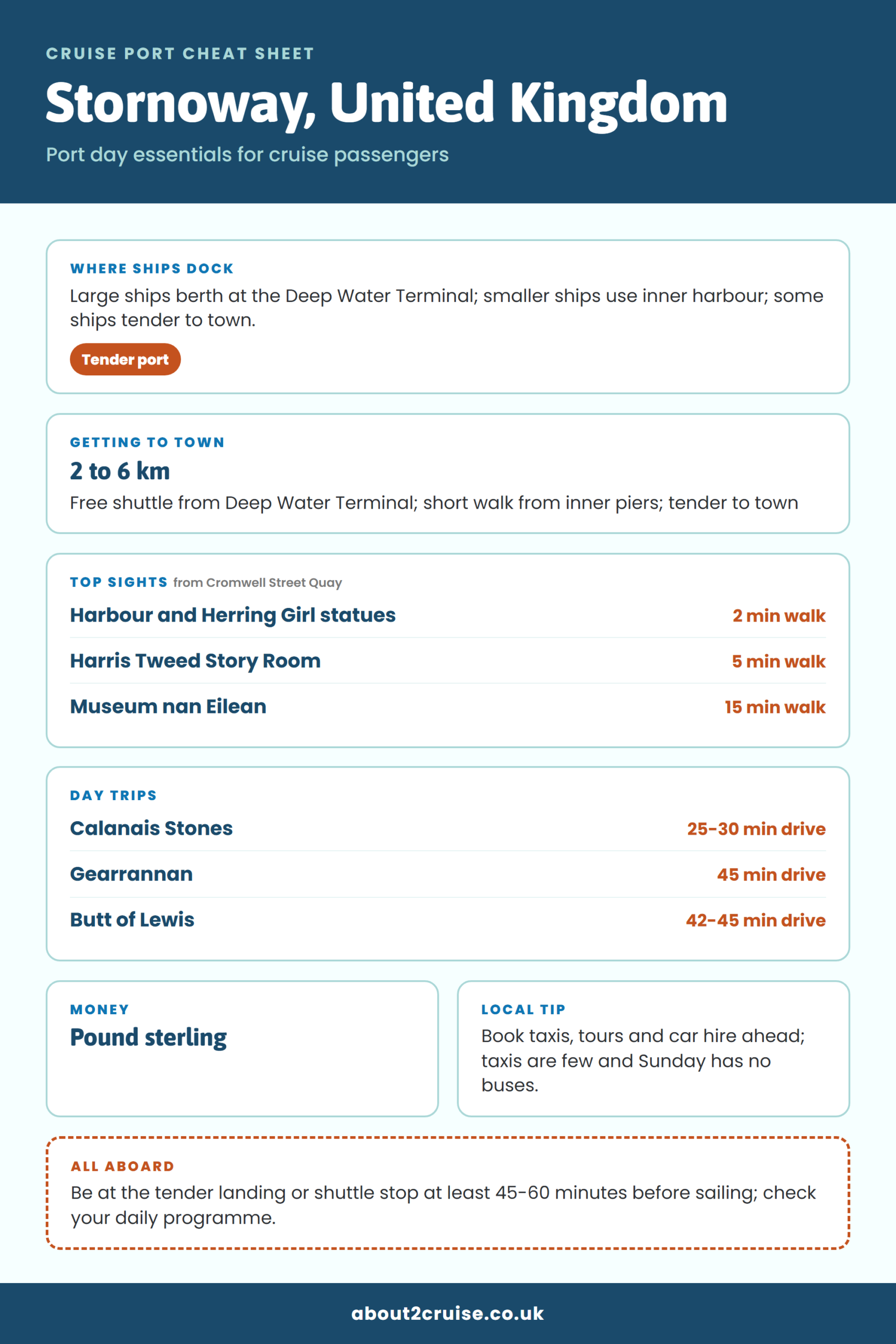
Stornoway has three main cruise scenarios: alongside at the deep water berth, alongside at an inner harbour pier, or at anchor with tenders.
Here’s the simple version:
- Deep Water Terminal: Used by large and medium cruise ships up to 360 metres long and 10 metres draft. There’s no terminal building, no toilets and no left luggage. A free shuttle usually runs to Cromwell Street Quay, taking about 15 minutes. Walking takes about 45 minutes through Lews Castle grounds. No shore power, but fresh water is available and fuel can be supplied by road tanker if pre-booked.
- No. 3 Pier: Used by smaller ships up to 156 metres long and 6.5 metres draft. You land next to the ferry terminal, a couple of minutes’ walk from town. Marina toilets and showers are nearby.
- No. 1 Pier: Expedition and small ships. Close to town, with limited pier-side facilities.
- Tender anchorage: If the ship anchors in the bay, tenders drop you at Cromwell Street Quay, right in the centre. Marina toilets, the bus stop, shops and cafes are nearby.
Berths can change on the day, so always check your ship’s daily programme.
Stornoway cruise port map
Tenders bring you ashore at Stornoway Deep Water Terminal. From there, An Lanntair is about a 24-minute walk and Harris Tweed Story Room about 24 minutes. Tap a pin for directions.
- Stornoway Deep Water TerminalWhere tenders land
- No. 3 PierWhere tenders land
- Stornoway bus stationBus station · About 23 min walk from Stornoway Deep Water Terminal
- Harris Tweed Story RoomTweed heritage centre · About 24 min walk from Stornoway Deep Water Terminal
- An LanntairArts centre · About 24 min walk from Stornoway Deep Water Terminal
- Cromwell Street QuayCruise drop-off quay · About 29 min walk from Stornoway Deep Water Terminal
- Lews CastleVictorian castle · About 2 km from Stornoway Deep Water Terminal
- Museum nan EileanMuseum · About 2 km from Stornoway Deep Water Terminal
- Calanais Standing StonesAncient standing stones · About 21 km from Stornoway Deep Water Terminal
- Gearrannan Blackhouse VillageBlackhouse village · About 26 km from Stornoway Deep Water Terminal
- Arnol BlackhouseBlackhouse · About 21 km from Stornoway Deep Water Terminal
- Dun Carloway brochIron Age stone tower · About 25 km from Stornoway Deep Water Terminal
- Butt of Lewis LighthouseLighthouse · About 36 km from Stornoway Deep Water Terminal
Walking from the Ship into Stornoway
If you’re at No. 3 or No. 1 Pier, yes, it’s a short, easy walk.
From the Deep Water Terminal, it’s more complicated. Depending on the route, it’s somewhere between 2 and 4 miles into town. The best walking route isn’t along the industrial dock road; it’s through Lews Castle Grounds, and it takes about 45 minutes. That walk is lovely if you’re fit and the weather cooperates, but most cruise passengers take the shuttle and save their energy for town or the castle grounds.

Cromwell Street Quay: Shuttle and Tender Drop-Off
This is Stornoway’s de facto cruise interchange. It’s next to the bus station, right at the harbour edge, and a short stroll from the main streets. Volunteer Stornoway Cruise Ambassadors usually meet you here with maps and local advice. In summer you might also see small retail pods behind the bus stop.
What Kind of Place Is Stornoway?
Stornoway is a working town, not a heritage theme park. The harbour mixes fishing boats, the CalMac ferry to Ullapool, yachts and cruise tenders. It’s the largest harbour in the Western Isles, well sheltered and accessible at all tidal states.
The town centre is compact. Cromwell Street and South Beach sit by the harbour and hold cafes, restaurants and the distillery. North Beach and Francis Street are more pub-oriented. You’ll see bilingual Gaelic and English signs. It’s not particularly polished, but it’s real, and you can cover the centre on foot in about an hour.
Stornoway Black Pudding: The One Food to Try
Stornoway black pudding, or marag dubh, has Protected Geographical Indication status. Only black pudding made in the town or parish of Stornoway can legally use the name. It’s softer, richer and more peppery than many mainland versions.

Three local butchers hold the PGI accolade: W J MacDonald, Charles MacLeod and MacLeod and MacLeod. Charles MacLeod has a well-known shop at Ropework Park. Many town cafes also serve black pudding in morning rolls or cooked breakfasts, so you can taste it without buying a whole one. If you want to bring some home, check your ship’s food rules before buying.
Harris Tweed and Local Shops
Harris Tweed isn’t just a souvenir label. It’s protected by UK law. To carry the Orb mark, the cloth must be handwoven by islanders at their homes in the Outer Hebrides, finished in the islands, and made from pure virgin wool dyed and spun locally.
To learn the story, visit the Harris Tweed Authority Story Room in Stornoway Town Hall at 2 Cromwell Street. Tours run Monday to Friday from 10am, with the last session at 2pm. It’s closed Saturday and Sunday. Tickets cost £10, children go free, and lift access is available. Harris Tweed Hebrides sells fabric and clothing at 25 North Beach, Monday to Saturday 10am to 5.30pm. Empty House Traders at 16 South Beach showcases more than twenty local artists and makers.
Calanais Standing Stones: The Big Excursion from Stornoway
Calanais, often spelled Callanish, is the headline reason many people get off the ship. It’s a Neolithic cross-shaped stone setting with a 4.8-metre central monolith inside a 13-stone circle, built around 2900–2600 BC. The stones are in the care of Historic Environment Scotland, while the visitor centre is run by Urras nan Tursachan.
It is not next to the port. By road it’s about 17.5 miles west of Stornoway, around 25–30 minutes by car. If you’re at the Deep Water Terminal, add the shuttle or taxi into town first.
How to Visit Calanais on Your Own
On Monday to Saturday, you can take the W2 West Side circular bus from Stornoway bus station to the Calanais visitor centre stop. A typical morning bus leaves at 09.50 and arrives around 10.22; an afternoon bus leaves around 13.05 and arrives around 13.37. Return buses run at 10.27, 14.20 and 17.20. There are no buses on Sunday. Times are seasonal, so check the current Western Isles timetable.
A taxi from town to the stones is roughly £65–£80 return, but taxis are limited and pre-booking is strongly advised. Car hire is also scarce and should be booked before you arrive.
Calanais Tickets and Facilities
The visitor centre and exhibition are normally open Monday to Saturday, closed Sunday. In quieter months, hours are often 10am to 4pm, with the cafe serving hot food until 3pm. Check seasonal opening for your date.
Exhibition tickets cost around £15 for an adult, £10 for a child aged 5–16, and £45 for a family of two adults and two children. Under-fives and essential companions go free. Historic Environment Scotland members enter free. The ticket is valid for 12 months. You don’t need a ticket for the cafe or shop.
Parking is free, with around 33 general spaces, 4 accessible spaces and 6 EV chargers. Coach parking is restricted during the visitor centre redevelopment. The centre has toilets, but only when it’s open. It’s step-free, but the path from the centre up to the stones climbs a hill that cannot be altered. If mobility is limited, the centre, cafe and exhibition are still accessible, but the stones themselves may be difficult.
Tour or Independent: Which Is Better?
If your ship calls on a Sunday, or you don’t want to worry about buses and taxis, book a ship excursion or pre-booked island tour. If you’re visiting Monday to Saturday and don’t mind fixed bus times, the W2 works. The bus is cheapest, but it gives you limited flexibility. A private or small-group tour usually combines Calanais with Dun Carloway, Arnol Blackhouse or Gearrannan, which is a much better use of your time than the bus alone.
Lewis Chessmen and Museum nan Eilean
Six of the famous Lewis Chessmen are on long-term loan from the British Museum at Museum nan Eilean, next to Lews Castle.
The museum is free, with a suggested £5 donation. It’s open Tuesday to Saturday, 10am to 5pm from April to September and 1pm to 4pm from October to March. It’s closed Sunday and Monday. The museum is on one level and wheelchair accessible. The published pedestrian approach from Bayhead includes steps, so check accessible parking and routes if that’s a concern.
Lews Castle and Grounds
Lews Castle is the Victorian building above the harbour. The ground floor has the Storehouse Cafe, an Outfitters shop and public rooms, open daily from 10am to 4pm. The grounds are open at all hours.
The grounds loop is the best easy walk in Stornoway. You get wide views over the harbour, woodland paths and a shoreline where seals often appear. It’s also the scenic walking route from Deep Water Terminal to town if you skip the shuttle.
Gaelic, Culture and Community
Gaelic is a living language here, not a folk display. Around 57% of people in the Western Isles have some Gaelic skills, about 45% can speak Gaelic, and a smaller percentage use it as their main language. Everyone speaks English, so you’ll have no practical problem, but you’ll notice Gaelic on signs and in conversations.
Stornoway is also more diverse than many visitors anticipate. There are Pakistani and Italian communities going back to the Second World War, and newer arrivals from Syria, Afghanistan, Ukraine and Somalia. More than twenty first languages have been heard in the town’s primary school. An Lanntair, the seafront arts centre, has exhibitions, cinema, theatre, cafe and bar. In July, the Hebridean Celtic Festival, HebCelt, takes over Lews Castle Green and venues around town.
Beaches, Moors and the Butt of Lewis
The Outer Hebrides feel open, raw and ancient. Lewis has broad moorland, peat bogs, lochs and a west coast of cliffs and pale sand beaches. The machair, flower-rich coastal grassland, is at its best in summer. Dalmore and Dalbeg beaches are often named among the best west-coast viewpoints. The Butt of Lewis, the island’s northern tip, has a red-brick Stevenson lighthouse on high cliffs. It’s about 42–45 minutes by road from Stornoway each way, so it works best on a pre-booked tour rather than public transport.
If you only have one day, Calanais gives you the ancient landscape. A private tour that adds west-coast beaches and small settlements gives a fuller sense of Lewis.
Salmon Fishing and Harbour History
Stornoway was once one of Britain’s most important herring ports. In summer, up to 1,000 boats could crowd the harbour, and the town’s population swelled roughly threefold. Up to 3,000 island women worked as Herring Girls, travelling in teams of three, two gutters and a packer, following the fleet as far as Hull and Lerwick.
You can see two Herring Girl statues at the harbour: one on North Beach Quay and one on South Beach. The River Creed salmon and sea trout fishery is managed by Stornoway Angling Association, keeping the fishing heritage current. For most cruise visitors, the harbour and statues are the easiest part of this story to absorb on foot.
A Simple Walking Tour of Stornoway
If you want no bus, no taxi and no fixed schedule, Stornoway works well on foot.
Start at Cromwell Street Quay. Walk along the harbour and look for the Herring Girl statues. Head into the town centre, then up to Lews Castle. Do the grounds loop for the harbour view, then visit Museum nan Eilean if it’s open. Walk back into town for Harris Tweed, craft shops and black pudding in a cafe. End near South Beach or Francis Street for a drink if you have time.
Allow two to four hours, depending on museum and shopping stops. This plan keeps you close to the shuttle or tender point if the weather turns.
Shore Excursions and Island Tours
Typical ship excursions from Stornoway include Lewis Far North Discovery, Lewis and Arnol Blackhouse, Lewis and Blackhouse Village, and Lews Castle Gallows Hill Hike and Museum. These remove the hassle of arranging island transport.
Independent small-group tours are also widely available. A typical five-hour Lewis day tour covers the Butt of Lewis, Arnol, Dun Carloway and Calanais, with a maximum of about eight passengers and pickup from the ship. Prices are often around £150–£160 per person, with admissions extra. Private minivan tours for up to six people, lasting about four hours, are also an option; Calanais and Gearrannan admission is usually extra.
Booking Ahead vs. Walking Up
Don’t assume there will be a line of taxis and guides waiting at the pier. There are a few taxis, a small tour sector and limited car hire. If you want a private tour, taxi, rental car or specific small-group tour, book before you cruise. Ship excursions simplify everything, especially on Sundays or when the weather is uncertain. Walk-up independent sightseeing works best if you stay in town or use the Monday-to-Saturday bus to Calanais.
Wildlife and Birdwatching
Around Lewis you might see common and grey seals, basking sharks, dolphins, porpoise, minke whales and otters. On land, look for sea eagles and golden eagles. Broadbay, north of Stornoway, is good for migrating birds. Puffins nest on the Shiants between April and August; the islands are RSPB-managed and reached by boat from Stornoway.
Wildlife boat trips and land tours run from the harbour, including whale, dolphin, seal and eagle watching combined with minibus tours. If wildlife is a priority, book ahead and check seasonality.
Photo Spots Worth Planning For
The best photos on a Stornoway call are usually outside town. Calanais is the obvious subject: the ancient gneiss and standing stones look best in low light, but even flat or dramatic daylight can produce powerful images. The nearby Calanais II circle is worth a shot too.
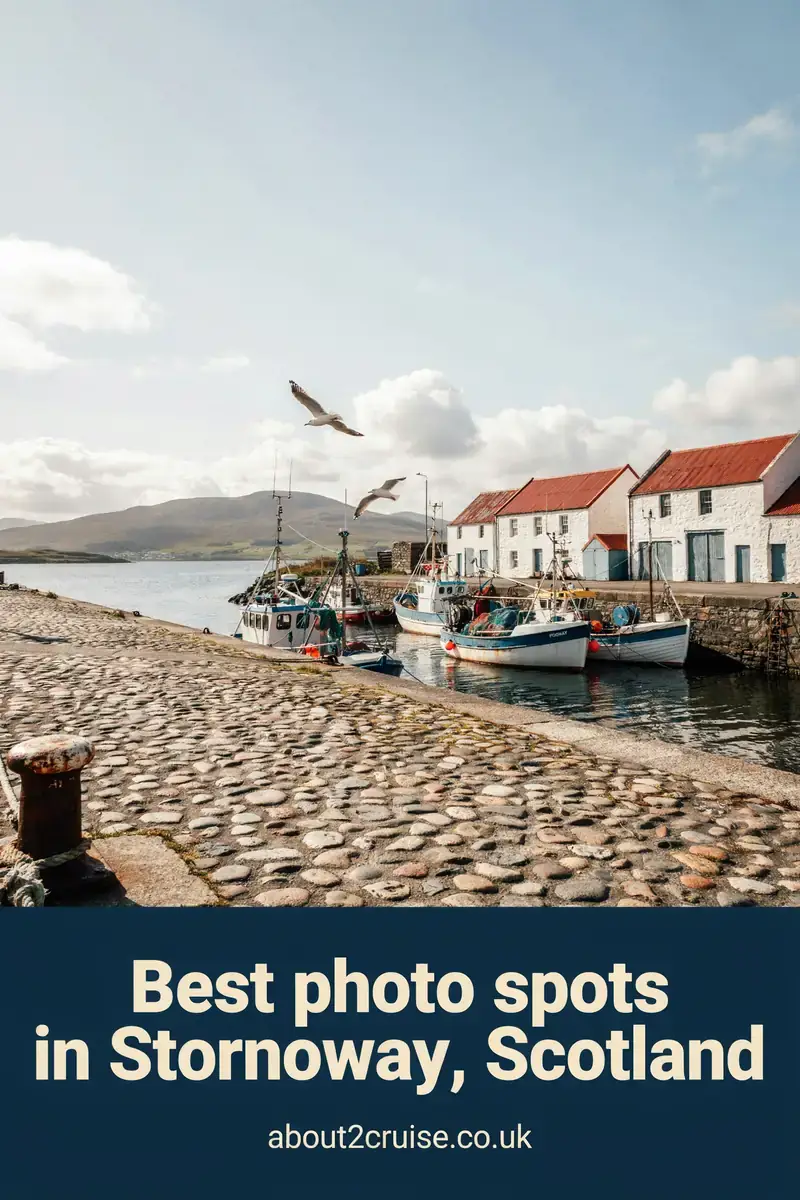
Lews Castle grounds give wide harbour views, woodland and shore. The Butt of Lewis is the place for the red-brick lighthouse, high cliffs and big seas. Dalmore and Dalbeg beaches are excellent west-coast sunset scenes. Pack a rain cover for your camera and be ready to change settings often, the light shifts quickly.
Food and Drink Beyond Black Pudding
Stornoway’s food scene is small but strong. Hebridean langoustines are the premium local catch landed at Stornoway, along with crab and lobster from the inshore fleet. Seafood is the safer bet.
Landfall Gin is made in Stornoway with hand-foraged heather, bog myrtle, bladderwrack, meadowsweet and lemon balm. The visitor centre, restaurant and cocktail bar are at 3 Cromwell Street, serving local seafood cooked over fire from Tuesday to Saturday. Guided gin tastings last about an hour and are best booked online; they cost about £25 per person.
For casual eating, look along Cromwell Street and South Beach. North Beach and Francis Street are pub territory. On Sunday, many cafes and shops close, so hotel restaurants become your main fallback.
Weather, Wind and Midges
Stornoway’s temperatures are moderate, but the weather is active. Average cruise-season daily highs are roughly 12.1°C in May, 14.4°C in June, 15.5°C in July, 15.7°C in August and 13.9°C in September. Rain is frequent, May averages 12.7 rain days, June 12.4, July 14.0, August 14.0 and September 17.7. Annual rainfall is about 1,171 mm over 197 days.
Wind is the bigger issue. Mean wind speeds at Stornoway Airport are around 10.0 knots in August, 10.4 knots in July and 12.2 knots in September. The island has little shelter, so exposed sites feel much colder.
Midge season runs roughly May to September, peaking in still, humid July and August weather. Breezy coastal ground usually keeps them down, but pack repellent and, for still evenings, a head net.
Sunday Closures: Plan Ahead
Lewis and Harris observe Sunday differently from most of Britain. Most shops, supermarkets, cafes, petrol stations and attractions close. There are no public buses. Calanais visitor centre, Museum nan Eilean, Gearrannan Blackhouse Village and the Harris Tweed Story Room all list Sunday closure. Lews Castle grounds stay open at all hours, but the castle’s public rooms and cafe may not follow normal hours.
If your ship calls on Sunday, your realistic options are a ship excursion, a pre-booked private tour or taxi, or a quiet walk around town, harbour and castle grounds. Hotels generally serve food, so you won’t go hungry, but the town will feel very closed. That’s simply the rhythm of the island.
Money and Cash
The currency is pounds sterling. Banks and ATMs are in Stornoway town centre, and currency exchange is available at the post office. Cards are widely accepted, but carry a little GBP cash for buses, small stalls, rural honesty boxes and any transaction that doesn’t take contactless. On Sunday, bank branches may be closed but town-centre ATMs should still be available.
Taxis, Buses and Why You Should Pre-Book
This is the single most important practical point about Stornoway: there are not many taxis, and car hire is limited. Taxis collect at the Deep Water Terminal by prior arrangement; otherwise the main taxi rank is in town. When a large ship is in port, do not expect a queue of spare taxis. Pre-book.
The local bus network is useful but island-scale. The W2 West Side circular serves Calanais and Carloway, the W1 serves Ness, the W5 runs to the airport, and the W7 is the town service. Stornoway Bus Station is in the town centre. Timetables are seasonal. There are no buses on Sundays, 25–26 December, or 1–2 January. Fares are not always easy to find online, so carry cash and allow time.
Tour Meeting Points and Getting Off the Ship
Your meeting point depends on your booking. Ship excursions usually meet on the pier, at the tender landing, or at a clearly signed point near the shuttle drop. Independent small-group tours and private drivers often say they will meet you at the cruise ship pier or at Cromwell Street Quay. Confirm this in writing before you travel. If you’re at the Deep Water Terminal, remember there is no terminal building: you step off the ship, pass security, and find the shuttle or your pickup area.
Getting Back to the Ship on Time
Build in return time before you need it. If you’re tendering, ship excursions usually get priority. Independent passengers may need tender tickets or may wait. Assume the last tender can be 45–60 minutes before sailing, and be at the landing earlier. If you’re berthed at the Deep Water Terminal, don’t rely on a very late shuttle. One line’s published shuttle sheet showed a last return at 16.00, but this varies.
If you walk back to the Deep Water Terminal, allow 45 minutes and don’t leave it late. If you’re delayed, the Stornoway Port Authority number is +44 1851 702688. Missing the ship in Stornoway is especially expensive because the only ways off the island are the ferry to Ullapool or a flight from Stornoway.
Weather Cancellations and Wet-Day Plans
Stornoway can be weather-sensitive. Wind and swell can make tendering unsafe or cause the captain to skip the port entirely. There is no hidden backup port on Lewis. The best preparation is to book excursions with a sensible cancellation policy and avoid non-refundable private tours unless you’re comfortable losing the money.
Before you sail
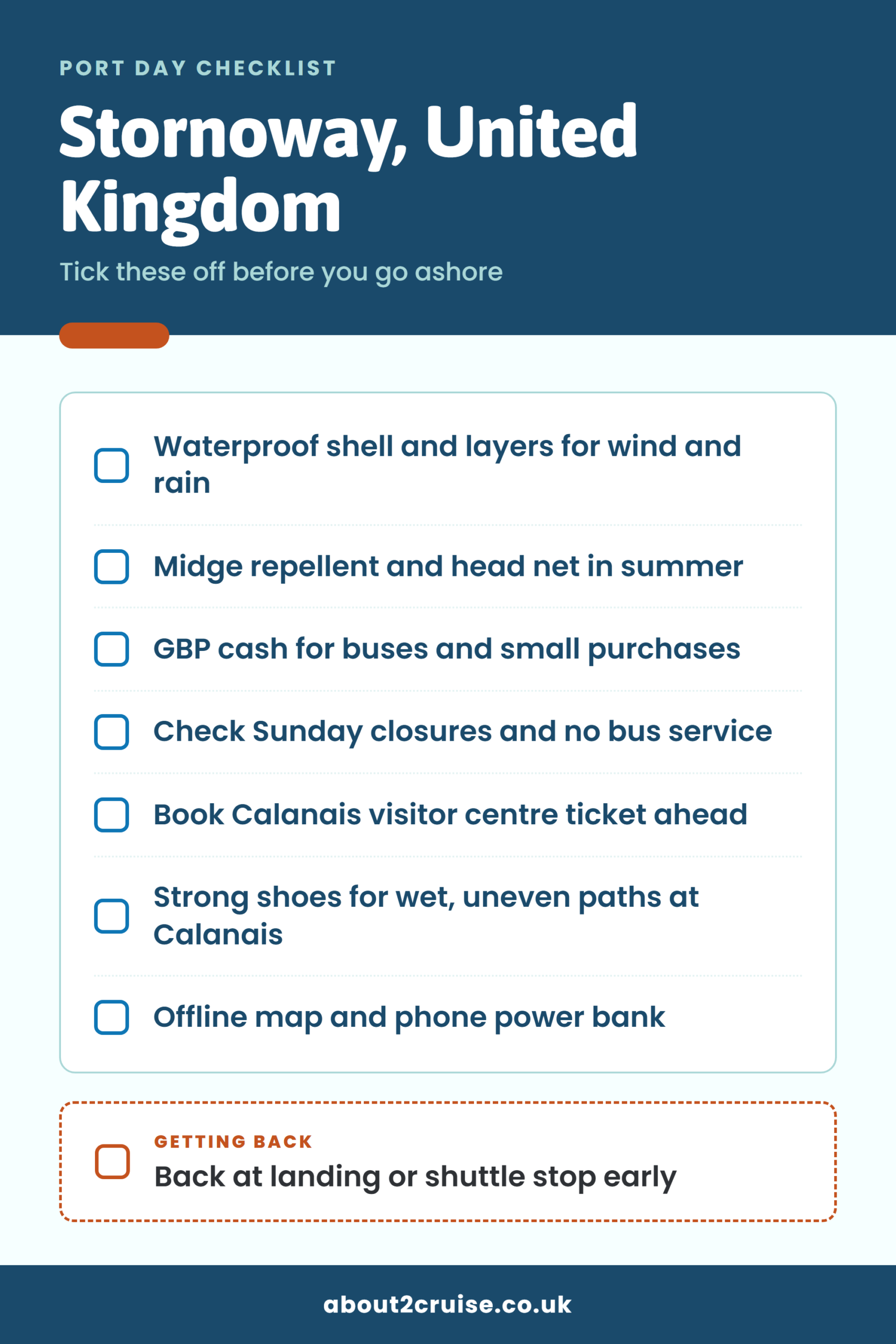
- Book Calanais visitor centre tickets online before you go.
- Pre-book taxis, private tours or car hire before you arrive.
- Check if your call is on Sunday; no buses and many sites close.
Short port day: under 6 hours
- On dockingFrom Cromwell Street QuayStart hereTenders and shuttles drop you beside the harbour, next to the bus station and town centre.
- +15 minStornoway harbour and Herring Girl statuesEasy flat walkA two-minute stroll along the waterfront; look for the two Herring Girl statues on North Beach Quay and South Beach.
- +45 minHarris Tweed Story RoomCheck opening daysHourly tours Monday to Friday, closed weekends. If it is closed, browse Harris Tweed Hebrides on North Beach instead.
- +1 hr 30 minLunch near South BeachTry marag dubhOrder Stornoway black pudding in a roll or Hebridean langoustines at a cafe on South Beach or Cromwell Street.
- +2 hrs 30 minLews Castle grounds loopHarbour viewsWalk up to the Victorian castle, do the grounds loop for harbour views, and watch for seals below.
- +3 hrs 45 minMuseum nan EileanLewis ChessmenFree museum beside the castle; six Lewis Chessmen are on long-term loan. Closed Sunday and Monday.
- All-aboard minus 1 hrBack at Cromwell Street QuayWatch the queueReturn to the shuttle or tender point with time to queue; if you miss two shuttles, find a taxi.
The time on the map is the whole walk, every stop added together.
Open this walking route in Google Maps
If plans change: If the Story Room or museum is shut, spend longer in the castle grounds and An Lanntair's exhibitions, then browse the harbour-side craft shops.
Long port day: 8 hours or more
- On dockingWalk to Stornoway bus stationNo Sunday busesFrom Cromwell Street Quay, it is a short walk to the bus station in the town centre.
- +15 minTake W2 bus to CalanaisCheck return timesThe W2 West Side circular runs Monday to Saturday and reaches the visitor centre stop in about 30 to 40 minutes.
- +55 minCalanais visitor centreBook ticket onlinePre-booked visitor centre ticket lets you skip any queue. The centre is step-free, with a cafe and 16 toilets.
- +1 hr 45 minStanding stonesStay on pathsWalk up the hill from the centre to the Neolithic stone circle. Stay on the paths; off-path moorland is boggy.
- +3 hrs 30 minReturn bus to StornowaySeasonal timetableTake the W2 back from the stones to the bus station. Timetables are seasonal, so note the last useful return.
- +4 hrs 15 minLunch near South BeachTry marag dubhBack in town, order Stornoway black pudding in a roll or Hebridean langoustines at a cafe on South Beach or Cromwell Street.
- +5 hrs 30 minLews Castle grounds and museumLewis ChessmenWalk up from the harbour to Lews Castle for the grounds loop and harbour views; Museum nan Eilean is beside it if open.
The times on the map are for the whole journey there by train and bus.
Get train and bus times in Google Maps
If plans change: If the W2 bus does not run or timetables do not fit, use a pre-booked taxi or ship excursion to Calanais; on Sundays Calanais visitor centre is closed.
On the day, keep your plan flexible. If the weather is too rough for the west coast, a town and castle day is still worthwhile. If it’s wet and windy, prioritise the museum, distillery, Story Room and cafes. Rain is normal here; high wind is the main thing that disrupts tenders and exposed sites.
Accessibility and Mobility
Accessibility depends on where you land. The port has a 15-metre gangway with self-levelling steps, and a 20-metre ramp can be made available on request. Arrange the ramp through your cruise line ahead of time if you need it. Tender boarding always adds uncertainty: the step can be difficult in swell, and wheelchair users may not be able to board tenders at all. An inner-harbour berth is the easiest option; Deep Water Terminal requires a shuttle; tendering involves the most steps and movement.
Shuttle buses from Deep Water Terminal are wheelchair-accessible double-deckers. Museum nan Eilean is fully accessible. Calanais visitor centre is step-free, but the hill to the stones is a barrier. Gearrannan has steep, rocky paths, and some accessible tours omit it. Dun Carloway needs strong footwear and has low entrances. Stornoway town centre is relatively flat, but not every shop doorway is step-free.
What to Pack
Layers matter more than a heavy coat. A waterproof shell is essential, even if the morning looks bright. Wind is constant enough that an umbrella is often useless. Wear shoes that can cope with wet paths, peat mud and uneven ground. If you visit Calanais, stay on paths; the surrounding moorland is boggy. Dun Carloway requires strong footwear.
Pack a small daypack with water, medication, a phone power bank and an offline map. In summer, add midge repellent and a head net for still evenings. Binoculars help for wildlife and seabirds.
Emergency Info
The UK emergency number is 999 or 112. Western Isles Hospital with A&E is on Macaulay Road, Stornoway HS1 2AF, telephone 01851 704704. For non-emergency health advice, check with your ship’s medical centre first. Recorded crime in the Western Isles is among the lowest in Scotland, so the practical risks are weather, slips and timing rather than personal safety.
So, Is Stornoway Worth a Cruise Stop?
Yes, if you know what kind of day you’re getting. Calanais is genuinely world-class. If you want an easy day, Stornoway town, Lews Castle, the museum, Harris Tweed and black pudding make a satisfying low-stress stop. The town is not a polished cruise port, and Sunday closures and limited transport can frustrate independent visitors. But for ancient stones, open scenery and a strong sense of place, it’s one of the more memorable ports in northern Scotland.
Stornoway Cruise FAQs
Do they speak English or Gaelic in Stornoway?
Both. English is universal, and Gaelic is widely spoken and visible on bilingual signs.
Is Stornoway a tender port or does the ship dock?
It can be either. Large ships usually dock at the Deep Water Terminal, smaller ships may use the inner harbour piers, and some ships anchor and tender to Cromwell Street Quay.
How far is Callanish from the Stornoway cruise port?
About 17.5 road miles, or 25–30 minutes by car. Add transfer time into town if you’re at Deep Water Terminal.
Can you visit Callanish independently?
Yes, Monday to Saturday you can take the W2 bus, or use a pre-booked taxi or rental car. There is no Sunday bus, so you need a pre-arranged tour or taxi.
Is there left luggage at the port?
No official left luggage or locker facility at the Deep Water Terminal or ferry terminal. Hotels may store bags for guests only.
Are there public toilets near the tender landing?
Yes, Stornoway marina at Cromwell Street Quay has toilets and showers. The Deep Water Terminal has no toilets. Calanais has toilets, but only when the visitor centre is open.
Do I need cash or are cards enough?
Cards are widely accepted, but carry some GBP cash for buses, small purchases and rural stops that don’t take cards.
What happens if I miss the ship?
You’ll need the CalMac ferry to Ullapool or a flight from Stornoway to rejoin your cruise. Leave generous return time, especially when tendering.
Other Scottish Ports on Your Itinerary
If your cruise also stops at Orkney, Shetland or Invergordon, these guides can help:
Last Updated: 15 November 2026