
Cozumel’s free beaches are real, though only a handful cost nothing and still work on a port day. Playa Caletita is the one you can walk to, about half an hour from Punta Langosta; the rest need a fixed-fare taxi. The wild east coast has the widest free sand and the fewest safeguards.
What “free” means on Cozumel
Four different things get sold as a beach day here, and only one of them is free. Work out which one you’re walking into and you’ll know whether you’re in for a cheap afternoon or a bill for two loungers and a minimum spend.
- Public beach access. No gate fee, no included services, and nobody bringing you a drink.
- Pay-as-you-go beach club. Free to walk in, but you’re expected to order.
- Day pass. One payment covering chair, shade and facilities.
- All-inclusive wristband. Food, drink and usually water toys in one price.
Plenty of beaches look free and aren’t. Playa Palancar is reached only through the Playa Palancar Beach Club, which sells admission that includes a lounger and umbrella, bathrooms and showers, with other charges on top. Paradise Beach sells a Fun Pass for its water toys, and Punta Sur charges park entry even though the beach inside is public.
On a free stretch you bring everything yourself. Nobody rents you a lounger, so pack towels, water, reef-safe sunscreen and your own shade, and use one bag that keeps the towels, the water and the snorkel gear together instead of scattering them across the sand.
Cozumel free beaches map
Each pin shows how far that place is from the nearest cruise pier. Tap a pin for directions.
- Punta Langosta TerminalWhere ships dock
- Puerta Maya TerminalWhere ships dock
- International Cruise TerminalWhere ships dock
- Playa CaletitaBeach · About 1 km from International
- Playa CoronaBeach · About 5 km from Puerta Maya
- Playa PalancarBeach · About 15 km from Puerta Maya
- Chen RíoBeach · About 15 km from Puerta Maya
- Playa San MartinBeach · About 15 km from Puerta Maya
- Playa San JuanBeach · About 6 km from Punta Langosta
- Punta SurPark · About 20 km from Puerta Maya
- Paradise BeachBeach · About 9 km from Puerta Maya
- Punta ChiquerosBeach · About 16 km from Puerta Maya
The sand is public; the way onto it often is not
Mexican federal law makes the beach and the 20 m federal maritime-terrestrial zone behind it common-use national property. The Chamber of Deputies has approved a reform making access free, gratis and permanent for everyone regardless of origin, nationality or social condition, banning charges or restrictive conditions on entry, and setting up a national register of beach access points compiled by SEMARNAT with the municipalities.
Existing law already punishes landowners and concession holders who block or condition access, with revocation for repeat offences.
On the ground, most west-side ways onto the sand are controlled by the resorts and clubs that own the land between the road and the water. You can legally walk the shoreline; you can’t cross their property or park on it. That’s why the free beaches are the ones where a road reaches the sand without crossing private land, and why west-side access keeps shifting as new development goes in.
Royal Caribbean’s Royal Beach Club Cozumel, under construction in the Zona Hotelera Sur, will include a new public beach free to cruise passengers and locals, and the line says the existing public beach stays open during the work. The line’s own position is that beach access is a right guaranteed under Mexican law.
The free beaches side by side
One of these charges admission, and the free ones differ far more in what you get than in what you pay. What’s underfoot, whether there’s shade, how long the taxi takes: that’s where the gaps are.
| Beach | What it costs | Underfoot | On the sand | Getting there | Suits |
|---|---|---|---|---|---|
| Playa Caletita | Nothing | Coarse sand and rock, tide pools | Contested: often nothing, sometimes chairs, umbrellas and a small bar | About 30 minutes on foot from Punta Langosta; taxi from the southern piers | Locals’ town beach; young children on the sandy slope |
| Playa Las Rocas | Nothing; free parking in a lay-by | Ironshore shelf, almost no sand | No loos, no showers, no lockers; access narrowed by a new restaurant | About 3 km north of the downtown ferry pier, by taxi | Shore snorkelling for strong swimmers |
| Money Bar (Dzul-Ha) | Free entry, order from the menu | Rock, steps and ladders into 2 to 4 m of water | Bar, kitchen and tables; no sand to lie on | About 3 km south of the piers, by taxi | Reef snorkelling without a boat |
| Playa Corona | Cover charge waived against a food-and-drink minimum | Shallow coral garden about 20 m offshore | Palapa restaurant, no club, no DJ | About 20 minutes south of San Miguel, by taxi | Snorkelling with a table and shade |
| Playa Palancar | Not free: club admission includes a lounger and umbrella | Sand | Bathrooms, showers, restaurant; other charges on top | About 25 minutes south of the terminals, by taxi | Booked-ahead comfort |
| Chen Río | Free to walk on; pay for lunch | Sand cove behind a rocky point | Small palapa restaurant, no lifeguard | East coast, by-the-hour taxi or rental car | The only east-coast cove you can swim in, on calm days |
| Playa San Martin | Free; free parking | Wide white sand | Nothing on the sand, one beach bar across the road | East coast, by-the-hour taxi or rental car | Empty sand and photographs, not swimming |
Playa San Juan turns up on free-beach lists, and the way in is a mess: the pin can land you at a beach club that charges after 10am, and the alternative is a boat or an unreliable dirt road with no facilities. Ask at the pier before you spend a fare on it.
Things change. Las Rocas access has been narrowed by a restaurant opening on the site, Palancar sells its pass through the club, and a new public beach is going in at the Zona Hotelera Sur. Check the board at your pier and ask before you get in the taxi.
West coast or east coast: the choice that decides the day
The west coast is where the calm water, the piers and every beach club sit. The east coast is the wild side: wide free sand, surf, and long empty views. Nearly every free-beach mistake a cruise passenger makes comes from mixing the two up.
West side: leeward water, comfortable sand mostly in front of a club, all the commercial operations and the town. East side: sand, limestone ledges and tide pools, crashing surf, almost no facilities and no lifeguards, with rip currents that catch people every year.
The east side faces the open Caribbean head-on, which is why the water there reads a deeper blue than the protected channel on the west.
Playa Caletita: the closest free beach to the cruise port
Playa Caletita is the free beach a Punta Langosta passenger can walk to: a small urban beach just south of downtown at the edge of the southern hotel zone, beside the ferry pier area and roughly half an hour on foot from the cruise terminal. It’s open around the clock and mostly used by locals.
Underfoot it’s coarse sand and rock with tide pools, not a smooth sweep of white. Facilities come and go, so you might find nothing at all, or chairs, umbrellas and a small bar.
Pack as though it’ll be nothing. Keep your shoes on, because broken glass turns up.
The beach also sits beside the ferry channel, so boat horns and cargo ships come with the view.
It isn’t wheelchair accessible down to the water, though there are shaded benches within sight of it. For families with young children it has one real advantage: a gentle sandy slope and no current.
Playa Las Rocas: free access, sharp ironshore, no sand
Playa Las Rocas is a free ironshore shelf on the Zona Hotelera Norte, about 3 km north of the downtown ferry pier, with a lay-by for free parking and almost no sand to lie on. It’s a snorkelling ledge rather than a beach, and a restaurant opening on the site has narrowed the way in.
Water shoes are non-negotiable: the rock is sharp and slippery, and the water deepens quickly past the shelf. There are no lockers and no showers, and it’s not a place for young children or non-swimmers.
Money Bar and Playa Corona: no entry fee, but you will buy something
Both of these make their money from the kitchen rather than the gate, so you walk in without paying and settle up at the table. That’s a fair deal if you wanted lunch and shade anyway, and a poor one if you planned to sit on your own towel.
Money Bar (Dzul-Ha) sits about 3 km south of the cruise and ferry piers over the Dzul-Ha reef. You get in by steps and ladders into 2 to 4 m of water, and it’s the best free shore snorkelling on the island, the pick of the DIY snorkelling spots near the cruise port, though it’s a reef club built over rock and not a place to lie on the sand.
Sea urchins on the rocks are the thing to watch. Lunch is fish tacos, ceviche and nachos, eaten between dips.
Playa Corona is about 20 minutes south of San Miguel, a family palapa restaurant with a shallow coral garden roughly 20 m offshore, no beach club and no DJ. There’s a cover charge for the facilities, waived against a food-and-drink minimum.
Ask what the minimum is before you sit, watch for an extra charge if you fall short of it, and pay in pesos: the rate chalked up for dollar notes sits well below the market rate.
Chen Río and Playa San Martin: free sand on the east coast
Chen Río is the east coast’s one swimmable cove: a rocky point shelters the southern side into a shallow pool that stays calm on a good day and turns into a spectator sport on a rough one. The sand is free to walk onto, and the palapa kitchen behind it does whole deep-fried fish with the best lunch view on the island.
Playa San Martin is the wide white sand beach further along the coast road: public access, parking, no chairs, no facilities on the sand, and one restaurant and beach bar across the road. Coolers are allowed, turtle nests are staked and marked, and a wooden platform juts over the beach. It’s not a swimming beach, and it’s not one for small children.
Punta Chiqueros, a crescent bay with a beach bar, is the other east-side spot that can be calm enough to swim inside the bay. The coast has no electricity, so bars and restaurants open roughly 10am to 6pm: plan lunch, not a late afternoon meal.
Sea turtles nest on these quiet beaches from about May to October. The nests are staked and marked, there are no lights on the beach at night, and hatchlings are never to be touched.
Which pier you dock at: Punta Langosta, International Pier or Puerta Maya
Which of the three piers you dock at decides whether your day starts with a walk or a taxi ride. Punta Langosta opens into downtown San Miguel, while the International Pier and Puerta Maya sit south of town and need a cab even to reach the town beaches. Getting that straight is the first job, and the Cozumel cruise port guide covers the buildings themselves.
Punta Langosta is the downtown berth. You exit through the terminal shopping area and walk north along Avenida Rafael E. Melgar into central San Miguel in five to ten minutes.
The International Pier, also called SSA or TMM, is about 3 miles south of town, and Puerta Maya about 3.5 miles south, built by Carnival Corporation and sitting next to the International Pier. Neither is walkable to town; a taxi takes 10 to 15 minutes depending on traffic.
The three get confused constantly, and a comparison of Puerta Maya, the International Pier and Punta Langosta sets them side by side.
Carnival’s ships use Puerta Maya and Royal Caribbean and Celebrity generally berth at the International Pier, but the other lines move between the three from season to season, so check your ship’s berth on the day rather than trusting a list.
Fixed-fare taxis: zone rates, per cab, cash
Cozumel taxis don’t use meters. Fares are set by government-approved zones, every driver carries the official rate card and has to show it on request, and the cards are posted at the ferry terminal, the piers, hotels and beach clubs.
A fare covers up to four people, with a second bracket for five to eight, so a group of nine that fits in one van is still charged as two taxis. Luggage rides free. Cruise-pier fares sit above town fares, and each berth has its own posted rates and its own queue, where you take the next car rather than choosing one.
Assume cash and small notes. Drivers rarely have change for a large bill, and paying in pesos is consistently cheaper than the dollar figure a driver quotes. Drivers also develop a sudden memory lapse about the fixed zone rates when they see a cruise lanyard, so confirm the price before you get in and check the board at the stand.
There’s no Uber, DiDi or other ride-hailing on the island; the rank and a phone call are your options. The union that runs every licensed taxi, the Sindicato de Taxistas Lic.
Adolfo López Mateos, also has vans, wheelchair-ramp vans and limousines bookable in advance, and it has a fare increase request in with the state mobility institute Imoveqroo after roughly a decade without one. Any rate you see quoted online is provisional; the board at the stand is the authority.
Renting a car or jeep for the east side
A rental car or Jeep is the only sane way to string together several east-coast beaches in one day, and it rarely pays for a single beach. Parking at remote beaches can be tight, and a rental usually works out cheaper than multiple taxi trips if you’re out for a full day.
A scooter is two-person short-trip transport and a poor idea with young children. A bicycle is fine for the west-side beaches near town and far too slow for the east side. A taxi by the hour or on a fixed circuit, with route, stops, waiting time and total agreed first, is a real alternative to a rental.
Whatever the vehicle, don’t put six people in a standard taxi: drivers won’t allow it and you’ll be charged for two cars. The detail on zones, rental desks and scooter rules is in the Cozumel taxi fares, car rentals and scooter rules guide.
The return leg, which is how people miss the ship
Getting out to a quiet beach is easy. Getting back at the hour you need is where port days go wrong, and the clock doesn’t negotiate.
Agree the return before you leave the pier. A beach club calling a taxi for you can take time, and when every ship is boarding at once the cars are all heading the other way.
- Fix a pick-up time and take the cab number or the driver’s phone.
- On the east side there are no return taxis at all: what you’re paying for is a driver who waits, with the route, stops, waiting time and total agreed first.
- Keep an hour’s buffer on the time you have to be back on board, not the sailing time.
Five or seven ships in port: what it does to the beach day
Days with five, six or seven ships in Cozumel are routine rather than exceptional, and on those days the clubs fill by late morning and the queues lengthen at every berth. Anything you can book before the ship docks, book it. Cozumel is a fixture of Western Caribbean cruise port guide itineraries for exactly that reason.
With fewer than five hours ashore, stay close to the piers. A beach club or a nearby public beach keeps travel time in proportion to the time you spend on the sand, and the far south and the east side stop making sense. If you’d rather not fix a driver for the day, getting around Cozumel without booking a cruise excursion covers the alternatives.
Seaweed on Cozumel’s beaches: the east side takes it
Sargassum arrives roughly from April to September, heaviest from May to August, and can show up in March or October in a big year; from November to February there’s usually little or none. It piles up on the exposed east side, where nobody is cleaning it, while the sheltered west coast stays largely clear.
So the free, wide, empty beaches are exactly the ones most likely to have weed on the sand in a heavy year. The piers and the clubs near them are on the sheltered west coast, so most port days are unaffected. The Mexican Navy’s SEMAR bulletins and NOAA give a monthly picture, but not beach by beach, so check on the day.
What turns a free beach into a paid day
Shade, chairs, loos, water and tips are what cost money on a beach that charges nothing to enter. None of the free beaches rents any of it, so an umbrella, drinking water and your own towels are the difference between a cheap day and an uncomfortable one.
On a club-fronted beach the minimum spend is the price of the shade. Check what that minimum is before you sit down, pay in pesos, keep small notes for tips and taxis, and don’t settle a bill in dollars at a rate chalked up by the till.
Swimming without a lifeguard, and where your bags go
There are no lifeguards on the east side, and no official list says which Cozumel beaches have one, so treat every swim as unguarded. The east coast’s rip currents catch people every year; if one gets you, swim parallel to the shore rather than fighting it, never swim alone, and keep children within reach.
On the free stretches nobody is watching your things either. Lock bags in the car boot if you have a car, or keep one person with them on the sand. Coolers are allowed under the palapas at Playa San Martin on a first-come basis.
What the paid alternative costs, so “free” has a benchmark
Day passes and entry-or-minimum clubs are priced in a narrow band, and a modest entry fee that buys a chair, shade and shore snorkelling often beats a bare free beach once you add the taxi and the supplies you had to carry. That goes double with children or a short port window.
The club side of the equation is a different purchase, and a guide to Cozumel beach clubs sorts the day passes from the minimum spends.
When the beach plan falls apart: an hour near the pier
Short port calls, a change of berth or a failed taxi hunt can leave you sitting in the terminal shops. Playa Caletita is the ready-made town-side fallback: free, open around the clock, roughly half an hour on foot from Punta Langosta and a short cab from the southern piers.
From Punta Langosta you can also simply walk into San Miguel, and the self-guided walking tour of Cozumel fills a couple of hours on foot from the terminal.
What to wear in Cozumel: outfit ideas for a port day
The single most useful thing in your bag is a pair of water shoes, because Cozumel’s free beaches are rock and ironshore rather than soft sand. Add sandals for the east side, where you may be walking over piles of seaweed, and a cover-up or rash vest for the taxi back into town.


Reef-safe sunscreen that lasts through a snorkel is on every bring list, both for the reef and because there’s no shade to rent on the free stretches. Swimwear plus a light layer handles the beach-to-town change on San Miguel’s waterfront.
If you want more, these Cozumel cruise outfit ideas for a port day go further.
Best photo spots on Cozumel’s beaches
El Mirador on the east coast is the one to build a loop around, with wave-carved rock, a natural arch and blowholes nearby. The blowholes fire only on a big swell and do nothing at all on a flat day, and the rock is sharp and slippery, so stay back from the edge.

Playa San Martin has a wooden platform jutting over the empty sand, and the shoreline photographs wide. The east coast is best shot early, before the light hardens, which on a port day means an early taxi.
For a full day of it, this one-day photo itinerary for Cozumel plots the stops.
Where to eat near Cozumel cruise port
On a beach day you eat where you swim: whole fried fish at the east-side coast road palapas, fish tacos and ceviche at the reef clubs south of San Miguel, or downtown San Miguel for a proper sit-down lunch.
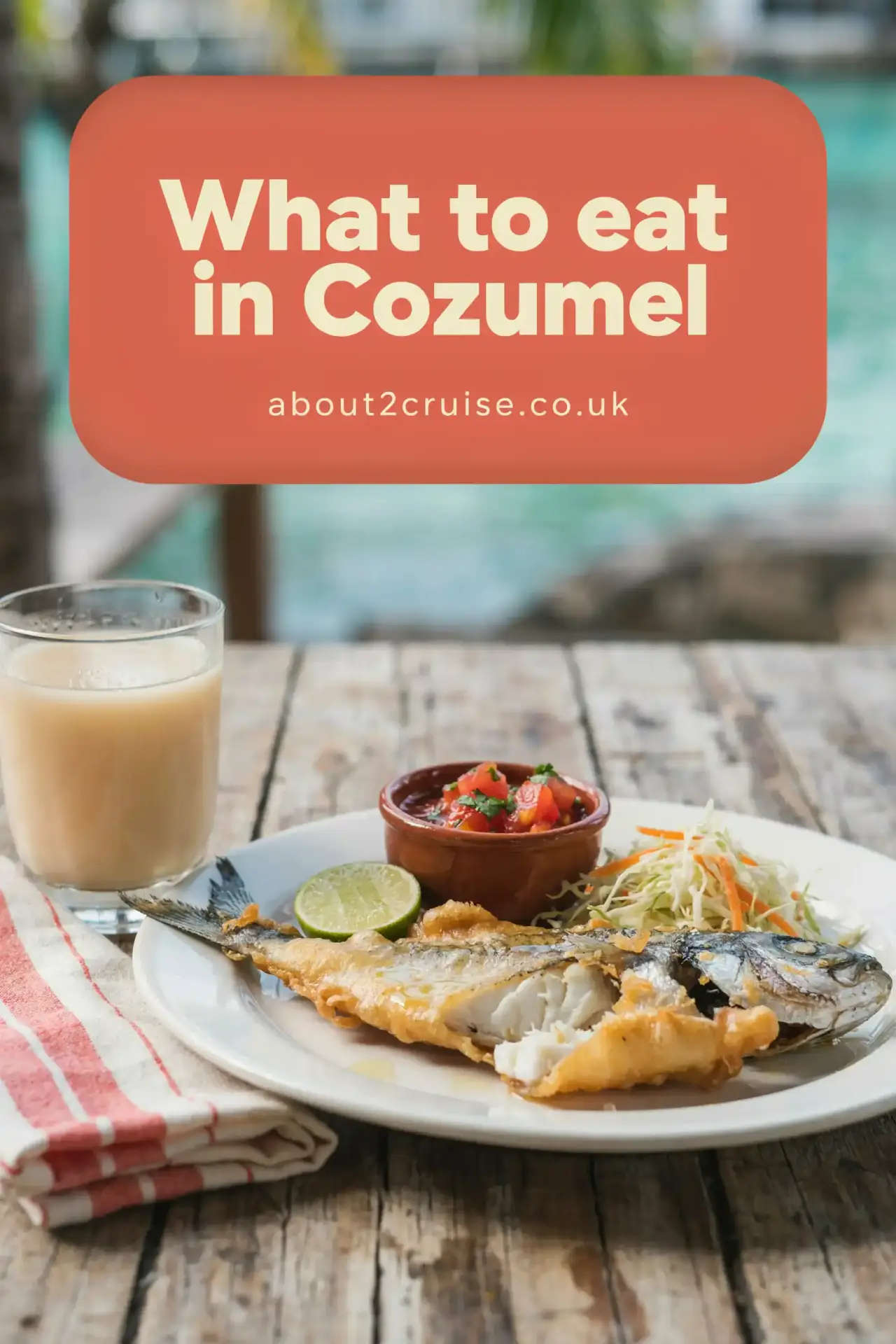
- Pescado frito. A whole fish deep-fried and served with tortillas, the classic east-coast beach lunch.
- Fish tacos and ceviche. The reef-club staples on the west side, eaten between snorkel dips.
- Sopa de lima. Yucatán chicken and lime soup, found along the east-side coast road.
- Margaritas and fajitas. The beach-bar order under a big palapa on the coast road.
East-side kitchens close early because the coast has no electricity, so lunch is the meal to plan. For the city side, there’s a whole taco crawl through Cozumel’s street food that justifies leaving the port.
Cozumel beach FAQs
Are there free public beaches in Cozumel?
There are four you can walk onto for nothing: Playa Caletita, Playa Las Rocas, Chen Río and Playa San Martin. Money Bar and Playa Corona charge no entry fee either, but expect you to order food or drink once you sit down.
Is Playa Palancar free?
It isn’t: the beach is reached only through the Playa Palancar Beach Club, which sells admission including a lounger, umbrella, bathrooms and showers, with other charges on top. Reserve 24 hours ahead and check in before 11am or the chair is released.
Is Cozumel walkable from the cruise piers?
From Punta Langosta it is: downtown San Miguel is five to ten minutes on foot. The International Pier and Puerta Maya are about 3 to 3.5 miles south of town and need a taxi.
Which beaches offer free swimming in Cozumel?
Playa Caletita is the free swimming bet, with a gentle sandy slope and no current, and Chen Río’s rock-sheltered cove works on calm days. Playa Las Rocas and Playa San Martin are not swimming beaches for children or weak swimmers.
What is the prettiest beach in Cozumel?
Playa San Martin, on the east coast, for wide white sand and an empty horizon, and Chen Río for a sheltered cove behind a rocky point. Both are free, and neither has facilities on the sand.
Is it safe to take a taxi in Cozumel?
Licensed taxis all belong to the Sindicato de Taxistas Lic. Adolfo López Mateos and charge fixed zone fares rather than metered ones. Confirm the price before you get in, check the posted board, and pay in pesos.
Last Updated: 14 November 2026