
Alaska’s waters host diverse marine life including humpback whales, orcas, gray whales, sea otters, harbor seals, Steller sea lions, and porpoises. Seabirds like puffins, eagles, and gulls are abundant. Salmon, halibut, and various fish species thrive here. Best viewing occurs in protected waters, fjords, and coastal areas throughout Alaska’s Inside Passage and Gulf regions.
Quick Facts: Alaska Marine Life
| Category | Key Species | Best Viewing Locations |
|---|---|---|
| Large Whales | Humpback, Gray, Orca | Glacier Bay, Frederick Sound, Icy Strait |
| Marine Mammals | Sea Otters, Harbor Seals, Sea Lions | Sitka Sound, Resurrection Bay, Kenai Fjords |
| Seabirds | Puffins, Bald Eagles, Kittiwakes | Kenai Fjords, Chiswell Islands, coastal cliffs |
| Fish Species | Salmon (5 species), Halibut, Rockfish | Rivers, bays, deep channels |
| Peak Viewing Season | All Species | May through September |
Want to know more about Alaska’s incredible wildlife and where to spot it?
Understanding Alaska’s Marine Ecosystem
The cold nutrient-rich waters of Alaska create one of the most productive marine environments on the planet. The mixing of ocean currents brings vital nutrients to the surface, supporting massive blooms of plankton that fuel the entire food chain. This is why you’ll see such abundance when cruising through these waters.
The Inside Passage cruise route threads through a network of protected waterways where marine life congregates. These sheltered channels provide calmer waters for viewing and essential habitat for feeding and breeding.
Whale Watching Strategies for Cruisers
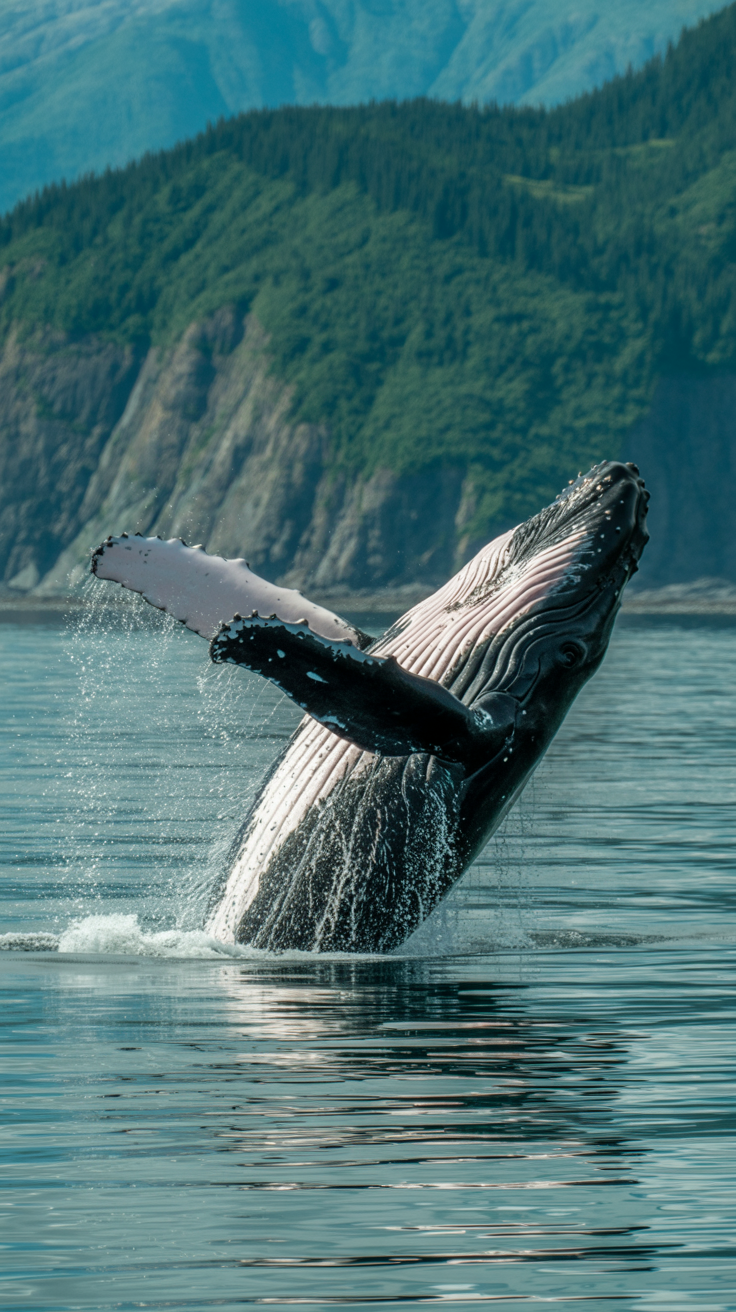
Cruise ships follow established routes through prime whale watching territory, but knowing when and where to position yourself makes all the difference.
Humpback Whale Hotspots
Humpback whales are the showboats of Alaska waters. They’re bubble-net feeding specialists, working in coordinated groups to corral fish. Look for them in:
- Icy Strait near Point Adolphus (arguably the best humpback viewing in Alaska)
- Frederick Sound between Petersburg and Kake
- Glacier Bay National Park
- Stephens Passage near Juneau
These whales are most active early morning and late afternoon when feeding. If you hear the captain announce “blow at 10 o’clock” that means a whale is spouting at the 10 o’clock position relative to the ship’s bow.
Orca Encounters
Orcas in Alaska fall into two categories: resident pods that eat fish and transient pods that hunt marine mammals. The residents are more commonly seen and tend to be less skittish around vessels. Prime orca territory includes:
- Resurrection Bay near Seward
- Lynn Canal near Haines and Skagway
- Prince William Sound
- Waters around Admiralty Island
Orcas travel faster than humpbacks and their tall dorsal fins are unmistakable. Males can have fins reaching six feet high.
Gray Whale Migration Routes
Gray whales make one of the longest migrations of any mammal, traveling from Mexico to Alaska. Unlike humpbacks and orcas, they’re bottom feeders that stir up sediment to filter out small crustaceans. You’ll most often spot them in shallower coastal waters rather than deep channels.
Sea Otters and Pinnipeds
Sea otters are ridiculously easy to love. They’re the teddy bears of the ocean and surprisingly visible from cruise ships when you’re in the right areas. Sitka Sound has a robust population, and they commonly raft together in groups. Watch for them floating on their backs in kelp beds, which they use as anchors to avoid drifting while sleeping.
Here’s something most people don’t know: sea otters have the densest fur of any animal with up to a million hairs per square inch. They don’t have blubber for insulation, so they depend entirely on that fur and a metabolism that requires them to eat 25% of their body weight daily.
Harbor seals are everywhere in Alaska waters. They’re the pudgy spotted ones you’ll see hauled out on rocks and ice floes. Steller sea lions are much larger and congregate in noisy colonies on rocky outcrops. The males can weigh over 2,000 pounds and the rookeries can get impressively loud and smelly.
Bird Watching from Your Cruise Ship
Alaska hosts over 470 bird species, but a few standouts steal the show for cruisers.
Tufted and Horned Puffins
Puffins nest on rocky cliffs and islands, making them challenging to see up close from large cruise ships. Your best opportunities come during kayaking excursions or small boat tours in Kenai Fjords National Park. They’re smaller than most people expect (about the size of a pigeon) and their colorful beaks only appear during breeding season.
Bald Eagles Everywhere
Bald eagles in Alaska are so common they’re almost like pigeons in a city park. Ketchikan and Haines have particularly dense populations. During salmon runs, eagles gather by the hundreds along streams. The Chilkat Bald Eagle Preserve near Haines hosts the largest gathering of bald eagles in the world during late fall.
Other Notable Seabirds
- Black-legged kittiwakes: Small gulls that nest on cliff faces in massive colonies
- Common murres: Penguin-like birds that dive deep for fish
- Marbled murrelets: Rare old-growth forest nesters you might spot fishing in bays
- Glaucous-winged gulls: The standard large gull throughout Alaska waters
- Pelagic cormorants: Black diving birds often seen with wings spread to dry
Fish and Underwater Life
Unless you’re snorkeling or diving (which is not common on Alaska cruises due to cold water), you won’t see much underwater action. However, understanding what’s beneath helps you appreciate what you’re seeing above.
Five species of Pacific salmon return to Alaska streams: king (chinook), sockeye (red), coho (silver), pink (humpy), and chum (dog). The salmon runs drive much of the marine ecosystem. When salmon are running, everything from brown bears and black bears to eagles and orcas shows up for the feast.
Halibut are the giants of the flatfish world, with some individuals exceeding 400 pounds. If you book a fishing excursion, halibut are a primary target. The meat is excellent, and yes, you can usually ship your catch home (for a price).
Practical Viewing Tips
Equipment You’ll Want
- Binoculars (8×42 or 10×42 are ideal for marine viewing)
- Camera with telephoto lens or excellent zoom capability
- Layered waterproof clothing so you can stay on deck comfortably
- Polarized sunglasses to cut glare and see into the water better
- Field guide or wildlife identification app
Positioning on the Ship
When your ship enters narrow passages or approaches shorelines, positioning matters. The bridge will sometimes announce which side will have better viewing. Port means left, starboard means right when facing forward. Generally, on northbound wildlife viewing passages, the starboard (right) side often faces land. Southbound, it’s reversed.
Higher decks give you better distance viewing, but lower decks put you closer to the water for otters and seals. The bow (front) offers unobstructed views but can be windy and spray-soaked.
Timing Matters
Wildlife is most active during low-light conditions. Dawn and dusk see increased feeding activity. Most cruise passengers are eating breakfast or dinner during these prime times, which means less crowding on the observation decks.
Slack tide periods (the brief calm between tidal changes) create mirror-like water surfaces that make spotting distant blows and fins much easier.
Challenges and Realistic Expectations
Alaska wildlife viewing from a cruise ship isn’t a zoo experience. Animals are wild and unpredictable. Some sailings see incredible activity while others are quieter. Weather dramatically affects visibility—fog and rain obscure views and make photography difficult.
Large cruise ships can’t maneuver like small boats. If whales appear off the opposite side of the ship, you’re out of luck unless the ship happens to turn. The captain won’t change course for wildlife (except occasionally in Glacier Bay where regulations are different).
Distance is also a factor. That speck you’re photographing might be a whale, but it’ll look like a pixel in your photo. Manage expectations about photography. Sometimes just watching with binoculars beats struggling with a camera.
Bonus Tips
- Download a whale blow identification chart before your cruise—different species have distinctive blow patterns and heights
- The naturalists and park rangers who board in Glacier Bay are incredible resources; follow them around and ask questions
- Sea conditions matter for viewing: flat calm water is ideal but rare; slight chop is workable; whitecaps make spotting difficult
- Birds diving and circling often indicate bait fish below, which means larger predators might be nearby
- If you see one sea otter, scan the entire kelp bed—they’re often in groups
- Whale tail flukes have unique markings like fingerprints; organizations track individuals through fluke photos
- The more days your cruise spends in Alaska waters (versus days at sea), the better your wildlife odds
- Small ship cruises and expedition vessels offer dramatically better wildlife encounters than mega-ships
- Alaska water temperature hovers around 50°F even in summer—if you fall in, you’ve got minutes not hours
- Breaching whales are unpredictable; if you see one breach, keep watching that area for several minutes
- Bears often feed along shorelines at low tide, so keep your binoculars scanning beaches
Shore Excursions for Enhanced Wildlife Viewing
While your cruise ship provides excellent wildlife opportunities, certain shore excursions take it to another level. Whale watching tours on smaller boats can approach wildlife more closely than cruise ships. Kayaking in Alaska gets you eye-level with otters and seals in their habitat.
Bear viewing excursions (typically via floatplane) to places like Pack Creek or Anan Creek provide guaranteed bear sightings during salmon runs. These book up quickly and cost extra, but the experience is unmatched.
Conservation and Responsible Viewing
Alaska has strict marine mammal protection laws. Vessels must maintain specific distances from whales (100 yards for most species, 200 yards for endangered species). Drones are prohibited in many areas including all national parks.
Never throw food to wildlife. Those charming sea otters and gulls don’t need human handouts and it’s actually illegal. Report any harassment of wildlife to crew members.
The Alaska waters you’re cruising through represent some of the last pristine marine ecosystems on Earth. Climate change is already affecting ice-dependent species and shifting fish populations. What you’re witnessing is precious and worth protecting.
Common Questions and FAQ
What’s the difference between a harbor seal and a sea lion?
Harbor seals have spotted coats, no external ear flaps, and they scoot along on their bellies when on land. Sea lions are much larger, have visible ear flaps, and can rotate their rear flippers forward to walk on all fours. Sea lions are also much more vocal.
Can you see marine life during the entire cruise or only in certain areas?
You’ll have opportunities throughout Alaska waters, but concentrated viewing happens in specific areas like Glacier Bay, Icy Strait, and Frederick Sound. Open ocean stretches between Seattle and Alaska see fewer sightings. The Inside Passage offers the most consistent wildlife viewing.
Do cruise ships have marine biologists or naturalists on board?
Most Alaska cruises have naturalists who provide commentary, but the expertise level varies. Federal park rangers board ships entering Glacier Bay and provide excellent interpretation. Some expedition cruises include PhD-level scientists, while mainstream cruises might have knowledgeable enthusiasts rather than trained biologists.
What if I see an injured or distressed marine animal?
Report it immediately to crew members who can contact the appropriate authorities. The Alaska Marine Mammal Stranding Network handles these situations. Don’t attempt to help the animal yourself as it’s dangerous and illegal.
Are there dangerous marine animals in Alaska waters?
Not to cruise ship passengers. The water itself is the danger due to extreme cold. Marine life isn’t aggressive toward humans. Even orcas, despite being apex predators, have never killed a human in the wild. Sleeper sharks lurk in deep water but you’ll never see one from a ship.
Why do whales breach and what does it mean?
Honestly, scientists aren’t entirely sure. Theories include communication, removing parasites, stunning prey, or just play. It doesn’t necessarily indicate feeding or specific behavior. Breaching appears more common when seas are calm and visibility is good.
Personal Experience
Last summer on our Alaska cruise, I spent most of my time glued to the ship’s railing with binoculars in hand, and it paid off big time. We spotted our first humpback whale near Icy Strait – the crew announced it over the loudspeaker, and within minutes the deck was packed. The whale breached twice, and honestly, no photo does justice to seeing that massive body launch out of the water in real life. Our naturalist guide mentioned early morning is prime time for whale activity, especially in areas like Frederick Sound and Glacier Bay. She wasn’t wrong – the next day around 7 AM, we watched a pod of orcas hunting near Admiralty Island. Their dorsal fins cutting through the glassy water was mesmerizing.
The sea otters were easier to spot than I expected, especially around Sitka and the Inside Passage. They just float there on their backs, cracking open shellfish like they don’t have a care in the world. Puffins were trickier – you really need to be near rocky islands and cliffs, and we had the best luck around Kenai Fjords. Bring a good zoom lens or binoculars because they’re smaller than you’d think. My best tip? Pick the side of the ship facing the shoreline when you’re cruising through narrow passages, dress in layers so you can stay outside comfortably, and don’t sleep in. The best wildlife moments happened when most passengers were still having breakfast.