
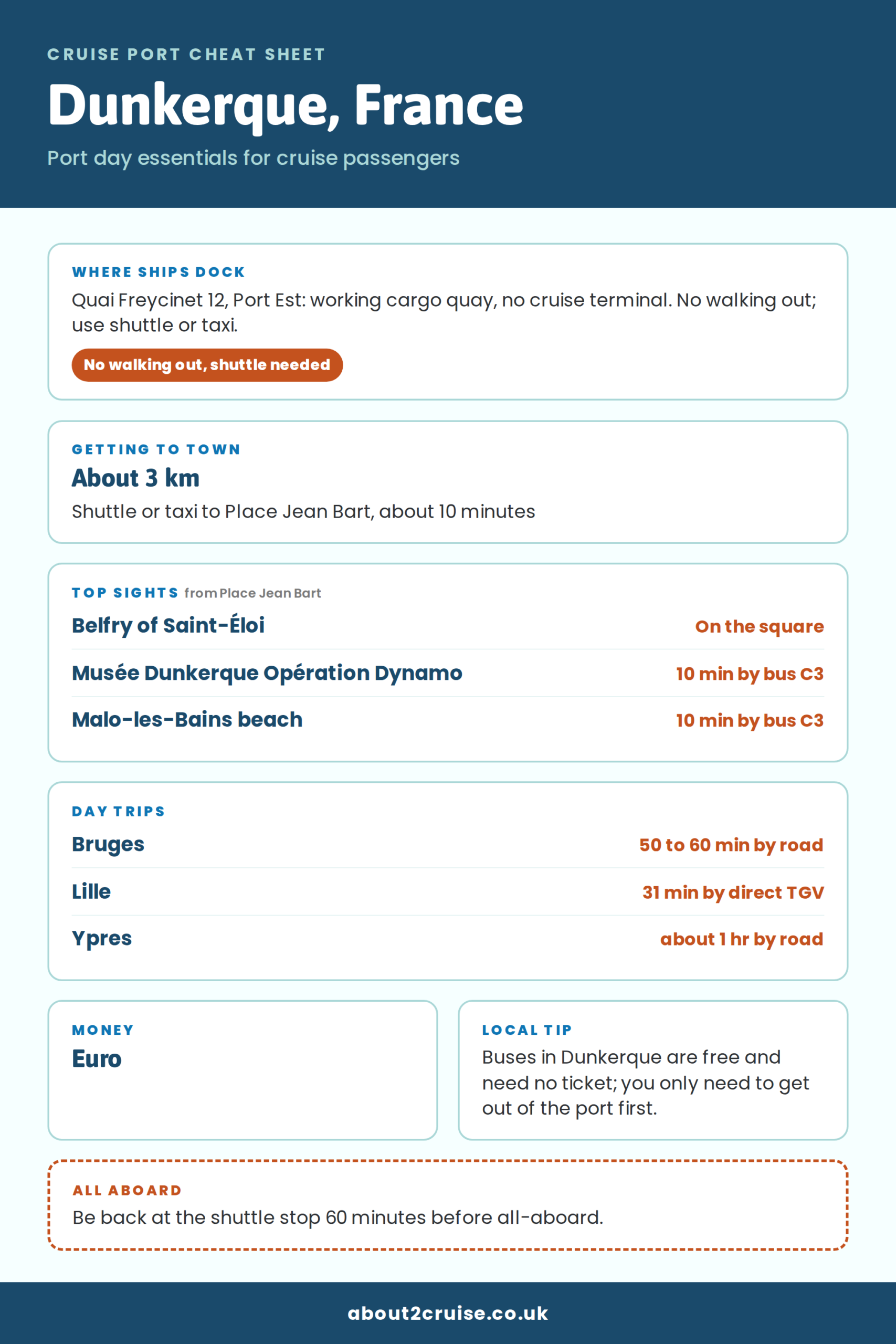
Dunkerque (Dunkirk) is a compact French Channel port where cruise ships berth in a working commercial dock about 3 km from the centre. You cannot walk out of the port: the way ashore is a shuttle or taxi. Once in town, the best short-call plan is the Operation Dynamo museum and evacuation sites, Malo-les-Bains beach, and the UNESCO-listed belfry.
What Makes Dunkerque Worth a Port Day
Dunkerque is not a polished cruise terminal destination. It’s a working freight harbour that also happens to be one of the most evocative Second World War memory sites in France.
The main reason to get off the ship is Operation Dynamo. In May and June 1940, 338,226 Allied soldiers were evacuated from the port and beaches here. The town also has a fine sandy beach at Malo-les-Bains, a UNESCO-listed belfry and a strong Flemish food culture. For more context on this stretch of coast, see our northern France cruise ship port guide.
Where Your Ship Actually Berths
Most cruise ships use Quai Freycinet 12 in the Port Est commercial docks. There is no dedicated cruise terminal building and no published passenger map. The quay is a cargo berth about 3 km west of Place Jean Bart, the central square.
The essential thing to know is that the docks are industrial and closed to pedestrians. You cannot walk from the ship along the quay or out of the port gate. The road route into town would take roughly 35–40 minutes on foot, much of it on port roads and dual carriageways, and it is neither safe nor permitted. Take the shuttle, a taxi or a pre-arranged pick-up.
Because there is no official published berth allocation tool, confirm the exact berth and exit point for your call with the ship or cruise line before arrival. If you are meeting a guide or driver, give them the ship’s port gate or meeting point, not just “the port”.
Dunkerque cruise port map
Ships dock at Quai Freycinet 12. From Place Jean Bart, Princess Elizabeth is about a 8-minute walk, Musée maritime et portuaire about 9 minutes and Dunkirk Memorial about 17 minutes. Tap a pin for directions.
- Quai Freycinet 12Where ships dock
- Place Jean Bart (shuttle stop)Town square · About 2 min walk from Place Jean Bart
- Princess ElizabethPaddle steamer restaurant · About 8 min walk from Place Jean Bart
- Musée maritime et portuaireMaritime museum · About 9 min walk from Place Jean Bart
- Gare de DunkerqueRailway station · About 13 min walk from Place Jean Bart
- Dunkirk MemorialCommonwealth war memorial · About 17 min walk from Place Jean Bart
- Musée Dunkerque Opération DynamoWWII evacuation museum · About 22 min walk from Place Jean Bart
- Malo-les-Bains beachSandy beach · About 3 km from Place Jean Bart
- Fort des Dunes19th-century fort · About 5 km from Place Jean Bart
Getting from the Ship into Dunkerque
Shuttle: On transit call days, most lines arrange a port shuttle. The usual drop-off is around Place Jean Bart. Journey time is about 10 minutes. Frequency is often every 10–20 minutes, but this varies by call and line: some shuttles are free, some are charged, and some calls have no shuttle at all. The port can run free discovery shuttles for certain calls. Confirm on board whether a shuttle is running, where it drops, whether it is free and when the last return leaves. Assume the last shuttle will be one to two hours before all-aboard unless the daily programme says otherwise.
Taxis: The city taxi number is 03 28 66 73 00. There is a rank at Place de la Gare, but taxis waiting directly at the quay are not guaranteed. Metered fares start at about €8, with higher rates at night and on Sundays and public holidays. If you are going to Bruges, Ypres, Lille or the outlying memorials, book the return journey.
Public bus: Dk’Bus is free for everyone, seven days a week, with no ticket or validation. However, you must first get out of the port by shuttle or taxi. There is no public bus stop at the cruise quay because the quay is not a passenger area. Once in the centre, bus C3 runs to Malo-les-Bains beach in about 10 minutes. Buses C2 or C4 serve the Parc Marine / Hôtel de Ville area for the maritime museum.
If You’re Starting or Ending a Cruise in Dunkerque
Turnaround passengers do not check in at the ship. The passenger meeting point is the Pavillon des Maquettes, 2502 Route de l’Écluse Trystram. On embarkation day you drop bags and passengers there first, park if you have a car, then take the shuttle to the ship. The flow is reversed on disembarkation.
Cruise parking with CFC is kept in a barrier-enclosed port compound for about €10 per day. Book at least 48 hours before sailing. Bays are 2.5 m x 5 m, with accessible bays 3.3 m x 5 m. Only vehicles up to 5 m are accepted, so no campervans.
Dunkerque station is in the town centre, about 10 minutes’ walk from the maritime museum. Lille is about 31 minutes by direct TGV to Lille Europe, or just over an hour by TER to Lille-Flandres. Paris Nord is roughly 1h37–2h12 direct. The nearest airport is Lille-Lesquin, about 90 km away.
Place Jean Bart and the UNESCO Belfry
The natural anchor for a cruise call is Place Jean Bart, the town’s main square and the usual shuttle drop-off. From here you can reach the belfry, the shopping streets and the tourist office on foot.
The Belfry of Saint-Éloi is 58 m high and carries a 50-bell carillon. It is part of the UNESCO World Heritage series “Belfries of Belgium and France”. You take a lift to the carillon level and then climb 65 steps to the open terrace. Adult tickets are €5, ages 7–18 pay €3.50, and a family ticket for two adults and two children is €14. The terrace gives a 360-degree view over the town, port and beach. It can close in high wind. The carillonneur plays on Saturdays from 16:00 to 17:00.
The tourist office and its shop are at the foot of the belfry. This is the easiest place to buy tickets, pick up a town map or ask about guided Dynamo walks. Compact shopping streets cluster around the square. Local beer, chocolates and Flemish specialities make good souvenirs.
Operation Dynamo: The Museum and Evacuation Landmarks
The definitive first stop is Musée Dunkerque 1940: Opération Dynamo, in the 1874 Bastion 32 at 32 rue des Chantiers de France. The bastion was the French and Allied command post during the battle. The museum tells the story of the evacuation through original objects, maps, archive film and bilingual displays. Adult entry costs €8, ages 12–18 and students pay €5, and children under 12 are free. A joint ticket with the maritime museum is €10. It is open daily in season from 10:00 to 18:00, with last admission before 17:00, but closes for a winter period, so check if your cruise falls outside the main season. Allow about one to one and a half hours.
The museum is labelled for all four disability categories and the documentary has French and English subtitles. A 10-minute walk from the museum brings you to the East Mole, the sea wall where thousands of men were lifted off the beaches into deeper water. It is a simple, moving view over Malo-les-Bains beach and the Channel, and one of the strongest stops for a short call.
If you want context, the tourist office runs guided Dynamo Tours covering the beach, port, town centre and the British Memorial. Private guided tours can be arranged, and there is a self-guided Operation Dynamo trail app.
The Dunkirk Film Connection
Christopher Nolan’s Dunkirk was shot on the beach at Malo-les-Bains and in the town’s streets, with around 2,000 local extras over a six-week shoot. The film gave the memory sites a lasting lift: visitor numbers to the 1940 museum roughly multiplied by 4.5 and Fort des Dunes by about nine over the following decade. The paddle steamer Princess Elizabeth, which evacuated 1,673 soldiers and appeared in the film, is moored in the city centre as a restaurant.
The beach tourist office in the Kursaal, used as a production workshop during filming, is the starting point for walking tours of the film locations. If you’re a film fan, combine the 1940 museum with a walk along the Malo-les-Bains dyke and you’ll recognise the shoreline immediately.
The Little Ships and Why They Matter Here
The “Little Ships” were the roughly 850 privately owned vessels that crossed the Channel in 1940 alongside Royal Navy, Merchant Navy and allied ships. They included barges, fishing boats, pleasure steamers and lifeboats. More than 200 vessels were lost. Every few years, surviving Little Ships return to Dunkerque for commemorations, and the Princess Elizabeth remains in the city as a floating restaurant and reminder. You may not have time to visit all the commemorative sites, but the museum and the East Mole give the best sense of the story.
Malo-les-Bains Beach and the Waterfront
Malo-les-Bains is the fine sand beach that runs east of the town centre. It has Belle Époque villas, coloured beach huts and a broad dyke lined with restaurants and terraces. Bus C3 runs from the centre in about 10 minutes. On a summer day it is a legitimate second or third stop after the museum.
Lifeguard posts are at Malo Centre and Malo Terminus, supervised roughly from mid-June to mid-September. Green means supervised, yellow means swell, red means bathing is banned, and purple indicates a pollution warning. Bathing can be temporarily closed after heavy rain, so read the flags rather than the weather alone.
Further east, at low tide, the wrecks of Crested Eagle and Devonia emerge at Zuydcoote beach. The Zuydcoote bunker line between Leffrinckoucke and Zuydcoote is another important defensive landscape. This is more of a photographer’s excursion than a walk from the shuttle drop-off, but it works if you have a taxi or a guide.
Fort des Dunes and the British Memorial
Fort des Dunes in Leffrinckoucke is a 19th-century fort that took heavy bombing in 1940, with nearly 100 killed there, including General Janssen. Eight resistance fighters were executed at the fort in 1944. It is self-guided with an audio guide in English, French, Dutch and German. Adult tickets are €7, ages 7–18 and students pay €3.50, and children under 7 are free. Allow about one and a half hours. The circuit has staircases and is not accessible for reduced mobility. The exhibition spaces are cold, so take a layer.
Fort des Dunes is open only from early March to 31 October, Tuesday to Sunday, 10:00–18:00. A free bus runs every 10 minutes from the centre of Dunkerque to the fort stop. This is a good half-day option if you want more than the central museum and beach.
The Dunkirk Memorial is at the entrance to the Commonwealth section of Dunkirk Town Cemetery, south-east of the town on the road towards Veurne. It commemorates more than 4,500 British Expeditionary Force dead of the 1939–40 campaign who have no known grave. The surrounding cemetery holds 810 Second World War graves. It is best reached by taxi or as part of a guided tour.
Food, Drink and Markets
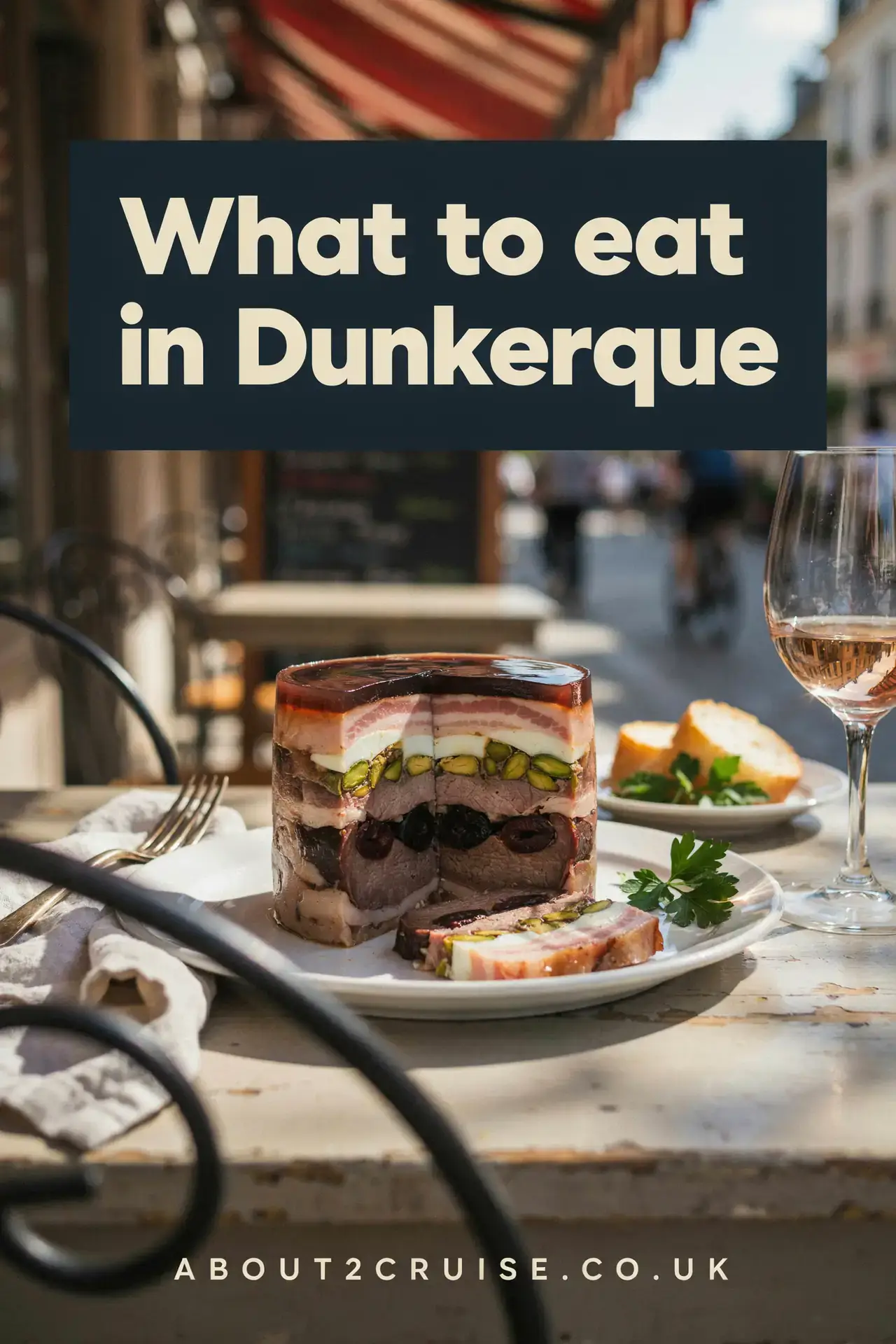
Dunkerque is Flemish in its cooking. The local specialities to try on a short call are potjevleesch, cold potted meat in jelly served with chips and salad; moules-frites, the standard northern French mussels and chips; and carbonade flamande, beef braised in beer with brown sugar and gingerbread. Maroilles cheese appears everywhere, and local beer is the default drink.
The easiest single stop is Halles des Sœurs Blanches, a covered food hall about 150 m from Place Jean Bart with around 15 counters. It is a good way to sample shrimp croquettes, maroilles chips, cheeses and beer without committing to a long restaurant lunch. It opens Sundays 09:00–14:00 and Wednesday and Saturday 08:00–19:00. The streets immediately around Place Jean Bart also have brasseries and estaminets serving the same dishes.
The open-air market is on Wednesday and Saturday, 08:00–13:00, at place du Général de Gaulle. That is the best place for local produce, cheese, and food gifts.
Carnival of Dunkerque: Dates, Crowds and the UNESCO Mix-up
Dunkerque’s carnival runs from January to April, peaking in the three days before Ash Wednesday, the “Trois Joyeuses”. On the first of the three days the town hall balcony throws about 450 kg of smoked herrings into the crowd at 17:00. Peak weekends can draw up to 70,000 people, and the Saturday-night Kursaal balls sell out.
If your cruise calls during carnival season, expect the centre to be busy, boisterous and difficult to move through quickly. It is not the right day for a quiet museum visit, but it is an extraordinary spectacle. Dress code is the traditional clet’che costume. If you join the crowd, wear broken-in shoes that hold your ankle.
One correction you will see repeated by tourism copy: the carnival itself is not on UNESCO’s intangible heritage list. The UNESCO-listed asset in Dunkerque is the belfry. The UNESCO-listed processional giants and dragons cover other French and Belgian towns, not Dunkerque.
Day Trips: Bruges, Lille, Ypres and Bergues
Dunkerque is close enough for a full-day excursion, but the practical choice depends on your port time and transport.
Bruges is about 70–76 km by road, roughly 50–60 minutes in a taxi or organised tour. By train it is awkward, about 2h43 via Lille Europe and Brussels-Midi, so independent train travel rarely makes sense on a cruise call. Cruise-line excursions or a private vehicle are the realistic approach. Lille is 66 km and much easier by train: about 31 minutes direct TGV to Lille Europe, or about 1h08 to Lille-Flandres by TER. Ypres is about an hour by road and is best by tour or taxi. Bergues is about 10 minutes by train from Dunkerque and is a small, pretty walled town if you want something low-key.
If you only have a short call, stay in Dunkerque. The 1940 museum, East Mole, belfry and Malo-les-Bains beach will fill four to six hours without spending most of the day in a vehicle.
Practical Details: Opening Hours, Weather, Money and Safety
Opening hours: Musée Dunkerque 1940 is open daily in season 10:00–18:00, last entry 17:00, but closes in winter. Fort des Dunes is open only from early March to 31 October, Tuesday to Sunday, 10:00–18:00. The maritime museum is closed on Tuesdays outside school holidays and on 1 January, 1 May, 25 December and the Monday before Shrove Tuesday. The belfry is open Monday 10:00–12:30 and 14:00–17:00, Tuesday to Saturday 10:00–13:00 and 14:00–17:30, and Sunday afternoon 14:00–17:30.
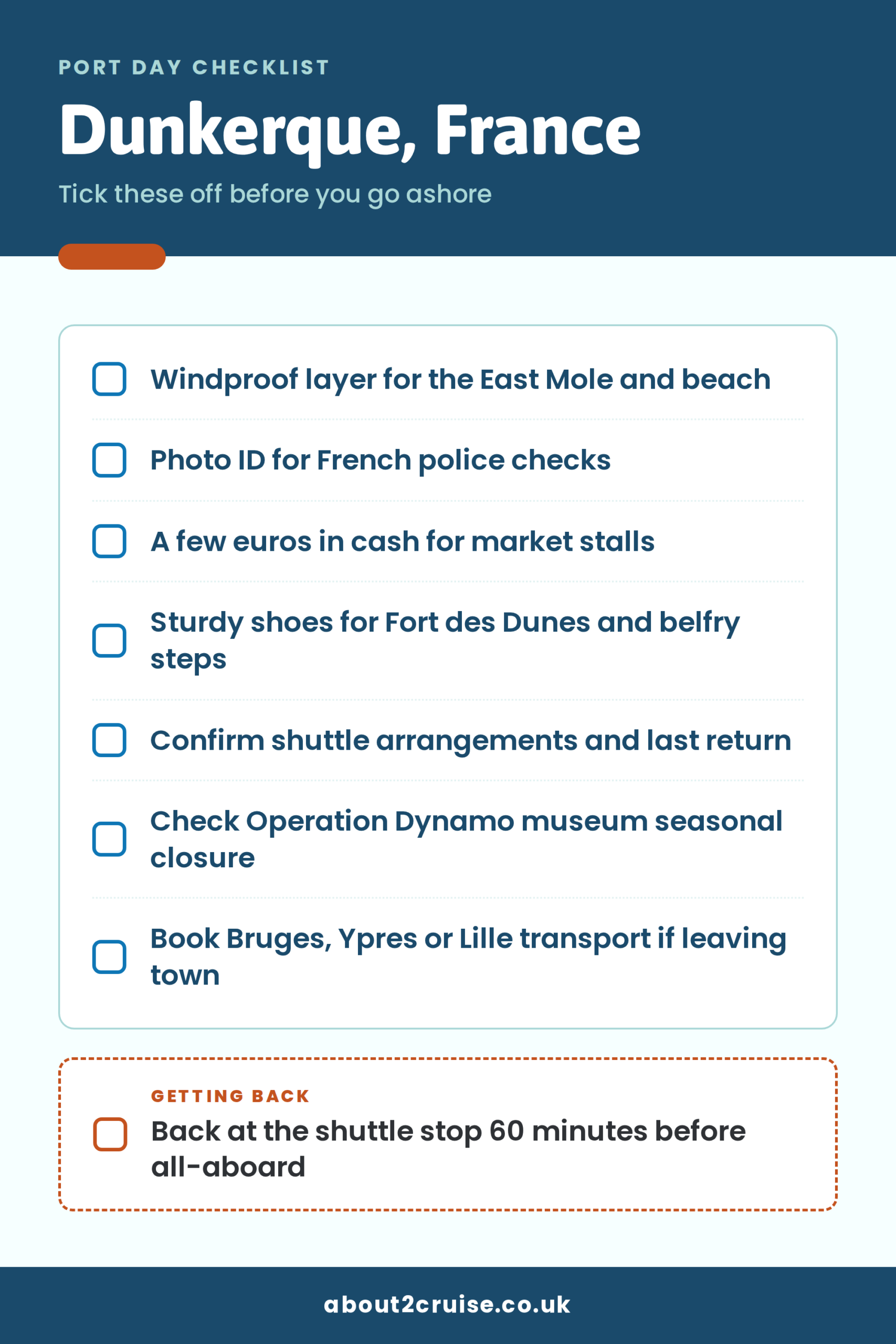
Weather: Dunkerque has an oceanic climate, cool and windy. Average daily maximum temperatures are around 21.7°C in August and 11.1°C in November. The one essential item is a windproof layer: the East Mole, beach and belfry terrace catch the full North Sea wind. Wear sturdy shoes for Fort des Dunes and flat shoes for the belfry steps.
Money and cards: The currency is the euro. Museums, cafés and shops take cards, but small market stalls may prefer cash. City buses are free, so you need no transport money. Service is included in restaurant prices; a tip is optional and not expected for ordinary service. Public toilets may require a small coin, so keep a few euro coins handy.
Safety: Treat Dunkerque like any French city. Pickpockets can work in teams around tourist sites and markets, so keep your passport, cards and cash in separate pockets and do not leave valuables in vehicles. In France you must be able to prove identity on demand, so carry photo ID. On the beach, follow the flag system. The port itself is the biggest hazard: do not attempt to walk through it. Reboarding deadlines are strict, so leave a 60-minute buffer before the ship’s all-aboard time.
Accessibility, Mobility and Luggage
Dunkerque holds gold-level “Destination Pour Tous” accessibility status, but that does not change the reality of the port. The industrial quay has no pedestrian route, and shuttle vehicles vary by call, so passengers with limited mobility should confirm the shuttle arrangements with the cruise line before arrival.
The 1940 museum is labelled for all four disability categories and has lifts, accessible toilets and subtitled films. The maritime museum building is wheelchair accessible, but the historic ships and lighthouse are not. Fort des Dunes is not accessible for reduced mobility because of staircases and uneven outdoor surfaces. The belfry involves a lift and 65 steps; it is not suitable for all visitors.
There is no left-luggage at the cruise quay and no SNCF luggage locker at Dunkerque station. Third-party bag drops operate near the station and belfry from around €4.40–€4.90 per bag per day. If you are disembarking and have an evening train, use one of those rather than trying to carry bags around town.
Suggested Port-Day Plans
Short call, 4–5 hours: Take the shuttle or taxi to Place Jean Bart. Climb or photograph the belfry, then walk or take bus C3 to the 1940 museum. Allow 1–1.5 hours inside, walk to the East Mole for the beach view, then return to Place Jean Bart for a quick lunch at Halles des Sœurs Blanches. Leave a 60-minute buffer for the port transfer.
Before you sail
- Confirm shuttle arrangements, drop-off and last return with the cruise line before arrival.
- Book transport in advance if you plan Bruges, Ypres or Lille; taxis at the quay are not guaranteed.
- Check Fort des Dunes seasonal closure and maritime museum Tuesday closures before you book.
Short port day: under 6 hours
- On dockingTake the port shuttle or taxiNo walking outNo walking out of the industrial docks. The shuttle or taxi takes about 10 minutes to Place Jean Bart.
- +15 minBelfry of Saint-Éloi65 stepsOn the square. Climb the 58 m tower for the port view; a lift then 65 steps. Terrace can close in high wind.
- +45 minBus C3 to Opération Dynamo museumFree busTake free bus C3 towards Malo-les-Bains, about 10 minutes to the museum stop.
- +1 hr 15 minOpération Dynamo museumAllow 1.5 hoursAllow 1 to 1.5 hours in the Bastion 32 museum.
- +2 hrs 45 minEast MoleA 10 minute walk from the museum. The sea wall where thousands were evacuated, with a view over Malo-les-Bains beach.
- +3 hrs 15 minLunch on Malo-les-Bains dykeTry potjevleeschTry moules-frites or potjevleesch at a seafront brasserie. The dyke is lined with restaurants.
- All-aboard minus 1 hrBack at the shuttle stopLeave a bufferBus C3 back to Place Jean Bart, then shuttle or taxi to the ship. Shuttle queues build late in the day.
The time on the map is the whole walk, every stop added together.
Open this walking route in Google Maps
If plans change: If the Operation Dynamo museum is closed out of season, swap it for the maritime museum and the East Mole, then keep the same return time.
Long port day: 8 hours or more
- On dockingTake the port shuttle or taxiNo walking outNo walking out of the industrial docks. The shuttle or taxi takes about 10 minutes to Place Jean Bart.
- +15 minBus C3 to Opération Dynamo museumFree busTake free bus C3 from Place Jean Bart towards Malo-les-Bains, about 10 minutes.
- +45 minOpération Dynamo museumAllow 1.5 hoursAllow 1 to 1.5 hours. The bastion was the French and Allied command post.
- +2 hrs 15 minEast Mole10 minute walk from the museum. The evacuation sea wall with a view over the beach.
- +2 hrs 45 minLunch on Malo-les-Bains dykeTry potjevleeschMoules-frites or potjevleesch at a seafront brasserie, then walk the beach.
- +4 hrs 30 minWalk Malo-les-Bains dykeFollow the pedestrian dyke past the beach huts and Belle Époque villas. Flat, easy walking.
- +5 hrs 30 minBus back to Place Jean Bart, then belfryBack to centreTake bus C3 back to Place Jean Bart and climb the belfry, or photograph it from the square.
The time on the map is the whole walk, every stop added together.
Open this walking route in Google Maps
If plans change: If the belfry is closed, spend the extra time at the tourist office shop and the streets around Place Jean Bart before the shuttle.
Saturday or market day: Add the market before or after the museum, but keep an eye on time. The market ends at 13:00.
Longer call, 6–8 hours: Museum and East Mole, then Fort des Dunes by free bus or taxi, then an hour on the Malo-les-Bains dyke or a harbour cruise. If you want a full day out, use Bruges, Ypres or Lille, but book through the ship or a reliable operator because independent public transport to Bruges and Ypres is not efficient.
More Northern France Cruise Port Guides
If you’re sailing this coast, you may also find our Le Havre cruise ship port guide, Cherbourg cruise ship port guide and Honfleur cruise ship port guide useful. The full set is in our northern France cruise ship port guide.
Quick Answers to Common Dunkerque Cruise Questions
Is Dunkerque worth visiting on a cruise?
Yes, especially for the 1940 Operation Dynamo story. The museum, East Mole and nearby memorial sites make a compact, evocative port-day combination, and Malo-les-Bains beach is a straightforward add-on.
Can cruise passengers walk from the ship to Dunkerque town centre?
No. The cruise quay is in the industrial Port Est, about 3 km from Place Jean Bart, and there is no pedestrian exit from the docks. You must use a shuttle, taxi or pre-arranged vehicle.
How far is Dunkerque cruise port from the city centre and beach?
The port is about 3 km from Place Jean Bart, a 10-minute shuttle or taxi ride. Malo-les-Bains beach is a further 10 minutes by free bus C3 from the centre.
How do you get from Dunkerque cruise port to Bruges or Lille?
Bruges is roughly 50–60 minutes by road, so use a ship excursion, taxi or private transfer. Lille is easier independently: about 31 minutes by direct TGV from Dunkerque station to Lille Europe.
What are the best things to do in Dunkerque in a few hours?
Visit Musée Dunkerque 1940, walk to the East Mole for the beach view, climb or photograph the belfry, and eat at the Halles des Sœurs Blanches food hall near Place Jean Bart.
Are the Dunkirk war museums open on Sundays and holidays?
Musée Dunkerque 1940 is open daily in season, including Sundays, 10:00–18:00. Fort des Dunes is open Tuesday to Sunday, but only from early March to 31 October. The maritime museum is closed on Tuesdays outside school holidays. Always check holiday closures.
Which Dunkerque cruise terminal do ships use?
Most cruise ships use Quai Freycinet 12. There is no cruise terminal building. For turnaround calls, the passenger meeting point is the Pavillon des Maquettes, 2502 Route de l’Écluse Trystram.
What facilities are at Dunkerque cruise terminal?
None in the normal sense. The quay is a working cargo berth with no shops, café, toilets or left-luggage. You are transported from the quay into town for any services.
Is Dunkerque cruise port industrial, and is it safe to explore independently?
It is a working freight port, and the quay area is not open to pedestrians. It is safe to travel independently once you are out of the port by shuttle or taxi, but do not attempt to walk through the dock roads.
What should passengers know about Dunkerque Carnival dates and crowds?
Carnival runs from January to April, peaking just before Ash Wednesday. Crowds can reach 70,000 on peak weekends, and the centre becomes hard to move through quickly. If you prefer a calmer port day, avoid peak carnival dates unless you actively want the spectacle.