
Hanga Roa is the tender-only gateway to Easter Island: the world’s most isolated inhabited landmass and home to roughly 900 moai statues. Cruise passengers anchor off Hanga Roa, come ashore through a fishing cove with no terminal, and need a US$100 park ticket plus an accredited guide for most archaeological sites. Only Ahu Tahai and Anakena can be visited without one.

Arriving by Tender at Hanga Roa: No Pier, No Terminal
There is no cruise dock on Easter Island. Your ship will drop anchor off Hanga Roa, the island’s only town, and everyone goes ashore by tender. The landing most often used by cruise passengers is Caleta Hanga Roa Otai, a small artisanal fishing cove at the end of Te Pito O Te Henua street where it meets Policarpo Toro. The Chilean navy describes it as an L-shaped berth made of riprap and concrete blocks, used for fishing boats and passengers, with anchorage points in about 23 metres of water.
Sometimes the captain or local authorities use Hanga Piko, a small natural cove just south of town. The navy says Hanga Piko is “occasionally” used for cruise passenger embarkation and disembarkation. The choice is made on the morning based on sea conditions. From Hanga Roa Otai, the town centre is right there. From Hanga Piko, it’s about 1 km on foot, allow 15 to 30 minutes depending on your pace and the surf.
Expect a short, wet, busy ramp and about five uneven concrete steps with no railing. Crews put rubber mats down and help guests on and off. There’s no breakwater and no sheltered alternative berth if the swell builds during the morning.
Hanga Roa cruise port map
Tenders bring you ashore at Hanga Piko. From the tender landing, Ahu Akivi is about a 26-minute walk. Tap a pin for directions.
- Hanga PikoWhere tenders land
- Ahu AkiviMoai platform · About 26 min walk from the tender landing
- Hanga Roa Craft MarketCraft market · About 2 km from the tender landing
- Anakena BeachBeach · About 15 km from the tender landing
- Rano RarakuMoai quarry · About 16 km from the tender landing
- Ahu TongarikiMoai platform · About 17 km from the tender landing
- Rano KauVolcanic crater · About 3 km from the tender landing
- Ahu VinapuCeremonial platform · About 4 km from the tender landing
- Puna PauRed scoria quarry · About 4 km from the tender landing
Getting Oriented in Hanga Roa
Hanga Roa is small, walkable, and very much a lived-in Pacific town rather than a purpose-built cruise port. The main street is Atamu Tekena, lined with restaurants, small shops, guesthouses, and tour offices. At the harbour end you’ll find Plaza Hotu Matu’a with a moai on a pedestal brought from Ahu Atiu, and Ahu Tautira where the caleta road meets the coast. The waterfront has the Santa Cruz church, the craft market, and a cemetery that doubles as a sculpture garden. The caleta at Hanga Roa Otai has restaurants at its entrance and far end, plus an ice-cream shop serving po’e and taro ice cream, worth a stop if you’re already near the landing.
Pea beach, a small lava-rock cove beside the restaurant of the same name in the town centre, is known for turtles swimming in. The nearby Poko pool is similarly sheltered. Both are among the safer swim spots on the island.
One thing not to plan around: the anthropology museum, the Museo Antropológico Padre Sebastián Englert, is closed to visitors with no reopening date published.
The Moai and Rapa Nui National Park: A Quick Overview
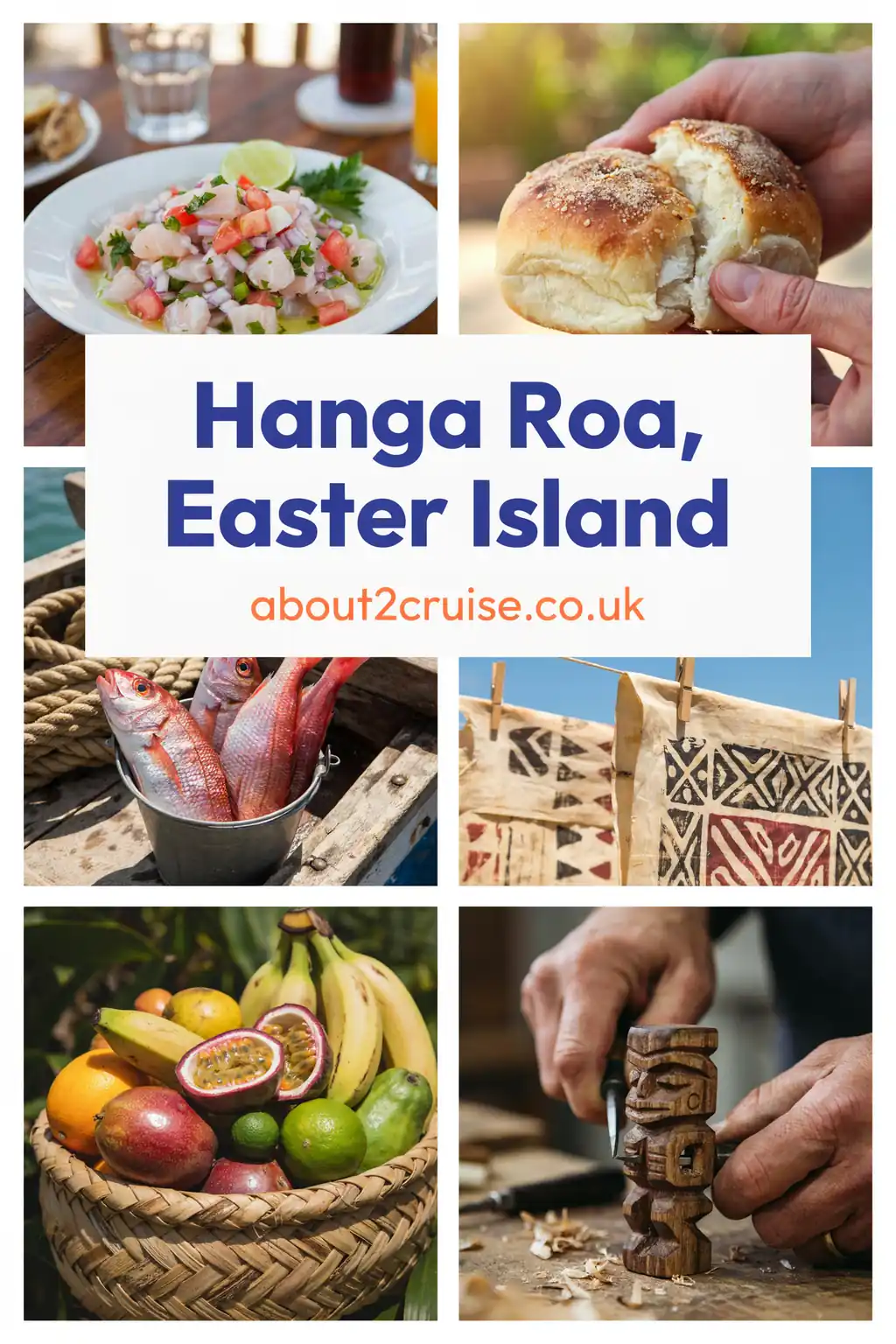
Easter Island holds roughly 900 moai ranging from 2 m to 20 m, more than 300 ceremonial platforms known as ahu, and over 25,000 archaeological remains. The Rapa Nui National Park covers about 43% of the island and is a UNESCO World Heritage site (property 715). The island itself is about 16,628 hectares and lies 3,700 km from continental Chile, impossibly remote, which is exactly why you’re looking at it from a cruise ship.
Moai are believed to represent sacred ancestors watching over villages and ceremonial areas. Most were carved from yellow-brown volcanic tuff at Rano Raraku, with a few in red scoria and one in basalt. The cylindrical red headdresses, called pukao, were quarried from the small volcano Puna Pau and are thought to denote special ritual status.
There are 12 visitable park sites: Tahai, Orongo, Vinapu, Vaihu, Akahanga, Rano Raraku, Ahu Tongariki, Te Pito Kura, Anakena (Hanga Rau), Ahu Akivi, Puna Pau and Ana Te Pahu. On a cruise call you’ll realistically see two major sites in any depth, plus the free ones near town.
Do You Need a Park Ticket and a Guide? Yes, for Most Sites
For most archaeological sites, yes, you need both a park ticket and an accredited guide. The current foreign adult ticket is US$100; foreign children ages 7–12 pay US$40, and the peso figure is about CLP 95,000. The ticket is personal, valid for 10 consecutive days from first entry, and allows one entry each to Rano Raraku and Orongo, they are single-entry sites, so you can’t visit the quarry in the morning and come back after lunch.
Tickets are sold online through the park’s own platform and through Chiletur Copec (chile.tur.com), plus self-service kiosks on the island. Counter sales are at the Ma’u Henua office in central Hanga Roa below the craft market, and the window normally stays open about an hour after scheduled flight arrivals, including Sundays and public holidays. The airport and CONAF offices are also listed as ticket points. Select the foreigner category at checkout, a wrong category can be refused at the gate, and the ticket is checked against the passport you booked with.
A guide is required at the controlled sites. Tahai and Anakena can be visited without one. Roughly 99 guides are authorised, working in Spanish, English, French, German, Italian, Portuguese and Russian. Rangers check tickets and guide credentials at the entrance to controlled sites and will not admit anyone alone.
Ahu Tahai: Free Moai and Sunset Views in Walking Distance
Ahu Tahai is the single best value on Easter Island. Three restored platforms sit on the coast at the north edge of Hanga Roa, a 10–15 minute walk from the centre, with no ticket and no guide required. It includes the only moai anywhere on the island with its coral-and-obsidian eyes reinstalled, and it’s the island’s sunset spot, with the platforms silhouetted against the Pacific and crowds gathering about an hour before dusk.
If your day is squeezed by tender queues or you simply want to see moai without paying for a park ticket and guide, Tahai is the answer. Rangers do enforce a line of small stones marking the monument boundary, stepping over it brings whistles and shouting. Stay on the visitor side.
Anakena Beach: Moai, Sand, and Swimming Without a Guide
Anakena is about 18 km from Hanga Roa, roughly 20–25 minutes by car. It has white coral sand, calm water, and seven moai at Ahu Nau Nau directly behind the beach, and like Tahai, it needs no park ticket and no guide. In Rapa Nui tradition Anakena is the landing place of the first king Hotu Matu’a and was known as Hanga Rau Ariki, the bay of kings. The palms shading the beach are imported; the island lost its tree cover long before European contact.
Anakena is the only beach officially classified as fully swimmable. It’s best in the morning, when the beach is quiet and the light is good for photographs of the moai. There are food kiosks, snack stands and paid public toilets behind the beach, and it’s effectively cash-only, bring Chilean pesos or small US dollar notes in good condition.
Rano Raraku: The Quarry Where the Moai Were Carved
Rano Raraku is the moai quarry, about 18 km / 11 miles from town, roughly 25 minutes by vehicle. It supplied the stone for about 95% of known moai and was quarried for roughly 500 years. Something under 400 moai remain on the quarry slopes in every stage of carving, including one unfinished figure of about 20 m, larger than any ever moved. Many of the buried statues have full carved bodies below ground, which is one of the most striking sights on the island.
The paths climb a volcanic slope and are steep in places, and staying on them is one of the fineable rules. This is a single-entry site: once you leave, your ticket’s Rano Raraku entry is spent. On a cruise day, pairing the quarry with Rano Kau and Orongo at the opposite end of the island usually means doing both badly. Choose one and do it properly.
Ahu Tongariki: The 15-Moai Platform
Ahu Tongariki holds 15 restored moai on the largest platform on the island, about 20 km / 12 miles from town, 30–40 minutes by road. It was rebuilt between 1992 and 1996 after a tsunami scattered its fallen statues, so it is a restoration rather than an original setting, though that doesn’t make the sight any less staggering. There are no toilets or food on site, and no shade at midday. Ahu Tongariki pairs naturally with Rano Raraku on the eastern loop; the two sit close together and most guided half-day tours cover exactly that route.
Rano Kau Crater and Orongo: Views and the Birdman Village
Rano Kau is a caldera about 1.6 km across holding a freshwater lake among floating totora reeds, at the edge of Hanga Roa, about 15 minutes from town by taxi. The crater rim delivers one of the most dramatic panoramas on the island. On the rim sits Orongo, the ceremonial village of the birdman cult, whose ritual was an annual race to bring the first sooty tern egg back from the islet of Motu Nui. Orongo consists of over fifty semi-subterranean stone houses and the main concentration of petroglyphs on the island, decorated with birdman and fertility carvings. The basalt moai Hoa Hakananai’a was removed from the site and is in the British Museum.
Orongo is a single-entry site and requires both park ticket and guide. The crater rim is unfenced in places, keep back from the edge.
Smaller Sites Worth Knowing: Ahu Akivi, Vinapu, and Puna Pau
Ahu Akivi has seven moai and was the first ahu to be scientifically restored. It is the platform whose statues face towards the sea rather than inland, and is aligned astronomically with two neighbouring hills. It sits about 6–7 km from town.
Ahu Vinapu is known for large basalt slabs fitted together in a style often compared to Inca masonry at Machu Picchu, with three ahu including one with six toppled moai painted red. It is about 4–5 km from Hanga Roa, the closest controlled site to town.
Puna Pau is a small red scoria crater east of Hanga Roa where the pukao headdresses were quarried, with unfinished and abandoned pukao still visible along the old transport route. It is about 7–8 km from town.
How to Plan One Day on a Cruise Call
A typical call gives you a single daylight day, with tenders starting early and the last tender well before dark, realistic time for two major sites rather than a full island circuit. Most calls run 10–17 hours, with about 11 hours typical. The sensible shapes are:
Before you sail
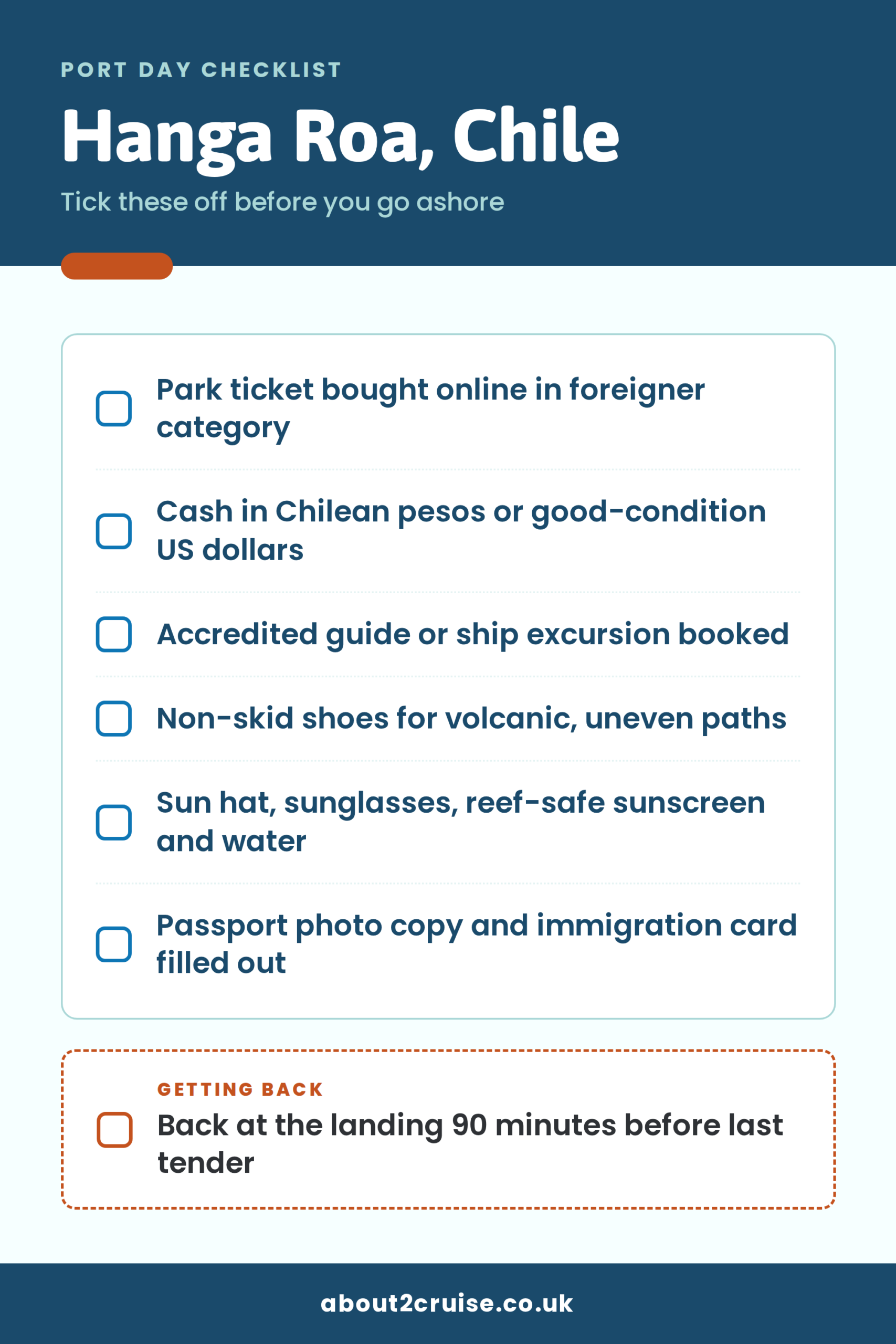
- Book park tickets online in the foreigner category before you land; a wrong category can be refused.
- Book a ship excursion or accredited guide early; ship tours get tender priority.
- Bring Chilean pesos or good-condition US dollars; the two ATMs often run out.
Short port day: under 6 hours
- On dockingTake the tender to Caleta Hanga Roa OtaiTender onlyThere is no cruise pier. Crew help you down a wet ramp and about five uneven concrete steps. Board early; ship tours take priority.
- +15 minPea beach and Poko poolA lava rock cove in the town centre where turtles swim in. Both pools are among the safer swim spots on the island.
- +45 minAhu Tahai moaiFree, no guideA 10 to 15 minute walk from town. Three restored platforms, including the only moai with coral and obsidian eyes. Stay behind the stone line.
- +1 hr 30 minLunch in Hanga RoaTry ceviche de atúnOrder ceviche de atún or a tuna empanada along Atamu Tekena. Small cafes and kiosks may need cash.
- +2 hrs 30 minSanta Cruz church and craft marketWalk through the waterfront church and the cemetery sculpture garden, then browse the market below the Ma'u Henua ticket office.
- +3 hrs 30 minWalk back towards the caletaFollow the waterfront past the Hanga Roa Otai restaurants and the ice cream shop selling taro ice cream.
- All-aboard minus 90 minBack at the tender landingCheck return timeQueue at the landing for a tender. The channel allows one boat at a time, so waits are normal; do not leave it too late.
The time on the map is the whole walk, every stop added together.
Open this walking route in Google Maps
If plans change: If tenders are delayed and you land late, skip the swim and stick to Ahu Tahai and lunch, then check the final tender time at the landing.
Long port day: 8 hours or more
- On dockingTake the tender to Caleta Hanga Roa OtaiTender onlyThere is no cruise pier. Crew help you down a wet ramp and about five uneven concrete steps. Board early; ship tours take priority.
- +30 minMeet your guide or taxiConfirm your park ticket and guide are ready. For taxis, agree the fare and drop-off before setting off, as meters are not used.
- +45 minRano Kau crater and OrongoBook guide aheadAbout 15 minutes by taxi. Orongo needs a park ticket and accredited guide, and the crater rim is unfenced.
- +2 hrs 30 minAhu Vinapu on the way backAbout 4 to 5 km from town. Large basalt slabs fitted like Inca masonry, with three ahu including one with red painted moai.
- +3 hrs 30 minLunch near Atamu TekenaTry ceviche de atúnBack in Hanga Roa. Order ceviche de atún or tuna empanadas; small cafes may need cash.
- +5 hrs 30 minAhu Tahai and Pea beachWalk from town to Ahu Tahai, the free moai platforms, then return via Pea beach for a quick swim before heading back.
- All-aboard minus 90 minBack at the tender landingCheck return timeQueue at the landing for a tender. The channel allows one boat at a time, so waits are normal; do not leave it too late.
This map shows the taxi ride from the ship. The time is the drive only, not your time ashore.
Open the taxi route in Google Maps
If plans change: If you cannot get a guide or park ticket, fall back to the no-ticket day: Ahu Tahai, lunch in Hanga Roa, and Anakena by taxi.
- The eastern loop: Rano Raraku quarry + Ahu Tongariki. The classic, and the strongest use of a ship excursion or independent guide. You see the quarry and the largest platform, but you need a ticket, a guide and a vehicle.
- The western loop: Rano Kau crater + Orongo, plus Ahu Vinapu on the way back into town. Shorter driving, dramatic caldera, petroglyphs. One entry to Orongo covers it.
- The no-ticket day: Ahu Tahai on foot from the landing (free, no guide), lunch in Hanga Roa, maybe a swim at Pea or Poko pool. If tenders are late, the sea is marginal, or you simply don’t want to spend US$100 per person, this is a legitimate and rewarding plan.
- The beach day: Anakena beach, seven moai at Ahu Nau Nau, a swim, kiosk food. Free and guide-free, but you need transport, a taxi or guide-driven car.
Fitting Orongo and the quarry into one day usually means rushing both. Pick one side of the island. The free Tahai site then pads out whatever time remains.
Ship Excursion vs Independent Tour
Ship tours take priority for tenders, so passengers not on a ship tour can be held back until the afternoon. If the call is marginal and only part of the day can be salvaged, the ship excursion is the one that runs. That matters more here than at almost any other port, because the tender capacity is small and the missed-port risk is real.
On price, guided full days are typically quoted at roughly US$100–294 per person, and ship shore excursions at about US$50–130 per person. But the headline numbers hide two things: some tours exclude the park ticket and some include it, it is a line item, not a given. Ask. And if tenders cannot reach shore, what you get back depends entirely on the operator. One local operator keeps 50% of the fare if tenders cannot run. Shore Excursions Group’s tours carry a return-to-ship guarantee and a refund if the ship misses the call; generic marketplace listings make no such promise. A ship tour is the line’s to cancel, so the line’s own refund policy governs.
Holland America Line’s overnight excursion uses the Nayara Hangaroa hotel, requires booking up to 95 days before the call, and is non-refundable inside that window. It is graded strenuous and marked not wheelchair accessible.
Tender Timing, Queues, and Getting Back to the Ship
Nobody publishes the tender schedule in advance, tender capacity, frequency and last-tender time are set on the day and announced on board. What is known: tendering depends on wind, swell direction and wave period, and a flat-looking sea can still be too rough at the water line. Tenders get delayed, the call gets shortened and landings are cancelled outright.
On one large-ship call, four tenders carried about 80 passengers each, with roughly an hour round trip, and a two-hour queue to get back in the afternoon. Only one tender at a time can pass through the channel to the landing, so tenders sometimes wait 10–15 minutes bobbing offshore to unload. Plan to be back in Hanga Roa at least 90 minutes before the last tender. One operator guarantees drop-off an hour before; treat that as the floor, not the target.
Immigration at anchor can take more than an hour. Ships have been reported as not cleared before about 09:20 because immigration officers would not board until daylight. Having your immigration card filled out before arrival speeds things up. You cannot bring fruit or meat ashore.
Weather, Swell, and the Real Risk of Missing the Port
The anchorage is fully exposed to Pacific swell, with no shelter on any side and no alternative berth. That makes Easter Island one of the most swell-affected tender ports in the world. If the sea is running, the captain may abort the call entirely. Passenger reports put the chance of a cancelled call at roughly 30%, and at 40–50% in other accounts, treat those as traveller estimates, not official statistics, but the point stands: you should not book a once-in-a-lifetime day here assuming you’ll land.
When Hanga Roa is too rough, ships have been known to move to anchor off Anakena on the north coast and improvise a landing. If guests cannot tender or disembark at all, there is no refund or credit for the missed port under at least one line’s published policy, and the captain’s decision is final.
The Chilean navy closes the caleta to small craft when wind exceeds 20 knots, except from NE, E and SE, and manoeuvres are permitted by day only. The south-east trade wind is constant between October and April, strongest at the start and end of that season; west winds prevail May–September. Rainfall is spread across the year: driest months around 50 mm, wettest around 99 mm, with 7–9 rain days a month and humidity of 72–76%. Sea temperature ranges from about 20.5°C in late August to a March peak of 25–27°C.
Getting Around: Taxis, Rental Cars, and Guided Tours
There is no public transport system on the island, no bus, tram, metro or ferry network. No Uber, Lyft, Grab or Bolt operates on Easter Island. That leaves four options:
- Walk: Hanga Roa itself is mostly flat and the main street is manageable. Ahu Tahai is 10–15 minutes on foot from the centre; the caleta and Pea beach are minutes away.
- Taxi: taxis do not run meters. Agree the fare and drop-off before getting in, this is standard practice, not a scam. Published levels include about CLP 10,000–12,000 to the Rano Kau viewpoint one way, CLP 35,000 centre to Anakena and back, CLP 6,000 for trips inside town before 20:00, and roughly US$20–30 each way from Hanga Roa to Ahu Tongariki.
- Rental car or 4×4: cars and 4×4 about US$60–115 a day, scooters about US$35–50, bicycles about US$15–20. You cannot get car insurance on Rapa Nui, if you damage a rental you pay for the repairs yourself. And a rental car alone does not get you into the controlled sites, because the guide rule still applies.
- Guided tour: the efficient shape for a cruise call. Minibuses and four-wheel drives rather than coaches, with groups capped somewhere between 8 and 16 depending on the operator.
Money, Cards, and ATMs
The currency is the Chilean peso, but US dollars and euros are accepted in some places, notes must be in near-perfect condition. Cards work widely in Hanga Roa for hotels, restaurants and the park ticket, but cash is needed for taxis, small kiosks and beach vendors, and Anakena is effectively cash-only.
There are exactly two ATMs on the island, at the BancoEstado and Santander branches in Hanga Roa, and both are known to run out of cash at weekends and in high season. The bank branches also exchange dollars and euros, with short small-town opening hours. Bring more cash than you think you need, in good-condition notes.
Food and Drink
Everything except seafood is shipped in, so prices are high by mainland standards. Meal guidance is roughly US$2–4 for an empanada, US$10–15 for a casual lunch and US$20–35 for a seafood dinner.
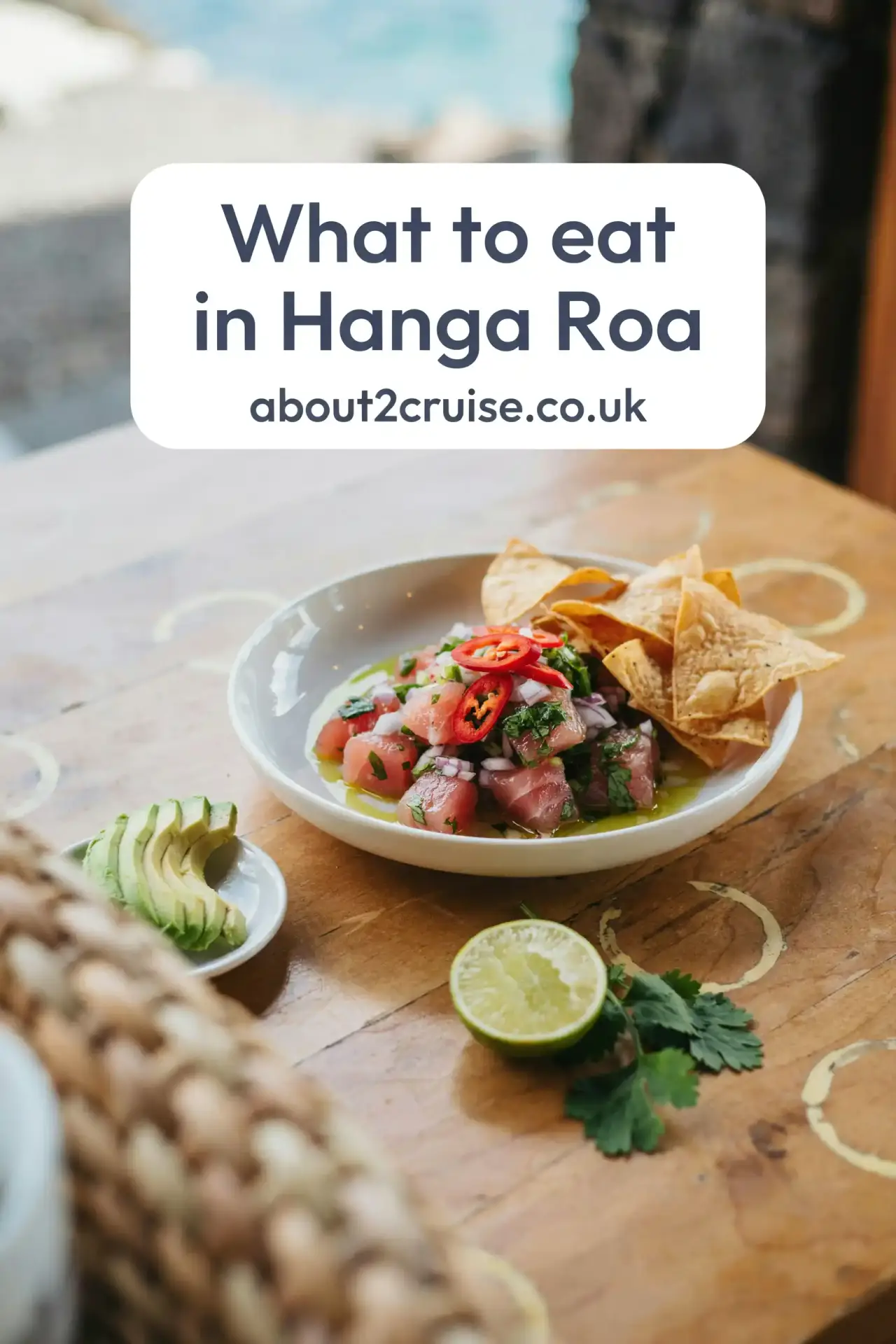
- Ceviche de atún, raw tuna cured in lime, often landed that morning, is the dish to order, about US$10–15.
- Empanadas de atún are the cheap filling snack, about US$2–3, sold at bakeries and small shops along Atamu Tekena.
- Po’e, a baked, sweetened Polynesian pudding of banana or pumpkin, is one of the few genuinely Rapa Nui dishes still commonly made.
- Curanto is the earth-oven meal of fish, chicken, sweet potato and taro cooked on hot stones under banana leaves.
Pacific fish is ordered by asking what is fresh. Atamu Tekena is the main street for restaurants; the caleta at Hanga Roa Otai has restaurants at both ends plus the ice-cream shop.
Shopping and Souvenirs
The craft market in central Hanga Roa below the Ma’u Henua ticket office is the most convenient place for souvenirs, wood carvings, small replica moai, shell work and textiles. The cemetery on the edge of town doubles as a sculpture garden and is worth a quiet look. Prices reflect the cost of shipping almost everything in; don’t expect bargain crafts. If you want something genuinely local, look for carvings and textiles made on the island rather than imported pieces, a local guide or vendor will usually tell you the difference if you ask.
Mobile Coverage and Wi-Fi
Entel is the network that works on the island, with Movistar covering the airport and parts of Hanga Roa. Coverage means Hanga Roa and the airport; the park sites are offline on any operator. Internet is slow and expensive by mainland standards because the island depends on satellite capacity shared across roughly 8,000 residents plus visitors. Wi-Fi is offered by most guesthouses and cafes, and hotel and rental Wi-Fi increasingly runs over Starlink. Don’t expect to livestream the quarry slopes.
Language and Tipping
Spanish and Rapa Nui are the languages of Hanga Roa. English is widely spoken in tourist areas and accommodation, but the official language is Spanish and English is not universal away from the main street. A 10% tip is suggested on restaurant bills in Chile, shown as “propina sugerida”; you can accept it or change it.
Accessibility and Tender Mobility
Tendering here is the first barrier. When a ship anchors, guests using mobility devices will not be transferred into or out of the tender if lifting more than 22 kg (50 lb) is required, and many tender ports provide no wheelchair access at the landing. The captain makes the final decision on who boards a tender or disembarks. On a call to this island, passengers with mobility devices have been told they would have to stay on board.
Even if you can ride a tender, Hanga Roa’s surfaces are uneven and curb cuts are inconsistent, and tour vehicles are minibuses and four-wheel drives rather than coaches with lifts. The island’s sites are the bigger obstacle: the quarry climbs a volcanic slope on rough marked paths, Orongo runs along an unfenced crater rim, and the stay-on-trail rule removes any easier line across the grass. If your mobility is limited, the realistic plan is the town, the craft market, lunch, and possibly the level parts of Ahu Tahai.
Safety
Crime against visitors on Easter Island is effectively absent, though pickpocketing, mugging and thefts from vehicles are common across mainland Chile, keep valuables secure and carry a printed copy of your passport photo page. The real risks on Rapa Nui are the sea, the sun and the terrain: strong currents, sudden swell, very few safe entry points, and drownings have occurred on the rocky coasts. Anakena is the only beach officially classified as fully swimmable. The island has a hospital in Hanga Roa for first-line care but is not a trauma centre; advanced treatment means a flight to Santiago. Drinking alcohol in public places is illegal in Chile, and open fires are illegal in national parks.
What to Pack for the Tender and the Sites
Sturdy non-skid walking shoes are the single most important item, the ground at sites is volcanic, uneven and in places steep, and the tender landing has wet, uneven steps. Beyond that: light long clothing as a cover-up, a hat, sunglasses, reef-safe sunscreen, bottled water, and Chilean pesos or good-condition US dollars. The island has almost no tree cover, so there is no shade at sites like Ahu Tongariki at midday, and the constant trade wind dries sweat so dehydration arrives quietly. A light rain layer is sensible year-round given the 7–9 rain days a month.
Photography Rules and the Drone Ban
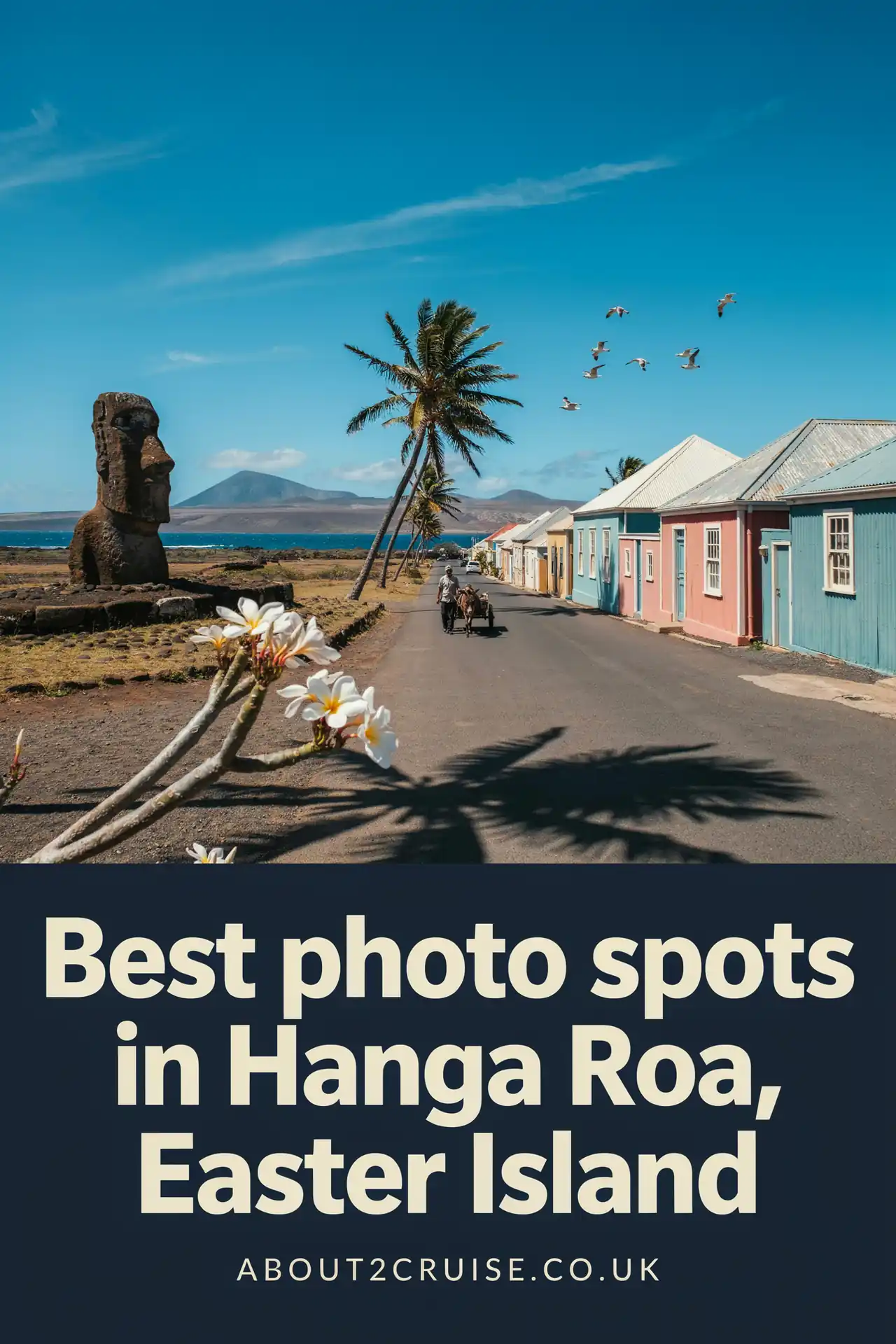
Touching or climbing moai, leaving marked trails, graffiti, fires, camping, alcohol, smoking and entering outside marked perimeters are all prohibited in the park. Fines run from 5 to 100 UTM under Chile’s national monuments law. Rangers check tickets and guide credentials at controlled-site entrances, and at Tahai a guard polices the line of small stones marking the monument boundary, stepping over it brings whistles and shouting. For photography, a guide can identify legal and culturally appropriate viewpoints; stepping beyond barriers for a cleaner shot can damage archaeology or breach park rules.
Drones are banned across Chile’s national protected areas for tourism and recreation regardless of weight, and on Rapa Nui flying without permission is a serious offence with fines collected on the spot. Every drone flight in Chile needs prior DGAC authorisation, and foreign certificates are not recognised. Leave the drone on the ship.
Visa, Entry Formalities, and What Happens if the Ship Cancels
Easter Island is part of Chile, as a special territory. British visitors can enter Chile for up to 90 days without a visa and are given a tourist card to keep and hand back on departure; passports must be valid beyond the day they leave. For Rapa Nui specifically, UK advice is to complete a Rapa Nui entry form, show a return ticket and show accommodation registered with SERNATUR or an invitation letter, but for cruise passengers on a port call, the ship’s itinerary is sufficient proof of onward travel under Chilean regulations for the special territory. If your line asks you to complete paperwork before arrival, do it; it speeds clearance at anchor.
If the captain cancels or changes the call, there is typically no refund or credit for the missed port under at least one major line’s policy. Independent tour payers should ask about cancellation terms before paying, one local operator keeps 50% of the fare if tenders cannot reach shore. Ship-booked excursions are the line’s to refund or not, under the line’s own terms.
Our Chile cruise ports guide covers the other ports in the region.
Frequently Asked Questions
Can you walk from the tender landing to town?
From Hanga Roa Otai, yes, the town centre is immediately at hand, with Atamu Tekena a short walk away. From Hanga Piko, the alternative landing, it is about 1 km and roughly 15–30 minutes on foot. Both are walkable if you are steady on your feet; the landing itself has uneven steps and no railing.
Can you see moai without booking a tour?
Yes. Ahu Tahai, a 10–15 minute walk from the town centre, has three restored platforms including the only moai with coral-and-obsidian eyes, and needs no ticket or guide. Anakena’s seven moai at Ahu Nau Nau are also free and guide-free, but you need transport to get there. Everything else controlled by the park requires a ticket and an accredited guide.
Is one day enough for Easter Island?
No, not for the whole island. A cruise call gives you time for two major sites done properly, or the free sites around Hanga Roa at a relaxed pace. Choose one side of the island: the eastern loop (Rano Raraku and Ahu Tongariki) or the western loop (Rano Kau, Orongo and Vinapu), and leave the rest for another voyage.
Are the beaches safe for swimming?
Anakena is the only beach officially classified as fully swimmable. Ovahe can get rougher. In town, the Pea and Poko lava pools are among the safest swim spots. The rocky coasts have strong currents and sudden swell, and drownings have occurred, don’t swim anywhere unmarked.
Can you rent a car or scooter?
Yes, in Hanga Roa you can rent mountain bikes, 125cc scooters, quad bikes, Suzuki Jimnys, Vitara SUVs and Toyota Hiluxes. Cars and 4×4 are about US$60–115 a day, scooters about US$35–50, bicycles about US$15–20. There is no car insurance available on the island, and a rental car alone does not get you into the controlled sites because the guide rule still applies.
Do UK, US, Australian or EU visitors need a visa for Easter Island?
No visa is needed for short tourist visits to Chile, including Easter Island, for UK, US, Australian or most EU passport holders. You may need to complete a Rapa Nui entry form if arriving by air; on a cruise call, the ship’s itinerary is accepted as proof of onward travel. Your passport should be valid beyond the day you leave Chile.
What happens if the ship cancels or changes the port?
The captain’s decision is final, and under at least one major line’s published policy there is no refund or credit for a missed port. If you booked an independent tour, ask the operator about its cancellation terms before paying, some keep a percentage if tenders cannot reach shore. Ship-booked excursions follow the line’s own refund policy.
Is the museum open?
No. The Museo Antropológico Padre Sebastián Englert, the island’s anthropology museum, is closed to visitors with no reopening date published. Don’t build your day around it.
Can you fly a drone?
No. Drones are banned across Chile’s national protected areas for tourism and recreation regardless of weight, and on Rapa Nui flying without permission is a serious offence with fines collected on the spot. Foreign drone registrations are not recognised.
Nearby Cruise Ports
Easter Island sits on South Pacific and world-voyage itineraries between mainland Chile and French Polynesia. If your voyage is heading that way, the next useful guides are Valparaiso/Santiago cruise port on the Chilean mainland, Papeete, Tahiti cruise port to the west, and Bora Bora cruise port beyond that.
If you are sailing between mainland Chile and Easter Island, Robinson Crusoe Island in the Juan Fernández Archipelago is often the call before or after this one.
Last Updated: 19 November 2026