
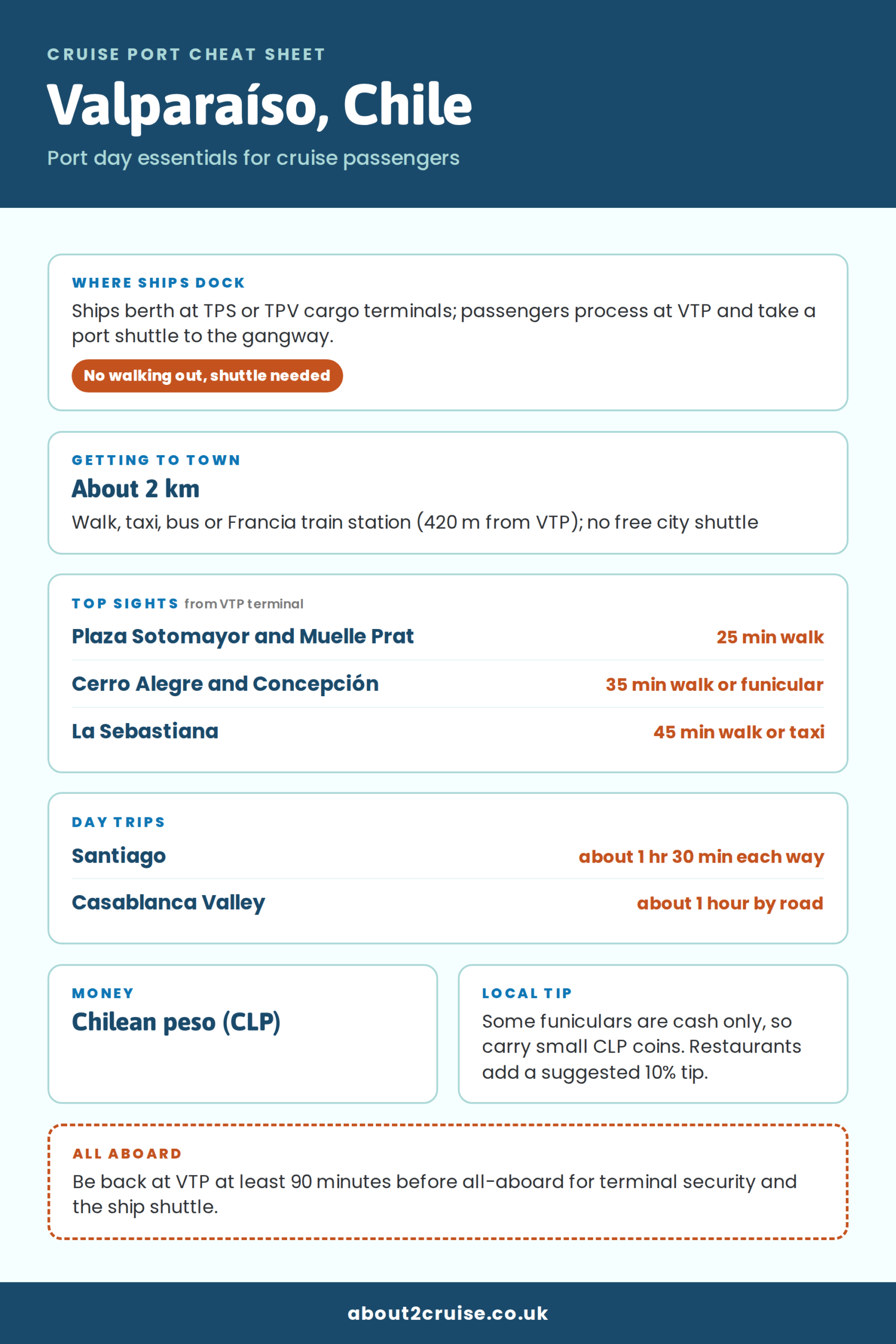
Valparaíso is Chile’s most atmospheric cruise port and the traditional Pacific gateway to Santiago, about 120 km inland. Your ship will not dock downtown: passengers process through the VTP passenger terminal on the waterfront and shuttle to the actual berths at TPS or TPV. The city itself is the main event: a UNESCO-listed amphitheatre of painted hills, antique funiculars, seafood, murals, Neruda’s La Sebastiana and bay viewpoints. If your ticket says San Antonio (Santiago), that is a separate port roughly 100 km south.
Valparaíso or San Antonio? Check Which Santiago Cruise Port You’re Actually Sailing From
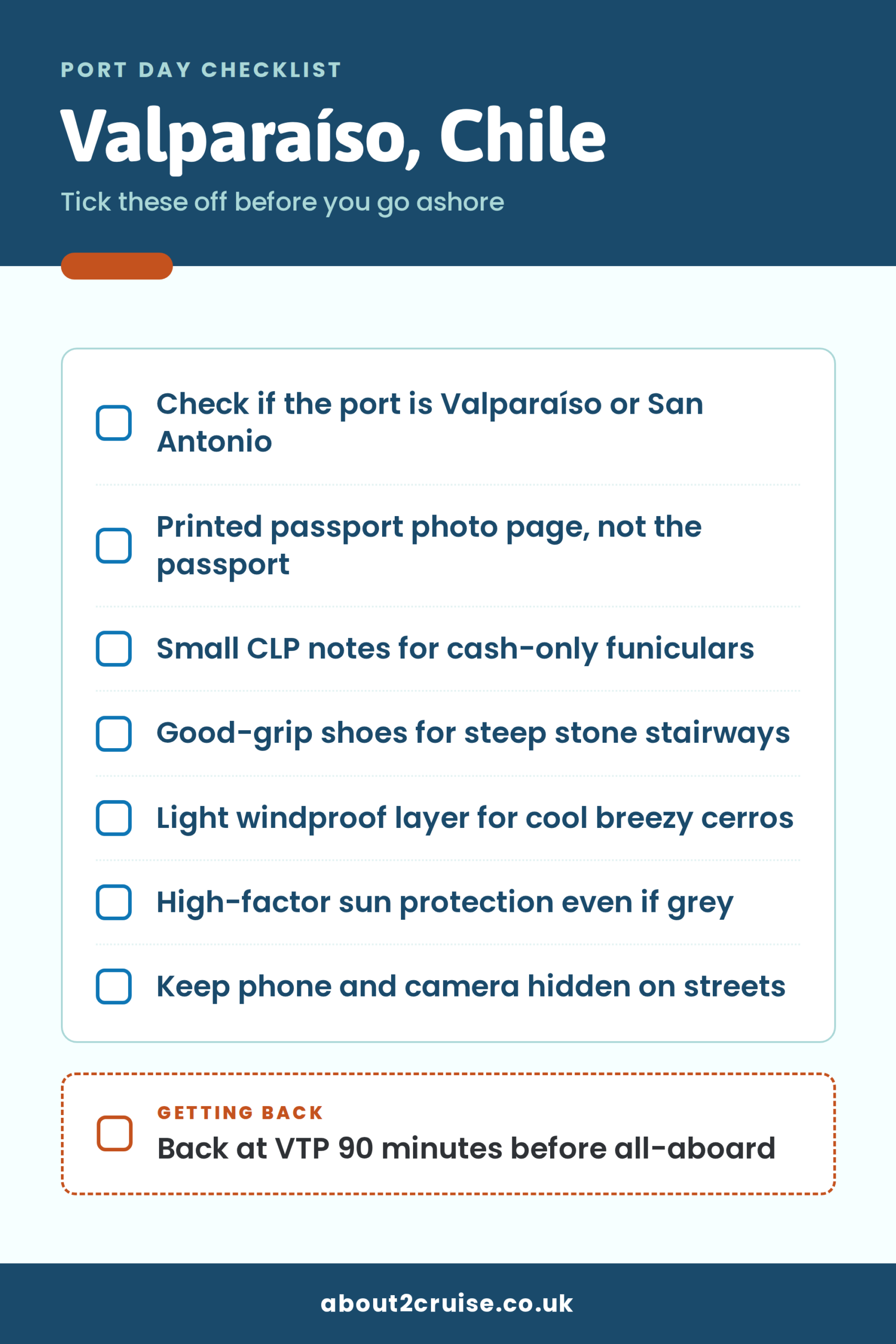
Two Chilean ports are sold as “Santiago” on cruise itineraries: Valparaíso and San Antonio. They are about 100 km apart, so do not assume which one you’ll use.
- Valparaíso is the historic port where the city itself is the main attraction.
- San Antonio is a purpose-built homeport further down the coast. It’s often used by Holland America and other lines for South America turnarounds.
Even the same ship can appear at both ports on different itineraries. Holland America’s Oosterdam, for example, has called at both Valparaíso and San Antonio in different seasons. So the ship name alone won’t settle it. Check the embarkation or disembarkation address in your cruise documents before booking transfers or making plans.
Valparaíso Cruise Terminals: VTP, TPS, and TPV Explained
All cruise passenger processing in Valparaíso happens at the Valparaíso Terminal de Pasajeros (VTP) on Avenida Errázuriz, next to Mall Barón. The ship itself berths at one of two commercial terminals:
- Terminal Pacífico Sur (TPS): usually for ships over about 250 metres.
- Terminal Portuario Valparaíso (TPV): mostly used by expedition ships and smaller tonnage.
You cannot walk through the cargo port. A shuttle bus transfers passengers between the VTP terminal building and the ship’s gangway. This applies whether you’re embarking, disembarking, or just in port for the day.
The VTP terminal is the only authorised route for cruise passengers at Valparaíso. Inside, you’ll find check-in, immigration, customs, baggage handling, a cafeteria, currency exchange desks, craft and souvenir stalls, a taxi service, and a tourist information point. There are coach bays and light-vehicle spaces for operations, but no public parking. Don’t plan your day around the terminal Wi-Fi, as it’s not reliable.
Both ship-organised coaches and private guides meet at VTP, so independent and cruise-line sightseeing start from the same building.
From VTP, the historic centre is about 2 km west. The closest Tren Limache–Puerto station is Francia, roughly 420 metres or six minutes on foot. There is no free city shuttle. You can walk, take the suburban train, use a local bus, or take a taxi. A taxi from the terminal or Plaza Sotomayor usually takes 10–15 minutes, but can double in afternoon peak traffic.
Valparaíso cruise port map
Ships dock at VTP passenger terminal. From VTP terminal, Mercado El Cardonal is about a 9-minute walk, Museo a Cielo Abierto about 18 minutes and Cerro Concepción about 22 minutes. Tap a pin for directions.
- VTP passenger terminalWhere ships dock
- Terminal Pacífico Sur (TPS)Where ships dock
- Francia stationTrain station · About 4 min walk from VTP terminal
- Mercado El CardonalMarket · About 9 min walk from VTP terminal
- Museo a Cielo AbiertoOpen-air museum · About 18 min walk from VTP terminal
- Cerro ConcepciónHistoric hill district · About 22 min walk from VTP terminal
- Paseo GervasoniHillside promenade · About 23 min walk from VTP terminal
- Estación PuertoTrain station · About 25 min walk from VTP terminal
- Muelle PratHistoric pier · About 26 min walk from VTP terminal
- La SebastianaPoet’s house museum · About 26 min walk from VTP terminal
- Plaza SotomayorNaval square · About 28 min walk from VTP terminal
- Ascensor El PeralFunicular lift · About 28 min walk from VTP terminal
- Cerro AlegreHistoric hill district · About 28 min walk from VTP terminal
- Museo Marítimo NacionalMaritime museum · About 2 km from VTP terminal
- Paseo 21 de MayoBay viewpoint promenade · About 2 km from VTP terminal
Cruise Lines, Seasons, and Schedule at Valparaíso
Valparaíso works as both a turnaround port and a day call. In a typical recent season the port has around 30 calls, split roughly 16 at TPS and 14 at TPV.
Cruise lines that have used Valparaíso include Viking, Silversea, Ponant, Cunard, Carnival, Princess, HX Expeditions, Holland America, and several luxury expedition operators. Recent seasons have seen ships such as Majestic Princess, Carnival Firenze, and Queen Anne. Some calls stay overnight, and days with two ships alongside are common in February and November.
Check the port schedule and your cruise line app for the exact berth and all-aboard time, because TPS or TPV is not always published far in advance.
Valparaíso is also promoted as a homeport for west-coast South America voyages between Valparaíso and Buenos Aires via the Strait of Magellan, and for Antarctic expedition departures.
San Antonio Cruise Port: The Other Santiago Gateway
San Antonio is about 100 km down the coast from Valparaíso and is sold as “San Antonio (Santiago), Chile” by several cruise lines. Its passenger terminal address is Alan Macowan 240.
The pier has no public parking and no luggage storage. Transfer to Santiago Airport is about 112 km via Ruta 78, typically 1 hour 10 minutes to 1 hour 40 minutes by road; private transfers often quote about two hours. San Antonio has no passenger rail link.
If your documents say Valparaíso, do not book a San Antonio transfer, and vice versa.
In a recent season San Antonio handled roughly 14 calls from nine lines, including Seabourn, Noble Caledonia, Aida, Holland America, Costa, Mystic, Oceania, Regent Seven Seas, and Azamara. Cruise ships use the DP World multipurpose terminal berths C1 and C2.
How to Get from Santiago Airport to Valparaíso Cruise Port
Valparaíso is about 120 km from Santiago via Ruta 68, normally 1 hour 30 minutes in clear traffic. From Santiago Airport (SCL), a taxi to Valparaíso takes a little over an hour; by public coach it’s about 90 minutes. San Antonio is about 112 km from SCL via Ruta 78, taking 1 hour 10 minutes to 1 hour 40 minutes.
At Santiago Airport, book official ground transport inside the terminal. Follow the blue floor line after SAG and customs to the transport centre. Official options include basic and tourist taxis, transfers, and buses. Transvip has 24-hour desks in domestic and international arrivals.
Avoid unlicensed airport taxis. They often inflate fares and card-reader amounts. Only book and pay at an official desk before exiting the building. Private transfers from SCL to Valparaíso are sold from roughly US$79 to US$209 depending on vehicle, time, and provider.
For a cheaper public option, take the airport bus to Pajaritos interchange. It takes about 20 minutes and costs around CLP 1,500. From Pajaritos, coaches to Valparaíso run every 15–20 minutes, take about 90 minutes, and cost roughly CLP 3,000–7,500. Departures run from about 07:20 to 21:50. Outside those hours, a pre-arranged taxi or private transfer is the practical choice.
Once in Valparaíso, the Tren Limache–Puerto suburban train runs along the coast from Puerto to Bellavista, Francia, Barón, Portales, Recreo, Miramar, Viña del Mar, and on to Limache. Zona A fares are about CLP 510 off-peak and CLP 610 at peak. A tourist day card giving unlimited travel costs about CLP 6,300 including the card, or CLP 3,800 if you already hold one. You can pay with contactless debit/credit cards and digital wallets. The Santiago bip! card does not work on this train.
Parking, Luggage, and Turnaround Day at Valparaíso
There is no public cruise parking at VTP and no long-stay parking product at the Valparaíso terminal. The small number of light-vehicle spaces on site are operational, not for passengers. San Antonio also has no public parking.
Passengers can drive to the terminal drop-off area, and then the free port shuttle takes them to the ship. If you’re driving, arrange commercial parking in Valparaíso, Viña del Mar, or Santiago. A UK photocard licence is valid for driving in Chile for up to three months, but expect tolls on major roads.
VTP has a baggage hall and baggage handling, with bags trucked between terminal and ship. However, no left-luggage service is published at VTP for transit passengers or early arrivals. San Antonio has no luggage storage at the pier.
If you need left luggage in Valparaíso, the intercity bus terminal about 2 km away at Pedro Montt has a counter. Prices have been quoted around CLP 500 for a small bag and CLP 1,000 for a large one. Third-party luggage networks also operate in Valparaíso, typically around US$6 for the first bag and US$5 for each additional bag per day.
On a turnaround day, disembarkation and embarkation are split into windows. Allow extra time: taxi to VTP, terminal security, then the shuttle to the berth. If you are joining or leaving the ship in Valparaíso, build the shuttle time into your plans at both ends.
Why Valparaíso’s UNESCO Quarter and Cerros Are Worth Your Time
Valparaíso’s UNESCO-listed historic quarter covers about 23 hectares in five interlinked sectors:
- La Matriz church and Plazuela Santo Domingo
- Plaza Echaurren and Calle Serrano
- Muelle Prat with Plazas Sotomayor and Justicia
- Calle Prat and Plazuela Turri
- Cerros Alegre and Concepción
Cerros Alegre and Concepción were largely built by British and German immigrants from the first half of the 19th century, and they remain the walkable core of the city.
Landmark stops include Puerta Roja, Escalera Piano, Casa Punto de Diamante, Paseo Gervasoni, Paseo Atkinson, and Palacio Baburizza, home of the fine arts museum. Access to the cerros is free; only the funicular lifts charge. Paseo 21 de Mayo on Cerro Artillería gives the widest bay panorama, looking down over the port and container yards.
Riding Valparaíso’s Historic Funiculars
Valparaíso has more than 15 ascensores, some over 140 years old. The best-known are Concepción, Reina Victoria, and Artillería.
The foreign-tourist fare is usually CLP 1,000 per ride. Local fares are lower; Concepción has charged CLP 300 locally, and under-14s, accredited students, and over-60s often travel free on local fares. Carry small notes and coins, because some lifts are cash only. Many of the busier lifts accept Chilean transport cards or contactless bank cards, but don’t rely on a specific lift when planning a route: individual funiculars close for maintenance without much notice.
Useful routes:
- Ascensor El Peral runs from Plaza de Justicia up to Cerro Alegre and Paseo Yugoslavo.
- Ascensor Concepción links Calle Prat to Cerro Concepción.
- Ascensor Artillería climbs from Plaza Wheelwright to Paseo 21 de Mayo and the naval museum.
A sensible walking loop is to go up El Peral, wander Cerro Alegre and Cerro Concepción, then descend near Concepción to Calle Prat.
Neruda’s La Sebastiana and Valparaíso’s Literary Side
La Sebastiana is Pablo Neruda’s hillside house at Ricardo de Ferrari 692, Cerro Bellavista. It’s open Tuesday to Sunday, 10:00–18:00, extending to 19:00 in January and February. It is closed Mondays, and on 1 January, 1 May, 18 and 19 September, and 25 December.
General admission is about CLP 11,000. A reduced rate of CLP 4,500 applies to under-17 students, students accredited in Chile, and over-60s resident in Chile with ID. No booking is taken, so entry is first come, first served. Audio guides are available in Spanish, English, Portuguese, French, German, and Italian. The house has five floors of stairs and small rooms, so visits can be slow when it fills. Check the official Fundación Neruda page before going.
Plaza Sotomayor and Valparaíso’s Naval Heritage
Plaza Sotomayor is the ceremonial naval square, with the Chilean Navy building and the Monument to the Heroes of Iquique, which holds the crypt of Arturo Prat. Muelle Prat at the foot of the square is part of the UNESCO site and is a good place to watch port movements.
The Museo Marítimo Nacional sits at Paseo 21 de Mayo 45 on Cerro Artillería, in the former naval school, reached by Ascensor Artillería. It opens daily 10:00–18:00, with last entry 30 minutes before closing, and closes on 1 January, 1 May, and 25 December. Foreign adult admission is about CLP 4,000; Chilean adults pay CLP 2,800; children up to 14, over-60s, and students with TNE pay CLP 1,000. Photography of naval personnel and high-security port areas is prohibited.
Street Art, Stairways, and the Best Viewpoints in Valparaíso
Valparaíso’s identity is a mix of 19th-century port architecture, painted hills, staircases, and street art. The Museo a Cielo Abierto on Cerro Bellavista is an open-air mural circuit on the same hill as La Sebastiana.
Painted staircases are a signature. Escalera Fischer climbs to Cerro Concepción, and the piano-key Escalera Piano sits on Cerro Alegre. The best viewpoints are Paseo Yugoslavo, Paseo Atkinson, and Paseo Gervasoni, each giving a different angle on the bay, the Prat pier, and the Turri clock tower. Paseo 21 de Mayo is the wide-angle spot for the whole amphitheatre of hills and the container port.
Morning light favours the painted façades of Alegre and Concepción; late afternoon into sunset is best for the bay.
Casablanca Valley Wine Tours from Valparaíso
The Casablanca Valley sits between Santiago and the coast and is Chile’s top cool-climate region for Sauvignon Blanc, Chardonnay, and Pinot Noir. It’s about one hour from Valparaíso and about 1.5 hours from Santiago.
Wineries on the route include Veramonte, Casas del Bosque, Indómita, Emiliana, Bodegas RE, Kingston Family Vineyards, and Viñamar, many around kilometre 66–72 of Ruta 68.
On a cruise day, the maths is tight. A full valley tour can run 8.5 to 9 hours hotel to hotel, which does not fit a normal day call. A shorter winery tour sold from Valparaíso may visit several vineyards in about six hours with one tasting included, but lunch is extra. The only sensible format is a chauffeured tour or ship-organised wine excursion; do not attempt to self-drive tasting rooms. If you have a pre- or post-cruise hotel night, Casablanca is far more relaxed.
Should You Visit Santiago on a Port Day?
Santiago’s compact historic core puts Plaza de Armas, the Metropolitan Cathedral, La Moneda, and the Pre-Columbian museum within about 15 minutes’ walk of each other. Santa Lucía hill is free to enter. Cerro San Cristóbal, in Parque Metropolitano, is reached by funicular from Bellavista or cable car from Pedro de Valdivia Norte; it gives the best city view with the Andes behind on a clear day. The funicular and cable car run Tuesday to Sunday, generally 10:00–18:45. Sky Costanera is Chile’s highest viewing deck at 300 metres. Bellavista holds Neruda’s La Chascona, and Lastarria and Providencia are the café, gallery, and modern districts.
For a port day, remember the arithmetic: Santiago is 1 hour 30 minutes each way from Valparaíso, so that’s three hours of road time before any sightseeing. A city day is better on a pre- or post-cruise stay, when you can use a hotel and avoid all-aboard pressure. If you do go, book a ship excursion or a private driver with a fixed return time.
What to Eat and Drink in Valparaíso
Valparaíso’s signature dish is the chorrillana: fried potatoes under beef, caramelised onion, and fried egg, built to share. Find it in the taverns around Calle Condell and Calle Blanco in the flat port district.
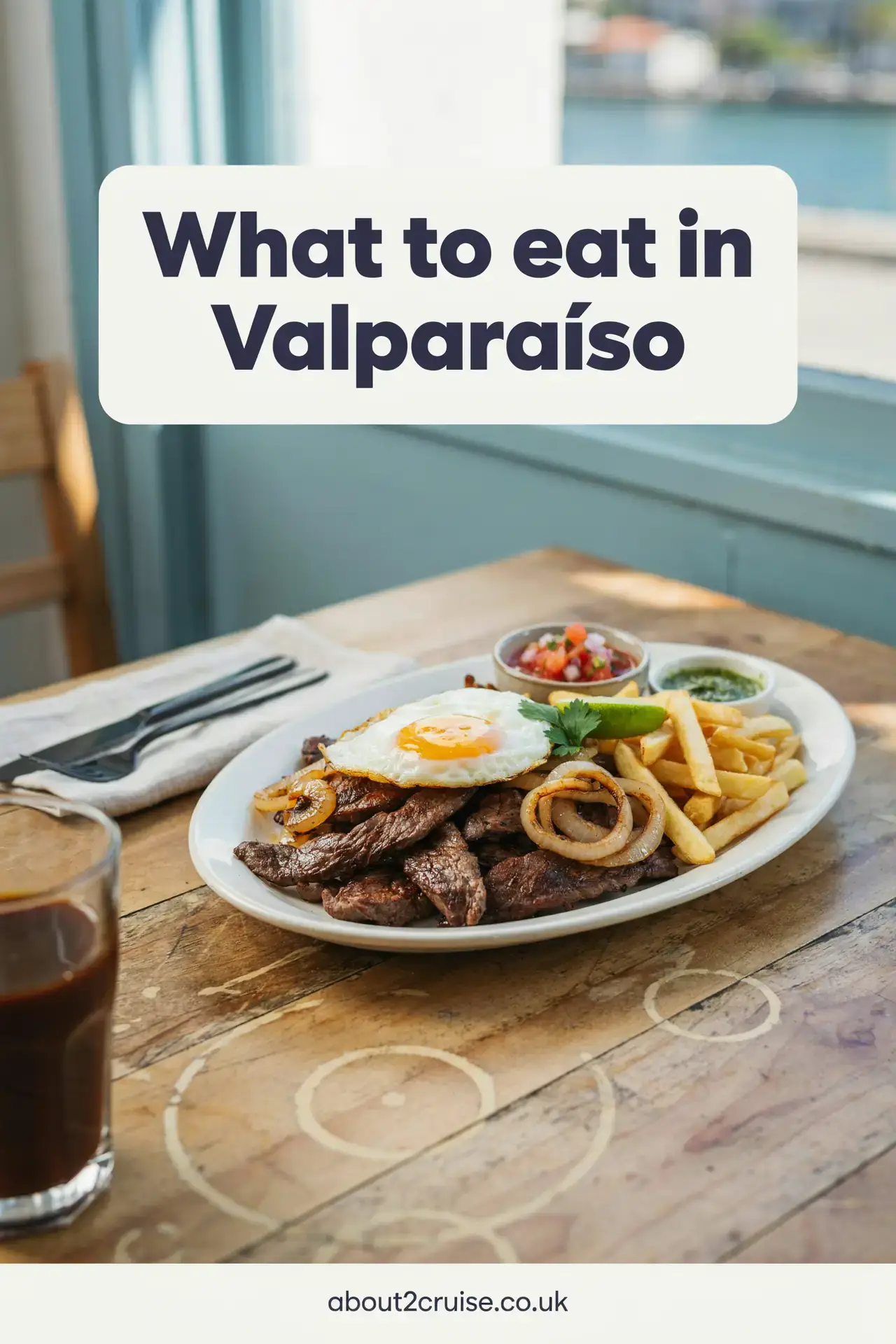
Caldillo de congrio, the conger-eel stew Neruda wrote an ode to, is served in the upstairs market kitchens of Mercado El Cardonal in El Almendral, near the bus terminal. Caleta Portales is the working fishing cove for fried merluza and reineta, Chilean salad, seafood empanadas, pelicans, and sea lions. Machas a la parmesana, native clams with butter, Parmesan, and Casablanca Sauvignon Blanc, is the classic Pacific starter.
Market kitchens run out of the day’s fish stews by early afternoon, so eat lunch early if you want the full market experience.
Money, Cards, and Tipping in Chile
The currency is the Chilean peso, written CLP, with a dot as thousands separator. Cards and contactless work in hotels, restaurants, and larger shops in Santiago and Valparaíso, but keep cash for small shops, market stalls, tips, taxis outside apps, and some funiculars. US dollars are not accepted in everyday places.
Restaurants add a suggested 10% tip to the bill. Taxi drivers do not expect a tip; rounding up is fine. Day-tour guides are tipped about CLP 5,000–10,000 per person.
ATMs are concentrated on Calle Prat, Calle Condell, and around Plaza Sotomayor. There are very few on the cerros, so withdraw before going up. ATM fees for foreign cards often run CLP 3,500–6,000 per withdrawal. Always choose to be charged in pesos and decline the machine’s conversion.
Foreign visitors are exempt from the 19% IVA on accommodation if they show their passport and tourist card at check-in.
Safety Tips for Valparaíso and Santiago
Pickpocketing, mugging, and thefts from vehicles are common throughout Chile, including in tourist areas of Santiago and Valparaíso. Pay attention at viewpoints, bus stations, petrol stations, churches, hotels, and airports. Distraction robbery, the liquid-spill scam, deliberate tyre punctures, and fake taxis are known tactics against British visitors. Muggings, sometimes armed, can happen in daylight in busy places.
Do not resist. Carry a printed copy of your passport photo page rather than the passport itself, and keep valuables in a hotel safe.
Use official taxi desks or pre-booked transfers rather than hailing taxis in the street. Stay in groups rather than walking alone late at night. Avoid using a phone openly in the street, and keep cameras close. In the popular cerros, stick to busy pedestrian routes during the day and avoid empty stairways or poorly lit side lanes. It is illegal to drink alcohol in public places, including streets, squares, and promenades. Emergency numbers are 133 for police and 131 for ambulance.
Valparaíso Weather and Packing Tips
Valparaíso has a Mediterranean coastal climate: warm dry summers, mild wet winters, rain concentrated between May and September, and constant sea breezes. Summer daytime temperatures are typically around 20–28°C; winter around 8–15°C. January and February average daytime maxima around 22°C, with very little rain and extreme UV. The sea is cold all year, around 16–17°C even in midsummer.
Coastal mornings often start grey with fog or low cloud, called camanchaca, clearing around midday. The coast stays cooler than inland Santiago, and afternoon winds can be strong.
Pack good-grip shoes for steep stone stairways and uneven lanes, a light windproof layer, and high-factor sun protection, even when the morning looks grey. La Sebastiana involves five floors of stairs.
Accessibility and Mobility at Valparaíso Cruise Port
For wheelchair users and anyone with significant mobility limits, the hillside quarters of Valparaíso are largely not independently navigable. What does work is the flat ground around Plaza Sotomayor, the port area, Muelle Prat, and the surrounding streets, all inside the inscribed historic quarter.
The funiculars are 19th-century machines with steps at one or both ends and variable availability, so treat a specific lift as accessible only if confirmed that day.
The Museo Marítimo Nacional reports ramps at the main entrance and second floor, braille labelling, QR audio guides, and a tactile tour, but no lift and no accessible toilet. If mobility is limited, plan specific accessible stops with a local operator rather than assuming a funicular makes a whole neighbourhood step-free.
Where to Stay Before or After Your Valparaíso Cruise
Most disembarking passengers head for Santiago, about two hours away, because it has more accommodation and is nearer the international airport. If you want a night in Valparaíso, choose a bay-view boutique hotel on the hills rather than a port-district chain.
- Hotel Casa Higueras on Cerro Alegre has a restaurant, pool, and spa, breakfast, and is a 15-minute walk from the city centre.
- Zerohotel is a small four-star in a historic building on Cerro Alegre with a Pacific-facing terrace.
- Gran Hotel Gervasoni sits on Paseo Gervasoni, a short walk from the port.
- Ibis Valparaíso is above Estación Puerto and within walking distance of Plaza Sotomayor, good for a practical budget base.
For a late Santiago Airport arrival before a coastal transfer, Holiday Inn Santiago: Airport Terminal is directly opposite Terminal 1, a few minutes’ walk, with breakfast from 05:00. Casablanca town is about 35 minutes from the airport hotel and has more than 15 wineries, useful for a pre-cruise wine day.
Shore Excursions vs. DIY Sightseeing in Valparaíso
Both ship excursions and private guides meet at VTP, so nobody gets closer to the ship without the port shuttle. The local town is easy enough independently: take the Tren Limache–Puerto from Francia, walk the flat centre, ride a funicular, and explore the cerros. You need your own timing discipline, because you must return to VTP, go through terminal security, and catch the shuttle back to the berth.
On a normal port day, Valparaíso and the cerros are more comfortable than a Santiago sprint. A Santiago day trip is possible with three hours of driving, but the safer format is a ship excursion or a private driver with a guaranteed return time. Missing the ship at Valparaíso can mean a road transfer to San Antonio or a flight to the next port, typically Puerto Montt or Coquimbo.
UK Passports, Visas, SAG, and Travel Insurance for Chile
British citizens can visit Chile for up to 90 days without a visa. Your passport must be valid beyond the day you plan to leave Chile. A tourist card is issued on entry; keep it, because it must be handed back on departure and it unlocks the accommodation IVA exemption.
A child travelling with only one parent, a guardian, or alone needs a notarised authorisation from the non-travelling parent and an original birth certificate.
All travellers must complete the SAG agricultural declaration, declaring any plant or animal products. Failure to declare risks confiscation and heavy fines.
British Airways operates a direct London Heathrow–Santiago service of about 14 hours 35 minutes. If asked for proof of economic solvency, the reference is about USD 46 per day of stay. Travel insurance is essential, especially on cruise turnaround days and for any potential missed-port transfer.
If Your Cruise Continues Beyond Valparaíso
Valparaíso and San Antonio fit into Chile’s wider cruise map. The other major Chilean cruise ports include Punta Arenas, Puerto Montt, and Coquimbo, with expedition calls in Puerto Williams, Puerto Natales, and the fjords. Southbound and Antarctic itineraries often continue to the Strait of Magellan and Ushuaia.
If you are on that route, read our Ushuaia cruise port guide. If your Pacific cruise also calls in Mexico, see our Acapulco guide and Cabo San Lucas guide.
Further north on the same Pacific coast, Antofagasta is a common call on cruises heading up towards Peru.
Arica lies north of Valparaíso on Chile’s Pacific coast and often appears as your next Chilean call before Peru.
On northbound Pacific itineraries, Coquimbo (La Serena) is often your first Chilean call after Valparaíso, offering a drier, beach-oriented contrast.
Some South Pacific itineraries call at Hanga Roa (Easter Island) before or after Valparaíso.
If your itinerary continues north, Iquique sits on Chile’s northern Pacific coast and often appears before Peruvian ports.
Heading south from Valparaíso, Puerto Montt is the usual next major cruise call on Chile’s Pacific coast.
On Pacific coast itineraries that run north from Chile, you may also call at Buenaventura in Colombia.
Further north on the Pacific coast, Manta in Ecuador often appears as your next or previous call on South American itineraries.
On some Pacific crossings, Robinson Crusoe Island can be your next Chilean port after Valparaíso.
On the same Pacific coast route, Pisco is the Peruvian port you may visit before or after Valparaíso.
How to spend a port day in Valparaíso
A port day in Valparaíso works best on foot: ride a funicular to the painted cerros, eat in the port district, and leave Santiago for a pre- or post-cruise stay.
Before you sail
- Check whether your documents say Valparaíso or San Antonio; they are 100 km apart.
- Book airport taxis or private transfers only at official desks inside SCL arrivals.
- Carry small CLP notes for cash-only funiculars and market stalls.
Short port day: under 6 hours
- On dockingTake the ship shuttle to VTPNo walking outShips berth at TPS or TPV in the cargo port. The shuttle drops you at VTP, the only passenger route.
- +15 minWalk to Plaza Sotomayor and Muelle PratAbout 2 km, a 25 minute walk from VTP. Plaza Sotomayor and Muelle Prat mark the start of the UNESCO quarter.
- +1 hr 15 minAscensor El Peral to Cerro AlegreCash for the liftFrom Plaza de Justicia, the El Peral funicular climbs to Paseo Yugoslavo. Carry small CLP notes, as some lifts are cash only.
- +2 hrCerro Alegre and Concepción viewpointsWalk Paseo Yugoslavo, Paseo Gervasoni and Paseo Atkinson, then descend near Ascensor Concepción back to Calle Prat.
- +3 hr 30 minLunch in the flat port districtTry chorrillanaOrder the shared chorrillana in the taverns around Calle Condell and Calle Blanco in the flat port district.
- +4 hr 30 minWalk back to VTPFollow Calle Prat and Avenida Errázuriz east to VTP, about 2 km and mostly flat.
- All-aboard minus 90 minTake the ship shuttleBack at VTP with time for terminal security and the shuttle to the berth. Taxis can take twice as long in afternoon peak.
The time on the map is the whole walk, every stop added together.
Open this walking route in Google Maps
If plans change: If Ascensor El Peral is closed, take Ascensor Concepción from Calle Prat to the same viewpoints.
Long port day: 8 hours or more
- On dockingTake the ship shuttle to VTPNo walking outShips berth at TPS or TPV. You cannot walk out; the shuttle drops you at VTP, the passenger terminal.
- +30 minWalk or train to Plaza SotomayorAbout 2 km, a 25 minute walk from VTP. Francia train station is 420 m away if you prefer the train.
- +1 hrPlaza Sotomayor and Muelle PratSee the naval square, the Monument to the Heroes of Iquique and Muelle Prat watching the port.
- +2 hrAscensor El Peral and cerros viewpointsCash for the liftFrom Plaza de Justicia, the El Peral funicular climbs to Paseo Yugoslavo. Then walk Cerro Alegre and Concepción viewpoints. Carry small CLP notes.
- +3 hr 30 minLunch at Mercado El CardonalEat lunch earlyCaldillo de congrio, Neruda's conger-eel stew, is served in the upstairs market kitchens at Mercado El Cardonal in El Almendral. Go before the day's stews run out.
- +5 hr 30 minLa Sebastiana on Cerro BellavistaClosed MondaysNeruda's five-floor house on Cerro Bellavista, reached by taxi or a 25 minute uphill walk from the flat district. Entry is first come, first served; it closes on Mondays.
- All-aboard minus 90 minBack at VTP for the ship shuttleAllow terminal security and the shuttle to the berth. Taxis from the historic centre can take twice as long in the afternoon.
The time on the map is the whole walk, every stop added together.
Open this walking route in Google Maps
If plans change: If La Sebastiana is closed, use the time for the Museo a Cielo Abierto murals on the same hill instead.
Our Chile cruise ports guide covers the other ports in the region.
Valparaíso Cruise Port FAQ
Can I walk from the ship into Valparaíso?
No. The ship is in a restricted cargo area, so you take the free shuttle to VTP first. From VTP you can walk about 2 km to the historic centre, or use Francia train station 420 m away, a taxi, or a bus.
Is Valparaíso the same as San Antonio cruise port?
No. Both are sold as Santiago, but they are about 100 km apart. Check your cruise documents for the actual terminal address.
Does Valparaíso terminal have luggage storage?
No left-luggage service is published at VTP. Use the intercity bus terminal counter or a third-party luggage network. San Antonio has no luggage storage at the pier.
How long is the transfer from Santiago Airport to Valparaíso?
About 1.5 hours by road. The public coach option takes roughly the same; a taxi or private transfer takes a little over an hour in light traffic. To San Antonio, allow 1 hour 10 minutes to 1 hour 40 minutes.
Do I need cash for the funiculars?
Some funiculars are cash only, so carry small CLP notes and coins. The foreign-tourist fare is usually CLP 1,000 per ride.
Is it safe to explore Valparaíso on foot?
The popular Cerros Alegre and Concepción are fine for most visitors who take normal city precautions. Avoid empty stairways and side lanes, do not flash valuables, and use pre-booked taxis or official ranks.
Can I do a Santiago day trip from Valparaíso cruise port?
Yes, but it means about three hours of driving before and after sightseeing. On a standard port day, Valparaíso itself is the more relaxed choice. If you do go, take a ship tour or private transfer with a fixed return.
Which cruise lines use Valparaíso?
Viking, Silversea, Ponant, Cunard, Carnival, Princess, HX Expeditions, Holland America, and others have used Valparaíso in recent seasons. Schedules and berth assignments vary, so check the port calendar and your line’s app.
Last Updated: 20 November 2026