
Puerto Chacabuco is a small working port at the head of the Aysén Fjord, used by cruise ships as the gateway to Coyhaique and wild Chilean Patagonia. Most ships tender ashore, and the real draw is the landscape, fjords, rainforest, waterfalls and big Patagonian views, rather than the village itself. Plan around a short weather window and long drives.
Why Do Cruise Ships Stop Here?
Puerto Chacabuco isn’t a polished resort or a sightseeing city. It’s the deep-water gateway to the Aysén region, a remote part of Chilean Patagonia where the Pacific coastline breaks into fjords, forested islands and glacier-fed rivers. Cruise lines use the port because it’s the closest landing for Coyhaique, the regional capital, and because the surrounding landscape, rainforest reserves, waterfalls, lakes and the Northern Patagonian fjords, is what passengers actually come to see.
The headline names around Puerto Chacabuco are Queulat National Park with its hanging glacier, and the San Rafael Glacier reached from the Northern Ice Field. Both are spectacular, but neither is a simple port-day excursion. For most cruise calls, the practical choices are local fjord scenery, the Simpson Valley, Coyhaique, the private Aikén del Sur park, village walks, and boat or kayak trips close to the port. Lines that have called or sold this port include Princess, Holland America, Oceania, Regent Seven Seas, Azamara, Lindblad/National Geographic, Viking, Seabourn, Silversea, Costa and MSC.
Tenders, Docks and Terminal Facilities
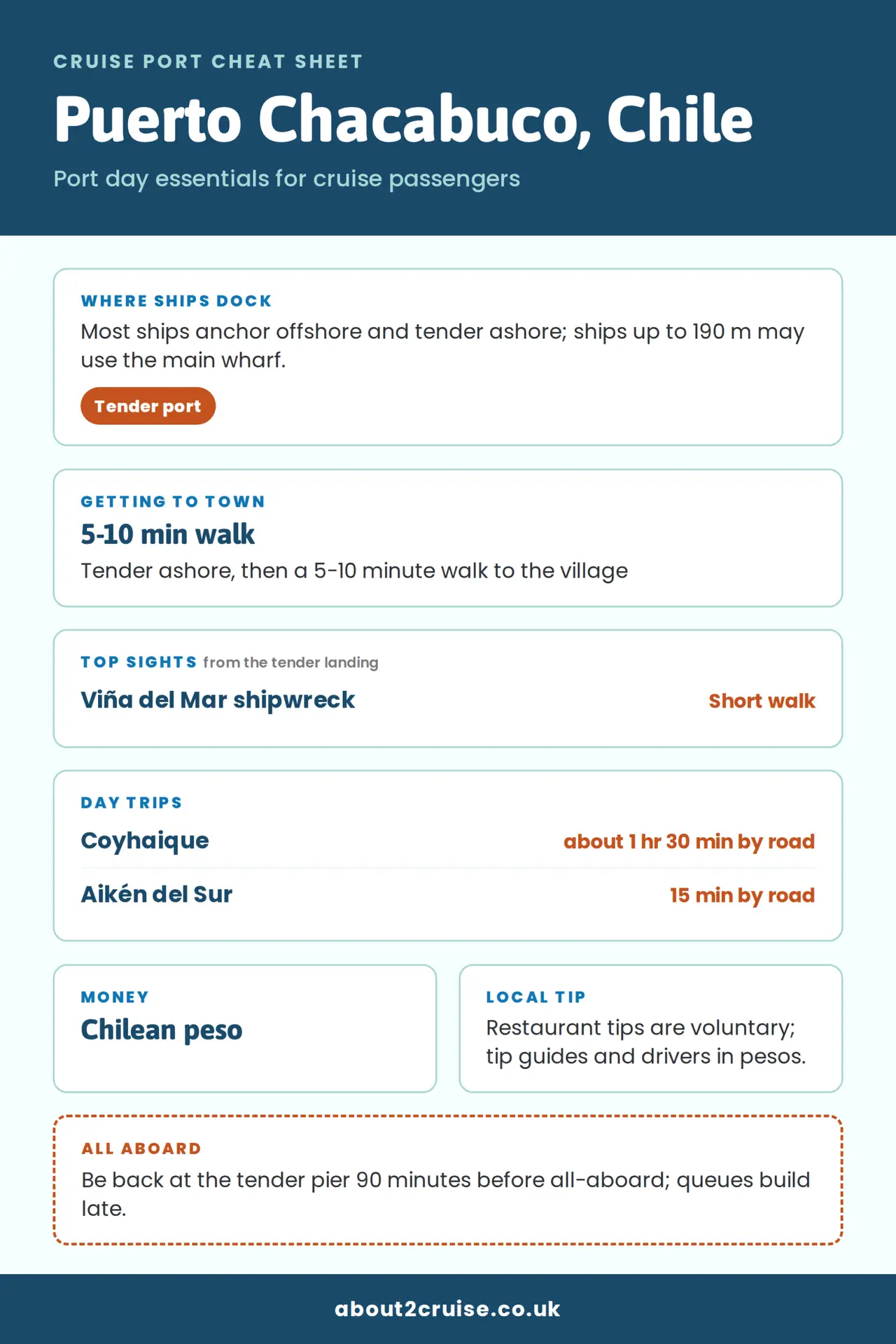
Puerto Chacabuco is a tender port for most cruise ships. Large vessels anchor offshore and send passengers ashore by tender; the crossing usually takes about 15 minutes each way, and the tender dock can receive boats on both sides. Some smaller ships, roughly up to 190 metres long and 9.6 metres draught, can tie up at the main wharf, but you should assume your ship will tender unless your line or the harbour master confirms otherwise.
After landing, passengers pass through a Chilean agricultural inspection, known as SAG control, before entering the passenger terminal. The terminal is modern by remote Patagonia standards: about 430 square metres, heated, with a cafeteria, free Wi-Fi, toilets including an accessible one, tourist information screens and a terrace overlooking the bay. Outside, a car park is used by the taxis, minibuses and excursion vehicles that meet the ship. There is no public left-luggage or bag-drop documented at the terminal or in the village; the only sourced luggage storage is at the Loberías del Sur hotel.
The village of Puerto Chacabuco is about a 5–10 minute walk from the tender landing. Puerto Aysén, a real town, is 15 km further inland, about 15 minutes by road. There is no official Emporcha cruises page with printable terminal maps or last-tender times, so use the daily announcements on your ship as the final word.
Puerto Chacabuco cruise port map
Tenders bring you ashore at Passenger terminal. From the tender landing, Mirador Puerto Chacabuco is about a 9-minute walk. Tap a pin for directions.
- Muelle de Puerto ChacabucoWhere tenders land
- Passenger terminalWhere ships dock
- Mirador Puerto ChacabucoViewpoint · About 9 min walk from the tender landing
- Plaza de Armas de CoyhaiqueMain square · About 60 km from the tender landing
- Cascada de la VirgenWaterfall · About 43 km from the tender landing
- Río Simpson National ReserveNational reserve · About 37 km from the tender landing
- Aikén del SurPrivate park · About 6 km from the tender landing
- Cinco HermanasNature monument · About 41 km from the tender landing
- Puente Presidente IbáñezBridge · About 13 km from Muelle de Puerto Chacabuco
- Museo Regional de AysénRegional museum · About 63 km from Muelle de Puerto Chacabuco
- Feria Artesanal de CoyhaiqueCraft market · About 60 km from Muelle de Puerto Chacabuco
- Piedra del IndioRock formation · About 62 km from Muelle de Puerto Chacabuco
- Reserva Nacional CoyhaiqueNational reserve · About 60 km from Muelle de Puerto Chacabuco
- Monumento al OvejeroMonument · About 60 km from Muelle de Puerto Chacabuco
- Catedral de CoyhaiqueCathedral · About 60 km from Muelle de Puerto Chacabuco
- Cerro MackayHill · About 60 km from Muelle de Puerto Chacabuco
Can You Walk from the Ship to the Village?
Yes, if you can use the tender. The walk from the landing to the centre of Puerto Chacabuco is short and relatively flat, about 5–10 minutes. The village has only about 1,300 residents, so don’t expect a big promenade or a dense street grid. You’ll find a small main street, a few shops, a bank machine, one hotel and a working harbour atmosphere.
The most interesting free thing within walking distance is the rusting wreck of the steamer Viña del Mar, stranded on the shore and visible from the coast. It’s one of the village’s most photographed objects and a short walk from the landing. Local artisans often set up at the harbour on cruise days, selling handmade woollens and woodwork, and the port often lays on a cultural welcome on the quay.
Beyond those, the village itself is quiet. If you get off the ship with no plan, your realistic options are the wreck photo stop, a coffee or snack near the terminal, buying crafts, joining a local taxi or tour, or taking a walk to the Mirador Puerto Chacabuco viewpoint on Ruta 240 for fjord views towards the Cóndor glaciers.
Things to Do Without a Ship Excursion
If you prefer not to book an organised tour, you have a few independent options, but they require flexibility and some Spanish.
Before you sail
- Book ship excursions early, especially Aikén del Sur and Coyhaique; capacity is small.
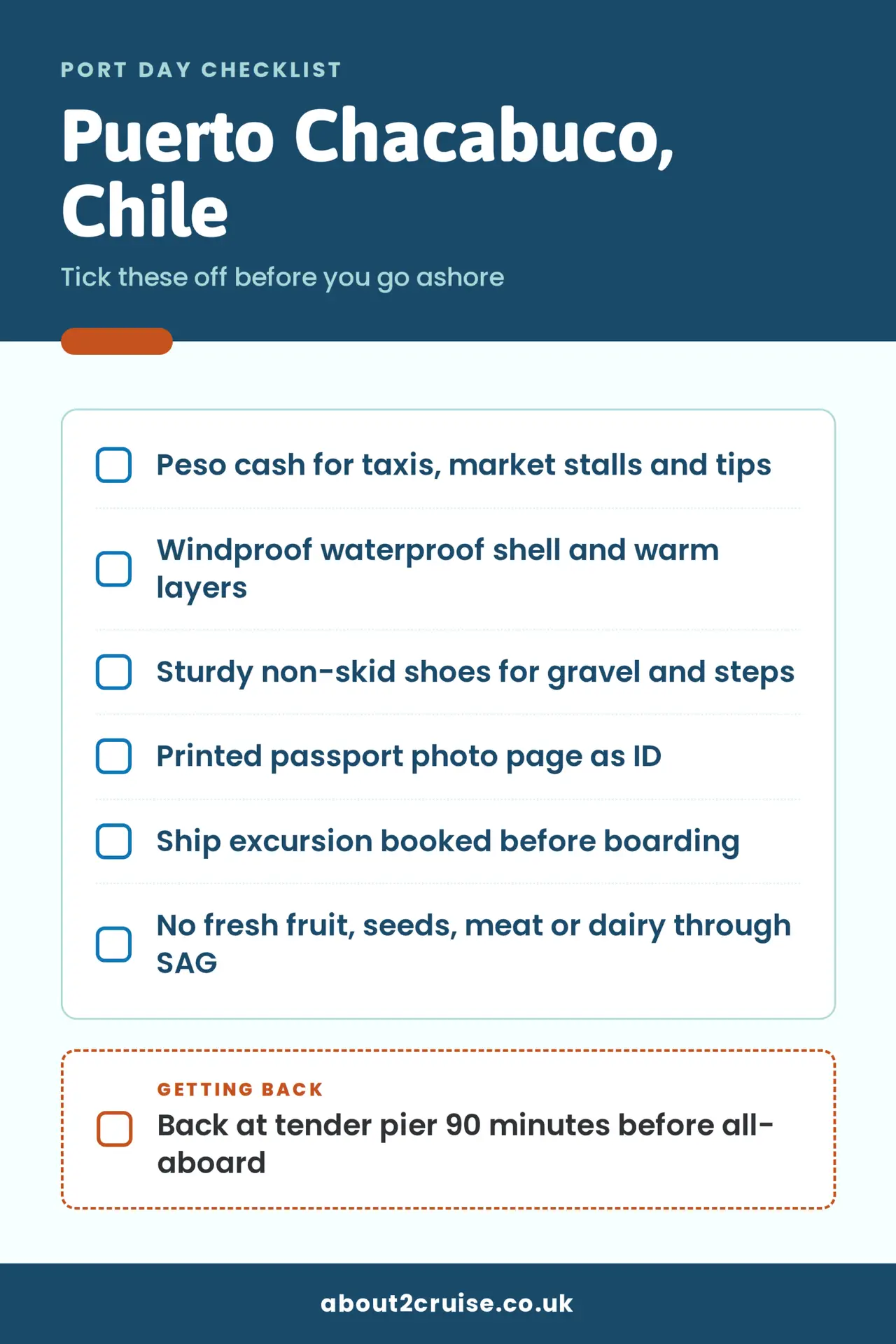
- Bring Chilean pesos in cash for taxis, market stalls and tips.
- Pack windproof waterproof layers, warm hat and sturdy non-skid shoes.
Short port day: under 6 hours
- On dockingTender ashore and clear SAGTake the ship's tender ashore and pass through the agricultural control before entering the terminal.
- +30 minDrive to Aikén del Sur15 minutes by taxi or prebooked transport to the private park on Lake Riesco.
- +1 hrWalk to Barba del Viejo waterfallJoin the guided two-hour walk on the easy half-mile trail to the waterfall; paths are uneven with steps.
- +2 hrs 30 minLunch at the Aikén del Sur quinchoTry cordero al palo, Patagonian spit-roast lamb, served with tortas fritas and pebre; the visit often includes a lamb asado and folk show.
- +3 hrs 30 minReturn to the tender pierDrive back to the port and join the tender queue in good time.
- All-aboard minus 90 minBack at the tender pierTender queues build late; if the first tender is full, wait for the next.
This map shows the taxi ride from the ship. The time is the drive only, not your time ashore.
Open the taxi route in Google Maps
If plans change: If Aikén del Sur is closed or full, walk the village shoreline to the Viña del Mar wreck and use the heated terminal.
Long port day: 8 hours or more
- On dockingTender ashore and meet transportTake the tender, clear SAG and meet your prebooked coach or taxi for the drive to Coyhaique.
- +30 minDrive the Simpson ValleyFollow Ruta 240 beside the Simpson River, past waterfalls and Patagonian farmland; the road has curves and possible livestock.
- +1 hr 30 minArrive at Plaza de ArmasCoyhaique's pentagonal main square has ten streets running into it. Shops may not open before 10:00 and many close Sunday.
- +2 hrs 30 minLunch near Plaza de ArmasOrder Aysén lamb, cazuela de cordero or empanadas at a restaurant around the square; Coyhaique has the best dining in the region.
- +4 hrs 30 minRegional Museum of AysénAbout 3 km from the centre by taxi or coach. Free; open Tuesday-Friday 10:00-19:00, Saturday 15:00-19:00, closed Monday and Sunday.
- +5 hrs 30 minCascada de la Virgen on the return driveStop at the roadside waterfall beside the Coyhaique-Puerto Aysén road, next to a shrine, then continue to the port.
- All-aboard minus 90 minBack at the tender pierAllow a 90-minute buffer; tender queues can be long at the end of the day.
This map shows the taxi ride from the ship. The time is the drive only, not your time ashore.
Open the taxi route in Google Maps
If plans change: If the road to Coyhaique is blocked or your tour is cancelled, stay in the Simpson Valley and return early; skip the museum.
- Walk the village and shoreline. See the Viña del Mar wreck, watch the fishing boats and photograph the fjord.
- Visit local artisans at the harbour. Handmade wool and woodwork are sold on call days.
- Use the terminal Wi-Fi and cafeteria. Good for a short stop, but not a full day.
- Negotiate a private taxi or minibus. You can arrange a trip to Coyhaique, the Río Simpson valley or a lookout, but agree the fare, route and return time before leaving. A taxi from the port to Coyhaique is roughly US$90–120 one way or round trip depending on waiting time; there are no published fixed fares.
- Try a local boat or fjord trip from the port. Boat operators sometimes offer trips to Isla de los Ciervos, the Ensenada Pérez and Chilconal hot springs, or the Cinco Hermanas nature monument where cormorants, sea lions and the rare marine otter are seen. Availability depends on the day and demand, so don’t rely on this if you have a tight departure.
- Use public transport if you are adventurous. Buses run between Coyhaique and Puerto Aysén, then minibuses leave from the Puerto Aysén bus station every 20 minutes for Puerto Chacabuco, but there is no reliable published timetable for the local section. This is better for someone already staying in Aysén than for a cruise day.
If you have a short call, a village walk plus a drink at the terminal may be enough. If you want the big scenery, book something or arrange transport to the Simpson Valley.
Puerto Chacabuco or Coyhaique: Which One Fits Your Port Day?
Coyhaique is the regional capital, about 80 km north-west of the port by Ruta 240. Driving time is roughly 1 hour 30 minutes each way in normal conditions, though some mapping estimates put it at about 1 hour 10 minutes. That means a Coyhaique visit costs at least three hours of road time before you have seen anything.
Choose Coyhaique if you want a proper Patagonian town, restaurants, shops, the regional museum, the pentagonal Plaza de Armas and a longer scenic drive through the Simpson Valley. Choose Puerto Chacabuco and the immediate fjord side if your call is short, the weather is bad, or you prefer a shorter excursion such as Aikén del Sur or a boat/kayak trip.
For a first-time visitor with a full port day of around 7–9 hours, the Coyhaique and Simpson Valley option is the classic cruise excursion. For a shorter call, anything requiring three hours or more on the road is a gamble.
A Realistic Coyhaique Day Trip from the Port
Coyhaique is the heart of the Aysén region and the easiest urban contrast to the empty fjords. The drive takes you along Ruta 240 beside or near the Simpson River, past waterfalls and old Patagonian farmland. The road is not a motorway; it is Carretera Austral region, with curves, possible livestock and quick weather changes.
In Coyhaique, most ship excursions include the Plaza de Armas, which is Chile’s only pentagonal main square, with ten streets running into it. You may also stop at the Regional Museum of Aysén about 3 km from the centre. It is free and open Tuesday–Friday 10:00–19:00, Saturday 15:00–19:00; closed Monday, Sunday and public holidays. A typical ship tour lasts around 5¾ hours and includes the drive, the city and a stop in the Simpson Valley.
Two waterfalls worth knowing are Cascada Velo de la Novia and Cascada de la Virgen, both beside the Coyhaique–Puerto Aysén road. The second sits next to a roadside shrine. The Piedra del Indio rock formation is best viewed from the bridge over the Simpson River.
Shops in Coyhaique tend to open after 10:00 and are often closed or very quiet on Sunday departures, so don’t plan a big shopping morning on a Sunday call.
Río Simpson National Reserve: A Quick Nature Stop
The Río Simpson National Reserve lies on the road between Puerto Chacabuco/Puerto Aysén and Coyhaique. It is one of the easiest protected areas to combine with a port day because you are driving through it or can stop on an organised excursion.
It has a visitor centre and a small museum, and the reserve includes the La Virgen waterfall, a short walk from the road. Opening hours are usually 08:30–17:30, extended to 19:30 in summer. Ship excursions sold for this port also include the Río Simpson National Reserve, Coyhaique and Simpson Valley, the Oro Verde trail and a fjord crossing to the Ensenada Pérez hot springs, depending on the line and season.
The Oro Verde hike may end with a Calafate Sour, a nice way to try the local berry in cocktail form.
Queulat Hanging Glacier: Beautiful, But Far
Queulat National Park is one of the most famous sights in Aysén because of its Hanging Glacier, a glacier that clings to a cliff face above a green valley. The viewpoint walk is easy: a short panoramic trail of about 250 metres, roughly 20 minutes each way, with an easy forest trail and viewpoint. The park also has longer forest trails.
The problem from Puerto Chacabuco is distance, not difficulty. Queulat is about 165 km north of Coyhaique and roughly 210 km by road from Coyhaique on the Carretera Austral. Operators based in Coyhaique sell it as a 12-hour day tour with about four hours of driving each way. The nearest village, Puyuhuapi, is 20 km from the park and about 222 km from Coyhaique.
That means Queulat is not a sensible independent cruise-day trip, and it is very unlikely to be offered as a standard shore excursion from Puerto Chacabuco unless your ship has an unusually long call. If it is offered, check the total time against your all-aboard before booking. If your cruise skips the port due to weather, you cannot do Queulat at all.
If you go independently, the park is open Tuesday to Sunday 09:00–16:30 with last entry at 14:30, and tickets must be bought in advance through the official Pases Parques platform. Foreign adult entry is quoted around CLP 11,400 in some sources, but the official booking page sometimes does not show the price. Trails can close in heavy rain, snow, frost or strong wind, and the camping area at the hanging-glacier sector has been closed recently, so check before setting out.
San Rafael Glacier: Why It Usually Doesn’t Fit a Cruise Day
The San Rafael Glacier and the Northern Ice Field are even more remote than Queulat. The standard independent catamaran trip from Puerto Chacabuco takes 13–14 hours: check-in around 07:00, departure around 08:00, Zodiac approach to the glacier, and return to the pier between 20:00 and 21:00. Prices run roughly CLP 309,000 per person, or about US$245–335, including breakfast and lunch.
That is longer than most cruise calls. Published calls at Puerto Chacabuco can be as short as 07:00–14:30 or as long as 11:00–20:00; none of those reliably fit a 13–14 hour boat trip. Therefore the San Rafael catamaran is for passengers staying in Puerto Chacabuco, usually overnight at Loberías del Sur, not for a standard cruise port day.
If a cruise line lists a San Rafael excursion, it would only work with an overnight or a specially extended call. Check the exact return time and all-aboard before buying. Otherwise, the closest way to see the Northern Ice Field on a cruise day is by ship, not by shore excursion.
Fjord Trips, Kayaking and Boat Tours Near the Port
The fjords are the easiest Patagonian landscape to reach from Puerto Chacabuco. You are already at the head of the Aysén Fjord, so even the tender ride gives you a sense of the geography. Small-boat trips can take you to waterfalls, cliffs, forested islands and hot springs without requiring a full day on the road.
One cruise-line option is kayaking on Lake Los Palos, about 3½ hours total and described as strenuous. It usually has a minimum age of 14 and a maximum weight of 260 lb, with about 45 minutes’ drive each way. Operators supply life vests and rain capes, but you should bring a change of clothes. That excursion is not wheelchair accessible.
Boat excursions sold by the ship may include a fjord crossing to the Ensenada Pérez hot springs or the Cinco Hermanas nature monument, where you may see cormorants, sea lions and the chungungo, or marine otter. These are generally better value for mature scenery than sitting in a minibus all day.
Aikén del Sur: The Low-Stress Patagonia Park
Aikén del Sur is a 250-hectare private park on Lake Riesco, about 15 minutes from the port/hotel area. It is the best short full-day or half-day nature option because it keeps you close to the ship while still getting you into Patagonian rainforest and lakeside scenery.
The park has four trails and a guided walk of about two hours. It is often sold as a shore excursion of about three hours, with an easy half-mile walk to the Barba del Viejo waterfall. Independent rates run around CLP 76,000 for an adult, or roughly US$75–100 depending on season, and include a guide, a cocktail, a lamb asado and a folk show. Ship excursions are from around US$179. It is not advisable for wheelchair users or those with significant mobility limitations because of uneven paths and steps.
This is often the best choice if you want Patagonian food, forest, waterfalls and a manageable schedule without the long Coyhaique drive. If you are staying overnight, Loberías del Sur is the only hotel in Puerto Chacabuco and the usual base for the early San Rafael sailing.
Wildlife You Might See in the Aysén Fjords
This is not a Galápagos-style wildlife port, but the fjord ecosystem holds a few good sightings. On boat trips and kayak outings around Puerto Chacabuco you may see cormorants, sea lions and the chungungo, the small South American marine otter. Forested coasts hold Patagonian birds and occasional Andean condors inland.
For the best chance of wildlife, take a boat trip rather than staying in the village. The waters around the Cinco Hermanas and the smaller islands are calmer and more protected than open ocean. Binoculars are useful, but keep them dry; rain and spray can arrive without much warning.
Food, Wine and Souvenirs in Aysén
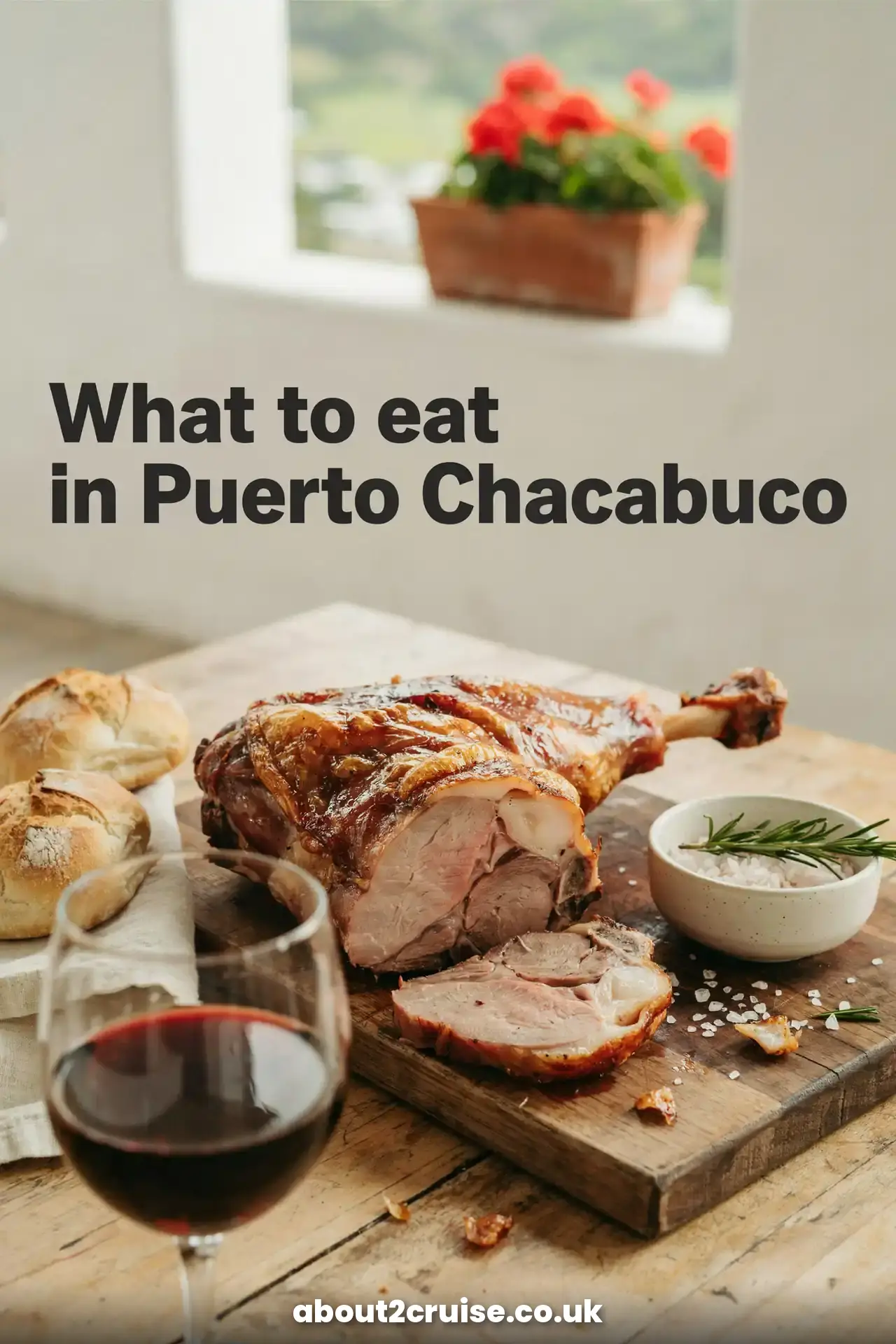
Food is one of the quiet highlights of Aysén, especially if you take an excursion that includes a meal. The signature dish is cordero al palo, Patagonian lamb slow-roasted on a spit over fire for three hours or more, served with tortas fritas, pebre, salads and red wine. It often has to be ordered in advance and is served at the Aikén del Sur quincho or at special welcome events on the quay.
The regional table also includes curanto, cazuela de cordero, empanadas, sopaipillas and calzones rotos, several of which are recorded in Chile’s food-heritage inventory for Aysén. German-settler baking survives as kuchen and streuselkuchen, and local ingredients include calafate, nalca, rhubarb, trout and salmon. A Calafate Sour is the local pisco-style berry cocktail, sometimes served at the end of the Oro Verde hike.
Restaurants and serious shopping are concentrated in Coyhaique around the Plaza de Armas. At the port itself you’ll find crafts rather than a food street: handmade wool and carved wood from local artisans, plus the terminal cafeteria for coffee and a snack.
Patagonia Weather and What to Pack
Cruise calls run roughly November to March, the southern summer, but Patagonian summer is cool and wet. Average daytime highs are about 13–17°C and night lows around 6–9°C, with rain on roughly 12–15 days a month in the season. It rains most of the year, and the regional average temperature is around 8°C.
Wind is the real show-stopper. Gusts above 25 knots have stopped berthing manoeuvres, and 33 knots can make berthing impossible. The harbour master can close the port to cruise traffic in high wind, and a cruise call has been lost because of it. If your ship cannot tender safely, the port is simply skipped.
Dress in layers with a windproof and waterproof outer shell. Bring a warm hat, gloves and scarf, and sturdy non-skid shoes. Paths can be gravel, roots, steps and slippery polished surfaces. For Queulat, the park service asks for hiking shoes, waterproof clothing and walking poles if you need them. Kayakers should bring a change of clothes.
Money, Cards, Tips and Language
The currency is the Chilean peso. Cards are widely accepted in cities, hotels and restaurants, but cash is needed in small villages, at market stalls, for local taxis and for tips. US dollars are not accepted in most everyday places, although some hotels and tour operators quote prices in dollars. Carry small peso notes and coins for the pier.
There is an ATM on the main street in Puerto Chacabuco, but don’t rely on it if the ship arrives early or on a holiday. Withdraw cash in Coyhaique if your tour stops there, or on the ship before going ashore.
Prices in Chile include 19% IVA. Foreign visitors can be exempted from VAT on hotel bills paid in foreign currency with a passport and tourist card, which is useful if you stay overnight in Coyhaique or Puerto Chacabuco. Restaurants may suggest a 10% propina, but it is voluntary by law; only food businesses are allowed to suggest a set 10%. Guides are usually tipped around US$3–5 per day, drivers US$2–3, and taxis are rounded up rather than tipped.
The language is Spanish. English from local guides may be limited, and tourism infrastructure here is thin. A few phrases, or booking a ship excursion with a bilingual guide, makes the day smoother.
Passports, Entry and Safety for UK Visitors
UK passports need only to be valid for the period of your stay in Chile. UK visitors can enter visa-free for 90 days and should keep the tourist card they receive. Carry a printed copy of your passport photo page as ID on shore.
Chile has general safety advice about pickpocketing, mugging and theft from vehicles, especially at transport hubs, ports and viewpoints. Do not resist a mugging. The FCDO has no specific advice against travel to the Aysén region; its warnings relate mainly to parts of Araucanía, Biobío, Los Ríos and Santiago. In Puerto Chacabuco the bigger risk is usually weather or a missed return, not crime.
Passengers entering through the terminal pass through a SAG agricultural inspection. Don’t bring fresh fruit, seeds, plant material, meat or dairy unless allowed; it can cause delays. Open fires, including cigarettes and gas stoves, are illegal in national parks outside permitted camping areas and can lead to removal from the country.
Wi-Fi, Mobile Signal and Accessibility
There is free Wi-Fi in the passenger terminal, which is useful for checking messages or shore plans. Mobile signal in the village comes from four networks: Entel, Movistar, Claro and WOM. Signal fades quickly once you drive into the fjords or forest valleys.
The tender itself is the main accessibility barrier. Cruise lines routinely state that the tender may be unsuitable for people with disabilities, reduced mobility or balance problems. Most shore excursions at Puerto Chacabuco are marked not wheelchair accessible, including the Coyhaique city tour, Aikén del Sur, kayaking and the San Rafael catamaran. No wheelchair-accessible shore excursion is documented by the operators.
The terminal has an accessible toilet and a heated indoor waiting area, which helps if you decide to stay near the pier.
Ship Tours vs Independent Excursions
Ship excursions in Puerto Chacabuco tend to sell out early because the local tourism supply is small. Typical options include Northern Patagonia and Coyhaique City, Río Simpson National Reserve and Simpson Valley, Aikén del Sur, Lake Los Palos kayaking, the Oro Verde trail and Ensenada Pérez hot springs. Prices often run from around US$179–189 for half-day and full-day tours, depending on the line.
Ship-organised tours are easier for this port: the guide is usually bilingual, the coach is waiting at the terminal, and the ship generally waits if the excursion is late. That matters in Patagonia, where a small road delay can eat a narrow buffer.
Independent tours can be cheaper, a Coyhaique day trip is roughly US$135–215 for 5½–6 hours, and Aikén del Sur around US$110, but you take on return risk. Some reputable independent operators promise transport to the next port at no extra cost if you miss the ship because their tour ran late, but that is not universal. Check the policy before booking. Several independent operators have refunded in full when a ship cancelled its call at short notice, but policies vary.
Allow a 90-minute return buffer and expect tender queues at the end of the day. All-aboard is usually about 30 minutes before departure. If your ship leaves at 16:00, aim to be back at the tender pier by 15:00 or earlier.
What Happens If Wind or Weather Cancels the Call?
Patagonia can cancel plans without much notice. If high wind closes the port, your ship may skip Puerto Chacabuco altogether. Cruise contracts allow the line to change or omit ports and to cancel or modify shore excursions and port visits.
If the ship is unable to tender, there is usually no backup plan at this port because the alternatives, Queulat, San Rafael, inland lakes, are too far or also weather-dependent. Ship-arranged excursions are refunded if cancelled. Independent operators vary; many refund if the ship does not make port, but pre-book only with operators that state this clearly.
Don’t plan your whole cruise around one Patagonian landing. The region is wild, and a skipped call is part of the deal.
Is Puerto Chacabuco Worth Visiting on a Cruise?
If you’re expecting a colourful city or a quick cable car, Puerto Chacabuco may feel underwhelming at first. The village is small, the weather is often grey, and the best sights sit at the end of long roads or boat rides.
But as a cruise port, it is one of the most authentic gateways in Chilean Patagonia. You can walk from a tender into a working fjord town, eat slow-roasted lamb, stand under a waterfall, kayak a placid lake or ride through the Simpson Valley into Coyhaique. The key is knowing what is realistic on your call, dressing for rain and leaving a cushion for the return to the ship.
Common Questions About Puerto Chacabuco
Can you walk from the cruise ship to Puerto Chacabuco town?
Yes, after the tender landing the village is a 5–10 minute walk. The tender itself is the only physical challenge.
How far is Coyhaique from Puerto Chacabuco cruise port?
About 80 km by road, or roughly 1 hour 30 minutes each way in normal conditions. Count on at least three hours of driving for a return trip.
Is Queulat Hanging Glacier visible without hiking?
There is a short 250-metre viewpoint walk to see the hanging glacier, but the park is roughly four hours’ drive from Coyhaique each way. It is not a practical independent trip on a standard cruise call.
Can I visit San Rafael Glacier from a cruise ship in one day?
No. The standard catamaran trip takes 13–14 hours and returns between 20:00 and 21:00, which is later than most ships depart. It only works with an overnight stay.
Are there ATMs, shops and Wi-Fi at Puerto Chacabuco?
Yes. There is free Wi-Fi in the passenger terminal and an ATM on the main street. Shops are small and local; for serious shopping and cafes, go to Coyhaique.
What are the best shore excursions for first-time visitors?
Aikén del Sur is the best short option, Northern Patagonia and Coyhaique City is the classic full-day option, and Lake Los Palos kayaking suits active travellers who don’t mind cool, wet weather.
What if I have limited mobility?
The tender may be unsuitable, and no wheelchair-accessible shore excursion is documented. The heated terminal with an accessible toilet is the best low-impact option.
Should I tip in Puerto Chacabuco?
A 10% restaurant tip is suggested only in food businesses and is voluntary. For guides, US$3–5 per person per day is a reasonable gesture; drivers US$2–3.
More South America Cruise Port Guides
If Puerto Chacabuco is part of a longer South America or Patagonia itinerary, these guides may help: Ushuaia, Argentina, San Antonio, Chile, and Puerto Madryn, Argentina.
On many South America itineraries, Castro (Chiloé) is the next or previous Chilean call, an island town contrast to Puerto Chacabuco’s fjord gateway.
Further along the Aysén fjords, you reach Caleta Tortel, a timber boardwalk village and often a quieter call than Puerto Chacabuco.
Last Updated: 19 November 2026