
This guide is about San Antonio, Chile, not any other place with the same name. It is Chile’s busiest container port and the cruise port sold as “Santiago (San Antonio)” on many itineraries. Ships dock alongside, a short port shuttle takes you to the passenger terminal, and the town is working rather than touristy. Most cruisers use it as the gateway to Santiago, Valparaíso, Casablanca Valley wine country or Isla Negra.
What This Port Actually Is
San Antonio is primarily an industrial container port. It handles around half of all containers moved in Chile, and the town of roughly 90,000 people is built on the port, commercial fishing, and food processing. It is not a manicured cruise village, and the view from your ship might include cranes, silos, and working quays rather than a palm-lined promenade.
Cruise lines sell San Antonio as “Santiago (San Antonio)” because it is the nearest cruise port to the capital. That does not mean the city is next door: Santiago is 110–120 km inland by road. The port is also the natural starting point for Valparaíso, Casablanca Valley wine country, and the coastal towns of the Litoral de los Poetas.
The cruise season here is small and concentrated, typically running from early November to early April. Recent seasons have had about 14 calls, mostly day calls rather than long overnight stays. That means the passenger experience can feel more like a working port with cruise facilities added than a dedicated cruise resort.
Cruise Terminal, Docks, and Getting Ashore
Where Ships Dock and What the Terminal Offers
San Antonio is not a tender port. Cruise ships berth alongside at DP World San Antonio’s multipurpose terminal inside the cargo port. Large vessels have used berths such as Sitio C1, while other calls have used C2, 4, or 5. The passenger terminal is a 3,600 m² building about 250 m from the berth. Inside you’ll find immigration and customs staff, SAG agricultural inspection, the maritime authority, and the investigative police.
The terminal can handle roughly 500 to 4,500 passengers on a busy day, but it does not feel like a large airport terminal. Facilities are functional rather than extensive. Basic toilets and seating exist, but don’t rely on Wi-Fi at the terminal. Independent port guides describe the Wi-Fi as unreliable, so do your downloads before arrival.
The Free Port Shuttle
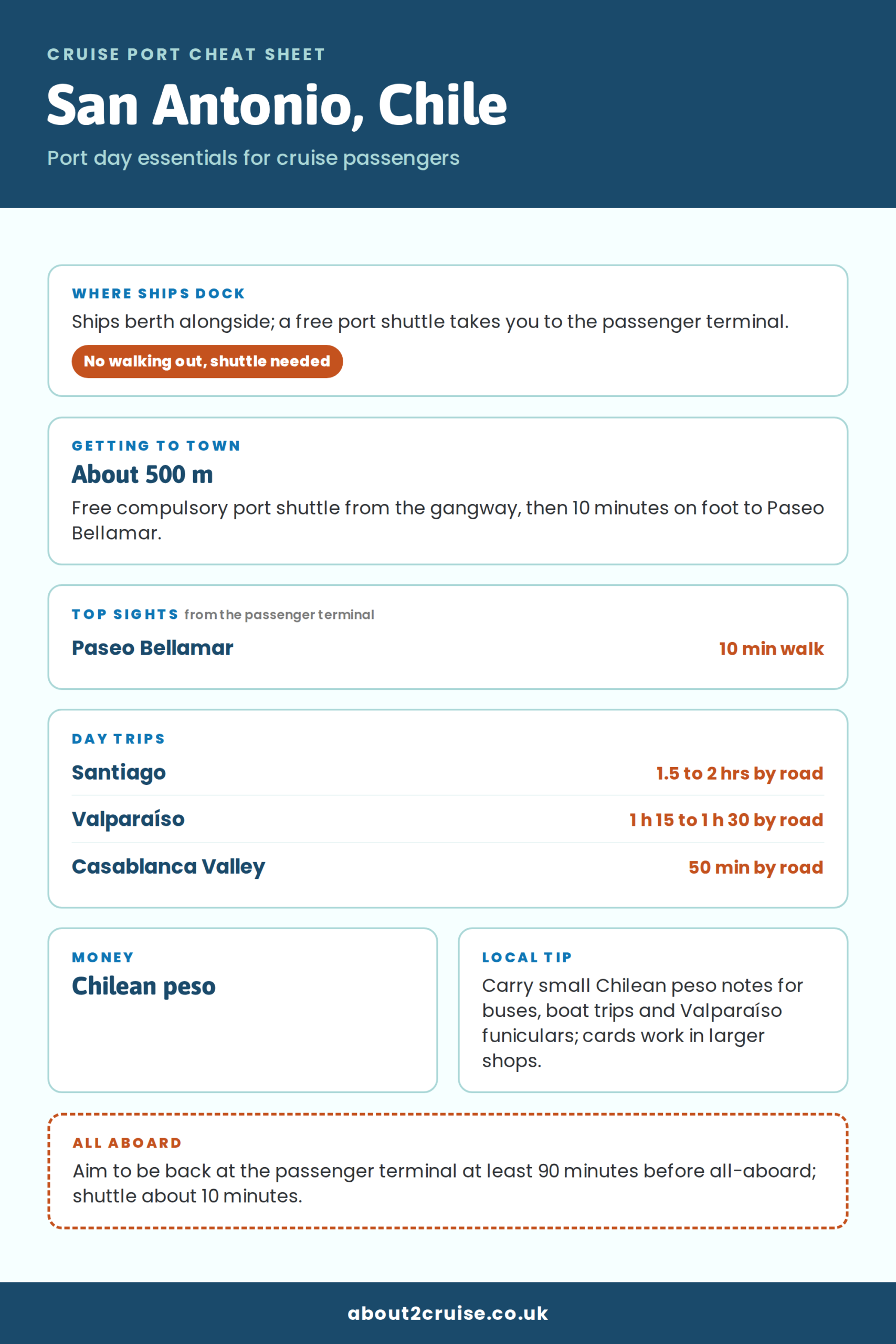
You cannot walk through the cargo port. The normal arrangement is a free, compulsory port shuttle bus from the foot of the gangway to the passenger terminal, taking about 10 minutes. Buses run continuously during the call. Always follow your ship’s daily programme and announcements because the exact meeting point and frequency can vary by berth and call size.
The shuttle drops you at the passenger terminal compound. From there, the town and the seafront are walkable for most people, but the pavement between the port area and the bus station is uneven. One former port authority manager has estimated that about a quarter of passengers, many older, struggle with luggage on that stretch. If you have heavy bags or mobility concerns, arrange assistance in advance rather than expecting a smooth, step-free airport-style route.
Terminal Address, Meeting Points, and Practical Notes
The street address most often given for the passenger terminal is Terminal de Pasajeros, Alan Macowan 240, San Antonio. In practice, taxis and local signs often refer to the terminal gate on Avenida Angamos, next to the Barrancas bus station at Av. Angamos 1464. The two are only a few minutes apart, but use the meeting point your cruise line gives you and allow a little extra time to orient yourself on arrival.
There is no public parking at the pier, no left-luggage facility, and no official cruise parking nearby. If you’re driving or arriving by private transfer, you’ll normally be dropped at the terminal gate. If you need luggage storage, arrange it through a hotel, tour provider, or private driver; don’t count on leaving bags at the terminal.
San Antonio cruise port map
Ships dock at San Antonio cruise port. From there, Fish terminal is about a 20-minute walk and Paseo Bellamar about 26 minutes. Tap a pin for directions.
- San Antonio cruise portWhere ships dock
- Barrancas bus terminalBus station · About 12 min walk from San Antonio cruise port
- Fish terminalSeafood market · About 20 min walk from San Antonio cruise port
- Paseo BellamarSeafront promenade · About 26 min walk from San Antonio cruise port
- Mirador Cristo del MaipoViewpoint · About 2 km from San Antonio cruise port
- MUSAMuseum · About 3 km from San Antonio cruise port
- Isla Negra Pablo Neruda housePoet’s house · About 18 km from San Antonio cruise port
- Casa Marín wineryWinery · About 11 km from San Antonio cruise port
- Casas del BosqueAbout 35 km from San Antonio cruise port
Arrival Formalities and Turnaround Days
Chile Entry Requirements
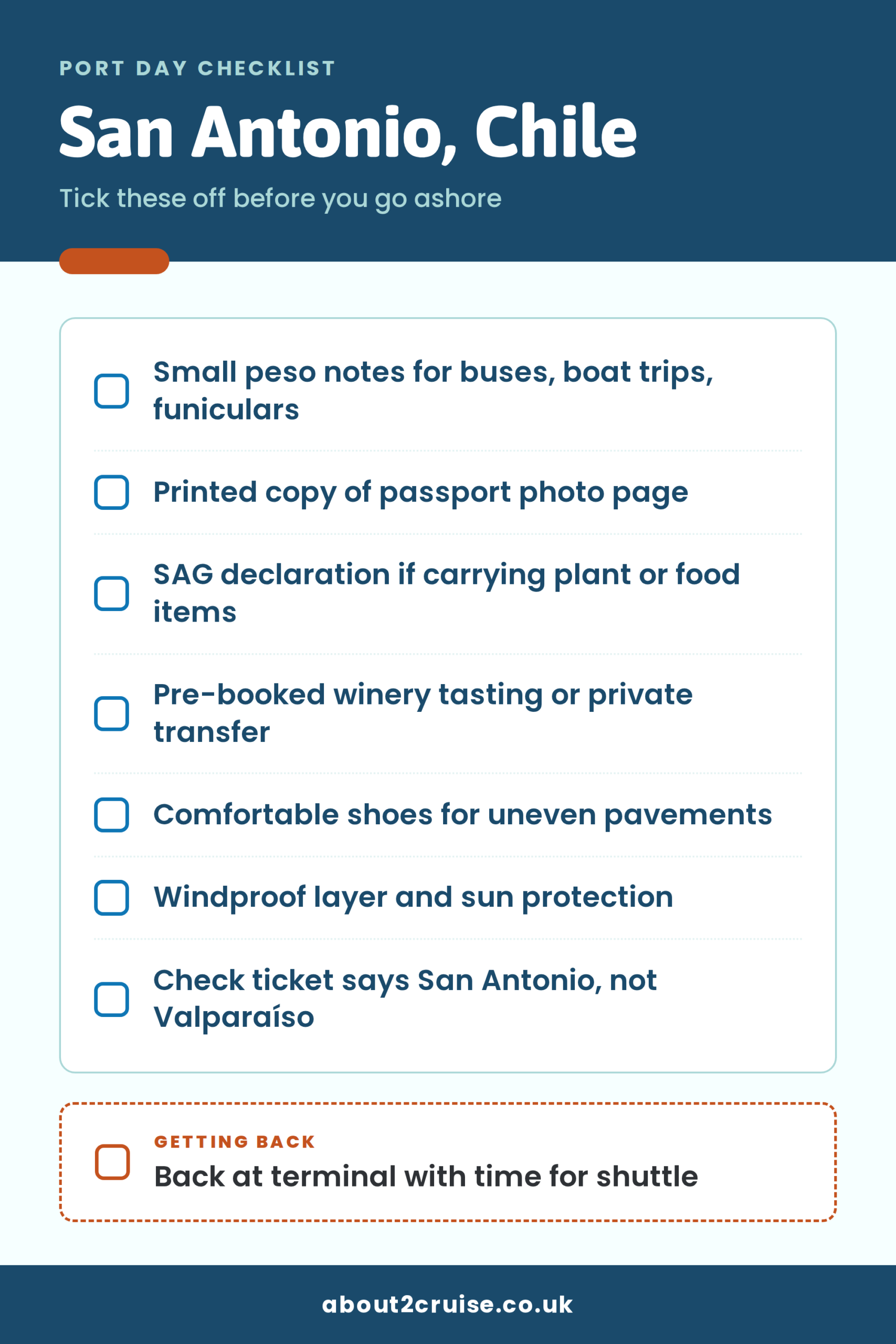
UK citizens can visit Chile for up to 90 days without a visa and are issued a tourist card, or tarjeta de turismo, on entry. Keep this card for departure. Carry a printed copy of your passport photo page; in many everyday situations a photocopy is sufficient ID, and it’s safer than carrying the original around town.
Every arrival must complete a SAG agricultural declaration if carrying animal or plant products, food, seeds, flowers, honey, or natural-material crafts. You can do this on paper or online before arrival. Chile is strict about this: fruit, seeds, plants, flowers, honey, and some wooden or natural-material handicrafts may not be brought in, and false declarations can lead to fines. If in doubt, declare it or leave it on the ship.
Embarkation and Disembarkation Tips
San Antonio is a turnaround port for several cruise lines. If you’re starting or ending a cruise here, remember that the international airport is in Santiago, so most passengers need a 1.5–2 hour road transfer. Cruise line packages usually place passengers in Santiago or Valparaíso before the sailing, then transfer them to the port on embarkation day. There are also local hotels in San Antonio, but the capital and Valparaíso give you a bigger buffer if your flight is delayed.
The terminal has no luggage storage, so if you arrive before check-in opens or have a late flight after disembarkation, book a cruise line transfer, private driver, or tour that can hold your luggage. Check your cruise line’s final documents for the exact terminal gate and check-in cut-off. San Antonio does not publish a standard all-aboard time; it changes by sailing.
Language and Local Time
Spanish is the local language, and at the fish terminal and smaller shops you may not find much English. Useful basics include: hola, por favor, gracias, ¿cuánto cuesta?, la cuenta, ¿aceptan tarjeta?, no hablo español, and ¿dónde está…? During the cruise season local time is usually UTC−3.
Exploring San Antonio Without an Excursion
Yes, for a low-key few hours. San Antonio is not a highlight port in the traditional sense, but it has a genuine Chilean working-harbour atmosphere, a good seafood market, and several easy coastal viewpoints. If you prefer a slow port day, or if your call is short, you can stay close and still enjoy yourself.
Paseo Bellamar and the Fishing Harbour
From the passenger terminal it is about 10 minutes on foot north to Paseo Bellamar, the seafront promenade with the tourist pier and fish terminal. The promenade has a large group of artisans selling local crafts, plus boat trips and views over the port operations.
Boat trips from the pier are inexpensive: a motor launch trip costs about CLP 3,000 per person for roughly 40 minutes, and a rowing boat about CLP 2,500 for the same time. Sea lions often haul out on the rocks and tetrapods beside the tourist pier, which is a reliable photo stop.
Two viewpoints are worth the walk. Mirador 21 de Mayo looks over the port and Paseo Bellamar. Mirador Cristo del Maipo, about 120 m above sea level, gives a wider panorama over San Antonio, Llolleo, and the Maipo river mouth.
Other Nearby Stops
Cartagena, about 10 minutes north, has the former house and hilltop tomb of the poet Vicente Huidobro. The Maipo river mouth wetland, about 10 minutes south, is a free coastal birding site. The local natural history and history museum, MUSA, sits above the river mouth with an outdoor viewpoint and a native-plant park.
If your ship has a long call and you want a half-day without a big tour, the easiest good day is: shuttle to the terminal, walk to Paseo Bellamar, take a boat trip, see the sea lions, eat at the fish terminal, then take a short taxi or local bus to Isla Negra or Cartagena before returning with plenty of buffer.
Santiago or Valparaíso: Which One Should You Choose?
If you have one port day, your biggest choice is whether to commit to Santiago, choose Valparaíso, or skip both for wine country and the coast. Santiago gives you Chile’s capital landmarks, but the drive is long. Valparaíso gives you a UNESCO-listed historic port with dramatic hills and painted streets, with a slightly shorter drive but still a full day. Do not try to do both. You would spend most of the day on Route 78 and see neither properly.
Santiago from Your Cruise Ship
Realistic Drive Times
Santiago is 110–120 km from the port via the Ruta 78 motorway. Allow 1.5 to 2 hours each way. If your ship is in port from early morning until late afternoon or evening, you can realistically get four to six hours in the capital. The drive is the constraint, not the city’s size. Traffic on Ruta 78 is unpredictable, so leave Santiago at least 3 hours before all-aboard.
Private car transfers are commonly quoted at about US$150 for up to three passengers and about US$300 for up to six. Ship-organised transfers are the simplest option for many passengers, especially for airport or embarkation-day transfers, because they absorb the logistics and late-running risk.
Best Things to See in Santiago
A first-timer’s capital day usually covers the historic centre and one viewpoint. Highlights include the Plaza de Armas and Metropolitan Cathedral, La Moneda palace, the Barrio Lastarria and Bellas Artes neighbourhoods, and Cerro San Cristóbal for sweeping views. A guided tour or private guide is worth it here: you’ll see more, waste less time, and avoid carrying valuables unnecessarily. Keep cameras and phones discreet, and do not leave bags on chairs or under café tables.
Getting to Santiago Airport
The airport, Arturo Merino Benítez, is usually described as about 80–120 km from San Antonio depending on the source. For planning, always allow at least 2 hours. Some destination pages still repeat an old “30 minutes from Santiago” claim; ignore that. It is unrealistic by road between the port and the capital or airport.
There is no direct public bus from the port to the airport. You can take a coach from San Antonio to Santiago and then the airport bus from Terminal Alameda, but that is too tight and fussy for most cruise passengers. Use a ship transfer, private driver, or pre-booked shuttle. If you are flying home on disembarkation day, do not book a flight that requires a white-knuckle dash from the port.
Valparaíso from San Antonio
Valparaíso is about 90 km from San Antonio, roughly 1 h 15–1 h 30 by road. It is a different port, and cruise lines can sometimes sell both as “Santiago”. Always check your ticket and final documents for exactly which port you are using, because the two are roughly 90–100 km apart.
Valparaíso’s historic quarter is UNESCO-listed, and the joy is in the hills. The flat lower city rises sharply into Cerro Alegre and Cerro Concepción, linked by century-old funiculars. The most useful for visitors are El Peral, Concepción, and Reina Victoria. They take you up to the balcony streets, Paseo Gervasoni and Paseo Yugoslavo, with views over the bay.
From those hills you can wander painted staircases and murals, including the piano staircase and the “We Are Not Hippies” stair. Wear proper shoes: there are hills, stairs, and cobbles. Carry small Chilean notes for the funiculars, dress in layers for wind, and keep your phone and camera secure. A Valparaíso day is best for travellers who enjoy walking, street art, and gritty port character rather than manicured sightseeing.
For the return, leave Valparaíso with a full buffer. The drive can vary from 1 h 15 to 2 h depending on traffic and road conditions. Aim to be back in San Antonio at least an hour before all-aboard, then add extra for the shuttle.
Wine Tasting Near the Port: Casablanca Valley and San Antonio Valley
Casablanca town is about 47 km, or 50 minutes, from San Antonio. The valley is known for cool-climate wines, and it is a natural choice for a cruise-port wine tour. Most ship excursions combine a winery visit with lunch or a Valparaíso stop.
Casas del Bosque, near Casablanca, offers several set tastings. Its “Aromas” tasting covers four wines and costs CLP 38,000, lasting about 45 minutes. “La Trampa” includes five wines for CLP 48,000 over about an hour, and “Icon” includes six wines for CLP 75,000 over about 70 minutes. These are popular and should be booked in advance.
If you want less driving and a more local experience, look at the San Antonio Valley instead. Casa Marín at Lo Abarca is about 17 km, or 20 minutes, from the port. It offers a tour and tasting for CLP 35,000 per person, with four daily slots at 10:00, 12:00, 14:00, and 16:00 from Tuesday to Sunday, in Spanish or English. It also sells walk-in wine flights of four wines for CLP 20,000 from the sales room without booking, Tuesday to Sunday 10:00–17:00. A five-course lunch with wine pairing costs CLP 100,000 with a minimum of four people and five days’ notice.
For independent wine touring, pre-book the winery and arrange a private taxi or driver who will wait for you. Public buses run to Casablanca, but they are less practical for timed tastings and return deadlines. The legal drinking age in Chile is 18, and tastings assume you are of age.
Isla Negra and the Poets’ Coast
Isla Negra, one of Pablo Neruda’s houses, sits about 17 km up the coast from San Antonio. Local guides put the drive at roughly 35 minutes by taxi or local bus. The house-museum is open Tuesday to Sunday from 10:00 to 18:00, and until 19:00 in January and February. It is closed on Mondays and on 1 January, 1 May, 18 September, and 25 December.
General admission costs CLP 11,000. Reduced entry of CLP 4,500 applies to under-17s, accredited students, and Chilean residents over 60. There is no advance booking for individuals: entry is first come, first served. Audio guides are available in Spanish, English, Portuguese, French, German, and Italian. This is a good half-day independent excursion from the port, especially when combined with the San Antonio waterfront or a nearby winery.
The regional tourism board markets the surrounding coast as the “Litoral de los Poetas”, covering San Antonio, Cartagena, El Quisco, El Tabo, Algarrobo, and Santo Domingo. If you want an easy coastal ride rather than a long city drive, this stretch has beaches, small seafood towns, and literary landmarks without the Santiago bus time.
How to Choose a Shore Excursion for One Day
The right excursion depends on your tolerance for bus time and whether this is your first visit to Chile.
Before you sail
- Book Casas del Bosque or Casa Marín tastings in advance.
- Confirm whether your ticket says San Antonio or Valparaíso.
- Complete the SAG agricultural declaration online if bringing food or plants.
Short port day: under 6 hours
- On dockingTake the free port shuttleNo walking outYou cannot walk through the cargo port. The compulsory shuttle takes about 10 minutes to the passenger terminal.
- +20 minPaseo BellamarAbout 10 minutes on foot from the passenger terminal to the seafront promenade, tourist pier and fish terminal.
- +40 minBoat trip and sea lionsCash for boatA motor launch trip takes about 40 minutes. Sea lions often haul out by the pier.
- +1 hr 30 minLunch at the fish terminalTry machas parmesanaUpstairs stalls serve fried fish, empanadas de mariscos, machas a la parmesana and caldillo de congrio. Lunch starts around 12:30.
- +2 hrs 30 minMirador 21 de MayoWalk up to the viewpoint over the port and Paseo Bellamar. Carry small peso notes for stalls and boatmen.
- All-aboard minus 1 hrBack at the passenger terminalWalk back the same way and take the shuttle. Allow time for security and the 10-minute ride.
The time on the map is the whole walk, every stop added together.
Open this walking route in Google Maps
If plans change: If the fish terminal is closed or you would rather skip the boat trip, walk the promenade and visit the MUSA museum and its native-plant park.
Long port day: 8 hours or more
- On dockingTake the free port shuttleNo walking outYou cannot walk through the cargo port. The compulsory shuttle takes about 10 minutes to the passenger terminal.
- +15 minMeet your pre-booked driverBook aheadOfficial taxis wait at the terminal, but a pre-booked private transfer is safer for a full day in Santiago.
- +30 minDrive to SantiagoAllow 1.5 to 2 hours on Ruta 78. The return needs the same buffer; traffic can be unpredictable.
- +2 hrs 30 minPlaza de Armas and Metropolitan CathedralStart in the historic heart of Santiago. Keep phones and cameras discreet.
- +3 hrs 30 minBarrio Lastarria and lunchTry empanadas de pinoA short walk from Plaza de Armas. Order empanadas de pino or ceviche at a café here.
- +5 hrs 30 minCerro San CristóbalA short taxi or funicular ride from Barrio Lastarria. Sweeping views over the city.
- All-aboard minus 3 hrsDrive back to San AntonioLeave the capital no later than three hours before all-aboard. Watch Ruta 78 traffic.
This map shows the taxi ride from the ship. The time is the drive only, not your time ashore.
Open the taxi route in Google Maps
If plans change: If your driver cancels or Ruta 78 is blocked, head to the cruise line's shore excursion desk immediately; ship-organised tours guarantee the ship waits.
If you have never been to Chile and your ship offers 10 or more hours in port, a private or ship-organised Santiago highlights tour is the classic choice. The drive is long, but you get the capital’s core. If you dislike long transfers, choose Valparaíso instead: it is closer, more compact, and more photogenic.
If you want wine, the most relaxed option is Casa Marín because it is only about 20 minutes from the berth. Casablanca Valley is the more famous wine route, but it involves more driving. A good all-rounder for repeat visitors is a private tour combining Casablanca or Casa Marín with Isla Negra, or a Valparaíso and Casablanca combination.
If you are tired, short on time, or simply want to eat well and hear Spanish rather than sit in a coach, stay in San Antonio: shuttle to the terminal, walk to Paseo Bellamar, take the boat trip, photograph the sea lions, eat at the fish terminal, and return to the ship. It is not the “greatest hits” day, but it is a real port day in a working Chilean town.
Ship-organised tours protect you if the tour runs late; independent tours give you a smaller group and more say in timing. If you go independent, build in a hard return buffer. The ship will not wait for a late taxi or a traffic jam unless you are on an official excursion.
Money, Cards, Tipping, and Etiquette
The currency is the Chilean peso, with notes from CLP 1,000 to CLP 20,000. Cards and contactless payment work in many shops, restaurants, and ride-hailing apps, but you should carry cash for buses, boat trips, market stalls, small cafés, and funiculars in Valparaíso. Small notes are more useful than large ones.
ATMs are available in San Antonio town, but do not rely on finding one inside the port area. A 10% restaurant tip is customary and often appears on the bill as a suggested propina. Tipping taxi drivers is not expected.
Foreign visitors are exempt from the 19% IVA on hotel rooms when paying in foreign currency with a foreign card and showing a passport and tourist card. This applies to hotels, not restaurants or shops.
Staying Safe in Port
Chile is not a dangerous country to visit, but pickpocketing, mugging, and theft from vehicles are common, including in bus stations, ports, and at viewpoints. Muggings happen frequently in Santiago and Valparaíso and increasingly involve guns or knives, sometimes in daylight. Do not resist; hand over what is demanded and stay calm.
Common scams include distraction robbery, “accidental” liquid spills, deliberate tyre punctures, and taxi meters with extra digits. Use official taxis, book in advance rather than hailing in the street, and at Santiago airport only use official taxis paid for before getting in. Police deploy at the port on cruise arrival days to prevent crime against passengers, with extra patrols in January and February, but that does not remove the need for normal caution.
Avoid demonstrations, especially in Santiago on Friday afternoons and evenings. It is illegal to drink alcohol in public places, including streets, squares, and promenades. Keep a photocopy of your passport, not the original, for everyday ID.
Weather, Sea Conditions, and Packing
San Antonio has a Mediterranean warm-summer climate. The warmest month averages about 24°C by day and the coolest about 16°C. Rain is almost absent in the cruise summer: around 1 mm in January and 3 mm in February. Humidity averages about 77%, and the sea temperature peaks at only about 17°C in February. Despite the mild air, this is not a hot-and-calm Caribbean port.
The central coast is windy and changeable, and morning fog or low cloud is common outside high summer. Dress in layers, bring a windproof outer layer, and use sun protection. If you are walking Valparaíso hills or the uneven pavement around the port, comfortable shoes with grip matter more than sandals. Carry water and a small daypack that you can keep closed and in sight.
Sea conditions are usually workable in the cruise season, but the port can close for adverse weather or cargo-ship congestion. Calls have been moved from San Antonio to Valparaíso at short notice, so keep an eye on your cruise line’s updates before sailing.
Where to Eat and What to Bring Home
The fish terminal on Paseo Bellamar is the best local eating experience near the port. It is about half a kilometre, or eight minutes’ walk, from the passenger terminal. The ground floor is a working fish and shellfish market, while the upstairs stalls serve fried fish, empanadas de mariscos, machas a la parmesana, and caldillo de congrio. Lunch up there usually costs about CLP 8,000–15,000 and is best from around 12:30 onwards. Cash is safest at the market stalls.
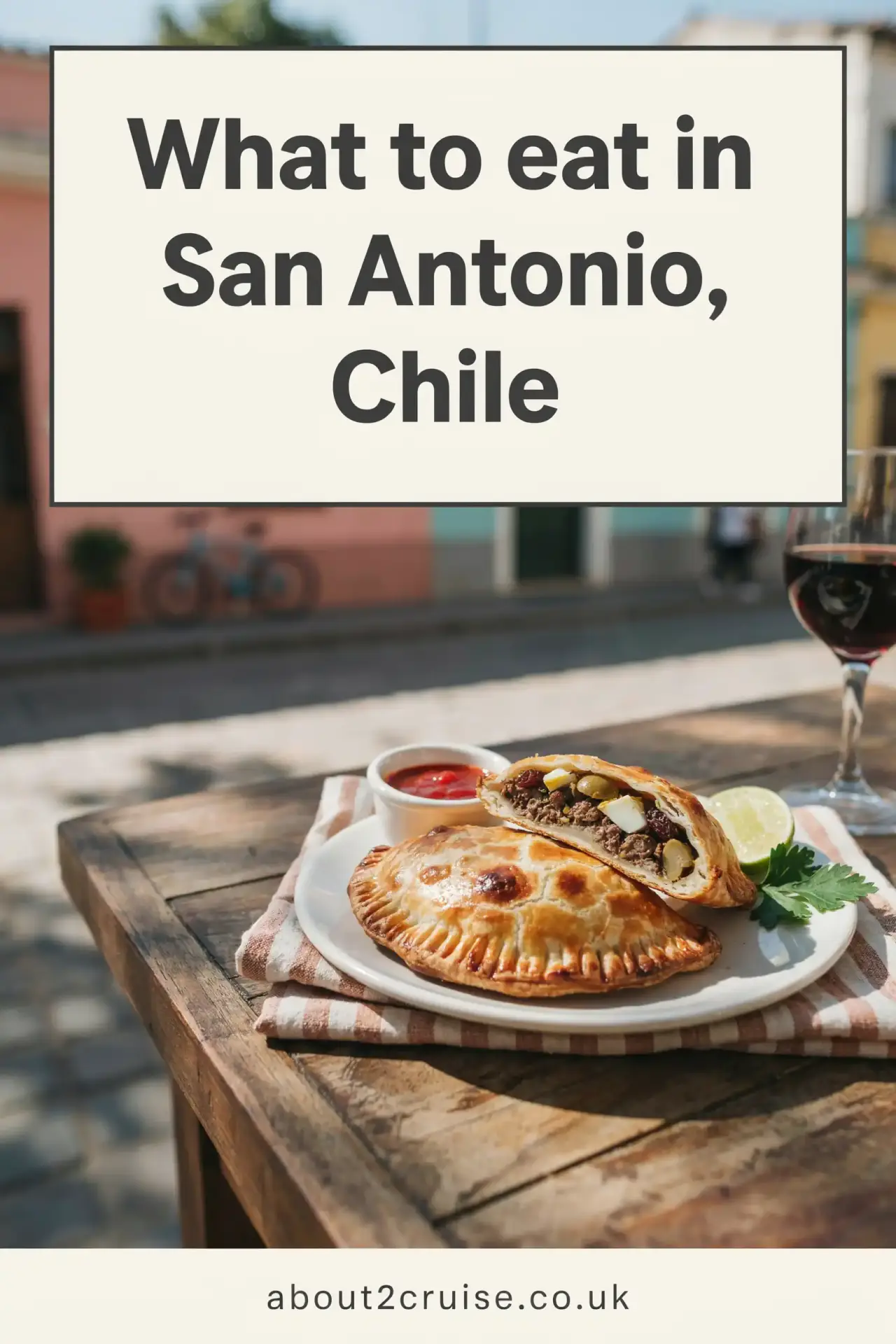
Elsewhere, Chilean dishes to try include empanadas de pino, ceviche, and mote con huesillo. Around Lo Gallardo and San Juan, local specialities are clay-oven empanadas and pan amasado. Valparaíso’s signature dishes are seafood empanadas and chorrillana, usually washed down with a pisco sour in the old port bars.
For souvenirs, the artisans at Paseo Bellamar are the closest option. There is no big duty-free mall at the passenger terminal, so do not plan terminal shopping. Chilean wine from a vineyard or supermarket makes an easy gift, and the Hotel Casino San Antonio by Enjoy has an attached mall and supermarket if you need supplies or last-minute essentials before a turnaround.
Hotels for Pre- or Post-Cruise Stays
Most cruise packages put you in Santiago before a San Antonio embarkation, with a transfer to the port on sailing day. That makes sense because the airport is in Santiago and a capital hotel gives a buffer against flight delays. Valparaíso is another common overnight base, giving you a shorter transfer than Santiago but still a proper pre-cruise evening.
If you want to stay as close to the pier as possible, San Antonio has several options. Hotel Casino San Antonio by Enjoy is next to Paseo Bellamar, about 120 m from the promenade and around a 15-minute walk from the cruise terminal by guest reports. It has harbour-view rooms, buffet breakfast, parking, an attached mall, and a supermarket. Hotel Puerto Mayor is at Avenida 21 de Mayo 758, about two blocks from Paseo Bellamar, with a restaurant, parking, and early or late check-in on request. Alhambra Hotel is at Divina Providencia 80, with parking and a 24-hour front desk; guests report that the owner can arrange a taxi to the port.
There is no cruise parking at the pier. If you need parking, the casino hotel is the closest documented option, reported at around CLP 11,700 per night. Otherwise, arrive by taxi, private transfer, or ship transfer.
Cruise Lines and Itineraries That Use San Antonio
Ships calling at San Antonio in recent and coming seasons include Seabourn Pursuit, Island Sky, AIDAsol, Costa Serena, Vasco da Gama, Insignia, Zaandam, Oosterdam, Seven Seas Mariner, and Azamara Journey. Holland America, Seabourn, Costa, and Azamara have used the port for turnarounds. Other ships seen recently include Sapphire Princess, Majestic Princess, Costa Deliziosa, and Artania. Majestic Princess, at 330 m, is the longest cruise ship to have called in Chile.
Itineraries from San Antonio typically run south to Cape Horn, the Chilean fjords, Punta Arenas, Ushuaia, and Buenos Aires, or north to Coquimbo, Iquique, Arica, and Peru. If your voyage continues south, see our Ushuaia cruise port guide. Expedition and longer South Atlantic itineraries may also call at South Georgia Island.
Be aware that San Antonio can be substituted by Valparaíso at short notice because of weather or cargo-ship congestion. Check your cruise line’s final port confirmation carefully, especially when booking independent tours.
If your cruise continues along Chile’s Pacific coast, Antofagasta is often the next or previous call.
On longer South American itineraries, you may call at Arica as the next or previous Chilean port, far to the north on the coast.
On your Pacific coast itinerary, Coquimbo (La Serena) is the next or previous call either side of San Antonio, taking you to a smaller port on Chile’s northern coast.
If your itinerary continues towards Peru, Iquique is often the next Chilean call, far to the north on the same Pacific coast.
On South American itineraries, you may also stop at Puerto Chacabuco, a small Patagonian port further south on Chile’s Pacific coast.
Transfer and Timing Cheat Sheet
Use these as planning distances and times, not exact guarantees. Always add buffer for the shuttle, road traffic, and security.
- Berth to passenger terminal: about 250 m by port shuttle, roughly 10 minutes; no pedestrian walking through the cargo port.
- Passenger terminal to Paseo Bellamar: about 10 minutes on foot.
- Passenger terminal to Barrancas bus terminal: about 3 minutes’ walk from the terminal gate.
- San Antonio to Santiago: 110–120 km, 1.5–2 hours each way.
- San Antonio to Santiago airport: allow 2 hours or more, regardless of shorter quoted distances.
- San Antonio to Valparaíso: about 90 km, 1 h 15–1 h 30 each way.
- San Antonio to Casablanca: about 47 km, 50 minutes.
- San Antonio to Casa Marín, San Antonio Valley: about 17 km, 20 minutes.
- San Antonio to Isla Negra: about 17 km up the coast, roughly 35 minutes by taxi or local bus.
- Santiago by public coach from Barrancas: roughly 1 h 40, departures throughout the day, but coaches drop in San Antonio town rather than at the cruise terminal.
Public coaches serve Santiago, Valparaíso, Viña del Mar, Casablanca, Algarrobo, and El Quisco from the Barrancas terminal. Pullman Bus, Pullman Costa Central, Buses GGO, and Pullman Lagunilla are among the operators. There is no passenger rail link to the port.
Port Delays and the Return Trip
The biggest risk on a San Antonio port day is not the town, the terminal, or the road distance by itself. It is the combination of a working port, a motorway that can become congested without warning, and a ship that must stick to its schedule. Traffic on Ruta 78 is unpredictable, and accident or weather-related closures can add serious delay.
If you go to Santiago or Valparaíso independently, leave the destination with a hard deadline, not a best-case estimate. The commonly repeated advice is to leave the capital at least three hours before all-aboard. If your tour or driver proposes something tighter, push back. Watch the time as if the ship will not wait for you: because, unlike a ship-organised excursion, an independent late return usually means you are left behind.
Our Chile cruise ports guide covers the other ports in the region.
San Antonio Cruise Port FAQs
Is San Antonio a tender port?
No. Cruise ships dock alongside. You cannot walk through the cargo port, so a port shuttle takes you from the ship to the passenger terminal.
How far is San Antonio cruise port from Santiago?
About 110–120 km by road, or 1.5 to 2 hours each way. It is not a 30-minute transfer, even though some cruise line pages can imply otherwise.
Can I store luggage at San Antonio cruise terminal?
No. There is no luggage storage at the pier or passenger terminal. Use a hotel, private driver, or tour operator if you need bag storage before embarkation or after disembarkation.
Are taxis and ride-hailing apps available at the port?
Yes. Official taxis normally wait at the terminal exit, and ride-hailing apps operate locally. For long transfers such as Santiago or wine country, pre-book a private driver or taxi rather than trying to hail one casually.
Do I need Chilean pesos?
Cards work in many places, but cash is useful for buses, boat trips, market stalls, small cafés, and Valparaíso funiculars. Carry small notes and do not rely on ATMs inside the port.
Why does my ticket say Santiago but the port is San Antonio?
Cruise lines often label both San Antonio and Valparaíso as “Santiago” because the capital is the main gateway. Check the actual port name carefully. San Antonio and Valparaíso are roughly 90–100 km apart, and ships are occasionally switched between them at short notice.
Is San Antonio worth a port day without an excursion?
Yes, if you want a low-key day and are not expecting a manicured tourist town. The seafront, fish terminal, boat trips, sea lions, and nearby Isla Negra can fill a genuinely pleasant few hours without a long coach ride.
Last Updated: 19 November 2026