
Puerto Baquerizo Moreno is the tender-only capital of the Galápagos on San Cristóbal. Ships anchor in the bay and passengers step ashore at the town pier. In a short call you can walk the malecón among sea lions, visit the free Interpretation Center, climb Frigatebird Hill for bay views, or snorkel with turtles at the cove below.
Tender, Pier & First Impressions at Puerto Baquerizo Moreno
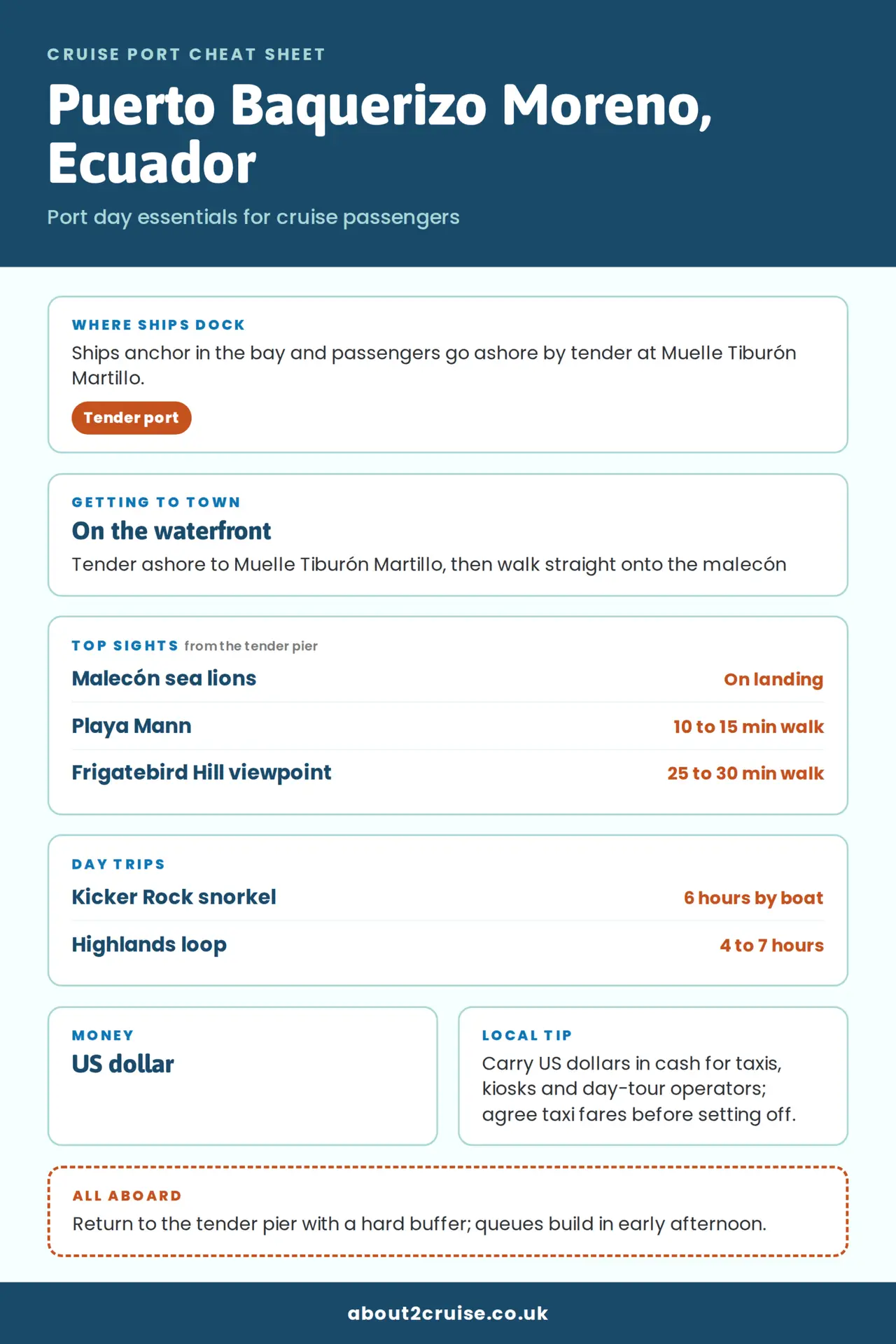
Puerto Baquerizo Moreno sits on the south-western coast of San Cristóbal, the easternmost island of the Galápagos and the province capital. Older English sources call San Cristóbal Chatham Island. There is no cruise terminal building. Ships anchor off the town and use ship tenders, pangas or Zodiacs to reach the shore. The town landing is normally a dry transfer onto a pier or floating dock, not a beach wade, but the boat can move sharply against the landing with steps, gaps or spray. The main pier for cruise passengers and inter-island ferries is Muelle Tiburón Martillo, the Hammerhead Shark Pier, with a wooden extension over a small beach. Muelle Acuario, the island’s first concrete passenger pier, is now used by water taxis and day-trip boats. A water taxi from the dock out to a moored boat costs about US$1.
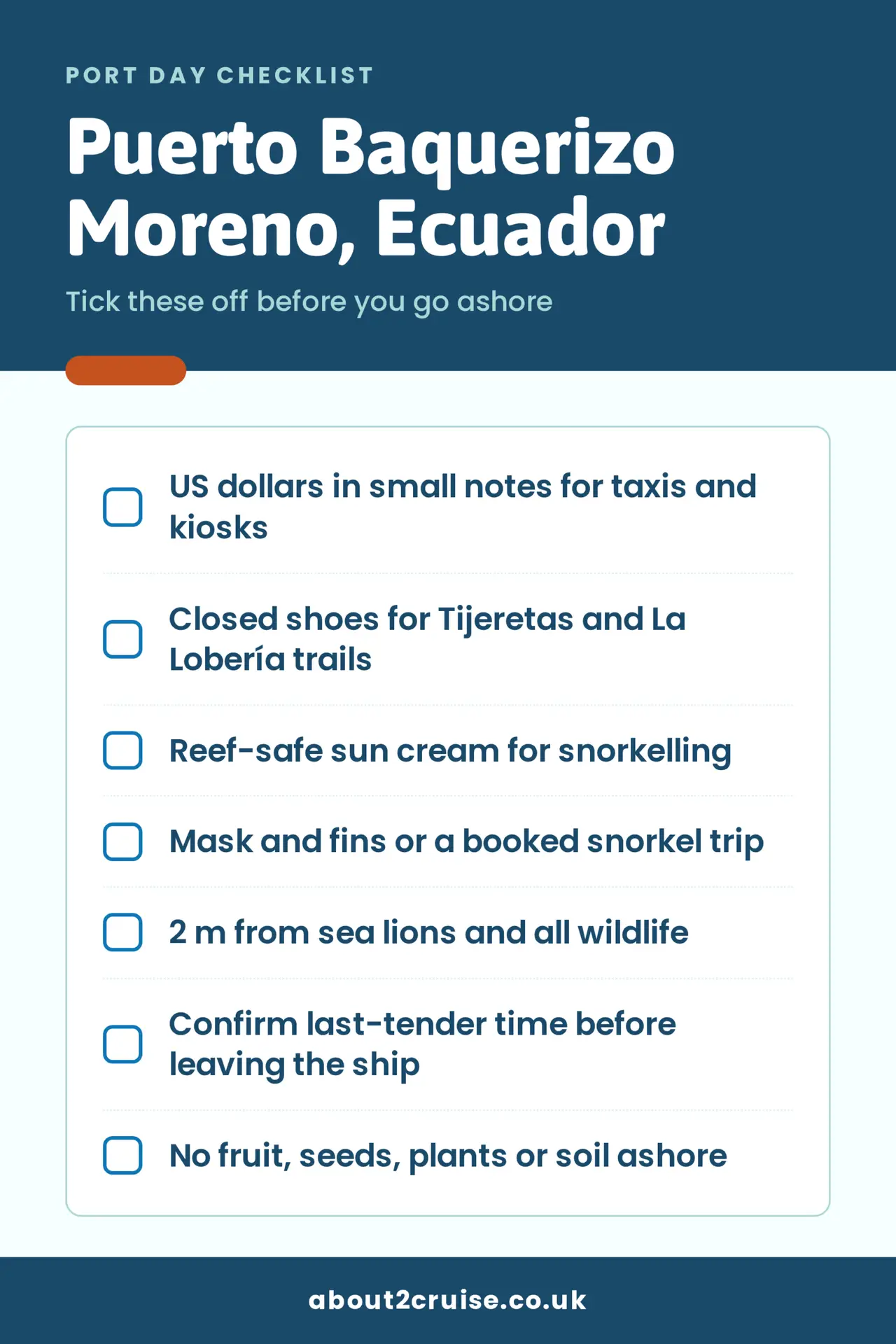
At the pier you pass through a Galápagos biosecurity quarantine filter with X-ray inspection. Do not bring fresh fruit, seeds, plants, soil or most animal products ashore. The Galápagos runs one hour behind mainland Ecuador.
Many visits are short: around three hours 30 minutes. Celebrity Flora has listed Puerto Baquerizo Moreno as tendered from 8:00 am to 11:30 am on some itineraries, and HX’s MS Santa Cruz II has called from 06:30 to 11:30. Confirm your ship’s exact time and last-tender time aboard. The good news is that multiple ships rarely overlap, so most calls feel quiet.
Puerto Baquerizo Moreno cruise port map
Tenders bring you ashore at Muelle Tiburón Martillo. From the tender pier, Malecón is about a 2-minute walk, Playa Mann about 9 minutes and Punta Carola about 19 minutes. Tap a pin for directions.
- Muelle Tiburón MartilloWhere tenders land
- MalecónWaterfront promenade · About 2 min walk from the tender pier
- Playa MannBeach · About 9 min walk from the tender pier
- Punta CarolaBeach · About 19 min walk from the tender pier
- Cerro TijeretasHill viewpoint · About 24 min walk from the tender pier
- La LoberíaSea lion colony · About 3 km from the tender pier
- El JuncoCrater lake · About 15 km from the tender pier
- La GalapagueraGiant tortoise breeding centre · About 19 km from the tender pier
- Puerto ChinoBeach · About 20 km from the tender pier
Sea Lions, Marine Iguanas & Easy Wildlife Sightings
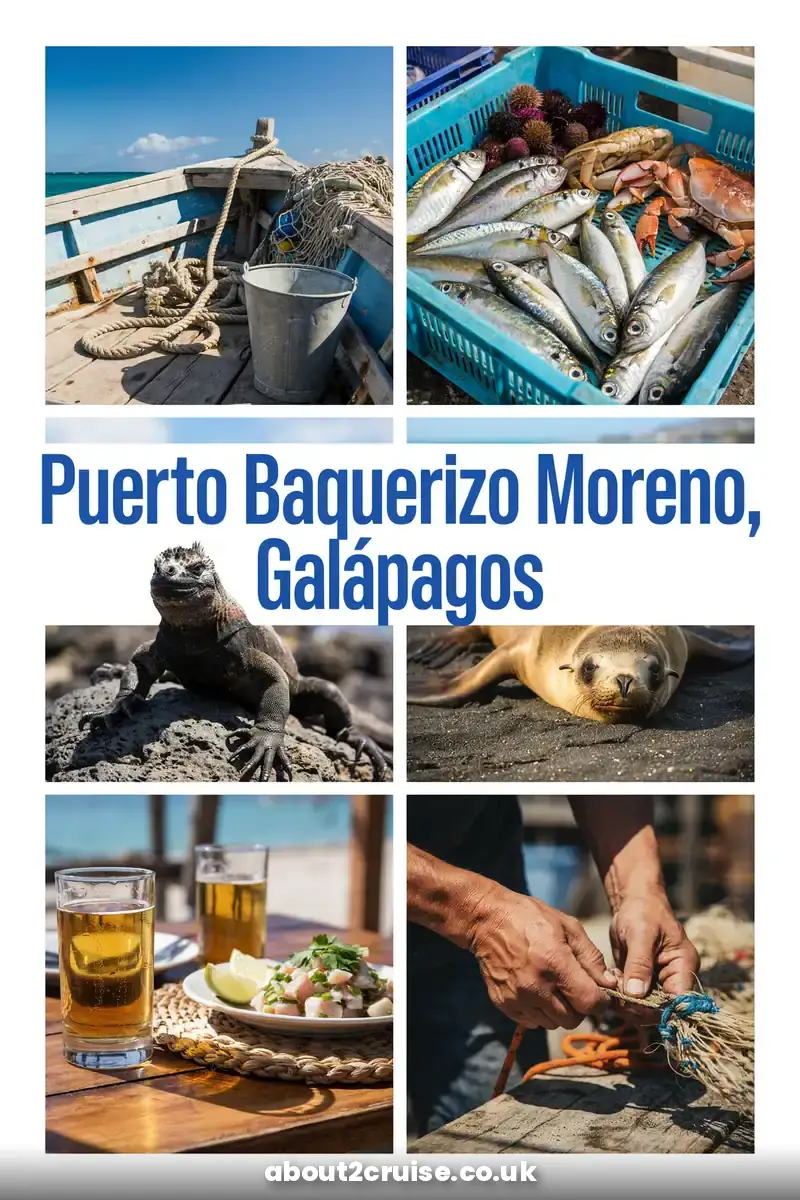
San Cristóbal’s El Malecón sea lion colony is the largest breeding colony in the archipelago, holding roughly 43% of the five colonies on the island. One census put about 5,600 sea lions on San Cristóbal, close to a third of the archipelago total. You will see them on benches, pavements, harbour rocks and Playa de los Marinos, often within minutes of stepping ashore. Adult males can reach 2.5 m and 400 kg and defend beach territories.
Other wildlife that needs no long excursion includes marine iguanas on the rocks, frigatebirds over Cerro Tijeretas, blue-footed boobies and pelicans around the harbour, lava lizards, Darwin finches, and turtles and rays in the sheltered cove below Frigatebird Hill. La Lobería adds a sea lion colony, marine iguanas and turtles in the bay.
Sea Lion Etiquette & Park Rules to Know Before You Go
Stay at least 2 m from wildlife when walking, snorkelling, freediving or diving, and at least 4 m in a kayak, on a paddleboard or on a panga ride. Do not touch, feed, chase, handle or approach animals, including pups and dead animals. If an animal approaches you, stop and let it pass rather than closing the gap. Adult males are territorial, especially during the August to January breeding season, with the highest activity between October and November. Use cameras without flash and treat drones as regulated. Sunscreens containing oxybenzone or octinoxate are restricted during water activities in protected areas.
Visits to protected areas must be made with an accredited naturalist guide except at sites the park expressly exempts. The easy town trails and beaches are generally fine independently, but any boat excursion or landing outside those sites must use an authorised operator and boat. The main town sites, La Lobería, the Tijeretas trails and Playa Baquerizo are free and normally open 06:00 to 18:00 daily.
Walking from the Pier to the Malecón: A Practical Route
From the tender pier, the town centre is immediately on the waterfront. You do not need a taxi for the core sights. The malecón is Avenida Charles Darwin, lined with hotels, cafés and sea lions. Playa de los Marinos and Playa de Oro sit around the harbour. Playa Mann is about 1 km away, a 10 to 15 minute walk. Frigatebird Hill is roughly 2 km from the pier, a 25 to 30 minute walk. The Interpretation Center is about a 15 minute walk from the town centre on Avenida Alsacio Northia in Sector Playa Mann. Surfaces are partly paved but can include curbs, sand patches and wet edges, so wear secure footwear.
Gianni Arismendy Environmental Interpretation Center
The Interpretation Center is free and takes about 30 to 45 minutes to see properly. Its three rooms cover Conservation and Development, Human History and Natural History. The walking trail to Cerro Tijeretas, the Tijeretas pier and Punta Carola starts directly from it. Opening hours are not always published consistently. The grounds and trail are usually open from around 06:00 to 18:00, but the indoor displays may close midday or follow shorter staffed hours. Plan for a morning visit if the displays matter to you. If the centre is closed, the trail to Frigatebird Hill and the coast can still often be used.
Frigatebird Hill / Cerro Tijeretas: Hike, Viewpoint & Darwin Link
Cerro Tijeretas is the free, no-guide-needed panoramic viewpoint above Puerto Baquerizo Moreno. From the pier it is about 2 km, or shorter from the Interpretation Center. The well-marked trail has steps and rocky sections, with roughly 45 minutes round trip to the viewpoint at an easy pace. From the top you look over the bay, the town and Kicker Rock, also called León Dormido, on the horizon. Frigatebirds nest on the slopes.
Below the hill, a sheltered cove has a bronze Charles Darwin statue marking the cove widely held to be where Darwin first landed in the Galápagos on 16 September 1835. The same cove is a shore-snorkelling site with sea lions, sea turtles, rays and reef fish. There is no gear rental at the trail, so bring equipment or book a guided trip. Wear closed shoes rather than flip-flops because of the steps and rocky sections.
Playa Mann, Punta Carola & La Lobería: Beaches and Shore Snorkelling
Playa Mann is the easiest beach from the passenger pier, about 1 km or 10 to 15 minutes on foot. It has kiosks from mid-morning to sunset selling snacks and cold drinks, but no alcohol. Sea lions often doze on the sand. Punta Carola is about 1.5 km away, a 20 minute walk, with a lighthouse, beach and sunset views but no kiosks or services. La Lobería is about 3 km from the pier, a 35 minute walk or a 5 to 10 minute taxi ride. It is free, has a sea lion colony, marine iguanas and turtles in the bay, and a cliff trail above frigatebirds and tropicbirds. The cliff trail has rough lava rock, so closed shoes are best.
For independent shore snorkelling, the Tijeretas cove below Frigatebird Hill is the best sheltered option in town. Water temperature runs about 22°C in August to October and 25 to 27°C in February to April, so a short wetsuit helps. Bring a mask and fins or join an organised snorkel trip. Do not touch wildlife, keep the 2 m distance, and use reef-safe sun cream. If you are not confident in the water, stay waist-deep or choose a guided trip with buoyancy support.
Kicker Rock Boat Snorkelling: Is It Realistic on a Short Call?
Kicker Rock or León Dormido is an eroded volcanic tuff formation about 144 m high, visible from the Frigatebird Hill viewpoint. It is not reachable on foot. Day tours typically leave Puerto Baquerizo Moreno around 07:30, last about six hours, sail about an hour, and include two roughly 45 minute snorkel sessions in the channel between the rocks, plus a beach stop such as Manglesito, Puerto Grande or Cerro Brujo. Advertised prices have ranged from US$160 for an economy boat to US$215 standard and US$237 superior, including guide, lunch, short wetsuit and snorkel gear. It is not suitable for non-swimmers, people over 80, or those with high blood pressure. Operators differ on whether the departure pier is Muelle Tiburón Martillo or Muelle Acuario, so confirm.
On a typical three and a half hour cruise call, an independent Kicker Rock trip almost certainly will not fit. If your ship offers Kicker Rock as an organised excursion with a guaranteed return, that reduces the timing risk. Otherwise save it for a longer call or a stay before or after the cruise.
Galapaguera, El Junco & Puerto Chino: Do You Have Time for the Highlands?
The classic highlands loop is La Galapaguera at Cerro Colorado, the David Rodríguez giant-tortoise breeding centre, plus El Junco freshwater crater lake and Puerto Chino beach. The Galapaguera requires a booking through the park visitor-site management system SIMAVIS, which agencies handle. El Junco is free, often misty and muddy, with a short uphill path to the crater rim. Puerto Chino is about 24 km from town, roughly 40 minutes by road plus a 10 to 15 minute paved walk down to the beach.
A taxi for the loop costs roughly US$60 to 90 per vehicle for about four hours. Shared taxi tours cost about US$60 to 80 per person, and private naturalist-guided tours US$70 to 120. Full highlands tours run four to seven hours, so they do not fit a three and a half hour tender call. Only do this if you are staying overnight or have an unusually long port stay.
Ship Excursions vs Independent Exploration
Puerto Baquerizo Moreno is one of the easiest Galápagos ports to do independently if the call is short. The town, sea lion malecón, Interpretation Center, Frigatebird Hill, Playa Mann and even La Lobería are within walking or short taxi distance and do not need a guide for the main trails.
The ship’s excursion has clear advantages if you want a guided Kicker Rock trip, the highlands, a boat-based landing, or if you have mobility concerns. It also transfers timing risk to the line. If you go independent, start with the sight furthest from the ship and work back. Keep a hard buffer for the last tender.
How Long to Spend Ashore in San Cristóbal
With a typical three and a half hour call you can cover the town, sea lions, the Interpretation Center, the Frigatebird Hill viewpoint, and maybe a quick paddle or photo stop at Playa Mann or the Tijeretas cove. If your call is five to six hours, you can add a slower beach stop or an organised shore snorkel. If you have a full day, that is when Kicker Rock or the highlands become practical. Always check the ship’s all-aboard time. The tender queue can build in early afternoon, so do not save the most important sight for the final 45 minutes.
Taxis, Transport & Where Tours Pick Up
Taxis in Puerto Baquerizo Moreno are white pickups and have no meters. Agree the fare before setting off. Rough fares are about US$2 for central trips, US$5 to the airport, and US$60 to 90 for a highlands loop. A water taxi from the dock to a moored boat costs about US$1. Excursion pick-up points may be Muelle Tiburón Martillo or Muelle Acuario, so confirm with your operator.
Currency, Cards, ATMs & Tipping
The currency is the US dollar, and Ecuadorian centavo coins circulate. There is one bank ATM in town, Banco del Pacífico, with withdrawal limits around US$300 a day, and it can run out of cash, so withdraw early if needed. Cards are accepted at larger hotels, tour agencies and mid-range or upper restaurants, often with a 4 to 10% surcharge. Taxis, kiosks, market stalls and many day-tour operators want cash. Tips are not included in day-tour prices; tip guides and boat crew in cash if you wish.
The Galápagos National Park entry fee is US$200 for international visitors over 12 and US$100 for those under 12. Andean Community and Mercosur visitors pay US$100 and US$50, Ecuadorian residents US$30 and US$15, and under-2s are exempt. It is paid in cash US dollars on arrival at Baltra or San Cristóbal airports, and cards are not accepted. The Transit Control Card costs US$20 per person and can be bought online by card or at the Galápagos counter in Quito or Guayaquil before check-in. If your cruise fare already includes Galápagos flights, park fee and Transit Control Card, do not pay again. Checked bags are inspected and sealed by the biosecurity agency before check-in.
Wi-Fi, Mobile & Staying Connected
Claro and Movistar 4G work in town and around the harbour. There is no coverage at sea, on uninhabited islands or on boat crossings. No mobile shops operate in the archipelago, so buy a SIM or eSIM on the Ecuadorian mainland before flying. Wi-Fi is available in hotels and some cafés but can be slow and unreliable.
Weather, Water Temperature & Packing Advice
There are two broad seasons: warm and wetter from January to May, and cooler and drier garúa season from June to December, influenced by the Humboldt Current. The warmest month is March, averaging about 25.6°C, while September is coolest at about 20.8°C. April is the wettest month at around 66 mm, and humidity runs 79 to 86% year-round. Sea temperature runs about 22°C in August to October and 25 to 27°C in February to April. August to October tends to be choppier.
For any port day take light layers, a brimmed hat, sun protection, a refillable bottle and closed shoes for trails. A light waterproof shell covers panga spray and highland mist. If you want warmer water for snorkelling, December to May is generally better, but wildlife is year-round. Sea lion breeding runs August to January and peaks October to November.
Language, Safety & Health Basics
Spanish is the local language, with English common in organised tourism. The emergency number is 911. UK advice against all but essential travel covers some mainland provinces and the Colombia border area, but the Galápagos are not in the advised-against areas. The FCDO warns of serious accidents involving tour boats and smaller vessels between islands, some without proper licences, capacity checks or life vests. Use reputable operators and ask about safety features, even for short trips. Strong, rapidly changing ocean currents are a drowning risk, and beaches may not have swimming safety warning flags. There is a tsunami risk along the coast and in the Galápagos, and sirens sound if there is an alert.
There is no risk of malaria in the Galápagos, but typhoid is known or presumed to occur, so food and water hygiene matters. Do not stand on rocks or the seabed unless a guide identifies a safe exit.
Accessibility & Mobility Considerations
The biggest barrier is the small-boat transfer. You may need to step across a moving gap and onto a pier or floating dock, and crew cannot always lift or transfer a passenger. The town has some paved and fairly level areas, but curbs, uneven surfaces, heat and wet harbour edges remain. Accessible vehicles and step-free routes should be arranged in advance. The Tijeretas trails are not fully wheelchair accessible, and there are many steps around the viewpoint.
Food, Drink, Shopping & Port Amenities
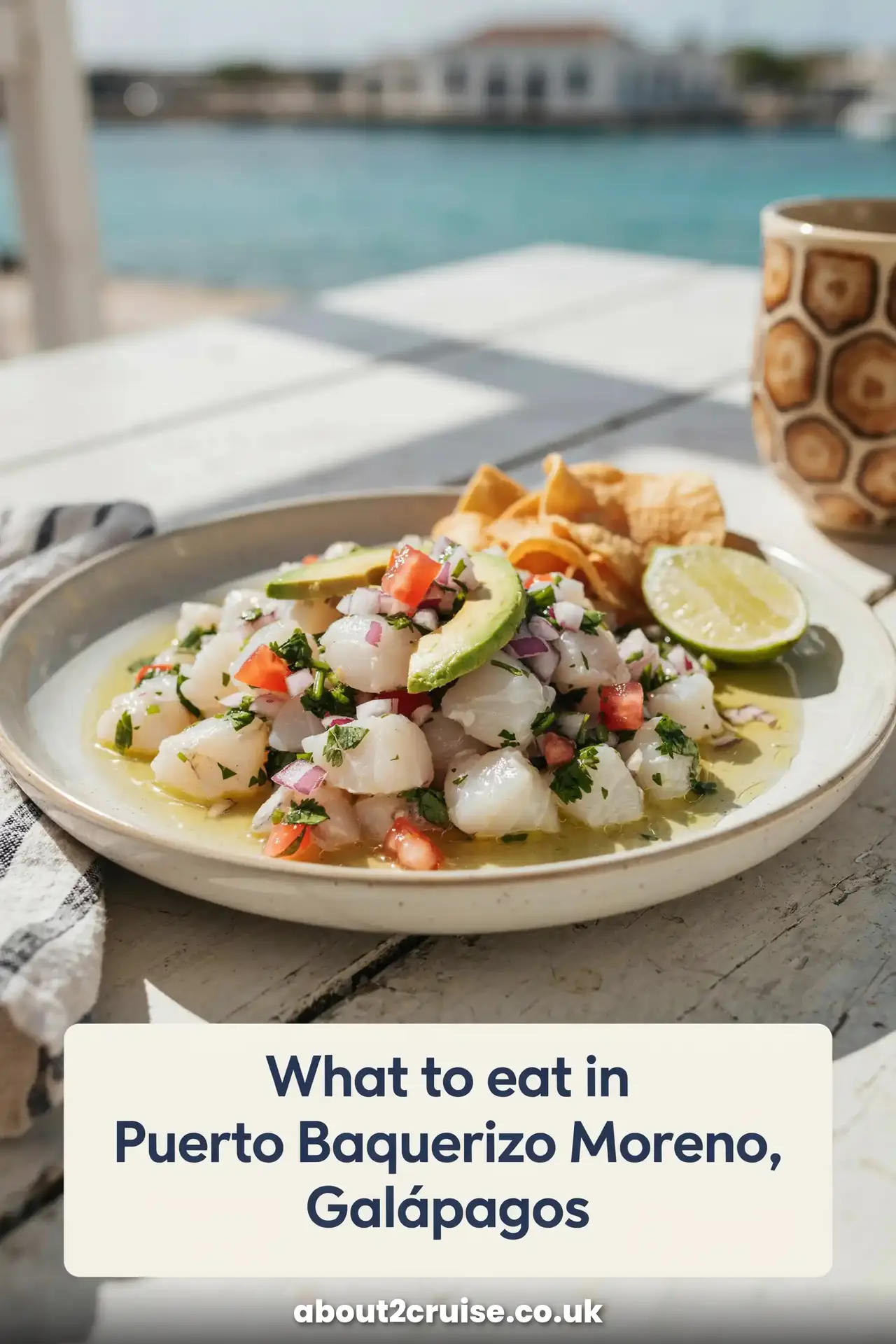
Eat on the malecón, Avenida Charles Darwin, for harbour-view restaurants. The local signature dish is ceviche de canchalagua, a chiton marinated in lime with onion, tomato, green pepper and coriander, served with chifles or rice. Spiny lobster is served grilled, with garlic or in coconut sauce, but only in the regulated season, roughly September to December. Waterfront menus often include seafood barbecue and octopus on volcanic stone. Seafood empanadas appear at carts near the pier, and San Cristóbal highland coffee is sold in local cafés. Playa Mann kiosks do snacks and cold drinks, no alcohol.
Shopping is small-scale: local crafts, coffee and Galápagos souvenirs around the malecón. There are no large port terminal shops and no left-luggage or consigna at the pier. Hotels can often store bags if you have a late flight or boarding.
If Your Cruise Starts or Ends at San Cristóbal
If your cruise starts or ends here, you will fly into San Cristóbal airport, SCY, which sits at the edge of town about 10 to 15 minutes by taxi. There is no channel or barge crossing. Avianca flies Quito to San Cristóbal non-stop, and both Avianca and LATAM reach it from Guayaquil. Most hotels cluster along the waterfront and malecón, five to ten minutes from arrivals, walkable to the dock and restaurants. Operators meet flights and take guests to the dock, then by panga to the anchored vessel.
For a pre-cruise night, stay close to the malecón. Galapagos Sunset Hotel, Hotel Indigo Galapagos and Golden Bay Galapagos are all in the waterfront area. Passengers arriving by air pay the Galápagos entrance fee in cash US dollars and have checked bags biosecurity-inspected before flying. Cruise fares sometimes include this, so confirm what is already covered.
How San Cristóbal Fits Galápagos Cruise Itineraries
San Cristóbal is a natural start and end point for many Galápagos cruises, especially Silversea Silver Origin round trips and Ecoventura yachts. Celebrity Flora calls here on Baltra round trips, often before Punta Pitt on the same day. HX’s MS Santa Cruz II includes Puerto Baquerizo Moreno on its eastern In Darwin’s Footsteps route. Ships calling here typically carry around 120 guests, and most calls feel quiet.
In broad terms, a five-day cruise gives about three full days ashore, a seven-day cruise gives about five, and an eleven-day itinerary reaches nine large islands plus smaller ones. Boats range from small yachts and catamarans of about 20 guests to mid-size ships of up to 100 guests. Inter-island speedboats connect San Cristóbal with Santa Cruz in about two to three hours. Fares are commonly quoted around US$30 to 50 one way, with a water taxi to the boat about US$1. Seas are usually more stable January to June. Reference fares include Celebrity Flora seven-night Galápagos suites from US$7,059, Silver Origin eight-day San Cristóbal round trip from US$17,600, and MS Santa Cruz II cruise-only from £5,703 per person.
San Cristóbal also has one of the region’s largest wind-diesel hybrid systems, a 2.4 MW wind project, plus small solar PV. Although diesel still supplies more than 85% of electricity in recent years, you may notice wind turbines in the highlands. It does not affect a short port call.
You may call at Baltra before or after San Cristóbal; it is the northern Galápagos gateway.
Related Port Guides
- Puerto Limón Cruise Port Guide
- Huatulco Cruise Port Guide
- Hanga Roa, Easter Island Cruise Port Guide
How to spend a port day in Puerto Baquerizo Moreno
A port day in Puerto Baquerizo Moreno works best on foot: see sea lions on the malecón, then choose the Interpretation Center and Frigatebird Hill if your call is short, or the highlands if you have a full day.
Before you sail
- Bring US dollars in cash for the park fee, taxis and small vendors.
- Confirm whether your fare covers the Galápagos park fee and Transit Control Card.
- Book the David Rodríguez tortoise centre through a licensed agency using SIMAVIS.
Short tender call: under 5 hours
- On dockingTender ashore at Muelle Tiburón MartilloNo terminalStep ashore at the Hammerhead Shark Pier. Pass the biosecurity X-ray filter and do not bring fruit, seeds, plants or soil.
- +15 minMalecón sea lionsWalk Avenida Charles Darwin past Playa de los Marinos. Keep at least 2 m from sea lions and stop if one approaches.
- +30 minInterpretation CenterFree entryA 15 minute walk from the town centre. Allow 30 to 45 minutes for the three rooms on human, natural and conservation history.
- +1 hr 15 minFrigatebird Hill viewpointClosed shoesThe trail starts from the centre. Roughly 45 minutes round trip from the centre, with steps and rocky sections. Views over the bay to Kicker Rock.
- +2 hrs 30 minLunch on the malecónTry canchalaguaOrder ceviche de canchalagua, San Cristóbal's marinated chiton, at a harbour-view restaurant on Avenida Charles Darwin.
- All-aboard minus 1 hrBack at the tender pierReturn to Muelle Tiburón Martillo. If a queue forms, do not leave your return to the last minute.
The time on the map is the whole walk, every stop added together.
Open this walking route in Google Maps
If plans change: If the Interpretation Center's indoor displays are closed, use the trail entrance anyway and continue to Frigatebird Hill and the cove.
Long port day: 8 hours or more
- On dockingTender ashore and taxi to El JuncoPre-book taxiStep ashore at Muelle Tiburón Martillo, pass the biosecurity filter and meet your pre-arranged taxi for the highlands loop. Agree the full fare first.
- +30 minEl Junco crater lagoonA short uphill path leads to the crater rim. It can be muddy and misty, so closed shoes help.
- +1 hr 30 minLa Galapaguera tortoise centreBook via SIMAVISThe David Rodríguez breeding centre requires a booking through the park's SIMAVIS visitor-site system, managed by agencies.
- +2 hr 30 minPuerto Chino beachFinish the loop with a 10 to 15 minute paved walk down to the sand.
- +3 hr 30 minReturn taxi to malecón and lunchTry canchalaguaRide back to Puerto Baquerizo Moreno and order ceviche de canchalagua or spiny lobster in season at a harbour-view restaurant on Avenida Charles Darwin.
- +5 hr 30 minFrigatebird Hill and Tijeretas coveClosed shoesWalk from the malecón to the viewpoint, then drop to the sheltered cove. Keep 2 m from wildlife; shore snorkel possible. Views over the bay to Kicker Rock.
- All-aboard minus 1 hrBack at the tender pierReturn to Muelle Tiburón Martillo and stay in the queue if one has formed.
This map shows the taxi ride from the ship. The time is the drive only, not your time ashore.
Open the taxi route in Google Maps
If plans change: If the highlands taxi or SIMAVIS booking falls through, stay in town and add Playa Mann and La Lobería instead.
Our Peru and Ecuador cruise ports guide covers the other ports in the region.
FAQs
Is Puerto Baquerizo Moreno a tender port?
Yes. There is no cruise terminal. Ships anchor in the bay and you transfer by ship tender, panga or Zodiac to the pier. The town landing is usually a dry pier transfer, but it may have steps, gaps and spray.
What can you do independently in San Cristóbal from a cruise ship?
Walk the malecón and sea lion beaches, visit the free Interpretation Center, hike Frigatebird Hill, swim or take photos at Playa Mann or La Lobería, and shore snorkel at Tijeretas cove. No guide is needed for those town trails. Boat trips such as Kicker Rock and highlands tours should be ship-organised or booked with a reputable operator if your call allows.
How long do you need ashore in Puerto Baquerizo Moreno?
For the town core, two and a half to four hours is enough for sea lions, the Interpretation Center, Frigatebird Hill and a beach or photo stop. For Kicker Rock or the highlands you need a full day or a pre-cruise stay.
Are Galápagos cruises worth it and how do five, seven and eleven-day itineraries differ?
For most people yes, because a cruise turns long inter-island transfers into wildlife time. A five-day cruise gives about three full days ashore, a seven-day cruise about five, and an eleven-day reaches nine large islands plus smaller ones. Pricing is high but includes naturalist guides and park logistics.
How does San Cristóbal fit into Galápagos island-based travel and cruise planning?
It is one of the two main airports and a frequent start or end port. Puerto Baquerizo Moreno is small and walkable, so it is easy to combine with a pre-cruise night or a short call.
What wildlife can you see without a long excursion?
Sea lions on the malecón and Playa de los Marinos, marine iguanas, frigatebirds, blue-footed boobies, pelicans, lava lizards, Darwin finches, and turtles and rays in the Tijeretas cove. La Lobería adds a sea lion colony and marine iguanas.
Can you visit the Interpretation Center and Frigatebird Hill in one port call?
Yes. They sit along the same trail. From the town centre the centre is about a 15 minute walk, and from there to the Frigatebird Hill viewpoint and back can be done comfortably in a short call. Allow one to one and a half hours for the centre plus trail.
What should you not do in the Galápagos National Park?
Do not touch, feed, chase or approach wildlife. Keep at least 2 m on foot or snorkel and 4 m on a kayak or panga. Do not use flash photography, do not fly drones unless authorised, and do not bring plants, seeds, fruit or soil ashore. Use reef-safe sun cream and stay with authorised guides or operators outside exempt areas.
Is San Cristóbal’s green-energy push relevant to visitors?
Only as background. The island has a 2.4 MW wind-diesel hybrid system and small solar PV, but diesel still supplies more than 85% of electricity in recent years. You may notice wind turbines in the highlands, but they are not a port-day activity.
What is the best time of year and sea conditions for a San Cristóbal port stop?
Sea temperature is warmest and land weather wettest from January to May. The garúa season from June to December is cooler and drier. Water is about 22°C in August to October and 25 to 27°C in February to April, with choppier seas in August to October. Wildlife is year-round, with sea lion breeding highest from August to January. If you want warmer snorkelling, December to May is better.
Last Updated: 20 November 2026