
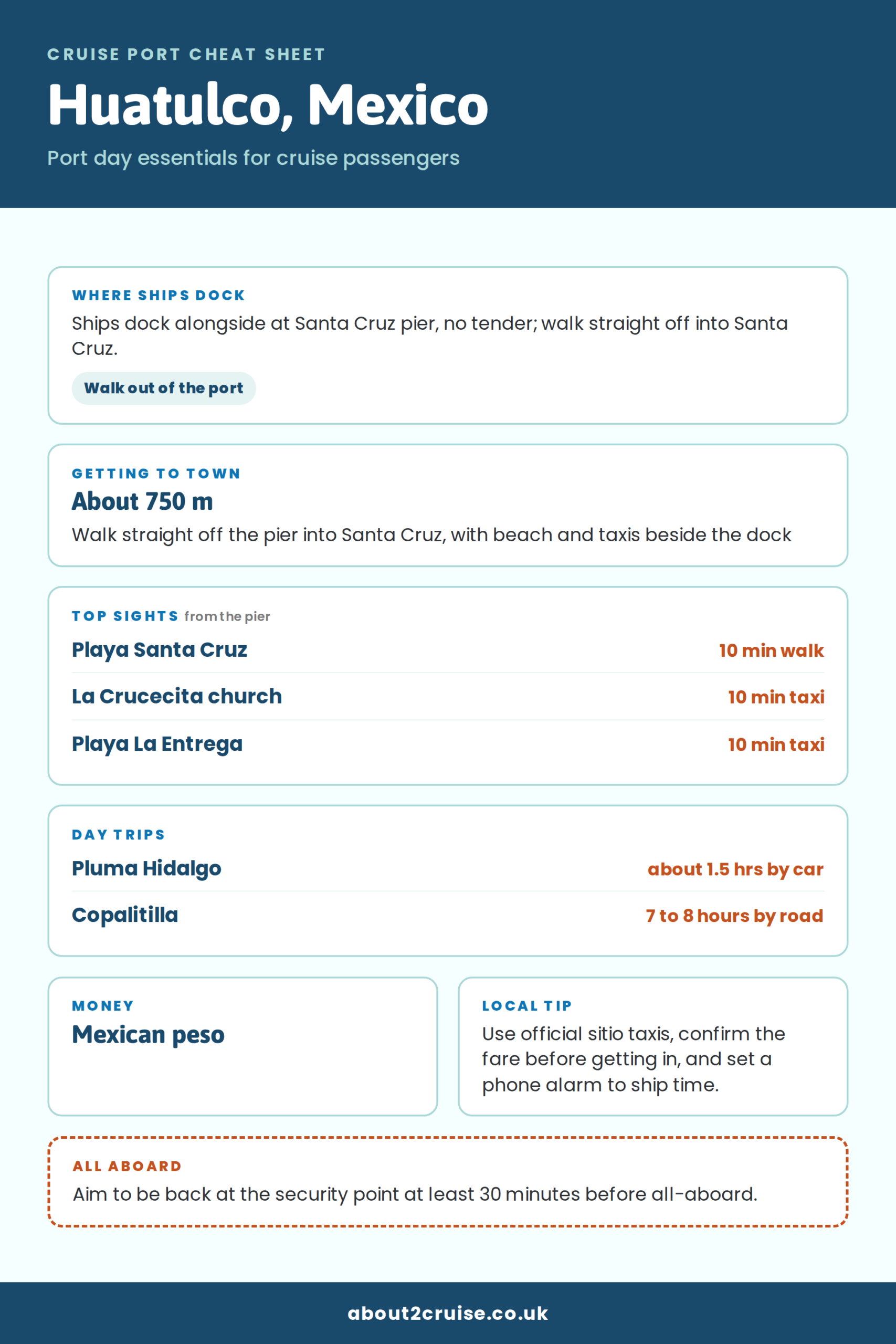
Huatulco is a walkable, eco-minded Mexican Pacific port. Ships dock alongside at Santa Cruz pier, with no tender. You step off near a beach, craft market, marina taxis and cafés. La Crucecita is three kilometres inland. The big decision is beach or bay boat, and get back at least 30 minutes before all-aboard.
Why Huatulco Feels Different: The Nine Bays of Bahías de Huatulco
Bahías de Huatulco isn’t one beach town. It’s a chain of nine bays, San Agustín, Chachacual, Maguey, Órgano, Santa Cruz, Chahué, Cacaluta, Tangolunda, and Conejos, strung along about 35 km of Oaxaca’s Pacific coast. Together they account for roughly 36 beaches.
Only the first few bays have hotels and palapa restaurants. The rest sit inside Huatulco National Park, where building is banned. Five bays, San Agustín, Chachacual, Cacaluta, Maguey, and Órgano, are part of the park’s marine zone. Some, like Chachacual, only make sense by boat. Others, such as Cacaluta and Órgano, end in footpaths or boat landings. San Agustín is 29 km from La Crucecita with a rough final road.
That’s why Huatulco feels quieter than Puerto Vallarta or Cabo. You’re not walking into a wall of high-rise beach bars. You’re choosing between an easy bay beside the ship, a short boat hop to a protected cove, or lunch inland in a real Mexican town.
Santa Cruz and La Crucecita: The Two Towns You Need to Know
Most cruise visitors will only deal with two places: Santa Cruz and La Crucecita.
Santa Cruz is the coastal village around the pier. It has the beach, the marina where bay boats leave, a small plaza with a bandstand café, an artisans’ market, banks on Calle Juárez, and a modest row of cafés and shops. For cruise passengers, it’s the arrival point and the easiest beach stop.
La Crucecita is about 3 km inland and is the actual working town. That’s where you’ll find better, cheaper Oaxacan food, the central plaza, pharmacies, banks, and the Mercado 3 de Mayo. Its parish church is dedicated to the Virgin of Guadalupe and houses what’s often described as the largest painting of the Virgin in Mexico: the ceiling mural is the visual centrepiece of the town.
Santa María Huatulco, the original inland settlement, is 27 km away and generally not worth a port-day visit unless you’re on a dedicated tour.

Eco-Tourism, Marine Life, and Park Fees
This part of Oaxaca is where the Sierra Madre del Sur foothills meet the Pacific, and much of it is protected. Huatulco National Park is both a Ramsar wetland and a UNESCO Man and the Biosphere reserve. Its marine records list 12 coral species, 78 marine invertebrates, and 121 fish species.
If you’re visiting between October and April, you might spot humpback whales. Bird migration runs roughly September to March, and sea turtles use the beaches from June to November. Four local beaches, Chahué, Santa Cruz, Pescadores, and Tangolunda, hold Blue Flag certification.
Some protected areas charge entry. Huatulco National Park officially costs 125 pesos per person per day, open 07:00–19:00. Huatulco II charges 95 pesos and opens 09:00–18:00. On an organised boat or ship tour, the operator usually handles or includes these fees, but always ask before booking.
Park rules ban removing coral or shells, campfires, and conventional sunscreen in the water. If you plan to swim or snorkel, bring reef-safe or biodegradable sunscreen.
Bocana del Río Copalita: Huatulco’s Pre-Hispanic Stop
Bocana del Río Copalita is a small archaeological zone on the Copalita–Tangolunda boulevard, about 10 km from the Bahías. It has a ball court, terraces, platforms, and a cliff-edge stone known locally as the sacrifice stone overlooking the coast. Finds date from roughly 900 BC to AD 1000.
It should be the culture stop for a cruise day, but access is inconsistent. INAH lists free entry daily 09:00–17:00. State tourism reports have described a reopening with a guided-only walk and a wristband costing about 46 pesos, while some visitors report paying 90–95 pesos and finding the museum largely empty and parts roped off. The safest approach is to ask on the day, use a ship excursion if you want certainty, and allow two to three hours.
The site is not suitable for wheelchair users or anyone with mobility or balance issues. If you can manage the paths, the cliff-top lookout over the river mouth and Pacific is the reward.
Coffee, Waterfalls, and Sierra Madre Day Trips
Pluma Hidalgo, the local coffee town, sits about 1.5 hours by car from Huatulco at 1,350 m in the Sierra Madre. Finca El Pacífico grows certified organic Pluma coffee and holds Smithsonian Bird Friendly certification. The coffee harvest roughly runs November to February.
A coffee tour needs at least five hours, so it’s a tight fit on a standard 08:00–17:00 call but doable on a ship excursion. Ships sell tours that climb from sea level to about 4,400 ft and include coffee tasting. Waterfall trips to Copalitilla run seven to eight hours. Treat these as ship or private-driver days, not public-transport experiments.
Arriving at Huatulco Cruise Port: Docking, Security, and First Steps
Dock or tender? Huatulco is an alongside port. Cruise ships berth at the Santa Cruz dock, also called the muelle de Santa Cruz, next to Playa Santa Cruz. No tender is needed. There is one cruise pier and it can handle up to two 3,000-passenger ships at a time.
The terminal is not a big air-conditioned mall. It’s a working marina and pier area next to the craft market, with an official taxi rank at the exit and a strip of cafés and shops across the road. Electric carts sometimes run along the pier for passengers who need a lift; drivers work for tips.
Port security is generally quick. Carry your cruise card and a photo ID. You may be asked to show the cruise card when re-entering the port area. The pier itself is a short, flat walk, but the hot sun can make it feel longer.
Walking into Santa Cruz: Playa Santa Cruz is about 750 m, roughly 10 minutes on foot, from the pier. Turn left for the beach, marina, and tour kiosks. The café and shop strip is across the road.
Facilities: There’s no official terminal information desk, and no confirmed terminal Wi-Fi or public toilets. Use the beach, palapas, cafés, or shops. Wi-Fi is better in La Crucecita, where internet cafés and some café hotspots exist. There’s no ATM at the pier; banks are on Calle Juárez in Santa Cruz and around the plaza in La Crucecita.
Huatulco cruise port map
The map shows Huatulco and the places worth seeing. Tap a pin for directions.
- HuatulcoTown centre
- Playa La EntregaBeach · About 23 km from the town centre
- Playa ChahuéBeach · About 23 km from the town centre
- Playa MagueyBeach · About 21 km from the town centre
- La Crucecita churchChurch · About 21 km from the town centre
- Mercado 3 de MayoMarket · About 21 km from the town centre
- La CrucecitaTown · About 21 km from the town centre
- Terminal ADO HuatulcoBus terminal · About 21 km from the town centre
- Cascadas Mágicas de CopalitillaWaterfalls · About 22 km from the town centre
- Playa Santa CruzBeach · About 22 km from the town centre
- Playa El ArrocitoBeach · About 25 km from the town centre
- Playa La BocanaBeach · About 29 km from the town centre
- Playa San AgustínBeach · About 19 km from the town centre
- Playa TangolundaBeach · About 25 km from the town centre
- Parque Nacional HuatulcoNational park · About 19 km from the town centre
Huatulco Cruise Ship Schedule and Which Ships Call Here
Huatulco is a port of call, not a homeport. Most visits come on Panama Canal runs and Mexican Riviera itineraries. Princess ships, Sapphire, Crown, Coral, and Island Princess, appear regularly, as do Holland America’s Zaandam, Cunard’s Queen Elizabeth, and occasional Seabourn, Royal Caribbean, and expedition or small ships.
The season typically runs from late autumn into May, with some calls later in the year. Around 29 calls are scheduled over the next 12 months, carrying roughly 59,000 passengers. A standard call is 08:00–17:00, but some ships arrive at 10:00 or 11:00 and still leave by 17:00. Always check your own itinerary and the all-aboard time posted at the gangway, not a website schedule.
On a Panama Canal itinerary, you often call at Puerto Caldera, on Costa Rica’s Pacific coast, before or after Huatulco.
Taxis and Getting Around from the Port
There’s a taxi rank at the port exit. Taxis are zone-based, not metered, and cash is expected. There’s no Uber or Lyft in Huatulco, so don’t rely on ride-hailing apps.
- Santa Cruz to La Crucecita: about MX$40, 10 minutes
- Santa Cruz to Tangolunda: MX$60–80
- Santa Cruz to Playa La Entrega: about MX$100
- Santa Cruz to Copalita: agree in advance, often MX$150–200
- Taxi by the hour: about MX$200, useful for a couple of beaches or lunch
Confirm the fare before getting in. Collectivos, shared taxis, run between La Crucecita and the bays for roughly MX$15–30 per person, but on a short port day a private taxi is simpler.
Getting to La Crucecita, Tangolunda, and the Beaches
La Crucecita is 3 km inland, a cheap 10-minute taxi ride. Tangolunda is about 5 km east and is mostly a hotel zone: useful for a viewpoint or resort lunch but not essential for cruise passengers.
For beaches: Santa Cruz is walkable. La Entrega is a short taxi ride. Chahué is near Santa Cruz but often has more swell. Maguey can be reached by taxi or boat. San Agustín is a long day and not recommended unless you have a private driver or a ship tour.
Ship Excursions vs Independent Tours in Huatulco
Ship excursions are easiest for bay boat trips with tight timing. Princess sells a 3.3-hour Huatulco by Land and Sea from US$89.95 adult / US$74.95 child, combining a catamaran view of the bays with a coach stop in La Crucecita. Holland America sells a five-bays catamaran with swim stop from about US$99. NCL and Cunard run 3-hour overview tours.
Independent tours are genuinely easy in Huatulco because the marina is beside the cruise pier. Local pangas sell bay tours, fishing, and snorkelling trips from the Santa Cruz marina. Independent booking sites list double-decker bay and snorkel cruises from around US$49 plus a park fee of about 70 pesos. Direct local boat prices are often quoted around 350 pesos per person for a bay trip, and seven-bay panga tours run about MX$450–600 per person for five hours.
If your ship arrives late or your all-aboard is earlier than 16:30, lean towards a ship excursion or a simple taxi and beach plan. If you have a long, standard call and are comfortable with local negotiation, independent boats are good value.
Beach Day or Bay Boat? How to Choose
For many passengers, the main decision is beach or boat.
Choose a beach day if you want calm, low cost, and low risk. Santa Cruz beach is beside the ship; La Entrega is a better snorkel beach. Choose a bay boat if you want the postcard version of Huatulco: passing Órgano’s blowhole and rock formations, swimming off Maguey, and seeing undeveloped Chachacual or Cacaluta.
A third option is inland: taxi to La Crucecita for the church, market, and lunch. Mixing beach and town is easy: La Entrega in the morning, La Crucecita lunch, Santa Cruz for a last drink.
Getting back to the ship on time: most ships leave at 17:00 and set all-aboard for 16:30. The dock is a short walk from Santa Cruz, so a 15:45 return to the port area is comfortable. For boat trips, ask what time the boat actually returns to the marina, not just the dock. Set a phone alarm to ship time. Confirm before leaving the ship whether local time matches ship time; don’t rely on your phone’s automatic time zone.
Best Beaches for Cruise Passengers and Sea Conditions
The main beaches for a cruise day are:
- Playa Santa Cruz: the nearest, about 750 m from the ship. Calm swell, gentle slope, public showers, toilets, palapa restaurants, and snorkel gear for hire.
- Playa La Entrega: the calmest water and easiest reef access, with coral 20–40 m from the sand. Snorkel gear rents for about 150–250 pesos. Arrive before 11:00 in high season to beat the crowds. It’s also Oaxaca’s inclusive beach, with amphibious wheelchairs and beach access equipment.
- Chahué: a Blue Flag beach, but the main stretch often has a steeper slope, swell, and currents. Santa Cruz next door is calmer for swimming.
- Maguey: one of the best for calm swimming, with beach restaurants. Often included on boat trips and can also be reached by taxi.
- San Agustín: a beautiful off-grid crescent reached via 29 km of road with a rough final section. Best saved for a private tour or long day.
Lifeguard modules operate at Santa Cruz Bay, Maguey, and Playa La Entrega. Sea conditions are generally calmer in the dry season, but always check local flags and ask at a lifeguard station if unsure.
Snorkelling, Diving, and Bay Boat Trips
Boat trips leave from the Santa Cruz marina immediately beside the cruise pier. A typical seven-bay panga tour leaves around 10:00 and lasts about five hours, costing about MX$450–600 per person. Shorter five-bay ship or independent catamaran tours fit more easily into a port day.
The main reef sites are fringing reefs close to shore, with the richest coral communities at Punta Violín, Cacaluta, Chachacual–La India, Jicaral, Dos Hermanas, and Isla San Agustín. Visibility runs about 15–30 m in the dry season. A two-tank certified dive costs about MX$2,000–2,500; open-water courses are longer and not a port-day activity.
If snorkelling is your goal and you don’t want a boat trip, La Entrega is the shore-access choice. If you want the bays and a swim stop, take a catamaran or panga tour. Some tours exclude snorkel gear rental, which can add about 250 pesos, and marine park fees may be extra.
Where to Eat in Santa Cruz and La Crucecita
Santa Cruz has palapa restaurants on the beach and simple cafés across from the pier. They’re good for seafood, beer, and a quick lunch without losing sight of the ship.
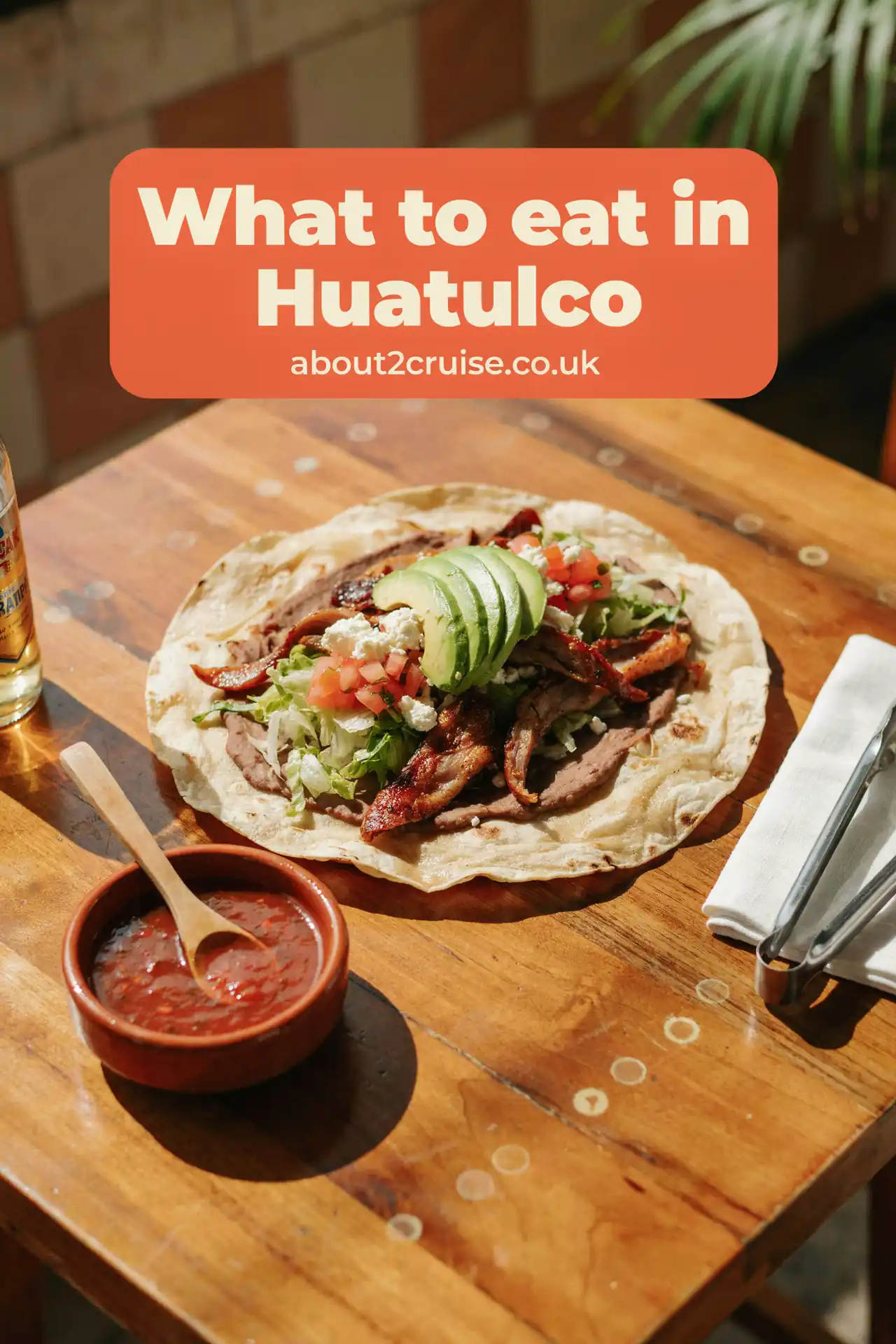
La Crucecita is the food centre. The Mercado 3 de Mayo has about 82 fixed stalls and nine kitchens serving Oaxacan food and seafood. Try a tlayuda, memelas, mole, quesillo, tasajo, chapulines if you’re curious, Oaxacan hot chocolate, and tejate, the pre-Hispanic cacao-and-maize drink.
Mezcal and chocolate tasting rooms exist in Santa Cruz and La Crucecita. Typical café prices in La Crucecita are around MX$55 for an americano and MX$52 for a soft drink. Use bottled water; tap water is not treated for visitors. Ice in established restaurants is usually safe, but when in doubt ask for drinks without ice.
Shopping, Crafts, and Local Markets Near the Port
The easiest shopping is the craft market beside the cruise pier and the artisans’ market at Santa Cruz plaza. Expect Oaxacan textiles, black pottery, alebrijes, mezcal, chocolate, coffee, and regional cheese.
La Crucecita’s Mercado 3 de Mayo is the place for lower prices and local goods. Stalls may be fixed-price, while market sellers often expect polite haggling. If you buy alcohol, remember the ship may store it until the final night.
Money in Huatulco: Pesos, Cards, ATMs, and Tipping
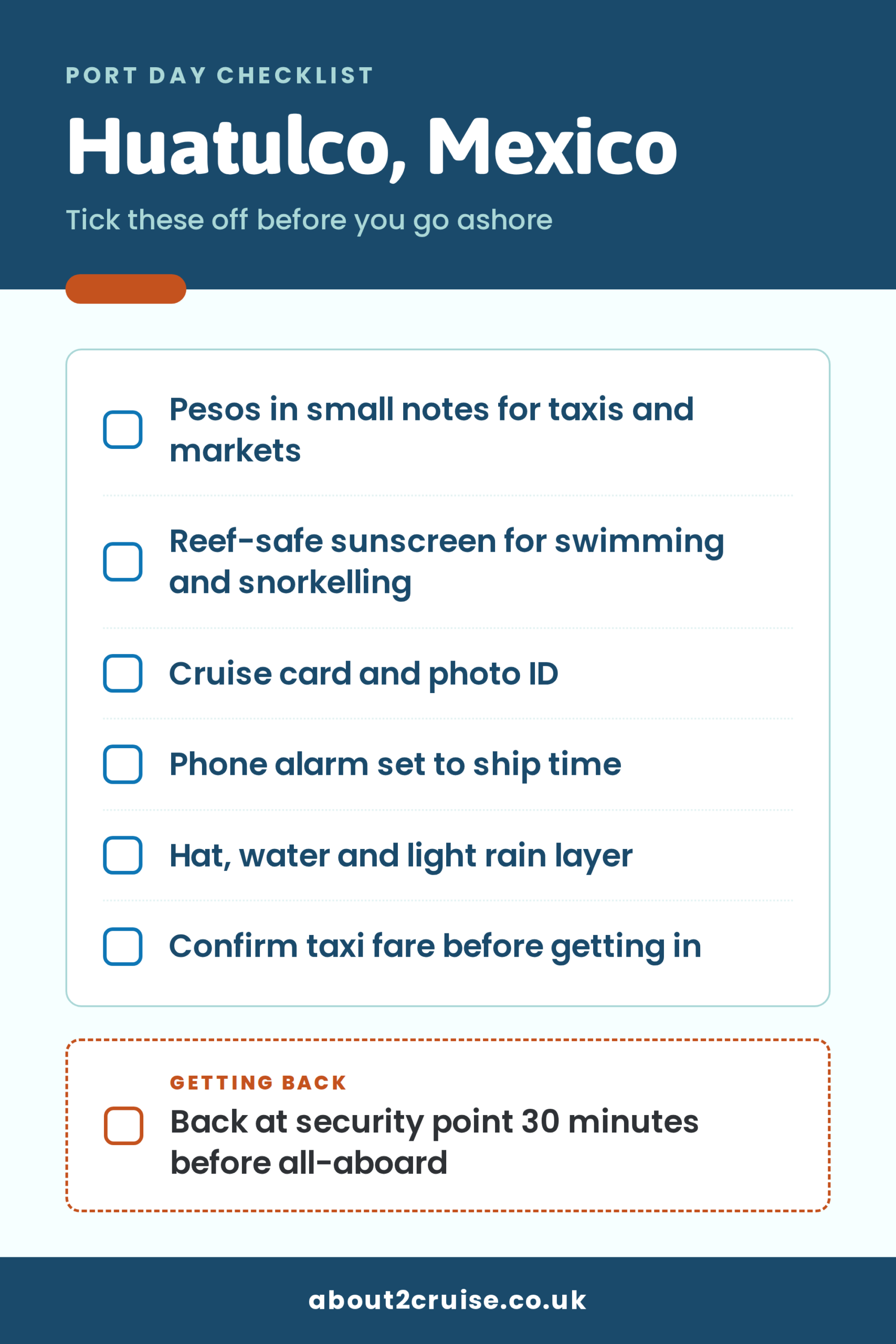
The local currency is the Mexican peso. Bring pesos for taxis, markets, small restaurants, and boat operators. US dollars are accepted near the pier and in some tourist shops or restaurants, but at a worse exchange rate.
There are no ATMs at the pier. You’ll find banks and ATMs on Calle Juárez in Santa Cruz and around the central plaza in La Crucecita. Cards work in larger restaurants and shops, sometimes with a surcharge. For a port day, a mix of a card for bigger purchases and a few hundred pesos in small notes for taxis and market stalls works best.
Tipping: 10–20% in restaurants depending on service and setting, about 10 pesos for a taxi driver who handles bags, and a few pesos for washroom attendants or market helpers. Mexican banks close on weekends and public holidays, so don’t rely on changing money at a bank on a holiday call.
Language, Opening Hours, and Local Holidays
Spanish is the local language. You’ll find some English in the marina, tourist restaurants, and excursion desks, but less in taxis and markets. A few phrases help: buenos días, por favor, ¿cuánto cuesta?, la cuenta, por favor.
Shops often open around 09:00 or 10:00 and close between 19:00 and 20:00, with shorter hours on Sunday. The Mercado 3 de Mayo is at its best in the morning, especially before 09:00 when the produce and food stalls are most active. If your call falls on a Mexican public holiday, banks may close and local beaches may be busier, but tourist services in the port area generally continue.
Weather, Heat, Rainy Season, and Hurricane Planning
Huatulco is hot and humid year-round. January averages about 33°C by day and 18.5°C at night with very little rain. April is hotter, around 34.7°C. The rainy season builds from June, with June and September each averaging more than 300 mm of rain and around 14–15 wet days. November is drier again, around 33°C with about 21 mm of rain.
Sea temperatures range from about 26°C in January to 30°C in June. The eastern Pacific hurricane season runs 15 May to 30 November, with peak activity from July to September. Cruise season mostly avoids the peak, but a call in May or November can still bring a passing storm or afternoon thunderstorm. Carry sunblock, a hat, water, and a lightweight rain layer if showers are forecast.
Safety Advice for Cruise Passengers
Huatulco’s resort area has a low-crime reputation, and during the cruise season local authorities deploy tourist police, state and traffic police, National Guard, navy, and the port captain around Santa Cruz Bay. No part of Oaxaca state is on the UK FCDO’s regional travel risk list.
Still, use the usual Mexico safety advice. Take official sitio taxis from the rank at the port rather than unlicensed drivers. Keep an eye on your phone and wallet in markets. Be cautious with ATM use, preferably in daylight and at a bank machine. Avoid demonstrations if they occur and monitor local advice. On the beach, swim at Santa Cruz, La Entrega, or Maguey where lifeguard modules operate, and don’t leave valuables unattended.
Accessibility and Mobility at the Port and Beaches
The pier and walk into Santa Cruz are mostly flat but can be hot, and the 750 m to the beach may be tiring for some. Electric carts sometimes run along the pier for tips, but don’t count on them.
Playa La Entrega is the standout for inclusive beach access, with amphibious wheelchairs, crutches, beach walkers, floating stretchers, shaded areas, and a platform to the sand. If you use a wheelchair or have limited mobility, a taxi to La Entrega is a good beach plan.
Ship catamaran tours typically require passengers to manage about four steps on and off the boat, and coaches have steps. The Copalita archaeological walking tour is not suitable for wheelchairs, mobility scooters, or people with balance or heart/respiratory issues. Taxis are usually standard saloons rather than wheelchair-accessible vehicles, so plan accordingly.
Mexico Entry Rules for UK Cruise Passengers
British citizens do not need a visa for tourism in Mexico. Border officials stamp your passport on arrival and note the permitted length of stay. The UK FCDO says your passport must be valid for the duration of your stay, while the Mexican Embassy recommends at least 180 days’ validity. Officials may ask for return travel, accommodation, and proof of funds, but cruise passengers on a day call rarely face this.
Mexico charges a Non-Resident Duty for foreign cruise passengers of US$10 per passenger. Cruise lines collect it once per itinerary, not per Mexican port. E-cigarettes, vaping devices, and vaping liquids are illegal to bring into Mexico and may be confiscated, so leave them on the ship.
Huatulco vs Other Mexican Riviera Ports
If your itinerary also calls at Puerto Chiapas, the difference is stark. Puerto Chiapas has little at the port itself; many passengers shuttle to Tapachula or take ship tours to Izapa, and some choose to stay aboard. Huatulco, by contrast, has a beach, restaurants, and shops within walking distance of the ship.
Compared with Puerto Vallarta, Cabo San Lucas, or Mazatlán, Huatulco is smaller, greener, and quieter. It’s the eco and beach stop rather than the big-resort stop. That’s exactly why many passengers like it.
If your cruise continues to other ports, see our Colón Panama Cruise Ship Port Guide, Los Angeles California Cruise Ship Port Guide, and San Diego California Cruise Ship Port Guide.
Further off the usual Mexican Riviera track, Puerto Baquerizo Moreno on San Cristóbal Island gives you a Galápagos call on deeper Pacific and South America routes.
If your ship also calls at Puerto Quetzal, Guatemala, expect a Pacific coast stop geared more to inland excursions than a walkable port town.
A Realistic Huatulco Port-Day Plan
For a standard 08:00–17:00 call, this plan works without a guided tour:
Before you sail
- Bring pesos in small notes for taxis, markets and local boat operators.
- Book a ship excursion early if you want Copalita or the coffee tour; independent spaces are limited.
- Check whether ship time matches local time and set a phone alarm to ship time.
Short port day: under 6 hours
- On dockingWalk off the pier into Santa CruzNo tenderIt is a flat 750 m walk, about 10 minutes, to Playa Santa Cruz. Electric carts sometimes run along the pier for tips.
- +15 minPlaya Santa Cruz swimReef-safe sunscreenCalm water, showers, toilets and palapa restaurants right by the beach. Swim or take a short look before heading inland.
- +1 hrTaxi to La CrucecitaCash onlyTake a taxi from the port rank. It is about 10 minutes and cash only; confirm the fare before getting in.
- +1 hr 30 minLa Crucecita church and plazaSee the ceiling mural of the Virgin of Guadalupe in the parish church and wander the central park.
- +2 hrs 15 minLunch at Mercado 3 de MayoTry a tlayudaThe market is one block from the central park. Order a tlayuda or memela at one of the food kitchens.
- +3 hrs 45 minTaxi back to Santa CruzStay near pierReturn by taxi and stay within a 10-minute walk of the pier. Have a final drink or browse the craft market.
- All-aboard minus 30 minWalk to the shipShip timeBe at the security point and gangway well before the posted all-aboard time.
This map shows the taxi ride from the ship. The time is the drive only, not your time ashore.
Open the taxi route in Google Maps
If plans change: If the market is busy or closed, eat at a palapa on Playa Santa Cruz instead and skip the inland taxi.
Long port day: 8 hours or more
- On dockingWalk to Santa Cruz marinaNo tenderThe marina is beside the cruise pier. Walk past the craft market to the panga or catamaran desks.
- +15 minBook a bay boat tripConfirm return timeChoose a five-bay catamaran of about 2.5 hours or a longer panga tour. Confirm the actual return time to the marina before boarding.
- +3 hrsTaxi to Playa La Entrega and snorkelCash taxiAfter returning to the same marina, take an official taxi for the short ride. The calmest bay has reef 20 to 40 m from the sand; gear rental may be extra.
- +4 hrsTaxi to La Crucecita for lunchCash onlyRide about 10 minutes to the central plaza, then walk one block to Mercado 3 de Mayo and order a tlayuda or memela.
- +5 hrs 30 minLa Crucecita church and plazaSee the Virgin of Guadalupe ceiling mural in the parish church, then wander the central park before heading back.
- All-aboard minus 30 minTaxi back to Santa Cruz and walk to the shipShip timeTake a taxi to the pier and walk to the security point. Be at the gangway 30 minutes before all-aboard.
This map shows the taxi ride from the ship. The time is the drive only, not your time ashore.
Open the taxi route in Google Maps
If plans change: If the boat trip is cancelled, taxi to Playa La Entrega for snorkelling and then continue with La Crucecita as planned.
- 08:30: Walk off the ship and along the pier. Stop at the craft market, then walk left to Playa Santa Cruz for a look or a quick swim. Buy water or reef-safe sunscreen if needed.
- 09:15: Take a taxi to Playa La Entrega for snorkelling and calm water, or go to the marina and negotiate a five-bay boat trip if you prefer the boat day.
- 12:30–13:00: Taxi back towards La Crucecita. Have lunch at the Mercado 3 de Mayo or a plaza restaurant, see the church ceiling, and wander the central park.
- 14:45: Taxi back to Santa Cruz. Stroll the plaza, have a final drink or deal with the craft market, and stay within a 10-minute walk of the pier.
- 16:00: Walk back to the ship. You should be at the security point and gangway well before the typical 16:30 all-aboard.
If your ship arrives later, compress by dropping La Crucecita and doing either La Entrega or a short bay boat trip, then a late lunch in Santa Cruz.
This is one of Mexico’s Pacific coast cruise ports. Our Mexico cruise ports guide covers the others on the Pacific and the Caribbean.
Huatulco Cruise Port FAQs
Is Huatulco safe for cruise passengers?
Yes. The resort area has a low-crime reputation, with tourist police, National Guard, and navy patrols around the cruise season. Use official taxis, watch your belongings in markets, and swim at lifeguarded beaches such as Santa Cruz, La Entrega, and Maguey.
Can you leave the ship in Huatulco without an excursion?
Yes. Huatulco is one of the easiest Mexican ports for independent exploration. The pier leads directly into Santa Cruz, and La Crucecita, La Entrega, and the marina boat tours are all reachable by taxi or on foot.
Can you walk to a beach from the Huatulco cruise port?
Yes. Playa Santa Cruz is about 750 m from the pier, roughly a 10-minute walk. It has calm water, beach restaurants, showers, and toilets.
How far is La Crucecita from the Huatulco cruise port?
La Crucecita is about 3 km inland, a 10-minute taxi ride. Fares are typically around MX$40, but confirm before getting in.
Do you need pesos in Huatulco or can you use cards?
You need pesos for taxis, markets, small restaurants, and many independent boat operators. Cards work in larger restaurants and shops, sometimes with a surcharge, but are not reliable in smaller places.
Are there ATMs and free Wi-Fi near the Huatulco cruise port?
There is no ATM at the pier itself, but banks and ATMs are available in Santa Cruz on Calle Juárez and around the plaza in La Crucecita. Free Wi-Fi is not guaranteed at the port; cafés and internet spots in town are more reliable.
What are the top things to do in Huatulco on a cruise stop?
The top choices are a five-bay or seven-bay boat trip, snorkelling at La Entrega, visiting La Crucecita church and market, swimming at Santa Cruz beach, or adding Copalita if you want ruins and a viewpoint.
Is Huatulco a tender port?
No. Cruise ships dock alongside at the Santa Cruz pier, so you can walk straight off the ship and into the port area.
What time is all-aboard in Huatulco?
Most ships set all-aboard 30 minutes before sailing. For a typical 17:00 departure that means 16:30, but always check the time posted at the gangway because some ships differ.