
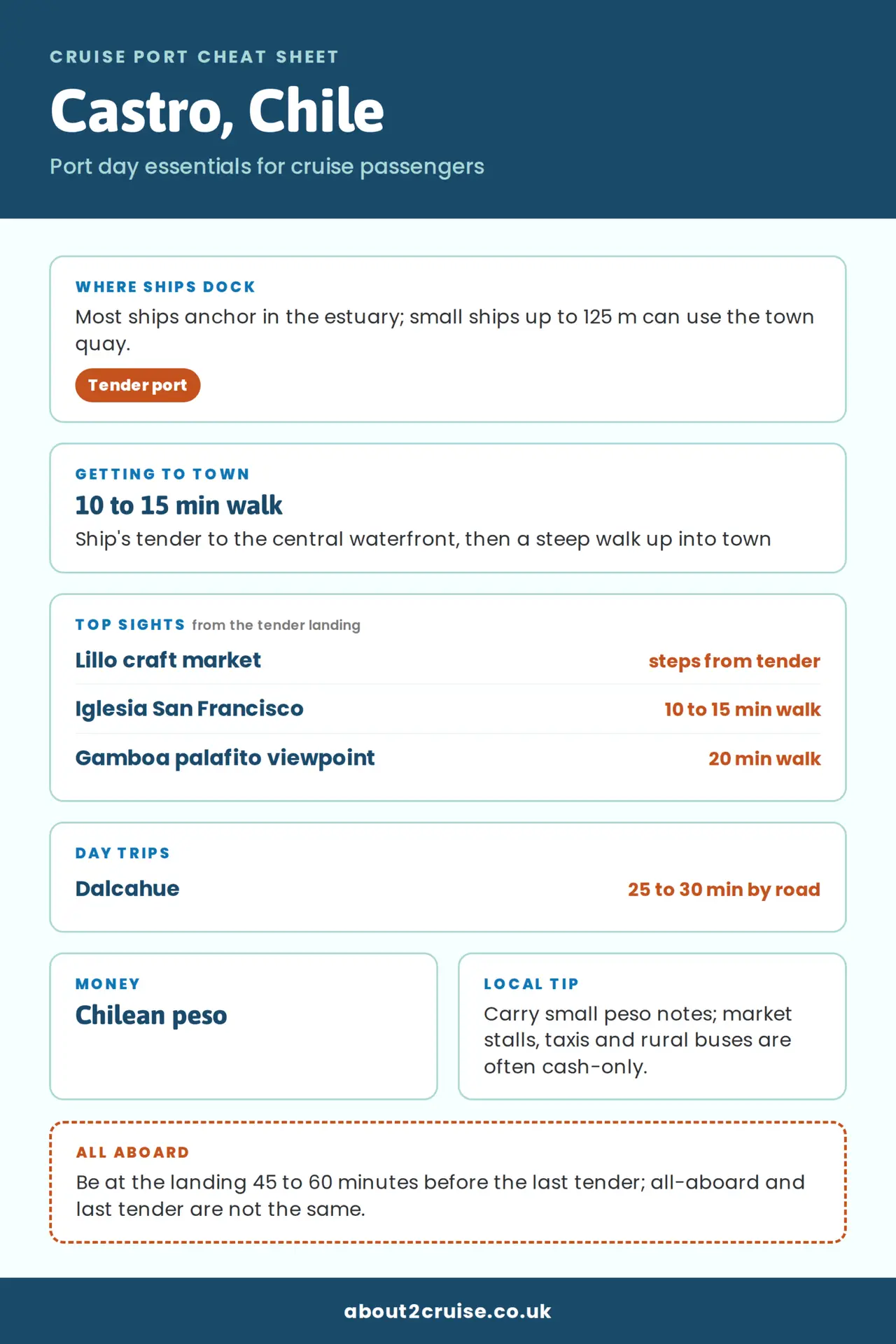
Castro is the compact capital of Chiloé, and for cruisers that is the point: the ship anchors in the estuary, tenders land beside the waterfront market, and the UNESCO wooden church, palafitos, crafts and a curanto lunch are all walkable. It rewards a slow half-day loop, not an island-wide dash.
Castro at a glance
| Port type | Anchor and tender for most cruise ships; small ships up to 125 m can use the town quay |
| Tender landing | Central waterfront, beside the Feria Artesanal y Mercado Campesino Lillo |
| Walk to the Plaza de Armas | 10–15 minutes, up a steep hill |
| Main sights on foot | Iglesia San Francisco, Gamboa and Pedro Montt palafitos, Lillo market |
| Money | Chilean peso; carry cash |
| Language | Spanish; English is limited |
| Signature food | Curanto, seafood empanadas, milcao |
| Main things to get right | Tender timing, rain gear, tide and church opening hours |
Castro cruise port map
Tenders bring you ashore at Puerto Castro passenger terminal. From the tender landing, Iglesia San Francisco is about a 7-minute walk, Museo Regional de Castro about 8 minutes and Plaza de Armas about 8 minutes. Tap a pin for directions.
- Puerto Castro passenger terminalWhere tenders land
- Iglesia San FranciscoWooden church · About 7 min walk from the tender landing
- Plaza de ArmasTown square · About 8 min walk from the tender landing
- Museo Regional de CastroRegional museum · About 8 min walk from the tender landing
- Terminal Municipal de CastroBus terminal · About 8 min walk from the tender landing
- Pedro Montt palafitosStilt houses · About 10 min walk from the tender landing
- Gamboa palafito viewpointStilt house viewpoint · About 14 min walk from the tender landing
- Mercado Municipal José Sandoval GómezMunicipal market · About 4 km from the tender landing
- Dalcahue craft fairCraft fair · About 14 km from the tender landing
- Muelle de CastroPier · About 28 km from the tender landing
- DalcahueTown · About 15 km from the tender landing
Where Castro fits into a Chile cruise
Castro usually appears on Chilean fjords and Patagonia routes alongside Puerto Montt, Puerto Chacabuco, and Puerto Natales. The difference is that Castro itself is the attraction rather than just a gateway. Puerto Chacabuco links to Aysén’s fjords and lakes, and Puerto Natales leads to Torres del Paine. If you want help comparing the options, see our Chile cruise ports guide.
Four reasons Castro is worth your port day
Castro’s cruise draw is unusually tight. These four reasons to visit all sit within the same walk, which is rare on a Chilean fjords itinerary.
The UNESCO wooden church on Plaza de Armas
Iglesia San Francisco de Castro is the main reason most people walk up the hill. It sits on Plaza de Armas, has two 42-metre towers, and is built entirely from native timber in a neo-Gothic style. Italian architect Eduardo Provasoli drew the design, but local carpenters built it using pegged construction and the same wooden joinery traditions as Chilote boatbuilding. It is one of the sixteen Churches of Chiloé on the UNESCO World Heritage list, and it is still an active parish rather than a museum. The interior is usually open Tuesday to Saturday from about 10:00 to 12:30 and again from 16:00 to 19:00, with Sunday mass from roughly 09:00 to 11:00. Hours are seasonal, so treat them as a plan rather than a promise.
The palafito houses along the water
The palafitos are the stilt houses that face the street on one side and stand over the tidal channel on the other. Castro has two main groups: Gamboa to the south, near the wetland and river, and Pedro Montt to the north along the costanera. Fishing families built them, and many now hold small hostals, cafés, restaurants, and galleries. They are homes and businesses, so enjoy them from the public street and viewpoints, not from private decks.
Chilote crafts and wool textiles
Chiloé has its own mythology, potato varieties, boatbuilding skills, and wool-craft heritage. In Castro, the easiest place to meet that culture is the Feria Artesanal y Mercado Campesino Lillo on the waterfront, with more crafts at Mercado Artesanal Los Palafitos in the Gamboa neighbourhood. Classic buys include sheep’s-wool knitwear, junquillo baskets, wood carvings, and small figures drawn from Chilote mythology. Ask who made a piece and where it was made, not everything on sale is locally produced.
Curanto and the local seafood scene
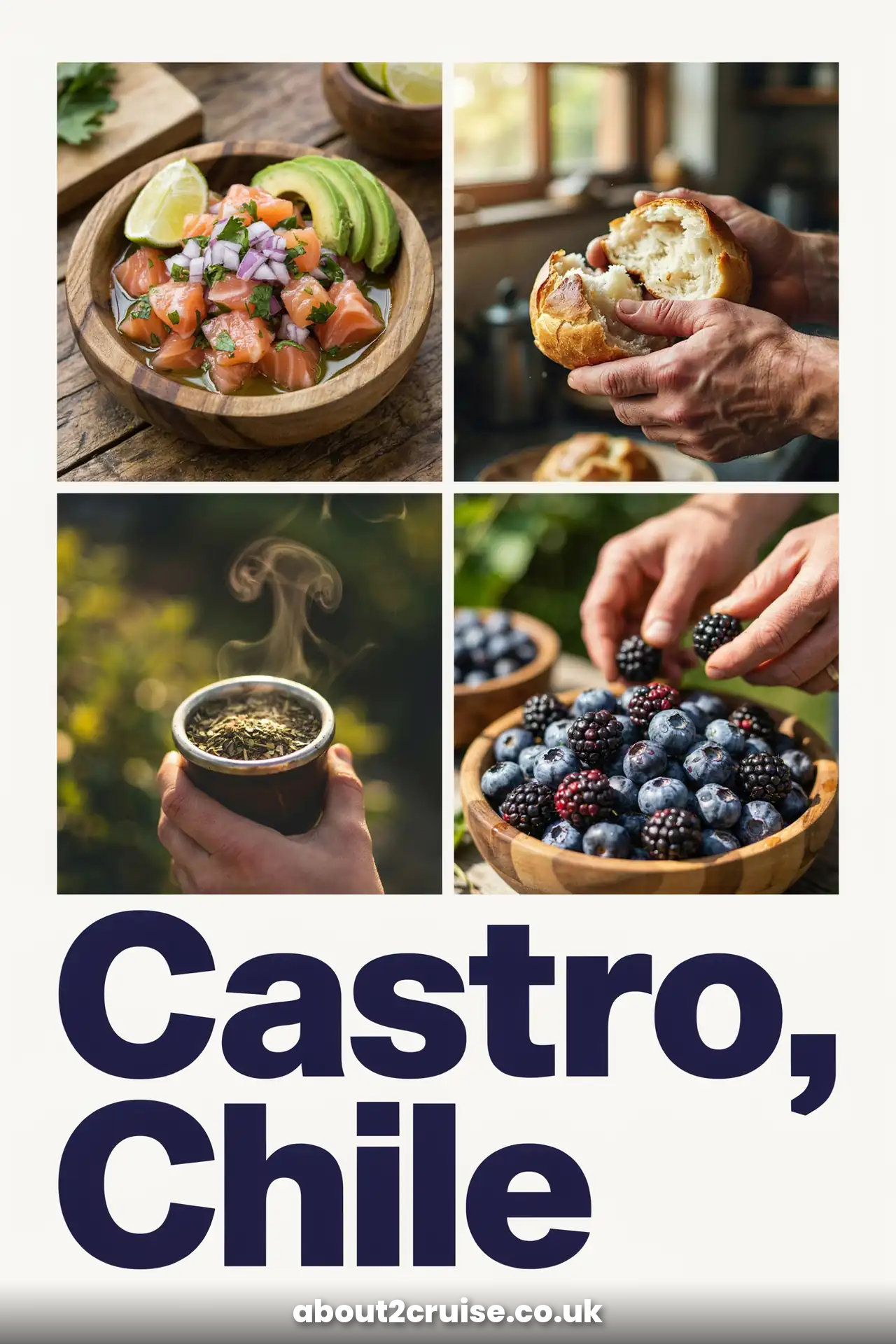
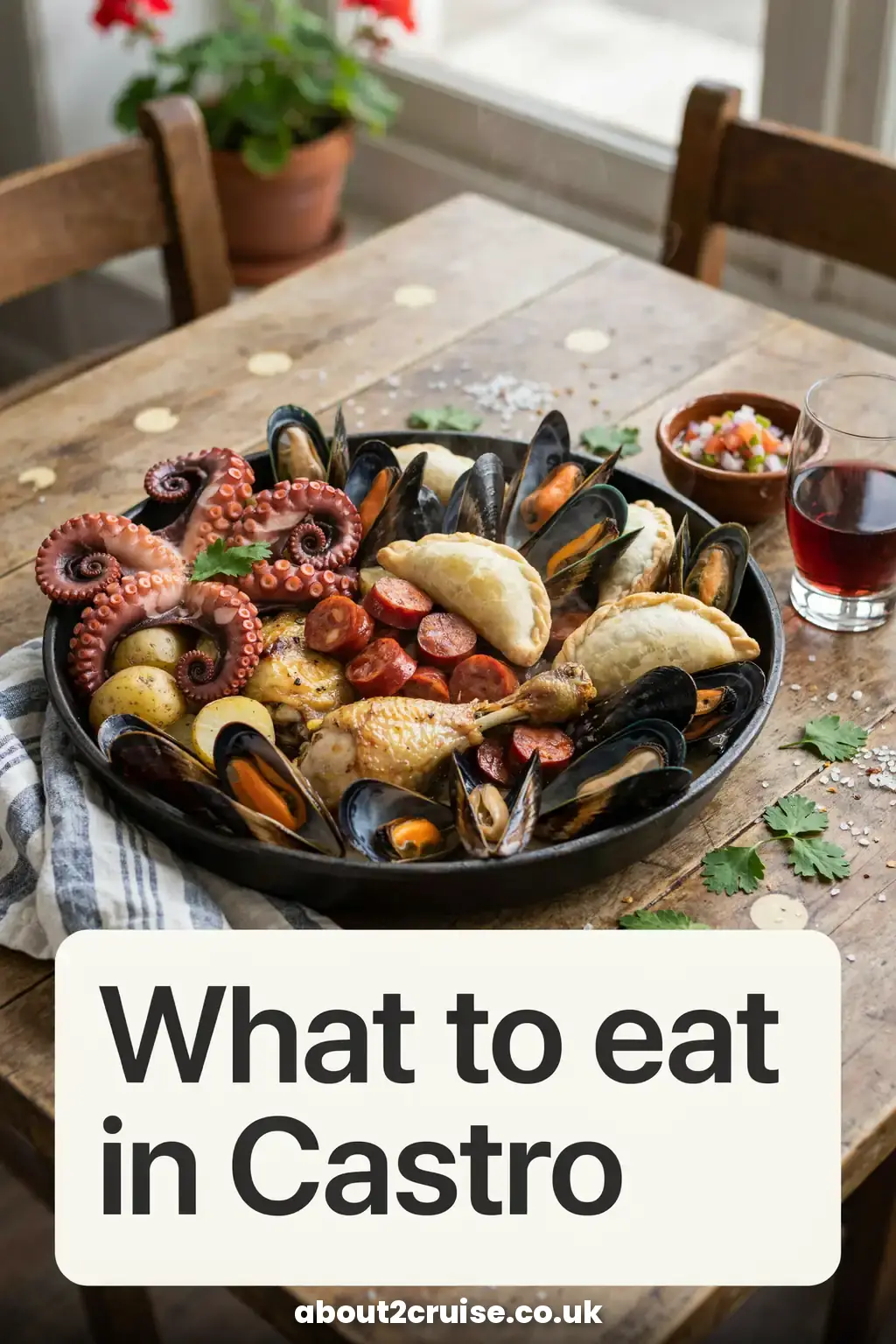
Curanto is Chiloé’s signature dish: clams, mussels, chorizo, chicken, and pork layered with potato bread and potato dumplings, traditionally steamed over hot stones in a pit and covered with nalca leaves. If your time ashore is short, the quicker pot version, pulmay, keeps the broth and fits a port day better. Castro’s waterfront cocinerías serve curanto, milcaos, chapaleles, and seafood stews within sight of the tender landing, so you can taste the region without burning half your day.
Castro cruise port: anchoring, tendering, and getting back to the ship
Most cruise ships anchor in the estuary rather than dock. The town quay is shallow and mainly used by small cargo and coastal vessels, so larger ships run tenders. The landing is central, directly below town. You step ashore beside Feria Lillo and the costanera, not a container terminal.
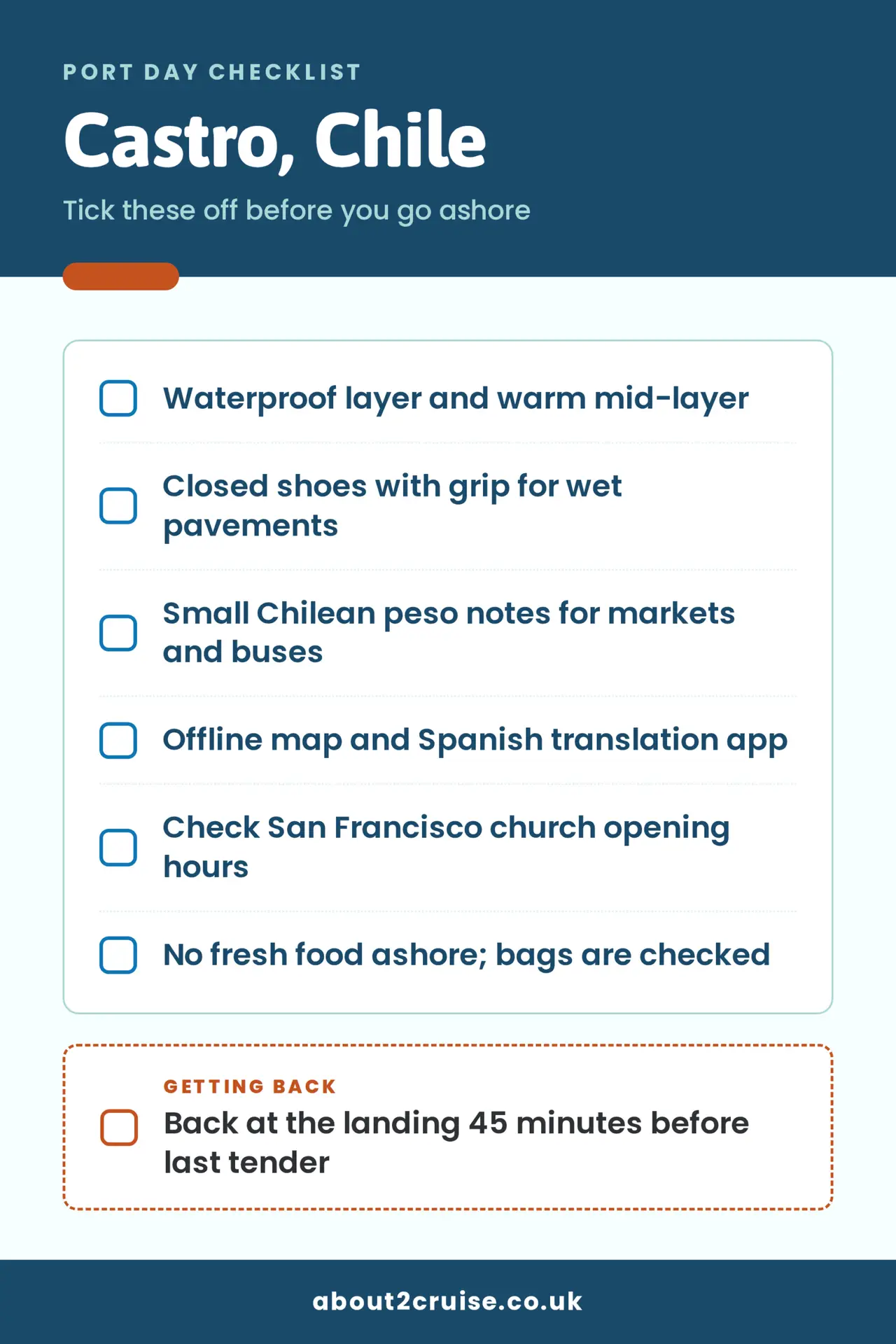
Chilean officials may check bags at the landing, and fresh food such as fruit or sandwiches is not allowed ashore. The passenger terminal is basic but has accessible toilets. Do not bring large bags or anything you cannot carry comfortably around a hilly town.
Listen to the ship’s announcements for first and last tender times. Early tenders are usually busy with excursion groups, but waiting for a later boat can eat into a short call. The crossing itself is brief once you are loaded and away; the real variable is the queue. On the return, aim to be at the landing at least 45 minutes to an hour before the last tender. The “all aboard” time and the last tender time are not the same thing.
The anchorage is sheltered from the prevailing wind, but southerly winds around 25 knots and local chop up to about a metre can make tendering bouncy. If the sea state becomes unsafe, tendering can be slowed or suspended, so keep your plans flexible and don’t leave your return to the final boat.
A simple walking route from the tender landing
From the tender landing, the centre is above you. The climb is short but steep, so pace yourself. The standard cruise walk goes: pier to Plaza de Armas, then to Iglesia San Francisco, then to the palafito viewpoint, and back to the craft market and pier. The heritage foundation also publishes three self-guided routes of roughly 1.2 km, 2.9 km, and 4.3 km with English and Spanish audio guides. For most cruisers, the 1.2 km or 2.9 km loop is the right size.
A workable half-day route looks like this:
- Land at the waterfront and leave the Lillo market for later while you still have dry strength for the hill.
- Walk up to the Plaza de Armas and check whether San Francisco church is open.
- From the Plaza, walk the short block to the Gamboa viewpoint on Calle Chacabuco, looking over the stilt houses, wetland, and boat traffic.
- If time allows, continue to the Pedro Montt palafitos along the shore road. If not, the Gamboa row is enough.
- Return to Feria Lillo for shopping, a seafood lunch, or an empanada, then join the tender queue.
How to get around Castro
Central Castro is a walking town, and the main sights are close together. If you want to go further, taxis and shared colectivos run fixed routes through the centre. There is no published taxi rank at the pier, but you can usually find a taxi or colectivo near the Plaza and the bus terminals. Agree the fare in pesos before getting in if the taxi is not metered.
Local buses to Dalcahue, Chonchi, Nercón, and other island towns leave from the Terminal Municipal at San Martín and Aldea. Rural buses are cash-only and less frequent on Sundays. Dalcahue is about 20 km north, roughly 25 to 30 minutes by road. Nercón, with another World Heritage church, is only about 4 km south of Castro and is a sensible taxi or colectivo add-on if you want a second church without a long drive.
How to spend 4 hours in Castro
If you only want the Castro highlights, stay in town. Allow about 15 minutes to get ashore and orient yourself, 20 minutes to walk up and see the Plaza, 30 minutes inside or around the church, 30 minutes at the Gamboa palafito viewpoint, 45 minutes for lunch at the Lillo market or Mercado Municipal, and 30 minutes for shopping. That still leaves a buffer for the tender queue. The total walking distance is only a few kilometres, but the steep hill makes it feel like more than the map suggests.
Before you sail
- Check San Francisco church seasonal opening hours and Sunday mass times before going ashore.
- Carry small Chilean peso notes for market stalls, taxis and rural buses.
- Download an offline map and Spanish translation app before leaving the ship.
Short port day: 4 hours
- On dockingTake the tender ashoreNo food ashoreThe tender lands at the central waterfront beside the Lillo market. Chilean officials may check bags; fresh food is not allowed ashore.
- +15 minWalk up to Plaza de ArmasSteep climbA 10 to 15 minute climb from the landing to the town centre. Pace yourself on the steep hill.
- +30 minIglesia San FranciscoCheck seasonal hoursOn the Plaza de Armas. It is an active parish with seasonal opening hours, usually open mid-morning and late afternoon Tuesday to Saturday, with Sunday mass.
- +1 hrGamboa palafito viewpointView from the miradorA short block from the Plaza on Calle Chacabuco. The public viewpoint looks over the stilt houses and wetland; morning light works best.
- +1 hr 45 minLunch at the waterfront marketTry curanto or pulmayWalk back down to the Lillo market or Mercado Municipal. Cocinerías serve curanto, seafood empanadas and milcao; choose busy stalls with hot food.
- +3 hrsBrowse the Lillo craft stallsShop for wool knitwear, junquillo baskets and wood carving. Ask if pieces are locally made, and keep purchases dry for the tender.
- All-aboard minus 1 hrBack at the tender landingJoin the tender queue at the central waterfront. Do not leave it to the final boat.
The time on the map is the whole walk, every stop added together.
Open this walking route in Google Maps
If plans change: If San Francisco church is closed, the Museo Regional de Castro is one block from the Plaza and works as a rainy-hour fallback.
Long port day: 8 hours or more
- On dockingTender and walk to PlazaTake an early tender to the central waterfront and walk up the steep hill to the Plaza de Armas.
- +30 minSan Francisco and Gamboa viewpointView from the miradorSee the UNESCO wooden church on the Plaza, then walk a short block to the Gamboa viewpoint on Calle Chacabuco. Morning light works best.
- +1 hr 30 minBus or taxi to DalcahueCash for the busUse a local bus from Terminal Municipal or agree a taxi fare in pesos. Dalcahue is about 20 km north and 25 to 30 minutes by road.
- +2 hr 30 minDalcahue churchSeasonal hoursSee Nuestra Señora de los Dolores, another UNESCO church, on the main square. Check the seasonal opening hours if you want the interior.
- +3 hr 30 minDalcahue craft fair and lunchTry curantoBrowse the craft fair and eat at the pier-side cocinerías. They serve curanto, milcao, caldillo and seafood; choose busy stalls with hot food.
- +5 hr 30 minReturn to Castro and Lillo marketKeep tender bufferTake the bus or taxi back to Castro. Browse the Lillo market on the way to the tender, and keep purchases dry.
- All-aboard minus 90 minBack at the tender landingBe at the central waterfront no later than this. Do not leave the return to the final tender; queues build before all-aboard.
The times on the map are for the whole journey there by train and bus.
Get train and bus times in Google Maps
If plans change: If rural buses are full or not running, take a taxi from near Terminal Municipal in pesos, or stay in Castro and add Nercón church and the Museo Regional.
If the weather turns, the Museo Regional de Castro is one block from the Plaza on Esmeralda 255. It has Huilliche material, boat models, and photographs of the 1960 earthquake. The labels are in Spanish, but it is a useful rainy-hour option.
What to add if you have 8 hours in port
With a longer call, the realistic independent pairing is Castro plus Dalcahue. Do the town loop first, then take a taxi, colectivo, or local bus to Dalcahue. There you get another UNESCO wooden church, Nuestra Señora de los Dolores, and the archipelago’s best-known craft fair. The fair operates daily but peaks on Sunday mornings, when artisans come in from the surrounding islands. The cocinerías by the pier are a good place for curanto.
Chonchi is another solid southern option. Its World Heritage church, Nuestra Señora del Rosario, is usually the most reliably open of the island churches, at 09:00 to 20:00 daily. Nercón is the nearest second UNESCO church at only 4 km south of Castro. Chiloé National Park and the Puñihuil penguin islets are not realistic independent add-ons from a typical cruise call; both are hours away and need a full day.
Can you see penguins from Castro?
You cannot see penguins in Castro itself. The famous Puñihuil islets, where Humboldt and Magellanic penguins nest side by side, lie near Ancud, roughly two hours each way from Castro. Boat trips run seasonally, usually September to March, with authorised local operators, and boats keep a respectful distance from the islets, so bring binoculars. That trip belongs to a ship excursion or a long land stay, not a short tender day.
Around Castro you can watch seabirds, shorebirds, and waterfowl near the Gamboa wetland and along the waterfront. Local boats do run short bay trips from the Castro muelle, but they are about seeing the town from the water, not wildlife.
Weather, rain, and what to pack for Castro
Castro is cool, oceanic, and changeable even in summer. February is the warmest month, but average highs only reach about 19°C, and rain falls in every month. Summer still brings seven to nine rain days a month. The wind can make a mild day feel much colder, especially near the water.
Pack a waterproof outer layer, a warm mid-layer, a hat, and closed shoes with grip for wet or worn pavements. Treat the tender as part of the weather: wind-blown spray and a moving platform can soak cameras and bags. A small dry bag inside your daypack is useful.
Tides, daylight, and the best palafito photo spots
Castro has a big tidal range. The mean range is about 3.6 m and spring tides average around 6 m. At high water the palafitos appear to rise straight out of the channel. At low water the stilts and mud are exposed, which can be atmospheric but less postcard-pretty. The best public photo spots are the Plazuela Martín Ruiz de Gamboa and the mirador on Calle Chacabuco. The foundation’s own advice is that these viewpoints work best in the morning or at sunset. If your call is at midday and the tide is low, photograph the painted street side of the houses instead of forcing a muddy water picture.
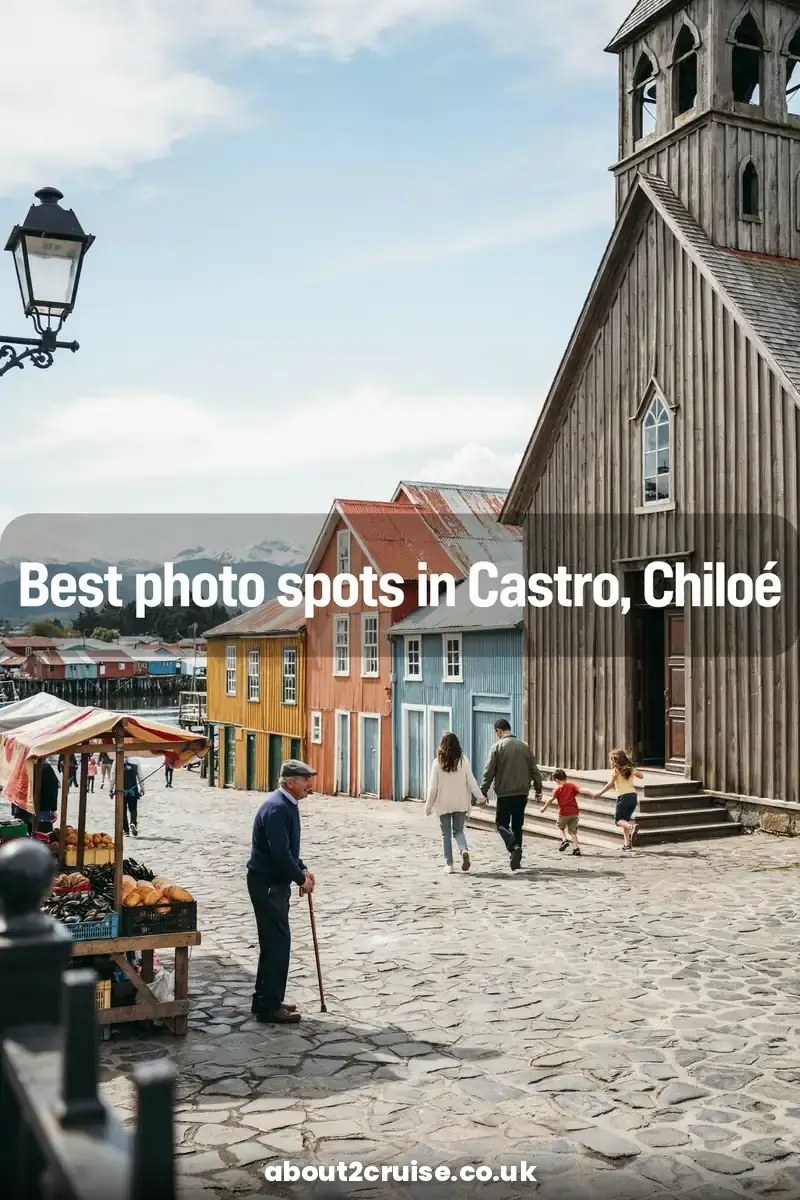
These are private homes. Stay on the street, the miradores, and the public costanera.
Where to eat in Castro
Head for the Feria Artesanal y Mercado Campesino Lillo or the Mercado Municipal José Sandoval Gómez near the waterfront. Both have cocinerías serving curanto, milcaos, chapaleles, seafood empanadas, and caldillo. A full pit curanto takes time to serve and eat, so if you have a tight call, order pulmay or a seafood stew instead. Vegetarians will find potato-based dishes like milcao and chapalele, but the menu is strongly seafood and meat driven. Choose busy stalls where food is cooked to order and served hot.
Craft shopping and what to buy in Castro
The Lillo market is the closest worthwhile stop to the tender landing. It mixes farm produce, honey, eggs, and vegetables with wool textile stalls, wood carving, and baskets. The Mercado Artesanal Los Palafitos in Gamboa is another option, and the Orígenes shop on Thompson 295 sells curated local craft. Classic Castro souvenirs are sheep’s-wool knitwear, junquillo baskets, small carved figures, and objects linked to Chilote mythology. Ask whether a piece was made locally, and keep everything dry for the tender ride.
Money, cards, and ATMs
Chile uses the Chilean peso. Cards work in larger shops and restaurants, but many market stalls, small cafés, taxis, and rural buses are cash-only or prefer cash. Carry enough small peso notes for lunch, a taxi, or a bus. ATMs exist in central Castro, not at the pier. Do not rely on being able to withdraw cash quickly on a Sunday or early tender morning.
Language, Wi-Fi, and phone signal
Spanish is the language ashore. English is not reliably spoken in markets, buses, or smaller cafés, though tour guides and hotel staff may have some. Museum signage is usually Spanish-only. A translation app downloaded for offline use helps. Phone signal is generally fine in town but can be patchy along rural roads and inside the market. Download an offline map before you go. Do not expect free Wi-Fi at the pier; cafés and hotels are the better bet.
Accessibility and walking difficulty
The biggest accessibility barrier is the tender itself. Anyone who cannot transfer into a moving boat may not be able to go ashore. After that, the main physical challenge is the steep climb from the landing to the town centre, and some pavements can be uneven. The passenger terminal has accessible toilets, but that does not extend to every street and viewpoint. If you have limited mobility, a ship excursion with transport from the landing may be the easiest option, but you still need to manage the tender transfer. Be realistic about that before you book.
Safety, medical help, and emergency planning
Castro is not a high-risk stop, but pickpocketing and theft are common in busy tourist areas across Chile, including churches, viewpoints, and transport hubs. Keep your bag in front of you, keep your phone out of a back pocket, and do not leave valuables on café tables. In an emergency, the numbers are 131 for SAMU ambulance, 132 for fire, and 133 for Carabineros police. The nearest full hospital is the Hospital de Castro on Ramón Freire, with an emergency department. Carry travel insurance details and a printed copy of your passport photo page. Drinking alcohol on public streets and squares is illegal in Chile.
Church opening hours, Sundays, and mass times
San Francisco church follows a seasonal timetable. It is normally open Tuesday to Saturday in a morning block and a late-afternoon block, with Sunday mass. Dalcahue church is published as Tuesday to Saturday from 11:00 to 13:00 and 15:00 to 19:00, with Sunday mass at 11:00 and afternoon opening. Chonchi church opens daily from 09:00 to 20:00 and is the most reliable of the three on a long call. Sunday in Castro can mean quieter streets and reduced rural bus service, but the Lillo market still operates and Dalcahue’s fair is at its busiest on Sunday morning. If your call is a Sunday, visit the church around mass, but do not treat it as a sightseeing session during worship.
Should you book a ship excursion or explore Castro on your own?
Independent exploration works very well in Castro because the core is walkable and clearly signed. If you only have four or five hours, skip the tour and do the town loop yourself. Book a ship excursion or a private driver if you want Dalcahue, Chonchi, Nercón, the penguins, or the national park, or if you need transport because of mobility. A ship tour also removes worry about local buses and rural road delays. The independent option wins in Castro; the escorted option wins once you leave town.
Castro with kids, older travellers, or limited mobility
For children, the tender is usually exciting, the hill is manageable with breaks, and the colourful palafitos and market stalls are easy entertainment. Keep the loop short and leave time for an empanada or ice cream stop. For older travellers or anyone with mobility concerns, the tender transfer and the hill are the two things to solve. A taxi from near the Plaza can reduce walking, but you still have to get from the landing up into town. If the ship describes the call as difficult tendering, that is a warning to take seriously.
Castro hotels for pre- and post-cruise stays
Castro is mostly a call port, not a turnaround port, so most cruisers manage without a local hotel. If you are staying on Chiloé, Palafito 1326 Hotel Boutique sits inside the Gamboa palafito neighbourhood and is about 700 to 800 m from the church. Mi Palafito Apart is another palafito option and advertises a free cruise terminal shuttle. Hotel de Castro is near the Plaza with pool, gym, and breakfast. Hotel Boutique Tierra de Islas is central and a short walk from San Francisco. If your main need is an airport overnight, most people stay in the Puerto Varas or Puerto Montt area instead; our Puerto Montt cruise ship port guide covers that side.
Common Castro cruise-call mistakes
- Trying to see too much by adding penguins or Chiloé National Park to a seven-hour call.
- Underestimating the tender queue and last-tender buffer.
- Carrying no cash and finding the market or taxi will not take a card.
- Not checking church opening hours or Sunday mass times before walking up the hill.
- Wearing sandals or a sundress without a rain shell on a day that starts dry.
- Taking a long curanto lunch when you still have to walk back and queue.
- Assuming the palafitos are one single viewpoint; they are in separate rows.
- Leaving the return to the final tender instead of planning to be early.
Castro cruise FAQs
Is it worth going to Chiloé Island?
Yes, if you understand what it offers. Chiloé is not about glaciers or dramatic Patagonian peaks. It is about a distinct wooden-architecture tradition, fishing towns, crafts, food, and a gentler, wetter landscape. Castro gives you the most concentrated sample of that in one walkable call.
Is Castro, Chile worth visiting on a cruise stop?
Yes. Unlike larger South American ports, Castro does not require an hour of bus travel to reach the first sight. You can see a UNESCO church, palafitos, a market, and a local lunch in a relaxed half-day loop.
What is Castro, Chiloé best known for?
Castro is best known for the wooden Iglesia San Francisco on the Plaza de Armas, one of the sixteen UNESCO Churches of Chiloé, and for its palafito stilt houses along the Gamboa and Pedro Montt waterfront.
Can you walk from the cruise port to Castro’s main sights?
Yes. The tender landing is at the central waterfront, and the Plaza de Armas, church, market, and palafito viewpoints are all walkable. The main issue is the steep hill from the landing up into the centre.
What can you do in Castro in one day?
On a typical call you can do the Plaza and church, photograph the Gamboa or Pedro Montt palafitos, browse the Lillo craft market, and eat curanto or seafood. With extra time, add Dalcahue or Nercón for a second church.
Are Chiloé’s wooden churches open to cruise passengers?
They are active parish churches, not gated attractions, so there is usually no admission charge. San Francisco has seasonal opening hours, Sunday mass, and periodic closures. Dalcahue has published tourist hours, and Chonchi is usually open daily. Always be respectful during mass.
Where are the best palafito photo spots in Castro?
The Plazuela Martín Ruiz de Gamboa and the mirador on Calle Chacabuco are the classic public viewpoints over the Gamboa palafitos. High tide and morning or sunset light give the cleanest photos. Pedro Montt can be photographed from the public costanera.
Can you see penguins or wildlife from Castro?
Penguins are not visible from Castro. The Puñihuil colony is near Ancud, about two hours from Castro each way, and needs a full ship excursion or a separate land stay. Around the town and wetland you can see seabirds and waterfowl.
Should I book a ship tour or explore Castro independently?
If your priority is the town itself, go independent. If you want Dalcahue, Chonchi, Nercón, the penguins, or the national park, a ship tour or pre-arranged driver is more reliable because rural transport is cash-based and infrequent.
Is Chiloé Island worth visiting from Puerto Montt instead?
Puerto Montt is the mainland gateway and has its own access to the Lakes District, but it is not the same as Castro. If you want a compact wooden-church and palafito town you can do on foot, Castro is the stronger call. If your itinerary includes both, our Puerto Montt cruise ship port guide helps you compare them.