
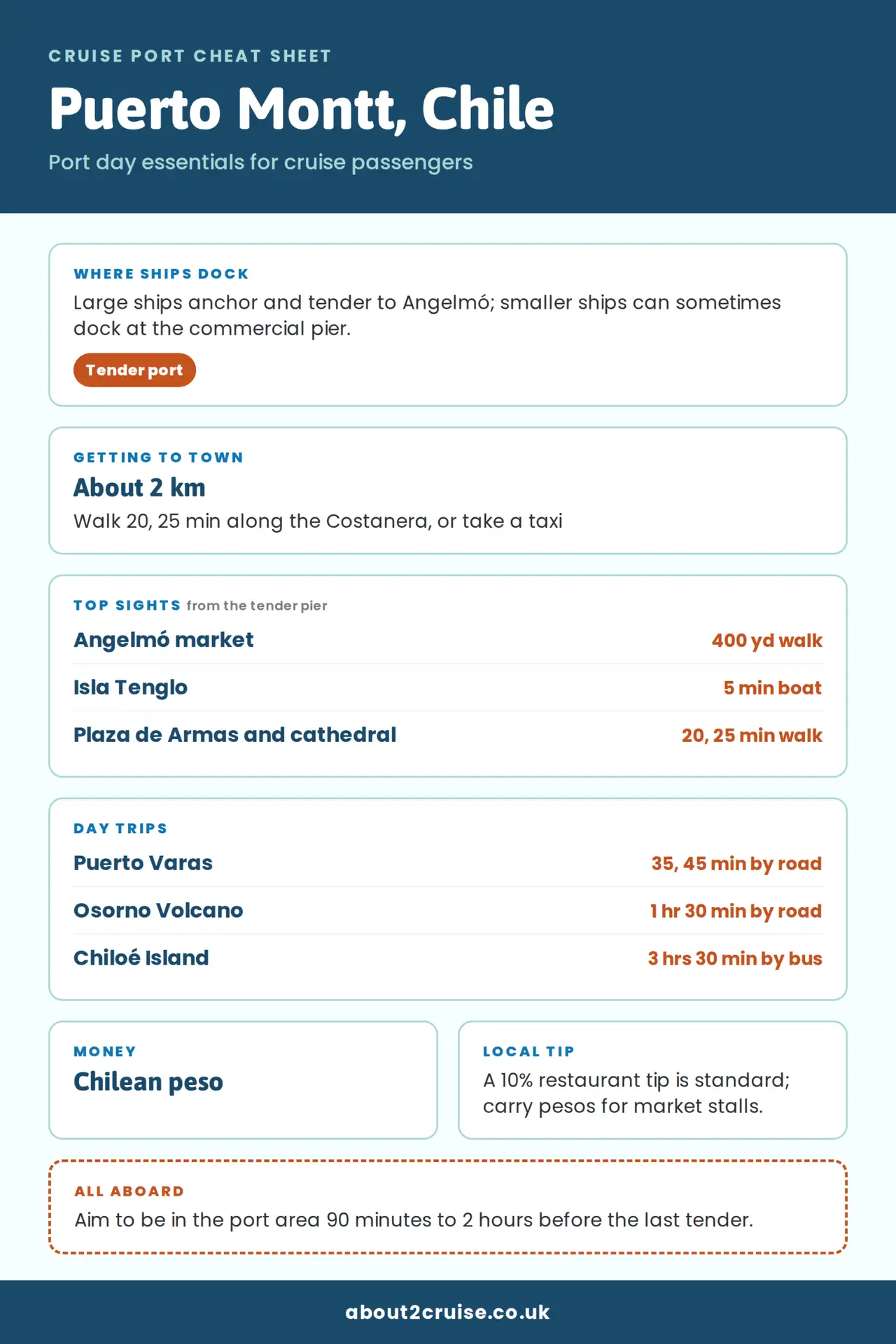
Puerto Montt is the cruise gateway to Chile’s Lake District and northern Patagonia. Most ships anchor in the bay and tender you ashore to the Terminal Internacional de Pasajeros at Angelmó, where the seafood and craft market is a few hundred yards from the pier. From here, Puerto Varas, Frutillar, Osorno Volcano and Petrohué Falls are the headline excursions.
Why Ships Stop in Puerto Montt
Puerto Montt sits on the north shore of the Reloncaví Sound and is the capital of the Los Lagos Region. It works as the service hub for Llanquihue Lake, Todos los Santos Lake, Chiloé, Alerce Andino National Park and Pumalín Park. The city was founded by Vicente Pérez Rosales as part of the German colonisation of the Llanquihue basin, and that German-Chilean layer still shows up in the lakeside towns, food and wooden churches.
The city itself is a working port and transport hub, not a manicured resort. Treat it as a springboard: the best sights are usually the lake and volcano landscapes beyond the city.
Tendering Ashore: The Pier, Terminal and What to Expect
Most large cruise ships anchor in the bay and tender guests ashore. Smaller ships can sometimes tie up alongside at the commercial pier. Your ship’s daily programme is the only reliable source for how your call will work, so check it before you join a queue.
The terminal is the Terminal Internacional de Pasajeros y Centro de Vinculación Ciudad Puerto, run by Empresa Portuaria Puerto Montt, at Avenida Angelmó 1673.
The terminal has two pontoons for receiving tenders plus the commercial pier for alongside calls. Inside or connected to it are separate embarkation and disembarkation halls, offices for SAG, Customs and PDI, a café with a terrace and viewpoint, and shops selling local crafts and typical products. The complex covers about 2,550 m² and sits next to Parque Costanera, with a covered waterfront walkway.
There are two road entrances: the main access at Independencia / Miraflores / Avenida Angelmó, and a ferry-terminal access on Avenida Angelmó about 400 metres from the main gate. A normal cruise season brings around 40 calls, roughly 49,000 passengers and 20,700 crew.
Tendering can be choppy even when Angelmó looks sheltered. Wind and swell can slow the run. Cruise lines warn that the tender may not be suitable for people with reduced mobility, balance problems or some disabilities. If you have any doubt, ask the shore excursions team before joining the tender queue.
Puerto Montt cruise port map
Tenders bring you ashore at Terminal Internacional de Pasajeros. From the tender pier, Sentados frente al mar is about a 24-minute walk, Cathedral of Puerto Montt about 28 minutes and Plaza de Armas about 28 minutes. Tap a pin for directions.
- Terminal Internacional de PasajerosWhere tenders land
- Angelmó tender pierWhere tenders land
- Sentados frente al marWaterfront sculpture · About 24 min walk from the tender pier
- Plaza de ArmasMain square · About 28 min walk from the tender pier
- Cathedral of Puerto MonttCathedral · About 28 min walk from the tender pier
- Angelmó marketSeafood and craft market · About 11 km from the tender pier
- Mirador Manuel MonttViewpoint · About 3 km from the tender pier
- Isla TengloIsland · About 3 km from the tender pier
- Puerto VarasLakeside town · About 18 km from the tender pier
- FrutillarLakeside town · About 41 km from the tender pier
- Museo Colonial Alemán de FrutillarMuseum · About 39 km from the tender pier
- Volcán OsornoVolcano · About 57 km from the tender pier
- Alerce Andino National ParkNational park · About 38 km from the tender pier
- Osorno Volcano Ski CentreSki centre · About 53 km from the tender pier
Finding Your Way Around: From Angelmó to the Plaza
Use the waterfront as your spine. The tender landing and terminal are at Angelmó cove. The Angelmó craft fair and seafood market are a 400-yard walk from the pier. The Plaza de Armas is about 2 km from the port, roughly 20–25 minutes on foot along the Costanera.
There isn’t a detailed official English walking map from the port, but the waterfront promenade links the pier, the Sentados frente al mar sculpture and the main square with its wooden cathedral.
For a quick geographic fix: the terminal and market are on the water, the main square is slightly inland and uphill, and the road to Puerto Varas heads north along the lake. Ship excursion coaches line up in the parking area next to the dock, and private drivers usually wait nearby.
Small passenger boats cross from Angelmó to Isla Tenglo in a few minutes. The island has trails and viewpoints over the bay and, on clear days, the volcanoes. It’s an easy add-on if you’re staying near the port and the weather is good.
Angelmó Market: Seafood, Crafts and Local Life
Angelmó is the port-day highlight you can do without a tour. The craft fair runs along Avenida Angelmó, with the fish and seafood market and its upstairs food stalls at the far end. Expect a working cove: fish being unloaded, stalls piled with shellfish, wool knits and carved wood. It is crowded, wet underfoot in places, and better earlier in the day.
The hard-to-miss photo spot is the ANGELMÓ letters sign at the cove. A good rhythm is to arrive around 11:00, when the food stalls open and before the biggest lunch rush, then leave time to circle the craft stalls before your last tender.
Eating at Angelmó Without the Guesswork
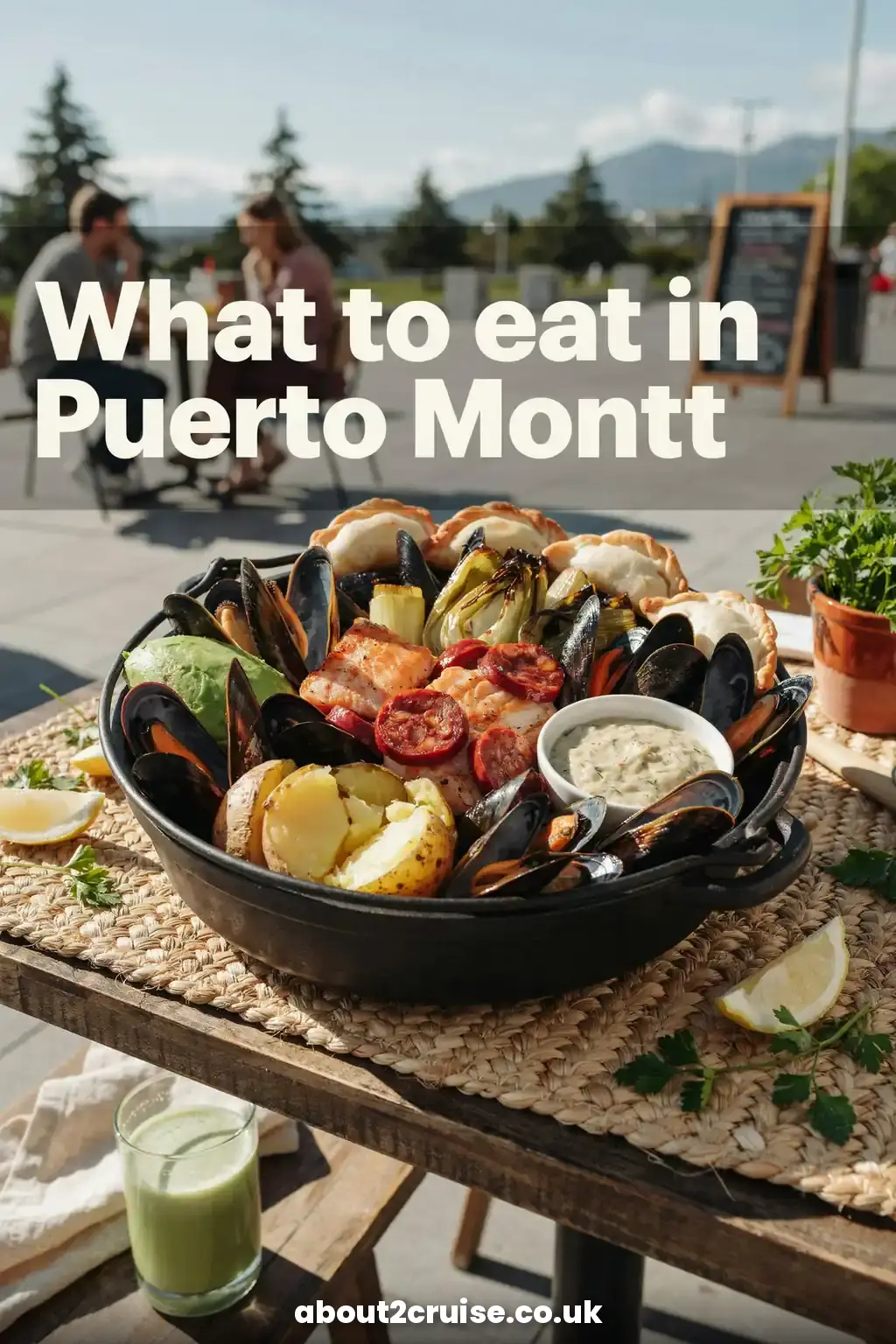
The market food stalls are the place to try curanto, the Chiloé-tradition dish of shellfish, meats, potatoes and milcao potato bread, traditionally cooked in a ground oven and often served pot-cooked as curanto en olla. You can also order paila marina seafood stew, fried fish, seafood empanadas, ceviche, milcao and chapaleles.
Chilean lunchtime starts later than many cruise passengers expect, and the stalls fill up at midday and after. Cash is advised because some vendors do not take cards. Pick a busy stall with high turnover, make sure hot seafood is cooked through and served hot, and follow standard travel eating caution if your stomach is sensitive. The market is not fine dining; it’s a working seafood scene.
Town Sights Worth a Quick Look
The Plaza de Armas and its cathedral are the centrepiece. The cathedral is the city’s oldest historic building, its structure carried on 12 alerce-wood columns with a Doric-columned façade. A few blocks away, the Costanera is a waterfront walk with the Sentados frente al mar sculpture, the city’s reference landmark. For a panorama over the city and the Reloncaví Sound, go up to Mirador Manuel Montt. If the day is clear and you’re still in town late, Pelluco beach is a local sunset option.
The Salmon Economy You’ll Notice Everywhere
Puerto Montt and Los Lagos run on salmon and trout. Salmon and trout products were 82.7% of the region’s total exports in one recent half-year period, worth about US$2,866 million. Los Lagos produces around 41% of Chile’s farmed salmon harvest, second only to Aysén at 45%, and Chile plus Norway account for about 77% of world salmon production. You’ll see the supply chain in the fish market, processing infrastructure, fjord farms and restaurant menus. It isn’t a traditional sight, but it explains the port city you’re walking through.
Puerto Varas and Lake Llanquihue: The Postcard View
Puerto Varas is 12 miles from Puerto Montt, on the shore of Lago Llanquihue, Chile’s second-largest lake. On a clear day the view of Osorno and Calbuco volcanoes reflected in the lake is the classic Lake District photograph. The town has German-colonial architecture, a rose-filled main square, cafés, chocolate shops and a more touristy, relaxed feel than Puerto Montt. It is easy to reach independently by taxi, colectivo or local bus, and it’s usually included in ship-run highlights tours.
Osorno Volcano: Only Worth It on a Clear Day
Osorno is a 2,652-metre stratovolcano with an almost perfect cone. A paved road climbs to the ski and mountain centre; outside the ski season the lifts can run as a panoramic viewpoint. The ski centre is about 45.7 km from Puerto Varas, roughly 45 minutes by road, and about 1 hour 30 minutes from Puerto Montt. The panoramic chair is around CLP 23,000 for adults and CLP 12,000 for ages 6–14, but prices change, so check the ticket office. Clouds and rain can obscure the volcano completely, so make this a clear-weather priority.
Frutillar: A Little German-Chilean Corner
Frutillar is about 16 miles north of Puerto Varas and feels more like a Black Forest lakeside town than a typical Chilean port stop. It has German-style houses and gardens, delicatessens and the Museo Colonial Alemán de Frutillar, which covers the first German settlers. The museum is open Tuesday–Sunday, 10:00–19:00 in January and February, and 10:00–14:00 and 15:00–18:00 from March to December; it closes on Mondays from March to December, plus 1 January, 1 May and 25 December. Entry is CLP 3,000 for adults, CLP 2,500 for students and CLP 1,000 for children.
Petrohué Falls and Vicente Pérez Rosales National Park
Saltos del Petrohué is a set of turquoise falls pouring over old lava flows, with easy walkways and viewpoints inside Vicente Pérez Rosales National Park. It is about 50 km from Puerto Varas on Route 225, and the main circuit is 1 km and rated easy. Park hours are 09:00–18:00 December–March with last entry 17:30, and 09:00–17:00 March–November with last entry 17:00. Hours can change for weather or safety.
Buy park tickets online through Pases Parques. The foreign adult rate is CLP 8,200, foreign 13–17 CLP 4,500, and Chilean adult CLP 3,900. Tickets are separate for nationals and foreigners. Arriving after last entry means no admission and no refund, though dates can be changed. Many tours combine Petrohué Falls with Osorno or a lake boat.
Alerce Andino National Park for a Quieter Nature Fix
Alerce Andino is a quieter nature stop for old alerce forest and trails. It is open 09:00–17:00 daily with last entry at 15:00. Foreign adults pay CLP 8,200 and Chilean adults CLP 3,900. Entry and exit must be logged at the ranger station, open sectors vary with weather, and some trails close. Fires and gas stoves are banned, pets and drones are prohibited, and you must register at the guard post coming and going. It works best as a guided half-day or part of a private nature itinerary, not as a rushed independent port-day add-on.
Chiloé Island from a Cruise: Long but Possible
Castro, the main town on Chiloé, is about 175 km from Puerto Montt and roughly 3 hours 30 minutes by bus including the Chacao Channel ferry crossing. The painted palafitos stand over the tidal estuary, and the island has wooden churches built without iron nails. This is too far for a comfortable independent port day, but some ship excursions or pre/post-cruise extensions cover Chiloé when the call allows a very long day.
Castro (Chiloé) is a common next or previous call on Chilean fjords itineraries, and its sheltered eastern coast makes it a calmer, island contrast to Puerto Montt.
Shore Excursions That Fit a Real Port Day
Typical choices:
- Puerto Varas and Frutillar highlights: about 4 hours, easy, from around US$84, not wheelchair accessible; usually includes the Frutillar Colonial Museum and leaves time for Angelmó before the last tender.
- Petrohué Falls and Osorno: a half-day version is about 4.75 hours, while a full-day lake-and-volcano version can run 7.5–8 hours.
- Angelmó market and city orientation: easy to do independently in a couple of hours if you are on foot.
- Alerce Andino guided walks: soft half-day nature stops.
- Chiloé long-day excursions: only when the itinerary gives enough time.
Guided tours of Petrohué Falls and Osorno Volcano can start from about CLP 37,000 per person, excluding park entry and the volcano chairlift. Book full-day trips early because they need almost all of the port day to work.
Should You Book a Ship Tour or Go Independently?
For Angelmó, the Costanera and Puerto Varas, independent travel is straightforward: you’re already beside the market, and Puerto Varas is a short taxi or bus ride. For Petrohué, Osorno, Frutillar-plus-lake loops or Alerce Andino, the distance, park windows and tender timing make a ship excursion or a licensed private driver with a guaranteed return the safer option. If an independent private tour runs late, the ship won’t wait; on a ship-run tour the line usually manages the logistics and return. The trade-off is independence and pace versus tender and timing certainty.
Taxis, Buses, Colectivos and Private Drivers
Taxis are metered yellow-and-black cars. Colectivos are shared fixed-route taxis identified by colour and a roof sign. Private tour guides and drivers usually wait in the parking area next to the dock or at the terminal exit. Rideshare is less predictable than in Santiago, so a local taxi or pre-booked transfer is usually easier.
Official taxi fares from the pier to Puerto Varas, Frutillar or the airport are not published at the terminal; agree a fare before leaving or use a metered taxi. Local buses to Puerto Varas run frequently from the city centre and bus terminal; ask for the Puerto Varas or Llanquihue direction. If you’re heading to the airport or onward to Patagonia, book an official transfer.
Shuttles, Walking and the Train That Isn’t
Don’t assume a free city shuttle. Complimentary cruise shuttles, where they run, usually only move guests through the port area to the gate, not into town or to attractions, and they aren’t offered at every call. Puerto Montt has no passenger train; the old locomotives displayed at Plaza Ferrocarriles are from the era when the railway reached the port. If you can walk 20–25 minutes each way, the Costanera to the Plaza de Armas is your free transfer; otherwise take a taxi from the port area.
Getting Back to the Ship in Rainy Weather
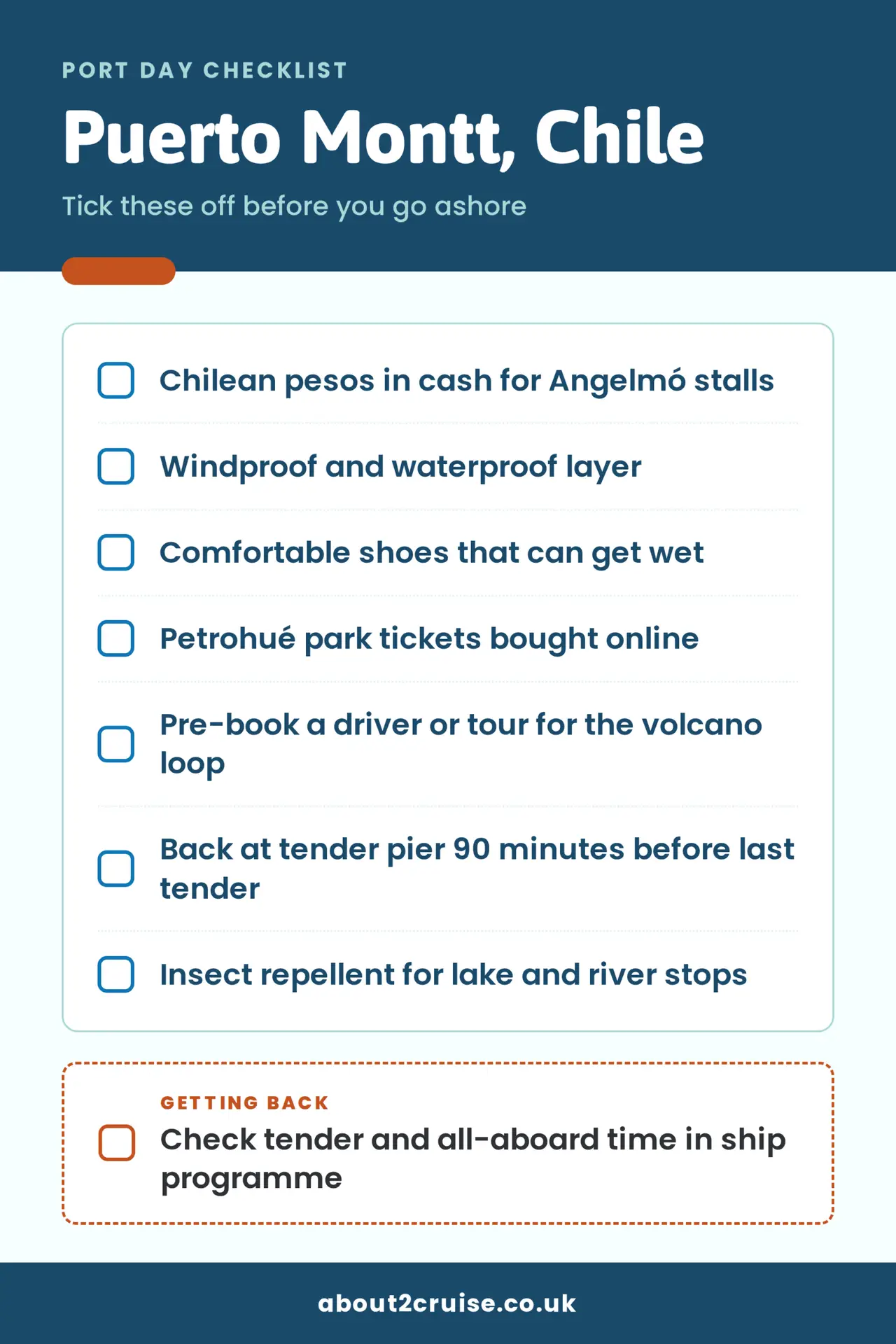
Treat the last tender time as immovable. For Puerto Varas, allow 35–45 minutes each way by road and more if traffic is heavy. For Petrohué, Osorno or Frutillar, don’t cut it fine: start back towards Puerto Montt with a solid cushion, and aim to be in the port area at least 90 minutes to 2 hours before the last tender because the tender queue can be long at the end of the day.
Rain is common in every month. Carry a lightweight windproof and waterproof layer, warm layers, and a hat or gloves for lake and volcano stops. Good rainy-day backups include the terminal café and shops, the cathedral, Puerto Varas cafés, the Frutillar museum, and the covered areas of Angelmó. Market ground stays wet, so wear shoes that can cope.
Money, Cards, ATMs and Tipping
The currency is the Chilean peso. Cards are widely accepted in city hotels, restaurants and larger shops, with contactless working in many places, but cash is still needed for small shops, market stalls, taxis and tips. ATMs are in the city centre about 2 km from the port. When using an ATM, decline any offer to convert the withdrawal to your home currency; pay in pesos. If paying by foreign card, saying sin cuotas can help avoid instalment prompts. A 10% restaurant tip is standard and often printed on the bill. US dollars are not accepted in most everyday places, though some hotels and tour operators quote in dollars.
Souvenirs: What’s Worth Buying at Angelmó
Angelmó’s craft fair sells Chilote wool knits, hats and socks, wooden items and carvings, basketry and copper. Wool quality varies widely between stalls, so check seams and thickness before buying. Bargaining is common. The terminal itself also has shops selling crafts and typical local products. If you want higher-end or gallery-style craft, Puerto Varas often has a slightly more polished selection than the port market.
Safety, Language and Solo Travel
Spanish is the working language. English is available in tourism businesses but less so in local taxis and market stalls. Learn a few phrases and carry your port name written down.
Chile has a real problem with pickpocketing, muggings and theft from vehicles, especially in busy cities and tourist areas. In Puerto Montt, use normal big-city caution: keep your passport, phone and watch out of sight, avoid the market area late at night, and don’t leave bags visible in cars. Street vendors at Angelmó can be persistent but are usually fine.
Solo travellers should stick to populated areas during the day, use official taxis, and avoid walking alone late in isolated parts of the waterfront. The day-time port and market scene is generally safe, but Chile-wide advice is to be alert around crowds, bus stations and ATMs.
Accessibility at a Tender Port
Because most ships tender, the first challenge is the transfer itself. Cruise lines warn that the tender may not be suitable for people with reduced mobility, balance problems or some disabilities. The terminal building is modern, but the tender landing can be wet and uneven. Angelmó is crowded and wet underfoot in places. City sidewalks vary. Several shore excursions are classified as not wheelchair accessible. If you use a wheelchair or have mobility concerns, talk to the shore excursions team before booking, and consider a private car for a seated sightseeing loop if you cannot manage the tender.
Where to Stay Before or After Your Cruise
Puerto Varas is the more touristy, quieter base; Puerto Montt has more transport links, services and the Angelmó cove. Many travellers combine the two. If you’re here for an expedition embarkation or a pre-cruise night, check your hotel’s cancellation and luggage rules because the cruise terminal does not advertise left-luggage storage.
Hotels Cruisers Often Mention
- Hotel Le Mirage, Rancagua 350: about 200 m from Angelmó, buffet breakfast, free parking and Wi-Fi, no lift.
- Courtyard by Marriott Puerto Montt: about 2.9 km from the Angelmó fish market, with free breakfast 07:30–10:30.
- Hotel Don Luis Puerto Montt: central, near the main square, with sauna, gym and restaurant; Angelmó is a 5-minute drive.
- Gran Hotel Vicente Costanera: directly in front of the main square, with sea views in superior rooms.
Luggage custody is available at the main bus terminal, Avenida Diego Portales 1001 on the waterfront, and at the Cruz del Sur terminal. There is no documented left-luggage service at the cruise terminal itself, so don’t plan on leaving bags at the pier.
Getting to Puerto Montt by Air, Bus or Road
Flights land at El Tepual International Airport, 16 km from the city. A transfer or taxi takes about 20–30 minutes to the centre. By road from Santiago it is more than 1,000 km on Route 5 South; an intercity bus takes 12–14 hours and arrives at the main bus terminal on Avenida Diego Portales 1001. The bus terminal has luggage custody, cafés, shops and ATMs. The city is also the natural gateway for driving or busing towards Patagonia, Chiloé and the lakes.
How Puerto Montt Compares with Other Chilean Cruise Ports
Puerto Montt is not a top-20 global mega cruise port; it’s a regional gateway with around 40 calls and 49,000 passengers in a strong season. Within Chile, the port mix looks like this:
- Valparaíso and San Antonio: the central Chile ports used for Santiago; see the Valparaíso (Santiago) cruise port guide for that terminal difference.
- Puerto Chacabuco: much smaller and more remote, used for the Aysén fjords and expedition itineraries; it has a 430 m² terminal at Muelle Huillin and another private terminal next door. Compared with Puerto Montt, it has fewer services, no big airport nearby, and much less independent sightseeing.
- Punta Arenas: southern Patagonia, with a bigger passenger hall, two tender platforms, and ships up to 258.6 metres at Muelle Arturo Prat.
- Ushuaia in Argentina is the major expedition and departure hub for Antarctica and southern Patagonia; see the Ushuaia cruise ship and departure port guide.
- Buenos Aires is the big turnaround port for many South America itineraries; see the Buenos Aires cruise ship port guide.
San Antonio passenger spending has been reported at around US$96 per transit visit and US$242 per embarkation, while Puerto Montt’s cruise-passenger spending has been put at about US$107 per stay. These are planning numbers, not promises.
If your cruise continues south, Punta Arenas is a common next call after Puerto Montt, on the Strait of Magellan.
On Chilean fjords itineraries, Puerto Edén is often your next call south of Puerto Montt, a much smaller settlement in the channels of Bernardo O’Higgins National Park.
Port Changes and What to Check on Board
Chilean cruise calls have been falling in some northern ports, and operators cite high operating costs including tugs and buoys, plus a preference for shorter routes. Puerto Montt can still see last-minute port changes, so always treat the ship’s daily programme as final.
There is no official regulator or cruise body that publishes a worst cruise line ranking. For a South America or Chilean fjords sailing, choose by itinerary, ship size, included shore excursions, onboard enrichment, and whether you can handle tender ports such as Puerto Montt. Smaller expedition or luxury ships may occasionally berth alongside, while large mainstream ships usually tender.
How to spend a port day in Puerto Montt
A port day in Puerto Montt works best if you pick one: a slow walk around Angelmó and the Costanera, or a road loop to Osorno and Puerto Varas.
Before you sail
- Book Petrohué Falls park tickets online via Pases Parques; last entry is strict.
- Book long Petrohué or Osorno tours early if you want a guaranteed return.
- Bring Chilean pesos for Angelmó stalls, taxis and tips; cards are not accepted everywhere.
Short port day: under 6 hours
- On dockingTake the tender to AngelmóTender portLarge ships anchor, so allow for a choppy transfer. You land beside the Angelmó market.
- +15 minAngelmó craft fair and fish marketThe market is 400 yards from the pier. Browse wool knits, wood carvings and the fish stalls.
- +1 hrLunch at the Angelmó food stallsTry curantoOrder curanto or paila marina from a busy upstairs stall. Cash is preferred.
- +2 hrsWalk the Costanera to Plaza de ArmasAbout 20, 25 minutes along the waterfront to the main square.
- +2 hrs 30 minCathedral and Plaza de ArmasThe cathedral is the city's oldest building, carried on 12 alerce-wood columns.
- +3 hrs 30 minWalk back along the waterfrontRetrace the Costanera to Angelmó, allowing 20, 25 minutes.
- All-aboard minus 90 minBack at the tender pierAim to be in the port area 90 minutes before the last tender; the queue can be long.
The time on the map is the whole walk, every stop added together.
Open this walking route in Google Maps
If plans change: If the cathedral is closed, continue along the Costanera to Mirador Manuel Montt for the city view.
Long port day: 8 hours or more
- On dockingTender to Angelmó, meet your driverBook aheadLarge ships anchor. Pre-book a driver or use a taxi to leave from the pier.
- +30 minDrive to Osorno VolcanoAbout 1 hr 30 min from Puerto Montt. The paved road climbs to the ski centre.
- +2 hrs 15 minOsorno panoramic chairRide the panoramic chair for views of the cone and Llanquihue Lake, if it is running outside ski season.
- +3 hrs 45 minDrive down to Puerto VarasAbout 45 minutes from the ski centre.
- +4 hrs 30 minLunch in Puerto VarasTry salmonOrder salmon or a café lunch; Puerto Varas has German-Chilean cafés and restaurants.
- +5 hrs 30 minPuerto Varas costanera and main squareThe classic photo is Osorno and Calbuco reflected in Llanquihue Lake.
- All-aboard minus 2 hrsReturn to the tender pierAllow 35, 45 minutes from Puerto Varas and extra for the tender queue.
This map shows the taxi ride from the ship. The time is the drive only, not your time ashore.
Open the taxi route in Google Maps
If plans change: If the Osorno chairlift is closed, head straight to Puerto Varas and swap the volcano for the Costanera and Frutillar's Colonial Museum.
Puerto Montt Cruise Port FAQs
How far is Angelmó market from the cruise terminal?
The craft and seafood market is about 400 yards from the pier, an easy walk. The city centre at the Plaza de Armas is about 2 km, or 20–25 minutes on foot along the Costanera.
Is Puerto Montt a tender port?
Usually yes. Large ships anchor in the bay and use tenders. Smaller ships can sometimes dock alongside at the commercial pier. Check the ship’s daily programme for your call.
Can I do Puerto Varas on my own from the cruise pier?
Yes. It’s about 12 miles by road. Use a metered taxi, a colectivo, or a local bus. Allow at least 35–45 minutes each way and leave extra time to get back for the last tender.
Do I need a tour for Petrohué Falls or Osorno Volcano?
No, but a tour or private driver makes the timing much easier. The park ticket is bought online via Pases Parques, and the area is about 50 km from Puerto Varas. A half-day visit works; a full-day tour is more comfortable if you also want Osorno or a lake boat.
What currency do I need at Angelmó?
Chilean pesos. Cash is strongly preferred in the market stalls and food stalls. There are ATMs in the city centre about 2 km from the port, but it’s easier to bring some pesos.
Is it safe to eat the seafood at Angelmó?
Many cruisers do. Pick busy stalls with high turnover, choose hot cooked seafood, and use standard travel eating caution. If your stomach is sensitive, skip raw ceviche and tap water.
Can I leave my luggage at the cruise terminal?
There is no documented left-luggage service at the cruise terminal. Use the luggage custody at the main bus terminal on Avenida Diego Portales 1001 or the Cruz del Sur terminal.
Do cruise lines provide a free shuttle to Puerto Montt centre or Puerto Varas?
Usually not. Shuttles, where provided, tend to run only through the port area or to the gate. The city centre is walkable for many passengers, and taxis or local buses cover the rest.
Is Puerto Montt the same as Valparaíso or San Antonio for Santiago?
No. If your itinerary says Santiago, you’ll likely dock at Valparaíso or San Antonio, not Puerto Montt. Use the Valparaíso (Santiago) port guide for that call.
What should I wear for a Puerto Montt port day?
Warm layers, a windproof and waterproof outer layer, and comfortable shoes that can get wet. Rain can appear in any month, and lake or volcano stops are cooler than the city.
Last Updated: 20 November 2026