
Salvador da Bahia is the Brazil cruise call where the ship docks in the lower city, a 72-metre lift hauls you up to a UNESCO-listed old town, and you can have a full day of Afro-Brazilian food, music, baroque churches and market life without a coach tour. It is hot, walkable at the core and culturally intense, but street awareness and ship timing matter.

What Makes Salvador Different from Other Brazil Cruise Stops
Salvador was Brazil’s first capital, from 1549 to 1763, and it remains the centre of Afro-Brazilian culture. The Pelourinho historic centre has been a UNESCO World Heritage Site since 1985 and is the largest colonial architectural ensemble in Latin America. In a single port call you can catch baroque churches, capoeira circles, samba drumming, baianas selling acarajé, the Mercado Modelo craft market, the Lacerda lift and the wide Baía de Todos os Santos. If you have more time, the beaches and sea turtle conservation at Praia do Forte stretch north along the Coconut Coast.
Is Salvador Worth Visiting on a Cruise?
Yes, and it is one of the easiest historic centres in Brazil to reach from a cruise ship. Ships dock in the Comércio district, about 400 m from the Mercado Modelo and a short lift ride below the Pelourinho, so there is no compulsory bus ride, no tender and no need to book a tour just to see the headline sights. The city is not a polished museum piece: uneven cobbles, heat, street poverty and the need for phone security are real. But for most UK cruisers the cultural punch, the food, music, architecture and Afro-Brazilian identity, makes the stop genuinely worthwhile. If your itinerary also calls at Rio de Janeiro, Recife or Fortaleza, Salvador offers the strongest African-Brazilian character of the set.
Where Your Ship Docks: Terminal and Port Orientation
Salvador has one cruise terminal, the Terminal Marítimo de Passageiros do Porto de Salvador, at Avenida da França 393, Comércio. Ships berth alongside at the southern end of the working port, roughly 12.9686° S, 38.5122° W. There is no tender and no compulsory shuttle. From the ship you look across the water towards the round Forte São Marcelo and the harbour fortifications.
The terminal has 7,678 m² over three floors, a 3,645 m² seafront terrace and capacity for about 20,000 passengers a day. On busy days the port coordinates more than 200 coaches and vans, with trilingual signage for passengers walking out of the gate. The building is accessible and has air conditioning, a tourist information desk, Wi-Fi, a first-aid clinic, ATMs, souvenir shops, a snack bar, a taxi rank and tour agencies. Customs, Federal Police and ANVISA desks operate inside during turnarounds. Lost property at the terminal can be reported on +55 71 3901-3670.
Salvador da Bahia cruise port map
Ships dock at Salvador da Bahia cruise port. From the terminal gate, Feira de São Joaquim is about a 20-minute walk, Largo do Pelourinho about 20 minutes and Salvador Cathedral about 24 minutes. Tap a pin for directions.
- Salvador da Bahia cruise portWhere ships dock
- Largo do PelourinhoHistoric square · About 20 min walk from the terminal gate
- Feira de São JoaquimTraditional market · About 20 min walk from the terminal gate
- Salvador CathedralCathedral · About 24 min walk from the terminal gate
- Mercado ModeloCraft market · About 27 min walk from the terminal gate
- Church of São FranciscoBaroque church · About 27 min walk from the terminal gate
- Elevador LacerdaHistoric lift · About 28 min walk from the terminal gate
- Farol da BarraLighthouse · About 6 km from the terminal gate
- Museu Náutico da BahiaNautical museum · About 6 km from the terminal gate
- Porto da BarraBeach · About 6 km from the terminal gate
- Bonfim churchChurch · About 4 km from the terminal gate
Terminal Facilities, ATMs, Wi-Fi and Luggage Storage
ATMs are listed among the terminal facilities, but for more reliable cash, use machines inside a bank branch in the city rather than a standalone street machine. Wi-Fi is available in the terminal, though it can be slow on busy turnaround days. The terminal does not advertise a left-luggage desk, so you cannot plan on leaving bags there for a late flight or a post-cruise day ashore. Independent luggage storage near the historic centre starts at about R$20 a day, with cheaper options around the Mercado Modelo area from about R$11 a day. Doubling back to the terminal for bags is not practical mid-sightseeing because the lift and old town are in the opposite direction from most storage points.
Which Cruise Lines Call at Salvador and When?
Salvador is one of Brazil’s busiest cruise ports and the busiest in the north-east. Sixteen ships from 13 different lines have been scheduled in recent seasons, with MSC dominant: MSC Virtuosa makes weekly calls, alongside MSC Divina, Musica, Seaview and Splendida. Costa also calls with Costa Diadema and Costa Serena. Other recent callers include Celebrity, Azamara, Silversea, Seabourn, Regent Seven Seas, Phoenix Reisen, Saga, Swan Hellenic and Hapag-Lloyd. P&O Cruises, Cunard and Holland America Line also appear on port schedules. For the wider regional picture, our cruise ports guide to Brazil explains how the calls fit together.
The season runs from early October to early April, with the busiest months for calls usually February and March. On peak days there can be up to three ships in port, which means more people waiting for the lift, more tour groups in the Pelourinho and more congestion on the waterfront.
Best Time to Cruise to Salvador: Weather and Season Guide
The southern-hemisphere summer, November to March or April, is the standard South America cruise season. Brazil is especially atmospheric in February and March because of Carnival, while Salvador’s own cruise season runs from early October to early April. This is also Salvador’s drier, sunnier half. Average highs run about 30–31°C from December to March and around 27°C in the southern winter. Rainfall peaks from April to June, with May usually the wettest month. UV levels are extreme and humidity sits around 77–81%, so heat and sun protection are not optional. The UK FCDO notes that north-east Brazil’s rainy season runs from April to July.
If you are choosing between South America and the Mediterranean, the seasons are almost mirror images: the Med peaks from April to October while Salvador and Brazil’s cruise season runs from October to April. South America is culturally richer but logistically heavier; Salvador itself is a relatively straightforward port day once you are alongside.
How Far Is Pelourinho from the Cruise Terminal?
The headline distances are smaller than they feel. Mercado Modelo is about 400–500 m from the terminal gate, roughly a 10-minute walk along Avenida da França with the water on one side. Pelourinho is about 1–1.2 km from the ship if measured directly, but the route everyone takes uses the Elevador Lacerda to cover the 72 m height difference between the lower city and the upper city. Allow 20–30 minutes from ship to the centre of the old town, including lift queue time.
Easiest Walking Route from the Port to the Historic Centre
Exit the terminal gate onto Avenida da França and walk with the bay and Forte São Marcelo on your seaward side. Continue to the large market building, Mercado Modelo, and the Praça Visconde de Cairu. The lower station of the Elevador Lacerda is directly opposite the market. Ride the lift up to Praça Tomé de Sousa in the upper city. From there, walk through Praça Municipal and Praça da Sé towards Terreiro de Jesus and Largo do Pelourinho. The whole historic core is compact, hilly in places, and best explored on foot once you are up top.
Elevador Lacerda: Getting from the Lower City to the Upper City
Salvador is split between the Cidade Baixa, the lower commercial city where the port is, and the Cidade Alta, the old administrative and residential city on the bluff above. The Elevador Lacerda links the two. It opened in 1873, is listed by IPHAN, rises 72 m in about 30 seconds, carries around 28,000 people a day and is free to ride. The upper station opens onto a flat paved esplanade with the classic view over the Baía de Todos os Santos, Mercado Modelo and Forte São Marcelo. If the lift queue is very long, the Plano Inclinado Gonçalves funicular also links the two cities and drops you behind the cathedral.
Pelourinho Historic Centre: What to See and Where to Walk
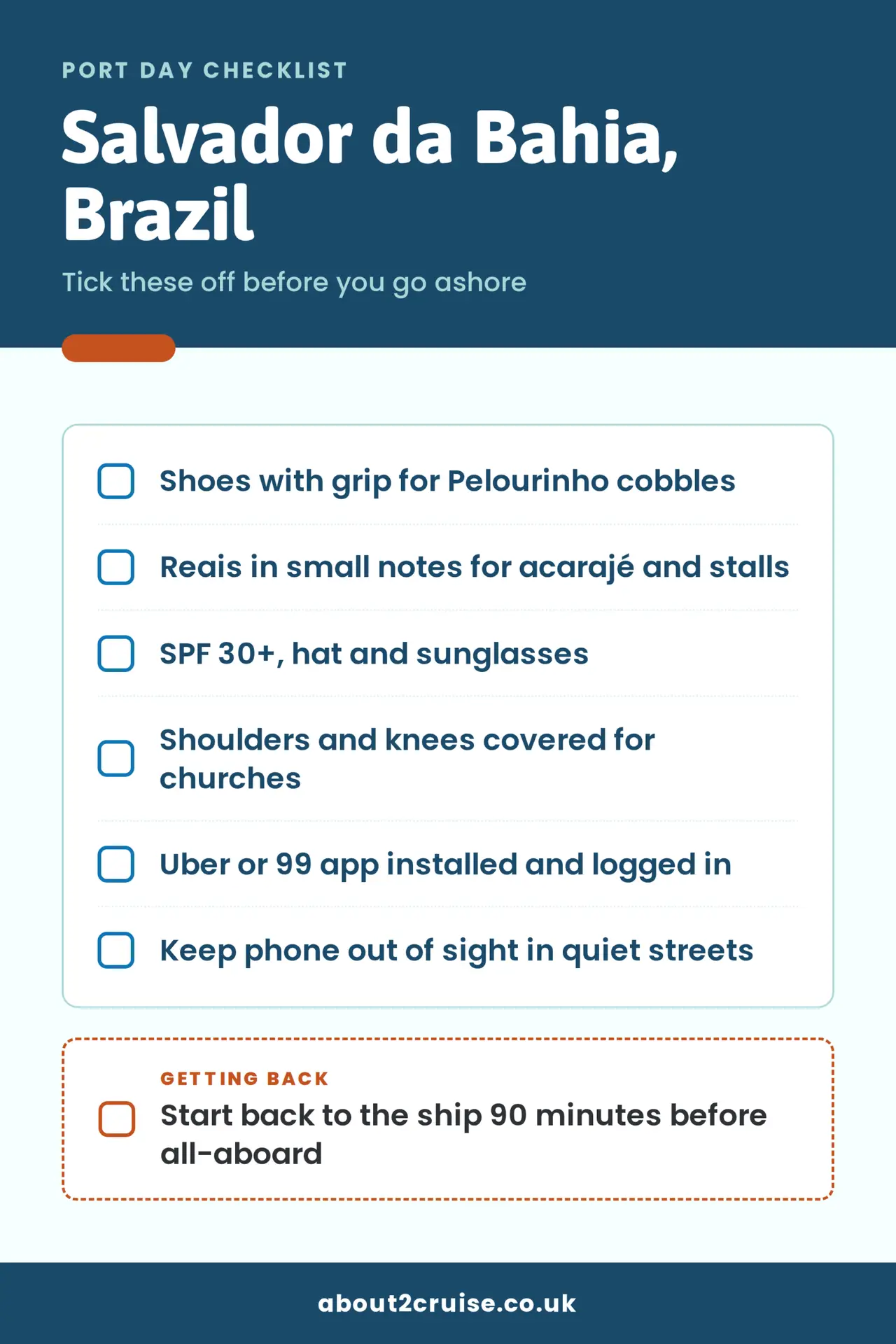
Pelourinho is the UNESCO-listed old town and the largest colonial architectural ensemble in Latin America. The sloping, pastel-fronted Largo do Pelourinho is the postcard centre, but the surrounding streets and squares are equally worth wandering: Praça da Sé, Terreiro de Jesus, Rua Gregório de Matos and the ladeiras falling away towards the port. A practical loop from the top of the lift through the main squares and back is under 4 km and takes about three hours with church interiors. The area is best late morning to mid-afternoon, when it is busiest and most patrolled. Wear shoes with grip: the cobbles are uneven, often steep and can be slick in humid weather.

Baroque Churches and Religious Heritage in Salvador
The historic centre is dense with baroque churches. The Church of São Francisco is the most famous, with its gilded interior and adjoining Ordem Terceira. A R$15 combination ticket covers both; opening is generally Monday to Saturday 9am–5pm and Sunday 9am–4pm, with some Tuesday hours ending at 4pm. The cathedral at Terreiro de Jesus charges R$10, opening Monday 10am–4:30pm, Tuesday to Saturday 9am–4:30pm and Sunday 11am–3pm. The Bonfim church, about 20–25 minutes by rideshare from the Pelourinho, is free and opens daily 6am–12pm and 2pm–6pm; its Lavagem do Bonfim procession falls on the second Thursday of January.
Dress with shoulders and knees covered to clear every church door. Hats come off inside, avoid flash photography and do not photograph worshippers at prayer. Some historic churches have stepped entrances, so do not assume level access.
Bahian Music, Dance and Capoeira in the Streets
Music is part of the streetscape in Salvador. In the Pelourinho you will often see capoeira circles, samba drumming and informal performances around Terreiro de Jesus and Largo do Pelourinho. Bahian rhythms are rooted in African traditions, and capoeira is a stylised martial art disguised as dance. If you want a structured performance, many shore excursions include a Bahian music, dance and capoeira show. Otherwise, simply walking the old town around late morning and early afternoon usually gives you a free taste.
Bahian Food: Acarajé, Moqueca and Market Eats
The signature street food is acarajé: a black-eyed pea fritter fried in dendê palm oil, split and filled with vatapá, dried shrimp and pepper, sold by baianas in traditional dress. Acarajé is registered as Brazilian intangible heritage. Other dishes to try are abará, the same dough steamed in banana leaf; vatapá, a creamy shrimp and coconut paste; caruru, an okra and shrimp dish; moqueca baiana, a coconut milk and dendê fish stew; and bobó de camarão. Acarajé is mostly a late-afternoon and evening food, but baianas operate throughout the day in busy tourist areas. Casual lunch in the Pelourinho or Comércio runs roughly R$20–120 per person; dinner is often R$80–200. The Mercado Modelo has food stalls and restaurants near the ship, while the Feira de São Joaquim is the city’s most traditional market for the ingredients behind these dishes.

Salvador Carnival: What Cruise Passengers Need to Know
Salvador’s Carnival fills the streets for six days before Ash Wednesday, with circuits in Barra–Ondina, Campo Grande and the historic centre, and enormous sound trucks called trio elétrico pulling the crowds. It is one of the biggest street parties in the world, not a quaint cultural performance. If your cruise calls during Carnival, expect road closures, large crowds, restricted access to parts of the upper city and a very different Pelourinho experience. Check your cruise line’s shore excursion plans early, because independent movement may be slower and less predictable than in a normal port day.
Farol da Barra and the Baía de Todos os Santos Viewpoint
Farol da Barra, the lighthouse and fortress at the entrance to the Baía de Todos os Santos, is one of the city’s best photo spots. The Museu Náutico da Bahia inside the fort is open daily 9am–6pm, with last entry at 5:30pm. Entry costs R$20, with half-price for students, teachers and over-60s and free for under-7s. The museum is closed on Mondays for maintenance, though the outside promenade stays open. Sunset from the promenade is a local ritual: people gather from about 16:45, and the sun sets between roughly 17:30 in June–July and 18:30 around February. The lighthouse is a 15–20 minute rideshare from the Pelourinho, costing about R$15–25.
Salvador Beaches and Praia do Forte Day Trips
The closest proper beach experience is Porto da Barra, a calm bay-side beach near Barra, with the old fort and bay as a backdrop. The Atlantic side near Farol da Barra has a seafront promenade rather than a protected swimming beach. Praia do Forte, about 50–80 km north of the city, is the famous beach destination: 75–90 minutes or more each way, which makes it a full-day commitment from a cruise call and tight on all but the longest port days. If your ship offers a Praia do Forte excursion and guarantees the return, that is the safest way to attempt it; independently, it is risky on a typical eight-hour call.
TAMAR Sea Turtle Conservation Centre: Is It Worth the Drive?
Praia do Forte is home to the TAMAR sea turtle conservation centre, one of Brazil’s best known wildlife projects. The visitor centre is open Tuesday to Sunday 11am–5pm. Admission is R$54 full price, R$27 half price, with a R$150 family pass for two adults and two children and free entry for under-6s. The centre is the highlight of a Praia do Forte day trip, but the journey time makes it a difficult add-on for a standard cruise day unless your ship has a long call or a dedicated excursion.
Mercado Modelo: Craft Shopping Near the Cruise Port
Mercado Modelo is the easiest souvenir stop because it is next to the port and the lower lift station. It is a 1912 customs house, now holding 263 craft shops over two floors. Entry is free. Opening is Monday to Friday 9am–7pm, Saturday 9am–2pm, and Sundays and holidays 9am–2pm. Expect lace, wood carvings, paintings, capoeira instruments, Bonfim ribbons and Bahian food products. Cards are widely accepted, but cash in small notes helps for small stalls and street vendors.
Shore Excursions in Salvador: DIY vs Organised Tours
You do not need an excursion to see the Pelourinho, the lift, the churches and Mercado Modelo. The independent route is easy, cheap and gives you control. A tour adds context, navigation help and sometimes a Bahian cultural show, which DIY cannot easily replicate. Ship-organised tours are useful if you are nervous about street safety, travelling with limited mobility or visiting during Carnival. Locally, half-day city tours run about R$40–60. Independent cruise-day tours range from roughly £15–45 for a simple city tour, private shore excursions from around US$45, an eight-hour private tour around US$146, and a Praia do Forte day trip around US$37. If you book independently, choose an operator with a back-to-ship guarantee and verify where the van can pick you up; many use the terminal gate or the port coach area.
A Practical One-Day Salvador Itinerary for Cruise Passengers
Start early, before the heat and the crowds. From the ship, walk to the lift and go straight up to Praça Tomé de Sousa for the view. Spend the mid-morning walking the Pelourinho loop: Largo do Pelourinho, Terreiro de Jesus, the cathedral and São Francisco. Stop for a Bahian lunch or at least an acarajé from a baiana. In the afternoon either stay in the old town, visit Mercado Modelo on your way back, or take a short rideshare to Farol da Barra if you have the time. Work backwards from all-aboard and leave plenty of buffer. For a typical afternoon departure, start heading back towards the ship from the upper city no later than 90 minutes before all-aboard; from Praça da Sé a taxi takes about 10 minutes to the terminal gate, but lift queues can add time.
Taxis, Uber and Tour Pickup Logistics in Salvador
Taxis wait at the terminal exit, but drivers may quote fixed tourist prices. Agree the fare before getting in, or use Uber or 99, with the pickup point at the terminal gate. Do not hail taxis on the street elsewhere in Salvador. Regulated municipal taxi tariffs are R$6.47 flag fall, R$3.23 per km on bandeira 1, R$4.52 per km on bandeira 2, and R$32.33 per waiting hour. The nearest metro station to the Comércio area is Lapa on Line 1; Campo da Pólvora is the station for the historic centre, about 800 m from the Pelourinho. The metro does not run to the port itself, so the last leg from any station is a taxi, rideshare or walk.
Money, Cards and Tipping in Salvador
The currency is the Brazilian real, written R$ or BRL. Contactless Visa and Mastercard are accepted almost everywhere, including market stalls and beach kiosks, but American Express is patchy. US dollars and euros are not accepted as cash. Always choose to be charged in reais on a card terminal; accepting the machine’s conversion to pounds costs several percent. Restaurants add a 10% service charge, which counts as the tip and is legally optional. Cash still matters for street food, small souvenirs and tips. Small notes are much more useful than R$100 notes. Withdraw cash inside bank branches where possible; Brazilian ATMs often cap withdrawals at R$300–500 between 22:00 and 06:00, and standalone Banco24Horas machines charge foreign cards about R$20–35 per withdrawal.
Safety, Scams and Health Precautions for Cruise Visitors
Salvador rewards street sense. The UK FCDO records that muggings and theft from hotel rooms are the most common incidents for British nationals in north-east Brazil. Phone theft is common, especially between 4pm and 9pm, and thieves target smartphones. Do not resist a robbery. Avoid quiet or deserted streets, do not carry a camera out between the terminal and the inner blocks of the Comércio, and take taxis or rideshares after sunset rather than walking. On public beaches, thieves sometimes work in groups called arrastões, grabbing belongings; do not leave valuables unattended and avoid city beaches after dark. Watch your card during transactions and check the amount on the machine before entering your PIN.
The tourist police, including a dedicated tourist battalion, patrol the Pelourinho, Elevador Lacerda, Mercado Modelo, Rio Vermelho, Farol da Barra and Bonfim. The city deploys more than 2,000 police officers during the cruise season, and the last full season closed with no serious crimes recorded against tourists, but that does not remove risk. Heat and UV are the other major health issue: use SPF 30+, wear a hat and sunglasses, and carry water even on overcast days. The old town’s steep cobbles can be slippery, so closed shoes with grip beat flip-flops outside the beach areas.
Portuguese Basics and Local Etiquette
Portuguese is the official language. Basic English is spoken at most hotels, museums and restaurants in the Pelourinho, but much less beyond the tourist core. Useful words: bom dia for good morning, boa tarde for good afternoon, por favor for please, obrigado if you are male and obrigada if you are female for thank you, and quanto custa? for how much. Ask before photographing people, baianas or ceremonies. Treat candomblé temples and churches as working places of worship, not photo sets. Dress respectfully in churches and avoid photographing worshippers.
Accessibility and Mobility in Salvador
The cruise terminal is accessible, and the Elevador Lacerda has level boarding at both ends, with four cars covering the 72 m drop. The lower city around Mercado Modelo is flat and much easier underfoot than the upper city. Pelourinho itself is rough setts, steep ladeiras, narrow kerbs and many stepped church entrances, so wheelchair users and those with limited mobility may need an adapted vehicle or a carefully planned route. Documented level-access sights include the Cidade da Música da Bahia, Casa do Carnaval, Casa das Histórias de Salvador and the Museu do Mar Aleixo Belov; visitors with disabilities plus one companion usually enter free. Always tell a shore-excursion operator about mobility needs before booking, because an adapted vehicle may be needed and may cost more.
Sunday, Holiday and Carnival Closures or Crowds in Salvador
Sundays and holidays are not a full city shutdown, but they change the rhythm. Mercado Modelo opens 9am–2pm on Sundays and holidays. The cathedral opens 11am–3pm on Sundays. Some smaller shops, bank branches and commercial streets are closed, and the Pelourinho can be quieter, which means fewer crowds but less street life and more need to stick to main squares. The lighthouse museum is closed on Mondays for maintenance, though the promenade outside remains open. During Carnival, road closures and event infrastructure can make the old town difficult or impossible to enter on a fixed schedule; this is one time a ship excursion is particularly worth considering.
How to Time Your Return to the Ship in Salvador
Cruise lines usually require passengers back on board about 30 minutes before departure, but treat that as the last possible moment, not the plan. Build in a 60-minute buffer on shore. From the upper city, start walking back 90 minutes before all-aboard. A taxi from the Praça da Sé rank takes about 10 minutes to the terminal gate in light traffic, but the lift queue, Comércio traffic and rideshare pickup delays can all eat time. If you are using a taxi or Uber, order or board it before you walk down to the lower city. The minimum realistic time ashore to do the historic centre independently and return with margin is about three hours.
Airport Transfers and Where to Stay Before or After a Salvador Cruise
The airport is about 28.1 km from the cruise terminal, a 30–50 minute drive depending on traffic. A pre-paid airport taxi to the port runs roughly R$120–180; Uber or 99 is about R$80–130; a shared shuttle van costs about R$50–90 per person. For a private transfer, fixed prices from about R$169 for up to four passengers are quoted at the airport desk. The official airport taxi booth is in the arrivals hall.
If you are starting or ending a cruise in Salvador, most first-time visitors base in Barra or Rio Vermelho rather than the Pelourinho, because the historic centre empties after dark and walking back needs more care. The Pelourinho suits short stays and atmosphere, but its pousadas are in old buildings with steep stairs. Well-placed options near the lift include Hotel Fasano Salvador at Praça Castro Alves 5, Fera Palace Hotel at Rua Chile 20 and Hotel Villa Bahia in the Pelourinho. From any of these the run to the ship is a five-to-ten-minute walk to the lift, the descent and a ten-minute waterfront walk to the terminal.
South America vs Mediterranean Cruise Planning: Where Salvador Fits
Salvador is best understood as a cultural and sensory port rather than a relaxing Mediterranean stop. The Med wins on ease, short transfers and predictable infrastructure; Salvador wins on character, music, food and a genuinely different Brazilian identity. The South America season is October to April, while the Mediterranean season runs April to October, so the choice is partly one of timing. If you are already planning a South America itinerary, Salvador combines well with Recife and Fortaleza in the north-east, and with Rio de Janeiro further south. Check your ship’s exact call length before deciding how ambitious to be: Salvador suits a focused day, not a rushed attempt at too much.
How to spend a port day in Salvador
A port day in Salvador works best if you start early and pick one core: the Pelourinho loop, or add Farol da Barra if your call is long.
Before you sail
- Book independent tours only with a back-to-ship guarantee and confirm the pick-up point.
- Check if your call falls on a Monday or during Carnival, when closures or crowds change.
- Bring reais or a contactless Visa or Mastercard; US dollars and euros are not accepted.
Short port day: under 6 hours
- On dockingWalk to the liftKeep phone hiddenExit the terminal onto Avenida da França and walk 10 minutes to the Elevador Lacerda lower station opposite Mercado Modelo.
- +15 minRide Elevador Lacerda upFree 72 m lift to Praça Tomé de Sousa in about 30 seconds; if the queue is long, use the Plano Inclinado Gonçalves funicular.
- +30 minPelourinho loopWalk from Praça Tomé de Sousa through Praça da Sé and Terreiro de Jesus to Largo do Pelourinho, past pastel-fronted buildings.
- +1 hr 30 minChurch of São FranciscoCombo ticketA combo ticket covers the gilded church and Ordem Terceira; shoulders and knees covered.
- +2 hrs 30 minLunch: acarajéTry acarajéFind a baiana's tray near Largo do Pelourinho or Mercado Modelo for the black-eyed pea fritter filled with vatapá and shrimp.
- +3 hrs 30 minMercado ModeloRide the lift back down to the former customs house with 263 craft shops; browse lace, wood carvings and Bonfim ribbons.
- All-aboard minus 1 hrWalk back to the shipFrom Mercado Modelo the terminal is a 10-minute walk along the waterfront.
The time on the map is the whole walk, every stop added together.
Open this walking route in Google Maps
If plans change: If the Elevador Lacerda queue is very long, use the Plano Inclinado Gonçalves funicular instead; it drops you close to the cathedral.
Long port day: 8 hours or more
- On dockingWalk to the liftExit the terminal onto Avenida da França and walk 10 minutes to the Elevador Lacerda lower station opposite Mercado Modelo.
- +15 minRide Elevador Lacerda upFree 72 m lift to Praça Tomé de Sousa in about 30 seconds; if the queue is long, use the Plano Inclinado Gonçalves funicular.
- +30 minPelourinho loop and churchWalk through Praça da Sé and Terreiro de Jesus to Largo do Pelourinho, then see the Church of São Francisco.
- +2 hrsLunch near Terreiro de JesusTry acarajéLook for a baiana's tray for acarajé, or a casual restaurant serving moqueca baiana.
- +3 hrs 30 minRideshare to Farol da BarraUse Uber or 99A 15 to 20 minute rideshare from the Pelourinho to the lighthouse and Museu Náutico da Bahia.
- +5 hrs 30 minPorto da Barra bay viewWalk or take a short rideshare to Porto da Barra for the calm bay-side beach and fort view before heading back.
- All-aboard minus 90 minRideshare back to the shipFrom Farol da Barra or Porto da Barra, book an Uber or 99 to the terminal gate; allow for traffic.
This map shows the taxi ride from the ship. The time is the drive only, not your time ashore.
Open the taxi route in Google Maps
If plans change: If the Museu Náutico is closed on Monday, stay in the Pelourinho or visit the Bonfim church by rideshare instead.
Frequently Asked Questions About a Salvador Cruise Call
Can I do Praia do Forte and the TAMAR turtle centre in a single cruise day?
Only if your ship has a long call, ideally with a ship-organised excursion and a back-to-guarantee. Praia do Forte is 75–90 minutes or more each way, so a standard eight-hour port day leaves little time on site and a small traffic delay can become a problem.
Why is the old town called Pelourinho?
The name comes from the pelourinho, the stone pillory where enslaved people were auctioned and punished in colonial Salvador. Today the name is attached to the UNESCO-listed historic centre, which is now a place of cultural tourism, music and Afro-Brazilian heritage.
What is a baiana de acarajé?
A baiana de acarajé is a woman, usually dressed in traditional white Bahian clothing, who sells acarajé and other street foods from a tray or stall. The craft of the baianas de acarajé is registered as Brazilian intangible heritage.
Are there beaches close to the cruise terminal?
Porto da Barra and the Barra seafront are the closest proper beach area, about 15–25 minutes by rideshare from the port or Pelourinho. They are city beaches, not a Praia do Forte-style excursion, so keep valuables secure and avoid staying after dark.
What should I do if the Elevador Lacerda queue is very long?
Use the Plano Inclinado Gonçalves funicular instead. It also links the lower and upper cities and drops you close to the cathedral. If you move quickly and time is short, a taxi up to the Pelourinho is another option, though you lose the lift experience.
Does the Salvador cruise terminal have luggage storage?
No. The terminal does not advertise a left-luggage desk. Independent storage points near the historic centre and Mercado Modelo are available from roughly R$11–20 a day, but you should plan luggage logistics before disembarking.