
Recife is a north-east Brazil cruise call where ships berth right beside the old town, Recife Antigo, rather than at a far industrial dock. Most visitors divide a port day between Recife Antigo and UNESCO-listed Olinda. Boa Viagem is for promenade and reef views, not swimming, because of shark risk. Independent exploration is practical if you plan traffic, heat and personal security.

Why Recife Is Called Brazil’s Venice
Recife is the capital of Pernambuco, built across islands where the Capibaribe and Beberibe rivers meet the Atlantic. The canals, waterways, and roughly 50 bridges are why locals call it the “Veneza Brasileira” or Brazilian Venice. The name Recife comes from “arrecife,” the long sandstone and coral reef running parallel to the coast that gave early ships a protected anchorage. When you step off the ship, you’ll see this geography immediately: the terminal is on Recife Antigo island, and water is part of almost every walk.
Where Your Ship Docks: Recife’s Cruise Terminal and Old Town Location
Your ship will dock at Porto do Recife, the commercial harbour on Recife Antigo island. You’ll disembark through the Terminal Marítimo de Passageiros, or TMP, which was built inside an old waterfront warehouse called Armazém 7. Cruise ships usually use the quay directly in front of the terminal, often called berths 7–9. The operational draft there is around 8 metres at zero tide, while berths 3–5 offer around 11 metres. The port can handle several large ships at once.
Because the terminal is inside the tourist district, the distance from gangway to Marco Zero and the historic centre is short, about 0.5–0.8 km, or 5–10 minutes on foot once you’re out of the gate. The terminal has check-in and Federal Police/customs processing, restrooms, lifts, ramps, escalators, shops, food counters, and information desks. On cruise days, state tourism staff run a tourist information point with English, Portuguese, Spanish, and French speakers, free maps, and suggested itineraries. There is usually also a tourist police post and craft stalls in the reception area. Currency exchange counters have been available on the mezzanine on call days.
The terminal address is Praça Comunidade Luso-Brasileira 70, Recife Antigo. Port contact: +55 81 3183-1900.
Don’t expect a mall-style terminal with lots of landside services. Recife is a port of call, not a home port or turnaround port, so there is no dedicated cruise-passenger car park, no documented left-luggage service at the terminal, and no embarkation-day hotel desk. Wi-Fi and SIM card availability inside the terminal is also not reliably confirmed, and waiting areas are fairly basic. If you need luggage storage, the nearest documented option is at Recife airport, 11–13 km away, really only useful if Recife is your final day.

Recife cruise port map
Ships dock at Terminal Marítimo de Passageiros. From the terminal gate, Cais do Sertão is about a 8-minute walk, Centro de Artesanato de Pernambuco about 10 minutes and Kahal Zur Israel Synagogue about 10 minutes. Tap a pin for directions.
- Terminal Marítimo de PassageirosWhere ships dock
- Cais do SertãoInteractive museum · About 8 min walk from the terminal gate
- Kahal Zur Israel SynagogueSynagogue museum · About 10 min walk from the terminal gate
- Paço do FrevoFrevo music museum · About 10 min walk from the terminal gate
- Centro de Artesanato de PernambucoCraft centre · About 10 min walk from the terminal gate
- Rua do Bom JesusHistoric street · About 11 min walk from the terminal gate
- Marco ZeroCentral square · About 12 min walk from the terminal gate
- Parque das Esculturas Francisco BrennandSculpture park · About 14 min walk from the terminal gate
- Casa da Cultura (shuttle drop-off)About 2 km from the terminal gate
- Mercado da Boa VistaMarket · About 2 km from the terminal gate
- Alto da SéHilltop cathedral square · About 5 km from the terminal gate
- Mercado da RibeiraOld market · About 5 km from the terminal gate
- Boa Viagem BeachUrban beach · About 8 km from the terminal gate
- Instituto Ricardo BrennandInstitute · About 10 km from the terminal gate
Getting Out of the Port: Shuttles, Walking, and What to Confirm On Board
This is the one thing people want to know, and no official source makes it completely clear. Recife Antigo is close, but whether you can walk out of the port compound depends on the port rules on the day. Several port guides say passengers may not walk through the working port area and are taken by shuttle to the gate or downtown. One recent passenger report from a Holland America call described exactly that: no pedestrian traffic inside the port, a free shuttle to the port entrance, then a second free shuttle to Casa da Cultura downtown. Other sources report free shuttles more generally.
The safest advice is simple: ask your ship’s shore excursions or guest services team before leaving. Don’t plan a timed independent tour assuming you can step straight off the gangway and walk. Once you’re at the port gate or city drop-off, Recife Antigo is easy to cover on foot.
If a shuttle drops you at the port entrance or at Casa da Cultura, you won’t be stranded. From the port entrance, Marco Zero is a short flat walk. From Casa da Cultura, you’re a short taxi ride or a manageable walk across the river from Recife Antigo. On call days, terminal staff and bilingual guides cater to independent travellers, so you don’t need to buy an excursion just to leave the port.
There is also an independently operated open-top sightseeing bus, the Ônibus Verde Ecológico, reported to board at the maritime terminal with routes through Recife and Olinda. It has been quoted at R$30 per person, running 08:30–17:00, but it is not confirmed for every call. Treat it as a bonus if it’s there, not something to build your day around.
Recife Antigo: The Historic Area Next to the Ship
Recife Antigo is the old island core and the easiest part of the city to see on a short call. The key sights are within about 1–2 km of each other on flat ground, so this is the best area to explore on your own.
- Marco Zero: Praça Barão do Rio Branco, the city’s symbolic kilometre zero, with the Cícero Dias compass rose in the paving and the Francisco Brennand sculpture park visible on the reef offshore. Best photos in morning or late afternoon; there is little shade.
- Rua do Bom Jesus: the old Rua dos Judeus, a row of coloured colonial facades and the street where the Americas’ first synagogue was founded during Dutch rule.
- Kahal Zur Israel synagogue: a museum with the excavated mikveh visible under glass. Typically open Tuesday–Friday around 09:00–17:00 and Sunday afternoons; closed Saturday and Monday. Admission quoted around R$30–40 full, with half-price concessions. Book ahead by phone if you want a guided visit.
- Paço do Frevo: a museum and school of frevo music and dance in the former Western Telegraph building. Admission R$10 full, R$5 half, free on Tuesdays. Open Tuesday–Friday 10:00–17:00, weekends 11:00–18:00, closed Mondays.
- Cais do Sertão: an interactive museum about the culture of the dry sertão, in Armazém 10 immediately beside the terminal. Admission R$10/R$5, free Tuesday; Tuesday–Friday 10:00–16:00, weekends 11:00–17:00, closed Mondays.
- Parque das Esculturas Francisco Brennand: the sculpture park on the reef offshore, reached by a short boat crossing from the Marco Zero waterfront. The 32 m Coluna de Cristal is the landmark.
- Centro de Artesanato de Pernambuco: Armazém 11, right next to the terminal, for crafts, bolo de rolo, cachaça and food counters.
If you only have an hour or two, do Marco Zero, Rua do Bom Jesus, and one museum. Paço do Frevo is the fastest single “Pernambuco in one hour” stop. If your call falls on a Monday, the old town is still walkable and photogenic, but the main museums will be closed.
Olinda: The UNESCO Hill Town Worth the Drive
Olinda’s historic centre is a UNESCO World Heritage Site about 7 km from central Recife, roughly 20–30 minutes by car depending on traffic. It’s the best-preserved colonial town in the immediate area, with steep lanes called ladeiras, about twenty baroque churches and chapels, and views from Alto da Sé over both Olinda and Recife.
Don’t underestimate the hills or the vehicle rules. Medium and large vehicles are not allowed into Olinda’s historic site by municipal decree, so tours switch to smaller vehicles or drop you and continue on foot. P&O’s own Recife and Olinda half-day tour is rated moderate activity, with around 1½ hours of walking, some of it on cobblestones, in a non-air-conditioned minivan. You’ll enjoy Olinda much more if you wear grippy flat shoes and carry water.
Key stops in Olinda:
- Alto da Sé: the hilltop viewpoint and cathedral square. The Sé opens daily around 08:00–16:00, with Sunday mass at 09:00. The observation area opens 16:00–20:00 Tuesday to Sunday.
- Mercado de Artesanato da Sé: craft stalls beside the Caixa d’Água viewing point, including the tapioqueiras da Sé food stalls.
- Mosteiro de São Bento: gilded baroque altar; no flash photography inside.
- Convento de São Francisco: noted for its azulejo tile panels.
- Rua do Amparo: artist studios and galleries on a sloping heritage street.
- Casa dos Bonecos Gigantes: the year-round display of Olinda’s carnival giant puppets, a few minutes below Alto da Sé.
- Mercado da Ribeira: Olinda’s old market, good for crafts and local snacks.
Several monuments charge small admission fees: Museu de Arte Sacra around R$10, Casa dos Bonecos Gigantes around R$10, Museu do Mamulengo around R$4, Museu Regional around R$2. Opening days vary, and many close or reduce hours on Mondays. P&O advises carrying Brazilian reais for small purchases and refreshments, although many shops near the tourist circuit accept US dollars.
Olinda works best as either the first stop on a full-day plan or as a ship excursion if you only have a half-day. Independent transport to Olinda is easy with a taxi or rideshare, but set a return time with a cushion: traffic back into Recife can add 10–20 minutes at the end of the day.
Boa Viagem Beach, Reef Pools, and Why You Shouldn’t Swim
Boa Viagem is Recife’s long urban beach, backed by Avenida Boa Viagem and high-rise hotels. An offshore reef about a kilometre out calms the water and creates shallow natural pools at low tide. That makes it look inviting on a hot port day, but the shark situation is real and well documented.
Pernambuco has Brazil’s highest number of recorded shark incidents, and the UK Foreign, Commonwealth & Development Office warns that shark attacks are a particular danger on beaches around Recife, that sharks have attacked in waist-deep water, and that deaths have occurred. The French foreign ministry states that bathing is prohibited on Recife’s urban beaches because of sharks, with police patrols enforcing warning signs. Locals use the natural pools in some areas, but for a cruise passenger who cannot read every local sign or understand every warning flag, the practical answer is: do not swim at Boa Viagem.
Boa Viagem is still worth seeing for the promenade, the reef line, and the atmosphere. It’s roughly 8–10 km south of Recife Antigo, or 20–40 minutes by car in traffic. One estimate puts a taxi from the port area at R$25–35, with 30–45 minutes back in afternoon traffic. Go earlier in the day if you want photographs: the high-rise seafront towers shade the sand by mid-afternoon. Treat it as a look-and-photo stop, not a beach day.
Frevo, Carnival, and the Music You’ll Hear in Recife
Frevo is Recife’s carnival music and dance, with frenetic steps, acrobatics, and colourful umbrellas. UNESCO lists it as Intangible Cultural Heritage of Humanity, and Brazil also protects it nationally. The best place to understand it is Paço do Frevo in Recife Antigo, which has exhibitions, dance and music classes, and a ground-floor café.
Recife’s carnival is the busiest period in the local calendar. Galo da Madrugada, which parades through central Recife on carnival Saturday, is recognised by Guinness World Records as the world’s largest carnival block, drawing more than 2.5 million people in recent editions. If your cruise call falls during carnival week, expect road closures, disrupted museum hours, huge crowds, and a lively but slower day. Recife Antigo and Olinda are both at the centre of this, so check your ship’s revised transfer and all-aboard plans carefully.
What to Eat Near the Port
Northeast Brazilian food is one of the best reasons to get off the ship. Near the port and around Recife Antigo, you can eat well without losing sight of the terminal.

Dishes worth trying:
- Tapioca: cassava-flour pancakes stuffed with coconut, cheese, carne de sol or banana. The most famous stalls are the tapioqueiras da Sé in Olinda, but you’ll also find them at markets and snack counters in Recife.
- Bolo de rolo: a thin rolled sponge filled with guava paste, legally recognised as Pernambuco intangible heritage. Sold in slices and boxes at the Centro de Artesanato and markets.
- Arrumadinho: dried meat, beans, farofa and macaxeira. A market-bar staple at Mercado da Boa Vista.
- Moqueca pernambucana, peixada, caldinho de sururu: regional seafood and shellfish dishes to look for on menus.
- Queijo coalho: grilled cheese on a stick, common at street stalls.
- Cachaça: listed as Pernambuco intangible heritage and sold at the state crafts centre beside the terminal.
Where to eat near the ship:
- Centro de Artesanato de Pernambuco, Armazém 11: food counters in a controlled, tourist-facing building next to the terminal.
- Praça do Arsenal and the restored warehouses in Recife Antigo: easy bars and restaurants with outdoor seating.
- Rua do Bom Jesus: a good street for a cold drink or light lunch between sights.
- Mercado da Boa Vista: Rua de Santa Cruz, Boa Vista. Open Monday–Saturday 06:00–18:00, Sunday 06:00–15:00. This is the most atmospheric market lunch, with regional food bars and weekend samba.
- Olinda: the Alto da Sé tapioca stalls and Mercado da Ribeira.
Food hygiene near the port is generally fine in established restaurants and busy stalls. Use the usual cruise-day rule: go where it is busy, choose cooked food over raw, and drink bottled or filtered water.
How to Plan Your Recife Port Day
If you have four hours or less
Stay in Recife Antigo. Exit the port or shuttle, walk Marco Zero, Rua do Bom Jesus, the synagogue exterior, and either Paço do Frevo or Cais do Sertão. This can take 2–3 hours at a relaxed pace with a food stop. Add the Centro de Artesanato if you want shopping without transport.
If you want a structured tour, the ship’s 4-hour Recife and Olinda Highlights is the sensible compressed option. The 3-hour Capibaribe catamaran tour is the low-walking alternative: an uncovered boat with a stop at Casa da Cultura, weather-dependent.
If you have eight hours or less
A full day comfortably fits Recife Antigo plus Olinda. Do Olinda first or last depending on ship excursions and shade. Olinda’s Alto da Sé is best in late afternoon for photographs, but the ladeiras are cooler earlier. Many independent travellers do Recife Antigo in the morning, Olinda in the afternoon, and leave a strict return cushion.
With eight hours, you can also add Instituto Ricardo Brennand in Várzea, about 11 km west of central Recife and 30–40 minutes by car. It houses the world’s largest group of Frans Post paintings and around 3,000 pieces of arms and armour. Admission is R$60/R$30 for the museum, R$30/R$15 for the garden and chapel, or R$80/R$40 combined, with last entry at 16:30 and closure on Mondays. Its published hours conflict between seasons, so confirm before relying on a morning visit.
Boa Viagem fits only as a photo stop. If you add Boa Viagem, Olinda, and Brennand to the same day, traffic will eat the day. Choose two areas maximum, not more.
Getting Around: Taxis, Uber, Private Drivers, and Buses
No official taxi or rideshare fare sheet is published for the cruise terminal. Independent passengers use taxis, Uber, or 99 from outside the terminal or the shuttle drop-off, and private transfers booked in advance. Use the app for rideshare; don’t hail street taxis in Recife, and don’t accept rides from unlicensed drivers posing as app drivers.
Getting to key points:
- Recife Antigo: 0.5–0.8 km, walking distance if you are allowed out of the port; otherwise shuttle.
- Olinda: about 7 km, 20–30 minutes by car. A taxi or rideshare ordered by app is the most flexible independent option. City buses cover the same route in 30–40 minutes for a flat metropolitan fare around R$4.50, but they suit confident travellers with Portuguese and time.
- Boa Viagem: about 8–10 km, 20–40 minutes. Use a taxi or rideshare; not a public-transport priority on a port day.
- Instituto Ricardo Brennand: about 11 km west, 30–40 minutes. Use a taxi or private transfer with a pre-arranged return.
- Recife airport: about 11–13 km, 20–40 minutes. Airport taxi quotes are roughly R$55–75 to Recife Antigo and up to R$90 to Olinda. Uber and 99 operate from designated airport pick-up areas. The metro’s Aeroporto station is about a 500 m covered walk from the terminal and runs to the city centre, but the Recife metro terminus is in São José, not Recife Antigo, so you may need a short taxi at the end.
Public transport around the cruise port is workable if you are adventurous, but it is not the easiest port-day choice. Buses are cheap but slow, Portuguese is essential, and you carry whatever you bring. Most cruise passengers will be happier with the free shuttle plus walking, a ship excursion, or a pre-booked taxi/private guide.
Shore Excursions Worth Considering
Ship and independent excursions in Recife cluster around a few types:
- Historic Recife and Olinda: the core excursion. Usually 4–8 hours, coach or minivan, with walking on cobblestones in Olinda.
- Catamaran or river cruise: a lower-walking option on the Capibaribe, often including Casa da Cultura.
- Cultural and museum tours: Recife Antigo, Paço do Frevo, Cais do Sertão, or Instituto Ricardo Brennand.
- Food and market tours: market visits and regional dishes, sometimes combined with Olinda.
- Beach and scenic tours: usually Boa Viagem or a drive along the coast. Be clear with the guide about shark rules and whether swimming is included; a reputable tour will not promise a swim on Recife’s urban beaches.
- Nature and reef tours: short boat trips to the reef or sculpture park, weather-dependent.
P&O’s own Recife and Olinda day is a useful benchmark: 4 hours, moderate activity, about 1½ hours of walking, with a non-air-conditioned minivan for the steep, narrow lanes. Independent private tours can cost several times more, but offer flexibility. Don’t overpay for a “Recife city tour” that only does what you can do free on foot.
Staying Safe on a Cruise Day in Recife
Recife requires more street-awareness than a small Caribbean port, but it’s not a no-go zone. The UK FCDO advises taking extra care in all Brazilian cities: robberies are common, phone theft peaks in late afternoon and early evening, and thieves work beaches in groups. Do not resist an attacker.
Street-safety basics for Recife:
- Book taxis and rideshares through an app; check plate and driver; do not stand in the street holding your phone.
- Carry only what you need. Use a cross-body bag or money belt, not a backpack on the beach.
- Watch card machines: check the amount before paying and keep your card in sight. Card cloning and machine overcharging are common scams.
- Short-term “express kidnapping”, being driven to an ATM, is a documented risk. Avoid unlicensed taxis and do not follow strangers to cash points.
- Stay in the busy tourist streets of Recife Antigo and Olinda, especially on weekday mornings and weekends. Avoid deserted streets and never walk into favelas.
- Check that your GPS route does not send you through an unfamiliar residential area or favela. If unsure, take a taxi instead of walking.
On cruise call days, Pernambuco’s tourist police and military police patrol Recife Antigo and central sights, including Casa da Cultura, Capela Dourada, and Mercado de São José, with foot, mounted, motorcycle, and dog patrols. The tourist police post in the terminal is a useful first point if anything goes wrong.
Emergency numbers: police 190, ambulance 192, fire service 193.
The French foreign ministry names Boa Viagem, Graças, Poço da Panela, and Casa Forte as the safer districts, and advises visiting Recife Antigo and Olinda in daylight or at weekends. The Boa Viagem seafront avenue remains relatively busy after dark, but the rest of the district empties. For a cruise passenger, the answer is simple: do your walking tour in daylight, eat lunch near the ship or in a busy market, and be back in the port area before late afternoon.
Money, Cards, and Tipping in Brazil
Brazil’s currency is the real, written R$. Cards are accepted in most established restaurants, museums, and shops, and contactless payment is common, but market stalls, beach vendors, small taxi fares, tips, and public toilets need cash. Carry at least R$100–200 in small notes for a DIY day.
Restaurants and bars usually add a 10% service charge. If it is not included, 10% is the local norm. US dollars are accepted in many shops near the port and tourist circuit, but P&O tells cruise guests to carry Brazilian reais for small purchases and refreshments. Cash machines exist in the city, but choose bank-affiliated ATMs in a secure location, not a dimly lit corner. Check the amount on card machines before paying and keep your card in sight.
Basic Portuguese for Your Port Day
Portuguese is the language. English is limited outside hotels, airports, and the cruise terminal’s tourist desk. On call days, the terminal information staff work in Portuguese, English, Spanish, and French. In Recife Antigo and Olinda, restaurant staff often know a few English words, but don’t assume fluent service.
Useful phrases:
- Olá: hello
- Obrigado / Obrigada: thank you (male/female speaker)
- Por favor: please
- Quanto custa?: how much does it cost?
- Onde fica…?: where is…?
- Cartão de crédito?: credit card?
- A conta, por favor: the bill, please
Weather, Heat, and What to Wear
Recife is hot and humid year-round. Average daily maxima run from about 27.9°C in July/August to 30.8°C in January, with minima of 20.7–23.3°C and humidity between 71% and 85%. Rain is strongly seasonal: November is relatively dry at around 39 mm, while June can see about 390 mm and 22–23 rain days. The north-east rainy season generally runs April to July, but heavy rain and flooding can occur outside it.


Dress for a hot, damp city, not a breezy ship deck. Wear light clothing, a hat, sunscreen, and comfortable shoes. Olinda’s ladeiras are steep and stone-paved; grippy flats are better than sandals. There is no published dress code for Recife’s or Olinda’s churches, but do not use flash photography inside São Bento monastery. A light rain jacket or small umbrella is useful in the rainy season.
Accessibility and Walking Surfaces
Recife Antigo is flat and largely paved, so it’s the best area for passengers with limited mobility. The terminal has lifts, ramps, and escalators. Paço do Frevo has accessibility provision and guided visits without prior booking.
Olinda is the challenge. The historic centre is steep, stone-paved, and partly closed to larger vehicles. Wheeled access is limited to the lower streets and viewpoints; the Alto da Sé and many churches require moderate or better mobility. P&O rates its combined Recife and Olinda tour as moderate activity with 1½ hours of walking, some on cobblestones. If you use a wheelchair or have difficulty with slopes, do Recife Antigo and save Olinda for a future land stay.
Opening Hours, Mondays, and Closures
Monday is the biggest closure risk in Recife and Olinda. Paço do Frevo, Cais do Sertão, the Kahal Zur Israel synagogue, and Instituto Ricardo Brennand are all closed on Mondays. The synagogue also closes on Saturdays. Several Olinda monuments reduce hours or close on Mondays. If your ship calls on a Monday, the old town is still photogenic from the outside, but don’t expect to tour the main museums.
Sunday is better for freedom but check hours. Casa da Cultura is open daily with shorter Sunday hours, and many markets and churches operate. Carnival week disrupts traffic, museum hours, and access in the historic districts, and the city centre becomes effectively pedestrian-only around Galo da Madrugada. Always check the individual site before you set out, especially Instituto Ricardo Brennand, whose own published hours have been inconsistent.
UK Entry Rules, Visas, and Health
For UK passport holders, Brazil requires at least six months’ passport validity beyond your arrival date. British citizens can visit for up to 90 days for tourism without a visa, but you must get your passport stamped on entry or risk a fine on exit. Cash or travellers cheques of US$10,000 or more must be declared. All e-cigarettes and vaping devices are illegal in Brazil and can be confiscated.
Health advice for Brazil includes yellow fever, dengue, chikungunya, oropouche, and high UV. Check vaccination advice at least eight weeks before travel and carry prescriptions for any medication. Public hospitals can treat foreign nationals in emergencies but are overcrowded; private hospitals require proof of money or insurance. Travel insurance with medical cover is essential.
On cruise calls, cruise lines normally allow independent shore leave for passengers who meet the ship’s general mobility and medical rules, but there is no published Recife-specific age or health gate for going ashore independently. If you have an excursion waiver, recent illness, or restricted mobility, check with guest services before leaving.
Souvenirs and Shopping Near the Port
- Centro de Artesanato de Pernambuco, Armazém 11, next to the terminal: ceramics, lace, leather, wood, bolo de rolo, and cachaça from across the state. Open Monday–Saturday 09:00–19:00, Sunday 10:00–16:00. This is the easiest and safest first shopping stop.
- Casa da Cultura: a converted 19th-century prison in Santo Antônio, with craft shops in the former cells and a bookshop specialising in Pernambuco history. Open daily, shorter Sunday hours.
- Mercado de São José and Mercado da Boa Vista: herbs, charque, queijo coalho, fruit, and everyday local goods. Mercado da Boa Vista is open Monday–Saturday 06:00–18:00 and Sunday 06:00–15:00.
- Olinda: Mercado da Ribeira, the Alto da Sé craft stalls, and Rua do Amparo studios for prints, ceramics, and frevo umbrellas.
More Brazil Cruise Port Guides
If you’re sailing the north-east Brazil coast, these other port guides may help:
You may also call at Salvador da Bahia on longer north-east Brazil cruises; it lies further south along the same coast as Recife and has a larger historic centre.
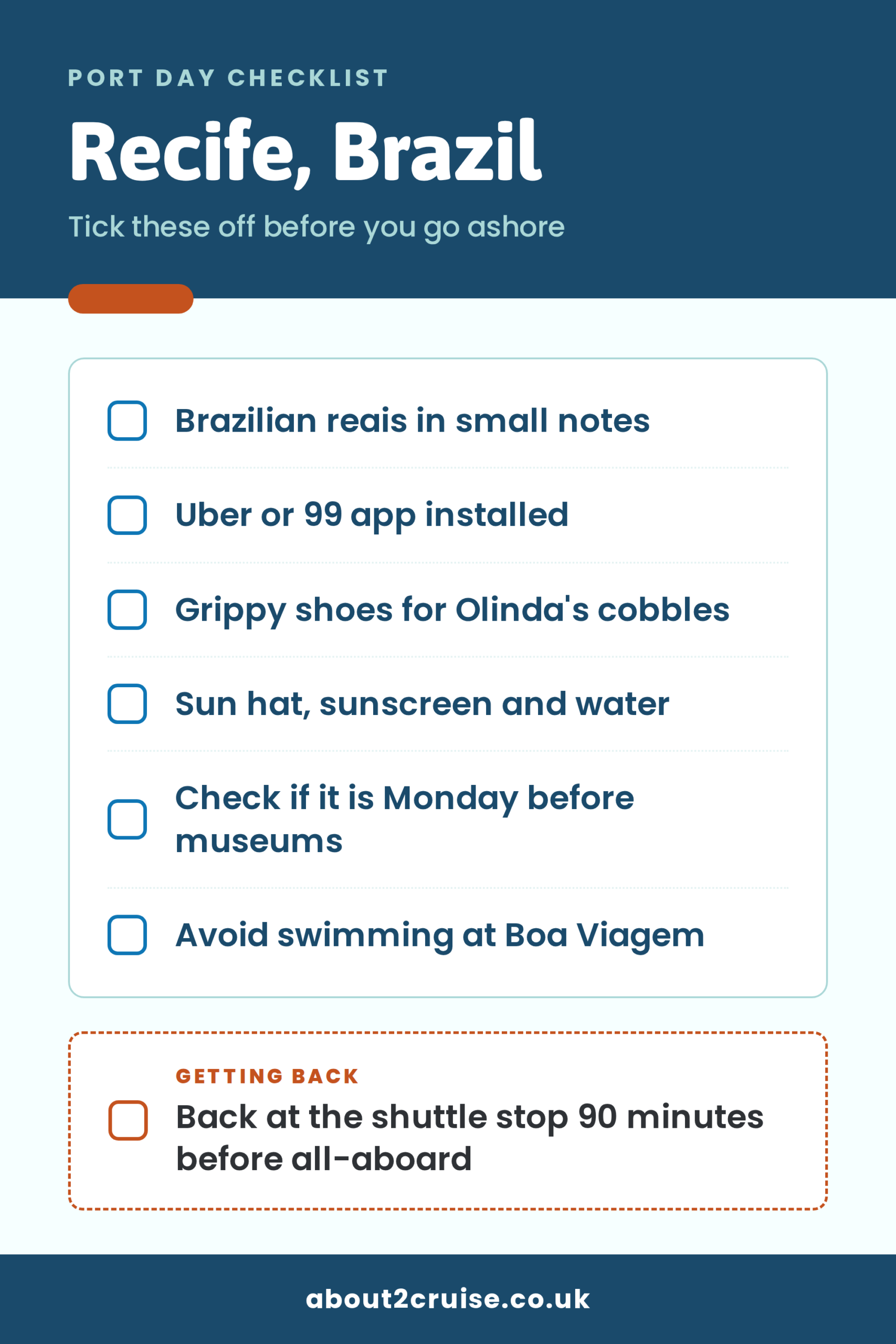
How to spend a port day in Recife
A port day in Recife works best if you pick one: a slow day around Recife Antigo, or Recife Antigo plus Olinda by taxi.
Before you sail
- Check if your sailing calls on a Monday; the main museums close.
- Download and set up Uber or 99, and never hail street taxis.
- Check Brazil entry rules: six-month passport validity and visa-free stay for UK citizens.
Short port day: under 6 hours
- On dockingTake the free port shuttleAsk firstWalking through the port may be restricted. Ask guest services; shuttles often run to the port gate or Casa da Cultura.
- +15 minMarco ZeroA 5-10 minute flat walk from the terminal gate or shuttle stop. See the compass rose paving and the reef offshore.
- +30 minRua do Bom JesusA short walk from Marco Zero. The coloured colonial facades line the old Jewish street.
- +1 hrPaço do FrevoA 5 minute walk. Museum of frevo music and dance; free on Tuesdays, closed Mondays.
- +1 hr 30 minLunch near Praça do ArsenalTry tapiocaTapioca and bolo de rolo near the old warehouses; choose busy stalls with cooked food.
- +2 hrs 30 minCentro de Artesanato de PernambucoNext to the terminal, so a calm last stop. Crafts, cachaça and food counters.
- All-aboard minus 1 hrBack at the shuttle stopReturn shuttles get busy; if two leave without you, take an app-ordered taxi.
The time on the map is the whole walk, every stop added together.
Open this walking route in Google Maps
If plans change: If Paço do Frevo is closed on a Monday, swap it for the free walk along Rua do Bom Jesus and the Centro de Artesanato.
Recife Cruise Port FAQs
Can I get off the ship in Recife without booking an excursion?
Yes. Recife is a normal cruise call, not a private island or tender port with excursion-only restrictions. Independent passengers are expected and catered for. The only complication is port pedestrian access: you may be required to take a free shuttle from the ship to the port gate or downtown. Once there, you can explore on foot or arrange transport.
Is there a free shuttle from the port to the city centre?
Reports and third-party port guides say yes, and a recent passenger report described a free two-stage shuttle from the ship to the port entrance and then to Casa da Cultura. However, there is no published official route, timetable, or drop-off map from the port authority or a cruise line. Confirm on board before leaving. If no shuttle runs, you’re still only 0.5–0.8 km from Recife Antigo, but you may need a taxi if walking through the port is not allowed.
Which is better on a short call: Recife Antigo or Olinda?
Recife Antigo is better if you have under four hours, are unsure about walking on cobbles, or want to stay close to the ship. It’s flat, quick, and low-risk. Olinda is better if you want the postcard UNESCO colonial hilltop and have at least four hours plus transport time. If you’re fit and organised, a full-day call can do both. Don’t try to do both in a rushed 2-hour window.
Can you swim at Boa Viagem?
No. The UK FCDO warns that shark attacks are a particular danger on beaches around Recife, that sharks have attacked in waist-deep water, and that deaths have occurred. Warning signs and police patrols are in place. Treat Boa Viagem as a promenade, photo, and lunch stop, not a swimming beach.
Is Recife safe for cruise passengers?
It’s safe enough for independent sightseeing if you follow basic Brazil street rules: stay in busy tourist areas, avoid displaying your phone, use app-ordered taxis, don’t resist a robbery, and return before late afternoon. On cruise days, tourist police patrol Recife Antigo and central sights. The risk is higher than in a small Caribbean port, but not enough to stay on the ship.
What should I do if my ship calls on a Monday?
Lower your museum expectations. Paço do Frevo, Cais do Sertão, the synagogue, and Instituto Ricardo Brennand close on Mondays. You can still walk Recife Antigo and photograph the facades, shop at Centro de Artesanato, and visit Olinda’s outdoor viewpoints. If you want indoor culture, consider a ship excursion that includes a church or private visit, or focus on food and street life.
How early should I head back to the ship?
Treat Recife traffic as the biggest variable. From Olinda, allow at least 45 minutes for the road journey plus a further 15 minutes for security and walking to the gangway. From Boa Viagem, allow 45–60 minutes in the afternoon. If your all-aboard is early, begin the return earlier than a map suggests. The ship will not wait for independent travellers.
Last Updated: 19 November 2026