
Durrës is Albania’s main Adriatic cruise port. Ships dock alongside in the working harbour, and the Roman amphitheatre, old walls and seafront sit a 15–20-minute walk or short taxi ride from the terminal. It is also the jumping-off point for Tirana and Krujë, so build in a solid return-to-ship margin.
Where is Durrës, and do cruise ships actually dock there?
Durrës sits on Albania’s central Adriatic coast, roughly 33 km (21 miles) west of Tirana. It’s the country’s second city, its largest seaport, and the main ferry and cruise gateway across the Adriatic from Italy.
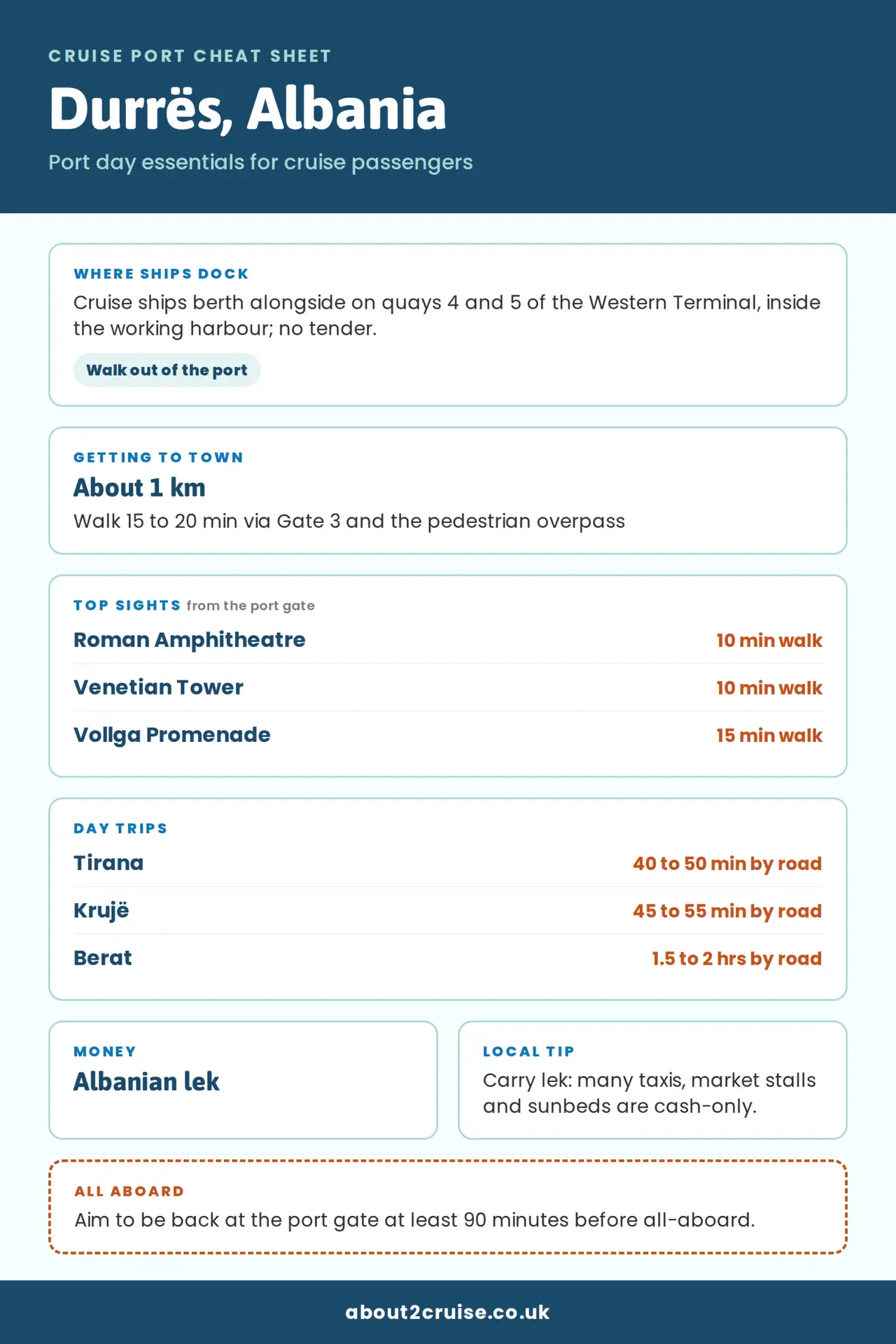
Yes, cruise ships do dock in Albania, specifically at Durrës. There’s no tendering here. Cruise vessels berth alongside inside the working harbour, mainly on quays 4 and 5 of the Western Terminal. The port handles ships from roughly 130 m to 210 m, plus expedition and small luxury vessels. Calls typically run from April into late October.
If you’re comparing this stop with other Adriatic ports, Durrës is not the same as Kotor, Corfu, or Dubrovnik. Those are separate calls, though they often appear on the same eastern Mediterranean itinerary. For a wider look at the region, our eastern Mediterranean cruise ports guide pulls everything together.
Durrës cruise port map
Ships dock at Durrës Ferry Terminal. From there, Roman Amphitheatre of Durrës is about a 15-minute walk, Venetian Tower about 15 minutes and Vollga Promenade about 18 minutes. Tap a pin for directions.
- Durrës Ferry TerminalWhere ships dock
- Durrës Railway StationRailway station · About 6 min walk from Durrës Ferry Terminal
- Roman Amphitheatre of DurrësAmphitheatre · About 15 min walk from Durrës Ferry Terminal
- Venetian TowerTower · About 15 min walk from Durrës Ferry Terminal
- Vollga PromenadeSeafront promenade · About 18 min walk from Durrës Ferry Terminal
- Golem BeachBeach · About 8 km from Durrës Ferry Terminal
- Krujë CastleCastle · About 35 km from Durrës Ferry Terminal
- Krujë Old BazaarOld bazaar · About 36 km from Durrës Ferry Terminal
Arriving by ship: berth, terminal, gates, and getting out
There’s no separate cruise terminal building. Cruise berths sit inside the same passenger-port complex as the ferry terminal, which is run by the Albanian Ferry Terminal Operator. The terminal has check-in desks, scanners, border and customs posts, benches, luggage trolleys, free Wi-Fi, ATMs, and taxi ranks.
Pedestrians usually leave through Gate 3, which is inside the Durrës railway station building. From there you cross a pedestrian overpass of about 226 m into the terminal. Gate 4 near Dajlani Bridge is for cars and coaches, and Gate 2 is for local passengers with vehicles. You’ll need your passport and cruise card or travel ticket at the gate.
The city centre is about 1 km away. Most cruise passengers walk out in 15–20 minutes, though fit walkers sometimes do it in 10–15. The route is only partly step-free: the overpass and pavements can be awkward with wheeled luggage. The main sights, old town, and seafront are all within about 0–2 km of the berth.
There’s no published port-operated shuttle, but some cruise lines run a complimentary shuttle to the port gate or town edge. Don’t assume one will run. Confirm your assigned berth, authorised exit, and shuttle plan on board before you leave. If your exit is Gate 3, IRI TRANS line 4 runs from Stacioni i Trenit to Sheshi Pranvera, the central bus terminus.

If your cruise also calls at Bari, our Bari cruise port guide covers the berth, the walk into Bari Vecchia and day trips by rail or bus.
How to choose your Durrës port day: old town, beach, or Tirana
For a first call, the easiest and most rewarding day is to walk or take a short taxi into Durrës old town. See the amphitheatre and Venetian Tower, then walk the seafront promenade and eat seafood. That keeps you within 20–30 minutes of the ship and works well for a 5–8 hour call.
If you want a beach day, head north to Currila or south toward Golem rather than swimming near the water directly beside the port channel. A beach day needs a taxi or bus, swimwear, towels, sun protection, and enough lek for sunbeds and snacks. Public facilities can be thin.
If you have a long call and want the classic excursion, Tirana or Krujë is realistic. Tirana is 40–50 minutes by road, and Krujë is 45–55 minutes. Don’t attempt Berat on a half-day call. For any independent Tirana or Krujë trip, leave at least 90 minutes to get back plus your all-aboard margin, and have a taxi app or fixed-price return taxi arranged.
If your cruise also calls at Vlorë, our Vlorë cruise port guide covers tendering, the walk to Flag Square and Sazan boat trips.
Durrës old town: a walk through Illyrian, Roman, Byzantine, and Ottoman history
Durrës does have an old town, but it’s fragmentary rather than a fully preserved quarter. The Ottoman wall of 1501 enclosed only the south-eastern edge, the Lagjia Kala area, an 800 m circuit with two gates: Porta e Madhe and Porta e Detit. Most of the visible heritage sits in the upper town, a short uphill walk from the seafront.
The city was founded in 627 BC as Epidamnus, later known as Dyrrachium. It’s one of the oldest continuously inhabited cities in the Balkans, and its layers show Illyrian, Greek, Roman, Byzantine, and Ottoman building. Much of the Roman city still sits under later houses and roads.
Within a compact walk you can see the Roman amphitheatre, the Byzantine city walls, the Byzantine forum and rotonda, the Roman baths, the medieval hammam, the Fatih Mosque of 1502–03, the oldest Islamic building in Albania, and the Venetian Tower. A guided walking route from Veliera Square covers the main points in about two hours.
The Roman amphitheatre and ancient Dyrrachium
The Roman amphitheatre is Durrës’s headline sight. Built in the early 2nd century AD under Trajan, it’s an ellipse 136 m across and about 20 m high, seating 15,000–20,000 people. It was rediscovered by excavation between 1966 and 1970. You can see the arena floor, seating tiers, underground passages and galleries, plus a Byzantine chapel with early Christian mosaics dedicated to Saint Stephen. Gladiator games were banned by Honorius in 404 AD, and medieval tombs were later found in the arena area.
Address: Rruga Kalase, Durrës. Tickets cost 300 lek for adults, 200 lek for groups over 12, 150 lek for disabled visitors, and 90 lek for children over 12 and students. In tourist season the amphitheatre typically opens 09:00–14:00 and 17:00–21:00; outside season the standard is 09:00–19:00 daily. Allow 30–60 minutes. Information panels are in Albanian and English, but there are no guided tours on site. Paths are uneven and stepped, so it is not suitable for serious mobility problems. Also watch the closing time: visitors can be locked in if they linger after hours.
The Archaeological Museum on Rruga Taulantia is the largest of its kind in Albania, with more than 3,000 objects from the Illyrian, Greek, Hellenistic, Roman, and Byzantine periods. Tickets are 800 lek for adults, 700 lek for groups, 400 lek for pensioners and disabled visitors, and 240 lek for students and children over 12. It normally opens 09:00–19:00 daily.
Venetian Tower and the old city walls
The Venetian Tower is a 15th-century circular tower built on a Byzantine base. It’s 16 m across and 9 m high, with five embrasures and narrow, steep internal stairs. It sits close to the amphitheatre and is one of the most photographed parts of the old town. Tickets cost 600 lek for adults, 500 lek for groups, 300 lek for disabled visitors and pensioners, and 180 lek for students; online tickets are 500 lek. The tower shows video screenings at 11:00 in Albanian and 13:00 in English.
The Byzantine city walls, built under Anastasius I between 491 and 518, originally ran about 3.5 km and stood 18 m high and 3.5 m thick. About 500 m survive, running through the upper town. The Lagjia Kala quarter retains gates and wall fragments, along with the Byzantine market square with its central podium and well.
Seafront promenade, beaches, and swimming on a cruise day
The Taulantia or Vollga seafront promenade is Durrës’s social centre. It’s lined with restaurants, hotels, galleries, and public art, and it fills with locals for the evening xhiro, the traditional stroll. The Sphinx of Durrës, a modern concrete sculpture at the water’s edge, is the local sunset photo stop.
The Durrës beach strip runs about 10.5 km with shallow, sandy entry. Golem lies about 10 km south. Currila is the closest quality beach to the centre, roughly 4 km from the port, with pebbles and coarse sand and calmer, cleaner water than the main strip near the port channel. The city bus fare is 40 lek; the bus to the Golem strip costs about 100 lek. A taxi from the port to Currila or a beach club costs roughly €5–10, agreed before you get in.
Private sunbeds with an umbrella normally run 500–700 lek, but can reach 1,000–1,500 lek at peak season. Private beaches usually have toilets and showers. The municipality has opened a free public beach, but visitors report no bins, showers, or public toilets there, so bring your own water and plan accordingly. Lifeguards are present on organised beach clubs in July and August, not on free stretches. Bathing water is graded by the National Environment Agency; the water is best north at Currila or south toward Golem, away from the port channel. Melia Durres is a Blue Flag beach with accessible ramps, adapted sanitary facilities, sunbeds, and showers.
Sea temperature peaks around 25 °C in August. High summer is hot: average August highs are about 29 °C with high humidity, so bring water, a hat, sunscreen, and shade cover. Tap water is not recommended for drinking; use bottled water.
Tirana or Krujë from Durrës: how to do it independently
Durrës is the gateway for Tirana and Krujë excursions, and ship-run coaches routinely leave for both. Tirana is about 33–38 km by road, roughly 40–50 minutes in normal traffic via the Durrës–Tirana highway, longer at Tirana rush hour. A fixed-price taxi from Durrës to Tirana or Rinas airport costs about 3,000 lek, around €31, for up to four passengers. Intercity buses to Tirana leave from the Durrës bus station on Rruga Adria roughly every half hour from about 06:00 to 21:00, cost around 200 lek in cash, and take under an hour. There is currently no passenger train; the rebuilt Tirana–Durrës line is planned for 2027.
Krujë is about 35 km inland, 45–55 minutes by road, with its castle and Old Bazaar. A private transfer is quoted around €35 per vehicle each way. Berat is a full-day option at 1.5–2 hours each way, not a half-day choice.
Independent excursion timing matters. All-aboard is normally about 30 minutes before departure, but some lines require you back one hour before. Only the ship’s own excursion guarantees the ship waits. If you go independently, arrange a return transfer or know the bus stop and schedule, and leave a margin of at least 90 minutes on the inbound leg. Carry enough lek or a working card for an emergency taxi.
Uber and Bolt do not operate in Albania. The locally used ride-hailing apps are Speed Taxi, Patoko, VrapOn, and Clust, all of which cover Durrës. At the port the main taxi companies are MerrTaxi and Speed Taxi. The published city taxi tariff is about 250 lek base plus 200 lek per km, with waiting time charged. Agree the fare in lek or euros before you get in. Patoko accepts Visa, Mastercard, and Amex via Stripe; Speed Taxi is cash-based, so carry lek.
What to eat and drink in Durrës
Durrës’s coastal menu runs to mussels with lemon, fish casserole with vegetables, squid casserole, hake, red mullet, whiting, sea bass, monkfish, squid, and shrimp. Local sweets include revani, a soft syrup cake flavoured with lemon or orange, and sheqerpare, syrup-soaked cookies. Seafood restaurants cluster along the seafront promenade, the Currila area, and Plazhi i Madh.

Albanian staples are everywhere: byrek from a pekëri or byrektore, tavë kosi of lamb baked under a yoghurt custard, fërgesë with peppers, tomato, and white cheese, qofte, and raki. Rough prices are about €1–2 for a piece of byrek, €8–12 for mussels or calamari, €10–18 for grilled fish, and €10–14 for a full Albanian meal. Fish is often sold by weight, so agree the price per kilo and the weight before it is cooked.
Water safety: don’t drink the tap water. Bottled water is cheap and widely available.
Shopping and souvenirs in Durrës and Krujë
Krujë’s Old Bazaar is the region’s main handicraft centre: a 17th-century cobbled lane of Ottoman-style shops below the castle selling filigree, woodwork, copper, carpets, traditional clothing, and souvenirs. Artisans are known for hand-carved wooden eagles, traditional instruments, rugs, and silver filigree jewellery. Bargaining is normal at bazaar stalls, especially for carpets, and many stalls take cash only in lek.
Genuine antiques and old icons need customs declaration and export permits, so ask the seller for documentation before buying. In Durrës itself, shops generally run about 09:00–20:00. For ordinary souvenirs, the seafront and old town are easiest, while Krujë offers the strongest local craft shopping.
Money, cards, and ATMs in Albania
The currency is the Albanian lek. The euro is not legal tender, though tourist businesses often accept it at a worse rate. Card acceptance is improving fast: Albania has record numbers of POS terminals, and card payments now outnumber ATM cash withdrawals overall. Even so, cash is still needed for many cafés, bakeries, kiosks, market stalls, sunbeds, parking, small family restaurants, many taxis, and tips.
Use ATMs in the city centre or the terminal, but note that Albanian ATMs typically charge foreign cards a flat 500–800 lek per withdrawal, and the fee is shown before you confirm. Always decline the machine’s offer to charge in sterling or euros and choose lek, otherwise dynamic currency conversion adds a markup. Amex is far less accepted than Visa and Mastercard. Licensed exchange offices marked Këmbim Valutor usually beat banks and charge no commission, with rates posted outside.
Tipping is usually 5–10 per cent in sit-down restaurants, with rounding up in cafés and tavernas. Tip in cash because many card terminals cannot pass a tip to the server. Some older Albanians still quote prices in old lek, ten times the real figure; trust the printed or displayed price.
Staying connected, language, and toilets
English is widely understood in tourist businesses, hotels, restaurants, and transport hubs. Basic Albanian always helps: përshëndetje for hello, faleminderit for thank you, po for yes, jo for no, and sa kushton for how much.
The terminal offers free Wi-Fi, but it can be patchy once you leave. Vodafone and One both sell tourist SIMs and eSIMs, with shops at Tirana airport arrivals and in Durrës. Passport registration is required. Standard European C and F plugs run on 230V, so bring an EU adapter if needed.
Public toilets are scarce outside museums and sit-down restaurants. Use the terminal before leaving, and plan purchases at cafés if you need a restroom during the walk. The tourist information office inside the passenger terminal has free maps and a touchscreen; a season-long info point is sometimes run for cruise passengers.
Safety, traffic, and port-area awareness
Reports of crime targeting foreigners are rare. The main risks are pickpockets and bag thieves in tourist areas, buses, and transport hubs, so keep a cross-body bag and avoid leaving phones on café tables. Avoid demonstrations and political rallies, which can disrupt traffic. Pedestrians do not automatically have the right of way, and driving standards are aggressive, so cross carefully.
Durrës is generally safe for daytime port calls. Watch for uneven pavements, kerbs, and chaotic traffic. Wildfires are possible in dry weather from April to October, and minor tremors are common. The unified emergency number is 112; ambulance 127, fire 128, police 129, traffic police 126, and maritime police 125.
Accessibility and mobility on a Durrës port day
The port walking route is only partly step-free: the overpass and pavements can be hard going with a wheelchair, walker, or heavy luggage. The Roman amphitheatre is not fully wheelchair accessible and has uneven steps. The Venetian Tower is reached by narrow, steep internal stairs. Guided walking tours of the old town generally state they are not suitable for people with mobility impairments.
If you use a mobility aid, the easiest option is a taxi from the port gate to the lower promenade or a specific beach club. Some beach clubs and the Melia Durres Blue Flag beach have accessible ramps and adapted sanitary facilities. Confirm taxi boot space if you travel with a folding wheelchair.
Weather, heat, and what to wear
Durrës has a Mediterranean climate with hot, dry summers and mild, wet winters. Only about 12 per cent of annual rainfall falls between June and September. August averages a high around 29 °C, with high humidity and about 22 muggy days. Sea temperature peaks at about 25 °C in August.


Wear comfortable shoes for cobbled lanes, steps, and uneven amphitheatre paths. Cover shoulders and knees when entering active mosques and churches; women should cover their hair in mosques and remove shoes at the door. At the beach, flip-flops help on hot sand, and bottled water is essential.
Photography, drones, and filming rules
Ordinary photography is fine at the amphitheatre, walls, promenade, and bazaar. For active religious buildings, ask permission and follow dress rules. Albania applies EU drone rules: maximum 120 m above ground, visual line of sight at all times, and no flying in restricted zones without permission. Operator registration is required from 250 g or for any drone with a camera or sensor. The Civil Aviation Authority registers only people resident in Albania, so if you intend to fly a drone as a visitor, contact them directly at dron@acaa.gov.al before you arrive.

Emergencies, pharmacies, and medical care
Durrës Regional Hospital is a 340-bed public hospital on Rruga Aleksander Goga with a 24-hour emergency service. Ambulance response times can vary and there can be delays, so for a port day it is often faster to use a taxi for non-life-threatening problems if you are close to the hospital. Pharmacies in town usually take cards. Drink only bottled water, not tap water.
For minor ailments, carry your own seasickness and pain relief, because brand names and chemist stock can vary. Know the 112 emergency number before leaving the ship.
If you’re starting or ending a cruise in Durrës: hotels, parking, luggage
If you are starting or ending a cruise in Durrës, the most convenient hotels are near the port and old town or on the seafront. Hotel Arvi is about 0.7 km from the port and a three-minute walk to the amphitheatre and Venetian Tower. Hotel Kloest is about 1.9 km from the port with 24-hour reception and an ATM. Hotel Epidamn Boutique & Spa is four minutes from Currila beach. The Adriatik Hotel sits on the beach about 5 km from the centre.
No official left-luggage office is published at the cruise berth or terminal. Commercial booking platforms list drop-off points in Durrës from about €2.50–3.90 per bag per day, including at the bus terminal and railway station. Don’t rely on storing bags at the terminal unless your ship or tour operator confirms it.
There is no cruise-passenger parking product. Port parking in the vehicle terminal is about 610 lek per day including VAT. On-street paid parking in Durrës is 100 lek per hour in Zone A and 40 lek per hour in Zone B, enforced 08:00–20:00 Monday to Friday from 1 June to 30 September.
Keep this info handy: print, offline, and current details
There is no official Durrës cruise guide PDF published by the port authority, and berth assignments can change by call. Save or screenshot this page before you leave the ship, so you’re not relying on port Wi-Fi. Old 2021 guides that suggest tendering or no terminal at all are out of date: current calls berth alongside inside the passenger-port complex. If your ship has changed berth or gate, follow the daily programme and pier-side signs, not a printed map from a previous season.
How to spend a port day in Durrës
A port day in Durrës works best if you pick one: walk the old town and seafront on a short call, or take a long call to Tirana or Krujë by road.
Before you sail
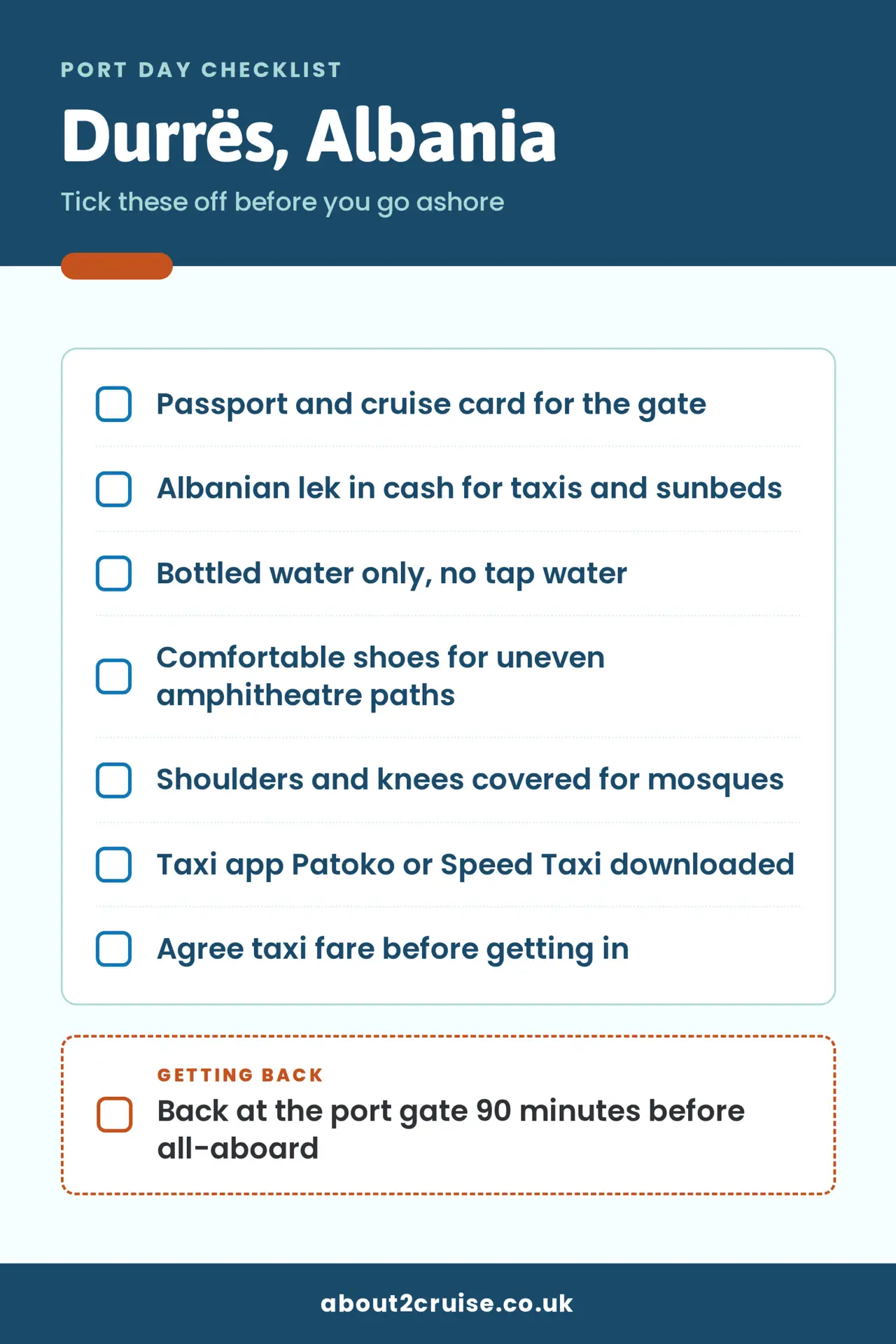
- Confirm your assigned berth and authorised exit on board; no port shuttle is published.
- Download Patoko or Speed Taxi before arrival if you plan a taxi.
- Bring Albanian lek in small notes for taxis, sunbeds and cafés.
Short port day: under 6 hours
- On dockingExit through Gate 3No port shuttleWalk out through Gate 3 in the railway station and cross the pedestrian overpass into the old town in 15 to 20 minutes.
- +20 minRoman AmphitheatreCash for ticketA 10 minute walk from the gate. Buy an amphitheatre ticket at the entrance and allow 30 to 60 minutes for the arena, passages and Saint Stephen chapel.
- +1 hrVenetian TowerNarrow stairsNext to the amphitheatre. Climb the narrow stairs inside the circular tower for a view over the old town.
- +1 hr 45 minSeafood lunch on the promenadeTry mussels with lemonWalk down to Vollga promenade and order Durrës mussels with lemon or fish casserole at a seafront restaurant.
- +3 hrs 15 minVollga promenade and SphinxStroll the waterfront promenade as far as the Sphinx of Durrës, the local sunset photo stop.
- All-aboard minus 90 minWalk back to the shipReturn via the overpass and Gate 3, aiming to be on board with time to spare.
The time on the map is the whole walk, every stop added together.
Open this walking route in Google Maps
If plans change: If the amphitheatre is shut, do the Byzantine walls and the Archaeological Museum instead, then head to the promenade.
Long port day: 8 hours or more
- On dockingExit through Gate 3Go earlyLeave the ship as soon as the gangway opens and walk out through Gate 3 to the taxi rank.
- +15 minTaxi to KrujëAgree fareTake a taxi from the port for the 45 to 55 minute drive up to Krujë castle.
- +1 hr 15 minKrujë CastleExplore the castle and its museum. The hilltop site looks out over the plain.
- +2 hr 30 minOld BazaarWalk down into the Ottoman-style bazaar below the castle and browse the filigree, woodwork and carpets.
- +3 hr 45 minLunch in the bazaarTry byrekOrder byrek or tavë kosi at a café near the bazaar lane.
- +5 hrs 30 minBazaar top and castle viewWalk back up to the top end of the bazaar for the classic view up to the castle walls.
- All-aboard minus 2 hrsTaxi back to DurrësDrive back to the port, aiming to be through Gate 3 with at least an hour to spare.
This map shows the taxi ride from the ship. The time is the drive only, not your time ashore.
Open the taxi route in Google Maps
If plans change: If traffic or a road issue threatens the return, abandon Krujë and head back to Durrës early; the ship will not wait.
Further south, our Sarandë cruise port guide covers docking and tendering there, Butrint and Ksamil.
Common questions from cruise passengers
Is Durrës walkable from the cruise ship?
Mostly yes. The old town and amphitheatre are a 15–20-minute walk via Gate 3 and the pedestrian overpass, but the route is only partly step-free. A taxi from the port to the old town costs roughly €3–5 and is the better choice for mobility concerns or extreme heat.
Do taxis at Durrës port take cards?
Some do, but not reliably. Speed Taxi is cash-based, while Patoko accepts card via its app. Always carry some Albanian lek and agree the fare before setting off.
Can I do Tirana and Krujë in one port day?
It is possible on a long call, but it’s rushed. Tirana and Krujë are in different directions, so doing both usually means less time in each and a tighter return. Most cruisers choose one, or take a ship excursion that manages the timing.
Is the water safe to drink in Durrës?
No. Use bottled water for drinking and brushing teeth. Avoid ice in informal places unless you trust the source.
Which beach is best on a cruise day?
Currila is the closest quality beach north of the centre. Golem south of town has a long strip with beach clubs. Both are better than the water directly beside the port channel.
Do I need Albanian lek or can I use euros?
Lek is the currency. Some tourist shops and restaurants accept euros, but the rate is rarely good. Bring a small amount of lek or withdraw from an ATM in the city, and keep cash for taxis, sunbeds, and small purchases.
Last Updated: 23 November 2026