
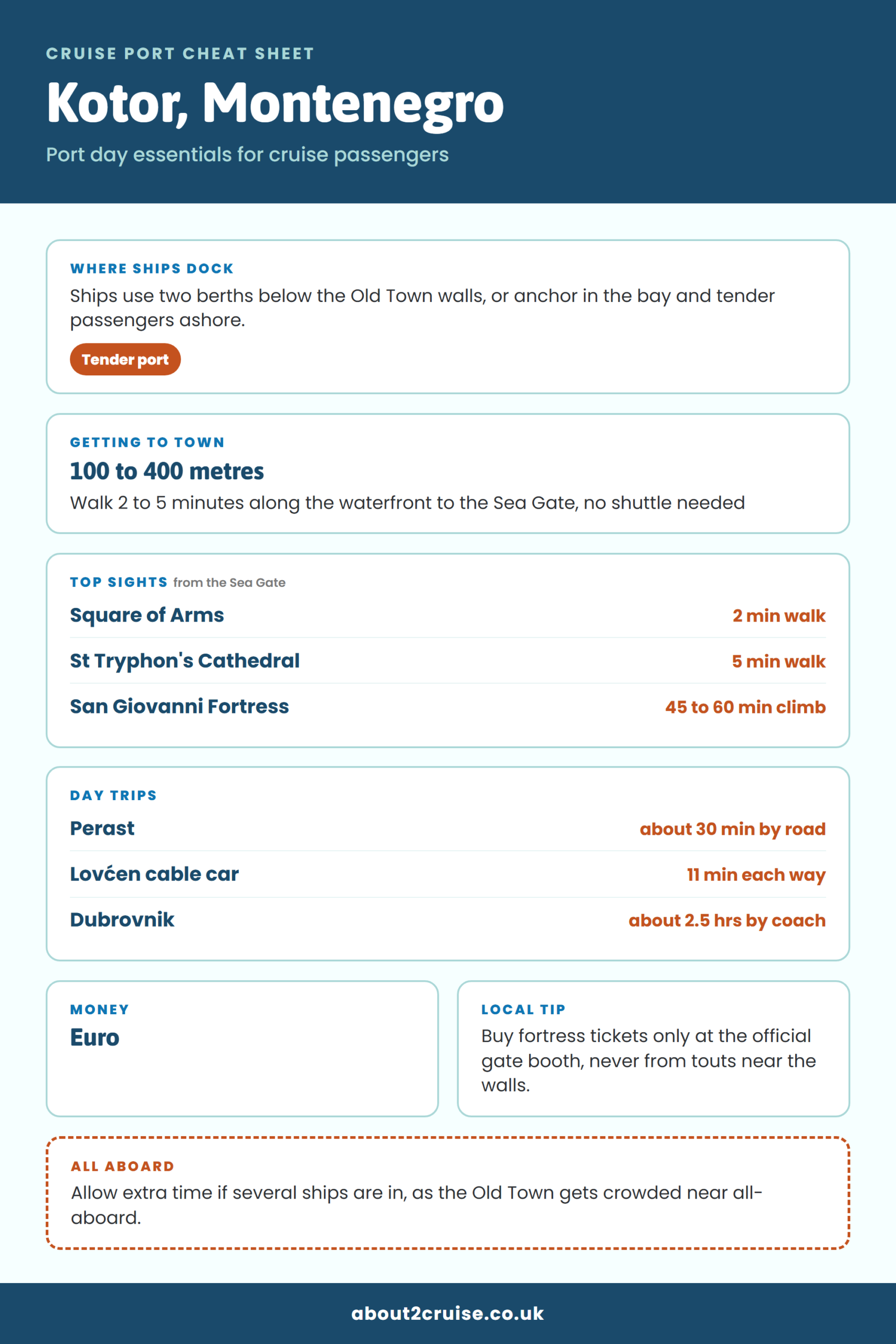
Kotor cruise ships dock or anchor right at the Old Town walls. If alongside, you step onto the quay and walk 2 to 5 minutes to the Sea Gate. If tendered, the landing is the same waterfront. No shuttle is needed. The Old Town, fortress climb and Bay of Kotor are all walkable or an easy trip away.
Where Do Cruise Ships Dock in Kotor?
Kotor is one of the easiest Mediterranean ports to get your head around. The arrival point is always the same stretch of waterfront. Your ship either pulls up on one of the berths below the Old Town walls or drops anchor out in the bay and you ride a tender in. Both options leave you on the flat quay directly below the UNESCO-listed Old Town.
The Port of Kotor has two cruise berths right next to the Old Town centre, plus three anchorage points out in the Bay of Kotor. That’s why some ships are listed as “alongside” and others as “at anchor” on the port arrivals sheet, sometimes in the same week. There’s no simple rule like “big ships anchor, small ships dock.” It comes down to how many ships are in port that day, the ship’s size, wind conditions, and berth availability.
Don’t worry if your itinerary says “tender.” This isn’t a long or complicated transfer. The tender crosses the final stretch of the bay at water level, and it gives you a close-up view of the mountains sliding straight into the water. Most tender rides are short, and they drop you at the same waterfront promenade the docked ships use. Either way, you walk off and the Old Town is right in front of you.
Kotor cruise port map
Tenders bring you ashore at Port of Kotor. From the Sea Gate, Maritime Museum is about a 2-minute walk, San Giovanni Fortress about 2 minutes and Sea Gate about 2 minutes. Tap a pin for directions.
- Port of KotorWhere tenders land
- Sea GateOld town gate · About 2 min walk from the Sea Gate
- San Giovanni FortressHilltop fortress · About 2 min walk from the Sea Gate
- Maritime MuseumMuseum · About 2 min walk from the Sea Gate
- Park SlobodeCity park · About 4 min walk from the Sea Gate
- Gurdić GateOld town gate · About 6 min walk from the Sea Gate
- Kotor Bus StationBus station · About 10 min walk from the Sea Gate
- Lovćen Cable Car (Dub)Cable car station · About 4 km from the Sea Gate
- PerastHistoric town · About 9 km from the Sea Gate
- Our Lady of the RocksIsland church · About 10 km from the Sea Gate
- Orahovac BeachBeach · About 6 km from the Sea Gate
Is Kotor a Tender Port?
Yes and no. When only one ship is in port, there’s a good chance you’ll dock alongside. When two or more ships are in, the pier can usually only take one ship at a time, so the rest use tenders. That’s why your cruise line will often say your ship will dock or anchor offshore.
There’s no named passenger terminal building at Kotor. You may pass through a small restricted port-area gate, but most cruise lines simply scan you off and you walk out onto the quay. No duty-free maze, no shuttle bus, no long walk through a commercial port. Just you, the water, and the walls in front of you.
How Far Is the Walk from the Ship to Old Town?
The pier and tender landing are roughly 100 to 400 metres from the Old Town walls, depending on exactly where your ship ties up or where the tender pulls in.
For most cruise passengers, the walk from the gangway to the Sea Gate, the main entrance to the Old Town, takes 2 to 5 minutes. It’s flat, along the waterfront, and partly shaded by the walls in the morning. You don’t need a shuttle, a taxi, or a tour guide. You step off the ship and start your day.
The Sea Gate, or Vrata od Mora, is the main entrance. It was built by the Venetians in 1555 and sits directly across from the port. Walk through it and you’re on Trg od Oružja, the Square of Arms, with the clock tower and Rector’s Palace in front of you.
If you want a quieter entrance, the Gurdić Gate is about an 8-minute walk from the port. It’s a less crowded way into the Old Town and brings you in near the southern corner of the walls, close to a small canal and the restaurant-lined lanes at the back of town. It’s a good option on days when four ships are in and the Sea Gate entrance feels like a football crowd.
What the Old Town Actually Looks Like When You Walk In
The Old Town of Kotor is compact: roughly 500 metres by 200 metres inside the walls. The entire area is car-free. That means no traffic, but it also means every path is stone paving, polished smooth by centuries of feet. You’ll be walking on cobbles and limestone slabs all day, so leave the thin-soled shoes on the ship.
The Old Town is a knot of little lanes, squares, and hidden courtyards. It’s very easy to lose your bearings, and that’s part of the fun. If you need a landmark, look for the clock tower on Trg od Oružja, or St Tryphon’s Cathedral: its twin towers stick up above the rooftops from almost everywhere in the old centre.
Things to Do in Kotor on a Port Day
Nearly every passenger lands at the same waterfront, so busy days are felt everywhere: in the lanes of the Old Town, on the Riva promenade, and on the road through Škaljari and Dobrota. The good news is that Kotor’s best experiences are either inside the walls or within a short boat ride or cable car journey.
Before you sail
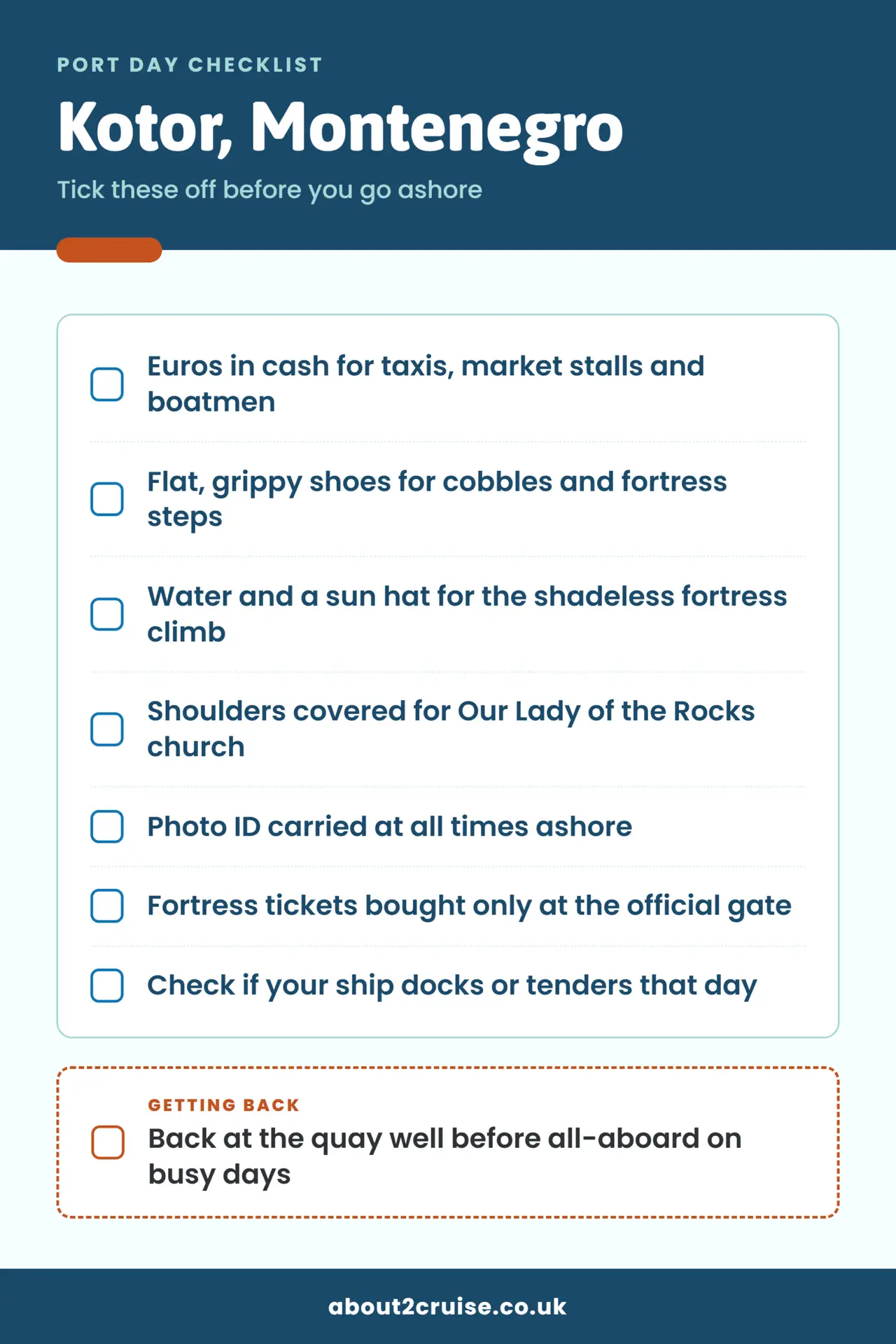
- Check whether your ship docks or anchors and tenders, as it varies by day.
- Bring euros in cash for taxis, market stalls and boat trips.
- Book a Blue Cave and Our Lady of the Rocks boat tour in advance if you want it sorted.
Short port day: under 6 hours
- On dockingWalk to the Sea GateNo shuttle neededThe quay is 100 to 400 metres from the walls, a 2 to 5 minute walk along the waterfront.
- +15 minSquare of Arms and the cathedralAdmire the clock tower, then step inside St Tryphon's Cathedral for a quiet look.
- +45 minPartway up the fortress pathNo ticket neededClimb to the Church of Our Lady of Health, about a third of the way up, for a free view.
- +1 hr 30 minLunch in the Old Town lanesTry buzara, mussels in white wine and garlic, in a konoba off the main squares.
- +2 hr 30 minCats' Square and Maritime MuseumWander to Cats' Square, then visit the Maritime Museum in Grgurina Palace.
- +3 hr 30 minGreen market by the Sea GateCash onlyBrowse for Njeguški pršut and mountain cheese before heading back to the quay.
- All-aboard minus 1 hrBack at the quayThe ship is a 2 to 5 minute walk from the Sea Gate, so there is no need to rush.
The time on the map is the whole walk, every stop added together.
Open this walking route in Google Maps
If plans change: If the Old Town feels packed, walk along the waterfront towards Dobrota instead, or duck into the quieter back lanes.
Long port day: 8 hours or more
- On dockingWalk to the Sea GateNo shuttle neededThe quay is 100 to 400 metres from the walls, a 2 to 5 minute walk along the waterfront.
- +20 minClimb the San Giovanni FortressBuy tickets at gateAbout 1,350 steps and 45 to 60 minutes up, for the classic view over the bay and rooftops.
- +1 hr 30 minSquare of Arms and the cathedralBack down through the Old Town, past the clock tower, into St Tryphon's Cathedral.
- +2 hr 15 minLunch in the Old Town lanesOrder crni rižot, black cuttlefish risotto, in a konoba off the main squares.
- +3 hr 15 minBoat trip to PerastCash on the islandBoats leave from Park Slobode, about 1.5 hours round trip to Our Lady of the Rocks.
- +5 hr 30 minGreen market by the Sea GateBack at Park Slobode, browse for Njeguški pršut before heading to the quay.
- All-aboard minus 1 hr 30 minBack at the quayAllow extra time on days when several ships are in and the lanes are busiest.
The time on the map is the whole walk, every stop added together.
Open this walking route in Google Maps
If plans change: If boats to Perast are fully booked, extend your time on the city walls or visit the Maritime Museum instead.
Here’s what most cruisers actually do with their day, roughly in the order most people choose.
Climb the San Giovanni Fortress and City Walls
This is the view you see in every photo of Kotor: the walls zigzagging up the hillside to the old fortress at the top. The climb starts inside the Old Town near the Church of St Mary. It’s around 1,350 steps, roughly 280 metres of vertical climb, and takes 45 to 60 minutes up at a reasonable pace. Coming down is faster, but your knees will feel it.
The path is made of old stone steps, many of them uneven and polished. It’s completely exposed, there’s no shade, so it’s a bad idea to do this at midday in July. Early morning or late afternoon are the golden hours, both for the light and for the temperature. Bring water. There’s a small kiosk part-way up, but don’t rely on it being open.
The walls themselves are impressive even if you only go part-way. You don’t have to climb all the way to the top to get a good view over the red rooftops and the bay. If you only have an hour or your legs aren’t up to the full climb, go up to the Church of Our Lady of Health, about a third of the way. The view from there is already worth the steps.
Tickets: The fortress fee is €15 per adult, with children under 12 free. The gate is staffed and ticket collection happens roughly 07:00–20:00 from May to September and 08:00–17:00 in October and November. From December to February the route is unmanned and free. Buy at the gate: don’t buy tickets from touts near the walls.
The climb is the single best thing to do in Kotor if you have the legs for it. It gives you the full sweep of the Bay of Kotor, the red rooftops, and the ship sitting below you in the water.
Ride the Kotor–Lovćen Cable Car
If you want the mountain view without the 1,350 steps, the cable car is the answer. The Kotor–Lovćen cable car runs from its lower station at Dub, about 4 km from the Old Town, up to Kuk at 1,348 metres. The ride takes 11 minutes each way, and the view over the bay is the kind that makes you forget to take your phone out of your pocket.
Prices: Around €25 return per adult, €14 one way. Children aged 2–12 pay about €7 return, and under-2s go free. Prices move with the season: lower in spring and autumn, highest in summer. The official ticket shop is shop.kotorcablecar.me. The cable car opens at 09:00, except Tuesdays when it starts at 10:30 for scheduled maintenance.
There’s no direct cable car station at the port. An official shuttle runs from Kotor Main Bus Station to Dub, with shuttle fares around €10 single or €15 return, or sometimes bundled as a €30 cable car + shuttle combo. There’s also a shuttle from near the cruise port area, close to Restoran Akustik, at around €10 return with fixed morning departures. Ten minutes in a taxi will also get you there. The top station at Kuk is noticeably cooler than the coast, so pack a layer.
Take a Boat Trip to Perast and Our Lady of the Rocks
The Bay of Kotor is a fjord-like waterway lined with old stone villages, and one of the best ways to see it from the water is already under your feet. Boat trips leave from Park Slobode, the city park near the port, about 200 metres from the Old Town’s main gate. You can’t miss the boatmen holding up laminated cards with photos of islands and sea caves.
The classic excursion is to Perast and Our Lady of the Rocks. Perast is a small baroque town about 12 km from Kotor by road: under 30 minutes, or a scenic boat ride across the bay. Our Lady of the Rocks is a 15th-century church on an artificial island, built over centuries by local sailors dropping stones in the water. It’s one of the most photographed spots in Montenegro.
Entry to the church and museum on the island is about €5 per adult, €2.50 for children aged 7–14, under-7s free, cash only, paid on the island. Shoulders should be covered to go inside. The church closes at 17:00 in April, May, September, and October, 18:00 in June, and 19:00 in July and August.
Shared boat trips to Perast and Our Lady of the Rocks take about 1.5 hours and cost roughly €20–28 per person. Private boats run from about €130–150. You can also combine the islands with the Blue Cave and the old submarine base, which is one of the most popular boat outings from Kotor port.
If you’d rather have it sorted before you arrive, book a Blue Cave, Submarine Base and Our Lady of the Rocks boat tour in advance. It takes the stress out of finding a boatman on a busy port day.
Check dates and availability for the Blue Cave and Our Lady of the Rocks boat tour →
If you want to go to Perast on your own, local buses on the Kotor–Herceg Novi/Risan route stop in Perast for about €2–3 each way. The bus station is a 10-minute walk from the Old Town. That gives you more flexibility to linger in Perast or walk the waterfront there.
Hop-On Hop-Off Bus
If you’d rather not negotiate with boatmen, Kotor Open Tour runs red open-top double-decker buses that do a circuit of the bay. The route has three stops: Kotor Old Town, Perast, and Orahovac beach. Buses run every 20–30 minutes, and the full loop takes about an hour. The 1-day ticket normally includes a guided walking tour of the Old Town, plus discounts on the boat trip to Our Lady of the Rocks and the Maritime Museum in Perast.
The bus parks inside the port and staff meet passengers as they come off the ship, so it’s about as easy as a port excursion gets without being a ship excursion. Bring a swimsuit if you plan to hop off at Orahovac beach: towels are sometimes included with hop-on tickets.
Old Town Highlights if You Only Have Two or Three Hours
Not everyone wants to climb the fortress or sit on a boat. If your plan is to wander the Old Town, drink coffee, and shop, here’s what to aim for:
- Sea Gate and Square of Arms (Trg od Oružja): the main entrance, the clock tower, Rector’s Palace. This is the postcard spot. Go early or late if you want the square without the crowd.
- St Tryphon’s Cathedral: the twin towers you can see from across the bay. Entry is around €4. It’s a Romanesque church that has been rebuilt several times after earthquakes, but the interior is cool and quiet.
- Maritime Museum: €4 for adults, €1 for children. It’s inside the Grgurina Palace and covers Kotor’s long seafaring history. A good rainy-day stop.
- Churches of St Luke and St Nicholas: a tiny Orthodox church and a larger one, both in the central lanes.
- Cats’ Square (Trg od Mačaka): exactly what it sounds like. Kotor is famous for its cats, and this square is their unofficial headquarters. Good photo stop.
- The green market (pijaca): right by the Sea Gate under the walls. Locals sell Njeguški pršut, mountain cheese, dried herbs, honey, and rakija. Open daily from about 06:00 to early afternoon.
The Old Town is free, no ticket needed, and the gates are open 24 hours. You can wander for half a day and still find new corners in the back lanes.
Local Food and Drink in Kotor
Montenegrin food flies under the radar, but Kotor is one of the best places on the Mediterranean coast to eat without spending much. The bay has its own very specific food culture, and it’s worth knowing what to order.
Njeguški pršut is the country’s signature product: beech-smoked, air-cured ham from the mountain village of Njeguši. It comes in long, almost leathery slices with a deep, smoky flavour you don’t get from Italian prosciutto. Njeguški sir is the mountain sheep’s cheese made in the same area. The best place to buy both is the green market by the Sea Gate, or in any good restaurant.
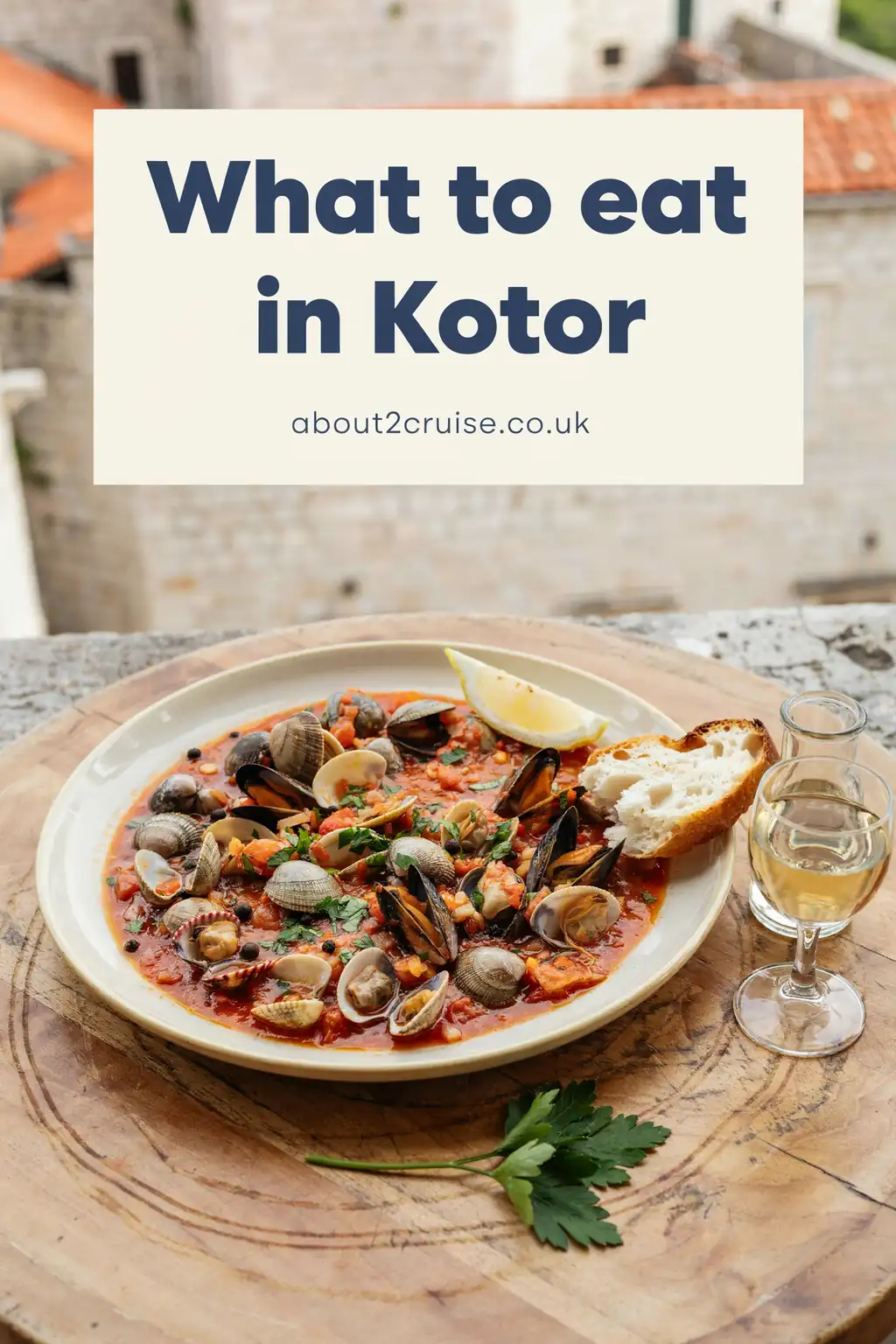
Buzara is the dish to order on the coast: mussels or prawns cooked in white wine, garlic, parsley, and olive oil. Eat it with bread, because you’ll want the bread to soak up the sauce. Crni rižot, black cuttlefish risotto, is the other classic of the bay. Both are found in the small konobas tucked into the lanes off the main squares.
For dessert, look for krempita, a cream pastry sold in Old Town cafés and pastry shops. It’s simpler than the version you’ll find further up the coast in Croatia, and many locals argue it’s better. If you’re offered rakija, the local fruit brandy, accept it. It’s strong, usually home-made, and refusing it politely is an art form.
To drink, the indigenous wines are Vranac (big, red, slightly earthy) and Krstač (dry white grown in the karst). A glass costs about what you’d pay in Croatia or Greece. Espresso runs about €1.20–2 in Old Town cafés, and gelato is about €2 a scoop. The Square of Arms is good for café sitting, but the back lanes off Trg od Salate are where you’ll find smaller family-run konobas.
Money, ATMs, and Paying for Things in Kotor
Montenegro uses the euro, even though it’s not in the EU or the eurozone. There’s no local currency to worry about. Prices are in euros everywhere.
Cards and contactless are widely accepted in hotels, restaurants, supermarkets, the cable car, and organised tours. But cash still rules for taxis, market stalls, small konobas, boatmen, parking machines, and public toilets. Some Old Town shops set a card minimum of around €10. Carry €60–80 in cash for a port day if you’re planning a boat trip, buying from the market, and having lunch in a small place.
ATMs are easy to find around the Old Town. But bank ATMs mostly charge a flat fee of about €5 per foreign-card withdrawal, capped at around €500 per withdrawal. Avoid the standalone Euronet machines clustered near the cruise port and Old Town entrances: they charge more and offer worse exchange rates. Always decline dynamic currency conversion and pay in euros. Exchange offices exist, but the ones on the port road have the worst rates.
What to Wear and Pack for Your Kotor Day
Kotor is a port where your shoe choice genuinely changes your day. The Old Town lanes are polished stone, the fortress is 1,350 uneven steps, and the walk to the Sea Gate is on flat but hard paving. Flat, grippy shoes are non-negotiable. Think trainers with good tread, or sturdy sandals with a strap. Thin flip-flops are for the beach, not the walls.


Browse walking shoes with good grip here →
For the fortress climb, wear light clothes that can get sweaty. The climb is completely exposed, so in July and August it’s brutal in the middle of the day. A hat and sunscreen are as important as your phone. If you plan to enter Our Lady of the Rocks, shoulders should be covered.
Pack a swimsuit and towel if you want to hop off at Orahovac beach or join a boat trip with swimming stops. A light layer is worth having for the cable car top station, which is noticeably cooler than the coast. You won’t need formal wear on a port day: this is a practical, walk-heavy stop. For ideas on what works well at a port like this, take a look at these casual cruise outfit ideas for women and cruise outfit ideas for men.
Weather in Cruise Season
Kotor has a warm temperate climate with rain possible in every month. July and August are the driest and hottest, and that’s also when the bay is busiest.
Daytime maxima in cruise season are roughly: May 21°C, June 25°C, July 28°C, August 28°C, September 24°C, October 18°C. Sea temperature hits about 21°C in June, 24–25°C in July–August, and about 23°C in September: warm enough for swimming, though beaches in Kotor itself are limited.
Expect about 8 to 10 rain days per month even in summer. Rain is more common in spring and autumn, but showers in July and August are not unusual. Summer humidity sits around 60–70%, so the air can feel heavy, especially inside the walled lanes. There’s no hurricane season here: the risk in Kotor is winter rain and spring flooding. Bring a light rain layer in shoulder months.
June is a sweet spot: nearly the same long daylight as July and August, but with fewer ships in port. The fortress climb is less punishing before 10:00 and after 16:00 throughout the season.
Best Time of Day and Avoiding Crowds
The crowd rhythm in Kotor follows the ships. Most arrivals hit the Old Town between 09:00 and 11:00, and the streets feel fullest from 11:00 to 16:00. In peak months the quietest hours are before 09:00 and after 17:00, when the day-trippers have gone and only a few ship passengers remain. If you can, get off the ship first thing, or plan your wander for late afternoon.
If four ships are in port, the Old Town can feel genuinely overwhelmed. There’s no daily cap on ship numbers in Kotor, and residents themselves say four ships is too much for the town. On those days, the smart move is to leave the walls: take a boat trip, ride the cable car, or walk along the waterfront towards Dobrota. The back lanes behind the main squares are also calmer, even at peak times.
Luggage Storage in Kotor
Kotor is overwhelmingly a port of call, not a turnaround port, so most cruise passengers never need luggage storage. If you do, for example, if you’re staying on after a small-ship charter or leaving a big bag while you travel Montenegro, there’s no left-luggage office at the cruise berth itself.
The most reliable option is Kotor Bus Station, just outside the walls, which has a staffed left-luggage counter charging a per-piece fee. Confirm the fee and closing time when you drop off, since it can change. Independent storage networks such as Nannybag and Radical Storage also list Kotor locations, typically around €4.20–5.50 per bag per day, with opening hours from about 07:00.
Hotels near the walls almost universally hold bags free for guests on check-out day, so if you’re staying over, your hotel is still the easiest place to leave a bag.
Getting to Kotor from Tivat Airport and Nearby Towns
Kotor has no train station. If you’re arriving independently, the nearest airport is Tivat (TIV), just 8 km from the Old Town and about a 12-minute drive. There’s no airport bus, and taxis from Tivat to Kotor cost roughly €20–45 depending on whether you pre-book or take one from the rank. Pre-book where possible: it’s cheaper and avoids negotiation.
Podgorica airport is about 85 km away, and the nearest railhead is Bar, roughly 45 km. Neither is practical for a cruise passenger on a port day.
Kotor Bus Station is at Put Prvoborca in Škaljari, outside the walls. It’s about a 10-minute walk from the historic centre. The station phone number is +382 32 325 809. Local Blue Line buses connect Kotor with Perast (about €1.50–2), Tivat (about €1.50), Budva (about €3), and Herceg Novi (about €4). Coaches to Dubrovnik run about twice daily, take about 2.5 hours, and cost €15–20 each way: but allow extra time in summer for border queues.
If you’re heading to Dubrovnik on a different day or want to compare ports, see the Dubrovnik cruise port guide.
Safety, Taxi Rules, and Common Sense
Kotor is generally a safe place for cruise passengers. The main annoyances are pickpocketing in the busiest tourist spots and occasional taxi overcharging.
Keep your phone and wallet in a front pocket inside the Old Town, especially in the middle of the day when the lanes are packed. Don’t leave bags unattended or luggage in a parked vehicle. Carry photo ID at all times: police can fine you for not having it. Photographing police or military installations, personnel, or vehicles is illegal, so be careful with your camera near the port gates.
If you’re taking a taxi, use a licensed one ordered in advance or through an app, and agree the full fare before you set off. Some drivers overcharge tourists who wave them down. FCDO also warns that traffic is busy and drivers don’t always stop at pedestrian crossings, and you can be fined for crossing within 100 metres of a pedestrian crossing without using it.
At the fortress entrance, avoid touts near the walls offering “exclusive” or “cheaper” tours to San Giovanni. Buy only at the official ticket booth on the route up. The emergency number in Montenegro is 112; for rescue at sea call 129.
Where to Stay if Your Cruise Starts or Ends in Kotor
Kotor is mostly a port of call, but small-ship and gulet charters do embark and disembark in Kotor harbour: typically Saturdays around 17:00 for embarkation and 09:00 for disembarkation. If you’re staying, the appeal of Kotor is sleeping inside a 13th-century walled town, and you can’t get much closer to port than these:
Hotel Vardar sits right on the Main Square, about 40 metres from the Sea Gate. Historic Boutique Hotel Cattaro is in an 18th-century building just off the main square, 50 metres from the gate. Boutique Hotel Astoria is set in the 13th-century Buča Palace, about 100 metres from the Sea Gate, with 24/7 reception, luggage holding on check-out day, and beach towels to borrow. Hotel Monte Cristo is on the Maritime Museum square in another 13th-century building, about 150 metres from the gate.
For something with a pool, Hotel Libertas in Prčanj is about 2.2–2.7 km from the Sea Gate, around 50 minutes on foot, with a private beach and pool. Remember that taxis cannot enter the Old Town itself. Drivers stop at a gate and you walk the last stretch over stone paving, so pack accordingly.
Best Photo Spots in Kotor
The single image of Kotor is taken from the fortress or the city walls: the red rooftops of the Old Town with the bay beyond. Go an hour before sunset for golden light. The climb is shadeless, so late afternoon is also easier on the legs.
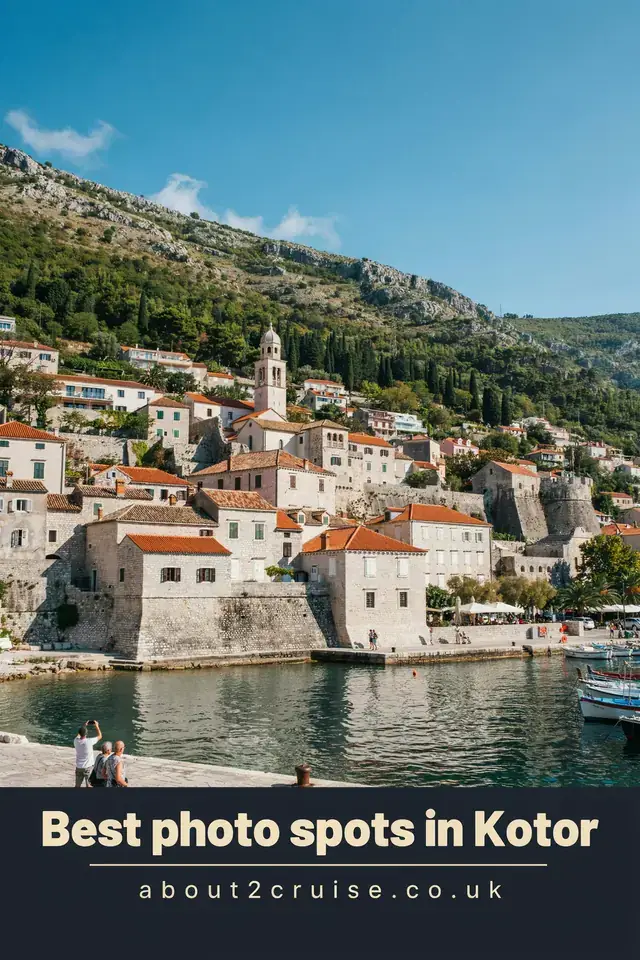
Inside the Old Town, Trg od Oružja with the leaning clock tower is the classic shot. The Sea Gate itself is also a stronger photo than people expect, especially with the mountains behind it. St Tryphon’s Cathedral backed by the mountains is another angle worth taking time over. For a quieter version of Old Town, head to the lanes behind the cathedral early in the morning, before 10:00.
If you do a boat trip, the Perast waterfront with its two islets, Our Lady of the Rocks and St George, is one of the best bay views in Montenegro. Have your camera ready for the sail-in as well: the approach to Kotor gives you nearly an hour of scenery before the ship even reaches the port, with steep cliffs rising straight out of the water.
Quick Questions Before You Go
Do I need a visa or passport to get off the ship in Kotor?
Your cruise card is what you’ll use to get on and off the ship, but always carry photo ID ashore: in Kotor, police can fine you for not having ID. Most UK, EU, and US passport holders don’t need a visa for short tourist visits to Montenegro, but always check the latest entry rules for your nationality before you travel.
Is English widely spoken in Kotor?
Yes, especially around the port, Old Town restaurants and shops, taxi drivers, and boatmen. Menus and tour signs are usually in English. Older residents in the back lanes may speak only Montenegrin, but you’ll get by without a phrasebook.
Do I need to book the San Giovanni fortress in advance?
No. There’s no timed entry to the fortress or the Old Town. You buy the fortress ticket at the gate when you arrive. Online tickets exist through third parties but cost a little more. No attraction in Kotor has timed entry.
Can I swim during my Kotor port day?
The water around Kotor itself isn’t ideal for swimming. The best swimming near the port is at Orahovac beach, which you can reach on the hop-on hop-off bus, or on a boat trip that includes swimming stops such as the Blue Cave tour. Sea temperatures in July and August reach about 24–25°C, so swimming is comfortable in summer.
Should I tip in Kotor?
Tipping is appreciated but not expected at the same level as in the US. Round up the bill or leave 5–10% for good service in restaurants. Boatmen and guides appreciate a tip but won’t ask for one. For taxis, rounding up is fine.
What if it rains in Kotor?
Kotor is still a good port day in the rain. The Maritime Museum (€4) and St Tryphon’s Cathedral (about €4) are both indoors and close together. The Old Town’s lanes are sheltered in places, and cafés on the Square of Arms are good places to sit out a shower. Save the fortress for a dry day: the stone steps are no fun when wet.
Are there public toilets near the cruise port in Kotor?
Public toilets in the Old Town usually require a small coin payment, typically less than €1. Carry small-denomination coins. Restaurants and cafés expect you to buy something if you use their facilities. The cruise ship is still the most reliable free toilet before and after your wander.
Is Kotor accessible for wheelchairs or people with reduced mobility?
It’s a difficult port for mobility issues. If your ship docks, you may be able to disembark onto the quay and reach the waterfront promenade, but the Old Town itself is made of polished stone slabs and steps: many lanes have at least one step. If your ship is tendering, the tender transfer may not suit passengers with disabilities, reduced mobility, or balance issues. The fortress climb is completely unsuitable unless you can manage 1,350 uneven steps. A waterfront walk towards Dobrota is the best option for wheelchairs.
How can I check which ships are in port on my date?
Third-party trackers such as shipitinerary.com and the port’s own arrivals spreadsheet list which ships are in Kotor on each date and whether they’re alongside or at anchor. Search for your ship name plus “Kotor” plus your date. This is useful for knowing how crowded the town will be before you decide what to do.
Can I use my phone data in Kotor?
Montenegro is not in the EU, so your usual EU roaming package may not apply. Check with your mobile provider before you travel. Many cafés and hotels offer free Wi-Fi if you need it. Download offline maps before you arrive.
Can I do a day trip to Dubrovnik from a Kotor cruise stop?
Technically yes: coaches run about twice daily and the journey takes about 2.5 hours each way: but with border queues in summer and limited port-day hours, it’s a risky and rushed day. Most travellers find Dubrovnik deserves its own port call. If you want to compare, read the Dubrovnik cruise port guide.
What is the sail-in to Kotor actually like?
The approach through the Bay of Kotor is one of the best sail-ins in the Mediterranean. Steep cliffs rise almost vertically from the water, and the ship threads through narrow channels past old stone villages and the occasional monastery. It takes nearly an hour from the entrance of the bay to the port, so get up early and be on deck: you’ll want the camera.
More Mediterranean Cruise Port Guides
If you’re sailing the Adriatic or the eastern Med, you’ll likely stop near Kotor again. Read the Dubrovnik cruise port guide before you go.
Save this port day plan to Pinterest
Further south along the Montenegrin coast, Bar is the country’s main commercial port and often appears on the same Adriatic itineraries as Kotor.
Last Updated: 13 November 2026
2 responses
Very good well informed really good information well 👍 will use this when I get of the ship to get art this beautiful port
So glad to hear that John, thanks for your kind comments. Enjoy your trip.