
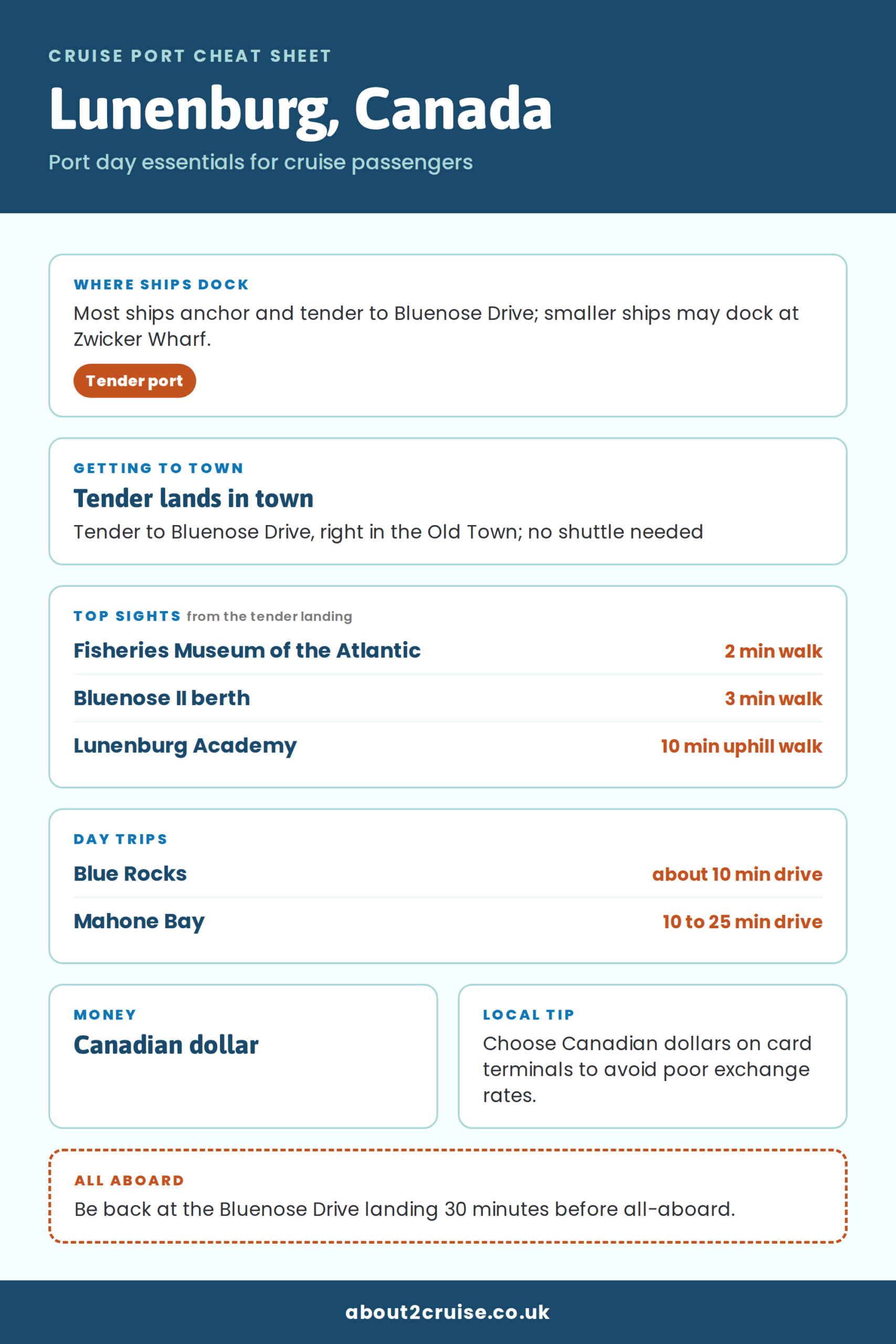
Lunenburg, Nova Scotia, is a tender port of call on Canada’s South Shore, and the tender drops you right beside the UNESCO-listed Old Town. Most cruisers spend the day walking the colourful wooden streets, visiting the Fisheries Museum and Bluenose II, eating seafood and climbing to the Academy viewpoint. No shuttle is needed, but calls are often short, so plan around tender queues and ship time. This guide covers the Canadian Lunenburg specifically, not another place with the same name.
Is Lunenburg Worth a Cruise Day? Honestly, Yes
Old Town Lunenburg is a UNESCO World Heritage Site, recognised as the best surviving example of a planned British colonial settlement in North America. The town was founded in June 1753 for around 1,450 mostly German-speaking Protestant German, Swiss, and Montbéliardian French colonists. The street grid was drawn up in London without much regard for the local hills, which is why the compact Old Town has dead-straight streets that can be surprisingly steep.
There are roughly 400 major buildings in the old town, and around 70% of them date from the 18th and 19th centuries. Almost all are wooden, and many are painted in bright colours. Keep an eye out for the Lunenburg bump, a five-sided Scottish dormer that extends out and down over the front door. It’s a signature detail you won’t find anywhere else. Lunenburg is one of only two urban communities in North America with full UNESCO World Heritage designation, which gives the waterfront and back streets a genuinely different feel from larger cruise ports.
The town has also appeared on screen in Dolores Claiborne, The Covenant, Haven, and Locke & Key, but most people remember it for the colourful harbourfront, the fishing schooners, and the smell of seafood drifting out of the wharf restaurants.
Lunenburg cruise port map
Tenders bring you ashore at Bluenose Drive tender landing. From the tender landing, Fisheries Museum of the Atlantic is about a 2-minute walk, Knaut-Rhuland House about 2 minutes and St John’s Anglican Church about 4 minutes. Tap a pin for directions.
- Bluenose Drive tender landingWhere tenders land
- Fisheries Museum WharfWhere ships dock
- Fisheries Museum of the AtlanticMaritime museum · About 2 min walk from the tender landing
- Knaut-Rhuland HouseHouse museum · About 2 min walk from the tender landing
- Old Town LunenburgUNESCO-listed historic district · About 2 min walk from Bluenose Drive tender landing
- St John’s Anglican ChurchAnglican church · About 4 min walk from the tender landing
- St. Andrew’s Presbyterian ChurchPresbyterian church · About 4 min walk from Bluenose Drive tender landing
- Lunenburg Heritage BandstandBandstand · About 4 min walk from Bluenose Drive tender landing
- Zion Evangelical Lutheran ChurchLutheran church · About 6 min walk from Bluenose Drive tender landing
- St. Norbert’s Roman Catholic ChurchRoman Catholic church · About 6 min walk from Bluenose Drive tender landing
- Ironworks DistilleryDistillery · About 7 min walk from the tender landing
- Lunenburg AcademyHistoric school building · About 9 min walk from the tender landing
- Lunenburg HarbourHarbour · About 17 min walk from Bluenose Drive tender landing
- Blue RocksAbout 5 km from Bluenose Drive tender landing
- Ovens Natural ParkNatural park · About 8 km from Bluenose Drive tender landing
- Mahone BayBay · About 10 km from Bluenose Drive tender landing
- Peggy’s Point LighthouseLighthouse · About 34 km from Bluenose Drive tender landing
Tendering in Lunenburg: What to Expect When You Step Ashore
For most cruise ships, Lunenburg is a tender port. Larger ships anchor offshore and send passengers to the Bluenose Drive waterfront by tender, right in the heart of the historic district. Smaller expedition vessels sometimes tie up directly at Zwicker Wharf or the Government Wharf, but there’s no cruise terminal building. The landing is an open working wharf, and the nearest facilities are the public washroom and visitor information point on Bluenose Drive.
The big advantage is that you don’t need a shuttle or coach. The entire UNESCO core, the Fisheries Museum, and the main shopping streets are within about a 10-minute walk of where the tenders land. The downside is time. Lunenburg calls are often short, around six hours in port, and tender queues tend to build towards all-aboard time. Plan to be back at the landing 30 minutes before the last tender unless your ship’s daily programme says otherwise.
Zwicker Wharf has floating docks and a public marina. The practical takeaway for cruise passengers is simple: you step off into town, but you may need to wait for a tender at busy times. Keep an eye on the all-aboard time and don’t treat the last tender as optional.
Seeing the Bluenose II: The Schooner That Made Lunenburg Famous
Lunenburg is synonymous with the Bluenose. The original schooner was built here, launched in 1921, and raced undefeated for 17 years as the pride of the Grand Banks fishing fleet. Today the schooner appears on the Canadian 10-cent coin, and her replica, Bluenose II, is based at 121 Bluenose Drive when she’s in port.
Bluenose II was launched in 1963 and remains an exacting replica of the original. When she’s in Lunenburg she usually runs two-hour harbour cruises at 9:30am and 1:30pm from June to late September, before a maintenance period in October. Fares have been around $110 per adult and $45 for children aged 3–12, with infants under two free, including taxes and fees. You can book online or by phone, but the schedule can change for weather or maintenance, and the ship does leave for other ports. Check the official Bluenose II schedule before your cruise.
When she’s not sailing, there are often free open-deck sessions with no booking, typically around 11:45am–1:00pm and 3:45pm to dusk. The deck is wheelchair accessible, but the ramp to the wharf can be steep depending on the tide. Even if you don’t go aboard, the berth at Bluenose Drive is one of the best photo spots in town, and the Bluenose II Company Store next to the berth sells maritime gifts.
Fisheries Museum of the Atlantic: A Smart First Stop
The Fisheries Museum of the Atlantic is a natural first stop for many cruisers. It sits at 68 Bluenose Drive, steps from the tender landing, in a complex of former fish-processing buildings on the working waterfront. It’s open daily from 9:30am to 5pm through the season, with reduced hours at the end of October before closing for the winter. Adult admission is around $15, seniors 60+ $12, students $9, youth 6–17 $4, and children under 6 free. A family ticket for two adults and children is about $32.
Inside, the exhibits cover the Mi’kmaq fishery, the inshore and bank fisheries, the Bluenose, storms and safety at sea, and daily life in the fishing community. The real highlight is going aboard the museum’s historic vessels. Admission includes the schooner Theresa E. Connor, Canada’s oldest salt-bank schooner, and the side trawler Cape Sable. There’s also an aquarium, theatre, and wharfside interpretation.
Allow at least an hour for a proper visit, and a little longer if you want to board both ships and watch the theatre film. The wharf ground and ship decks are uneven, so watch your step in wet weather. The museum has a lift to the upper galleries, accessible washrooms, wide pathways, and wheelchairs available on a first-come basis. Some expedition cruise lines include museum entry in the cruise fare, so check your excursion inclusions before buying a ticket.
A Self-Guided Walk Through Old Town Lunenburg
The best-known self-guided loop is only about 1.5 km and takes 30–40 minutes without stops. Walk along Bluenose Drive past the Fisheries Museum, climb King Street to Lunenburg Academy for the harbour view, then come back down Lincoln Street to Montague Street for shops and food. The grid is easy to navigate, and the Old Town borders the waterfront directly, so it’s hard to get lost.
Lunenburg Academy, at 97 Kaulbach Street, is the castle-like National Historic Site known locally as the Castle on the Hill. Built between 1893 and 1895, it served as a school until 2012 and now offers the classic elevated view back down over the harbour and old town. It’s a short but steep walk up from the waterfront.
St. John’s Anglican Church, at 64 Townsend Street, is well worth a detour. Founded in 1753, it’s described as the second-oldest Protestant church in Canada and is a National Historic Site. The church is open daily May through October for guided tours or quiet visits, but it remains an active parish, so be respectful if a service is taking place. Sunday services are usually at 8:30am and 10:30am.
If you enjoy house museums, Knaut-Rhuland House at 125 Pelham Street is free and open daily from 11am to 5pm from mid-May to the end of August. It’s a short uphill walk from the main shopping street and gives a good sense of the town’s 18th-century domestic life.
Where to Eat in Lunenburg: Lobster, Chowder, and More
Lunenburg is a working fishing town, and the food scene is one of the main reasons cruisers look forward to the stop. The classic orders are lobster roll, smoked seafood chowder, fishcakes, Digby scallops, and fresh local mussels or oysters. Salt Shaker Deli at 124 Montague Street is on the Nova Scotia Lobster Trail and Chowder Trail, and it’s a good central choice for a quick but excellent port-day lunch.

For a sit-down meal with a wharfside view, the Old Fish Factory & Ice House Bar is inside the Fisheries Museum building at 68 Bluenose Drive. It serves lobster, scallops, haddock, mussels, and chowder, and it’s usually seasonal from the start of June to early October. The South Shore Fish Shack at 108 Montague Street is another reliable seasonal option for clams, scallops, lobster, and fish with harbour-view patios, typically open from late May to early October.
The Grand Banker is known locally for its lobster-topped burger and bacon-wrapped scallops. If you want something old-fashioned, Solomon Gundy, pickled herring with onion, vinegar, and pickling spice, is an old Lunenburg-area dish still found on some South Shore menus.
For a drink stop, Ironworks Distillery at 2 Kempt Street makes rum, vodka, and liqueurs from local fruit and grain in an 1893 marine blacksmith’s shop. They offer a complimentary taste and bookable 45-minute tours. It’s a particularly good rainy-day or late-afternoon option because it’s indoors and compact.
Shopping for Souvenirs Without the Tourist Traps
Montague Street is the main shopping street, and it’s full of independent shops rather than chain stores. Lunenburg Bound Books at 139 Montague Street is a good browse for local authors and maritime history, while Sweet Treasures Confectionery at 110 Montague Street is a popular stop for fudge and souvenirs. The Bluenose II Company Store at 121 Bluenose Drive is the place to buy official Bluenose apparel, gifts, books, and maritime keepsakes, and it usually runs from May to December.
Ironworks Distillery sells its own rum, vodka, and liqueurs directly from the shop at 2 Kempt Street, which makes a good carry-off gift if your cruise line allows alcohol to be brought back on board. If your call falls on a Thursday, the Lunenburg Farmers’ Market runs from 8am to noon year-round: outdoors at Lunenburg Arena in summer and indoors at the Community Centre in the cooler months. Both sites are about five minutes’ walk from the waterfront and are a good source of local crafts, baked goods, and produce.
Shore Excursions or DIY? How to Explore Lunenburg on Your Own
You don’t need a ship excursion to enjoy Lunenburg. The town is compact, safe, and walkable, and the tender lands you inside the historic district. The most popular independent option is the Essential Lunenburg guided walk, a 90-minute tour that runs daily at 10am and 2pm from May through October. It starts at Lunenburg Academy and works gently downhill to the waterfront. Tickets are about $25 per adult, $15 for youth 6–17, free for children under 5, and $75 for a family. There are no washrooms at the start or en route, so use the public facilities near the tender landing before you set off.
If you want a fuller managed day, the Lunenburg Day Tripper package combines a 1.5-hour walking tour with a one-hour harbour trip on the Harbour Star, a Fisheries Museum day pass, and a small confectionery voucher. It costs about $85 per adult and $45 per youth. There’s also a Sights & Spirits tour lasting 3.5 hours and open to those 19 and over, which adds an Ironworks Distillery tasting to a walk and harbour cruise for around $89.
For a genteel overview of the Old Town, Trot in Time carriage tours depart from 72 Bluenose Drive. A 35-minute shared ride is about $45 per adult and $20 for youth 6–15, with children under 5 free. Private 40-minute rides are available for small groups. The carriages run from May to the end of October, and there’s sometimes a discount on the earliest departure.
Whale watching from Lunenburg is possible on a cruise day, but only if your call is long enough. Lunenburg Whale Watching Tours runs three-hour trips from the waterfront with a booth at 68 Bluenose Drive. The season runs from early May to the end of October, and adult tickets are about $90, youth under 14 $48, infants free, taxes included. Summer departure times can include 8:30am, 11:30am, 2:30pm, and 5:30pm, with a 1:00pm departure earlier in the season. You need to check in 30 minutes before departure and check the weather, because no whale sighting is guaranteed and trips are weather dependent. On a short six-hour call, a whale watch plus tender time and a meal can be tight, so only book if the timing clearly works with your all-aboard time.
Star Charters also offers two-hour sailing trips on a 48-foot ketch from Lunenburg harbour, with several departures through the day arranged on the dock. It’s a more flexible alternative to Bluenose II if you want to get out on the water but the schedule doesn’t fit.
How to Spend 2 Hours, 4 Hours, or a Full Day in Lunenburg
If you only have about two hours, focus on the waterfront and the Fisheries Museum or the Essential Lunenburg walk, then walk along Bluenose Drive to see Bluenose II if she’s in port. The museum and the berth are within a few minutes of each other, so this works well even with tender queues.
Before you sail
- Check the official Bluenose II schedule; she may be away or on maintenance.
- Book Bluenose II harbour cruise tickets online or by phone.
- Check your cruise line's tender instructions and all-aboard time before sailing.
Short port day: under 6 hours
- On dockingTake the tender ashoreGo earlyLand on Bluenose Drive in the Old Town. Tender queues build later, so be on an early tender.
- +15 minFisheries Museum of the AtlanticA 2 min walk along the waterfront. Allow an hour to board the Theresa E. Connor and Cape Sable.
- +1 hr 30 minBluenose II berthCheck scheduleA 3 min walk north. She is often open for free deck visits around midday, but confirm the official schedule.
- +2 hr 15 minLunch on Montague StreetTry lobster rollWalk uphill to Montague Street. Order a lobster roll, smoked seafood chowder or fishcakes from a local deli.
- +3 hr 15 minSt John's Anglican ChurchA 5 min walk from Montague Street. The second-oldest Protestant church in Canada is open daily May to October.
- +4 hrLunenburg AcademyA 10 min uphill walk from the church. The Castle on the Hill viewpoint looks down over the harbour.
- All-aboard minus 30 minBack at Bluenose Drive landingA 10 min downhill walk from the Academy. Return before tender queues build.
The time on the map is the whole walk, every stop added together.
Open this walking route in Google Maps
If plans change: If the Bluenose II is away or the museum is closed, swap the berth for the Knaut-Rhuland House and Montague Street shops.
Long port day: 8 hours or more
- On dockingTake the tender ashoreGo earlyLand on Bluenose Drive in the Old Town. Tender queues build later, so be on an early tender.
- +15 minFisheries Museum of the AtlanticA 2 min walk along the waterfront. Allow an hour to visit all three floors and the historic ships.
- +1 hr 30 minBluenose II berthCheck scheduleA 3 min walk north. If she is in port, look for free open decks or photograph her from the wharf.
- +2 hr 30 minLunch on Montague StreetTry seafood chowderWalk uphill to Montague Street. Lobster roll, smoked seafood chowder and fishcakes are the local orders.
- +3 hr 45 minSt John's Anglican ChurchA 5 min walk from the lunch strip. Open daily May to October for quiet visits or guided tours.
- +4 hr 30 minLunenburg Academy viewpointA 10 min uphill walk from the church. The Castle on the Hill has the classic harbour view.
- +5 hr 30 minIronworks DistilleryWalk downhill from the Academy. Taste local rum, vodka or liqueurs in a former marine blacksmith's shop.
The time on the map is the whole walk, every stop added together.
Open this walking route in Google Maps
If plans change: If the Ironworks Distillery is closed, use the time to browse Montague Street shops and the Bluenose II Company Store before returning.
With four hours, add a proper seafood lunch on Montague Street and a slow wander up to St. John’s or the Academy viewpoint. You could also substitute a carriage tour for the walking tour and still have time for shopping.
On a full port day, you can add Blue Rocks, Mahone Bay, a whale-watching trip, or a Bluenose II sail. Each of those options uses two to three hours on its own, so choose one or combine a short drive with time in the Old Town. Blue Rocks, a working fishing village about 10 minutes’ drive east, has slate ledges and the water-borne fish house that is the county’s most photographed building. Mahone Bay is about 10–25 minutes’ drive north and is a pretty South Shore town with its own waterfront, but on a short cruise call it’s usually better to stay in Lunenburg rather than split your day.

Rainy Day in Lunenburg? Here’s What Still Works
Lunenburg is still a good port in the rain. The Fisheries Museum is mostly indoors and easily occupies an hour or more. The Knaut-Rhuland House, Ironworks Distillery, and the Montague Street shops all work as indoor stops. The Old Fish Factory restaurant inside the museum building is a convenient wet-weather lunch choice if it’s in season.
Seasonal closures matter here. The museum closes at the end of October, the Bluenose II sailing season runs June to late September, and several restaurants and the farmers’ market vary with the month. Many calls fall in June and September–October, when the weather is still workable but not everything is guaranteed to be open. If you’re on an early June or late October call, check the museum and any tours before assuming they’ll be running.
What to Wear and Pack for a Lunenburg Cruise Stop
Lunenburg’s cruise season brings typical daytime highs of about 18°C in June, 22°C in July and August, 20°C in September, and 14°C in October, with night lows from 9°C to 17°C. Rain days run at around eight or nine per month through the season, and October, November, and December are the wettest months. Humidity is high in summer, but the sea stays cold, and wind picks up from early October.


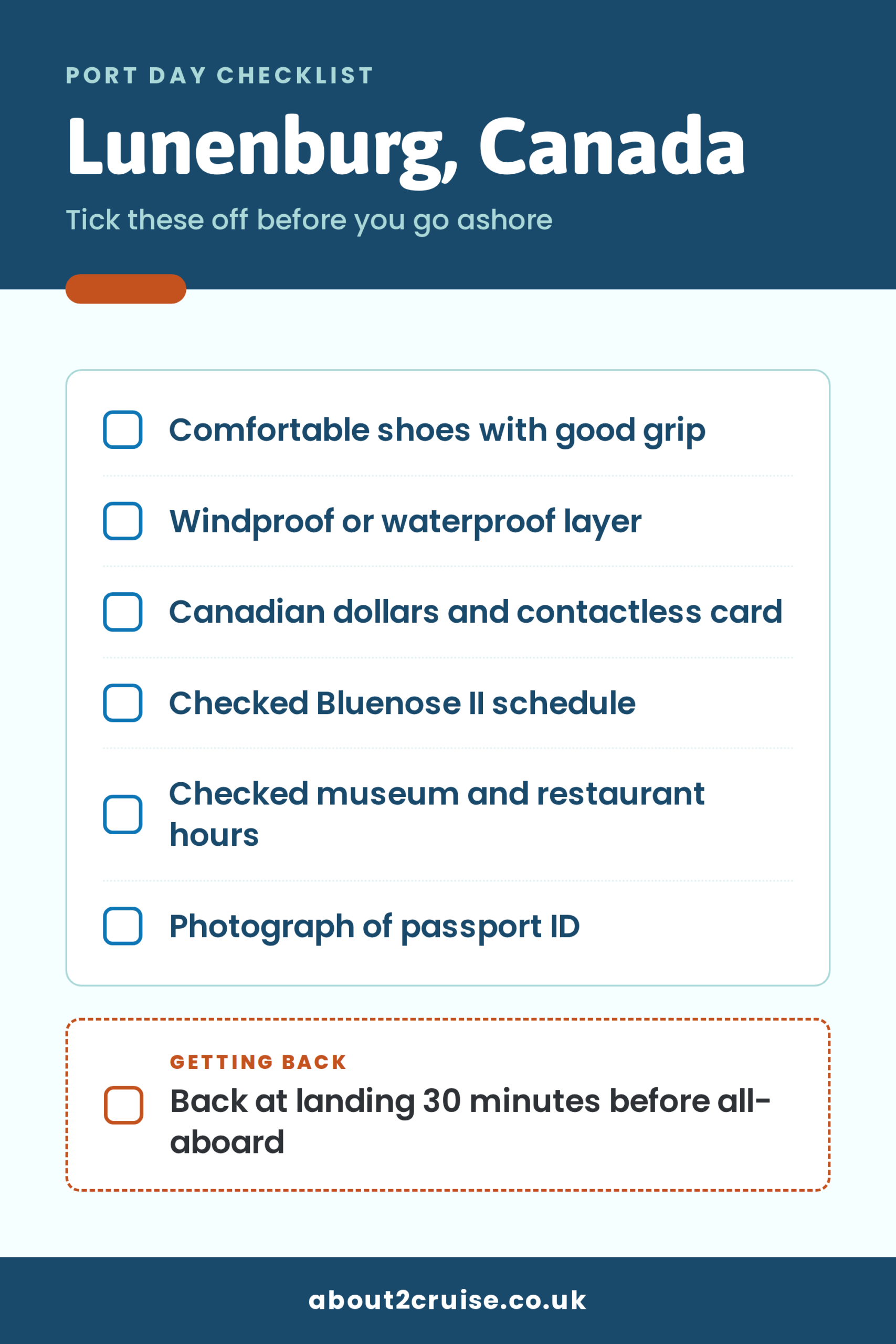
The main advice is to wear comfortable walking shoes with good grip. The streets are steep and the historic paving is uneven, and the museum wharf and ship decks are very uneven. Bring a windproof or waterproof layer even on a sunny morning, because the weather on this coast can flip from clear to foggy and cold quickly. Sun protection is still worth having in summer despite the breeze.
Accessibility and Getting Around with Limited Mobility
The biggest accessibility constraint is tendering itself. Boarding the ship’s tenders can be difficult for wheelchair users and anyone with limited mobility, and the landing is a working wharf rather than a purpose-built cruise terminal. If you can get ashore, the Old Town is compact and much of the waterfront is level, but many side streets are steep and paved with older surfaces.
The Fisheries Museum has a lift to the upper galleries, accessible washrooms, wide pathways, and two wheelchairs available on loan. Bluenose II’s deck is wheelchair accessible, but the ramp to the wharf can be steep depending on the tide. The Essential Lunenburg walk is described as suitable for most mobility levels because it starts at the Academy and runs gently downhill, but it has no washrooms en route and still covers uneven ground.
For anyone who needs a pre-booked, door-to-door accessible ride within town, Lunenburg County Wheels runs wheelchair-accessible vans Monday to Friday, bookable on 902-523-4455. Fares for trips within town are around $2.50 one way. Arrange this in advance rather than expecting to flag one at the pier.
Money, Cards, Tipping, Toilets, Wi-Fi, and Other Practicalities
The currency is the Canadian dollar. Visa and Mastercard with contactless tap are accepted almost everywhere, including small shops and food stalls. Cash is useful for tips and very small vendors, and bank ATMs are the cheapest way to get it. US dollars may be accepted by some tourist-facing businesses, but often at a poor exchange rate and with Canadian change. Whenever a card terminal or ATM offers to charge you in your home currency, decline it and choose Canadian dollars to avoid poor conversion rates.
Tipping is expected in restaurants, bars, and taxis, usually 10–20%. It’s not required for counter-service food, but a small tip for table service is normal.
Public toilets are available at 39 Bluenose Drive, open daily from 8am to 9pm until late October. There are also public washrooms at the Zwicker Building, 146 Bluenose Drive, daily 9am–9pm; at Town Hall on weekdays; and at the Community Centre on Green Street. The Visitor Information Centre at 11 Blockhouse Hill Road is open daily through the visitor season, and there’s a waterfront visitor information point next to the Fisheries Museum.
Free Wi-Fi is available through Nova Scotia’s public library network. The Lunenburg Library is on the first floor of 97 Kaulbach Street, inside Lunenburg Academy, and has daytime hours Monday to Saturday, with a late Thursday evening and Sunday afternoon opening. This is a useful fallback if ship Wi-Fi is slow or your phone signal is poor.
There is no cruise terminal, so there’s no official left-luggage service at the tender landing or visitor centre. You should plan to carry everything you take ashore, or ask your ship whether bags can be checked at the gangway. Some local accommodation advertises luggage storage for guests, but day visitors should not rely on a hotel taking bags unless they have booked a stay or arranged it in advance.
The UK Foreign, Commonwealth & Development Office advises normal precautions against petty crime in Canada, keeping bags and valuables secure, and carrying a copy of your passport as ID. Hurricanes can affect coastal areas from July to November, and summer thunderstorms are frequent. The main practical hazards in town are wet wooden docks and uneven historic paving.
Getting Around Beyond Old Town: Taxis, Buses, and Day Trips
There is no official taxi rank at the tender landing, and local taxi availability can be limited on cruise days. If you know you’ll need a taxi, pre-book one before you travel. For anyone staying in town, Lunenburg County Wheels provides pre-booked, door-to-door, wheelchair-accessible vans Monday to Friday at about $2.50 one way for trips within town, bookable on 902-523-4455.
Maritime Bus connects Lunenburg with Halifax on limited days, leaving Lunenburg about 8:55am and returning from Halifax about 3:55pm. The timetable doesn’t fit a normal cruise call, so don’t rely on it for a port-day trip to Halifax. Parking for visitors arriving by car is best at the public lot in front of the Fisheries Museum, where the rate has been about $5 per hour with a $25 daily maximum. There’s no cruise parking because no cruises start or end at Lunenburg.
How Far Is Lunenburg from Halifax and Peggy’s Cove?
Lunenburg is about 97–100 km southwest of Halifax, roughly 1 hour 10 minutes to 1 hour 30 minutes by road. It’s a feasible day trip from a Halifax cruise call, but it uses around 2.5–3 hours of driving before any sightseeing. If your ship is docked in Halifax, you can comfortably see Lunenburg, but you’ll want a private car, arranged tour, or rental vehicle rather than public transport.
Peggy’s Cove is about 95 km and 1.5 hours from Lunenburg by road, so it’s not a realistic add-on from a short Lunenburg call. If you want both, choose an itinerary that calls at Halifax and spend a separate day exploring Peggy’s Cove from there. Halifax Stanfield International Airport is about 111–113 km from Lunenburg, roughly 1 hour 15 minutes to 1 hour 25 minutes by road.
Best Time to Cruise to Lunenburg and Nova Scotia
The best time to visit Nova Scotia is June through October. July and August are the warmest and busiest months, while September and October bring autumn colour and often clear, crisp days. For Lunenburg specifically, most cruise calls fall between June and October because the town’s infrastructure is seasonal. The Bluenose II sailing season runs June to late September, and the Fisheries Museum closes at the end of October.
For a Nova Scotia cruise, September through October is often the sweet spot. September is warmer for walking and tends to have excellent light, while October gives peak foliage but cooler, wetter weather. Hurricane season can affect coastal areas from July to November, so be prepared for itinerary changes in autumn.
Which Cruise Lines Stop in Lunenburg?
Lunenburg is generally a small-ship port. Cruise lines calling here include Azamara, Ponant, Viking, Seabourn, Scenic, Windstar, Pearl Seas, and Hurtigruten, with ships typically carrying roughly 220–700 passengers. That’s part of the appeal: the town is not set up for giant resort ships, and on most days the Old Town absorbs the crowd comfortably.
Typical Canada and New England itineraries pair Lunenburg with Halifax, Saint John, New Brunswick, and Bar Harbor. Calls often cluster in June and then again in September–October, and some are as short as six or seven hours. Check your line’s voyage details in our Canada cruise ports guide before you book excursions.
Third-party port trackers sometimes show different call counts, but expect a quieter, more intimate port than Halifax or Saint John. The town has been developing its cruise welcome steadily, so if you’re on a new Princess or small-ship call, your landing arrangements may differ slightly from older patterns. The safest approach is to listen to your ship’s daily brief and follow tender instructions.
For advice on what to see, do, and eat in Sydney on Cape Breton Island, see our Sydney Cape Breton Island cruise port guide.
Mistakes to Avoid on a Lunenburg Port Day
- Assuming Bluenose II will be at the wharf. She sails, does maintenance, and leaves for other ports, so check the official schedule before you plan your day around her.
- Leaving the Old Town too late and getting caught in a tender queue. Short calls mean an early start and a firm return time are worth it.
- Wearing smooth-soled shoes on wet docks and historic paving. The town is best on foot, but grip matters.
- Booking a whale-watching or Bluenose II sail without checking it fits your all-aboard time. Both take two to three hours plus check-in or tender time.
- Assuming everything is open on a Sunday or after 5pm. Lunenburg is a small town with seasonal hours, and some restaurants and tours close early or on certain days.
- Paying in your home currency on a card terminal. Always choose Canadian dollars to avoid dynamic currency conversion.
- Not bringing a rain layer. The weather can change quickly even in summer.
- Planning a day trip to Peggy’s Cove from a Lunenburg call. It’s too far for a short port day; save it for a Halifax call.
Lunenburg Cruise Port FAQs
Can I leave the ship without an excursion in Lunenburg?
Yes. The tender lands on Bluenose Drive in the heart of the UNESCO Old Town, and the Fisheries Museum, Bluenose II berth, restaurants, and shops are all within easy walking distance. There’s no shuttle or coach required to reach the town.
Is Lunenburg a tender port, and how long is the tender ride?
For most ships, yes, Lunenburg is a tender port. Larger ships anchor offshore and tender passengers to the Bluenose Drive waterfront. Smaller and expedition ships may dock directly. The tender ride itself is usually short, but the queuing and loading time can eat into a six-hour call, which is why being back 30 minutes before all-aboard is sensible.
Can I see Bluenose II without booking a harbour cruise?
Often yes. When she’s in port there are free open-deck sessions with no booking, usually around midday and late afternoon. The schedule is not guaranteed, and the ship can be away or on maintenance, so check the official Bluenose II schedule for your call date. Even if she’s away, the berth and company store are still worth a quick look.
Is Lunenburg worth visiting compared with staying in Halifax?
Many cruisers prefer Lunenburg specifically because it’s the smaller, more walkable UNESCO stop. It offers a very different experience from Halifax, which is a larger city with more museums and a different waterfront. On a Canada and New England itinerary, Lunenburg is often the favourite small-town call. If you have to choose between the two from a Halifax ship, Lunenburg is worth the drive if you want colourful historic streets, the Bluenose story, and a stronger feeling of a working maritime community.
Are shops and restaurants open on Sunday in Lunenburg?
Many are, but not all. The Old Town is a genuine working town, not a cruise-designed port, so Sunday hours can be reduced and some smaller shops may open later or stay closed. Public toilets and the visitor centre usually maintain seasonal daily hours, but always check restaurant times before you walk all the way to a particular dining room.
Do I need Canadian cash in Lunenburg?
Cards are accepted almost everywhere, including small shops and food stalls. Contactless Visa and Mastercard are the easiest way to pay. It’s still useful to carry a small amount of Canadian cash for tips, very small vendors, or market purchases, but you don’t need much. Don’t rely on US dollars, and avoid paying in pounds on card terminals.
How early should I be back at the tender landing?
Plan to be back at the Bluenose Drive landing at least 30 minutes before your ship’s all-aboard time unless the daily programme gives a different instruction. Tender queues can build quickly in the final hour, and the last tender is not something to gamble on.
Is there Wi-Fi in Lunenburg?
Free public Wi-Fi is available through Nova Scotia’s library network. The Lunenburg Library at 97 Kaulbach Street, inside Lunenburg Academy, is the most reliable indoor option. Some cafés and restaurants may offer Wi-Fi to customers, but the library is the most dependable fallback.
Can I get to Peggy’s Cove from Lunenburg in a port day?
Peggy’s Cove is about 95 km and 1.5 hours by road from Lunenburg, so it’s not a practical add-on for a short cruise call. If you want to visit Peggy’s Cove, do it from a Halifax port day, where the drive is shorter and the logistics are easier.
What should I do if my ship misses the port or my tender is delayed?
Follow the ship’s daily programme and tender instructions. Lunenburg is a small tender port, and sea conditions can occasionally affect operations. If you’ve booked an independent tour or whale watch, check the cancellation policy and ask the operator about weather and late-arrival refunds before paying. The town is compact enough that a truncated visit can still cover the waterfront, the Fisheries Museum, and a quick seafood lunch.
Last Updated: 24 November 2026