
Bar Harbor, Maine is a tender-only cruise port and the main cruise gateway to Acadia National Park. Ships anchor in Frenchman Bay and passengers come ashore at the Town Pier or the West Street floats. Expect a compact, walkable New England waterfront, serious lobster, Cadillac Mountain views, whale-watching, and a port where tendering, tides and park reservations decide how much you actually fit in.
Getting Ashore in Bar Harbor: Tenders, Docks, and Timing
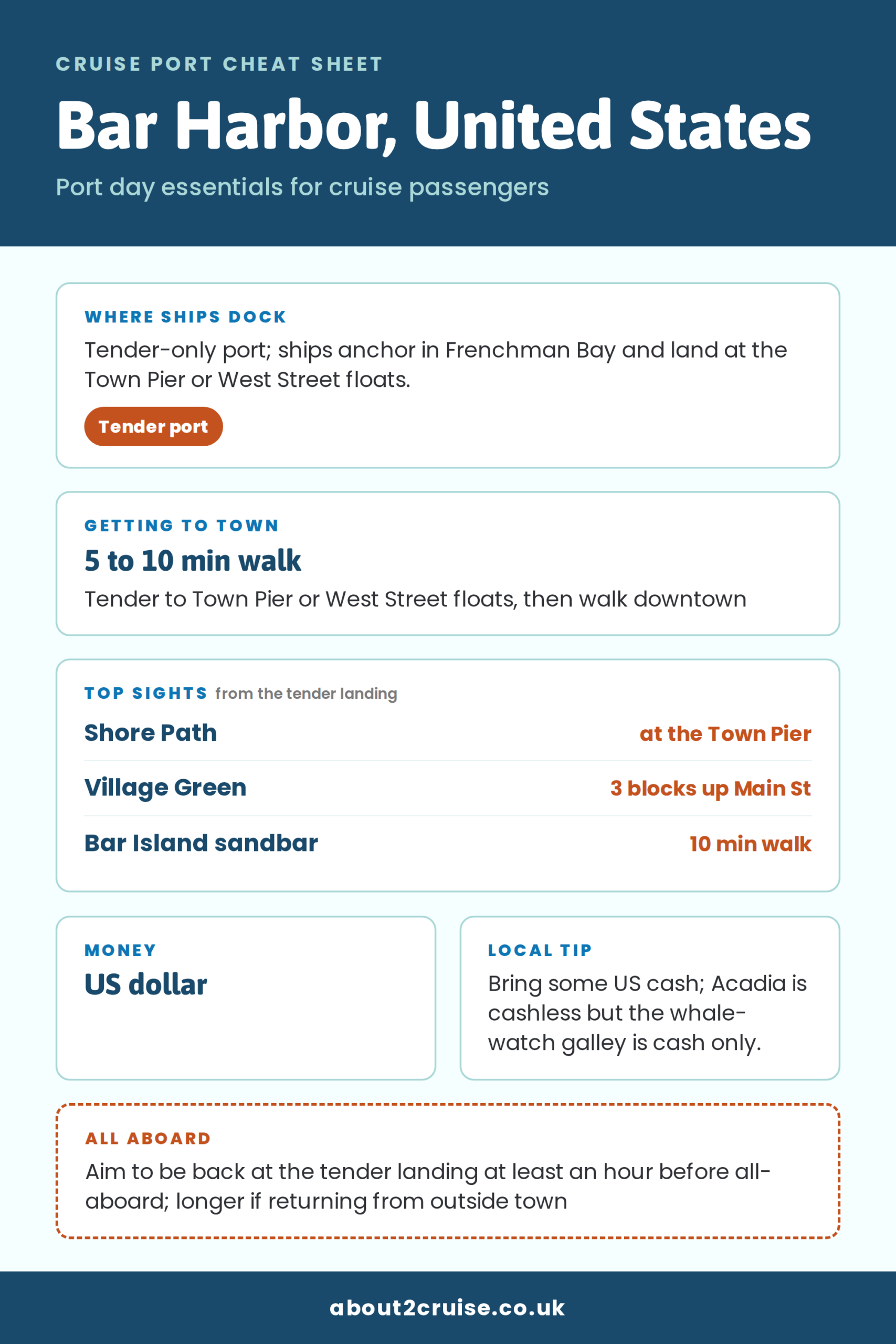
Bar Harbor has no cruise berth for large ships. Every large ship anchors in Frenchman Bay and tenders passengers ashore. Small US-flag ships dock or tender at the Town Pier, formally Ells Pier, which can moor vessels up to 170 feet. Large-ship passengers come ashore at the private floating docks at Harbor Place and Harborside Marina on West Street, immediately west of the Town Pier. Those tender floats are 140 to 160 feet long.
There are two anchorage zones. Anchorage A is about half a mile east of the tender landing, roughly a 10-minute tender ride. Anchorages B1 and B2 lie north of Bar Island about a mile out. B is the preferred anchorage, and A is used for the smallest ship on three-ship days. The main coach and tour-bus queuing area is on West Street, across from the Harbor Place entrance, so most ship excursions begin within a short walk of the tender platform.
Because this is a tender-only port, your real arrival time in town is later than the ship’s scheduled arrival. Ships normally reach the anchorage around 07.30 so tender platforms can be rigged, which takes about 15 minutes per platform. A full tender turnaround, load, transit, unload and return, runs about 35 minutes from the closer anchorage and longer from the farther one.
Bar Harbor cruise port map
Tenders bring you ashore at Harbor Place tender float. From the tender landing, Village Green is about a 7-minute walk, Bar Island about 10 minutes and Shore Path about 10 minutes. Tap a pin for directions.
- Harbor Place tender floatWhere tenders land
- Harborside Marina tender floatWhere tenders land
- Town Pier (Ells Pier)Where tenders land
- Village GreenPublic park · About 7 min walk from the tender landing
- Shore PathWaterfront walking path · About 10 min walk from the tender landing
- Bar IslandTidal island · About 10 min walk from the tender landing
- Hulls Cove Visitor CenterNational park visitor centre · About 4 km from the tender landing
- Cadillac MountainMountain summit · About 5 km from the tender landing
- Jordan Pond HousePark restaurant · About 9 km from the tender landing
How Tendering Actually Works in Bar Harbor
Ship-organised excursions assemble on board, usually in the theatre, and get priority tender slots. Independent passengers are released after the tours have gone. If your ship has just arrived from Canada or Bermuda, immigration clearance can add up to an hour before anyone goes ashore. That means a shore tour you booked independently for 09.00 on a Canada and New England itinerary is a risky booking on arrival day.
Large-ship lines use numbered tender tickets for independent passengers, then switch to open tendering once the numbers have been called. Suite guests, high loyalty tiers and ship-excursion guests get first call. The town does not publish tender ticket rules because ticketing is entirely line-specific. The tender number you receive is decided on board, so build in a buffer for any independently booked tour that cannot wait.
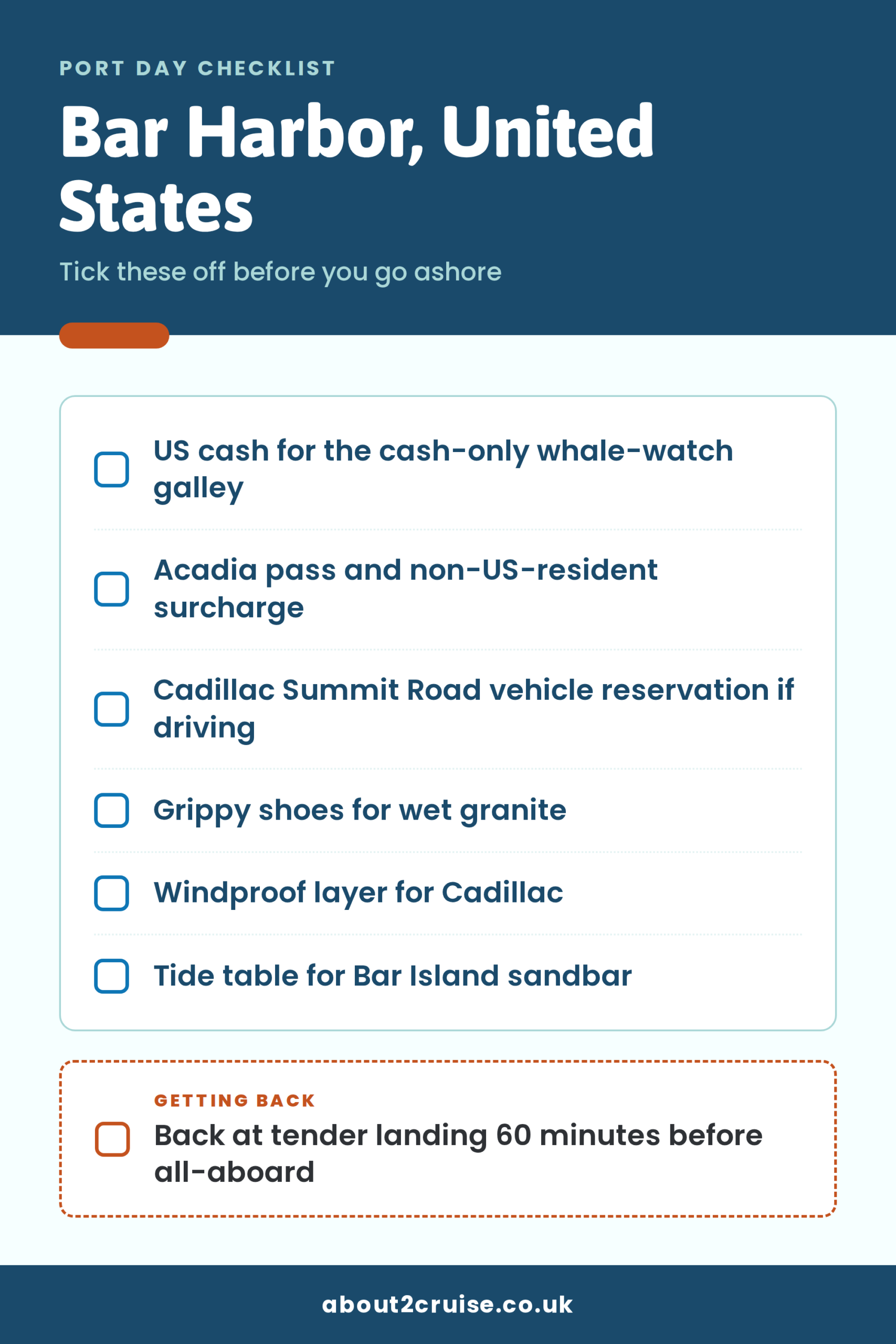
Returning to the ship requires no tender ticket. You join the queue at the landing. There is no official published last-tender time for Bar Harbor. All-aboard is ship-specific, so use the time in your ship’s app or daily programme. As a working rule, aim to be back at the tender landing at least an hour before the all-aboard time, and more if you are returning from anywhere outside the downtown area. The Village Green, where the Island Explorer hub sits, is a three-block walk up Main Street from the tender landing.
Checking the Schedule and Ships in Port
Cruise lines request and hold anchorages through PortCall, Maine’s public booking system. That is the booking record and shows each vessel’s date, arrival and departure times, guest count and assigned anchorage. The harbour master also publishes a confirmed docking list with arrival and departure times and total hours in port. Third-party trackers show the same forward schedule plus live ship positions in the bay, which is the fastest way to answer the common question: what ship is in Bar Harbor today.
August and September are the busiest months. The current-season schedule is dominated by American Cruise Lines, with 55 visits by five small US-flag ships, plus grandfathered calls by Norwegian Breakaway and Norwegian Jewel. No large ships beyond those two NCL vessels are currently scheduled because the town has stopped accepting new advance cruise reservations while it works through the court rulings on passenger caps. Any guide that shows a full normal schedule of large ships is out of date.
Acadia National Park from Bar Harbor: A Practical Guide
Bar Harbor is the main jumping-off point for Acadia National Park, which covers most of Mount Desert Island and protects a landscape of granite summits, coastal pine forest, rocky headlands and 45 miles of carriage roads. The park’s 27-mile Park Loop Road is the scenic spine, and the National Park Service allows one to four hours for the drive in summer, but the park’s own advice is to use the fare-free Island Explorer shuttle where possible because car parks usually fill by 9am in peak season.
The main visitor centre is Hulls Cove, reached from the northern side of the island. It has 52 steps up to the front entrance, plus an accessible rear entrance with four accessible parking spaces and a lift. You do not need to visit Hulls Cove first. Many cruise passengers buy a park pass in town and board the Island Explorer from the Village Green, three blocks up Main Street from the tender landing.
The Island Explorer is useful, but it is not a guided tour. It connects the Village Green with trailheads, Sand Beach, Thunder Hole, Jordan Pond and other park stops. It does not serve the Cadillac Mountain summit. A park entrance pass is required to ride the bus into Acadia.
Lobster, Blueberries, and Where to Eat Near the Ship
This is one of the easiest ports on the US East Coast to eat well within sight of your ship. Maine supplies nearly 85 percent of all American lobster, and Bar Harbor’s waterfront restaurants turn that into the classic shore lunch. The benchmark order is a lobster roll: cold lobster lightly dressed with mayo, served in a griddled split-top bun. Cheaper, more casual takeaway windows sit alongside sit-down restaurants on West Street, Main Street and Cottage Street.
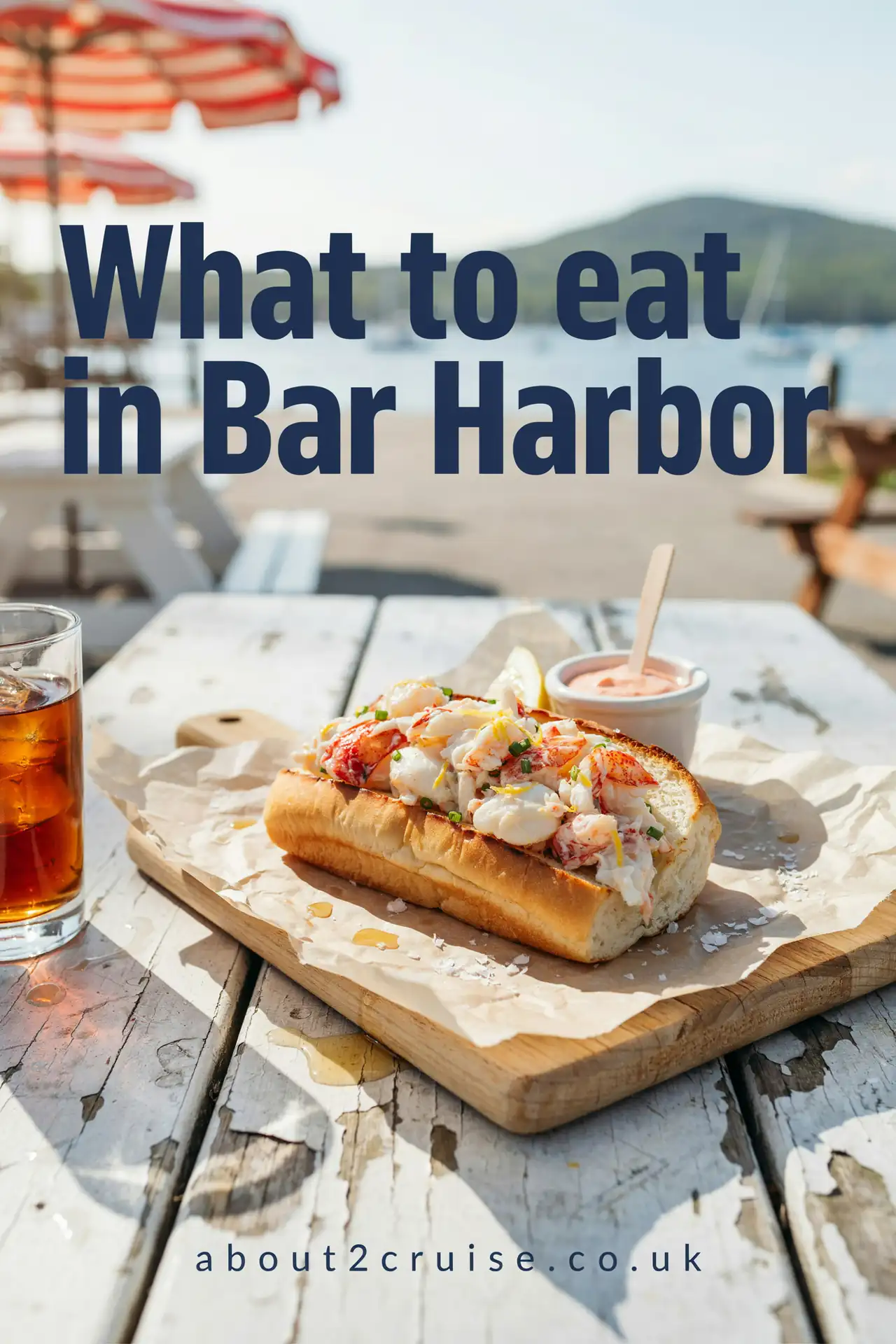
A full lobster bake or steamed lobster dinner is the other local fixture, usually served with steamers, corn and drawn butter. Portion sizes are generous, queues build around 12.30pm on busy ship days, and the average cruise passenger spends roughly $23 ashore on meals and drinks. If you want a table at a popular place, eat early or late, not at noon.
Wild blueberry pie, blueberry soft serve and blueberry pancakes are everywhere for a reason: Maine grows about 99 percent of US wild blueberries. Two more local curiosities are the whoopie pie and Moxie, Maine’s state soft drink. The only restaurant inside the park is Jordan Pond House, known for popovers with butter and jam on the lawn overlooking Jordan Pond and the Bubbles.
Walkable Downtown, Shore Path, and the Bar Island Sandbar
Bar Harbor still looks like the New England summer colony it once was: a walkable grid of shops, restaurants, inns and tour operators on West, Main, Cottage and Mount Desert streets. From the tender landing you can be in the middle of the downtown shopping area in five to ten minutes on foot, and the wayfinding signs and maps in the centre make it easy to wander without a plan.
The Shore Path begins at the Town Pier and runs along the harbour front, giving an easy flat stroll with views across Frenchman Bay to the Porcupine Islands. The town’s namesake sandbar, the Bar, runs from Bridge Street to Bar Island. You can walk it up to two hours either side of low tide. Miss that window and the route is underwater for about nine hours; people have been stranded and one death has been reported, so check a tide table before heading across.
The Chamber visitor centre is on the corner of Main and Cottage streets and is the most useful indoor stop for maps, questions and park passes. Because the commercial core is compact and flat, many passengers simply walk ashore without booking any transport and treat Bar Harbor as a food, shopping and waterfront port day.
Cadillac Mountain and Coastal Scenery
Cadillac Mountain is the highest point on the US eastern seaboard and the headline view of Acadia. The 3.5-mile summit road climbs to 1,530 feet, and between early October and early March it is the first place in the country to see the sunrise. In summer, sunset and sunrise still draw large crowds. Summits conditions can be dramatically colder, foggier and windier than downtown Bar Harbor, even on a warm day.
There is no public transport to the summit. The Island Explorer does not go up Cadillac. Your options are a ship excursion, a private tour, a taxi, or a rental car with a timed vehicle reservation. Foot passengers, cyclists and taxis do not need the Cadillac timed reservation, but you still need an Acadia entrance pass for yourself unless the tour includes it.
The rest of the coastal scenery is strung along the one-way section of Park Loop Road. Thunder Hole is roughly a mile south of Sand Beach. The boom and spray are best one to two hours before high tide, when waves can shoot more than 40 feet into the air. At low tide or in calm weather you may hear only gurgling. The lower viewing deck and steps are often wet, algae-slick and slippery, and sections close in storms. Jordan Pond sits below the two rounded peaks called the Bubbles, and the Park Service recommends exploring it in the morning before crowds build.
Cadillac Mountain Without Your Own Car
Cadillac Summit Road requires a $6 timed vehicle reservation from May 20 to October 25, sold only online through Recreation.gov. Thirty percent of reservations are released 90 days ahead and the other 70 percent at 10am two days before. Reservations are per vehicle, do not guarantee a parking space, and do not allow re-entry. Download the QR code before you enter because mobile service in the park is poor.
If you do not have a rental car or a reservation, you can still reach the summit by taxi, private tour or Oli’s Trolley. Foot, bicycle and taxi arrivals do not need a timed Cadillac reservation, but they still need park admission. No RV or trailer is allowed up the road. Oli’s Trolley runs sunrise and sunset Cadillac tours that bypass the need to secure a summit reservation yourself, with check-in at 1 West Street or 55 West Street. Ship excursions may include Cadillac, but ask about the entrance fee and non-resident surcharge separately from the transport.
Thunder Hole, Jordan Pond, and the Bar Island Sandbar
Thunder Hole only performs on a rising tide. The best window is one to two hours before high tide, when incoming waves compress into the granite channel and shoot spray above the lower viewing deck. At low tide you may hear nothing more than a gurgle. The lower area is often wet and slippery, so wear grippy shoes and do not leave the viewing platforms.
Jordan Pond is the classic mid-day stop: a clear pond with the Bubbles rising behind it, a level path around the water, and the park’s only restaurant. Jordan Pond House is fully accessible, including the upper deck by lift, and there is an accessible trail from the lower car park to the pond. In peak season, go early or expect a wait for the popovers.
The Bar Island sandbar is the most tide-dependent walk in town. It runs from Bridge Street to Bar Island and is walkable for roughly two hours either side of low tide. The island is part of Acadia. Missing the window means a nine-hour wait, and people have been stranded. Check a tide table, do not walk it when the tide is turning, and carry your ship contact information if you go across.
Whale Watching and Wildlife Tours from the Waterfront
Whale-watching boats leave from 1 West Street, beside the tender landing. The main operator runs whale watches of three to over five hours from late May to early October, with adult tickets around $84, juniors about $72 and children five and under about $35. Boats travel 30 to 50 miles offshore, so the return time matters against your ship’s all-aboard, and trips can cancel for dense fog, high seas or severe thunderstorms.
The same waterfront operator runs lobster-fishing trips, puffin cruises, lighthouse trips and nature cruises, so if a five-hour offshore trip feels tight on a short port day, a shorter inshore sail is a better fit. Whale-watch vessels are wheelchair accessible and have wheelchairs available on request, but the galley is cash only. Bring warm, waterproof layers; it can feel up to 20 degrees Fahrenheit colder offshore than in town.
Shore Excursions vs. Independent Touring
A ship excursion in Bar Harbor buys you three things: priority tender access, transport that meets you at the landing, and someone else responsible for the timing on a day when tender queues can eat an hour. It usually costs more, and it is wise to check whether your ship’s Acadia tour includes the park entrance fee and the non-resident surcharge before assuming it does.
Independent touring works well if you are willing to build in buffer time. Oli’s Trolley runs narrated Park Loop Road tours with photo stops at Cadillac, Jordan Pond and Thunder Hole. The standard trip is 2.5 hours, with a four-hour option, plus downtown tours and semi-private vans. Check-in is at Harbor Place, 1 West Street, or Harborside, 55 West Street, seating is first come, first served, and you should arrive 30 minutes before departure. That means a late tender can break your plan.
The Island Explorer is a transit system, not a tour. It is fare-free, but a park pass is required to ride into Acadia. Buses do not provide narration and do not linger at stops. On ship days they often have standing room only, and late-afternoon demand strains capacity when everyone returns at once. If you want an independent day with no fixed tour time, taking the Island Explorer to one or two stops and walking back toward town is the most flexible option.
Whale watches and private tours leave from West Street, beside the landing, so at least meeting points are easy. The main independent risk in Bar Harbor is not finding the meeting point; it is getting off the tender late and missing a fixed departure. For any non-refundable independent tour, choose an afternoon time or make sure the operator understands your ship’s tender schedule.
Acadia National Park: Passes, Fees, and the Non-Resident Surcharge
Acadia’s entrance fee is straightforward until the non-resident surcharge appears. A private vehicle pass costs $35 for seven days. An individual arriving on foot, bicycle or shuttle pays $20 for seven days. Children under 16 are free. The Acadia annual pass is $70.
The part many UK passengers miss is the extra $100 per person for non-US residents aged 16 and over. That surcharge applies unless you hold an Acadia annual pass or an America the Beautiful pass, and it also applies to non-residents arriving as part of a commercial tour or concessioner group. So a couple could pay $200 in surcharges on top of the entrance fee or tour price. Before booking a ship excursion into Acadia, ask whether the price includes this surcharge. If not, you will owe it.
Acadia is cashless at park fee outlets. Cards and mobile payment are accepted. The Bar Harbor Chamber of Commerce at 2 Cottage Street is a third-party seller that still takes cash for park passes, so you can buy a pass in town before boarding the Island Explorer. Free-entrance days apply to US citizens and residents only.
Getting Around: Island Explorer, Taxis, and Walking
The Island Explorer is the best free resource in Bar Harbor. Routes run from June 23 to October 12, with Gateway Center, Loop Road and Schoodic routes starting May 20. Fall timetables begin in mid-August. Buses carry a maximum of 30 seated and 13 standing passengers, take up to six bikes, cannot carry e-bikes, and are wheelchair accessible. You need a park entrance pass to ride into Acadia.
On cruise-ship days the Island Explorer is heavily used. The operator’s own cruise guidance says buses often have standing room only and late-afternoon demand strains capacity when everyone returns at once. If you use it as the backbone of an independent day, start early and leave a generous cushion for the return to the ship. Do not try to use it as a panoramic tour: there is no narration, and drivers cannot wait at viewpoints.
Taxis exist but are limited. Two local operators list themselves as Bar Harbor Coastal Cab and At Your Service Taxi. The town is not large enough to provide a reliable taxi rank at all times, so treat a taxi as something to call by phone in advance rather than assume you can hail one after dinner. Downtown Bar Harbor itself is flat and walkable, and most cruise passengers walk between the landing, shops, restaurants and tour offices.
Money, Language, and Time
The currency is the US dollar. ATMs and banks sit within about five blocks of the harbour, including Bar Harbor Bank and Trust at 82 Main Street and Camden National Bank at 43 Cottage Street, both of which exchange currency on weekdays. Language is English, and the port runs on Eastern time, which is GMT-5 in winter and GMT-4 in summer.
US alcohol purchase age is 21, so take photo ID if you look close to it. Carry your passport rather than leave it in a bag at the landing, but do not carry valuables unnecessarily. UK photocard driving licences are accepted for driving, though some US states want an International Driving Permit. Average cruise-passenger spend ashore has been measured at about $105 per person, with meals and drinks accounting for roughly $23 of that. Bar Harbor is not a big-souvenir port, but a lobster roll, a park pass and a small boat trip add up quickly.
Weather, Season, and Packing
Spring is foggy with temperatures roughly 30 to 70 degrees Fahrenheit. Summer days range from 45 to 90 degrees Fahrenheit, while ocean water stays at 50 to 60 degrees. Autumn is variable, 30 to 70 degrees, and fall colour generally peaks in mid-October. The important rule is that weather flips quickly between warm and sunny and cold and rainy, and conditions at Cadillac summit can be completely different from the harbour.
The cruise season runs from May to October, with August and September the busiest months. NCL markets Canada and New England cruises from August to October, describing temperatures as cooler but not unbearable. The whale-watch operator warns of up to 20 degrees Fahrenheit of difference offshore, so bring warm, waterproof layers for any boat trip.
For a typical port day, pack a lightweight waterproof jacket, a windproof layer, grippy shoes for wet granite, and sun protection. Trainers are the minimum if you plan to walk any park trail beyond the village. Do not assume a warm harbour morning means a warm summit or dry rocks at Thunder Hole.
Accessibility and Mobility
Tendering is the main accessibility filter in Bar Harbor. Boarding a tender requires taking steps and using a collapsible manual wheelchair. Motorised wheelchairs and scooters cannot go on tenders unless roll-on capability is available, and that is not guaranteed. Cruise lines will not lift guests or equipment, and the captain makes the final call on any transfer. If you use a scooter or powered chair, speak to guest services before booking plans ashore.
Once ashore, the downtown is flat and walkable. Island Explorer buses have wheelchair lifts, and drivers can assist. Acadia’s 45 miles of carriage roads are the most usable park surfaces for limited mobility. The Cadillac summit loop is partly paved and partly steep with steps, and accessible parking exists at the summit with five marked spaces. Jordan Pond House is fully accessible, including the upper deck by lift. Hulls Cove Visitor Center has an accessible rear entrance with a lift, so do not be put off by the 52 front steps.
Cruise Limits, Fees, and Missed-Port Risk
Bar Harbor’s local cruise politics are more visible than at most US ports. Voters approved a 1,000-person daily cap on cruise disembarkations, with a minimum $100 penalty per excess person charged to pier owners. A federal judge later declared that cap unenforceable in all months other than July and August. The town is not accepting new advance cruise reservations until regulations conform to the court rulings.
The big ships still on the schedule are there because their calls were booked before the caps took effect and are treated as grandfathered. The town charges cruising vessels a $3 passenger fee plus a $2.68 port development fee, about $5.68 per passenger. American Cruise Lines pays a $14-per-passenger docking fee regardless of whether passengers disembark, with an annual minimum of $85,000.
Missed-port risk is real because everything depends on tendering. Wind, fog, sea conditions and equipment problems can delay, restrict or cancel the call. Cruise lines generally state that if a guest cannot tender, there is no refund or credit for the missed port. Whale-watch boats cancel for high seas, severe thunderstorms and dense fog, sometimes as late as 30 minutes before departure. If you are on an independent tour, ask about the operator’s cancellation policy. If you book a ship excursion, the line normally adjusts or refunds if the port is cancelled.
Safety, Emergency Contacts, and Returning to the Ship
The emergency number in the US is 911. Bar Harbor and Mount Desert Police non-emergency number is 207-288-3391. The UK Foreign Office advises staying aware of your surroundings in crowded places and following local authority instructions in the US. Violent crime and gun crime rarely affect tourists, but take care in unfamiliar areas and avoid walking through quieter areas alone at night.
The more immediate hazards in Bar Harbor are water and tide. Rogue waves have washed people off the rocks at Thunder Hole, and the Bar Island sandbar strands people for roughly nine hours when the tide comes in. Do not linger on wet lower rocks, and treat the sandbar as a tide-dependent walk rather than a stroll. Give yourself a firm all-aboard cushion, especially if you are using the Island Explorer or coming back from a boat trip.
Where Bar Harbor Fits in a Canada and New England Cruise
Bar Harbor is a port of call only. No cruise starts or ends here, so there is no cruise parking and no embarkation terminal. UK passengers almost always arrive on a Canada and New England itinerary from Boston, New York or Quebec. A typical seven-night Boston round trip calls at Portland, Bar Harbor, Saint John and Halifax, with Bar Harbor as the fourth-day call. NCL’s seven-night Bar Harbor and Halifax sailing runs round-trip from Boston with one sea day each way.
If you are comparing New England ports, our Portland, Maine cruise ship port guide covers the other Maine call, and our Boston, Massachusetts cruise ship port guide covers the usual turnaround city. For the Canadian side, see Halifax, Nova Scotia. Our US East Coast cruise ports guide covers the rest of the coast.
If your ship continues north, Lunenburg is often the next Canadian call after Bar Harbor, on Nova Scotia’s Atlantic coast.
Do You Need a Hotel in Bar Harbor?
Not for a cruise, because Bar Harbor is not an embarkation port. You only need a hotel if you are adding a land stay before or after a Boston or New York sailing, or spending a few days exploring Acadia on your own. The most convenient cluster sits on West Street, near the tender floats and downtown, including Bar Harbor Inn at 1 Newport Drive, West Street Hotel at 50 West Street, and Harborside Hotel, Spa and Marina.
There is no public left-luggage or locker facility at or near the tender landing. Do not plan a luggage-heavy day in Bar Harbor. For a cruise call, leave your bags on the ship and carry only what you need for the day.
What Old Bar Harbor Port Guides Get Wrong
Old guides from 2022 and 2023 often repeat several things that are now wrong. The previous 3,500 and 5,500 seasonal passenger caps are gone, along with the 3,800 shoulder-season figure and the 3,200-cap Chapter 50 licensing regime. The operative rule is the 1,000-per-day cap, enforceable only in July and August after the federal court ruling.
The town is not taking new advance cruise reservations at all, so any page showing a full normal large-ship schedule is out of date. Acadia is now cashless, and non-US residents aged 16 and over pay the $100 surcharge unless they hold an annual or America the Beautiful pass. Large ships tender to private West Street floats, not the Town Pier, except for small US-flag ships. And the Island Explorer season now begins with Gateway, Loop Road and Schoodic routes on May 20, ending October 12, not the old mid-June to mid-October window.
How to spend a port day in Bar Harbor
A port day in Bar Harbor works best if you pick one: a slow day along the Shore Path, lobster lunch and the Bar Island sandbar, or Acadia National Park by Island Explorer.
Before you sail
- Buy an Acadia park pass online or at the Bar Harbor Chamber of Commerce before going ashore.
- Check PortCall for your ship's anchorage and the day's guest count.
- Book independent tours for the afternoon and confirm their refund policy.
Short port day: under 6 hours
- On dockingTake the tender ashoreShip tours go firstShips anchor in Frenchman Bay. Large ships land at the West Street floats and small ships at the Town Pier; independent passengers follow ship excursions ashore.
- +30 minWalk the Shore PathFrom the landing, join the flat harbour-front path at the Town Pier for views across the bay to the Porcupine Islands.
- +1 hrLunch near the waterfrontTry a lobster rollOrder a cold lobster roll or steamed lobster at a counter or café on West, Main or Cottage Street. Eat early or late to avoid the noon rush.
- +2 hrs 30 minBar Island sandbarWalk from Bridge Street across the sandbar to Bar Island only within two hours either side of low tide. Check a tide table before you go.
- +3 hrs 30 minWild blueberry pie and Main StreetPick up wild blueberry pie, blueberry ice cream or a whoopie pie, then browse the shops between Main and Cottage streets.
- All-aboard minus 1 hrBack at the tender landingNo ticket is needed for the return tender. Join the queue at the West Street floats or Town Pier.
The time on the map is the whole walk, every stop added together.
Open this walking route in Google Maps
If plans change: If the tide is wrong for the Bar Island sandbar, swap it for the Village Green and island views from the Shore Path.
Long port day: 8 hours or more
- On dockingTake an early tenderGo earlyGet ashore as soon as independent tendering opens. Ship excursions land first, so don't book anything for the first hour.
- +45 minWalk to the Village GreenThree blocks up Main Street. Buy an Acadia pass at the Chamber of Commerce at 2 Cottage Street or online before boarding.
- +1 hr 30 minIsland Explorer to Jordan PondNeed park passBoard the fare-free bus at the Village Green. It is a transit bus, not a tour, and often standing-room-only on ship days.
- +2 hrs 30 minJordan Pond and the BubblesWalk the level path around the pond or enjoy the view of the Bubbles. Go early to avoid the main crowd.
- +3 hrs 30 minLunch at Jordan Pond HousePopovers with butter and jam on the lawn is the classic park tea-room stop. It is the only restaurant inside Acadia.
- +4 hrs 30 minThunder HoleRejoin the Island Explorer south to Thunder Hole. The boom and spray are best one to two hours before high tide; stay off wet rocks.
- +5 hrs 30 minIsland Explorer back to Bar HarborReturn from Thunder Hole to the Village Green. Late-afternoon buses run full, so leave a generous buffer.
The times on the map are for the whole journey there by train and bus.
Get train and bus times in Google Maps
If plans change: If the Island Explorer queues are too long, switch to an afternoon Oli's Trolley tour from West Street or hire a taxi to the park loops.
FAQs
Which tender landing will my ship use?
Large ships such as Norwegian Breakaway and Norwegian Jewel use the private tender floats at Harbor Place and Harborside Marina on West Street. Small US-flag ships, including American Cruise Lines vessels, dock or tender at the Town Pier, formally Ells Pier. The town does not publish this by passenger, but if your ship is a large ocean-going vessel, plan for the West Street floats.
Do ship excursions into Acadia include the park entry fee and the $100 non-resident surcharge?
Not always. The National Park Service says the non-resident surcharge applies to non-US residents arriving on commercial tours unless they hold an annual or America the Beautiful pass. Before booking, ask your cruise line or the excursion desk whether the price includes the Acadia entrance fee and the $100 per-person surcharge. If it does not, you will owe it separately.
Can I visit Cadillac Mountain without a timed vehicle reservation?
Yes, by taxi, private tour, ship excursion or Oli’s Trolley. The $6 timed reservation applies to private vehicles driving themselves. Foot, bicycle and taxi arrivals do not need a Cadillac reservation, but you still need park admission, and taxis cannot guarantee a parking space at the summit.
What happens if Bar Harbor is cancelled?
Cruise lines generally treat a missed tender port as an operational change. The stated position of several lines is that there is no refund or credit for a missed port call. Ship excursions are typically refunded to your onboard account. Independent tours follow the operator’s own policy, so check before paying. Cancel calls are usually weather- or sea-related: fog, wind and swell can make tendering unsafe.
How busy will my day feel?
There is no official passenger-load forecast by date. PortCall shows which ships are in port and their guest capacity, but not how many people will actually tender ashore. As a rule, a day with Norwegian Breakaway or Norwegian Jewel feels busy, and the Island Explorer and waterfront restaurants run at peak. American Cruise Lines calls are much smaller and feel like a normal summer day.
Do I need cash in Bar Harbor?
Most restaurants and shops take cards, but a small amount of US cash is useful. The national park is cashless, while some private operations such as the whale-watch galley are cash only. ATMs and banks are within five blocks of the harbour, but you cannot rely on a card-only day if you plan to buy from small food counters or tip in cash.
Is there luggage storage near the tender landing?
No. There is no public left-luggage or locker facility at or near the landing. Leave your bags on the ship. If you are staying overnight, ask your hotel to hold bags; the port itself has no storage option.
Last Updated: 24 November 2026