
Acapulco is Mexico’s original Pacific resort, and cruise ships dock in the old town beside the fort and Zócalo. You can walk the historic centre, but the divers, Caleta beach and Costera need taxis. The UK advises against all but essential travel in this part of Guerrero, so weigh ship excursions carefully.
Why Acapulco Still Draws Cruise Passengers
Acapulco was Mexico’s first internationally famous beach resort and the old-Hollywood playground of the 1950s. Film stars stayed at Los Flamingos, Casablanca, and El Mirador; Eisenhower and Queen Elizabeth II visited. The horseshoe bay, framed by the Sierra Madre del Sur, was marketed for decades as the “Pearl of the Pacific.”
The city is divided into three main tourist zones. The traditional zone, where your ship docks, holds the old town, Zócalo, cathedral, fort, and malecón. The golden zone, Zona Dorada, is the hotel strip along the Costera. Diamante stretches beyond it towards the airport, and Pie de la Cuesta is the quieter beach strip on the open Pacific side.
Acapulco is best known today for the La Quebrada cliff divers, whose professional association dates from the 1930s. Their daily dive is a working tradition, not a tourist invention. Locals also point to the star-shaped Fort of San Diego, the blue-tiled cathedral on the Zócalo, the Sinfonía del Mar amphitheatre, and the Capilla de la Paz viewpoint. Add in fresh seafood, mariachi, nightlife, and hard-bargaining markets, and you have a very different port day from the polished Caribbean.
Where Your Ship Actually Docks in Acapulco
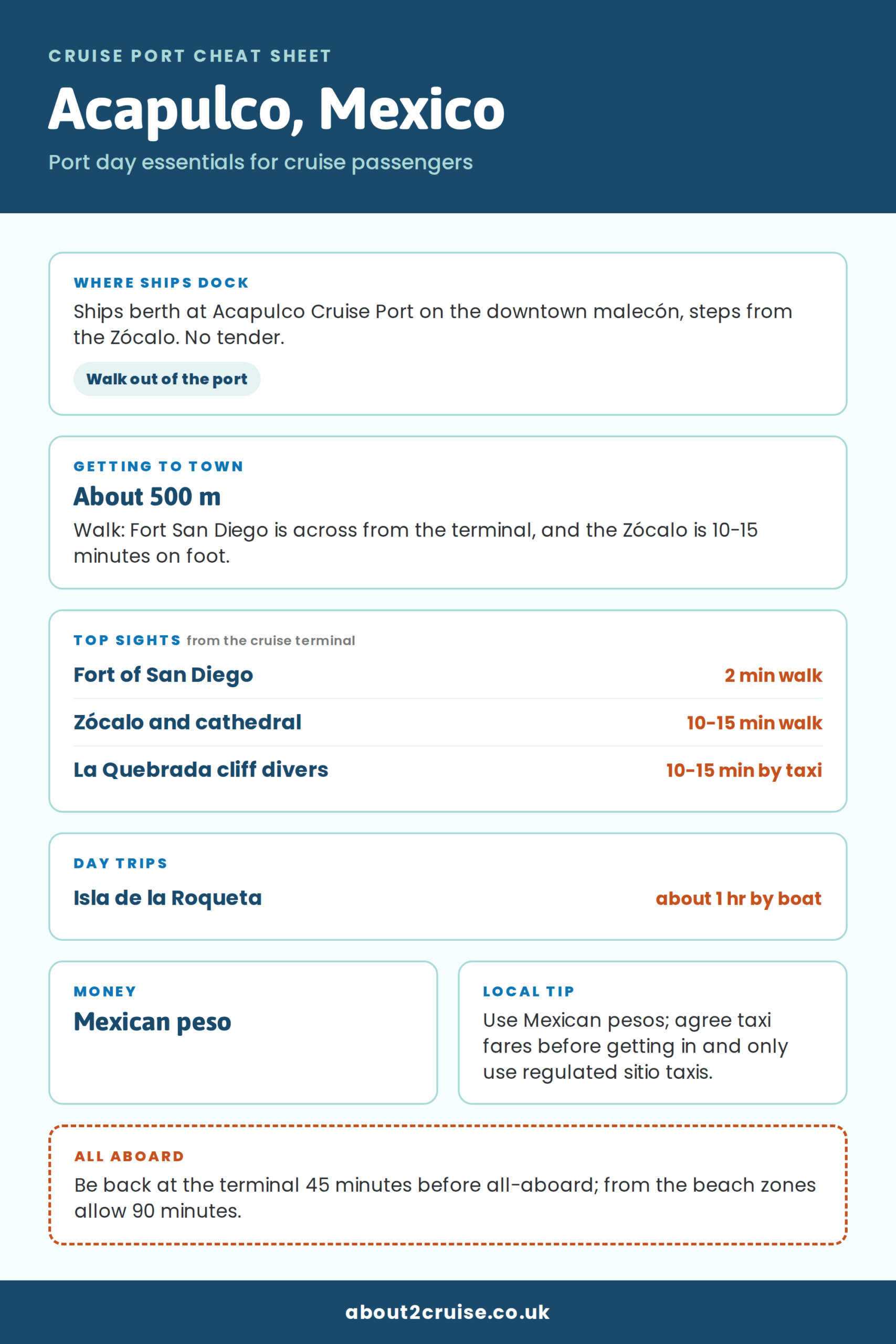
You berth at Acapulco Cruise Port, officially the Puerto Transatlántico Internacional Teniente José Azueta, on the downtown malecón. It’s not a distant commercial quay: you’re beside Parque de la Reina, a few hundred metres from the Zócalo, and directly across from the Fort of San Diego.
There’s one cruise berth with about 406 m of berthing line. Ships up to roughly 333 m in length and 9.1 m draught can use it. Norwegian Encore, Holland America’s Eurodam, and other large ships have called here. No tendering is needed: you walk down the gangway onto the pier and out through the terminal.
The terminal itself is functional rather than a big resort mall. Expect restrooms, a few souvenir and jewellery counters, and tour dispatch. It shares the wider port area with cargo operations, and occasional construction can affect the area around the pier. If you’re on a Pacific coastal itinerary, this is a useful comparison with the California city piers: see our Los Angeles, San Diego, and San Francisco port guides.
Typical day calls run from around 07:00 or 08:00 until 17:00 or 18:00, with some 10:00-to-18:00 calls. Acapulco is not a turnaround port, so very few cruisers start or end a voyage here. Lines that have returned include Norwegian Cruise Line, Holland America, Carnival, Oceania, Regent Seven Seas, and Phoenix Reisen.
For immigration, a cruise passenger landing and re-boarding the same ship does not need a Mexican visa. You travel under a collective permit of up to 21 days, but you must carry a valid passport or travel document. British tourists do not need a visa for Mexico, and the passport should be valid for the stay. Mexican authorities can ask to see the passport and entry stamp, so copies or photos are not enough. Vapes and e-cigarettes are illegal to bring into Mexico, and smoking or vaping in public places can draw a fine of up to 3,000 MXN.

Acapulco cruise port map
Ships dock at Acapulco Cruise Port. From the cruise terminal, Mercado de Artesanías is about a 27-minute walk. Tap a pin for directions.
- Acapulco Cruise PortWhere ships dock
- Mercado de ArtesaníasCraft market · About 27 min walk from the cruise terminal
- Plaza Álvarez (Zócalo)Town square · About 5 km from the cruise terminal
- Acapulco CathedralCathedral · About 5 km from the cruise terminal
- La Quebrada cliff diversCliff diving viewpoint · About 6 km from the cruise terminal
- Playa CaletaBeach · About 5 km from the cruise terminal
- Playa CaletillaBeach · About 5 km from the cruise terminal
- Mercado CentralCentral market · About 4 km from the cruise terminal
- Sinfonía del MarAmphitheatre · About 6 km from the cruise terminal
- MalecónSeafront promenade · About 5 km from the cruise terminal
- Parque de la ReinaPark · About 4 km from the cruise terminal
Is Acapulco Safe for Cruise Passengers? An Honest Look
The UK Foreign, Commonwealth & Development Office advises against all but essential travel to the state of Guerrero, with the only exception being Zihuatanejo/Ixtapa reached by air. Acapulco sits inside that advice-against area. Organised crime is present, and armed crime including shootings has happened in and outside tourist areas. The FCDO also notes that local authority work to reduce risks to tourists in Acapulco’s tourist zone stopped after hurricane recovery efforts, with reports of more crime, robbery, and looting. Travelling against this advice can invalidate standard travel insurance.
That doesn’t mean every cruise line has written the port off. Carnival, Holland America, Norwegian, Oceania, Regent, and Phoenix Reisen have resumed calls. But the official advice is firmer here than for many Mexican cruise ports, and the US State Department places Guerrero at Level 4 Do Not Travel.
For a port day, the realistic risk management is simple. Stay in the traditional tourist area around the pier, Fort San Diego, Zócalo, La Quebrada, and Caleta. Don’t wander alone into unfamiliar neighbourhoods, especially after dark. Use regulated “sitio” taxis from authorised ranks rather than flagging random cabs, because unlicensed drivers have robbed passengers. Use ATMs in daylight inside shops or malls, don’t make large withdrawals, and keep an eye on who is near you. Don’t leave drinks unattended: tainted alcohol has caused illness and deaths in Mexico.
If you’re anxious about the advisory, a ship shore excursion is the easiest way to keep the day structured with vetted transport and a guaranteed return. Independent day plans are still possible in the old town, but they require more caution and a time buffer.
Exploring Old Acapulco on Foot from the Cruise Terminal
The strongest independent option is a walk through traditional Acapulco. The Fort of San Diego is across from the terminal, open Tuesday to Sunday from 09:00 to 17:00. It’s a five-point star fort rebuilt after an earthquake and now a 14-room history museum. Foreign visitors pay about 155 MXN; Mexican nationals pay 85 MXN. Allow one to two hours. No food, flash photography, or pets are allowed inside, and professional cameras carry an extra fee.
The Zócalo, officially Plaza Álvarez, is a 10-to-15-minute flat walk. The cathedral of Nuestra Señora de la Soledad sits on its north side, with a blue and gold tiled interior rebuilt in the 1950s. Men should remove hats, shoulders should be covered, and flash is not used. The malecón, Mercado Central, and the craft market are also within 15 minutes.
Old-town streets are flat but not perfect. Kerbs can be high without ramps, and the heat adds effort. Don’t try to walk all the way to La Quebrada: it’s uphill on narrow, obstructed pavements and the midday sun makes it a poor use of port-day energy. The golden zone along the Costera is also a taxi ride, not a walk.
La Quebrada Cliff Divers: Times, Tickets, and What to Expect
La Quebrada is the one sight most cruise passengers want to see. The cliff is about 45 m high above a channel roughly 7 m wide and 4 m deep, and divers launch from a platform about 35 m up. It’s a genuine working dive show, not a theme-park act.
Show times aren’t perfectly standardised, but published daily times include 13:00 in the afternoon and evening shows around 19:00 or 19:30, 20:00 or 20:30, 21:00 or 21:30, with a torch-lit show at about 22:00 on some nights. Friday, Saturday, and Sunday nights may add light, sound, and torch elements. For most cruise day calls, only the 13:00 show fits before all-aboard, because ships sailing at 17:00 or 18:00 leave before the evening performances. Confirm the day’s schedule locally or through your ship.
Admission to the public viewpoint is cash-based and small. Figures range from about 50 MXN to 100 MXN for adults, with half-price or reduced child entry. Arrive at least 30 minutes before a night show, and earlier for a better spot. The viewpoint has no shade, so the 13:00 show is hot and bright.
The best seated view is from the La Perla restaurant at the Hotel Mirador, which applies a minimum spend. It’s also the better choice for anyone with mobility concerns, because you can sit on a terrace rather than fight for standing space at the public rail.
Best Beaches and Boat Trips from the Port
For a beach day, Caleta and Caletilla are the classic traditional beaches, about 3.5 km from the pier and a short taxi ride. They’re partly sheltered by Isla de la Roqueta, but they’re not always calm. The shoreline is low and the sea can still be rough, especially when a “mar de fondo” swell arrives. Lifeguards operate along the coast from Playa El Morro to Caleta and use red flags to keep people out of the water. If red flags are up, don’t swim: drownings have occurred at Caletilla and other beaches.
Isla de la Roqueta is reached only by boat. Glass-bottom boats run from Caleta and Caletilla, with fares quoted around 150 MXN for the crossing or 250 MXN for a round trip with island time. Boats also leave from the Parque de la Reina dock beside the cruise terminal, priced around 210 MXN online or 300 MXN at the booth, with the last boat back from the island at about 17:00. The crossing takes about an hour on a glass-bottom boat, and the island has a lighthouse walk, beaches, and snorkelling from about age seven with life jackets provided.
For most cruise passengers, the decision comes down to time and sea conditions. Caleta or Caletilla is the convenient beach lunch. Roqueta is worth it if you want a boat trip and a short island walk. The Blue Flag beaches in Acapulco are Pie de la Cuesta, Icacos, and Revolcadero, but they’re not the closest to the port.
Acapulco Taxis, Getting Around, and Making It Back to the Ship
Taxis wait immediately outside the terminal. They’re unmetered, so agree the fare before getting in. Short city-centre trips run roughly 50 to 100 MXN, and a taxi from the hotel zone back to the terminal is about 250 MXN. Drivers and the state transport authority have agreed a minimum fare of about 60 MXN.
Uber, DiDi, and similar ride-hailing services are not authorised in Acapulco. Their vehicles have been detained and fined, and the platforms cannot operate legally until a local law exists. Don’t rely on them. Use the regulated taxi ranks and agree the price up front.
From the gangway to the Zócalo and fort is a 5-to-10-minute walk. La Quebrada is about 2 km and takes 10 to 15 minutes by taxi. Caleta and Caletilla are about 3.5 km. For return-to-ship planning, leave a buffer of at least 45 minutes from the traditional zone and 90 minutes from the beach zones. The ship will not wait for independent passengers.
Money, Cards, and Tipping in Acapulco
Use Mexican pesos as your default. US dollars are accepted in tourist areas, but at a rate 10 to 15 percent worse than the bank rate, and change comes in pesos. Cards work in hotels, larger restaurants, and fixed shops, but taxis, markets, the divers’ viewpoint, and fort tickets are cash. ATMs are available at the terminal and along the Costera. Use them in secure indoor locations during daylight.
Budget in pesos for a short independent day: about 155 MXN for the fort, 50 to 100 MXN for La Quebrada, 50 to 100 MXN for a short taxi, 90 to 160 MXN for a simple lunch, and 350 to 600 MXN for a whole grilled fish at a beach palapa.
Tipping is expected. Leave 10 to 15 percent in restaurants. Round up taxi fares. Porters and helpful luggage handlers get about 20 to 50 MXN.
Local Food and Drinks to Try Near the Port
Acapulco’s food is one of the best reasons to get off the ship. Pescado a la talla is a whole snapper or robalo butterflied and charcoal-grilled, half painted with red chilli adobo and the other half with a green or mayonnaise marinade. It’s sold by size to share. Ceviche and seafood cocktails, called cóctel de mariscos, come in tall glasses with lime, onion, coriander, and crackers. Tiritas are thin strips of fish cured in lime with onion and chilli, a Guerrero-coast speciality. Green pozole is the traditional Thursday dish, served in fondas and cocinas económicas around the Zócalo.
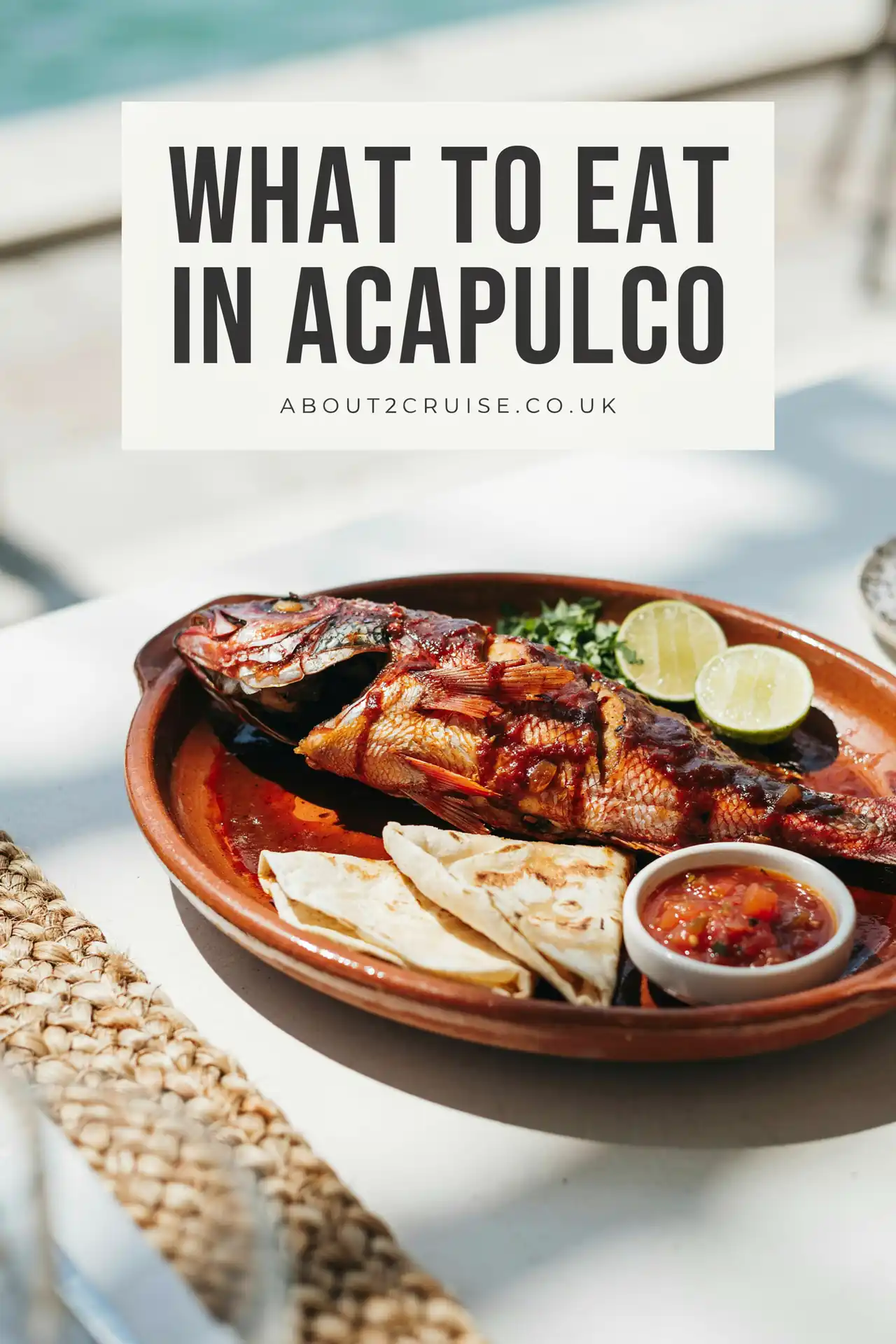
For food near the ship, the palapa seafood stands at Caleta and Caletilla are the place for whole grilled fish. The fondas and market cooks around the Zócalo and Mercado Central are better for pozole, seafood cocktails, and cheap antojitos. In the evening on Plaza Álvarez, stalls sell chilate, a cold roasted cacao and corn drink, and marquesitas, crisp filled wafers. Rough prices are 90 to 160 MXN for a set lunch or pozole, 120 to 220 MXN for a seafood cocktail, and 350 to 600 MXN for a whole grilled fish.
Drink only boiled or bottled water and avoid ice unless you trust the source. Cases of Cyclospora have been reported in travellers returning from Mexico. Hepatitis A and typhoid vaccination are recommended for most travellers to Mexico.
Acapulco Weather, Heat, and What to Pack
Acapulco is hot and humid all year. Average monthly highs run from about 30°C to 33°C, with little seasonal temperature change. Rain concentrates from June to October, with average monthly rainfall over 240 mm in the wettest months, while February to May is much drier. The eastern Pacific hurricane season runs from 15 May to 30 November, peaking from July to September. Cruise itineraries can change when a storm threatens.
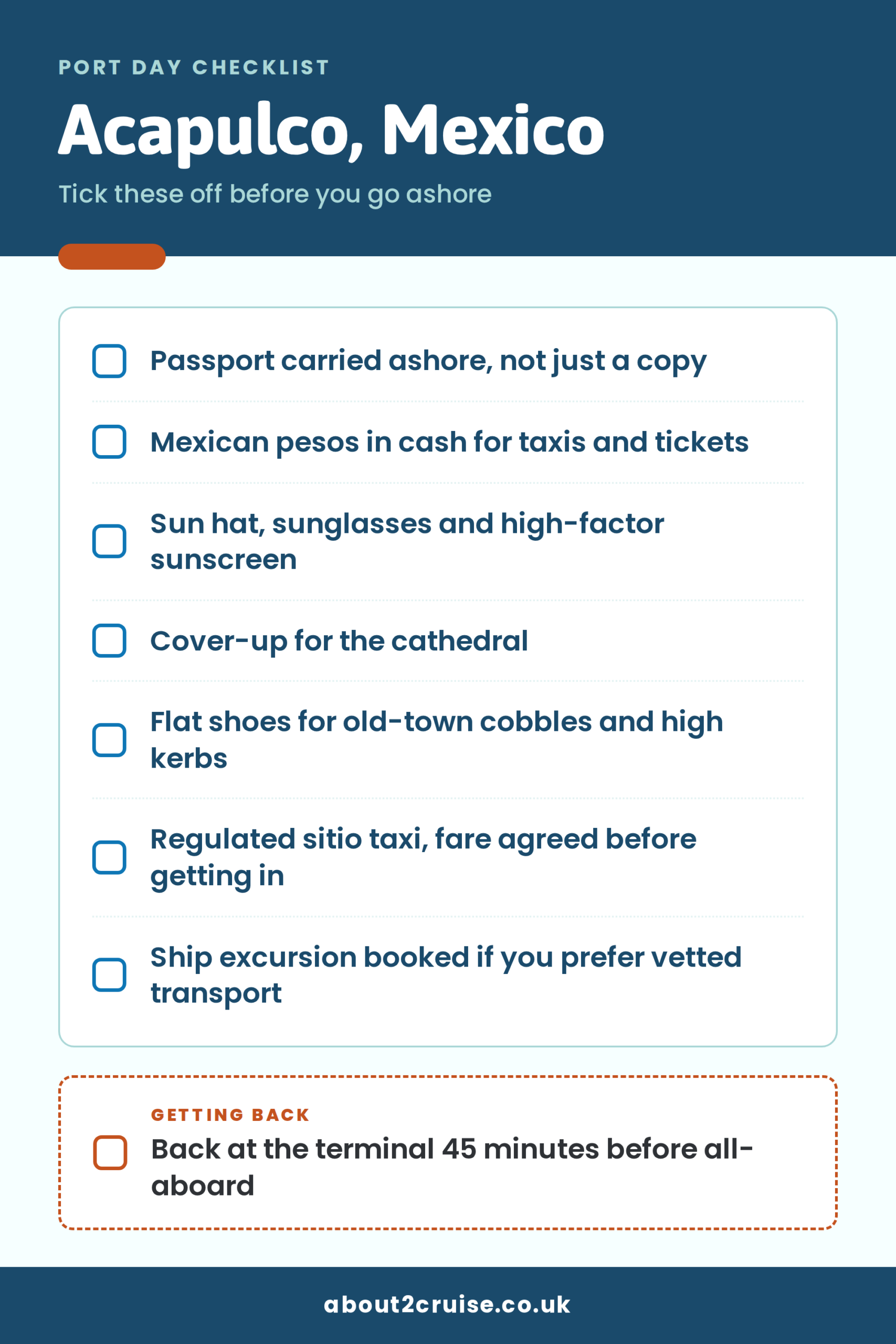
Heat illness is a genuine port-day issue. Tourist assistance staff report treating visitors for heat stroke on the beaches. Bring a hat, sunglasses, and high-factor sunscreen. Wear flat comfortable shoes. In the wet season, pack a lightweight rain shell or poncho. Cover up for churches: no hats or bare shoulders. Swimwear belongs at the beach clubs, not in the old town.
Accessibility and Mobility in Old Acapulco
The terminal is reported as flat with ramps and lifts, but the gangway angle varies with the tide. The old town is not fully accessible: kerbs can be high, the Zócalo lacks ramps in places, the route up to La Quebrada is uphill, and Fort San Diego’s ramps are cobbled and steep.
If you use a wheelchair or walker, don’t attempt the walking route to La Quebrada. Take a taxi to the Hotel Mirador and watch the divers from the seated restaurant terrace instead. Some ship tours state they cannot take wheelchairs but can take collapsible ones: check before you book. A four-hour independent itinerary involves about 2.5 km of walking, and an eight-hour day can reach 5 km, so use taxis between sites.
Souvenirs, Markets, and Helpful Spanish Phrases
The Mercado de Artesanías, a few blocks from the Zócalo, has roughly 560 covered stalls selling Taxco-style silver, Amuzgo textiles, hammocks, ceramics, and leather. It normally opens from about 09:00 to 21:00. Bargaining is expected, especially on multiple buys, and cash is standard. Check silver for a “.925” mark: alpaca alloy can be stamped to imitate a Mexican silver hallmark.
Most shops open from about 09:00 to 18:00, with some closing for siesta between noon and 14:00, though tourist-facing shops stay open when a ship is in port. Useful Spanish: “¿Cuánto cuesta?” means how much; “por favor” is please; “gracias” is thank you; “disculpe” is excuse me. A 10 to 15 percent tip in restaurants is usual.
Shore Excursions vs. Doing Acapulco on Your Own
Ship excursions typically package the city, the fort, the cliff divers, and sometimes a beach stop. One example is a five-hour “Different Faces of Acapulco” tour, activity level 1, priced from around $89.99 including the La Quebrada divers. Independent operators sell similar four-hour city orientations with the divers from about $70 per person, departing the pier. Other tours add beach breaks, boat trips to Roqueta, or market visits.
The decision is different here from many ports because of the FCDO advice. A ship excursion gives vetted transport and a guaranteed return if the day runs long. Independent exploration is workable in the traditional zone, but it requires using official taxis, carrying cash in pesos, and keeping a hard time buffer. Avoid ambitious independent road trips into outlying areas unless you’re with a licensed operator and you understand the current security picture.
Sample Itineraries for a 4, 6, or 8-Hour Port Day
With four hours, do the highlights on a simple loop: walk to the Fort of San Diego, continue to the Zócalo and cathedral, then take a taxi to La Quebrada for the 13:00 cliff show. This leaves enough time to walk back to the ship or take a short taxi.
With six hours, add a beach lunch. After the divers, take a taxi to Caleta or Caletilla for pescado a la talla and a look at the old beach scene. If sea conditions are calm and you’re quick, you could take the glass-bottom boat from Parque de la Reina to Isla de la Roqueta, but check the last return boat carefully.
With eight hours, you can do a fuller traditional-zone day: fort, Zócalo, craft market, La Quebrada, then a taxi to Caleta for lunch and a boat trip to Roqueta. Add a view stop at Sinfonía del Mar or Capilla de la Paz if you have a driver. Keep your return buffer in mind and be back in the terminal area at least 45 minutes before all-aboard.
Emergency Numbers and Tourist Help in Acapulco
The general emergency line is 911. Tourist assistance in Acapulco is available 24/7 from CAPTA on 744 484 9800 or WhatsApp 744 326 0512. Its office is on Costera Miguel Alemán opposite the former Instituto Guerrerense de la Cultura. Lifeguards operate from Playa El Morro to Caleta and put out red flags when the swell is dangerous. If the port captain suspends water activity, don’t try to swim or take small boats anyway.
How to spend a port day in Acapulco
A port day in Acapulco works best if you pick one: a walkable old-town loop with the cliff divers, or the same plus Caleta and the Roqueta boat.
Before you sail
- Check the FCDO Guerrero advice; travel insurance may be invalid if you ignore it.
- Book a ship excursion if you want vetted transport and a guaranteed return.
- Bring Mexican pesos in cash for taxis, market stalls and the divers' viewpoint.
Short port day: under 6 hours
- On dockingWalk to Fort of San Diego2 min walkThe fort is directly across from the cruise terminal, a few minutes on foot.
- +20 minVisit Fort of San DiegoOpen Tuesday to Sunday 09:00 to 17:00; allow an hour. Pay cash in pesos; no food, flash or pets inside.
- +1 hr 30 minWalk to the Zócalo and cathedralA 10-15 minute flat walk. Cover shoulders and remove hats inside the blue-tiled cathedral.
- +2 hrsLunch near the Zócalo or Mercado CentralTry pozole verdeFondas around the Zócalo and Mercado Central serve green pozole and seafood cocktails for small cash.
- +3 hrsTaxi to La QuebradaAgree fare firstUse a regulated sitio taxi, agree the fare before getting in. You are aiming for the early-afternoon cliff dive show.
- +3 hrs 30 minWatch the cliff diversBuy a cash ticket at the public viewpoint; arrive up to 30 minutes early. The viewpoint has no shade.
- All-aboard minus 1 hrTaxi back to the cruise terminalAgree the fare before getting in. The ride takes about 10-15 minutes; if taxis are scarce, wait at the official rank.
The time on the map is the whole walk, every stop added together.
Open this walking route in Google Maps
If plans change: If the divers are cancelled or the queue is too long, skip La Quebrada and spend longer at the craft market and malecón, which are close to the ship.
Long port day: 8 hours or more
- On dockingWalk to Fort of San Diego2 min walkThe fort is directly across from the cruise terminal, a few minutes on foot.
- +30 minVisit Fort of San DiegoOpen Tuesday to Sunday 09:00 to 17:00; allow up to two hours. Pay cash in pesos; no food, flash or pets inside.
- +1 hr 45 minWalk to the Zócalo, cathedral and craft marketThe Zócalo and cathedral are 10-15 minutes on foot. The Mercado de Artesanías is a few blocks further and cash is standard.
- +3 hrsTaxi to La Quebrada and watch the diversAgree fare firstTake a regulated sitio taxi to the cliff-diver viewpoint and watch the early-afternoon show. Arrive up to 30 minutes early.
- +4 hrs 15 minLunch at Caleta beachTry pescado a la tallaTaxi to Caleta and order pescado a la talla or ceviche at a palapa seafood stand. Agree the beach taxi fare first.
- +5 hrs 30 minGlass-bottom boat to Isla de la RoquetaBoats run from Caleta or from the Parque de la Reina dock beside the terminal. Check the last return boat, usually around 17:00.
- All-aboard minus 90 minBoat back, then taxi to the cruise terminalReturn by boat to Caleta and take a taxi to the terminal. If boats are suspended, stay on Caleta and leave earlier by taxi.
This map shows the taxi ride from the ship. The time is the drive only, not your time ashore.
Open the taxi route in Google Maps
If plans change: If the port captain suspends boats to Isla de la Roqueta, skip the island and stay on Caleta or return early to the old-town craft market.
This is one of Mexico’s Pacific coast cruise ports. Our Mexico cruise ports guide covers the others on the Pacific and the Caribbean.
If your cruise continues along the Pacific coast, Valparaíso is the Chilean port to the south and a common turnaround for South America itineraries.
Frequently Asked Questions
Are there left-luggage facilities at the cruise terminal or airport?
No. The airport has no left-luggage or baggage storage, and the cruise terminal is a day-call terminal, not a turnaround facility. Third-party storage in the Acapulco area is extremely limited and not practical for a port day, so plan to carry what you take ashore.
Is there terminal Wi-Fi, mobile coverage, or charging?
There’s no reliable first-party confirmation of terminal Wi-Fi or charging points. Mobile roaming generally works in the downtown area, but coverage can be patchy inside thick-walled buildings. Bring a charged phone, a portable power pack, and your own data plan if you need navigation.
What happens if the sea is too rough for Isla de la Roqueta?
The port captain can suspend all small-boat activity at Caleta, Caletilla, and Isla de la Roqueta during strong “mar de fondo” swell. If that happens, switch to a land-based plan: the fort, Zócalo, craft market, and La Quebrada. Don’t attempt to negotiate with boatmen to go anyway: the suspension is for safety.
Can I visit Acapulco on a cruise during hurricane season?
Cruise lines do call during the eastern Pacific hurricane season, but itineraries can change at short notice. If Acapulco is on your schedule from May to November, check the forecast before you sail and build flexibility into your plans. The port may still be hot and sunny on a day with rough offshore swell, so the cliff divers and old town are the most weather-proof options.
Do I need to carry my passport ashore?
Yes. Mexican authorities can ask to see your passport and entry stamp, and copies or photos are not accepted. Keep it secure in a money belt or zipped day bag and don’t leave it in a beach bag or taxi.
Last Updated: 15 November 2026