
Almería is one of Spain’s easiest cruise ports: your ship ties up beside the city, there is no tender, and the historic centre is a flat 10–15-minute walk away. In a single call you can climb a huge Moorish fortress, see a fortress-cathedral, eat excellent free tapas and still be back on board with time to spare.

Where You Dock and What the Terminal Is Like
Most cruise ships use one of two alongside berths: Muelle de Levante (220 metres, 9 metres depth) or Muelle de Ribera II (450 metres, 9.5 metres depth). There isn’t a published berth allocation by cruise line, so check your ship’s programme or listen for the onboard announcement. Either way, you won’t need a tender, you step straight onto the quay.
The shared passenger terminal, Estación Marítima, sits between the two berths and has a hospitality desk, a city map, wi-fi and toilets. If you arrive at Ribera II, the route from the boarding bridge into the terminal is step-free with ramps and lifts. A dedicated cruise terminal is also being fitted out in the south-west corner of the Estación Marítima, with two floors, a panoramic lift, waiting area, charging points, internet and a tourist information desk, but it isn’t expected until the first four months of 2027. For now, expect a working ferry terminal rather than a glamorous cruise terminal.
This is very much a small-ship port. Boutique and premium lines make up most calls. In the latest counted year the port handled 28 cruise calls and 18,112 cruise passengers, with around 30 calls forecast. Excursion coaches park beside the berths, and shops and restaurants signed up to the Almería Cruise Friendly programme offer discounts and more personal service to cruise visitors.
Almería cruise port map
Ships dock at Muelle de Levante. From there, Cable Inglés is about a 8-minute walk, Catedral de Almería about 12 minutes and Parque Nicolás Salmerón about 12 minutes. Tap a pin for directions.
- Muelle de LevanteWhere ships dock
- Estación MarítimaWhere ships dock
- Cable InglésOre-loading structure · About 8 min walk from Muelle de Levante
- Catedral de AlmeríaCathedral · About 12 min walk from Muelle de Levante
- Playa de las AlmadrabillasBeach · About 12 min walk from Muelle de Levante
- Parque Nicolás SalmerónPark · About 12 min walk from Muelle de Levante
- Mercado CentralMarket hall · About 17 min walk from Muelle de Levante
- Plaza de la ConstituciónSquare · About 17 min walk from Muelle de Levante
- Estación IntermodalTrain and bus station · About 18 min walk from Muelle de Levante
- Plaza Manuel Pérez GarcíaSquare · About 19 min walk from Muelle de Levante
- Alcazaba de AlmeríaMoorish fortress · About 20 min walk from Muelle de Levante
- Refugios de la Guerra CivilCivil War shelters · About 50 km from Muelle de Levante
- Plaza de las FloresSquare · About 36 km from Muelle de Levante
- Cabo de Gata-Níjar Natural ParkNatural park · About 38 km from Muelle de Levante
- Oasys MiniHollywoodTheme park · About 21 km from Muelle de Levante
Getting Into the City: Walking, Taxis, Buses and the Tourist Train
The port is bolted onto the city, so getting around is simple. The commercial and tourist centre is about a five-minute walk from the berths. The old town is roughly 10 minutes north through Parque Nicolás Salmerón, and the cathedral and Plaza Vieja are 10–15 minutes from the port gate. Most of the immediate route is flat, though the historic centre mixes paving, tiles and cobbles.
- On foot: Usually your best option. The route is safe, direct and well used.
- Taxi: Taxis wait at the port. A short city ride was recently quoted at about €4.51 one way by day. Stick to the official rank; unlicensed taxis can get you a fine of up to €600.
- City bus: Stops near the port. A single is around €1.05. A 10-ride Surbus bonobús costs €4.45 plus a €3 refundable deposit, and you get free transfers within an hour.
- Tourist train: From Plaza Emilio Pérez (Plaza Circular) the ride is about 50 minutes and costs €3.50, with children under 4 free. Departures: Friday and eve-of-holiday at 16:45, 18:00 and 19:15; Saturday, Sunday and holidays at 10:30, 11:45, 13:00, 16:45, 18:00 and 19:15. There’s also a port-run tourist train when operating from the port area; it seats 54 and takes about an hour. Check on the day because schedules can vary.
How to Spend One Day in Almería from a Cruise Ship
If you’re on a typical port call, start with the Alcazaba first in the morning before the stone ramparts heat up. Afterwards, walk or taxi down into the old town for the cathedral, Plaza Vieja, the Mercado Central and a relaxed tapas crawl. Finish with the short seafront walk past the Cable Inglés and back to the ship. If your call falls on a Monday, swap the Alcazaba for more time in the old town, the Alcazaba is closed on Mondays except public holidays.
Before you sail
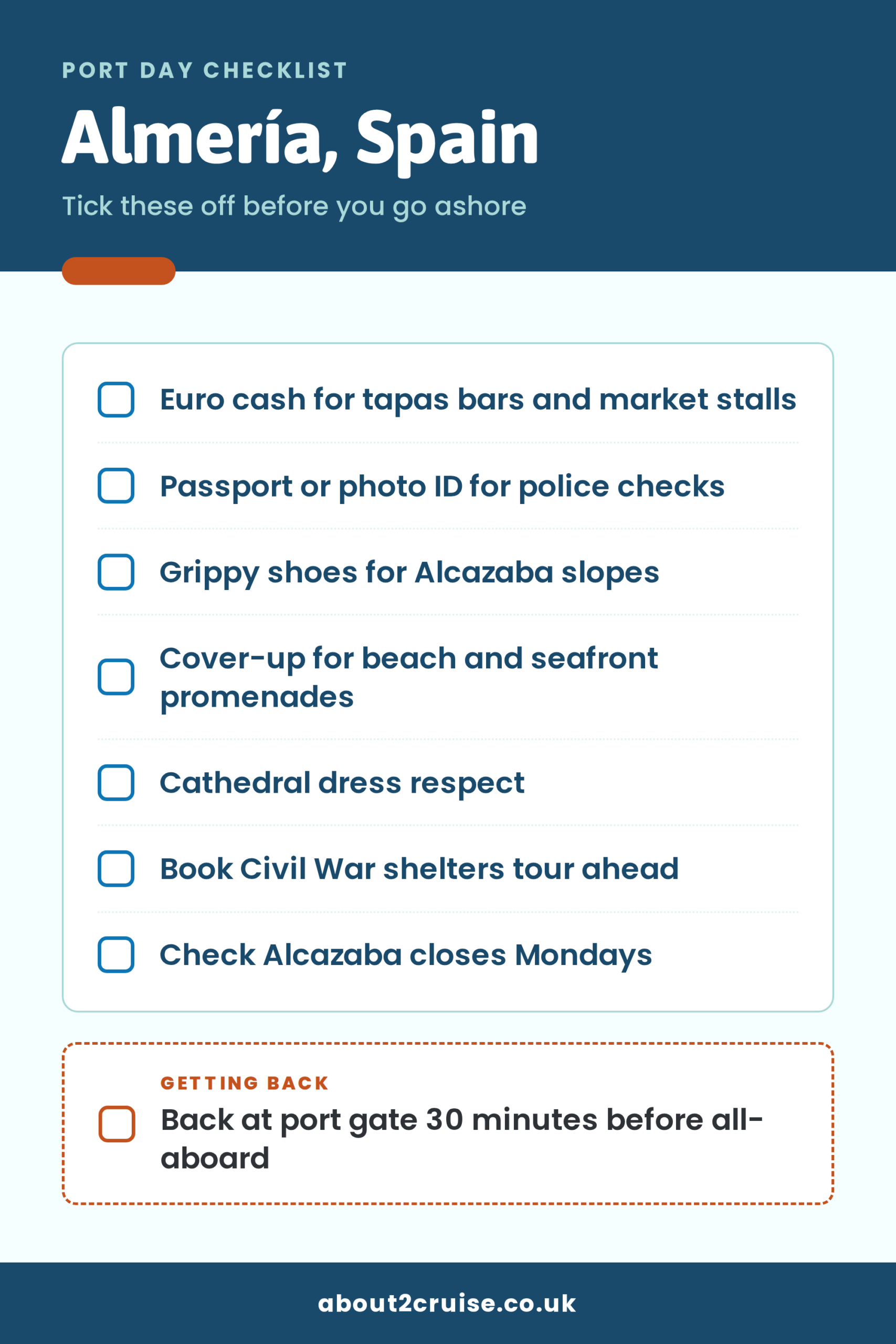
- Book Civil War shelter tours ahead; groups are small and times limited.
- Book Saturday Alcazaba guided tours by phone on 950 801 008.
- Pre-book a driver or ship excursion for Cabo de Gata or Tabernas.
Short port day: under 6 hours
- On dockingWalk to the old townFlat 10-minute walk north through Parque Nicolás Salmerón from the port gate to the old town.
- +15 minAlcazaba de AlmeríaGo earlySteep 15-minute uphill walk. Allow 90 minutes inside; free for EU citizens, small fee for others. Closed Mondays.
- +2 hrsCathedral and Plaza ViejaWalk downhill to the fortress-cathedral, then Plaza Vieja. Last entry 45 minutes before closing; visits pause around masses.
- +3 hrsLunch around Plaza ViejaTry chériganThe main restaurant zone is around Plaza Vieja and Plaza de las Flores. Order chérigan or a tapas crawl; three rounds can cost very little.
- +4 hrsMercado CentralWalk to the iron-and-glass Mercado Central. Morning tastings at Kiosco La Selecta run to about 11:30; it shuts at 15:00 on weekdays.
- +4 hrs 30 minCable Inglés and seafrontA 10-minute walk back towards the port brings you to the listed Cable Inglés on Playa de las Almadrabillas.
- All-aboard minus 30 minWalk back to the shipThe Cable Inglés is beside the port, so you are only a few minutes from the terminal.
The time on the map is the whole walk, every stop added together.
Open this walking route in Google Maps
If plans change: If the Alcazaba is closed on a Monday, swap it for more time in the cathedral, Mercado Central and the old-town tapas bars.
Long port day: 8 hours or more
- On dockingWalk to the old townFlat 10-minute walk north through Parque Nicolás Salmerón from the port gate to the old town.
- +15 minAlcazaba de AlmeríaGo earlySteep 15-minute uphill walk. Allow 90 minutes inside; free for EU citizens, small fee for others. Closed Mondays.
- +2 hrsCathedral and Plaza ViejaWalk downhill to the fortress-cathedral, then Plaza Vieja. Last entry 45 minutes before closing; visits pause around masses.
- +3 hrsMercado CentralWalk to the iron-and-glass Mercado Central. Morning tastings at Kiosco La Selecta run to about 11:30; it shuts at 15:00 on weekdays.
- +3 hrs 30 minLunch around Plaza ViejaTry chériganThe main restaurant zone is around Plaza Vieja and Plaza de las Flores. Order chérigan or a tapas crawl; three rounds can cost very little.
- +4 hrs 30 minCivil War shelters tourBook aheadMeet at Plaza Manuel Pérez García. Tours run Tuesday, Thursday and Sunday and last about 1 hour 15 minutes; not suitable for claustrophobia or breathing problems.
- +6 hrsCable Inglés and seafrontA 10-minute walk back towards the port brings you to the listed Cable Inglés on Playa de las Almadrabillas, then walk to the ship.
The time on the map is the whole walk, every stop added together.
Open this walking route in Google Maps
If plans change: If the Civil War shelter tour is sold out or not running, use the time for a longer tapas crawl on Calle Jovellanos and the Cable Inglés seafront walk.

Visiting the Alcazaba: Tickets, Opening Hours and the Climb
The Alcazaba is the second-largest Muslim fortress in Spain after the Alhambra, and a full visit takes about 90 minutes. Entry is free for EU citizens who can prove EU citizenship; other nationalities pay just €1.50. You don’t need to book general admission in advance. Saturday guided tours should be booked by phone on 950 801 008 though.
Opening hours:
- 21 March–20 June: Tuesday–Saturday 09:00–21:00.
- 21 June–20 September: Tuesday–Saturday 09:00–15:00 and 20:00–22:00.
- 21 September–20 March: Tuesday–Saturday 09:00–18:00.
- Sundays, public holidays and Mondays that precede a public holiday: 09:00–15:00.
- Closed Mondays except public holidays. Last entry is 30 minutes before closing.
The approach is a steep uphill walk; allow about 30 minutes return on foot or take a taxi from the port. The climb involves exposed stone, and the upper ramparts get punishingly hot by midday from June to September. Go early, wear grippy shoes, carry water, and take photos from the tower viewpoints over the port, sea and desert hills.
Cathedral, Civil War Shelters and Old Town Highlights
Almería’s cathedral is also a fortress, and because it’s an active place of worship, visits can pause around mass times. General admission is €7; over-65s pay €6, ages 13–17 and students pay €5, and under-12s and residents of Almería city enter free. An audio guide is included free, and last entry is 45 minutes before closing. Hours: Monday–Friday 10:00–14:30 and 16:00–19:00, Saturday 10:00–19:00, Sunday 15:00–18:00. The entrance is via Calle Velázquez. A combined cathedral plus Monasterio de las Puras ticket is sold at €12. Dress respectfully because it’s a working church.
The Civil War shelters are a more unusual stop. More than 4 km of galleries were dug to protect about 40,000 people after 754 bombs fell on the city. Guided tours last about 1 hour 15 minutes and meet at Plaza Manuel Pérez García. They run Tuesday at 13:00, Thursday at 11:30 and Sunday at 12:30, with tickets from around €8–11 depending on the seller. Book ahead because groups are small and times are limited. The shelters are underground and enclosed, so they’re not suitable if you have claustrophobia or breathing problems.
The Mercado Central, opened in 1893, is an iron-and-glass market hall worth seeing. Hours are Monday–Friday 08:00–15:00 and 17:30–20:30, Saturday 08:00–15:00. Tastings at the Kiosco La Selecta stalls are best between 10:00 and 11:30.
Just along the seafront, the Cable Inglés ore-loading structure on Playa de las Almadrabillas is a listed industrial landmark and an easy walk from the ship.
Where to Eat Tapas in Almería
In Almería province a free tapa comes with every wine, beer, soft drink or water while the kitchen is open, and in the city you usually choose it from a list. Tapas bars cluster within about 200 metres of each other on Calle Jovellanos, Calle de las Tiendas and around Plaza de la Constitución. Three rounds of drinks with tapas can cost about €12, so you can eat extremely well without spending much.

Casa Puga at Calle Jovellanos 7 has been open since 1870 and is the city’s best-known tapas bar. Each drink comes with a free tapa chosen from the board, typically around €3. Go early or expect to wait. The main restaurant zone is in the historic centre, a little over 10 minutes on foot from the port, around Plaza Vieja and Plaza de las Flores.
Local dishes to look for include migas, ajo colorao, ajo blanco, trigo, acelgas esparragadas, lomo al ajillo, bacalao con tomate, and the chérigan, toasted bread spread with alioli and topped, classically, with tuna. Tomate Raf, the green greenhouse tomato grown only in the province’s greenhouses, is served as a salad with olive oil and garlic. Carry a little euro cash: small bars and market stalls may prefer it, and US dollars are not widely accepted.
Day Trips from Almería: Cabo de Gata, Tabernas and More
For a normal cruise port day, independent public transport to Cabo de Gata, Tabernas or Granada doesn’t fit comfortably. If you want to visit any of these, use a ship excursion or a pre-booked driver unless your call is unusually long.
- Cabo de Gata-Níjar Natural Park: about 30 km from the city, roughly 25 minutes by car. Public buses from the Estación Intermodal reach the village of Cabo de Gata in about an hour and San José for around €2–3 each way. Flamingos at Las Salinas are seasonal and never guaranteed.
- Tabernas MiniHollywood: about 30 km and 30 minutes from the city, on the N-340A at km 464. The park generally opens April to November, with days varying by season. Adult admission is from about €30 and child admission from about €20.
- Granada and the Alhambra are too far for a relaxed independent port day; book a ship excursion if it’s offered.
Beaches, Seafront Walks and Photo Spots Near the Port
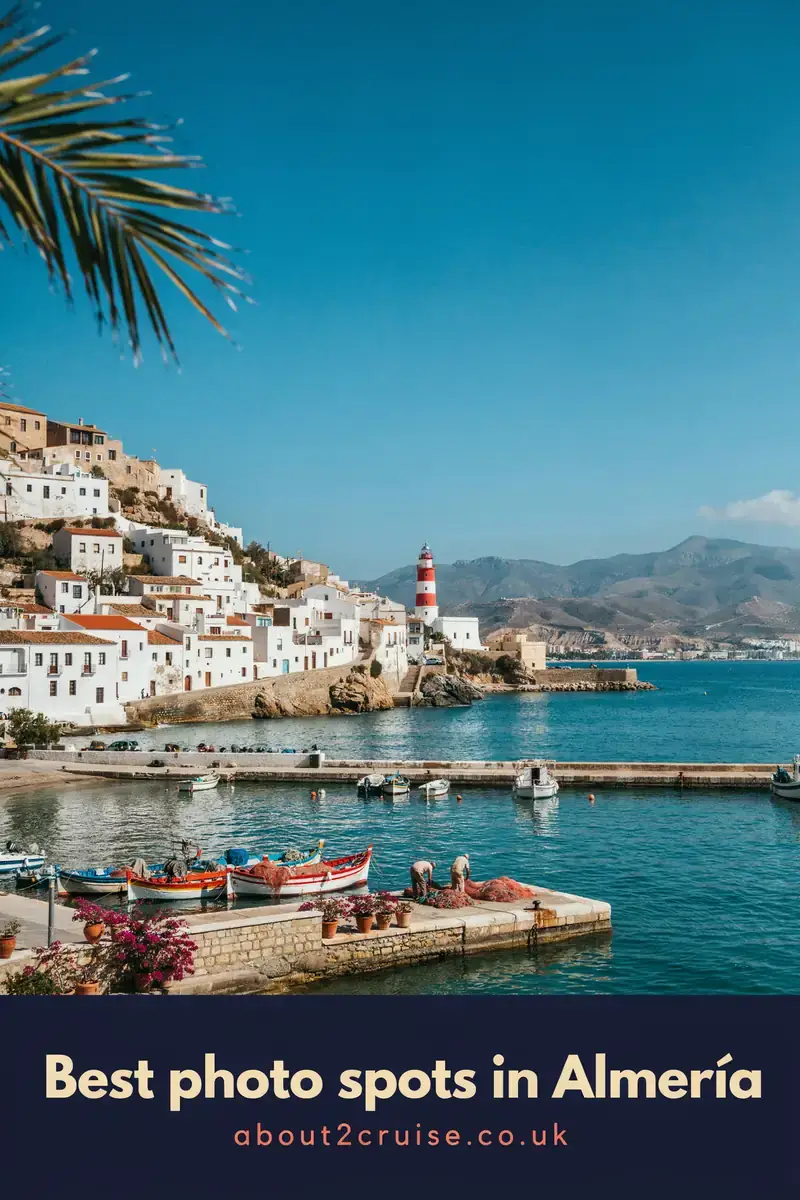
Playa de las Almadrabillas and the Cable Inglés sit right next to the port, making an easy leg-stretch before or after sightseeing. The Alcazaba’s towers offer the best views over the port, sea and desert hills, and early morning is the ideal time before the heat builds. The Mercado Central’s iron-and-glass hall is a good photographic stop in the old town. If you visit the Cabo de Gata area, Las Salinas can draw birdlife including flamingos at certain times of year.
Practical Tips for Your Almería Cruise Stop
- Money: Spain uses the euro. Use official exchange offices or banks; unofficial changers may pass counterfeit notes. US dollars are not widely accepted, and small bars or market stalls may prefer cash.
- Safety: Almería is a very safe city for tourists, but standard pickpocketing precautions apply in markets and at major sights. Street thieves use distraction techniques and work in teams. Thieves have been known to pose as police; genuine officers will ask for ID but never for your wallet. Carry photo ID, as police can ask for it. Only use licensed taxis; using an unlicensed taxi can result in a fine of up to €600.
- Dress: It is illegal in parts of Spain to be in the street in only a bikini or swimming shorts, and going bare-chested is illegal in some areas, including seafront promenades and adjacent streets. Cover up when returning from the beach. The Alcazaba involves exposed stone and slopes, so wear grippy shoes. The cathedral is a working church, so dress respectfully.
- Weather: The port averages 322 sunny days a year and 22°C. Average daily maxima range from 19.6°C in March and 21.4°C in April, to 24.1°C in May, 27.9°C in June, 30.5°C in July, 31.0°C in August, 28.4°C in September, 24.5°C in October and 20.5°C in November. Rainfall is very low in summer: 1 mm in July and August, 5 mm in June, 12 mm in May, 27 mm in October and 28 mm in November. The city records 2,994 hours of sunshine a year and 65% average relative humidity.
Getting to the Train Station, Airport and Where to Stay
The train and bus station, Plaza de la Estación, is 1.3 km from the port, about 15 minutes on foot. One direct Alvia a day runs to Madrid Puerta de Atocha in about 6 hours 40 minutes, and five trains a day run each way to Granada, taking about 2 hours 40 minutes to 3 hours 10 minutes. The intermodal station has no left-luggage office, so don’t plan to store bags there. Car rental desks are at Plaza de la Estación, and the A-7 motorway is under 2 km from the port.
Almería airport is 9 km east of the city. Urban bus line 30 runs from the airport to the city centre 365 days a year, taking about 35 minutes. A taxi from the airport to the city centre costs about €20 and takes about 10 minutes, plus an airport surcharge of €5.09 and €0.66 per item of luggage over 60 cm. Some port information also mentions bus line 22 from Plaza de la Estación as the airport connection.
Almería is almost always a port of call rather than an embarkation port, so treat hotel choices as useful for independent pre- or post-cruise stays rather than a guarantee of cruise turnaround logistics. If you’re staying independently, good port-adjacent options include Ohtels Gran Hotel Almería on Avenida Reina Regente 8, next to the port and Salmerón Park; Hotel Costasol, about 800 m from the docks; Hotel Catedral Almería, a restored 1850 mansion with a rooftop pool; and Nuevo Torreluz on Plaza de las Flores, five minutes from the cathedral and Alcazaba.
More Spanish Cruise Ports to Explore
If Almería is part of a longer Spanish or western Mediterranean itinerary, take a look at Málaga, Alicante and Valencia, or browse the wider Spanish cruise ports guide.
Common Questions About Visiting Almería on a Cruise
Is there left luggage at the port or station?
The port does not advertise a left-luggage office, and the bus/train Estación Intermodal is reported by users to have no left-luggage office. If you need bag storage, look for a commercial luggage network or a nearby hostel service.
Are there cash machines near the port?
The main city centre banks and ATMs are a short walk away, but the immediate port area is not a banking district. Have a little euro cash for tapas bars and market purchases.
What if my cruise calls on a Monday?
The Alcazaba is closed Monday except public holidays, though the cathedral, Mercado Central and old town remain walkable. Civil War shelter tours operate only Tuesday, Thursday and Sunday, so you would miss those on a Monday call.
Can I pay in US dollars?
No, euros are used in Spain. Exchange currency at an official exchange office or bank, not with unofficial changers.
How accessible is the route into town?
The terminal route from Ribera II is step-free, and the immediate port-to-city route is largely flat. The historic centre has paving, tiles and cobbles, and the Alcazaba is steep with exposed stone, so it is not ideal for wheelchairs or limited mobility.
Can I walk to a beach from the ship?
Yes, Playa de las Almadrabillas and the Cable Inglés are immediately beside the port. If you swim, bring a cover-up because walking along seafront promenades or streets in swimwear can be fined in parts of Spain.