
Busan ships dock at the Busan Port International Passenger Terminal near Busan Station, or, if yours is one of the big ones, across the harbour at Busan Yeongdo Cruise Terminal. Either way you’re in the city within 20 minutes by shuttle, taxi or metro. Nampodong’s markets, Gamcheon’s hillside village and Haeundae Beach all make a solid day.
Which Busan cruise terminal will your ship use?
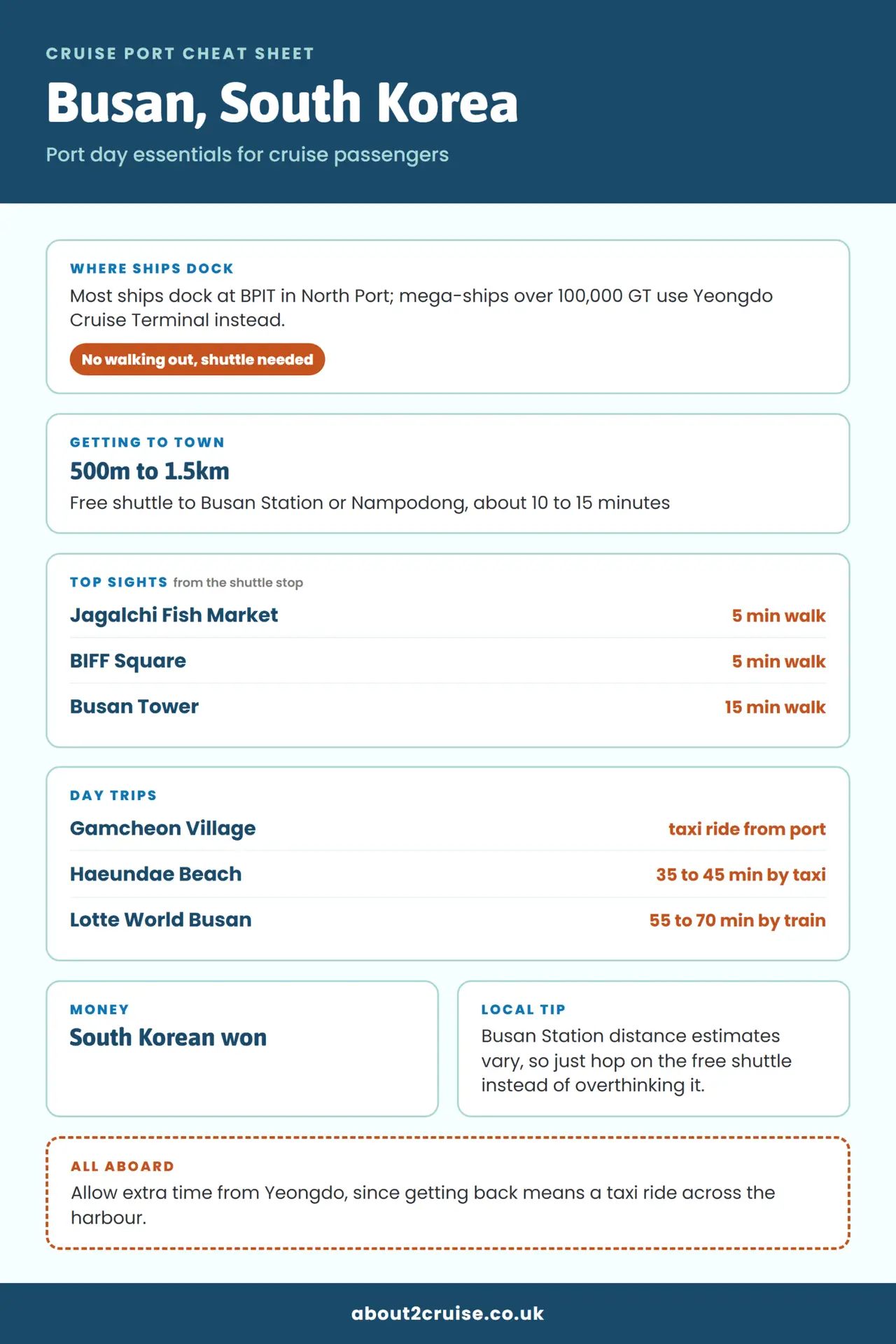
Your Busan cruise terminal depends on how big your ship is. Most vessels dock at the Busan Port International Passenger Terminal (BPIT) in North Port, while anything over 100,000 GT (gross tonnage) usually gets sent across the harbour to the Busan Yeongdo Cruise Terminal on Yeongdo Island, or wherever there’s a free berth if North Port is full.
The two terminals have confusingly similar names, so check your cruise line’s documents rather than guess.
| Terminal | Location | Typically used by |
|---|---|---|
| Busan Port International Passenger Terminal (BPIT) | North Port, Dong-gu, next to Busan Station | Most cruise ships |
| Busan Yeongdo Cruise Terminal | Yeongdo Island, across the harbour | Mega-ships over 100,000 GT, or overflow when North Port is full |
Inside BPIT, immigration and customs are on the lower floors, and departure and arrival halls split across the second and third levels of the five storey building. If your cruise calls elsewhere in the country too, the South Korea cruise ports guide covers the rest of the itinerary.
Busan cruise terminal to city centre
Getting from the Busan cruise terminal to the city centre is easiest from BPIT, where Busan Station is close enough to walk to: somewhere between 500 metres (an easy walk, or a 5 minute taxi) and 1.5km (15 to 20 minutes), linked by an elevated walkway via Exits 8 and 9.
A free shuttle covers the same ground to Busan Station or Nampodong in 10 to 15 minutes, so just hop on one rather than fretting over which distance figure is right.
From Busan Yeongdo Cruise Terminal
From here the city centre is a taxi job, not a walk. Busan Station is about 4km away, and a taxi to Nampo-dong or Busan Station takes roughly 15 to 20 minutes.
By road it’s around 50 minutes to Gimhae International Airport. BPIT has the better airport run, at about 16km or 25 minutes by car.
Build in extra time to get back to the ship from here, since it’s a taxi ride across the harbour rather than a quick walk or shuttle.

Getting around Busan on a port day
Getting around Busan on a port day is easiest by metro. It’s clean, cheap, signed in English, and gets you to most of the sights worth seeing in a few hours ashore. From Busan Station, line 1 runs straight to Nampodong, Jagalchi and Beomeosa, and you change to line 2 for Haeundae and Gwangalli.
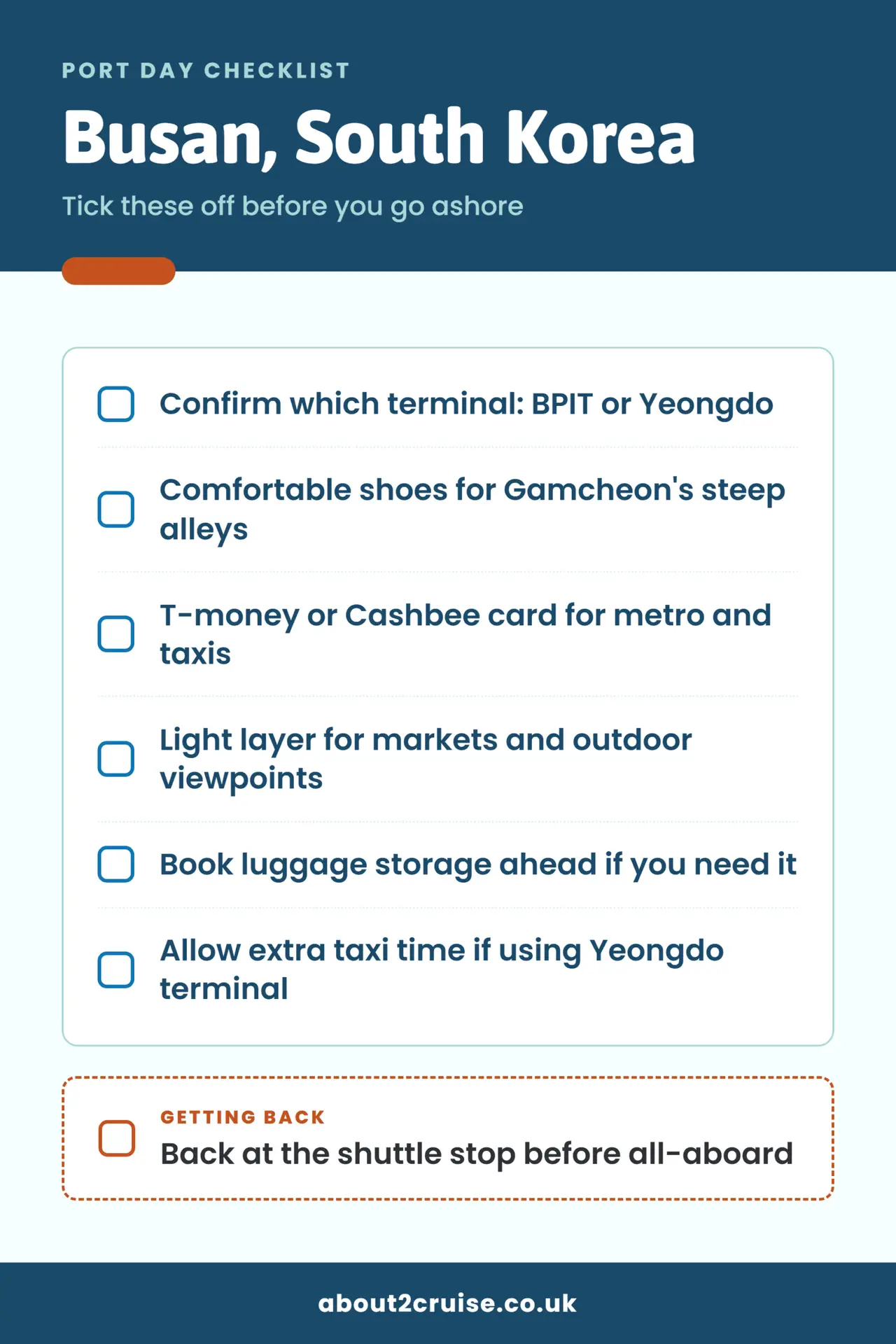
- Pay with a T-money or Cashbee card, or grab a single ticket from the machines
- Haeundae Beach, Haedong Yonggungsa and Beomeosa are all 30 to 50 minutes away by metro or taxi
- Taxis are everywhere and cheap, and cards work almost everywhere you go
For general advice on staying safe while you’re out on your own, see our port safety tips guide.
Things to do near Busan cruise port
Things to do near Busan cruise port range from a quick wander to a half day out, depending on how long you’ve got ashore. Nampodong and BIFF Square are close enough to the North Port terminal to reach on foot or by shuttle, while Haeundae Beach and Lotte World Adventure Busan need a taxi or a train.
Before you sail
- Check your cruise line's documents for which Busan terminal you'll use
- Don't rely on Busan Station lockers, as the service isn't guaranteed
- Book luggage storage near the terminal ahead if you want it sorted early
Short port day: under 6 hours
- On dockingTake the free shuttle to NampodongNo walk outMost ships can't walk straight into town. The free shuttle covers the ground to Nampodong in about 10 to 15 minutes.
- +20 minJagalchi Fish MarketA few minutes' walk from the shuttle stop. Browse the stalls and try hoe, Korean raw fish, straight from the tanks.
- +50 minBIFF SquareTry ssiat hotteokA short walk from the fish market. Grab a seed-stuffed hotteok pancake, first popularised right here.
- +1 hr 30 minLunch in NampodongTry dwaeji-gukbapPork and rice soup is Busan's signature dish, served all through the old downtown's backstreets.
- +2 hr 30 minBusan Tower, Yongdusan ParkA walk uphill from the old downtown for a 360 degree view over the harbour and city.
- All-aboard minus 1 hrBack to the shuttle stopHead back towards Nampodong's shuttle pickup point, or flag a taxi if you're running late.
The time on the map is the whole walk, every stop added together.
Open this walking route in Google Maps
If plans change: If BIFF Square feels too packed, Jagalchi's side streets have the same street food with more room to move.
Long port day: 8 hours or more
- On dockingTake the free shuttle to NampodongGo earlyThe shuttle takes about 10 to 15 minutes. Going early leaves more daylight for Gamcheon later.
- +20 minJagalchi Market and BIFF SquareTry ssiat hotteokWander both, a few minutes apart, trying the seed-stuffed hotteok and fresh hoe until it's time for lunch.
- +2 hrLunch in NampodongTry dwaeji-gukbapPork and rice soup, a Busan staple served all through the old downtown streets.
- +3 hrTaxi to Gamcheon Culture VillageShort taxi rideA taxi from the old downtown up to the hillside village of pastel houses and stone alleys.
- +3 hr 30 minWander Gamcheon's alleysSteep lanes and stairways wind through the village, lined with small cafes and murals, worth a couple of hours.
- +5 hr 30 minHaneul Maru Observation DeckGolden hour lightThe whole hillside opens up from here, rows of pastel rooftops with the coast behind them.
- All-aboard minus 90 minTaxi back to the terminalAllow extra time, since Gamcheon is a taxi ride from the port rather than a walk.
This map shows the taxi ride from the ship. The time is the drive only, not your time ashore.
Open the taxi route in Google Maps
If plans change: If taxis queue up at Gamcheon, head back to Busan Tower at Yongdusan Park for harbour views instead.
- Nampodong and BIFF Square: the old downtown at full volume, close enough to the North Port terminal for a couple of hours of browsing and eating
- Jagalchi Fish Market: a few minutes from Nampodong, worth wandering through even if you’re not buying anything
- Gamcheon Culture Village: a hillside maze of pastel houses and stone alleys, a taxi ride from the port area
- Haeundae Beach: about 15km from the cruise terminal, 35 to 45 minutes away by taxi depending on traffic
- Lotte World Adventure Busan: in Osiria, around 55 to 70 minutes from the terminal via Busan Station and the Donghae Line to Osiria Station
Where to eat near Busan cruise port
The best place to eat near Busan cruise port is the old downtown around Nampo, where Jagalchi Fish Market, BIFF Square, Gukje Market and the Bupyeong Kkangtong Night Market are all within a few blocks of each other.

- Ssiat hotteok: a pancake stuffed with sunflower seeds, pumpkin seeds, nuts and brown sugar syrup, invented in BIFF Square
- Hoe (Korean sashimi): fresh raw fish, plus crab, abalone and shellfish, sold and served right there at Jagalchi Market
- Gomjangeo: spicy grilled hagfish, a Jagalchi staple alongside grilled clams
- Dwaeji-gukbap: pork and rice soup, one of Busan’s signature dishes, served all over the old downtown
Where to stay near Busan cruise port
Where to stay near Busan cruise port depends on which terminal your ship uses, but staying near Busan Station suits most itineraries. It sits close to the Busan Port International Passenger Terminal and on the KTX and metro network, so starting or ending a cruise from there is straightforward.
- Le Collective Busan Station: about 0.2 miles from the terminal, an easy walk to Busan Station and two subway stations
- Crown Harbor Hotel Busan: a 10 minute walk from the terminal, close to the Busan Modern History Museum and Busan Tower
- The Port Hotel: walking distance of both Busan Station and the terminal, with sea views over Busan Port and an airport limousine bus stop right outside
The same areas work just as well for a night before or after your cruise, especially with an early start or a late flight out of Gimhae International Airport.
Luggage storage at Busan cruise port
Luggage storage at Busan cruise port is available right inside the Busan Port International Passenger Terminal building, where a manned storage service on the 2nd floor holds bags for up to 30 days. Busan Station also has coin lockers on its ground level, though availability isn’t guaranteed, so don’t rely on them as your only plan.
If you’d rather have this sorted before you land, you can book luggage storage near the terminal in advance, handy if you’re off the ship early with a late flight out of Gimhae International Airport.
What to wear in Busan: outfit ideas for a port day
What to wear in Busan for a port day comes down to comfortable shoes and a layer you can peel off. Gamcheon Culture Village is a hillside of steps and narrow stone alleys, and BIFF Square and Jagalchi Market get properly crowded underfoot.


- Flat, supportive shoes make the steep lanes of Gamcheon and the markets far easier going, for men and women both
- A light layer works well moving between the covered markets, the metro and outdoor viewpoints
Comfortable walking shoes for women or walking shoes for men earn their space in the case for the hills alone. For more ideas, see these casual cruise outfit ideas for women and cruise outfit ideas for men.
Best photo spots in Busan
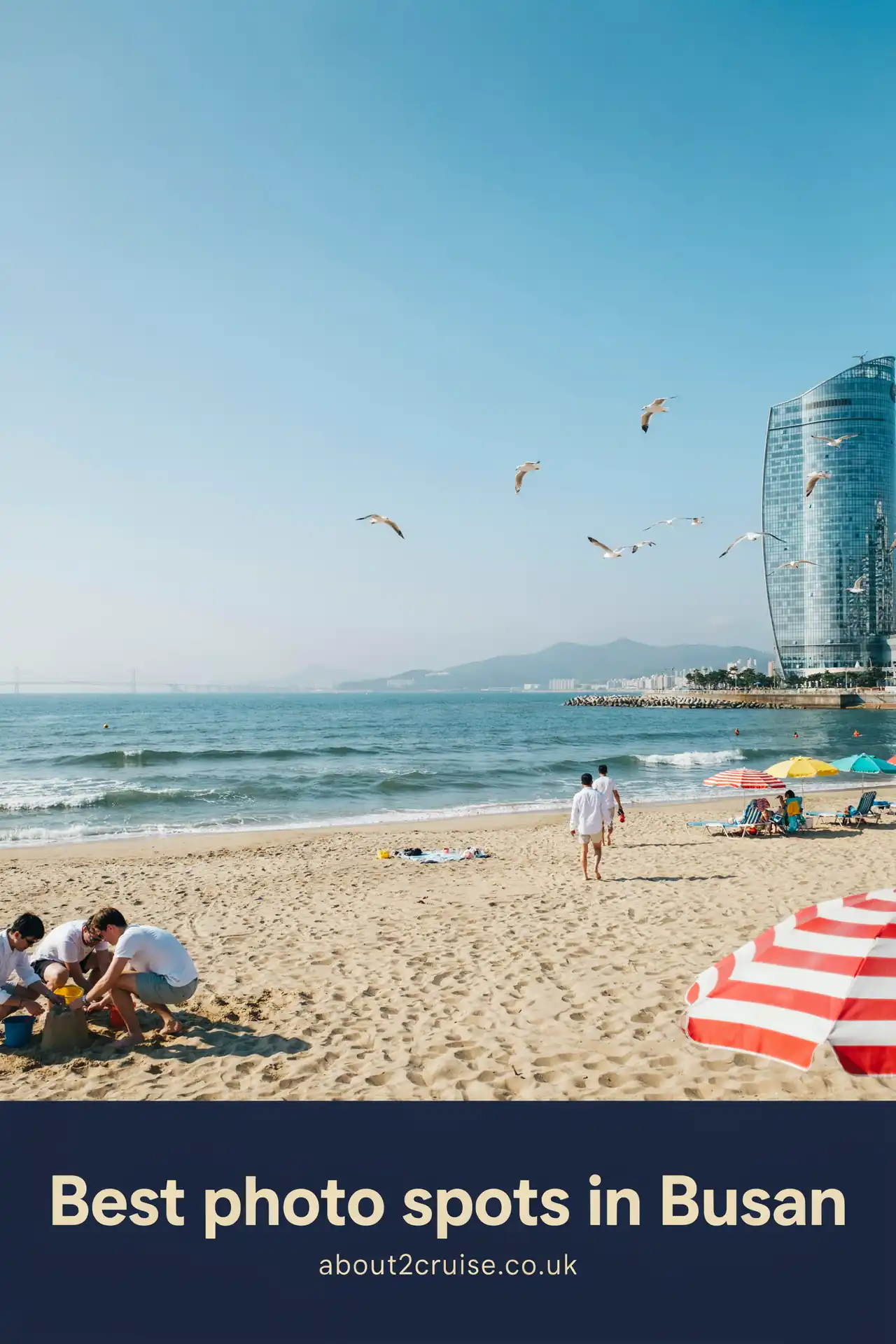
The best photo spots in Busan are mostly a taxi or metro ride from the port, and Gamcheon Culture Village’s hillside of pastel rooftops leads the way.
- Haneul Maru Observation Deck, Gamcheon Culture Village: the whole hillside opens up from here, rows of pastel rooftops with the coastline behind them; go early morning or late afternoon when the crowds thin out
- Busan Tower, Yongdusan Park: a 360 degree view over the old downtown and harbour, good by day or night, with Gamcheon itself visible from the deck
- Haedong Yonggungsa: a sea temple that looks its best at sunrise
Busan cruise port FAQs
Which terminal will my Busan cruise use?
Your Busan cruise terminal is most likely the Busan Port International Passenger Terminal in North Port, unless your ship is over 100,000 GT, in which case it’s the Busan Yeongdo Cruise Terminal instead. Check your cruise line’s documents to confirm which one applies to your sailing.
How far is the Busan cruise terminal from Busan Station?
The Busan cruise terminal sits somewhere between 500 metres (an easy walk) and 1.5km (15 to 20 minutes) from Busan Station, connected by an elevated walkway via Exits 8 and 9. From Busan Yeongdo Cruise Terminal it’s about 4km, a 15 to 20 minute taxi.
Is there a free shuttle from the cruise terminal to the city centre?
A free shuttle from the cruise terminal to the city centre usually runs to Busan Station or Nampodong, taking about 10 to 15 minutes and giving you the easiest link to the metro and downtown.
Can I store luggage at the cruise terminal?
Luggage storage is available at the cruise terminal, where a manned service on the 2nd floor of the Busan Port International Passenger Terminal holds bags for up to 30 days.
How do I get to Haeundae Beach from the cruise port?
Haeundae Beach is about 15km from the cruise port, and a taxi usually takes 35 to 45 minutes depending on traffic.
Does Busan run overnight cruise calls?
Busan does run overnight cruise calls. It became the first cruise terminal in the country to operate on a 24-hour schedule, and a growing number of overnight calls now let passengers stay ashore after dark.
Which terminal is closer to Gimhae International Airport?
The Busan Port International Passenger Terminal is the closer of the two to Gimhae International Airport, about 16km or 25 minutes by car. Busan Yeongdo Cruise Terminal is around 50 minutes away.
What is the easiest way to pay for transport in Busan?
The easiest way to pay for transport in Busan is a T-money or Cashbee card, which covers the metro, and cards work almost everywhere else in the city too, including taxis, so there’s little need to carry much cash.
Last Updated: 19 October 2026